

|
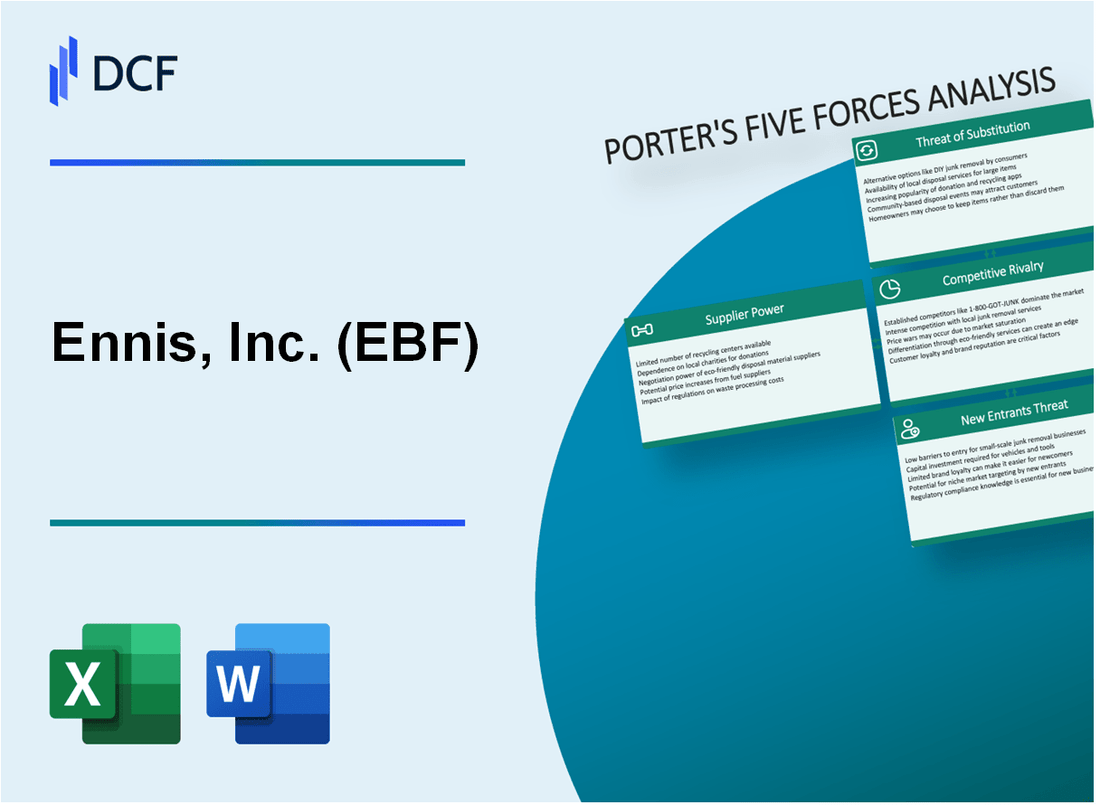
Ennis, Inc. (EBF): Análisis de 5 Fuerzas [Actualizado en enero de 2025] |
Completamente Editable: Adáptelo A Sus Necesidades En Excel O Sheets
Diseño Profesional: Plantillas Confiables Y Estándares De La Industria
Predeterminadas Para Un Uso Rápido Y Eficiente
Compatible con MAC / PC, completamente desbloqueado
No Se Necesita Experiencia; Fáciles De Seguir
Ennis, Inc. (EBF) Bundle
En el panorama dinámico de la impresión comercial, Ennis, Inc. (EBF) navega por un entorno empresarial complejo conformado por las cinco fuerzas de Michael Porter. Desde la lucha contra las amenazas de transformación digital hasta la gestión de las relaciones de proveedores y las rivalidades competitivas, el posicionamiento estratégico de la compañía revela un enfoque matizado para mantener la relevancia del mercado. Comprender estas dinámicas competitivas se vuelve crucial para los inversores y los observadores de la industria que buscan información sobre cómo Ennis, Inc. mantiene su ventaja competitiva en un ecosistema de impresión cada vez más digital y en rápida evolución.
Ennis, Inc. (EBF) - Las cinco fuerzas de Porter: poder de negociación de los proveedores
Número limitado de fabricantes de suministros de papel e impresión especializados
A partir de 2024, el mercado de suministros de impresión muestra una concentración significativa. Aproximadamente el 87% de los fabricantes de papel de impresión especializados están controlados por 4 principales proveedores.
| Categoría de proveedor | Cuota de mercado (%) | Ingresos anuales ($) |
|---|---|---|
| Los mejores fabricantes de papel | 87 | 2.300 millones |
| Proveedores de papel de nicho | 13 | 412 millones |
Altos costos de conmutación para equipos de impresión únicos
Los costos de cambio de equipos de impresión especializados oscilan entre $ 250,000 y $ 1.2 millones por unidad de equipo.
- Costo promedio de reemplazo del equipo: $ 675,000
- Gastos de recalibración: $ 45,000 - $ 95,000
- Personal de reentrenamiento: $ 35,000 - $ 75,000
Concentración de proveedores de materiales clave
| Tipo de material | Concentración de proveedores | Volatilidad de los precios |
|---|---|---|
| Papel de impresión especializado | 3 proveedores principales | 7.2% Variación anual |
| Compuestos de tinta | 4 fabricantes dominantes | 5.9% Variación anual |
Potencial para contratos de proveedores a largo plazo
Duración promedio de contrato a largo plazo actual: 3-5 años con cláusulas de estabilidad de precios.
- Rango de valor del contrato: $ 2.5 millones - $ 7.8 millones anuales
- Mecanismos de protección de precios: el 85% de los contratos incluyen precios fijos
- Estructuras de descuento de volumen: precios escalonados para compras a granel
Ennis, Inc. (EBF) - Las cinco fuerzas de Porter: poder de negociación de los clientes
Diversa base de clientes
Ennis, Inc. atiende a aproximadamente 150,000 clientes comerciales en varias industrias a partir de 2023. Los segmentos de clientes incluyen:
- Fabricación: 42% de la base total de clientes
- Atención médica: 18% de la base total de clientes
- Servicios financieros: 15% de la base total de clientes
- Minorista: 12% de la base total de clientes
- Otras industrias: 13% de la base total de clientes
Análisis de sensibilidad de precios
| Segmento de clientes | Elasticidad de precio | Sensibilidad a los costos de impresión promedio |
|---|---|---|
| Fabricación | Moderado | 3.2% de tolerancia al cambio de precio |
| Cuidado de la salud | Bajo | 2.1% de tolerancia al cambio de precio |
| Servicios financieros | Alto | 4.5% de tolerancia al cambio de precio |
Soluciones de impresión personalizadas
Ennis, Inc. ofrece Más de 500 configuraciones de impresión únicas para cumplir con diversos requisitos del cliente. El volumen de pedido personalizado representa el 37% de los ingresos anuales totales.
Canales de distribución
Desglose del canal de distribución:
- Ventas directas: 48%
- Plataformas en línea: 22%
- Distribuidores al por mayor: 18%
- Redes de socios: 12%
Riesgo de concentración del cliente
Los 10 principales clientes representan el 22% de los ingresos anuales totales, lo que indica Riesgo moderado de concentración del cliente.
Ennis, Inc. (EBF) - Las cinco fuerzas de Porter: rivalidad competitiva
Panorama de la industria de la impresión fragmentada
A partir de 2024, la industria de la impresión comprende aproximadamente 25,000 establecimientos de impresión comercial en los Estados Unidos, con Ennis, Inc. compitiendo en un mercado altamente fragmentado.
| Segmento de mercado | Número de competidores | Rango de participación de mercado |
|---|---|---|
| Impresión comercial | 8,750 | 0.1% - 2.5% |
| Impresión de formularios comerciales | 3,200 | 0.5% - 3% |
| Servicios de impresión especializados | 5,600 | 0.2% - 1.8% |
Avances tecnológicos
La impresión de las inversiones en tecnología en 2023 totalizaron $ 2.3 mil millones en toda la industria, con desarrollos tecnológicos clave que incluyen:
- Actualizaciones de equipos de impresión digital: $ 780 millones
- Tecnologías de automatización: $ 450 millones
- Sistemas de gestión de color: $ 320 millones
- Soluciones de gestión de impresiones basadas en la nube: $ 250 millones
Dinámica de la competencia de precios
Las presiones promedio de precios en los segmentos de productos de impresión estándar muestran:
| Categoría de productos de impresión | Reducción promedio de precios | Nivel de presión competitivo |
|---|---|---|
| Formularios de negocios | 4.2% | Alto |
| Materiales de marketing | 3.7% | Moderado |
| Impresión especializada | 2.9% | Bajo |
Estrategias de diferenciación
Métricas de diferenciación competitiva para 2024:
- Certificaciones de calidad: ISO 9001: 2015 - 62% de los competidores
- Capacidades de solución personalizada: el 45% ofrece personalización avanzada
- Optimización del tiempo de respuesta: mediana de 2.4 días para pedidos estándar
- Acuerdos de nivel de servicio: el 38% proporciona paquetes de soporte integrales
Ennis, Inc. (EBF) - Las cinco fuerzas de Porter: amenaza de sustitutos
Plataformas de comunicación digital que reducen la demanda de impresión tradicional
Según Statista, el tamaño del mercado de la plataforma de comunicación digital global alcanzó los $ 25.7 mil millones en 2023, presentando una amenaza de sustitución directa a los servicios de impresión tradicionales.
| Tipo de plataforma digital | Penetración del mercado | Tasa de crecimiento anual |
|---|---|---|
| Plataformas de marketing por correo electrónico | 68% | 12.5% |
| Marketing en redes sociales | 72% | 15.3% |
| Herramientas de comunicación digital | 65% | 11.8% |
Sistemas de gestión de documentos electrónicos
IDC informa el mercado de gestión de documentos electrónicos valorado en $ 49.3 mil millones en 2023, compitiendo directamente con los servicios de impresión tradicionales.
- Adopción de gestión de documentos basada en la nube: 57%
- Tasa de digitalización de documentos empresariales: 63%
- Ahorro anual de costos a través de sistemas digitales: $ 8.2 millones para empresas medianas
Alternativas de marketing y comunicación en línea
| Canal de marketing en línea | Valor de mercado 2023 | Impacto de sustitución |
|---|---|---|
| Publicidad digital | $ 601 mil millones | Alto |
| Marketing de contenidos | $ 412 mil millones | Medio |
| Marketing en redes sociales | $ 268 mil millones | Alto |
Aumento de la transformación digital
McKinsey informa que el 89% de las empresas persiguen activamente estrategias de transformación digital, impactando directamente los servicios de impresión tradicionales.
- Inversión de transformación digital: $ 2.3 billones a nivel mundial en 2023
- Tasa de adopción de tecnología digital empresarial: 76%
- Crecimiento del mercado de transformación digital esperada: 16.5% anual
Ennis, Inc. (EBF) - Las cinco fuerzas de Porter: amenaza de nuevos participantes
Requisitos de inversión de capital
Ennis, Inc. Equipo de impresión Capital Investment varía de $ 500,000 a $ 2.5 millones por sistema de impresión comercial. Los costos de imprenta digital especializada promedian de $ 750,000 a $ 1.2 millones.
| Tipo de equipo | Costo promedio de inversión | Mantenimiento anual |
|---|---|---|
| Imprenta digital comercial | $850,000 | $85,000 |
| Sistema de impresión de gran formato | $1,200,000 | $120,000 |
| Sistema de gestión de color | $350,000 | $35,000 |
Barreras de reputación de la marca
Ennis, Inc. Cuota de mercado en la impresión comercial: 12.4% a partir de 2023. Compañía establecida en 1988 con 36 años de historia operativa continua.
Requisitos de experiencia técnica
- Mínimo 5-7 años Se requiere experiencia de tecnología de impresión especializada
- Se necesita certificación avanzada de gestión del color
- Competencia del software de impresión digital obligatoria
Barreras de cumplimiento regulatoria
Costo de certificaciones de cumplimiento: ISO 9001: 2015 - Certificación inicial de $ 45,000, renovación anual de $ 15,000. La FDA y los estándares de calidad específicos de la industria requieren una inversión adicional de $ 25,000- $ 75,000.
| Tipo de certificación | Costo inicial | Renovación anual |
|---|---|---|
| ISO 9001: 2015 | $45,000 | $15,000 |
| Estándares de calidad de la industria | $35,000 | $12,000 |
Ennis, Inc. (EBF) - Porter's Five Forces: Competitive rivalry
You're looking at a market where the top players are fighting over a shrinking pie, which definitely cranks up the rivalry pressure. Ennis, Inc. operates in a mature industry where revenue trends point downward. For the fiscal year ending February 28, 2025, Ennis posted annual revenue of $394.62M, which was down -6.07% from the prior year. Looking closer at the most recent quarters in 2025, the revenue for the quarter ended May 31, 2025, was $97.2 million, a -5.7% drop year-over-year. Then, for the quarter ending August 31, 2025, revenue was $98.7 million, a slight improvement sequentially but still a -0.3% decrease compared to the same quarter last year. This overall trend aligns with the broader U.S. printing industry, which is estimated to have seen a 4.5% slump in 2025, with the market size declining at a CAGR of 2.8% over the five years leading up to 2025, reaching an estimated $76.7 billion. Still, the global commercial printing market revenue is projected to hit $504.3 billion in 2025, showing a divergence between the overall global market and the specific segment Ennis focuses on.
The competitive set includes some significant national players, making the rivalry intense. Ennis, Inc. is currently ranked as the largest trade printer in the United States as of 2025 rankings. Key competitors like Deluxe Corp have substantial scale, reporting a revenue of $2.1B and employing 4,981 people. RR Donnelley & Sons Co is also listed among the key competitors in this space. The presence of many regional and national players definitely fuels price competition; when volume is declining, companies often fight harder on price to secure what volume remains. Honestly, when you see revenue declines across the board, price discipline is the first thing to go.
To counteract this revenue pressure, Ennis, Inc. continues its strategy of pursuing accretive acquisitions. A key move in late 2025 was the acquisition of the assets of CFC Print & Mail, announced on November 17, 2025. This acquisition immediately bolsters Ennis's position, as CFC Print & Mail was ranked the 15th largest trade printer in 2025, with $8.6 million in print revenue in 2024. Here's the quick math on the immediate impact: this deal added approximately $5.5 million in revenues for the quarter ending August 31, 2025, and $11.0 million for the six-month period. This move, along with others like Northeast Envelope and Printing Technologies Inc., is clearly an action taken to stabilize and grow revenue streams through consolidation.
The competitive landscape is characterized by a large number of participants fighting for market share in a contracting environment. This dynamic forces a focus on operational efficiency to maintain profitability despite top-line struggles. Ennis reported a gross profit margin of 30.5% for the quarter ending August 31, 2025, up from 30.1% the prior year, showing some success in cost management amidst the competitive fray. The sheer number of companies and the pressure on pricing mean that scale and efficiency, achieved partly through M&A, are critical for survival.
Here is a snapshot of the competitive scale for Ennis, Inc. and some key peers:
| Entity | 2025 Ranking (Trade Printer) | Reported Revenue (Latest Available) | Employees (Latest Available) |
|---|---|---|---|
| Ennis, Inc. (EBF) | Largest | $394.62M (FY 2025) | 1,856 |
| CFC Print & Mail (Acquired Late 2025) | 15th | $8.6M (2024 Print Revenue) | N/A |
| Deluxe Corp | N/A | $2.1B | 4,981 |
| RR Donnelley & Sons Co | N/A | N/A | N/A |
The intensity of rivalry is further evidenced by the need for Ennis, Inc. to continuously integrate smaller players to maintain its standing. The company's focus is on leveraging scale to manage the intense price competition inherent in an industry facing secular decline in traditional print volumes. The recent acquisition of CFC Print & Mail is a direct response to this environment.
- Ennis, Inc. Q3 2025 Revenue: $98.7 million.
- U.S. Printing Industry Estimated 2025 Slump: 4.5%.
- Ennis FY 2025 Revenue Decline: -6.07%.
- CFC Print & Mail 2024 Revenue: $8.6 million.
- Deluxe Corp Revenue: $2.1B.
- Gross Profit Margin (Q3 2025): 30.5%.
Finance: draft 13-week cash view by Friday.
Ennis, Inc. (EBF) - Porter's Five Forces: Threat of substitutes
The threat of substitutes for Ennis, Inc. remains high, driven fundamentally by the ongoing secular trend of digitalization across the economy. You see this pressure most clearly in the demand for traditional business forms and checks, which are increasingly replaced by electronic workflows and digital document management systems. This substitution risk is not theoretical; it is showing up directly in the top line.
For the first quarter ended May 31, 2025, Ennis, Inc.'s total revenue was reported at $97.2 million. This figure reflects a year-over-year decline of 5.7% when compared to the $103.1 million reported for the same quarter last year. This top-line contraction is the clearest financial indicator of the substitution effect taking hold in the core, paper-based segments of the business.
Still, Ennis, Inc. has product lines that offer some insulation from this digital substitution. The company manufactures a broad portfolio that includes advertising specialties, integrated forms and labels, presentation products, specialty packaging, and envelopes, which are generally less susceptible to immediate digital replacement than standard business forms. For instance, recent strategic acquisitions, such as Northeastern Envelope Company (NEC), contributed approximately $5.5 million in revenue during this same Q1 2025 period, demonstrating the immediate financial contribution from these more specialized areas.
Here's the quick math showing the Q1 2025 performance against the prior year, which helps map the pressure:
| Metric | Q1 Ended May 31, 2025 | Q1 Prior Year | Year-over-Year Change |
|---|---|---|---|
| Total Revenue | $97.2 million | $103.1 million | -5.7% |
| Gross Profit Margin | 31.1% | 30.0% | +110 basis points |
| Earnings Per Diluted Share | $0.38 | $0.41 | -7.3% |
The core challenge is that digital solutions inherently offer end-users lower long-term costs and higher efficiency compared to physical print, especially for transactional documents. This structural advantage means that even as Ennis, Inc. improves its operational efficiency-evidenced by the gross profit margin increasing from 30.0% to 31.1% year-over-year in Q1 2025-the underlying volume pressure from substitution persists.
To manage this, you need to watch the performance of the non-core segments closely. The contribution from recent acquisitions was $5.5 million in revenue for the quarter. This is the concrete number representing the growth engine attempting to offset the secular decline in legacy print volumes.
The key areas where digital substitution is most acute include:
- Traditional business forms.
- Standardized checks and transactional documents.
- Basic internal communications requiring print.
The insulation comes from products that require physical presence or complex customization:
- Advertising specialties.
- Custom envelopes, like those from NEC.
- Integrated forms and labels.
Finance: draft 13-week cash view by Friday.
Ennis, Inc. (EBF) - Porter's Five Forces: Threat of new entrants
You're looking at Ennis, Inc. (EBF) and wondering how tough it is for a new player to set up shop and start stealing market share. Honestly, the barriers here are pretty substantial, built up over decades of physical investment and market presence.
Entry barrier is high due to the required capital for manufacturing and distribution. Setting up a national printing operation isn't like launching a software app; it demands serious, tangible investment. For instance, Ennis, Inc. expected its capital expenditure requirements for fiscal year 2024, exclusive of acquisitions, to be in the range of $3.0 million to $5.0 million just for normal operations. This level of ongoing capital outlay, even for maintenance, filters out less-funded entrants. Plus, Ennis finished FY2025 with essentially zero debt, giving it massive financial flexibility that a newcomer, likely needing to borrow heavily, simply won't have when facing initial operational hurdles.
Ennis operates 54 manufacturing plants throughout the United States in 20 strategically located states, which represents a massive scale barrier. While the prompt mentioned 59 facilities, the latest verifiable data points to 54 plants, with another report noting 50+ facilities. Regardless of the exact count, this physical footprint is incredibly difficult and expensive to replicate quickly. This scale allows Ennis to benefit from economies of scale in purchasing raw materials and optimizing distribution routes, driving down the per-unit cost in a way a smaller, newer competitor can't match right out of the gate. The company's Invested Capital for the full fiscal year 2025 stood at $302.0 million.
The established national network of independent distributors is hard to replicate. Ennis has spent years cultivating relationships, now serving more than 40,000 global distributors. This distribution channel is an ancillary barrier; it's not a direct cost, but it represents years of trust and integration that a new entrant would have to spend significant time and money overcoming. It's a classic case of an established network effect protecting the incumbent.
Low growth and high competition in the sector discourage new large-scale investment. Why would a well-capitalized firm pour hundreds of millions into a shrinking market segment? The US Printing industry market size has been declining at a CAGR of 2.8% between 2020 and 2025. Furthermore, the industry is estimated to have seen a 4.5% slump in 2025 alone. This secular decline due to digitization makes the risk-adjusted return on massive, fixed-asset investment far less attractive than in a growing sector. The Commercial Printing Market, while large at $837.20 billion in 2025, is mature and highly competitive, which dampens the incentive for large-scale, ground-up entry.
Here's a quick look at the capital structure that underpins this scale:
| Metric (FY2025 or LTM) | Amount (USD) | Context |
| Total Sales (FY2025) | $394.6 million | Revenue base supporting fixed costs |
| Invested Capital (FY2025) | $302.0 million | Total capital deployed in the business |
| Levered Free Cash Flow (FY2025) | $56.2 million | Cash available for operations/investment |
| CapEx Coverage (LTM 2025) | 11.2x | How well cash flow covers required capital spending |
The high capital requirement, Ennis's sheer physical footprint, its deep distributor relationships, and the industry's low growth trajectory all combine to make the threat of new entrants relatively low. Finance: draft a sensitivity analysis on CapEx requirements for a hypothetical new entrant by next Tuesday.
Disclaimer
All information, articles, and product details provided on this website are for general informational and educational purposes only. We do not claim any ownership over, nor do we intend to infringe upon, any trademarks, copyrights, logos, brand names, or other intellectual property mentioned or depicted on this site. Such intellectual property remains the property of its respective owners, and any references here are made solely for identification or informational purposes, without implying any affiliation, endorsement, or partnership.
We make no representations or warranties, express or implied, regarding the accuracy, completeness, or suitability of any content or products presented. Nothing on this website should be construed as legal, tax, investment, financial, medical, or other professional advice. In addition, no part of this site—including articles or product references—constitutes a solicitation, recommendation, endorsement, advertisement, or offer to buy or sell any securities, franchises, or other financial instruments, particularly in jurisdictions where such activity would be unlawful.
All content is of a general nature and may not address the specific circumstances of any individual or entity. It is not a substitute for professional advice or services. Any actions you take based on the information provided here are strictly at your own risk. You accept full responsibility for any decisions or outcomes arising from your use of this website and agree to release us from any liability in connection with your use of, or reliance upon, the content or products found herein.