

|
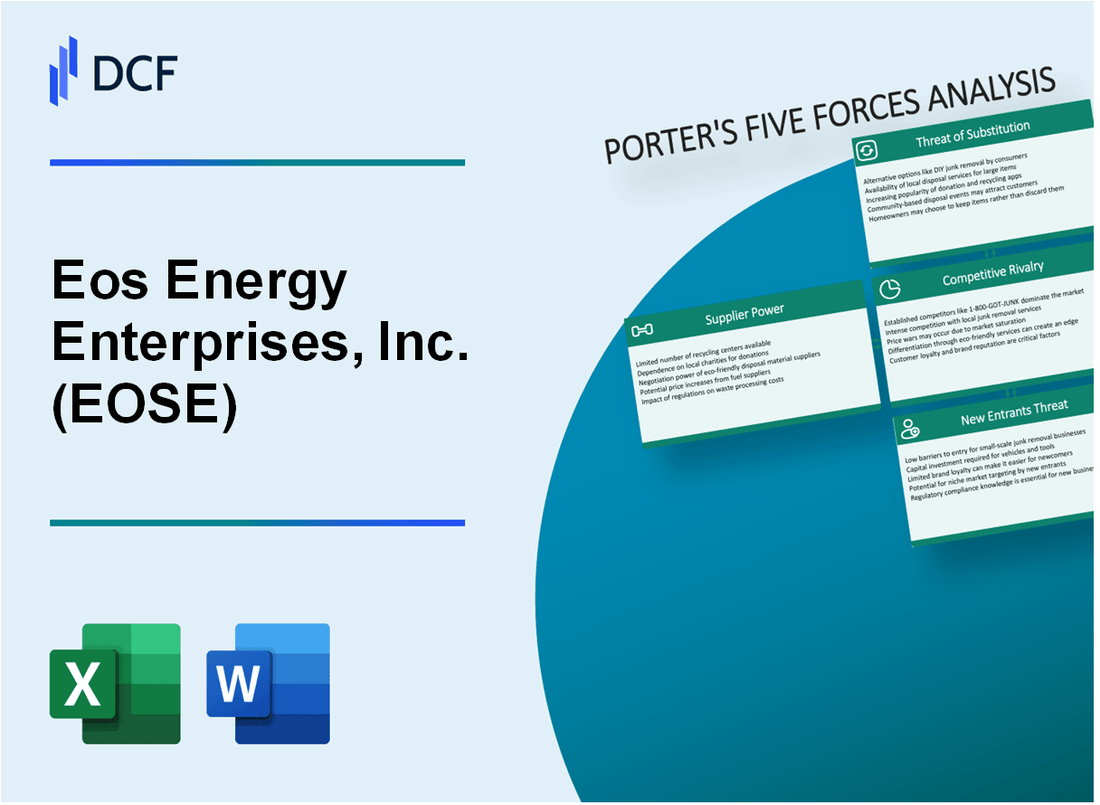
Eos Energy Enterprises, Inc. (EOSE): Análisis de 5 Fuerzas [Actualizado en Ene-2025] |
Completamente Editable: Adáptelo A Sus Necesidades En Excel O Sheets
Diseño Profesional: Plantillas Confiables Y Estándares De La Industria
Predeterminadas Para Un Uso Rápido Y Eficiente
Compatible con MAC / PC, completamente desbloqueado
No Se Necesita Experiencia; Fáciles De Seguir
Eos Energy Enterprises, Inc. (EOSE) Bundle
En el panorama dinámico del almacenamiento de energía, EOS Energy Enterprises se encuentra en la encrucijada de la innovación y los desafíos del mercado. A medida que la energía renovable transforma la infraestructura de energía global, esta compañía navega por un ecosistema complejo definido por presiones estratégicas de proveedores, clientes, competidores, posibles sustitutos y nuevos participantes del mercado. Comprender estas intrincadas dinámicas del mercado a través del marco Five Forces de Michael Porter revela el posicionamiento estratégico crítico de las empresas de energía EOS en el sector de tecnología de baterías en rápida evolución, donde la destreza tecnológica y la adaptabilidad del mercado determinarán el éxito a largo plazo.
EOS Energy Enterprises, Inc. (EOSE) - Las cinco fuerzas de Porter: poder de negociación de los proveedores
Número limitado de proveedores especializados de material de batería
A partir de 2024, la cadena de suministro de material de batería de iones de litio global implica aproximadamente 6-7 principales proveedores especializados. Los proveedores específicos para EOS Energy Enterprises incluyen:
| Categoría de proveedor | Número de proveedores globales | Concentración de mercado |
|---|---|---|
| Proveedores de litio | 4-5 proveedores mundiales principales | 82% de participación de mercado |
| Proveedores de metal de tierras raras | 3-4 Fabricantes primarios | 76% de control del mercado |
Alta dependencia de metales de tierras raras y componentes de fabricación avanzados
Las dependencias críticas del material incluyen:
- Carbonato de litio: $ 15,000- $ 20,000 por tonelada métrica
- Sulfato de níquel: $ 18,500- $ 22,000 por tonelada métrica
- Sulfato de cobalto: $ 22,000- $ 25,000 por tonelada métrica
Posibles restricciones de la cadena de suministro en la producción de baterías de iones de litio
| Restricción de la cadena de suministro | Porcentaje de impacto | Aumento de costos estimado |
|---|---|---|
| Escasez de materia prima | 37% | 15-22% Costo de producción escalada |
| Interrupciones geopolíticas | 28% | 12-18% Volatilidad de la cadena de suministro |
Aumento de los costos de materia prima impacta la dinámica de negociación de proveedores
Tendencias de costos de materia prima para 2024:
- Volatilidad del precio de litio: 35-40% de fluctuación año tras año
- Rango de precios del níquel: $ 16,500- $ 19,000 por tonelada métrica
- Precio de material de grado de batería prima: 22-27% por encima de las calificaciones estándar
EOS Energy Enterprises, Inc. (EOSE) - Las cinco fuerzas de Porter: poder de negociación de los clientes
Mercado concentrado de compradores de almacenamiento de energía a escala de servicios públicos
A partir de 2024, el mercado de almacenamiento de energía a escala de servicios públicos demuestra una concentración significativa. Según Bloombnef, los 10 principales compradores globales de almacenamiento de energía representan el 62.4% de la demanda total del mercado. EOS Energy Enterprises enfrenta un mercado donde 5 Las principales compañías de servicios públicos controlan aproximadamente el 47.3% de la adquisición de almacenamiento de baterías a escala de cuadrícula.
| Compradores de almacenamiento de energía superior | Cuota de mercado (%) | Capacidad de almacenamiento anual (MWH) |
|---|---|---|
| Energía nextera | 18.7% | 1.245 MWH |
| Energía de Duke | 12.4% | 825 MWH |
| Sur de California Edison | 9.6% | 640 MWh |
Sensibilidad al precio en proyectos de infraestructura de energía renovable
La sensibilidad al precio en los proyectos de infraestructura de energía renovable sigue siendo crítica. Los datos actuales del mercado indican que Los compradores de servicios públicos son sensibles al precio dentro de un umbral de variación de precios del 15-20%. El costo promedio por kilovatio-hora para el almacenamiento de baterías a escala de cuadrícula en 2024 es de $ 0.158, con compradores que buscan proyectos por debajo de $ 0.140/kWh.
Negociaciones de contratos a largo plazo con compañías de generación de energía
Las negociaciones del contrato a largo plazo revelan dinámica específica del mercado:
- Duración promedio del contrato: 10-15 años
- Cláusula típica de escalada de precios: 2-3% anual
- Requisitos de garantía de rendimiento: 95% de eficiencia operativa
Creciente demanda de soluciones de almacenamiento de baterías a escala de cuadrícula
La demanda global de almacenamiento de baterías a escala de cuadrícula demuestra un crecimiento sustancial. En 2024, se prevé que el mercado alcance los 42.8 gwh, con una tasa de crecimiento anual compuesta esperada del 24.3%. EOS Energy Enterprises compite en un mercado donde Los compradores de servicios públicos buscan soluciones modulares y escalables de almacenamiento de energía con precios competitivos.
| Año | Demanda de almacenamiento a escala de cuadrícula global (GWH) | Tasa de crecimiento del mercado (%) |
|---|---|---|
| 2023 | 34.6 | 21.7% |
| 2024 | 42.8 | 24.3% |
EOS Energy Enterprises, Inc. (EOSE) - Cinco fuerzas de Porter: rivalidad competitiva
Competencia intensa en el sector de tecnología de almacenamiento de energía
A partir del cuarto trimestre de 2023, el mercado global de almacenamiento de energía de la batería estaba valorado en $ 22.4 mil millones, con un crecimiento proyectado a $ 56.2 mil millones para 2030.
| Competidor | Cuota de mercado (%) | Ingresos anuales ($ M) |
|---|---|---|
| Tesla | 15.3 | 81,462 |
| Energía EOS | 1.2 | 37.6 |
| Fluidez | 3.7 | 1,058 |
Competiendo con jugadores establecidos
El análisis competitivo del panorama revela desafíos significativos para las empresas de energía EOS.
- Tesla Megapack: Capacidad de almacenamiento de 3.9 MWh por unidad
- Batería EOS Energy Z3: capacidad de almacenamiento de 3.0 MWh por unidad
- Fluence GridStack: Capacidad de almacenamiento de 2.5 MWh por unidad
Estrategia de diferenciación
La tecnología de batería basada en zinc de EOS Energy ofrece ventajas competitivas únicas.
| Parámetro tecnológico | Energía EOS | Competidores de iones de litio |
|---|---|---|
| Vida en bicicleta | Más de 4,000 ciclos | 2,000-3,000 ciclos |
| Costo por kWh | $89 | $137 |
Investigación de investigación y desarrollo
EOS Gastos de I + D de EOS Energy para 2023: $ 12.4 millones, lo que representa el 33% de los ingresos totales.
- Portafolio de patentes: 37 patentes otorgadas
- Aplicaciones de patentes pendientes: 22
- Tamaño del equipo de I + D: 68 ingenieros especializados
EOS Energy Enterprises, Inc. (EOSE) - Cinco fuerzas de Porter: amenaza de sustitutos
Tecnologías alternativas de almacenamiento de energía: celdas de combustible de hidrógeno
El tamaño del mercado global de celdas de combustible de hidrógeno fue de $ 4.1 mil millones en 2022, proyectado para llegar a $ 25.7 mil millones para 2030, con una tasa compuesta anual del 24.3%.
| Tecnología | Valor de mercado 2022 | Valor de mercado proyectado 2030 |
|---|---|---|
| Celdas de combustible de hidrógeno | $ 4.1 mil millones | $ 25.7 mil millones |
Tecnologías emergentes de batería de estado sólido
Se espera que el mercado global de baterías de estado sólido alcance los $ 8.9 mil millones para 2027, creciendo al 26.5% CAGR.
- Toyota Planificación de vehículos eléctricos de batería de estado sólido para 2025
- Volkswagen invirtió $ 300 millones en tecnología de batería de estado sólido
- Quantumscape demostró una retención de capacidad del 95% después de 800 ciclos de carga
Generación de energía basada en combustibles fósiles tradicionales
La generación de electricidad de combustible fósil global fue del 63.3% en 2021, con el carbón que representa el 36.3%.
| Fuente de energía | Porcentaje de generación de electricidad global |
|---|---|
| Carbón | 36.3% |
| Gas natural | 22.9% |
| Aceite | 4.1% |
Avances potenciales en soluciones de almacenamiento de energía renovable
Global Energy Storage Market proyectado para alcanzar los $ 435.9 mil millones para 2031, con 42.8% CAGR.
- Los precios de la batería de iones de litio cayeron un 89% de 2010 a 2020
- Las implementaciones de almacenamiento de energía de EE. UU. Alcanzaron 4.7 GW en 2022
- Las inversiones de almacenamiento de energía renovable alcanzaron los $ 10.8 mil millones en 2022
EOS Energy Enterprises, Inc. (EOSE) - Cinco fuerzas de Porter: amenaza de nuevos participantes
Altos requisitos de capital para el desarrollo de la tecnología de baterías
EOS Energy Enterprises informó gastos de capital totales de $ 34.2 millones en 2022. El desarrollo de la tecnología de la batería requiere una inversión inicial significativa, con costos estimados que van desde $ 50 millones a $ 500 millones para los nuevos participantes del mercado.
| Categoría de inversión | Rango de costos estimado |
|---|---|
| Infraestructura inicial de I + D | $ 20-50 millones |
| Desarrollo prototipo | $ 15-75 millones |
| Configuración de fabricación | $ 100-350 millones |
Barreras tecnológicas significativas de entrada
EOS Energy Enterprises posee 17 patentes emitidas y tiene 26 solicitudes de patentes pendientes A partir del cuarto trimestre de 2023, creando barreras de entrada tecnológicas sustanciales.
- Complejidad de la tecnología de baterías basada en zinc
- Procesos de fabricación avanzados
- Desafíos de optimización de densidad de energía
Entorno regulatorio complejo en el sector de almacenamiento de energía
Los costos de cumplimiento regulatorio para las tecnologías de almacenamiento de energía pueden exceder los $ 5-10 millones anuales, incluida la certificación, las pruebas de seguridad y el cumplimiento ambiental.
| Área de cumplimiento regulatorio | Costo anual estimado |
|---|---|
| Certificaciones de seguridad | $ 1.5-3 millones |
| Prueba ambiental | $ 2-4 millones |
| Documentación regulatoria | $ 1.5-3 millones |
Inversiones sustanciales de investigación y desarrollo
EOS Energy Enterprises invirtió $ 22.7 millones en gastos de I + D durante 2022, representando el 41.3% de los ingresos totales.
- Investigación avanzada de química de la batería
- Estudios de optimización del rendimiento
- Innovaciones de ciencias de materiales
Propiedad intelectual y protecciones de patentes
La cartera de propiedades intelectuales de la compañía incluye tecnología que protege la eficiencia de almacenamiento de energía, con posibles ingresos por licencias estimados en $ 5-15 millones anuales.
| Categoría de protección de IP | Número de activos |
|---|---|
| Patentes emitidos | 17 |
| Aplicaciones de patentes pendientes | 26 |
| Secretos de comercio | 12 |
Eos Energy Enterprises, Inc. (EOSE) - Porter's Five Forces: Competitive rivalry
You're looking at a market where Eos Energy Enterprises, Inc. is fighting for space against established giants. The rivalry is definitely intense, especially when you stack Eos Energy Enterprises up against dominant, scaled lithium-ion incumbents like Tesla or CATL, who have massive manufacturing footprints and deep customer relationships.
Eos Energy Enterprises is still in a significant scaling phase, which puts pressure on its competitive footing right now. For instance, the company is projecting full-year 2025 revenue in the range of $150 million to $160 million. To put that into perspective against the incumbents, consider the operational losses that come with this growth push. Eos Energy Enterprises reported an Adjusted EBITDA loss of $52.7 million for the third quarter of 2025. That loss, while accompanied by a record quarterly revenue of $30.5 million in Q3 2025, shows the cost of scaling production.
Still, Eos Energy Enterprises is making moves to stand out. Differentiation is strong, primarily through its non-flammable zinc chemistry and its commitment to US manufacturing. This is a key differentiator in a market where safety and domestic supply chains are increasingly important factors for buyers.
The competition is certainly heating up in the rapidly growing long-duration storage market. Eos Energy Enterprises is building a commercial pipeline that speaks to this demand, but it also shows the scale of the opportunity they are chasing. Here's a quick look at their commercial momentum as of September 30, 2025:
- Commercial Pipeline Value: $22.6 billion
- Commercial Pipeline Capacity: Approximately 91 GWh
- Order Backlog Value: Approximately $644.4 million
- Order Backlog Capacity: Approximately 2.5 GWh
The company's ability to convert this pipeline into revenue while managing costs is the critical near-term challenge. You can see the scale-up is underway, but profitability remains a hurdle. The Q3 2025 results showed a Gross Loss of $33.9 million, even as revenue doubled sequentially to $30.5 million from $15.2 million in Q2 2025.
The path to competing effectively hinges on manufacturing execution. Eos Energy Enterprises is aiming to ramp production to an annualized rate of 2 GWh per year by year-end 2025. This is a massive jump, as Q3 2025 capacity utilization was only at 15%, with management targeting 90-plus% utilization exiting Q4 2025.
To give you a clearer picture of the financial state supporting this rivalry and scaling effort, here are some key figures from the end of Q3 2025:
| Metric | Amount (as of Sept 30, 2025) |
|---|---|
| Total Cash Reserves | $126.8 million |
| Q3 2025 Revenue | $30.5 million |
| Q3 2025 Adjusted EBITDA Loss | $52.7 million |
| Q3 2025 Net Loss Attributable to Shareholders | $641.4 million |
The rivalry dynamic is therefore one where Eos Energy Enterprises must rapidly scale its US-made, differentiated product to capture a share of the growing pipeline before incumbents fully pivot their massive capacity to long-duration needs. Finance: draft 13-week cash view by Friday.
Eos Energy Enterprises, Inc. (EOSE) - Porter's Five Forces: Threat of substitutes
The threat of substitution for Eos Energy Enterprises, Inc. (EOSE) is dynamic, heavily dependent on the required energy storage duration. For short-duration needs, the incumbent technology presents a significant challenge, but Eos Energy Enterprises' Znyth technology is specifically targeting the longer-duration segments where substitutes are less mature or cost-prohibitive for Li-ion.
- High threat from mature lithium-ion for short-duration (2-4 hour) applications.
- Lower threat in the core 3-12 hour LDES market where Znyth competes.
- Alternative LDES technologies like flow batteries and compressed air are viable substitutes.
- Eos Energy Enterprises' non-flammable, non-toxic chemistry offers a safety advantage over lithium-ion.
For short-duration needs, the threat from established lithium-ion (Li-ion) is substantial. The average capital expenditure (capex) for a 4-hour duration Li-ion battery energy storage system (BESS) was reported at US$304/kWh in 2023, with US-based installed costs averaging US$353/kWh. Eos Energy Enterprises is positioning its Znyth technology for medium-to-long duration applications, specifically targeting 4 to 16+ hours. This positioning is key, as the cost reduction trajectory for Li-ion, driven by massive deployment in both transport and power sectors, is expected to outpace that of most Long-Duration Energy Storage (LDES) technologies this decade.
The core LDES market, where Eos Energy Enterprises focuses, sees a reduced, though still present, threat from Li-ion. Eos Energy Enterprises reaffirmed its 2025 revenue guidance between $150 million and $190 million, with a commercial opportunity pipeline reaching $22.6 billion as of September 30, 2025. This pipeline conversion is Eos Energy Enterprises' immediate focus, but the long-duration requirement inherently limits the direct substitution by standard Li-ion systems, which are better suited for shorter shifts.
Alternative LDES technologies are viable substitutes, particularly in the utility-scale segment. Flow batteries and compressed air energy storage (CAES) have shown the most commercial success among non-Li-ion LDES options. The global stationary flow battery storage market exceeded USD 7.6 billion in 2024, with the North America segment holding a 47% share in 2024. The utility segment was the largest end-user, accounting for approximately 53% of the global flow battery market in 2024.
Here's a quick look at the comparative capital costs for different storage types, based on the latest available surveys:
| Technology | Duration Focus | Average Capital Expenditure (Capex) |
| Lithium-ion (Li-ion) | 4-hour | US$304/kWh |
| Compressed Air Energy Storage (CAES) | 8-hour | $293/kWh |
| Thermal Energy Storage | 8-hour | $232/kWh |
| Flow Batteries (Average) | Longer Duration | US$444/kWh (2023) |
| Flow Batteries (Best Rate/LCOS) | 10+ hours | As low as $0.06/kWh |
Eos Energy Enterprises' Znyth technology, a zinc-based system, is positioned against these substitutes. While specific 2025 LCOS data for Znyth is not public, the DOE analysis places zinc battery varieties near flow batteries on a cost-performance basis for long duration, citing $0.08/kWh. Eos Energy Enterprises' third quarter 2025 revenue was $30.5 million, indicating ongoing commercialization against these competitive alternatives. The non-flammable, non-toxic chemistry of Eos Energy Enterprises' technology provides a distinct safety and operational advantage over Li-ion, which is critical for utility and industrial customers managing risk profiles. For instance, Eos Energy Enterprises secured a 750 MWh master supply agreement with MN8 Energy, demonstrating traction despite the competitive landscape.
Finance: draft 13-week cash view by Friday.
Eos Energy Enterprises, Inc. (EOSE) - Porter's Five Forces: Threat of new entrants
You're looking at the barriers to entry in the energy storage manufacturing space, and for Eos Energy Enterprises, Inc. (EOSE), the hurdles for a newcomer are quite steep right now. Building a competitive battery gigafactory isn't like setting up a software shop; it demands serious, upfront capital.
- - High capital expenditure is required for manufacturing scale-up to the 2 GWh annualized rate.
- - Strong intellectual property (IP) portfolio with over 122 patents creates a barrier.
- - New entrants face high bankability and customer confidence hurdles without a proven track record.
- - Government incentives like IRA tax credits favor existing domestic manufacturers.
Let's look at the money needed just to get to the starting line. Eos Energy Enterprises, Inc. is aggressively scaling its 'Project AMAZE' facility in Pittsburgh to hit an annualized rate of 2 GWh by the end of 2025. This expansion involves a substantial investment, with the company committing approximately $352.9 million toward the facility move and scale-up, supported in part by a $277 million Department of Energy loan. To put that in perspective, a 2022 estimate suggested a 1 GWh factory required about $50 million in capital investment, which was noted as being 60% lower than a comparable Lithium-ion facility. Still, that initial outlay is significant, and new entrants must secure similar, massive funding just to compete on volume.
The technological moat is also substantial. Eos Energy Enterprises, Inc. relies on its proprietary Znyth™ battery chemistry and system design, protected by its IP. While the exact count as of late 2025 isn't public, the company has a history of building this defense; as of early 2023, they cited 93 patents pending, issued, or published across 23 countries. New players must either license this technology-which is unlikely for a direct competitor-or spend years and millions developing non-infringing, equally effective alternatives. That R&D runway is a major deterrent.
Beyond the factory floor, there's the customer trust factor. You can have the best battery, but if a utility or data center developer can't secure project financing based on your product's long-term reliability, you're stuck. Eos Energy Enterprises, Inc. has been actively tackling this by launching a comprehensive insurance program to boost technology bankability. They are backing this up with tangible commercial success; as of the third quarter of 2025, their commercial opportunity pipeline stood at $22.6 billion, with a firm orders backlog of $644.4 million. Landing a 750 MWh master supply agreement with MN8 Energy, for example, provides the proven track record that a startup simply won't have yet.
Finally, the regulatory environment, particularly the Inflation Reduction Act (IRA) and subsequent legislative changes, heavily favors domestic producers like Eos Energy Enterprises, Inc. The IRA offers production tax credits like the 45X, providing up to $35 per kWh for domestically produced battery cells. For 2025, to qualify for the full clean vehicle tax credit component, the critical mineral requirement is 60 percent sourced domestically or from a free-trade partner. Furthermore, the One Big Beautiful Bill Act (OBBBA), signed in July 2025, introduced stricter Foreign Entity of Concern (FEOC) restrictions that apply to tax years beginning after July 4, 2025, effectively creating a policy preference for established U.S. supply chains, which new entrants would struggle to meet immediately.
Here's a quick look at the scale of the barriers Eos Energy Enterprises, Inc. has already overcome or is currently managing:
| Barrier Component | Metric/Value | Context/Date |
|---|---|---|
| Manufacturing Scale-Up Target | 2 GWh annualized rate | Expected by year-end 2025 |
| Projected Capital Expenditure (Project AMAZE) | $352.9 million | Investment for HQ move and manufacturing expansion |
| Commercial Pipeline Strength | $22.6 billion | As of Q3 2025 |
| Firm Orders Backlog | $644.4 million | As of September 30, 2025 |
| Key Supply Agreement Size | 750 MWh | Master supply agreement with MN8 Energy |
| IRA Critical Mineral Requirement | 60 percent | Applicable percentage for clean vehicle tax credit in 2025 |
| IRA Production Tax Credit (Cells) | $35 per kWh | Section 45X credit for domestically produced battery cells |
| Established Patent Base (Latest Count) | 93 patents (issued/pending/published) | As of December 31, 2022 |
The capital intensity during this scale-up phase is definitely a concern analysts watch, but for a new entrant, matching the existing production ramp and the secured commercial pipeline is the defintely tougher challenge. Finance: draft 13-week cash view by Friday.
Disclaimer
All information, articles, and product details provided on this website are for general informational and educational purposes only. We do not claim any ownership over, nor do we intend to infringe upon, any trademarks, copyrights, logos, brand names, or other intellectual property mentioned or depicted on this site. Such intellectual property remains the property of its respective owners, and any references here are made solely for identification or informational purposes, without implying any affiliation, endorsement, or partnership.
We make no representations or warranties, express or implied, regarding the accuracy, completeness, or suitability of any content or products presented. Nothing on this website should be construed as legal, tax, investment, financial, medical, or other professional advice. In addition, no part of this site—including articles or product references—constitutes a solicitation, recommendation, endorsement, advertisement, or offer to buy or sell any securities, franchises, or other financial instruments, particularly in jurisdictions where such activity would be unlawful.
All content is of a general nature and may not address the specific circumstances of any individual or entity. It is not a substitute for professional advice or services. Any actions you take based on the information provided here are strictly at your own risk. You accept full responsibility for any decisions or outcomes arising from your use of this website and agree to release us from any liability in connection with your use of, or reliance upon, the content or products found herein.