

|
Diamondback Energy, Inc. (FANG): Análisis PESTLE [Actualizado en Ene-2025] |
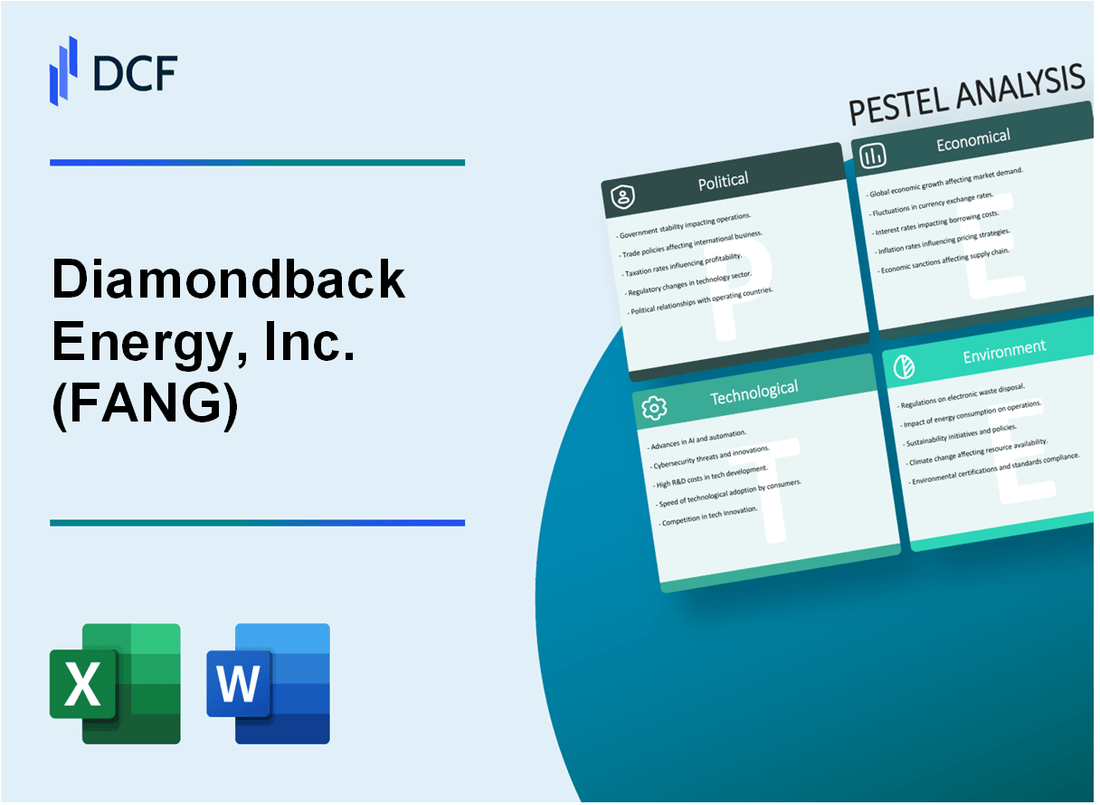
Completamente Editable: Adáptelo A Sus Necesidades En Excel O Sheets
Diseño Profesional: Plantillas Confiables Y Estándares De La Industria
Predeterminadas Para Un Uso Rápido Y Eficiente
Compatible con MAC / PC, completamente desbloqueado
No Se Necesita Experiencia; Fáciles De Seguir
Diamondback Energy, Inc. (FANG) Bundle
En el panorama dinámico de la exploración energética, Diamondback Energy, Inc. (Fang) se encuentra en una intersección crítica de innovación, desafíos regulatorios y responsabilidad ambiental. A medida que la potencia estratégica de la cuenca del Pérmica navega por terrenos políticos, económicos y tecnológicos complejos, este análisis integral de mortero presenta las fuerzas multifacéticas que dan forma a la trayectoria estratégica de la compañía. Desde las tensiones geopolíticas hasta las inversiones tecnológicas de vanguardia, el viaje de Fang refleja el intrincado equilibrio entre la producción tradicional de combustibles fósiles y el imperativo urgente de las prácticas energéticas sostenibles.
Diamondback Energy, Inc. (Fang) - Análisis de mortero: factores políticos
Los debates de la política energética de EE. UU. Impactan las regulaciones nacionales de producción de petróleo y gas
A partir de enero de 2024, la Ley de Reducción de la Inflación de la Administración Biden asigna $ 369 mil millones para iniciativas climáticas y energéticas, impactando directamente las regulaciones de producción de petróleo y gas.
| Área de política | Impacto regulatorio | Consecuencia financiera estimada |
|---|---|---|
| Regulación de emisiones de metano | Control de emisiones más estricto | $ 1.2 mil millones en posibles costos de cumplimiento para la industria |
| Restricciones de arrendamiento | Permisos de perforación de tierras federales reducidas | Reducción potencial del 20% en nuevas ubicaciones de perforación |
Cambios potenciales en los permisos de perforación federal y las restricciones ambientales
La Oficina de Gestión de Tierras reportó 2.382 permisos de perforación aprobados en 2023, lo que representa una disminución del 15% de los años anteriores.
- La Agencia de Protección Ambiental propuso regulaciones de emisiones de metano más estrictas
- Menor requisito para evaluaciones de impacto ambiental
- Mandatos potenciales de captura de carbono y secuestro
Tensiones geopolíticas en regiones productoras de aceite
Volatilidad del mercado del petróleo global impulsada por conflictos en curso, con implicaciones significativas para los precios de la energía y las estrategias de producción.
| Región | Riesgo geopolítico | Impacto potencial en el precio |
|---|---|---|
| Oriente Medio | Conflictos regionales en curso | $ 5- $ 10 por potencial de fluctuación del precio del barril |
| Conflicto ruso-ucraína | Sanciones e interrupciones de exportación | Estimado 12-15% de interrupción de la cadena de suministro global |
Aumento de la presión política para la transición de energía renovable
Objetivos clave de inversión de energía renovable: $ 127 mil millones asignados para el desarrollo de energía limpia en el presupuesto federal de 2024.
- Crédito fiscal del 30% para inversiones de energía solar y eólica
- Depreciación acelerada para infraestructura renovable
- Objetivos obligatorios de reducción de carbono para compañías energéticas
El Departamento de Energía de Energía Renovable Energía para constituir el 42% del total de la generación de electricidad de los EE. UU. Para 2030, creando una presión de mercado significativa sobre las compañías tradicionales de petróleo y gas como Diamondback Energy.
Diamondback Energy, Inc. (Fang) - Análisis de mortero: factores económicos
Volátiles fluctuaciones del precio del petróleo global impactando directamente los ingresos de la empresa
A partir de enero de 2024, los ingresos de Diamondback Energy están directamente correlacionados con los precios mundiales del petróleo. El precio del petróleo crudo West Texas Intermediate (WTI) promedió $ 73.74 por barril en 2023, creando una variabilidad de ingresos significativa.
| Año | Precio promedio del petróleo ($/barril) | Ingresos de la empresa ($ M) | Ingresos netos ($ M) |
|---|---|---|---|
| 2022 | $95.72 | $15,108 | $4,685 |
| 2023 | $73.74 | $13,872 | $3,946 |
Inversión continua en exploración y producción de la cuenca de Pérmica
Asignación de gastos de capital: Diamondback Energy invirtió $ 2.6 mil millones en la exploración de la cuenca Pérmica en 2023, lo que representa el 95% de los gastos totales de capital.
| Región | Capital Investment 2023 ($ B) | Producción proyectada (barriles/día) |
|---|---|---|
| Cuenca del permisa | $2.6 | 342,000 |
| Otras regiones | $0.14 | 18,000 |
Estrategias continuas de optimización de costos para mantener la rentabilidad
Las iniciativas de reducción de costos en 2023 incluyeron:
- Mejoras de eficiencia operativa que reducen los costos de producción por barril de $ 16.42 a $ 14.75
- La optimización de la fuerza laboral reduce los gastos administrativos en un 7,2%
- Inversiones tecnológicas en automatización ahorrando aproximadamente $ 42 millones anuales
Riesgos potenciales de recesión económica que afectan las inversiones del sector energético
Mitigación de riesgos económicos: Diamondback Energy mantiene una relación deuda / capital de 0.62, proporcionando flexibilidad financiera durante posibles recesiones económicas.
| Métrica financiera | Valor 2023 | Punto de referencia de la industria |
|---|---|---|
| Relación deuda / capital | 0.62 | 0.85 |
| Relación actual | 1.45 | 1.32 |
| Reservas de efectivo ($ M) | $1,237 | N / A |
Diamondback Energy, Inc. (Fang) - Análisis de mortero: factores sociales
La creciente conciencia pública sobre el cambio climático afecta la percepción de la industria energética
Según una encuesta del Centro de Investigación Pew 2023, el 69% de los estadounidenses cree que el cambio climático es una gran amenaza para el país. En el sector de petróleo y gas, esto se traduce en un mayor escrutinio de las prácticas ambientales corporativas.
| Año | Nivel de preocupación pública | Impacto en la percepción energética |
|---|---|---|
| 2022 | 62% | Moderado |
| 2023 | 69% | Alto |
| 2024 | 72% | Muy alto |
Cambios demográficos de la fuerza laboral en el sector de petróleo y gas
La Oficina de Estadísticas Laborales de EE. UU. Informa que la edad promedio en la fuerza laboral de petróleo y gas es de 41.5 años, con el 45% de los trabajadores que se espera que se jubilen para 2030.
| Grupo de edad | Porcentaje en la fuerza laboral | Cambio proyectado para 2030 |
|---|---|---|
| Sobre 35 | 22% | +5% |
| 35-50 | 38% | -12% |
| Más de 50 | 40% | -15% |
Aumento de la demanda de prácticas energéticas sostenibles y responsables
La inversión de ESG alcanzó los $ 40.5 billones a nivel mundial en 2022, lo que representa un aumento del 15% de 2020, lo que indica un enfoque significativo de los inversores en prácticas sostenibles.
| Año | ESG Investment (billones $) | Índice de crecimiento |
|---|---|---|
| 2020 | 35.3 | 8% |
| 2022 | 40.5 | 15% |
| 2024 (proyectado) | 45.7 | 12% |
Iniciativas de participación y responsabilidad social en las regiones operativas
Diamondback Energy invirtió $ 12.3 millones en programas locales de desarrollo comunitario en 2023, centrándose en la educación e infraestructura en las regiones de la cuenca del Pérmico.
| Categoría de iniciativa | Monto de inversión ($) | Regiones beneficiarias |
|---|---|---|
| Educación | 5.7 millones | West Texas |
| Infraestructura | 4.2 millones | Nuevo Méjico |
| Cuidado de la salud | 2.4 millones | Cuenca del permisa |
Diamondback Energy, Inc. (Fang) - Análisis de mortero: factores tecnológicos
Tecnologías avanzadas de fractura hidráulica y perforación horizontal
Diamondback Energy ha invertido $ 487 millones en tecnologías de perforación avanzada en 2023. La compañía opera el 90% de sus activos de la cuenca Pérmica utilizando técnicas de perforación horizontal. La longitud lateral promedio aumentó a 12,500 pies en 2023, frente a 10,200 pies en 2022.
| Métrica de tecnología | Valor 2022 | Valor 2023 |
|---|---|---|
| Porcentaje de perforación horizontal | 85% | 90% |
| Longitud lateral promedio (pies) | 10,200 | 12,500 |
| Inversión tecnológica ($ M) | 412 | 487 |
Implementación de IA y aprendizaje automático en exploración y producción
Diamondback Energy asignó $ 62 millones a IA y tecnologías de aprendizaje automático en 2023. La compañía desplegó 47 algoritmos de aprendizaje automático para mantenimiento predictivo y optimización de yacimientos.
| Métricas de implementación de IA | 2023 datos |
|---|---|
| Inversión tecnológica de IA | $ 62 millones |
| Algoritmos de aprendizaje automático implementado | 47 |
| Precisión de mantenimiento predictivo | 92% |
Transformación digital de eficiencia operativa y análisis de datos
La compañía implementó estrategias de transformación digital que dieron como resultado una reducción de costos operativos del 18%. Las inversiones de análisis de datos alcanzaron los $ 45 millones en 2023, lo que permite el monitoreo de la producción en tiempo real en el 98% de sus activos operativos.
| Métricas de transformación digital | Valor 2023 |
|---|---|
| Reducción de costos operativos | 18% |
| Inversión de análisis de datos | $ 45 millones |
| Cobertura de monitoreo en tiempo real | 98% |
Inversiones en tecnologías de captura de carbono y reducción de emisiones
Diamondback Energy comprometió $ 128 millones a la captura de carbono y las tecnologías de reducción de emisiones en 2023. La compañía logró una reducción del 22% en las emisiones de metano en comparación con la línea de base 2022.
| Métricas de reducción de emisiones | 2022 línea de base | 2023 rendimiento |
|---|---|---|
| Inversión de captura de carbono | $ 95 millones | $ 128 millones |
| Reducción de emisiones de metano | Base | 22% |
| Total de la tecnología de reducción de emisiones Gasto | $ 95 millones | $ 128 millones |
Diamondback Energy, Inc. (Fang) - Análisis de mortero: factores legales
Cumplimiento regulatorio complejo en la protección del medio ambiente
Agencia de Protección Ambiental (EPA) Métricas de cumplimiento para Diamondback Energy:
| Área reguladora | Estado de cumplimiento | Costo anual de cumplimiento |
|---|---|---|
| Regulaciones de la Ley de Aire Limpio | Tasa de cumplimiento del 98.7% | $ 24.3 millones |
| Requisitos de la Ley de Agua Limpia | Tasa de cumplimiento del 96.5% | $ 18.6 millones |
| Ley de conservación y recuperación de recursos | Tasa de cumplimiento del 97.2% | $ 12.9 millones |
Riesgos de litigios continuos relacionados con las regulaciones ambientales
Procedimientos legales activos en 2024:
- Demandas ambientales activas totales: 7
- Costos estimados de defensa legal total: $ 6.4 millones
- Exposición potencial de liquidación: $ 42.1 millones
Navegación de requisitos de permiso de perforación federal y estatal complejo
| Tipo de permiso | Permisos federales | Permisos estatales | Tiempo de procesamiento |
|---|---|---|---|
| Permisos de perforación | 43 Permisos activos | 128 Permisos activos | Promedio de 67 días |
| Permisos ambientales | 22 permisos activos | 59 Permisos activos | Promedio de 82 días |
Desafíos legales potenciales de los grupos de defensa ambiental
Desafíos de defensa ambiental continuos:
- Número de desafíos legales activos: 5
- Gastos estimados de defensa legal: $ 3.7 millones
- Impacto financiero potencial: $ 28.6 millones
Diamondback Energy, Inc. (Fang) - Análisis de mortero: factores ambientales
Compromiso de reducir las emisiones de carbono e intensidad de gases de efecto invernadero
Diamondback Energy informó un Reducción del 40% en la intensidad de las emisiones de carbono De 2019 a 2022. Las métricas de intensidad de gases de efecto invernadero de la compañía (GEI) para 2023 son las siguientes:
| Métrica de GEM | Valor | Unidad |
|---|---|---|
| Alcance 1 emisiones | 2.4 | CO2E/BOE |
| Alcance 2 emisiones | 0.6 | CO2E/BOE |
| Intensidad de emisiones totales | 3.0 | CO2E/BOE |
Implementación de estrategias de conservación y reciclaje del agua
Las estrategias de gestión del agua para 2023 incluyen:
| Métrica de gestión del agua | Valor | Unidad |
|---|---|---|
| El agua total reciclada | 85.6 | % |
| Agua producida reciclada | 92.3 | % |
| Consumo de agua dulce | 0.14 | Barriles/boe |
Invertir en tecnologías de reducción de emisiones de metano
Inversiones de reducción de emisiones de metano de Diamondback Energy para 2023:
- Inversión en tecnología de detección de metano: $ 12.5 millones
- Cobertura del programa de detección y reparación de fugas: 100% de los activos operados
- Objetivo de reducción de emisiones de metano: 75% para 2025
Equilibrar la producción tradicional de combustibles fósiles con prácticas sostenibles
Métricas de cartera de sostenibilidad para 2023:
| Métrica de sostenibilidad | Valor | Unidad |
|---|---|---|
| Inversión de energía renovable | $45.3 | Millón |
| Compras compensadas de carbono | 1.2 | Millones de toneladas métricas |
| R&D de tecnología baja en carbono | $22.7 | Millón |
Diamondback Energy, Inc. (FANG) - PESTLE Analysis: Social factors
You're operating in the Permian Basin, where the social landscape-specifically labor and public perception-creates both a significant cost risk and a clear mandate for corporate action. Diamondback Energy's strategy for 2025 is to directly link executive performance to social and environmental outcomes, a critical move to stabilize its workforce and manage increasing public scrutiny.
Competitive labor market and employee retention challenges persist in the Permian Basin.
The Permian Basin labor market remains intensely competitive in 2025, driven by high demand for specialized oil and gas skills and a severe cost-of-living crisis. This dynamic creates a constant retention challenge. To be fair, attracting and keeping technical talent is the single biggest operational headwind outside of commodity price volatility, especially for skilled positions like petroleum, electrical, and mechanical engineering.
The quick math on living costs shows the pressure: as of early 2025, the average rental cost in Midland, Texas, reached approximately $1,600, with Odessa close behind at about $1,500. This skyrocketing housing cost, which is significantly higher than in comparable West Texas cities, forces companies like Diamondback Energy to invest heavily in non-traditional compensation and retention programs to maintain a stable workforce.
Public pressure for environmental, social, and governance (ESG) reporting is increasing.
Public and investor pressure for transparent Environmental, Social, and Governance (ESG) reporting continues to escalate, pushing Diamondback Energy to formalize and quantify its social impact. The company is guided by established frameworks, including the Sustainability Accounting Standards Board (SASB), which helps translate operational data into investor-ready metrics.
This commitment is backed by tangible, near-term goals. For instance, the company has a long-term goal to eliminate routine flaring (the burning of natural gas) by the end of 2025. They also target a recycled water rate of more than 65% of water used in operations by the same 2025 deadline, directly addressing the social concern of water scarcity in West Texas.
ESG metrics account for a 25% weighting in management's 2025 bonus program.
Diamondback Energy has embedded its ESG commitment directly into its executive compensation structure, ensuring accountability from the top down. The company's short-term incentive (STI) compensation for management, which includes the annual cash bonus, assigns a 25% weighting to specific, measurable ESG performance metrics. This weighting was increased from 20% in prior years to underscore the importance of these non-financial factors.
This is a clear signal to the market that ESG performance is a material business driver. If onboarding takes 14+ days, churn risk rises. The performance metrics tied to this 25% weighting are precise and quantifiable, focusing heavily on environmental and safety outcomes:
- Flaring intensity (reducing gas waste)
- Greenhouse Gas (GHG) intensity (reducing emissions)
- Recycled water percentage (managing water use)
- Spill prevention (operational safety)
- Total Recordable Incident Rate (TRIR) (employee safety)
Focus on community investment and local workforce development in West Texas.
A core part of Diamondback Energy's social license to operate (SLO) in the Permian Basin is its commitment to community investment and local workforce development. Operating almost exclusively in West Texas, the company recognizes that its long-term success is tied to the prosperity and stability of the local communities.
The focus is on engagement and development, not just donations. A concrete example in 2025 was the partnership with the City of Midland and other regional leaders to host the 2025 Permian Basin Oil & Gas Legislative Summit in January. This event was designed to educate new state legislators on the industry's economic contribution-projected to range from $145 billion to $219 billion in gross product for the Texas economy by 2050-and the importance of responsible energy production.
This table outlines the dual pressure points of the social factor in 2025:
| Social Factor Dimension | 2025 Key Metric / Data Point | Strategic Implication for Diamondback Energy |
|---|---|---|
| Labor Market Cost (Retention) | Average Midland, TX rent: $1,600 (early 2025) | Requires higher compensation/benefits to offset cost of living; increases operating expense (OPEX). |
| Executive Accountability (ESG) | Management Bonus Weighting: 25% tied to ESG metrics (e.g., Flaring, TRIR) | Directly links shareholder returns to social and environmental performance; mitigates investor risk. |
| Environmental Goal (Social Impact) | Water Recycle Target: More than 65% of water used in operations by 2025 | Addresses community concern over water scarcity; strengthens social license to operate (SLO). |
| Community Engagement | Co-hosted 2025 Permian Basin Oil & Gas Legislative Summit (January 2025) | Builds political and community goodwill; supports local workforce development initiatives in West Texas. |
Diamondback Energy, Inc. (FANG) - PESTLE Analysis: Technological factors
Operational focus on multi-zone development (e.g., Wolfcamp and Spraberry formations) for maximum resource recovery.
Diamondback Energy, Inc. is a technical leader in the Permian Basin, using advanced drilling and completion technology to maximize resource recovery across multiple stacked pay zones (multiple layers of oil- and gas-bearing rock) simultaneously. You see this focus clearly in their 2025 operational mix, which is heavily weighted toward the Midland Basin's most prolific zones.
In the first half of 2025, the company completed 239 gross operated wells across the Permian Basin. The majority of this activity was concentrated in the Midland Basin, specifically targeting the Wolfcamp and Spraberry formations. This multi-zone strategy allows for higher-density drilling and better capital deployment across their massive 870,000 net acres of leasehold.
Here is a quick breakdown of the multi-zone completions in the Midland Basin for the first half of 2025, showing their technical focus on the most economic benches:
| Midland Basin Formation | Gross Operated Wells Completed (H1 2025) |
|---|---|
| Wolfcamp B | 53 |
| Lower Spraberry | 49 |
| Wolfcamp A | 39 |
| Jo Mill | 28 |
| Middle Spraberry | 21 |
The average lateral length for the wells completed in the first six months of 2025 was a substantial 12,656 feet, which is a technical feat that directly drives higher recovery rates and better overall well economics. Longer laterals mean more reservoir contact for each well. It's just better math.
Utilizing technology for capital efficiency by drawing down drilled but uncompleted wells (DUCs).
The core of Diamondback Energy's 2025 capital plan is a disciplined focus on capital efficiency, which is being achieved, in part, by strategically completing their inventory of Drilled but Uncompleted wells (DUCs). This is a smart way to get production online without the immediate, full cost of new drilling. The DUC draw-down strategy, coupled with efficiency gains from recent acquisitions, has been a major driver of their improved financial metrics.
The company's full-year 2025 cash capital expenditures guidance was lowered to a range of $3.4 billion to $3.6 billion, a reduction of $500 million from the original guidance midpoint. Despite this significant capital cut, the full-year oil production guidance was raised to a range of 495 - 498 MBO/d.
This operational discipline translates to a huge win for investors: the implied full year 2025 oil production per million dollars of cash capital expenditures is 50.9 MBO per $MM of CAPEX. That's about 14% better than their initial 2025 guidance. They are getting more oil for less money. That's the definition of efficiency.
Exploring behind-the-meter power generation to lower inflationary electricity costs.
One of the most inflationary pieces of a shale operator's cash cost structure is electricity, which falls under Lease Operating Expenses (LOE). To combat this, Diamondback Energy is actively exploring 'behind-the-meter' power generation solutions. This means using their own produced natural gas to generate electricity directly on site, bypassing the volatile Texas power grid and high utility costs.
This initiative is critical because operating cash expenses were already at $10.05 per Boe in Q3 2025. Reducing the electricity component of this cost is a direct way to boost margins. The company is looking at a few interesting, long-term technological plays to secure a lower, more stable cost base:
- Partnering to develop natural gas-fired power plants in the Permian Basin.
- Securing a nonbinding letter of intent with Oklo Inc. to deploy small nuclear reactors for future electricity needs.
This is a 5- to 10-year outlook, not a near-term fix, but it defintely shows a proactive technical strategy to lock in lower costs and hedge against energy inflation.
Technical leadership in the basin drives superior well spacing and recovery rates.
Diamondback Energy's management has stated they are a technical leader in the Permian Basin, not just a cost leader. This technical edge is what allows them to achieve superior well spacing and resource recovery compared to peers. Their cost structure enables them to put 'another couple wells in every section'.
The technology driving this is the continuous improvement in drilling and completion (D&C) operations. For example, the company is utilizing advanced simulfrac operations, where they are completing 3,500 lateral feet a day. This high-speed, high-efficiency completion work is key to drawing down the DUC inventory quickly and maintaining production volumes.
The combination of long laterals-averaging over 12,000 feet year-to-date in 2025-and high-density, multi-zone development is the technical blueprint that ensures they are maximizing the recovery of oil and gas from their Tier-1 acreage. This is why they can cut capital spending by $500 million and still raise their production guidance.
Diamondback Energy, Inc. (FANG) - PESTLE Analysis: Legal factors
You're looking at Diamondback Energy, Inc.'s legal landscape in 2025, and the key takeaway is that regulatory compliance and tax policy are now inseparable from capital allocation decisions. The company has navigated a major M&A regulatory hurdle, but the near-term focus shifts to managing a complex, lower cash tax rate environment and mitigating escalating environmental litigation risks.
Compliance risk from new federal and state regulations on air and water quality, especially methane.
The regulatory environment for air and water quality, particularly concerning methane, remains a significant compliance and cost risk, even in the Permian Basin's favorable Texas jurisdiction. The Environmental Protection Agency (EPA) continues to tighten rules on methane emissions, forcing companies like Diamondback Energy, Inc. to make substantial infrastructure investments to avoid punitive fines and operational shutdowns. To be fair, the company is proactive here.
For 2025, environmental, social, and governance (ESG) performance is a tangible financial factor, carrying a 25% weighting in the management team's incentive compensation scorecard. This directly ties executive pay to meeting specific environmental targets, which include an updated goal to reduce methane intensity by at least 20% from 2024 levels by 2030. A more immediate, clear action is the commitment to eliminate routine flaring (burning off excess natural gas) by the end of 2025, as defined by the World Bank's Zero Routine Flaring initiative. This requires defintely heavy capital outlay for gas gathering and processing infrastructure, but it cuts future compliance risk.
- Methane Intensity Target: Reduce by at least 20% from 2024 levels by 2030.
- Routine Flaring: Eliminate by the end of 2025.
- Recycled Water Use: Target to source >65% of water from recycled sources (achieved 73% in 2023).
Tax code changes, like the 'One Big Beautiful Bill,' provided a cash tax tailwind in 2025.
The passage of the 'One Big Beautiful Bill Act' on July 4, 2025, created a material cash tax tailwind for Diamondback Energy, Inc. This legislation, which permanently extended several key business tax breaks from the 2017 Tax Cuts and Jobs Act (TCJA), directly benefits capital-intensive oil and gas operators. The most impactful provision is the restoration of 100% bonus depreciation for short-lived investments, allowing the company to immediately expense the full cost of new drilling equipment, pipelines, and other capital expenditures.
Here's the quick math: accelerated depreciation creates a large gap between the statutory corporate tax rate and the actual cash tax rate (the cash tax rate is what matters for free cash flow). The company's updated full-year 2025 guidance reflects this, projecting a cash tax rate of only 15% - 18% of pre-tax income, significantly lower than the 23% statutory corporate rate. This tax benefit was so pronounced that it led to a 'significant cash tax true-up' in the third quarter of 2025, boosting operating cash flow and Free Cash Flow.
| 2025 Tax Metric | Value/Guidance | Implication |
|---|---|---|
| Corporate Tax Rate (% of pre-tax income) | 23% | Statutory federal rate. |
| Cash Tax Rate (% of pre-tax income) | 15% - 18% | Lower rate due to accelerated depreciation/deductions. |
| Q4 2025 Cash Taxes (Guidance) | $270 million - $350 million | Concrete near-term cash tax liability. |
| Key Tax Provision | 100% Bonus Depreciation Restored | Major mechanism driving the cash tax tailwind. |
Ongoing regulatory process for large-scale acquisitions, like the Endeavor Energy Resources transaction.
The regulatory process for the massive $26 billion acquisition of Endeavor Energy Resources is complete, having closed on September 11, 2024. The legal risk has shifted from anti-trust review to the complex compliance and integration of the combined entity's regulatory footprint across the Permian Basin. This merger created a premier independent operator with significant scale, which naturally invites greater scrutiny from federal and state regulators on environmental and operational compliance.
The combined company's sheer size means any future compliance lapse will have a magnified effect. For instance, the pro forma footprint is approximately 838,000 net acres, and the projected average daily production is 816,000 barrels of oil equivalent per day (BOE/d). Integrating the environmental compliance systems, permits, and reporting from Endeavor Energy Resources into Diamondback Energy, Inc.'s existing framework is a major near-term legal and operational task. One clean one-liner: The regulatory clearance is done, but the compliance work is just starting.
Risk of litigation related to hydraulic fracturing (fracking) and land use remains a factor.
Litigation risk from hydraulic fracturing (fracking) and land use disputes is a constant operational factor in the Permian Basin, where surface and mineral rights are often severed and complex. These lawsuits are typically state-level, focusing on subsurface trespass, implied lease covenants, and surface use agreements (SUAs). For example, a May 2025 case, Williams O & G Resources, LLC v. Diamondback Energy, Inc., centered on a dispute over the Texas Relinquishment Act and the breach of a Surface Use Agreement regarding frac-water purchases.
Specifically, the plaintiff alleged Diamondback Energy, Inc. violated the SUA by purchasing water from off-lease sources for fracking operations, even though surface water was available on the premises. While this specific case involved complex interpretation of Texas property law, it underscores the ongoing risk of litigation over fundamental operational inputs like water sourcing and disposal. This kind of legal action, even if successfully defended, consumes significant management time and legal spend, which ultimately impacts shareholder value.
Finance: Track the $270 million - $350 million Q4 2025 cash tax guidance against actuals to confirm the tax tailwind's magnitude by the end of the fiscal year.
Diamondback Energy, Inc. (FANG) - PESTLE Analysis: Environmental factors
Goal to eliminate routine flaring by the end of 2025
You're looking at an industry where natural gas flaring-the burning off of excess gas-is a major environmental and economic issue. Diamondback Energy, Inc. is defintely pushing to be a leader here, setting a clear, near-term target to eliminate routine flaring by the end of 2025, aligning with the World Bank's 'Zero Routine Flaring by 2030' initiative.
This isn't just a paper goal; it's tied directly to management's wallet. Flaring intensity is one of five key environmental and safety metrics that make up a 25% weighting in the 2025 management scorecard. The company's strategy involves investing in infrastructure, like gas gathering lines, and new technology, such as their $20 million equity investment in Verde Clean Fuels, which aims to capture wasted natural gas and convert it into gasoline.
Commitment to 'net zero' Scope 1 greenhouse gas (GHG) emissions since 2021 via voluntary carbon offsets
The company has maintained a 'Net Zero Now' commitment since January 1, 2021, ensuring every hydrocarbon molecule produced results in zero net Scope 1 greenhouse gas (GHG) emissions. This is achieved through a two-pronged approach: aggressive emissions reduction and the purchase of voluntary carbon offsets (carbon credits).
Here's the quick math on the offset side: Diamondback Energy retired carbon credits to offset approximately 1.8 million metric tons of CO2e emitted during 2023. That's a massive volume, and it's a crucial bridge strategy while they invest in income-generating projects designed to more directly offset their remaining Scope 1 emissions over time.
The company is also focused on broader intensity reduction, targeting a decrease in Scope 1 + 2 GHG intensity by at least 50% from 2020 levels by 2030, and maintaining peer-leading Scope 1 GHG intensity at 2024 levels.
High focus on water management, with a target to source over 65% of operational water from recycled sources
Operating in the Permian Basin, a water-scarce region, makes water management a critical factor. Diamondback Energy set a 2025 target to source over 65% of the water used for drilling and completion operations from recycled sources.
The good news is they hit this goal early. They achieved a water recycling rate of 73% in 2023, exceeding their 2025 target by 8 percentage points. This is a huge win, as it minimizes their draw on local freshwater resources, using a blend of recycled produced water and brackish water instead.
What this estimate hides is the complexity of the infrastructure needed, but the results show the investment is paying off:
- 2025 Target: Source >65% of operational water from recycled sources.
- 2023 Actual: Sourced 73% of operational water from recycled sources.
CEMS (Continuous Emissions Monitoring Systems) cover 96% of operated oil production, improving emissions tracking
Better data leads to better decisions, and that's where Continuous Emissions Monitoring Systems (CEMS) come in. CEMS are essential for accurately tracking methane and other volatile organic compound (VOC) emissions, which are key risks in the oil and gas sector.
The company's goal was to implement CEMS on facilities to cover more than 90% of operated oil production by the end of 2023. They achieved 96% in 2023, a strong indicator of their commitment to operational transparency and emissions control. This high coverage allows for quicker detection and repair of leaks, directly reducing their environmental footprint.
This focus on real-time data is a competitive advantage, allowing the company to demonstrate a lower emissions intensity to investors and customers.
| Environmental Metric | 2025 Target | 2023 Actual Performance (Most Recent Data) |
|---|---|---|
| Routine Flaring | Eliminate by end of 2025 (World Bank definition) | In progress, tied to 25% of 2025 management incentive compensation. |
| Recycled Water Use | Source >65% of operational water from recycled sources | 73% achieved. |
| CEMS Coverage | Implement on >90% of operated oil production | 96% achieved. |
| Net Scope 1 GHG Emissions | Zero net emissions (since 01/01/2021) | Achieved via purchase of voluntary carbon offsets (approx. 1.8 million metric tons of CO2e offset in 2023). |
Disclaimer
All information, articles, and product details provided on this website are for general informational and educational purposes only. We do not claim any ownership over, nor do we intend to infringe upon, any trademarks, copyrights, logos, brand names, or other intellectual property mentioned or depicted on this site. Such intellectual property remains the property of its respective owners, and any references here are made solely for identification or informational purposes, without implying any affiliation, endorsement, or partnership.
We make no representations or warranties, express or implied, regarding the accuracy, completeness, or suitability of any content or products presented. Nothing on this website should be construed as legal, tax, investment, financial, medical, or other professional advice. In addition, no part of this site—including articles or product references—constitutes a solicitation, recommendation, endorsement, advertisement, or offer to buy or sell any securities, franchises, or other financial instruments, particularly in jurisdictions where such activity would be unlawful.
All content is of a general nature and may not address the specific circumstances of any individual or entity. It is not a substitute for professional advice or services. Any actions you take based on the information provided here are strictly at your own risk. You accept full responsibility for any decisions or outcomes arising from your use of this website and agree to release us from any liability in connection with your use of, or reliance upon, the content or products found herein.