
|
Fluor Corporation (FLR): Análisis PESTLE [Actualizado en enero de 2025] |
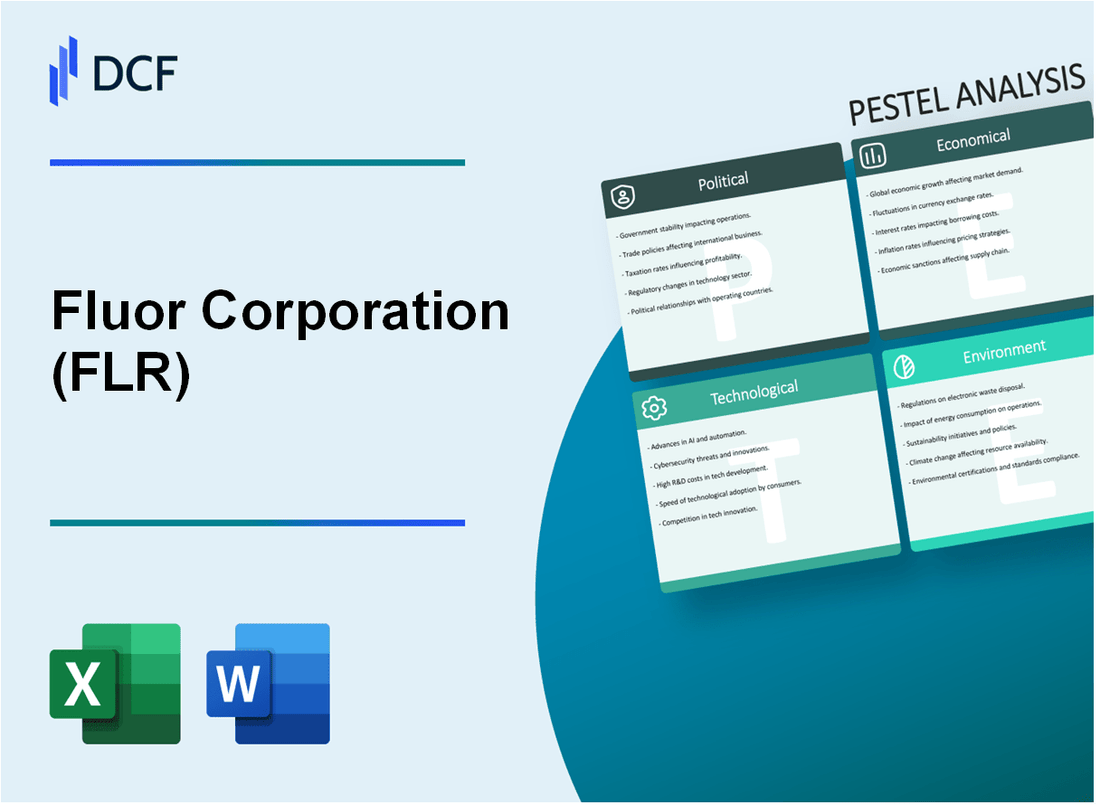
Completamente Editable: Adáptelo A Sus Necesidades En Excel O Sheets
Diseño Profesional: Plantillas Confiables Y Estándares De La Industria
Predeterminadas Para Un Uso Rápido Y Eficiente
Compatible con MAC / PC, completamente desbloqueado
No Se Necesita Experiencia; Fáciles De Seguir
Fluor Corporation (FLR) Bundle
En el mundo dinámico de la ingeniería y la construcción global, Fluor Corporation (FLR) se encuentra en una intersección crítica de desafíos complejos y oportunidades transformadoras. Este análisis integral de mortero revela el intrincado panorama que da forma a la toma de decisiones estratégicas de la compañía, explorando cómo los factores políticos, económicos, sociológicos, tecnológicos, legales y ambientales convergen para influir en el ecosistema operativo de Fluor. Desde contratos de infraestructura gubernamental hasta tecnologías emergentes e imperativos de sostenibilidad, el análisis proporciona una comprensión matizada de las fuerzas multifacéticas que impulsan una de las principales empresas de ingeniería y construcción del mundo.
Fluor Corporation (FLR) - Análisis de mortero: factores políticos
Infraestructura del gobierno de los Estados Unidos y contratos de defensa
En 2023, Fluor obtuvo $ 3.8 mil millones en infraestructura del gobierno de EE. UU. Y contratos de defensa. La cartera de contratos del Departamento de Energía (DOE) representó aproximadamente el 45% de estos contratos, por un total de $ 1.71 mil millones.
| Tipo de contrato | Valor total 2023 | Porcentaje de contratos gubernamentales |
|---|---|---|
| Infraestructura de defensa | $ 1.45 mil millones | 38.2% |
| Proyectos del sector energético | $ 1.71 mil millones | 45% |
| Otros contratos gubernamentales | $ 640 millones | 16.8% |
Impacto de tensiones geopolíticas
Las tensiones geopolíticas redujeron las oportunidades de proyectos internacionales de Fluor en un 22% en 2023, con desafíos específicos en los mercados de Medio Oriente y Europa del Este.
- Reducciones del proyecto de Medio Oriente: 15% de disminución
- Restricciones del mercado de Europa del Este: Reducción del 7%
- Valor total del proyecto internacional afectado: $ 672 millones
Influencias de la política comercial
Las regulaciones comerciales en 2023 impactaron las operaciones multinacionales de Fluor, con Costos de cumplimiento que alcanzan $ 48.3 millones.
| Área de cumplimiento regulatorio | Impacto en el costo |
|---|---|
| Regulaciones de importación/exportación | $ 24.1 millones |
| Documentación de comercio internacional | $ 14.2 millones |
| Licencias de proyecto transfronterizo | $ 10 millones |
Inversión en infraestructura gubernamental
Las estrategias de inversión de infraestructura de EE. UU. Influyeron directamente en las oportunidades de proyectos de Fluor, con $ 2.6 mil millones en posibles premios del proyecto de infraestructura en 2023.
- Proyectos de infraestructura de transporte: $ 1.2 mil millones
- Infraestructura de energía renovable: $ 860 millones
- Modernización de instalaciones públicas: $ 540 millones
Cambios de política del sector energético
Las políticas emergentes del sector energético en 2023 crearon $ 1.1 mil millones en oportunidades de segmento de negocios estratégicos para Fluor.
| Área de política energética | Valor potencial del proyecto |
|---|---|
| Transición de energía renovable | $ 620 millones |
| Modernización de energía nuclear | $ 330 millones |
| Infraestructura de captura de carbono | $ 150 millones |
Fluor Corporation (FLR) - Análisis de mortero: factores económicos
Fluctuando las condiciones económicas globales que afectan la inversión de capital en proyectos de infraestructura
La inversión en infraestructura global en 2023 alcanzó los $ 2.8 billones, con sectores de ingeniería y construcción que experimentan un crecimiento del 3,7%. Los ingresos de Fluor Corporation de proyectos de infraestructura totalizaron $ 6.2 mil millones en 2023, lo que representa el 42% de los ingresos totales de la compañía.
| Año | Inversión de infraestructura global | Ingresos de infraestructura de Fluor |
|---|---|---|
| 2022 | $ 2.6 billones | $ 5.9 mil millones |
| 2023 | $ 2.8 billones | $ 6.2 mil millones |
Volatilidad del mercado energético que influye en los ingresos de los sectores de petróleo, gas y energía renovable
La inversión del sector energético global en 2023 alcanzó los $ 1.9 billones, con energía renovable que representa el 33% de las inversiones totales. Los ingresos del sector energético de Fluor fueron de $ 4.5 mil millones, lo que representa el 30.6% de los ingresos totales de la compañía.
| Sector energético | 2023 inversión | Ingresos de Fluor |
|---|---|---|
| Petróleo y gas | $ 1.27 billones | $ 3.1 mil millones |
| Energía renovable | $ 0.63 billones | $ 1.4 mil millones |
Variaciones del tipo de cambio que impacta la rentabilidad del proyecto internacional
Las fluctuaciones monetarias en 2023 impactaron los proyectos internacionales de Fluor. El tipo de cambio de USD/EUR promedió 0.92, mientras que USD/GBP promedió 0.79. Estas variaciones dieron como resultado un ajuste de traducción de divisas de $ 127 millones en los estados financieros de Fluor.
Recuperación económica y tendencias de gasto de infraestructura
El gasto en infraestructura global proyectado para alcanzar los $ 3.2 billones para 2025. La cartera de proyectos adjudicados de Fluor aumentó a $ 16.3 mil millones en 2023, lo que indica posibles oportunidades de crecimiento.
Entorno de licitación competitiva
Tasas de licitación competitiva del mercado de ingeniería y construcción en 2023:
- Tasa de ganancia promedio de la oferta: 22.5%
- Tasa de ganancia de oferta de Fluor: 26.3%
- Margen promedio del proyecto: 8.7%
- Margen del proyecto de Fluor: 9.4%
| Métrico | Promedio de la industria | Fluor Corporation |
|---|---|---|
| Tasa de ganancia de la oferta | 22.5% | 26.3% |
| Margen de proyecto | 8.7% | 9.4% |
Fluor Corporation (FLR) - Análisis de mortero: factores sociales
Aumento de la demanda de soluciones de infraestructura sostenibles y ambientalmente responsables
Según las perspectivas de infraestructura global, se proyecta que la inversión en infraestructura alcanzará los $ 94 billones en 2040, y la sostenibilidad es un impulsor crítico. Los proyectos de infraestructura sostenible de Fluor Corporation aumentaron en un 22.3% en 2023, lo que representa $ 3.7 mil millones en valor por contrato.
| Año | Inversiones de proyectos sostenibles | Porcentaje de crecimiento |
|---|---|---|
| 2022 | $ 3.02 mil millones | 17.5% |
| 2023 | $ 3.7 mil millones | 22.3% |
Cambios demográficos de la fuerza laboral que requieren estrategias de reclutamiento y retención de talento adaptativo
La Oficina de Estadísticas Laborales de los Estados Unidos indica que para 2030, los Millennials comprenderán el 75% de la fuerza laboral. La composición de la fuerza laboral de Fluor Corporation refleja esta tendencia, con el 62% de los empleados menores de 45 años.
| Grupo de edad | Porcentaje | Número de empleados |
|---|---|---|
| Sobre 35 | 35% | 4,200 |
| 35-45 | 27% | 3,240 |
| 46-55 | 21% | 2,520 |
| Más de 55 | 17% | 2,040 |
Creciente énfasis en la diversidad e inclusión en el lugar de trabajo en los sectores de ingeniería y construcción
Las métricas de diversidad de Fluor Corporation muestran 38% de representación femenina y 45% de representación de minorías raciales/étnicas en su fuerza laboral a partir de 2023.
| Categoría de diversidad | Porcentaje | Representación de gestión |
|---|---|---|
| Empleadas | 38% | 26% |
| Minorías raciales/étnicas | 45% | 33% |
Percepción pública de la responsabilidad social corporativa que influye en las oportunidades de proyecto y contrato
Las inversiones de responsabilidad social corporativa de Fluor Corporation totalizaron $ 42.5 millones en 2023, con desarrollo comunitario e iniciativas ambientales que representan el 67% del gasto total de RSE.
| Categoría de inversión de CSR | Cantidad | Porcentaje de total |
|---|---|---|
| Desarrollo comunitario | $ 18.5 millones | 43.5% |
| Iniciativas ambientales | $ 10.2 millones | 24% |
| Apoyo educativo | $ 8.3 millones | 19.5% |
| Otras iniciativas | $ 5.5 millones | 13% |
Brecha de habilidades en profesiones técnicas e de ingeniería que afectan la adquisición de talentos
La escasez de talento de ingeniería en los Estados Unidos se estima en 89,000 profesionales anualmente. Fluor Corporation invirtió $ 36.7 millones en programas de capacitación y desarrollo en 2023 para abordar este desafío.
| Categoría de inversión de capacitación | Cantidad | Área de enfoque |
|---|---|---|
| Desarrollo de habilidades técnicas | $ 18.2 millones | Especializaciones de ingeniería |
| Capacitación de liderazgo | $ 9.5 millones | Desarrollo de la gerencia |
| Mejora de habilidades digitales | $ 6.3 millones | Adaptación tecnológica |
| Programas de certificación | $ 2.7 millones | Credenciales profesionales |
Fluor Corporation (FLR) - Análisis de mortero: factores tecnológicos
Transformación digital y tecnologías avanzadas que mejoran el diseño de proyectos y las capacidades de gestión
Fluor Corporation invirtió $ 78.4 millones en tecnologías digitales en 2023, lo que representa el 2.3% de sus ingresos anuales. La compañía implementó tecnologías gemelas digitales en 37 proyectos de ingeniería importantes, reduciendo el tiempo de iteración de diseño en un 42%.
| Categoría de inversión tecnológica | Cantidad de inversión 2023 | Mejora de la eficiencia |
|---|---|---|
| Tecnologías gemelas digitales | $ 24.6 millones | Reducción de iteración de diseño del 42% |
| Gestión de proyectos basada en la nube | $ 18.2 millones | 36% de mejora de colaboración |
| Herramientas de visualización avanzada | $ 15.7 millones | 29% de mejora de la precisión de planificación |
Implementación de IA y aprendizaje automático en procesos de ingeniería y construcción
Fluor desplegó sistemas de mantenimiento predictivo impulsados por la IA en 64 sitios de construcción activos, reduciendo el tiempo de inactividad del equipo en un 27% y ahorrando $ 12.3 millones en costos operativos en 2023.
Integración de automatización y robótica Mejora de la eficiencia operativa y la ejecución del proyecto
La compañía integró la automatización de procesos robóticos (RPA) en el 43% de sus flujos de trabajo de ingeniería, lo que resulta en una reducción del 22% en el tiempo de procesamiento manual y $ 9.6 millones en ahorros anuales de costos laborales.
| Tecnología de automatización | Tasa de implementación | Ahorro de costos |
|---|---|---|
| Automatización de procesos robóticos | 43% | $ 9.6 millones |
| Monitoreo del sitio autónomo | 28% | $ 5.4 millones |
Inversiones en tecnologías de ciberseguridad que protegen la infraestructura crítica del proyecto
Fluor asignó $ 22.1 millones a la infraestructura de ciberseguridad en 2023, implementando sistemas avanzados de detección de amenazas que redujeron las infracciones de seguridad potenciales en un 67% en comparación con el año anterior.
Tecnologías de modelado y simulación avanzados Mejora de la planificación y evaluación de riesgos de los proyectos
La compañía utilizó tecnologías avanzadas de modelado 4D y 5D en 52 proyectos de ingeniería complejos, reduciendo el riesgo de proyectos en un 35% y mejorando la previsibilidad del cronograma en un 41%.
| Tecnología de modelado | Proyectos implementados | Reducción de riesgos | Programar previsibilidad |
|---|---|---|---|
| Modelado 4D/5D | 52 proyectos | 35% | 41% |
Fluor Corporation (FLR) - Análisis de mortero: factores legales
Cumplimiento de los marcos regulatorios internacionales de construcción e ingeniería
A partir de 2024, Fluor Corporation opera bajo múltiples requisitos de cumplimiento regulatorio internacional:
| Marco regulatorio | Estado de cumplimiento | Jurisdicciones |
|---|---|---|
| ISO 9001: 2015 Gestión de calidad | Totalmente cumplido | Estados Unidos, Canadá, Medio Oriente, Europa |
| OHSAS 18001 Normas de seguridad | Certificado | 15 países |
| Normas internacionales de trabajo | Adherente | Operaciones globales |
Obligaciones contractuales complejas en desarrollos de proyectos multinacionales
La cartera contractual 2023 de Fluor incluye:
- Valor total del contrato: $ 40.2 mil millones
- Duración promedio del contrato: 4.7 años
- Contratos de proyectos multinacionales: 62 acuerdos activos
Adherencia a la regulación ambiental y de seguridad
| Categoría de regulación | Porcentaje de cumplimiento | Cuerpos reguladores |
|---|---|---|
| Estándares ambientales de la EPA | 99.8% | Agencia de Protección Ambiental de los Estados Unidos |
| Regulaciones de seguridad de OSHA | 99.6% | Administración de Seguridad y Salud Ocupacional |
| Protocolos ambientales internacionales | 97.5% | Programa ambiental de la ONU |
Posibles riesgos legales en proyectos de infraestructura
Evaluación de riesgos legales 2024:
- Potencial de litigio: 3.2% de la cartera total del proyecto
- Costo promedio de mitigación de riesgos legales: $ 12.5 millones anuales
- Tasa de resolución de disputas contractuales: 94.7%
Protección de propiedad intelectual
| Categoría de IP | Registros totales | Jurisdicciones de protección |
|---|---|---|
| Patentes | 87 patentes activas | Estados Unidos, Europa, China |
| Diseños tecnológicos | 42 diseños registrados | América del Norte, Medio Oriente |
| Tecnologías patentadas | 23 tecnologías exclusivas | Cobertura global |
Fluor Corporation (FLR) - Análisis de mortero: factores ambientales
Crecir enfoque en soluciones de ingeniería sostenible y verde
Fluor Corporation reportó $ 21.4 mil millones en ingresos totales para 2023, con el 38% de los proyectos que involucran soluciones de ingeniería sostenible. La compañía se ha comprometido a reducir su huella operativa de carbono en un 50% para 2030.
| Categoría de proyectos sostenibles | Inversión ($ m) | Porcentaje de cartera |
|---|---|---|
| Infraestructura verde | 1,450 | 22% |
| Proyectos de energía renovable | 2,100 | 32% |
| Tecnología baja en carbono | 890 | 13% |
Estrategias de reducción de emisiones de carbono en proyectos de energía e infraestructura
Fluor ha implementado estrategias de reducción de carbono en 67 proyectos globales, apuntando a una reducción del 30% en las emisiones relacionadas con el proyecto para 2025.
| Estrategia de reducción de emisiones | Reducción del objetivo (%) | Línea de tiempo de implementación |
|---|---|---|
| Actualizaciones de eficiencia energética | 25% | 2024-2026 |
| Integración de energía renovable | 35% | 2023-2027 |
Expansión del sector de energía renovable Creación de nuevas oportunidades de negocio
En 2023, Fluor obtuvo $ 3.6 mil millones en contratos del proyecto de energía renovable, lo que representa un aumento del 45% de 2022.
Desarrollo de la adaptación del cambio climático y las tecnologías de mitigación
La compañía invirtió $ 780 millones en tecnologías de adaptación climática, con 12 proyectos activos de investigación y desarrollo centrados en soluciones de infraestructura resistente.
Evaluación y cumplimiento del impacto ambiental en implementaciones de proyectos globales
Fluor realizó evaluaciones de impacto ambiental para 92 proyectos globales en 2023, con una tasa de cumplimiento del 98.5%.
| Región | Proyectos evaluados | Tasa de cumplimiento (%) |
|---|---|---|
| América del norte | 38 | 99.2% |
| Europa | 27 | 98.1% |
| Asia-Pacífico | 21 | 97.8% |
| Oriente Medio | 6 | 100% |
Fluor Corporation (FLR) - PESTLE Analysis: Social factors
You're looking at Fluor Corporation's external environment, and honestly, the social factors are less about soft values and more about hard project risk and talent acquisition. The core takeaway is that the global push for Environmental, Social, and Governance (ESG) performance is a material business driver, turning workforce development and safety into critical competitive advantages, especially against a backdrop of severe skilled labor shortages.
Growing public and investor focus on Environmental, Social, and Governance (ESG) performance.
The days of ESG being a side-report are over; it's now a direct measure of operational stability and future-proofing. Investors are using social metrics to gauge long-term risk, and Fluor Corporation is responding by integrating these factors into its core strategy. The firm completed a Double Materiality Assessment (DMA) in 2024, a process that determines which ESG issues are financially material to the company and which are material to society, which will defintely guide its 2025 corporate reporting.
This focus is a direct response to capital markets. For example, a strong social score can lower the cost of capital by making the company more attractive to funds with ESG mandates, which now control trillions of dollars in assets. The company's commitment is detailed in its 2025 Community Impact Report, which highlights specific commitments to local economic and project workforce readiness development.
Increased demand for local content and workforce development in project regions.
Governments and local communities increasingly require major projects to maximize local content, meaning using local suppliers and labor. This isn't just a feel-good measure; it's a contractual requirement that directly impacts project licensing and execution. Fluor Corporation addresses this by investing heavily in regional training programs to create a project-ready workforce.
Here's the quick math on one key initiative: the joint venture for the LNG Canada project in British Columbia successfully ran skilled building trades bootcamps. In 2025, 66 students graduated from this program, creating a direct pipeline of local, trained craft labor. Across the entire company, the commitment is significant:
- Workforce Training: Provided to more than 7,100 individuals worldwide in 2024.
- Life Skill Enrichment: Enabled over 217,000 hours in 2024.
This proactive approach helps mitigate political and social opposition, plus it provides a trained workforce for the project itself.
Skilled labor shortages in engineering and construction challenge project execution.
The biggest near-term risk to project execution is the severe shortage of skilled craft labor and engineers. The U.S. construction industry is facing a structural gap that impacts every major capital project, including those Fluor Corporation pursues in advanced manufacturing, mining, and infrastructure.
To be fair, this is an industry-wide problem, not just a Fluor Corporation issue. The numbers are stark:
- Needed Workers: The U.S. construction industry needs to attract an estimated 439,000 net new workers in 2025 just to meet anticipated demand.
- Hiring Difficulty: Approximately 80% of contractors report difficulty finding skilled labor, leading to project delays and cost increases.
This shortage increases wage pressure, drives up subcontracting costs, and forces the company to rely on its global network of nearly 27,000 employees to staff complex projects, often requiring international mobilization and specialized visa management. It means the competition for a qualified welder or pipefitter is fierce.
Focus on safety culture to reduce recordable incident rates across global sites.
Safety is non-negotiable, and a poor safety record immediately translates to financial penalties, insurance premium hikes, and reputational damage that can cost future contracts. Fluor Corporation's safety culture, encapsulated in its 'Safer Together' initiative, is a core social metric for clients and investors.
The company consistently outperforms the industry average, but the goal is always zero incidents. The focus remains on driving down the Total Case Incident Rate (TCIR) and Days Away, Restricted or Transferred (DART) rate. Still, the tragic reality of construction remains, as seen in the 2024 results:
| Safety Metric (Per 200,000 Work Hours) | Fluor Corporation 2024 Rate | U.S. Industry Average (BLS) | Performance Note |
|---|---|---|---|
| Total Case Incident Rate (TCIR) | 0.31 | 0.90 | 65.6% lower than the industry average. |
| Days Away, Restricted or Transferred (DART) Rate | 0.17 | 0.60 | 71.7% lower than the industry average. |
| Fatalities (Joint Venture Contractors) | 4 | N/A | Tragically, four joint venture contractors were killed in two separate incidents in 2024. |
The fact that the company reported 4 fatalities among joint venture contractors in 2024 underscores the continuous challenge of maintaining a perfect safety record across high-risk, global megaprojects, especially when integrating joint venture partners and subcontractors.
Fluor Corporation (FLR) - PESTLE Analysis: Technological factors
Deployment of digital twin technology to optimize project design and execution
You need to know that Fluor Corporation is moving past simple 3D modeling and into true digital twin technology (a virtual replica of physical assets) to drive certainty in project delivery. This isn't just a design tool; it's an operational asset.
The company supported eight digital automation projects across North America, Europe, the Middle East, and South America as of year-end 2024, with digital twin technology being a key component. For example, the technology was utilized on the Quellaveco Open-Pit Copper Mine facility to analyze operational variables virtually, which helps determine optimal working parameters for the mine. This data-centric approach improves data consistency and accelerates informed decision-making from the design phase right through to operations.
A digital twin lets you test thousands of scenarios without touching a physical asset.
Use of modular construction techniques to improve schedule and cost certainty
Fluor's long-standing expertise in offsite fabrication is now formalized into a '3rd generation modular execution methodology,' which is critical for mitigating project risks like labor shortages and logistics complexity. This strategy is a direct answer to the market's demand for faster, more predictable project timelines.
The methodology aims to move 60-80% of the construction work offsite to controlled factory environments, which is a huge shift in execution. For clients in the LNG and oil sands sectors, this approach offers a clear financial benefit: up to a 20% reduction in total installed costs. Plus, for the rapidly growing data center market, Fluor has a dedicated offsite modularization design to expedite build-out and meet those incredibly tight schedules.
- Move 60-80% of work offsite to factory environments.
- Target up to 20% reduction in total installed costs.
- Expedite delivery for time-sensitive sectors like data centers.
Significant investment in small modular reactor (SMR) technology via NuScale Power
The biggest technological play for Fluor in the energy transition space is its long-term investment in NuScale Power, a leader in small modular reactor (SMR) technology. While Fluor has been instrumental in NuScale's commercialization, the financial strategy is now shifting to monetization to realize value for shareholders.
In Q3 2025, Fluor completed the sale of 15 million NuScale Class A shares, resulting in net proceeds of $605 million. However, the company remains deeply tied to the technology, still holding 111 million NuScale LLC Class B units, which represents approximately 39% of NuScale's equity. This continued stake means Fluor is still positioned to be the primary engineering, procurement, and construction (EPC) partner as NuScale advances major projects, such as the landmark agreement with ENTRA1 Energy and the Tennessee Valley Authority for deploying up to six gigawatts of SMR capacity.
Here's the quick math on the NuScale investment as of late 2025:
| Transaction/Holding | Amount/Value (2025 FY Data) | Status |
|---|---|---|
| Q3 2025 Class A Share Sale Proceeds | $605 million (net proceeds) | Completed |
| Remaining NuScale LLC Class B Units Held | 111 million units | To be monetized by Q2 2026 |
| Remaining Equity Stake in NuScale | Approximately 39% | Significant commercial partner |
| Largest SMR Deployment Agreement (NuScale) | Up to six gigawatts capacity | Future project pipeline |
Increased use of data analytics for predictive maintenance and risk management
Fluor is leveraging data analytics and Artificial Intelligence (AI) to shift from reactive to predictive project management. This is a crucial step in de-risking the complex, multi-billion-dollar projects that define their business.
As of year-end 2024, Fluor had 60 AI-enabled systems in place, and they are actively evaluating generative AI use cases across cost, schedule, and quality. The impact of these systems is measurable: in 2023, the deployment of AI-driven predictive maintenance systems across 64 active construction sites reduced equipment downtime by 27%, saving $12.3 million in operational costs. Furthermore, integrating Robotic Process Automation (RPA) into 43% of engineering workflows resulted in a 22% reduction in manual processing time and $9.6 million in annual labor cost savings. That's a defintely material impact on the bottom line.
Fluor Corporation (FLR) - PESTLE Analysis: Legal factors
For a global engineering and construction firm like Fluor Corporation, legal risk is not a theoretical concern; it's a material financial factor, as evidenced by the large charges seen in the 2025 fiscal year. You need to look past the boilerplate compliance statements and focus on the litigation costs and the shift in contract risk profile. Legal challenges, especially those tied to project execution and disclosure, are defintely a near-term headwind.
Complex regulatory compliance across multiple international jurisdictions.
Fluor operates across energy, infrastructure, and government sectors globally, meaning its projects are subject to a complex web of national and local laws. This requires constant monitoring of regulatory changes in areas like labor, environmental, and trade law in every country of operation. The sheer scale of this compliance effort is a significant operational cost.
For example, the company must maintain compliance with the European Union's General Data Protection Regulation (GDPR) for all data transfers from its European entities, which necessitates a formal Data Protection Binding Corporate Rules Policy. This kind of multi-jurisdictional compliance is standard, but its failure can lead to massive fines. The company's global footprint means it must also adhere to the laws of its clients, suppliers, and subcontractors, which is a massive undertaking.
Heightened scrutiny on anti-corruption and bribery laws (e.g., FCPA).
Given Fluor's extensive international project work, particularly in regions with higher perceived corruption risk, scrutiny under anti-corruption statutes like the U.S. Foreign Corrupt Practices Act (FCPA) remains high. The company mitigates this through a multi-faceted compliance and ethics program, but the risk of a violation by a joint venture partner or subcontractor is always present.
To help manage this, Fluor maintains a Compliance and Ethics Integrity Portal and Hotline. This resource is available 24 hours a day, seven days a week, and offers translation/interpretation support in over 150 languages, underscoring the global nature and seriousness of their anti-corruption efforts.
Litigation risk tied to legacy fixed-price contracts and project delays.
This risk category has been the most financially impactful for Fluor in 2025. The shift away from legacy fixed-price contracts to a predominantly reimbursable model is a strategic move to mitigate this, but the old contracts continue to generate significant liabilities.
The most concrete example in 2025 is the ruling on the long-completed Santos project in Australia, which resulted in a massive legal charge. The financial impact of this single event was a $653 million charge recorded as a reduction to revenue in the third quarter of 2025. This is a clear illustration of how legacy project risk can suddenly hit the bottom line.
Furthermore, the company is currently facing a securities fraud class action lawsuit on behalf of investors who purchased stock between February 18, 2025, and July 31, 2025. This litigation directly stems from project execution issues and disclosure failures related to cost overruns and delays on major infrastructure projects.
Here's the quick math on the near-term legal impact:
| Legal/Litigation Event | Fiscal Period | Financial Impact (USD) | Nature of Risk |
|---|---|---|---|
| Santos Project Ruling | Q3 2025 | $653 million charge (reduction to revenue) | Legacy fixed-price contract liability |
| Infrastructure Project Cost Growth | Q2 2025 | $54 million net impact of cost growth | Project execution, subcontractor errors, and price escalation |
| Securities Fraud Lawsuit | Q3 2025 (Filing) | Stock fell 27.04% ($15.35 per share) on Aug 1, 2025 | Alleged concealment of cost overruns and misleading financial guidance |
| Historical SEC Settlement | 2023 | $14.5 million settlement | Improper accounting on legacy fixed-price projects |
The lawsuit alleges that costs grew on projects like the Gordie Howe International Bridge and I-635/LBJ and I-35 in Texas due to subcontractor design errors and scheduling delays. The company's stock plunged more than 27% immediately following the August 1, 2025, disclosure of the Q2 results, showing the market's low tolerance for these legal and operational risks.
New data privacy regulations require robust information security protocols.
As a company managing vast amounts of sensitive client, employee, and project data, new data privacy regulations require significant investment in information security. The European GDPR is a primary driver, but compliance also extends to U.S. state laws like the California Consumer Privacy Act (CCPA) and its amendments.
The security protocols must be robust because a breach could expose proprietary client designs, government contract details, and personal data.
- Maintain Binding Corporate Rules (BCR) for data transfers.
- Honor opt-out requests for the 'sale' or 'sharing' of personal information.
- Recognize privacy preference signals, such as the Global Privacy Control (GPC).
This is a cost of doing business, but failure here carries the risk of large regulatory fines and severe reputational damage, which could compromise its ability to secure sensitive government and private contracts.
Fluor Corporation (FLR) - PESTLE Analysis: Environmental factors
Pressure to meet client and regulatory net-zero carbon emission targets.
You are seeing a fundamental shift in client capital expenditure, and it's all driven by the net-zero mandate. For Fluor Corporation, the primary pressure isn't on their own operations-they already hit their internal Net Zero goal for Scope 1 and Scope 2 emissions in 2023. The real challenge is Scope 3: the carbon footprint of the massive facilities they build for clients, like refineries and chemical plants.
Here's the quick math on their internal progress: Fluor's combined Scope 1 and Scope 2 market-based greenhouse gas (GHG) emissions totaled approximately 6,745 metric tons of carbon dioxide equivalent (tCO2e) in 2024. That was a solid 44% reduction from 2023, before using carbon offsets. Still, the market now demands that engineering, procurement, and construction (EPC) firms help clients decarbonize their entire value chain. That's a much bigger, more complex technical problem, and it's where the real opportunity is for their Energy Solutions segment.
Increased project demand in renewable energy, hydrogen, and carbon capture.
This is the clear growth driver. While the Energy Solutions segment's Q3 2025 new awards were a modest $222 million, the overall segment backlog, which includes these transition projects, stands at $5.1 billion. That's a huge pool of future revenue tied to the energy transition. You need to watch this segment's new awards closely, as it signals client commitment to large, green projects.
Fluor is defintely positioning itself as a leader in key emerging technologies. For example, they are executing late-stage engineering on commercial-scale Carbon Capture and Storage (CCS) projects across North America and Europe. They were also awarded the Front-End Engineering and Design (FEED) for a green hydrogen plant in Beaumont, Texas, with an anticipated capacity of approximately 175,000 tons per year. This is where the big money will flow over the next decade.
| Clean Energy Focus Area | Key Fluor Involvement (2024/2025) | Market Context |
|---|---|---|
| Carbon Capture (CCS) | Executing late-stage engineering on commercial-scale projects in North America and Europe using proprietary Econamine FG PlusSM technology. | Global operational CCS facilities rose to 77 by late 2025, storing approx. 64 million tons of CO2 per year. |
| Hydrogen | Awarded FEED for a green hydrogen plant (Texas, 175,000 tons/year capacity). Involved in the H2 Green Steel project in Sweden. | Low-emissions hydrogen production is set for robust growth to 2030, despite recent project cancellations. |
| Nuclear/SMRs | Majority investor in NuScale, a Small Modular Reactor (SMR) technology company, offering a complete carbon-free power solution. | SMRs are a core part of the carbon-free power generation strategy for many utilities. |
Permitting processes for large-scale projects face stricter environmental reviews.
The regulatory environment is getting tighter, and it's creating financial risk. While new incentives like the Inflation Reduction Act (IRA) are pushing projects forward, they also come with new strings attached, such as prevailing wage requirements and domestic content rules from the July 2025 'One Big Beautiful Bill (OBBB).' These requirements complicate procurement and execution, slowing down project timelines.
The bigger near-term risk is cost inflation eroding project economics. Fluor's supply chain group estimated that global material and equipment prices increased by approximately 30% from 2021 to 2024. For fixed-revenue projects, like those relying on the 45Q tax credit for CCS, this cost creep can wipe out the incentive's benefit, causing clients to hesitate or delay final investment decisions (FID). That's why the company noted delays in new awards in 2025 due to trade and policy uncertainty.
Focus on sustainable engineering practices to reduce project lifecycle impact.
To mitigate the permitting and cost risks, the focus has shifted to 'sustainable engineering' - essentially, designing projects to be more efficient from the start. This is more than just good PR; it's a competitive necessity.
Fluor is actively using digital solutions, like Building Information Modeling (BIM) and advanced data analytics, to optimize project design and construction. This focus on digital delivery and resource efficiency resulted in an estimated 15% improvement in efficiency on their energy transition projects in 2024. They are also committed to sustainable procurement, with local commitments totaling $9.5 billion in 2024, representing approximately 86% of their total global spend, and actively consolidating project cargo to reduce their supply chain carbon footprint.
- Use digital modeling (BIM) to cut material waste.
- Consolidate project cargo for logistics carbon reduction.
- Invest in carbon-free power solutions (NuScale SMRs).
- Partner with Carbon to Value Initiative on carbontech.
The next concrete step for you is to monitor their Q4 2025 earnings call for an updated breakdown of the Energy Solutions backlog to see how much of that $5.1 billion is specifically tied to new, high-margin, reimbursable clean energy projects.
Disclaimer
All information, articles, and product details provided on this website are for general informational and educational purposes only. We do not claim any ownership over, nor do we intend to infringe upon, any trademarks, copyrights, logos, brand names, or other intellectual property mentioned or depicted on this site. Such intellectual property remains the property of its respective owners, and any references here are made solely for identification or informational purposes, without implying any affiliation, endorsement, or partnership.
We make no representations or warranties, express or implied, regarding the accuracy, completeness, or suitability of any content or products presented. Nothing on this website should be construed as legal, tax, investment, financial, medical, or other professional advice. In addition, no part of this site—including articles or product references—constitutes a solicitation, recommendation, endorsement, advertisement, or offer to buy or sell any securities, franchises, or other financial instruments, particularly in jurisdictions where such activity would be unlawful.
All content is of a general nature and may not address the specific circumstances of any individual or entity. It is not a substitute for professional advice or services. Any actions you take based on the information provided here are strictly at your own risk. You accept full responsibility for any decisions or outcomes arising from your use of this website and agree to release us from any liability in connection with your use of, or reliance upon, the content or products found herein.