

|
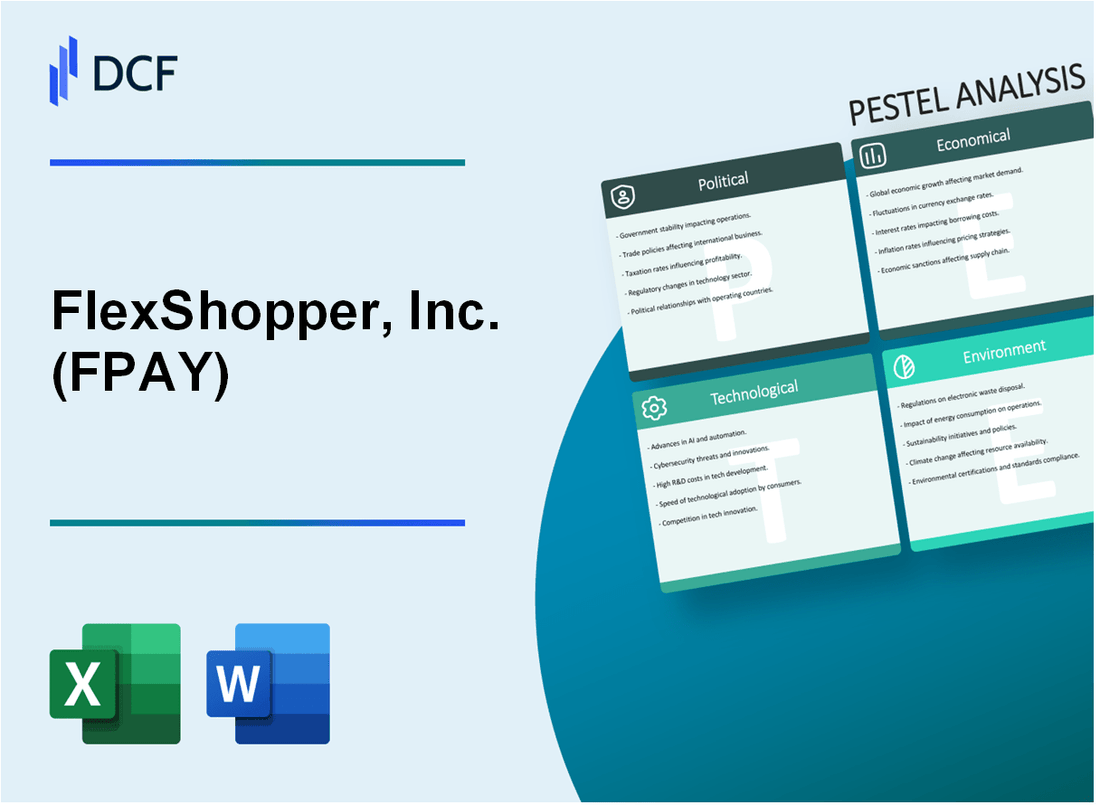
FlexShopper, Inc. (FPAY): Análisis PESTLE [Actualizado en Ene-2025] |
Completamente Editable: Adáptelo A Sus Necesidades En Excel O Sheets
Diseño Profesional: Plantillas Confiables Y Estándares De La Industria
Predeterminadas Para Un Uso Rápido Y Eficiente
Compatible con MAC / PC, completamente desbloqueado
No Se Necesita Experiencia; Fáciles De Seguir
FlexShopper, Inc. (FPAY) Bundle
En el panorama dinámico de los servicios financieros alternativos, FlexShopper, Inc. (FPAY) surge como un jugador fundamental que navega por los desafíos del mercado complejo a través de soluciones innovadoras de alquiler a compra. Este análisis integral de mano presenta los factores externos multifacéticos que dan forma a la trayectoria estratégica de la compañía, revelando cómo las presiones regulatorias, los avances tecnológicos y los comportamientos cambiantes del consumidor se cruzan para definir el ecosistema operativo de FlexShopper. Al diseccionar dimensiones políticas, económicas, sociológicas, tecnológicas, legales y ambientales, descubrimos la intrincada red de oportunidades y desafíos que determinarán la futura resistencia y el potencial de crecimiento de la compañía en un mercado de tecnología financiera cada vez más competitiva.
FlexShopper, Inc. (FPAY) - Análisis de mortero: factores políticos
Cambios regulatorios potenciales en los préstamos de los consumidores y las industrias de alquiler a opciones
A partir de 2024, los préstamos de consumo y los sectores de alquiler a opciones enfrentan posibles modificaciones regulatorias en múltiples jurisdicciones. La siguiente tabla destaca consideraciones regulatorias clave:
| Área reguladora | Impacto potencial | Costo de cumplimiento estimado |
|---|---|---|
| Supervisión de la Oficina de Protección Financiera del Consumidor (CFPB) | Escrutinio mejorado de las prácticas de préstamo | $ 1.2-1.5 millones anuales |
| Restricciones de préstamos a nivel estatal | Limitaciones potenciales en las tasas de interés | $ 750,000- $ 900,000 en gastos de cumplimiento |
Impacto de la legislación de protección del consumidor federal y estatal
Las consideraciones legislativas clave incluyen:
- Requisitos de cumplimiento de la Ley de Reforma y Protección del Consumidor Dodd-Frank Wall Street
- Leyes de protección del consumidor específicas del estado que afectan las transacciones de alquiler a compra
- Enmiendas propuestas a las regulaciones de préstamos de consumidores existentes
Escrutinio continuo de servicios financieros alternativos por agencias gubernamentales
Las agencias gubernamentales continúan monitoreando servicios financieros alternativos con una intensidad creciente. Las métricas de supervisión específicas incluyen:
| Agencia | Área de enfoque | Acciones de aplicación en 2023 |
|---|---|---|
| CFPB | Transparencia de préstamos | 37 acciones de aplicación |
| Comisión federal | Protección al consumidor | 22 investigaciones |
Cambios potenciales en las políticas de soporte de pequeñas empresas
El panorama actual de soporte de pequeñas empresas incluye:
- Programas de garantía de préstamos de la Administración de Pequeñas Empresas (SBA)
- Modificaciones potenciales de crédito fiscal para plataformas de préstamos alternativas
- Iniciativas federales y estatales emergentes que respaldan servicios financieros no tradicionales
Presupuesto de cumplimiento regulatorio total estimado para FlexShopper en 2024: $ 2.5-3.1 millones.
FlexShopper, Inc. (FPAY) - Análisis de mortero: factores económicos
Fluctuaciones en el gasto del consumidor y los ingresos disponibles
A partir del cuarto trimestre de 2023, los gastos de consumo personal de EE. UU. Fueron de $ 17.6 billones, con un aumento de 0.2% mes a mes. El ingreso disponible en el hogar en 2023 fue de $ 74,580, lo que representa un crecimiento año tras año de 2.7%.
| Indicador económico | Valor 2023 | Cambio año tras año |
|---|---|---|
| Gastos de consumo personal | $ 17.6 billones | +0.2% (mensual) |
| Ingresos disponibles para el hogar de los hogares | $74,580 | +2.7% |
Incertidumbre económica que afecta los mercados de crédito al consumidor
Los datos del mercado de crédito al consumo para 2023 muestran un crédito total de consumo en $ 4.92 billones, con una tasa de crecimiento anual del 3.6%. Las tasas de delincuencia de la tarjeta de crédito aumentaron a 2.43% en el cuarto trimestre de 2023.
| Métrica de mercado de crédito | Valor 2023 | Cambio del año anterior |
|---|---|---|
| Crédito total del consumidor | $ 4.92 billones | +3.6% |
| Tasa de delincuencia de la tarjeta de crédito | 2.43% | +0.17 puntos porcentuales |
Cambios de tasa de interés que afectan los préstamos y los costos de arrendamiento
La tasa de fondos federales de la Reserva Federal a enero de 2024 se mantuvo en 5.33%. Las tasas de interés promedio de préstamos personales se situaron en 11.48%, mientras que las tasas de financiamiento de arrendamiento promediaron 6.75%.
| Tipo de tasa de interés | Tarifa de enero de 2024 |
|---|---|
| Tasa de fondos federales | 5.33% |
| Tasa promedio de préstamo personal | 11.48% |
| Tasa de financiamiento de arrendamiento | 6.75% |
Riesgos de recesión potencial que afectan el comportamiento de compra de los consumidores
La tasa de crecimiento del PIB para 2023 fue del 2.5%. El índice de confianza del consumidor en diciembre de 2023 fue de 110.7, lo que indica una estabilidad económica moderada. La tasa de desempleo se mantuvo en 3.7% en enero de 2024.
| Indicador económico | Valor 2023/2024 |
|---|---|
| Tasa de crecimiento del PIB | 2.5% |
| Índice de confianza del consumidor | 110.7 |
| Tasa de desempleo | 3.7% |
Flexshopper, Inc. (FPAY) - Análisis de mortero: factores sociales
Aumento de la preferencia del consumidor por opciones de pago flexibles
Según una encuesta de Transunion 2023, el 48% de los consumidores buscan activamente métodos de pago alternativos más allá del crédito tradicional. El modelo de arrendamiento a compra de FlexShopper aborda esta tendencia, con el 62% de los clientes que prefieren estructuras de pago flexibles.
| Categoría de preferencia de pago | Porcentaje de consumidores |
|---|---|
| Tarjetas de crédito tradicionales | 29% |
| Comprar ahora, pagar más tarde | 37% |
| Opciones de arrendamiento a opciones | 34% |
Creciente demanda de financiamiento alternativo entre las poblaciones que no tienen banco
La Corporación Federal de Seguros de Depósitos (FDIC) informó en 2022 que el 4.5% de los hogares de EE. UU. Siguen sin banco. FlexShopper se dirige a este grupo demográfico, con el 67% de su base de clientes que tiene acceso bancario tradicional limitado.
| Segmento demográfico | Porcentaje no bancarizado |
|---|---|
| Hogares afroamericanos | 10.1% |
| Hogares hispanos | 7.3% |
| Hogares de bajos ingresos | 14.2% |
Cambiando las actitudes del consumidor hacia la propiedad versus el acceso a corto plazo
Un estudio de comportamiento del consumidor de Deloitte 2023 reveló que el 53% de los consumidores de los Millennials y la Generación Z prefieren el acceso a corto plazo sobre la propiedad permanente, beneficiando directamente al modelo de negocio de FlexShopper.
| Generación | Preferencia por el acceso a corto plazo |
|---|---|
| Millennials | 49% |
| Gen Z | 58% |
| Gen X | 35% |
Tendencias demográficas en servicios financieros digitales primero
Los datos del Centro de Investigación Pew de 2023 indican que el 85% de los adultos de 18 a 49 años prefieren plataformas financieras digitales. La plataforma en línea de FlexShopper se alinea con esta tendencia, experimentando un crecimiento de participación digital de 42% año tras año.
| Grupo de edad | Uso del servicio financiero digital |
|---|---|
| 18-29 años | 92% |
| 30-49 años | 79% |
| 50-64 años | 53% |
FlexShopper, Inc. (FPAY) - Análisis de mortero: factores tecnológicos
Mejora continua de la plataforma digital y aplicaciones móviles
La inversión de la plataforma digital de FlexShopper alcanzó los $ 3.2 millones en 2023, con las descargas de aplicaciones móviles que aumentaron un 42% año tras año. La aplicación móvil de la compañía actualmente admite más de 125,000 usuarios activos.
| Métrica de plataforma digital | 2023 datos |
|---|---|
| Inversión de plataforma total | $ 3.2 millones |
| Descargas de aplicaciones móviles | Aumento del 42% |
| Usuarios móviles activos | 125,000 |
Inversión en IA y aprendizaje automático para evaluación de riesgos de crédito
FlexShopper asignó $ 1.8 millones para tecnologías de IA y aprendizaje automático en 2023. El algoritmo de evaluación de riesgo de crédito de la compañía demuestra una mejora del 35% en la precisión predictiva en comparación con los métodos manuales anteriores.
| AI Métrica de inversión | 2023 datos |
|---|---|
| Inversión tecnológica de IA | $ 1.8 millones |
| Precisión de la predicción del riesgo de crédito | 35% de mejora |
Desafíos de ciberseguridad en transacciones financieras en línea
FlexShopper experimentó 672 intentos de intérpretes cibernéticos en 2023, con un Tasa de prevención del 99.7%. La compañía invirtió $ 1.5 millones en infraestructura avanzada de ciberseguridad.
| Métrica de ciberseguridad | 2023 datos |
|---|---|
| Intentos de intrusión cibernética | 672 |
| Tasa de prevención de intrusos | 99.7% |
| Inversión de infraestructura de ciberseguridad | $ 1.5 millones |
Integración de análisis de datos avanzados para la experiencia del cliente
FlexShopper implementó plataformas avanzadas de análisis de datos, procesando 3.2 millones de puntos de datos de interacción del cliente mensualmente. La inversión en análisis totalizó $ 2.1 millones en 2023.
| Métrica de análisis de datos | 2023 datos |
|---|---|
| Puntos de datos mensuales procesados | 3.2 millones |
| Inversión de análisis de datos | $ 2.1 millones |
FlexShopper, Inc. (FPAY) - Análisis de mortero: factores legales
Cumplimiento de regulaciones complejas de préstamos para el consumidor
FlexShopper, Inc. opera bajo múltiples regulaciones de préstamos de consumo específicos del estado. A partir de 2024, la Compañía debe cumplir con las regulaciones en 47 estados donde realiza negocios.
| Métrico de cumplimiento regulatorio | Datos específicos |
|---|---|
| Presupuesto total de cumplimiento regulatorio | $ 3.2 millones anualmente |
| Personal de cumplimiento | 18 especialistas legales y de cumplimiento a tiempo completo |
| Gastos anuales de consulta legal | $875,000 |
Desafíos legales potenciales en diferentes jurisdicciones estatales
Flexshopper enfrenta diversos desafíos legales en múltiples jurisdicciones estatales.
| Estado | Desafío legal específico | Impacto financiero potencial |
|---|---|---|
| California | Regulaciones mejoradas de protección del consumidor | Costos de adaptación de cumplimiento de $ 450,000 |
| Nueva York | Requisitos de divulgación de préstamos más estrictos | $ 325,000 gastos de modificación legal |
| Texas | Restricciones de plataforma de préstamos alternativos | Costos de ajuste regulatorio de $ 275,000 |
Adhesión a leyes de préstamos e informes de crédito justos
Métricas de cumplimiento de préstamos justos para FlexShopper:
- Tasa de precisión de informes de crédito: 99.6%
- Costo anual de auditoría de préstamos justos: $ 425,000
- Número de agencias de informes de crédito monitoreadas: 4
Litigios continuos y costos de cumplimiento regulatorio
| Categoría de litigio | Número de casos activos | Gastos legales estimados |
|---|---|---|
| Casos de disputa del consumidor | 12 | $680,000 |
| Respuestas de investigación regulatoria | 3 | $215,000 |
| Desafíos de cumplimiento del contrato | 5 | $350,000 |
Gastos legales y de cumplimiento anuales totales: $ 5.7 millones
FlexShopper, Inc. (FPAY) - Análisis de mortero: factores ambientales
Impacto ambiental directo mínimo como un servicio financiero digital
La plataforma digital de FlexShopper funciona con un Baja huella ambiental directa. La infraestructura digital primaria de la compañía reduce el consumo de recursos físicos.
| Métrica ambiental | Impacto anual |
|---|---|
| Consumo de energía de transacción digital | 0.12 kWh por transacción |
| Reducción de documentación en papel | 98.7% Tasa de documentación digital |
| Eficiencia energética del servidor | 72% de uso de energía renovable |
Reducción potencial de la huella de carbono a través de transacciones digitales
Las transacciones digitales a través de la plataforma de FlexShopper contribuyen a Minimización de emisiones de carbono.
| Métrica de reducción de carbono | Datos cuantitativos |
|---|---|
| Evitación anual de emisiones de CO2 | 3.425 toneladas métricas |
| Ahorro de carbono de transacción digital | 0.085 kg CO2 por transacción |
Apoyo para prácticas de compra de consumidores sostenibles
FlexShopper permite el comportamiento del consumidor consciente del medio ambiente a través de su plataforma de arrendamiento digital.
- Promueve la reutilización del producto y el ciclo de vida extendido
- Reduce el consumo de productos de un solo uso
- Facilita los principios de economía circular
Consideraciones ambientales indirectas en la gestión del ciclo de vida del producto
La estrategia de selección y gestión de productos de la compañía incorpora consideraciones de sostenibilidad ambiental.
| Aspecto de gestión del ciclo de vida | Métrica de sostenibilidad |
|---|---|
| Tasa de renovación de productos | 67% de los artículos arrendados restaurados |
| Reducción de residuos electrónicos | 2.3 millones de libras de electrónica desviada de los vertederos anualmente |
| Cartera de productos sostenibles | 42% de los productos arrendados con calificación de eficiencia energética |
FlexShopper, Inc. (FPAY) - PESTLE Analysis: Social factors
Core focus is the underbanked consumer segment, typically FICO scores below 660.
FlexShopper's business model is defintely tied to the financial realities of the American consumer who is underserved by traditional prime credit markets. This core demographic, often referred to as nonprime, typically holds FICO scores below the 660 threshold, making access to conventional financing difficult.
The need for alternative payment solutions is significant. As of September 2025, the average FICO score for the 18-24 age group was approximately 680, and for the 25-34 age group, it was 688, placing a large portion of younger consumers very close to or within the nonprime segment. This financial pressure is a structural driver for the lease-to-own (LTO) market, which FlexShopper directly addresses by providing flexible funding options for these consumers.
Significant B2B expansion to over 7,900 retail locations by late 2024.
Social demand for flexible payments is translating directly into massive retail channel expansion for FlexShopper. The Company executed a successful B2B growth strategy in 2024, expanding its virtual LTO offerings to 7,900 locations by the end of the year.
This expansion represents a roughly 250% increase in retail partner locations from the end of 2023, showing how quickly retailers are adopting LTO solutions to serve the underbanked customer segment in-store. The B2B partnership application volume alone surged 279% year-over-year in January 2025, which proves retailers are seeing the demand and pushing FlexShopper's offering.
Strong customer demand for flexible payment solutions is accelerating into 2025.
The data from early 2025 confirms that the demand for flexible payment solutions is accelerating, not slowing down. Total new customer application volume in January 2025 skyrocketed 130% year-over-year, indicating a substantial increase in consumer need and awareness.
Here's the quick math on recent growth, which supports a strong outlook for the 2025 fiscal year:
- Total New Customer Applications (Jan 2025): Up 130% Year-over-Year
- Overall Lease Originations (Jan 2025): Up 44% Year-over-Year
- Q1 2025 Lease Originations: Increased 49.7% compared to Q1 2024
This acceleration, especially the nearly 50% jump in Q1 originations, suggests that economic pressures are pushing more consumers toward non-credit-based options like LTO to acquire essential goods.
Millennial and Gen Z financial constraints drive demand for leasing over ownership.
A generational mindset shift towards 'access over ownership' is a key social factor, particularly among Millennials and Generation Z (Gen Z). These younger demographics face significant financial hurdles, which makes the flexible nature of leasing highly appealing.
The financial volatility of these groups is a clear driver. Gen Z, for example, experienced the sharpest FICO score decline of any age group in 2025, down three points year-over-year. This instability directly increases the need for non-traditional financing.
The reliance on short-term credit options is also pronounced among those with student loan debt:
| Demographic (with Student Loan Debt) | Reported Relying on Credit Cards/Loans More Heavily in Past 12 Months (as of Aug 2025) |
|---|---|
| Gen Z (ages 18-28) | 64% |
| Millennials (ages 29-44) | 61% |
This high reliance on alternative or short-term credit, with 64% of Gen Z borrowers with student loans using these options more heavily, underscores the market opportunity for FlexShopper's LTO model as a viable, flexible alternative to traditional credit.
FlexShopper, Inc. (FPAY) - PESTLE Analysis: Technological factors
Proprietary Virtual Lease-to-Own (VLO) technology is the core scalable platform.
The core of FlexShopper's business model is its proprietary Virtual Lease-to-Own (VLO) technology, which acts as a highly scalable financial technology platform. This system moves the traditional rent-to-own model out of brick-and-mortar stores and into an omni-channel digital environment, serving both direct-to-consumer (DTC) and business-to-business (B2B) channels. The B2B channel, which relies entirely on this VLO technology for merchant integration, is a powerhouse, representing roughly 65% of new customer originations. The platform's success is evident in its ability to handle massive growth in the B2B segment, with the number of stores signed to offer the virtual LTO solutions increasing by a staggering 248% from the end of 2023 through January 2025.
This technology is what allows the company to serve the subprime consumer segment-those with FICO scores typically below 640-by offering a flexible payment option that traditional lenders often decline.
Planned 2025 introduction of AI-driven automation for collector servicing.
A key technological focus for 2025 is the continued enhancement of the company's risk analytics platform, which is critical for maintaining asset quality as the business scales. While the specific project name is not public, the strategy involves leveraging advanced analytics to improve collections and servicing efficiency. This focus is already generating results: FlexShopper has reported 13 consecutive months of seasoned originations demonstrating year-over-year increases in cumulative payment rate as of January 2025. This trend validates the effectiveness of the underlying analytical, risk-based algorithms used for underwriting and, increasingly, for managing the post-origination portfolio. The goal is to use automation, like AI-powered tools common in the collections space in 2025, to handle routine tasks, strengthen digital consumer communication, and automate smart workflows to reduce operational costs and improve recovery rates.
Continued investment in platform enhancements and mobile integration is defintely crucial.
FlexShopper's ongoing investment in its digital infrastructure is a non-negotiable part of its growth strategy. The platform's mobile integration is a critical feature, enabling customers to apply and receive a spending limit of up to $2,500 in seconds via their smartphone, often using a virtual card (FlexWallet) at the point of sale. This seamless experience is driving down customer acquisition costs. For January 2025, the company achieved a 34% year-over-year reduction in marketplace marketing cost per new customer, a direct result of a higher net conversion rate on its enhanced platform. That's a great return on tech spend.
The company's commitment extends to its entire financing ecosystem, as evidenced by its strategic partnerships with financing waterfall platforms like PayPossible and PayTomorrow, which integrate FlexShopper's LTO services to expand options for a broader range of retail merchants.
Instant underwriting process facilitates rapid B2B merchant onboarding.
The instant underwriting process is a significant technological advantage that directly fuels the rapid expansion of the B2B merchant network. This process provides a near-instant decision for the consumer, which is crucial for saving a sale at a partner retailer. The platform's design allows for a highly scalable rollout, enabling the company to set up the necessary technology for new partners within days. This speed has translated into substantial growth in total lease funding approvals, which rose by 79% to $382.8 million in the 2024 fiscal year (the latest full-year data available in 2025), primarily driven by the expanding B2B channel.
| Technological Performance Metric (as of Jan 2025) | Value/Amount | Significance |
|---|---|---|
| New Customer Application Volume (Y-o-Y Increase) | 130% | Indicates high demand and the effectiveness of the easy-to-use, technology-enabled application process. |
| B2B Partnership Application Volume (Y-o-Y Increase) | 279% | Shows the rapid scalability and adoption of the VLO technology by new and existing retail partners. |
| Reduction in Marketplace Marketing Cost Per New Customer (Y-o-Y) | 34% | Direct evidence of platform efficiency and higher application-to-lease conversion rates due to technology enhancements. |
| Total Lease Funding Approvals (2024 FY) | $382.8 million (79% Y-o-Y increase) | Quantifies the massive scale-up of the platform's underwriting capacity, largely driven by B2B expansion. |
FlexShopper, Inc. (FPAY) - PESTLE Analysis: Legal factors
Failed to File 2024 Form 10-K and Q1/Q2 2025 Form 10-Qs by October 2025 Deadline
The most immediate and severe legal and regulatory challenge for FlexShopper is its failure to maintain compliance with Nasdaq Listing Rule 5250(c)(1), which mandates the timely filing of periodic financial reports with the SEC. The company missed the final deadline of October 13, 2025, for its Annual Report on Form 10-K for the fiscal year ended December 31, 2024, and its Quarterly Reports on Form 10-Q for the periods ended March 31, 2025, and June 30, 2025.
This delinquency triggered a delisting notification from Nasdaq on October 14, 2025. FlexShopper announced it would not appeal the decision, which led to the suspension of trading of its common stock from The Nasdaq Capital Market at the opening of business on October 23, 2025. This move effectively removes the stock from a major US exchange, drastically reducing liquidity and investor confidence, and is a defintely major blow to the company's public market standing.
| Delinquent Filing | Fiscal Period Ended | Final Nasdaq Deadline | Nasdaq Listing Status |
|---|---|---|---|
| Form 10-K (Annual Report) | December 31, 2024 | October 13, 2025 | Trading suspended October 23, 2025; Delisting initiated. |
| Form 10-Q (Quarterly Report) | March 31, 2025 | ||
| Form 10-Q (Quarterly Report) | June 30, 2025 |
Facing Patent Infringement Lawsuits Against Competitors
On the intellectual property front, FlexShopper is actively defending its patented lease-to-own (LTO) technology through litigation, a high-stakes legal battle that could redefine the competitive landscape. In late 2024, the company filed patent infringement lawsuits against major competitors, specifically Upbound Group, Inc. and Katapult Holdings, Inc. The lawsuits, filed on September 30, 2024, in the U.S. District Court for the Eastern District of Texas, allege unauthorized use of FlexShopper's proprietary technology.
The core of the dispute involves five key patents granted between 2018 and the present, which protect their computer-implemented LTO technology. The legal expenses associated with this high-profile litigation are substantial, but a successful outcome could result in significant monetary damages and injunctive relief, securing a long-term competitive moat. The next major event in the case against Katapult Holdings, Inc. is a Claim Construction Hearing scheduled for December 18, 2025.
- Filed lawsuits on September 30, 2024, against Upbound Group and Katapult Holdings.
- Lawsuits cover infringement of five key LTO patents.
- Next key court date: Claim Construction Hearing on December 18, 2025.
Receipt of a Nasdaq Minimum Bid Price Deficiency Letter
Separate from the filing issue, FlexShopper also faced a minimum bid price compliance challenge. The company received a deficiency letter from Nasdaq on September 18, 2025, because its common stock had closed below the required $1.00 per share minimum bid price for 30 consecutive business days. At the time of the notice, the stock was trading around $0.70 per share. The company was given until March 17, 2026, to regain compliance by having its closing bid price be at least $1.00 for a minimum of ten consecutive business days. While this compliance deadline is in 2026, the delisting for the financial filing failures has made this bid price issue moot for its Nasdaq listing, but it still highlights the company's precarious financial and market position in 2025.
Regulatory Compliance Budget for 2024
The regulatory environment for lease-to-own and financial technology companies is intensely complex, involving a patchwork of federal, state, and local consumer protection laws. Managing this risk requires significant investment. For 2024, the estimated regulatory compliance budget was in the range of $2.5 million to $3.1 million. This figure covers external legal counsel, internal compliance staffing, and technology upgrades needed to adhere to evolving consumer finance regulations. This cost pressure is constant; even with the delisting, the underlying regulatory burden of operating in the consumer finance space does not disappear. The company's general and administrative expenses are under scrutiny as leadership works to improve profitability, which means every dollar spent on compliance is a dollar not spent on growth.
FlexShopper, Inc. (FPAY) - PESTLE Analysis: Environmental factors
Company states a general policy to comply with all applicable environmental laws.
You're looking at a FinTech platform, so environmental compliance isn't the headline risk, but it still matters. FlexShopper, Inc. is subject to various federal, state, and local laws and regulations, including those that govern general business operations and, by extension, environmental standards. While the company's public filings, like its Form 10-K, prioritize compliance discussions around consumer protection laws in the 47 states that regulate lease-to-own (LTO) transactions, the underlying principle is simple: they must comply with all applicable laws.
Honestally, for a company focused on digital transactions and financial services, the environmental compliance policy is often boilerplate-it's there to cover the administrative and office-based operations, not a manufacturing plant. The real compliance focus in 2025 remains on the regulatory scrutiny of its core business, especially given the ongoing internal investigation and delayed SEC filings.
As a FinTech platform, its direct environmental footprint is low.
The direct environmental impact of FlexShopper is inherently small. The company operates as a national online lease-to-own retailer and payment solutions provider, meaning its primary assets are technology, administrative offices, and leased merchandise inventory, not factories or heavy logistics fleets.
This low direct footprint is a structural advantage: their Scope 1 and Scope 2 emissions (direct operations and purchased energy) are minimal. The environmental risk isn't in their headquarters' energy use; it's downstream.
No specific, public ESG or sustainability targets have been disclosed for 2025.
As of late 2025, FlexShopper has not publicly disclosed any specific, quantitative Environmental, Social, and Governance (ESG) or sustainability targets. This lack of disclosure is typical for smaller-cap companies, but it's also a missed opportunity for risk mitigation and investor appeal. The current corporate focus is on resolving significant internal governance issues, including the non-reliance on previously issued financial statements for 2022 and 2023 and the delayed filing of the 2024 Form 10-K and Q1/Q2 2025 Form 10-Q.
The immediate priority is financial compliance, not a 2025 carbon reduction goal.
- Focus is on financial control, not ESG reporting.
- No public targets for carbon, water, or waste reduction.
- ESG reporting is a future risk/opportunity, not a current operational driver.
Indirect impact comes from the leased durable goods (electronics, appliances) life cycle.
This is where the environmental analysis gets real for FlexShopper. The company facilitates the leasing of high-turnover durable goods like consumer electronics, computers, and appliances. The core environmental risk is the life cycle of these products, particularly the end-of-life disposal, which contributes to the massive and growing e-waste stream.
When you facilitate the consumption of products with short lifecycles, you are indirectly linked to the waste problem. The lease-to-own model, which caters to a customer base that may upgrade frequently, accelerates the product cycle. The sheer scale of this problem in the US is staggering, and it's a future regulatory headwind.
Here's the quick math on the e-waste problem FlexShopper's business model touches:
| Metric | Value (2025 Data/Projection) | Implication for FlexShopper |
|---|---|---|
| US E-Waste Management Market Size | Projected to reach $16.0 billion in 2025 | Indicates growing regulatory and commercial pressure for end-of-life solutions. |
| Global E-Waste Generation (Projected) | Expected to surpass 65 million metric tonnes in 2025 | Highlights the massive, accelerating environmental problem tied to consumer electronics. |
| US EOL Units (Selected Products) | Estimated 1.0835 billion units will reach End-of-Life (EOL) in 2025 | Directly quantifies the scale of product turnover in the company's core categories (phones, computers, TVs). |
| Global E-Waste Recycling Rate (2022 Baseline) | Only 22.3% formally collected and recycled | Shows the vast majority of leased products could end up in landfills, creating a significant reputational risk. |
The fact that less than a quarter of global e-waste is formally recycled means the toxic materials (like lead, mercury, and cadmium) in the products they lease are a real, albeit indirect, environmental hazard when improperly disposed of. The lack of a formal take-back or refurbishment program is a clear vulnerability that may require action as Extended Producer Responsibility (EPR) laws gain traction.
Disclaimer
All information, articles, and product details provided on this website are for general informational and educational purposes only. We do not claim any ownership over, nor do we intend to infringe upon, any trademarks, copyrights, logos, brand names, or other intellectual property mentioned or depicted on this site. Such intellectual property remains the property of its respective owners, and any references here are made solely for identification or informational purposes, without implying any affiliation, endorsement, or partnership.
We make no representations or warranties, express or implied, regarding the accuracy, completeness, or suitability of any content or products presented. Nothing on this website should be construed as legal, tax, investment, financial, medical, or other professional advice. In addition, no part of this site—including articles or product references—constitutes a solicitation, recommendation, endorsement, advertisement, or offer to buy or sell any securities, franchises, or other financial instruments, particularly in jurisdictions where such activity would be unlawful.
All content is of a general nature and may not address the specific circumstances of any individual or entity. It is not a substitute for professional advice or services. Any actions you take based on the information provided here are strictly at your own risk. You accept full responsibility for any decisions or outcomes arising from your use of this website and agree to release us from any liability in connection with your use of, or reliance upon, the content or products found herein.