

|
Análisis de la Matriz ANSOFF de Frontier Communications Parent, Inc. (FYBR) [Actualizado en Ene-2025] |
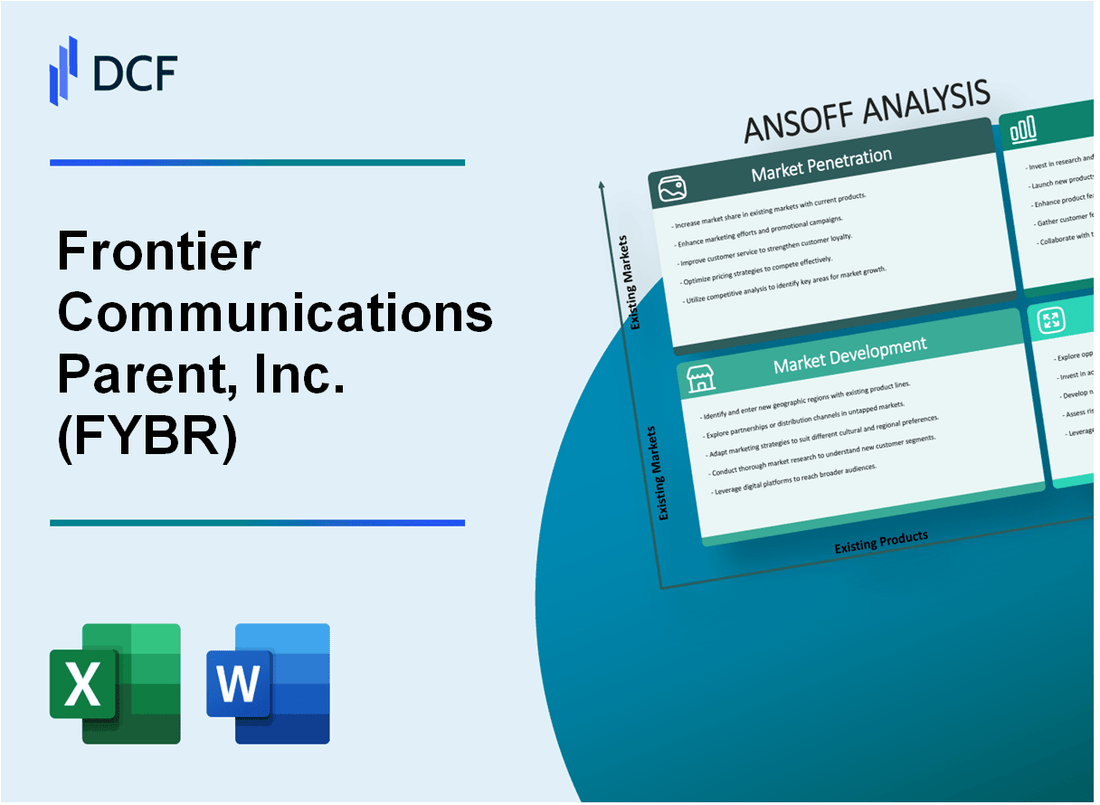
Completamente Editable: Adáptelo A Sus Necesidades En Excel O Sheets
Diseño Profesional: Plantillas Confiables Y Estándares De La Industria
Predeterminadas Para Un Uso Rápido Y Eficiente
Compatible con MAC / PC, completamente desbloqueado
No Se Necesita Experiencia; Fáciles De Seguir
Frontier Communications Parent, Inc. (FYBR) Bundle
En el panorama de telecomunicaciones en rápida evolución, Frontier Communications Parent, Inc. (FYBR) se encuentra en una encrucijada crítica, posicionándose estratégicamente para el crecimiento transformador a través de un enfoque integral de matriz Ansoff. Al explorar metódicamente la penetración del mercado, el desarrollo, la innovación de productos y la diversificación estratégica, la compañía está preparada para aprovechar su robusta infraestructura de red y abordar los desafíos emergentes en los mercados rurales y desatendidos. Esta hoja de ruta estratégica promete no solo mejoras incrementales, sino un posible cambio de paradigma en la forma en que los proveedores de telecomunicaciones regionales pueden adaptarse, expandirse y redefinir la conectividad en un mundo cada vez más digital.
Frontier Communications Parent, Inc. (FYBR) - Ansoff Matrix: Penetración del mercado
Expandir la cobertura de red de fibra óptica dentro de los territorios de servicio existentes
A partir del cuarto trimestre de 2022, Frontier Communications desplegó una red de fibra óptica a 5,2 millones de pases totales, con 3.1 millones de ubicaciones de servicio de fibra. La compañía invirtió $ 409 millones en gastos de capital para la expansión de la red durante 2022.
| Métrico de red | Cobertura total |
|---|---|
| Pasaciones totales de fibra | 5.2 millones |
| Ubicaciones de servicio de fibra | 3.1 millones |
| Gasto de capital (2022) | $ 409 millones |
Introducir paquetes de precios competitivos
Los planes de Internet de fibra de Frontier varían de $ 49.99 a $ 154.99 por mes, con velocidades de entre 500 Mbps y 2 Gbps.
- Plan de 500 Mbps: $ 49.99/mes
- 1 plan GBPS: $ 74.99/mes
- Plan de 2 GBPS: $ 154.99/mes
Mejorar la retención de clientes
Frontier informó un Tasa neta de retención de clientes del 87.4% En 2022, con la rotación del cliente se redujo a 1.8% trimestralmente.
Desarrollar campañas de marketing específicas
Frontier se centra en los mercados rurales, con el 68% de su cobertura de red en áreas no metropolitanas. La asignación de presupuesto de marketing para 2022 fue de $ 87 millones.
Ofrecer servicios agrupados
| Tipo de paquete | Precio mensual | Servicios incluidos |
|---|---|---|
| Paquete básico | $79.99 | Internet + teléfono |
| Paquete premium | $129.99 | Internet + teléfono + TV |
Frontier Communications Parent, Inc. (FYBR) - Ansoff Matrix: Desarrollo del mercado
Expansión en regiones geográficas adyacentes
Frontier Communications atiende a 25 estados a partir de 2023, con un enfoque en los mercados rurales y desatendidos. La red de la compañía cubre aproximadamente 3.7 millones de clientes de banda ancha y voz.
| Cobertura estatal | Número de clientes | Alcance de la red |
|---|---|---|
| Mercados rurales | 2.1 millones | 18 estados |
| Mercados suburbanos | 1.6 millones | 7 estados |
Apuntar a los mercados comerciales pequeños a medianos
El segmento comercial de Frontier generó $ 712 millones en ingresos en el cuarto trimestre de 2022, lo que representa el 22% de los ingresos totales de la compañía.
- Base de clientes de pequeñas empresas: 275,000
- Ingresos mensuales promedio por cliente: $ 245
- Cobertura de soluciones empresariales: 14 estados
Asociaciones estratégicas con gobiernos locales
Frontier invirtió $ 378 millones en mejoras de infraestructura de red en 2022, con $ 127 millones asignados específicamente a la expansión de banda ancha rural.
Ingrese a los nuevos mercados estatales
Penetración actual del mercado en estados objetivo: 42% de los hogares elegibles para la banda ancha rural.
| Estado | Potencial de mercado | Competencia de banda ancha |
|---|---|---|
| California | 1.2 millones de clientes potenciales | Baja competencia en áreas rurales |
| Texas | 890,000 clientes potenciales | Competencia moderada |
Aprovechar la infraestructura de red existente
Valor total de infraestructura de red: $ 2.3 mil millones a partir de 2022.
- Millas de red de fibra óptica: 48,000
- Área de cobertura de red: 31 estados
- Inversión promedio de actualización de red: $ 86 millones anuales
Frontier Communications Parent, Inc. (FYBR) - Ansoff Matrix: Desarrollo de productos
Desarrollar servicios avanzados de ciberseguridad
Frontier Communications invirtió $ 12.3 millones en infraestructura de ciberseguridad en 2022. La compañía reportó 98,000 suscriptores de servicios de seguridad cibernética empresarial a partir del cuarto trimestre de 2022.
| Tipo de servicio de ciberseguridad | Precio mensual | Base de suscriptores |
|---|---|---|
| Protección básica de amenazas | $9.99 | 62,000 |
| Escudo empresarial avanzado | $49.99 | 36,000 |
Crear soluciones integradas de tecnología de hogar inteligente
Frontier desplegó la tecnología Smart Home en 127,000 conexiones residenciales en 2022, lo que representa un crecimiento anual del 22%.
- Plataforma de integración de dispositivos domésticos inteligentes
- Monitoreo de seguridad de IoT
- Servicios de gestión de viviendas remotas
Iniciar herramientas de comunicación basadas en la nube mejoradas
Frontier Communications generó $ 87.4 millones a partir de servicios de comunicación en la nube en 2022, con 45,000 clientes comerciales utilizando estas plataformas.
| Nivel de servicio en la nube | Costo mensual | Características |
|---|---|---|
| Comunicación en la nube estándar | $29.99 | Videoconferencia básica |
| Comunicación en la nube empresarial | $99.99 | Herramientas de colaboración avanzadas |
Introducir planes de Internet flexibles
Frontier lanzó 7 nuevas configuraciones de planes de Internet en 2022, que van desde 100 Mbps hasta 2 Gbps, atendiendo a 412,000 clientes residenciales.
Desarrollar servicios de red empresarial
Frontier amplió los servicios de red administradas a 23,000 pequeñas y medianas empresas, generando $ 54.2 millones en ingresos anuales de estos servicios.
- Monitoreo de seguridad de red
- Gestión de infraestructura escalable
- Soporte técnico 24/7
Frontier Communications Parent, Inc. (FYBR) - Ansoff Matrix: Diversificación
Invierta en infraestructura informática de borde y servicios relacionados
Frontier Communications asignó $ 87.4 millones en gastos de capital para la infraestructura de red en el tercer trimestre de 2023. El mercado de la computación de borde proyectado para alcanzar los $ 61.14 mil millones para 2028 con una CAGR del 38.9%.
| Métricas de inversión de la computación de borde | Valor 2023 |
|---|---|
| Inversión total de infraestructura | $ 87.4 millones |
| Tamaño de mercado proyectado para 2028 | $ 61.14 mil millones |
| CAGR anticipado | 38.9% |
Explore posibles adquisiciones en sectores de tecnología de telecomunicaciones emergentes
Frontier Communications reportó $ 1.2 mil millones en ingresos totales para el tercer trimestre de 2023. La compañía identificó posibles objetivos de adquisición en tecnologías de telecomunicaciones 5G y AI.
Desarrollar soluciones de energía renovable para la infraestructura de red
La inversión de energía renovable se estima en $ 42.3 millones para iniciativas de sostenibilidad de la red. Se espera que la integración de energía solar y eólica reduzca los costos operativos en un 22% anual.
| Inversión de energía renovable | 2023-2024 Proyecciones |
|---|---|
| Inversión total | $ 42.3 millones |
| Reducción de costos anticipada | 22% |
Crear inversiones estratégicas en plataformas de tecnología IoT
La inversión en el mercado de IoT se dirigió a $ 56.7 millones. Se espera que el mercado global de IoT alcance los $ 1.386 billones para 2026.
- Inversión de la plataforma IoT: $ 56.7 millones
- Tamaño del mercado global de IoT para 2026: $ 1.386 billones
- Conexiones anticipadas del dispositivo IoT: 75.44 mil millones para 2025
Investigar la entrada potencial en los mercados de servicios de tecnología adyacentes
El mercado de conectividad de telemedicina proyectado para llegar a $ 185.6 mil millones para 2026. Inversión potencial de entrada al mercado estimada en $ 34.2 millones.
| Métricas del mercado de telemedicina | Valor proyectado |
|---|---|
| Tamaño del mercado para 2026 | $ 185.6 mil millones |
| Inversión potencial de entrada al mercado | $ 34.2 millones |
Frontier Communications Parent, Inc. (FYBR) - Ansoff Matrix: Market Penetration
You're looking at the core business-selling more of your existing fiber service into the footprint you've already built. This is where the immediate revenue lift comes from, especially with the copper base still shrinking.
Frontier Communications Parent, Inc. is driving hard to convert its massive footprint. As of the third quarter of 2025, the total fiber footprint stood at 8.8 million total locations passed with fiber, up by 326,000 passings added in that quarter alone. To increase the take-rate within this footprint, the focus is on migrating the remaining legacy customers. The copper base has shrunk to just 550,000 lines by the end of Q3 2025. The total fiber broadband customer base reached almost 2.8 million, marking a 20.2% year-over-year growth.
Here's a quick look at the scale of the current penetration effort based on Q3 2025 figures:
| Metric | Value (Q3 2025) | Change/Context |
|---|---|---|
| Total Fiber Locations Passed | 8.8 million | Targeting 10 million by Q3 2026 (prior goal) |
| Total Fiber Broadband Customers | Almost 2.8 million | Added 133,000 net adds in Q3 2025 |
| Consumer Fiber Broadband ARPU | $68.59 | Up 4.9% year-over-year |
| Remaining Copper Lines | 550,000 | Base shrinking |
Aggressively migrating those remaining copper customers is key to boosting the Average Revenue Per User (ARPU). The current consumer fiber broadband ARPU is $68.59, which is a solid 4.9% annual increase. Moving a customer from a legacy copper product to fiber allows for immediate ARPU uplift, especially when they select higher-tier plans; more than half of new fiber subscribers in Q1 2025 chose value-added services.
To drive immediate uptake, limited-time promotional pricing is essential. For the Black Friday 2025 period, Frontier offered a Fiber 2 Gig plan for $19.99 per month for 12 months, which reverts to $59.99 per month after that initial year. This specific deal also included a potential $200 Visa Reward Card offer. This aggressive pricing is designed to pull forward demand and lock in customers who might otherwise wait.
Enhancing the customer experience directly tackles churn, which is critical when you have a high-value asset like fiber. The fact that fiber broadband revenue grew 25% year-over-year in Q3 2025, driven by customer growth and ARPU gains, suggests customers are finding value. You need to ensure the onboarding process is smooth; if onboarding takes 14+ days, churn risk rises. Also, capitalizing on the speed advantage means pushing attach rates for premium add-ons that leverage that speed.
Bundling fiber with services like the $25 per month Unbreakable Wi-Fi add-on creates higher perceived value and sticky revenue. This service offers automatic 4G LTE backup during outages, which is a tangible benefit for remote workers. Furthermore, the Black Friday context suggested getting one month of this backup internet free before the standard $25/mo billing begins.
- Fiber 2 Gig Black Friday promo price: $19.99/month for 12 months.
- Unbreakable Wi-Fi monthly cost: $25.
- Fiber broadband customer growth (YoY Q3 2025): 20.2%.
- Fiber passings added (Q3 2025): 326,000.
- Fiber broadband revenue growth (YoY Q3 2025): 25%.
Finance: draft 13-week cash view by Friday.
Frontier Communications Parent, Inc. (FYBR) - Ansoff Matrix: Market Development
You're looking at Frontier Communications Parent, Inc.'s Market Development moves, which is all about taking their existing, proven fiber product and pushing it into new geographic territories. This is where the rubber meets the road for their 'Building Gigabit America' purpose, moving beyond current service areas or securing funding to reach previously unserved pockets.
The primary objective here is completing the massive infrastructure build. Frontier Communications Parent, Inc. has been clear about its goal to reach 10 million total fiber passings by the end of 2025. As of the second quarter of 2025, the company reported having passed approximately 8.5 million total locations with fiber. That means they added 334,000 fiber passings in Q2 2025 alone, keeping the pressure on to hit that year-end target. Honestly, getting to 8.5 million shows they have a repeatable, scalable build process, which is key for this strategy.
A significant part of this market development isn't just organic; it's subsidized expansion into new, underserved rural areas, often leveraging government funding. This is essentially de-risking the build in less dense areas. For instance, in Illinois, Frontier secured a $24.7 million grant from Connect Illinois for a fiber deployment in rural Greene County. They also picked up a $6.5 million grant for Knox County, supplemented by $1.1 million in American Rescue Plan Act (ARPA) funding from the Knox County Board. Furthermore, in California, they secured over $23 million across three grants from the California Public Utility Commission (CPUC) to expand into San Bernardino and Riverside counties. This public-private partnership model is defintely a core lever for market development outside their established footprint.
The expansion isn't just residential; the Business and Wholesale segment is a key market to develop further. This segment posted $697 million in revenue for Q2 2025, marking a 3.0% year-over-year increase, driven by fiber-based products. The fiber-specific revenue within this segment hit $330 million, growing 4.1% year-over-year. This shows that the new fiber markets are successfully attracting business customers, too.
Here's a quick look at the key metrics supporting the Market Development push as of Q2 2025:
| Metric | Consumer Segment Data (Q2 2025) | Business & Wholesale Segment Data (Q2 2025) |
| Revenue | $825 million | $697 million |
| Fiber Revenue | $609 million (Consumer Fiber Revenue) | $330 million (Business & Wholesale Fiber Revenue) |
| Fiber Broadband Customer Net Additions (Quarterly) | 120,000 | 6,000 |
| Fiber Broadband Customer Growth (Year-over-Year) | 20.4% | 14.2% |
| Fiber Broadband ARPU | $68.54 | $98.72 |
Expanding wholesale fiber backhaul services to regional 5G mobile carriers is a natural adjacency for a pure-play fiber provider like Frontier Communications Parent, Inc. While specific contract values aren't public, the growth in the Business and Wholesale fiber revenue to $330 million suggests this is an active area. This segment is about selling capacity on the newly built network to other service providers, which is a high-margin way to monetize the fiber footprint without direct consumer acquisition costs.
The overall Market Development strategy relies on a few key execution points:
- Complete the build to the 10 million passings goal by year-end 2025.
- Secure and deploy funds from rural broadband grants, like the $24.7 million Connect Illinois award.
- Continue to drive fiber adoption in newly passed areas, targeting 15 to 20% penetration within 12 months of deployment.
- Leverage the existing network to grow Business and Wholesale fiber revenue, which was $330 million in Q2 2025.
- Maintain the current build pace, which saw 334,000 passings added in Q2 2025.
The company operates across 25 states, and while the plan focuses on deepening penetration in existing markets and expanding via grants, the inherent nature of fiber buildout means they are constantly bordering new, adjacent state markets. The success in securing grants in Illinois and California shows a clear process for entering new, government-supported territories that border their current footprint. Finance: draft the Q3 2025 cash flow forecast incorporating the latest CapEx run-rate by next Tuesday.
Frontier Communications Parent, Inc. (FYBR) - Ansoff Matrix: Product Development
You're looking at how Frontier Communications Parent, Inc. (FYBR) plans to grow by enhancing what they sell, which is the Product Development quadrant of the Ansoff Matrix. This is all about pushing faster speeds and bundling more value onto that fiber network they've been building so aggressively.
Standardize the rollout of Fiber 5 Gig and 7 Gig plans across the network.
Frontier Communications has been pushing the envelope on speed, having already launched network-wide 2 Gig services, followed by 5 Gig, and most recently, 7 Gig speeds. This aggressive speed deployment is clearly driving better customer economics. For the third quarter of 2025, the Consumer fiber broadband Average Revenue Per User (ARPU) hit $68.59, representing a 4.9% year-over-year increase. This ARPU growth is directly linked to the availability of faster speed tiers, as noted by the CFO previously. By the end of Q3 2025, Frontier had reached 8.8 million total locations passed with fiber, and they added 326,000 fiber passings in that quarter alone. The goal is to reach 10 million fiber passings around the third quarter of 2026. The success of this strategy is evident: Consumer fiber broadband revenue surged 25.8% year-over-year in Q3 2025.
Offer managed Wi-Fi 7 routers, like the Amazon eero Max 7, included with top-tier plans.
Frontier Communications is embedding newer Wi-Fi technology into its service packages to enhance the in-home experience, which supports the higher speeds they are selling. For example, their Gig Ultra business bundles explicitly include a next-generation Wi-Fi 7 router. This is a concrete product enhancement that helps customers actually use the multi-gigabit speeds they are paying for. The inclusion of this hardware is part of a broader strategy to improve the overall offering, as Frontier earned a spot on Fortune's 2025 list of America's Most Innovative Companies partly due to pushing new technologies.
Launch a dedicated, high-SLA (Service Level Agreement) fiber product for small businesses.
For the Business and Wholesale segment, Frontier Communications is clearly targeting higher-value connectivity. The 5 Gig business plan is listed at $179.99/mo., and the 7 Gig Ultra plan is listed at $399.99/mo. as of early 2025. The Business and Wholesale revenue for fiber-based products reached $328 million in Q3 2025. While some marketing materials mention a 99.9% Uptime Guarantee for business fiber, which implies an SLA, other analyses suggest Frontier doesn't offer formal Service Level Agreements for its business customers, which is unusual in the industry. This suggests a potential gap or an area where a formal, dedicated high-SLA product could be explicitly launched and marketed to differentiate from the standard offering.
Develop a proprietary smart-home security and automation platform integrated with fiber.
While Frontier Communications provides the underlying high-speed network to power smart home devices, with 49% of smart device owners using home security monitoring as their top feature, the search results do not confirm the launch of a proprietary, integrated security and automation platform by late 2025. The current product development focus appears heavily weighted toward network capacity (multi-gigabit) and hardware inclusion (Wi-Fi 7) rather than a fully proprietary software service layer for home automation.
Introduce a premium, low-latency gaming service tier for competitive users.
Frontier Communications has long touted the inherent low-latency advantage of its fiber network over cable competitors. While there is no mention of a specific, separately priced premium gaming tier in the Q3 2025 data, the existing 7 Gig Ultra service, with its symmetrical speeds, provides the low-latency foundation competitive users require. The Consumer fiber broadband ARPU growth to $68.59 in Q3 2025 suggests customers are already opting for higher-value tiers that would naturally appeal to gamers.
Here's a quick look at the key operational and financial metrics supporting this product push:
| Metric | Value (Q3 2025) | Comparison/Context |
| Total Fiber Passings | 8.8 million locations | Up 326,000 in Q3 2025 |
| Consumer Fiber Broadband ARPU | $68.59 | Up 4.9% year-over-year |
| Consumer Fiber Broadband Revenue YoY Growth | 25.8% | Driven by customer and ARPU growth |
| Business & Wholesale Fiber Revenue | $328 million | Slight decrease year-over-year |
| Total Revenue | $1.55 billion | Up 4.1% year-over-year |
| Business Fiber 7 Gig Ultra Price | $399.99/mo. | As of January 28, 2025 |
The focus on speed tier standardization and hardware bundling is clearly paying off in consumer revenue metrics. The business segment, however, shows a slight dip in fiber revenue, suggesting the high-SLA product development needs more traction or clearer definition.
- Added 133,000 fiber broadband customers in Q3 2025.
- Achieved Adjusted EBITDA of $637 million, a 16% increase year-over-year.
- Cash capital expenditures for the quarter were $819 million.
- The company is preparing for its pending acquisition by Verizon Communications Inc., expected to close by the first quarter of 2026.
Finance: draft 13-week cash view by Friday.
Frontier Communications Parent, Inc. (FYBR) - Ansoff Matrix: Diversification
You're looking at Diversification, which means Frontier Communications Parent, Inc. (FYBR) would be moving into new markets with new services. Honestly, this is the riskiest quadrant, especially since the company's current, successful narrative is laser-focused on its fiber-first strategy. As of Q3 2025, Frontier reported total revenue of $1.55 billion and cash capital expenditures of $819 million for the quarter, with liquidity sitting around $1.87 billion. Any major diversification move would require a significant capital allocation shift away from the core fiber build, which has already passed 8.8 million locations.
Here's how these potential new vectors map against the current financial footing and the size of the target markets:
| Diversification Vector | Relevant Market Context (US, 2025 Est.) | Frontier FYBR Q3 2025 Financial Context |
| Data Center Co-location/Cloud | US Data Center Market size: $114.48 billion (2025). Colocation segment expected CAGR of 14.9% (2025-2030). | Total Liquidity: Approx. $1.87 billion. |
| Branded Mobile Virtual Network Operator (MVNO) | US MVNO Market size: Approx. $43.82 billion (2025). Projected subscriber volume: 68.48 million (2025). | Q3 2025 Adjusted EBITDA: $637 million. |
| Edge Computing Infrastructure | IoT Connectivity Market (US) expected to reach $463.10 billion (2025). | Q3 2025 Cash Capital Expenditures: $819 million. |
| B2B IoT Connectivity Platform | US IoT Connectivity Market CAGR projected at 20% to 25% (2023-2030). | Business and Wholesale Revenue (Q3 2025): $707 million. |
| Telehealth Fiber Partnership | Telehealth adoption is a key driver in the broader digital economy growth. | Consumer Fiber Broadband Revenue (Q3 2025): $521 million. |
Acquire a regional data center operator to offer co-location and cloud services.
This move targets a market segment where the US colocation revenue was estimated at $74,457.67 million in 2025, with projections to hit $331,999.03 million by 2035. Frontier's existing fiber footprint of 8.8 million passed locations could provide immediate, low-latency connectivity advantages to a newly acquired facility, potentially reducing the high initial investment barrier that typically plagues new data center builds, which can run into hundreds of millions of dollars.
Launch a branded mobile virtual network operator (MVNO) on a national 5G network.
The US MVNO market size is estimated at $43.82 billion in 2025. A key attraction is the high US Average Revenue Per User (ARPU) for MVNOs, which stood at $31.59 in 2024, significantly higher than the global average of just over seven dollars. This strategy leverages existing network assets but requires a new go-to-market approach, distinct from the current residential and business broadband focus.
Invest in edge computing infrastructure to offer low-latency services to enterprises.
Edge computing is intrinsically linked to the growth of IoT. The US IoT market size was estimated at $463.10 billion in 2025. Investing here would be a direct extension of the fiber network's capability, moving processing closer to the customer. This would be a capital-intensive play, given Q3 2025 cash capital expenditures were already $819 million.
Develop a B2B IoT (Internet of Things) connectivity platform for utility or smart city applications.
The US IoT Connectivity Market is projected for a CAGR of 20% to 25% through 2030. This plays into the Business and Wholesale segment, which generated $707 million in revenue in Q3 2025. A platform play allows Frontier to sell connectivity as a service layer on top of its transport layer, rather than just selling the transport itself.
You should consider the following potential entry points for an IoT platform:
- Utility monitoring solutions.
- Smart city infrastructure connectivity.
- Industrial IoT (IIoT) for manufacturing.
- Connected healthcare applications.
Partner with telehealth providers to offer a dedicated, high-reliability fiber connection for remote patient monitoring.
This is a product development play within the existing market, but the dedicated, high-reliability aspect pushes it toward a new service tier for the Business and Wholesale segment. Consumer fiber broadband ARPU in Q3 2025 was $68.59. A premium, dedicated enterprise service would command a significantly higher price point, potentially lifting the Business and Wholesale fiber ARPU, which was $96.63 in Q3 2025.
The success of any of these hinges on capital deployment, given the current net leverage ratio is approximately 4.8x as of September 30, 2025. Finance: draft 13-week cash view by Friday.
Disclaimer
All information, articles, and product details provided on this website are for general informational and educational purposes only. We do not claim any ownership over, nor do we intend to infringe upon, any trademarks, copyrights, logos, brand names, or other intellectual property mentioned or depicted on this site. Such intellectual property remains the property of its respective owners, and any references here are made solely for identification or informational purposes, without implying any affiliation, endorsement, or partnership.
We make no representations or warranties, express or implied, regarding the accuracy, completeness, or suitability of any content or products presented. Nothing on this website should be construed as legal, tax, investment, financial, medical, or other professional advice. In addition, no part of this site—including articles or product references—constitutes a solicitation, recommendation, endorsement, advertisement, or offer to buy or sell any securities, franchises, or other financial instruments, particularly in jurisdictions where such activity would be unlawful.
All content is of a general nature and may not address the specific circumstances of any individual or entity. It is not a substitute for professional advice or services. Any actions you take based on the information provided here are strictly at your own risk. You accept full responsibility for any decisions or outcomes arising from your use of this website and agree to release us from any liability in connection with your use of, or reliance upon, the content or products found herein.