

|
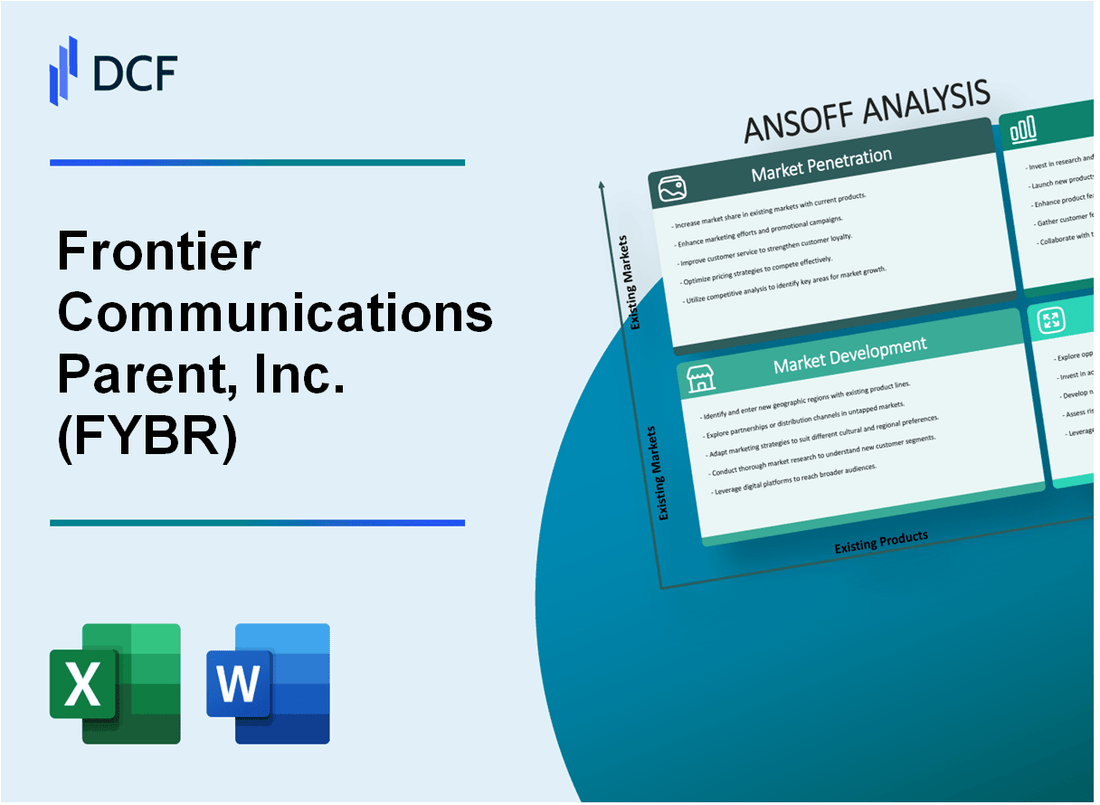
Frontier Communications Parent, Inc. (FYBR): ANSOFF Matrix Analysis [Jan-2025 Mise à jour] |
Entièrement Modifiable: Adapté À Vos Besoins Dans Excel Ou Sheets
Conception Professionnelle: Modèles Fiables Et Conformes Aux Normes Du Secteur
Pré-Construits Pour Une Utilisation Rapide Et Efficace
Compatible MAC/PC, entièrement débloqué
Aucune Expertise N'Est Requise; Facile À Suivre
Frontier Communications Parent, Inc. (FYBR) Bundle
Dans le paysage des télécommunications en évolution rapide, Frontier Communications Parent, Inc. (FYBR) se dresse à un carrefour critique, se positionnant stratégiquement pour une croissance transformatrice grâce à une approche complète de la matrice d'Ansoff. En explorant méthodiquement la pénétration du marché, le développement, l'innovation des produits et la diversification stratégique, la société est sur le point de tirer parti de son robuste infrastructure réseau et de relever les défis émergents des marchés ruraux et mal desservis. Cette feuille de route stratégique promet non seulement des améliorations progressives, mais un changement potentiel de paradigme dans la façon dont les fournisseurs régionaux de télécommunications peuvent s'adapter, développer et redéfinir la connectivité dans un monde de plus en plus numérique.
Frontier Communications Parent, Inc. (FYBR) - Matrice Ansoff: pénétration du marché
Développez la couverture du réseau fibre optique dans les territoires de service existants
Au quatrième trimestre 2022, Frontier Communications a déployé le réseau de fibres optiques à 5,2 millions de passages totaux, avec 3,1 millions de sites de services en fibre. La société a investi 409 millions de dollars dans les dépenses en capital pour l'expansion des réseaux au cours de 2022.
| Métrique du réseau | Couverture totale |
|---|---|
| Passages en fibres totales | 5,2 millions |
| Emplacements de service de fibre | 3,1 millions |
| Dépenses en capital (2022) | 409 millions de dollars |
Introduire des forfaits de tarification compétitifs
Les plans Internet des fibres de Frontier varient de 49,99 $ à 154,99 $ par mois, avec des vitesses comprises entre 500 Mbps et 2 Gbps.
- Plan de 500 Mbps: 49,99 $ / mois
- Plan 1 Gbps: 74,99 $ / mois
- Plan 2 Gbps: 154,99 $ / mois
Améliorer la fidélisation de la clientèle
Frontier a rapporté un taux de rétention de clientèle net de 87,4% en 2022, avec le désabonnement du client réduit à 1,8% trimestriel.
Développer des campagnes de marketing ciblées
Frontier se concentre sur les marchés ruraux, avec 68% de leur couverture réseau dans les zones non métropolitaines. L'allocation du budget marketing pour 2022 était de 87 millions de dollars.
Offrir des services groupés
| Type de paquet | Prix mensuel | Services inclus |
|---|---|---|
| Pack de base | $79.99 | Internet + téléphone |
| Paquet premium | $129.99 | Internet + téléphone + téléviseur |
Frontier Communications Parent, Inc. (FYBR) - Matrice Ansoff: développement du marché
Expansion dans les régions géographiques adjacentes
Frontier Communications dessert 25 États en 2023, en mettant l'accent sur les marchés ruraux et mal desservis. Le réseau de l'entreprise couvre environ 3,7 millions de clients haut débit et vocal.
| Couverture de l'État | Nombre de clients | Réalisation du réseau |
|---|---|---|
| Marchés ruraux | 2,1 millions | 18 États |
| Marchés suburbains | 1,6 million | 7 États |
Cibler les marchés commerciaux de petite à moyenne taille
Le segment des entreprises de Frontier a généré 712 millions de dollars de revenus au T2 2022, ce qui représente 22% du total des revenus de l'entreprise.
- Base de clients de petite entreprise: 275 000
- Revenus mensuels moyens par client: 245 $
- Couverture des solutions d'entreprise: 14 États
Partenariats stratégiques avec les gouvernements locaux
Frontier a investi 378 millions de dollars dans l'amélioration des infrastructures de réseau en 2022, avec 127 millions de dollars spécifiquement alloués à l'expansion rurale du large bande.
Entrez de nouveaux marchés d'État
Pénétration actuelle du marché dans les états cibles: 42% des ménages ruraux éligibles à large bande.
| État | Potentiel de marché | Compétition à large bande |
|---|---|---|
| Californie | 1,2 million de clients potentiels | Faible concurrence dans les zones rurales |
| Texas | 890 000 clients potentiels | Concurrence modérée |
Tirer parti de l'infrastructure réseau existante
Valeur d'infrastructure du réseau total: 2,3 milliards de dollars en 2022.
- Miles de réseau à fibre optique: 48 000
- Zone de couverture du réseau: 31 États
- Investissement moyen de mise à niveau du réseau: 86 millions de dollars par an
Frontier Communications Parent, Inc. (FYBR) - Matrice Ansoff: développement de produits
Développer des services de cybersécurité avancés
Frontier Communications a investi 12,3 millions de dollars dans les infrastructures de cybersécurité en 2022. La société a déclaré 98 000 abonnés aux services de cybersécurité de l'entreprise au quatrième trimestre 2022.
| Type de service de cybersécurité | Prix mensuels | Base d'abonné |
|---|---|---|
| Protection de base des menaces | $9.99 | 62,000 |
| Bouclier d'entreprise avancée | $49.99 | 36,000 |
Créer des solutions de technologie de maison intelligente intégrée
Frontier a déployé la technologie des maisons intelligentes dans 127 000 connexions résidentielles en 2022, ce qui représente une croissance de 22% sur l'année.
- Plate-forme d'intégration de l'appareil à domicile intelligent
- Surveillance de la sécurité IoT
- Services de gestion des maisons à distance
Lancez des outils de communication en cloud améliorés
Frontier Communications a généré 87,4 millions de dollars auprès des services de communication cloud en 2022, avec 45 000 clients commerciaux utilisant ces plateformes.
| Niveau de service cloud | Coût mensuel | Caractéristiques |
|---|---|---|
| Communication cloud standard | $29.99 | Conférence vidéo de base |
| Communication du cloud d'entreprise | $99.99 | Outils de collaboration avancés |
Introduire des plans Internet flexibles
Frontier a lancé 7 nouvelles configurations de plan Internet en 2022, allant de 100 Mbps à 2 Gbps, desservant 412 000 clients résidentiels.
Développer des services de réseau d'entreprise
Frontier a étendu les services de réseau gérés à 23 000 petites et moyennes entreprises, générant 54,2 millions de dollars de revenus annuels de ces services.
- Surveillance de la sécurité du réseau
- Gestion des infrastructures évolutives
- Assistance technique 24/7
Frontier Communications Parent, Inc. (FYBR) - Matrice Ansoff: diversification
Investissez dans l'infrastructure informatique Edge et les services connexes
Frontier Communications a alloué 87,4 millions de dollars de dépenses en capital pour les infrastructures de réseau au troisième trimestre.
| Edge Computing Investissement Métriques | Valeur 2023 |
|---|---|
| Investissement total d'infrastructure | 87,4 millions de dollars |
| Taille du marché prévu d'ici 2028 | 61,14 milliards de dollars |
| CAGR anticipé | 38.9% |
Explorez les acquisitions potentielles dans les secteurs de la technologie des télécommunications émergents
Frontier Communications a déclaré 1,2 milliard de dollars de revenus totaux pour le troisième trimestre 2023. La société a identifié des objectifs d'acquisition potentiels dans les technologies de télécommunications 5G et AI.
Développer des solutions d'énergie renouvelable pour l'infrastructure réseau
Investissement en énergies renouvelables est estimée à 42,3 millions de dollars pour les initiatives de durabilité du réseau. L'intégration d'énergie solaire et éolienne devrait réduire les coûts opérationnels de 22% par an.
| Investissement d'énergie renouvelable | 2023-2024 Projections |
|---|---|
| Investissement total | 42,3 millions de dollars |
| Réduction des coûts prévue | 22% |
Créer des investissements stratégiques dans les plateformes technologiques IoT
Investissement sur le marché IoT destiné à 56,7 millions de dollars. Le marché mondial de l'IoT devrait atteindre 1,386 billion de dollars d'ici 2026.
- Investissement de la plate-forme IoT: 56,7 millions de dollars
- Taille du marché mondial de l'IoT d'ici 2026: 1,386 billion de dollars
- Connexions anticipées des périphériques IoT: 75,44 milliards d'ici 2025
Enquêter sur l'entrée potentielle sur les marchés de services technologiques adjacents
Marché de la connectivité de la télémédecine prévue pour atteindre 185,6 milliards de dollars d'ici 2026. Investissement potentiel d'entrée sur le marché estimé à 34,2 millions de dollars.
| Métriques du marché de la télémédecine | Valeur projetée |
|---|---|
| Taille du marché d'ici 2026 | 185,6 milliards de dollars |
| Investissement potentiel d'entrée sur le marché | 34,2 millions de dollars |
Frontier Communications Parent, Inc. (FYBR) - Ansoff Matrix: Market Penetration
You're looking at the core business-selling more of your existing fiber service into the footprint you've already built. This is where the immediate revenue lift comes from, especially with the copper base still shrinking.
Frontier Communications Parent, Inc. is driving hard to convert its massive footprint. As of the third quarter of 2025, the total fiber footprint stood at 8.8 million total locations passed with fiber, up by 326,000 passings added in that quarter alone. To increase the take-rate within this footprint, the focus is on migrating the remaining legacy customers. The copper base has shrunk to just 550,000 lines by the end of Q3 2025. The total fiber broadband customer base reached almost 2.8 million, marking a 20.2% year-over-year growth.
Here's a quick look at the scale of the current penetration effort based on Q3 2025 figures:
| Metric | Value (Q3 2025) | Change/Context |
|---|---|---|
| Total Fiber Locations Passed | 8.8 million | Targeting 10 million by Q3 2026 (prior goal) |
| Total Fiber Broadband Customers | Almost 2.8 million | Added 133,000 net adds in Q3 2025 |
| Consumer Fiber Broadband ARPU | $68.59 | Up 4.9% year-over-year |
| Remaining Copper Lines | 550,000 | Base shrinking |
Aggressively migrating those remaining copper customers is key to boosting the Average Revenue Per User (ARPU). The current consumer fiber broadband ARPU is $68.59, which is a solid 4.9% annual increase. Moving a customer from a legacy copper product to fiber allows for immediate ARPU uplift, especially when they select higher-tier plans; more than half of new fiber subscribers in Q1 2025 chose value-added services.
To drive immediate uptake, limited-time promotional pricing is essential. For the Black Friday 2025 period, Frontier offered a Fiber 2 Gig plan for $19.99 per month for 12 months, which reverts to $59.99 per month after that initial year. This specific deal also included a potential $200 Visa Reward Card offer. This aggressive pricing is designed to pull forward demand and lock in customers who might otherwise wait.
Enhancing the customer experience directly tackles churn, which is critical when you have a high-value asset like fiber. The fact that fiber broadband revenue grew 25% year-over-year in Q3 2025, driven by customer growth and ARPU gains, suggests customers are finding value. You need to ensure the onboarding process is smooth; if onboarding takes 14+ days, churn risk rises. Also, capitalizing on the speed advantage means pushing attach rates for premium add-ons that leverage that speed.
Bundling fiber with services like the $25 per month Unbreakable Wi-Fi add-on creates higher perceived value and sticky revenue. This service offers automatic 4G LTE backup during outages, which is a tangible benefit for remote workers. Furthermore, the Black Friday context suggested getting one month of this backup internet free before the standard $25/mo billing begins.
- Fiber 2 Gig Black Friday promo price: $19.99/month for 12 months.
- Unbreakable Wi-Fi monthly cost: $25.
- Fiber broadband customer growth (YoY Q3 2025): 20.2%.
- Fiber passings added (Q3 2025): 326,000.
- Fiber broadband revenue growth (YoY Q3 2025): 25%.
Finance: draft 13-week cash view by Friday.
Frontier Communications Parent, Inc. (FYBR) - Ansoff Matrix: Market Development
You're looking at Frontier Communications Parent, Inc.'s Market Development moves, which is all about taking their existing, proven fiber product and pushing it into new geographic territories. This is where the rubber meets the road for their 'Building Gigabit America' purpose, moving beyond current service areas or securing funding to reach previously unserved pockets.
The primary objective here is completing the massive infrastructure build. Frontier Communications Parent, Inc. has been clear about its goal to reach 10 million total fiber passings by the end of 2025. As of the second quarter of 2025, the company reported having passed approximately 8.5 million total locations with fiber. That means they added 334,000 fiber passings in Q2 2025 alone, keeping the pressure on to hit that year-end target. Honestly, getting to 8.5 million shows they have a repeatable, scalable build process, which is key for this strategy.
A significant part of this market development isn't just organic; it's subsidized expansion into new, underserved rural areas, often leveraging government funding. This is essentially de-risking the build in less dense areas. For instance, in Illinois, Frontier secured a $24.7 million grant from Connect Illinois for a fiber deployment in rural Greene County. They also picked up a $6.5 million grant for Knox County, supplemented by $1.1 million in American Rescue Plan Act (ARPA) funding from the Knox County Board. Furthermore, in California, they secured over $23 million across three grants from the California Public Utility Commission (CPUC) to expand into San Bernardino and Riverside counties. This public-private partnership model is defintely a core lever for market development outside their established footprint.
The expansion isn't just residential; the Business and Wholesale segment is a key market to develop further. This segment posted $697 million in revenue for Q2 2025, marking a 3.0% year-over-year increase, driven by fiber-based products. The fiber-specific revenue within this segment hit $330 million, growing 4.1% year-over-year. This shows that the new fiber markets are successfully attracting business customers, too.
Here's a quick look at the key metrics supporting the Market Development push as of Q2 2025:
| Metric | Consumer Segment Data (Q2 2025) | Business & Wholesale Segment Data (Q2 2025) |
| Revenue | $825 million | $697 million |
| Fiber Revenue | $609 million (Consumer Fiber Revenue) | $330 million (Business & Wholesale Fiber Revenue) |
| Fiber Broadband Customer Net Additions (Quarterly) | 120,000 | 6,000 |
| Fiber Broadband Customer Growth (Year-over-Year) | 20.4% | 14.2% |
| Fiber Broadband ARPU | $68.54 | $98.72 |
Expanding wholesale fiber backhaul services to regional 5G mobile carriers is a natural adjacency for a pure-play fiber provider like Frontier Communications Parent, Inc. While specific contract values aren't public, the growth in the Business and Wholesale fiber revenue to $330 million suggests this is an active area. This segment is about selling capacity on the newly built network to other service providers, which is a high-margin way to monetize the fiber footprint without direct consumer acquisition costs.
The overall Market Development strategy relies on a few key execution points:
- Complete the build to the 10 million passings goal by year-end 2025.
- Secure and deploy funds from rural broadband grants, like the $24.7 million Connect Illinois award.
- Continue to drive fiber adoption in newly passed areas, targeting 15 to 20% penetration within 12 months of deployment.
- Leverage the existing network to grow Business and Wholesale fiber revenue, which was $330 million in Q2 2025.
- Maintain the current build pace, which saw 334,000 passings added in Q2 2025.
The company operates across 25 states, and while the plan focuses on deepening penetration in existing markets and expanding via grants, the inherent nature of fiber buildout means they are constantly bordering new, adjacent state markets. The success in securing grants in Illinois and California shows a clear process for entering new, government-supported territories that border their current footprint. Finance: draft the Q3 2025 cash flow forecast incorporating the latest CapEx run-rate by next Tuesday.
Frontier Communications Parent, Inc. (FYBR) - Ansoff Matrix: Product Development
You're looking at how Frontier Communications Parent, Inc. (FYBR) plans to grow by enhancing what they sell, which is the Product Development quadrant of the Ansoff Matrix. This is all about pushing faster speeds and bundling more value onto that fiber network they've been building so aggressively.
Standardize the rollout of Fiber 5 Gig and 7 Gig plans across the network.
Frontier Communications has been pushing the envelope on speed, having already launched network-wide 2 Gig services, followed by 5 Gig, and most recently, 7 Gig speeds. This aggressive speed deployment is clearly driving better customer economics. For the third quarter of 2025, the Consumer fiber broadband Average Revenue Per User (ARPU) hit $68.59, representing a 4.9% year-over-year increase. This ARPU growth is directly linked to the availability of faster speed tiers, as noted by the CFO previously. By the end of Q3 2025, Frontier had reached 8.8 million total locations passed with fiber, and they added 326,000 fiber passings in that quarter alone. The goal is to reach 10 million fiber passings around the third quarter of 2026. The success of this strategy is evident: Consumer fiber broadband revenue surged 25.8% year-over-year in Q3 2025.
Offer managed Wi-Fi 7 routers, like the Amazon eero Max 7, included with top-tier plans.
Frontier Communications is embedding newer Wi-Fi technology into its service packages to enhance the in-home experience, which supports the higher speeds they are selling. For example, their Gig Ultra business bundles explicitly include a next-generation Wi-Fi 7 router. This is a concrete product enhancement that helps customers actually use the multi-gigabit speeds they are paying for. The inclusion of this hardware is part of a broader strategy to improve the overall offering, as Frontier earned a spot on Fortune's 2025 list of America's Most Innovative Companies partly due to pushing new technologies.
Launch a dedicated, high-SLA (Service Level Agreement) fiber product for small businesses.
For the Business and Wholesale segment, Frontier Communications is clearly targeting higher-value connectivity. The 5 Gig business plan is listed at $179.99/mo., and the 7 Gig Ultra plan is listed at $399.99/mo. as of early 2025. The Business and Wholesale revenue for fiber-based products reached $328 million in Q3 2025. While some marketing materials mention a 99.9% Uptime Guarantee for business fiber, which implies an SLA, other analyses suggest Frontier doesn't offer formal Service Level Agreements for its business customers, which is unusual in the industry. This suggests a potential gap or an area where a formal, dedicated high-SLA product could be explicitly launched and marketed to differentiate from the standard offering.
Develop a proprietary smart-home security and automation platform integrated with fiber.
While Frontier Communications provides the underlying high-speed network to power smart home devices, with 49% of smart device owners using home security monitoring as their top feature, the search results do not confirm the launch of a proprietary, integrated security and automation platform by late 2025. The current product development focus appears heavily weighted toward network capacity (multi-gigabit) and hardware inclusion (Wi-Fi 7) rather than a fully proprietary software service layer for home automation.
Introduce a premium, low-latency gaming service tier for competitive users.
Frontier Communications has long touted the inherent low-latency advantage of its fiber network over cable competitors. While there is no mention of a specific, separately priced premium gaming tier in the Q3 2025 data, the existing 7 Gig Ultra service, with its symmetrical speeds, provides the low-latency foundation competitive users require. The Consumer fiber broadband ARPU growth to $68.59 in Q3 2025 suggests customers are already opting for higher-value tiers that would naturally appeal to gamers.
Here's a quick look at the key operational and financial metrics supporting this product push:
| Metric | Value (Q3 2025) | Comparison/Context |
| Total Fiber Passings | 8.8 million locations | Up 326,000 in Q3 2025 |
| Consumer Fiber Broadband ARPU | $68.59 | Up 4.9% year-over-year |
| Consumer Fiber Broadband Revenue YoY Growth | 25.8% | Driven by customer and ARPU growth |
| Business & Wholesale Fiber Revenue | $328 million | Slight decrease year-over-year |
| Total Revenue | $1.55 billion | Up 4.1% year-over-year |
| Business Fiber 7 Gig Ultra Price | $399.99/mo. | As of January 28, 2025 |
The focus on speed tier standardization and hardware bundling is clearly paying off in consumer revenue metrics. The business segment, however, shows a slight dip in fiber revenue, suggesting the high-SLA product development needs more traction or clearer definition.
- Added 133,000 fiber broadband customers in Q3 2025.
- Achieved Adjusted EBITDA of $637 million, a 16% increase year-over-year.
- Cash capital expenditures for the quarter were $819 million.
- The company is preparing for its pending acquisition by Verizon Communications Inc., expected to close by the first quarter of 2026.
Finance: draft 13-week cash view by Friday.
Frontier Communications Parent, Inc. (FYBR) - Ansoff Matrix: Diversification
You're looking at Diversification, which means Frontier Communications Parent, Inc. (FYBR) would be moving into new markets with new services. Honestly, this is the riskiest quadrant, especially since the company's current, successful narrative is laser-focused on its fiber-first strategy. As of Q3 2025, Frontier reported total revenue of $1.55 billion and cash capital expenditures of $819 million for the quarter, with liquidity sitting around $1.87 billion. Any major diversification move would require a significant capital allocation shift away from the core fiber build, which has already passed 8.8 million locations.
Here's how these potential new vectors map against the current financial footing and the size of the target markets:
| Diversification Vector | Relevant Market Context (US, 2025 Est.) | Frontier FYBR Q3 2025 Financial Context |
| Data Center Co-location/Cloud | US Data Center Market size: $114.48 billion (2025). Colocation segment expected CAGR of 14.9% (2025-2030). | Total Liquidity: Approx. $1.87 billion. |
| Branded Mobile Virtual Network Operator (MVNO) | US MVNO Market size: Approx. $43.82 billion (2025). Projected subscriber volume: 68.48 million (2025). | Q3 2025 Adjusted EBITDA: $637 million. |
| Edge Computing Infrastructure | IoT Connectivity Market (US) expected to reach $463.10 billion (2025). | Q3 2025 Cash Capital Expenditures: $819 million. |
| B2B IoT Connectivity Platform | US IoT Connectivity Market CAGR projected at 20% to 25% (2023-2030). | Business and Wholesale Revenue (Q3 2025): $707 million. |
| Telehealth Fiber Partnership | Telehealth adoption is a key driver in the broader digital economy growth. | Consumer Fiber Broadband Revenue (Q3 2025): $521 million. |
Acquire a regional data center operator to offer co-location and cloud services.
This move targets a market segment where the US colocation revenue was estimated at $74,457.67 million in 2025, with projections to hit $331,999.03 million by 2035. Frontier's existing fiber footprint of 8.8 million passed locations could provide immediate, low-latency connectivity advantages to a newly acquired facility, potentially reducing the high initial investment barrier that typically plagues new data center builds, which can run into hundreds of millions of dollars.
Launch a branded mobile virtual network operator (MVNO) on a national 5G network.
The US MVNO market size is estimated at $43.82 billion in 2025. A key attraction is the high US Average Revenue Per User (ARPU) for MVNOs, which stood at $31.59 in 2024, significantly higher than the global average of just over seven dollars. This strategy leverages existing network assets but requires a new go-to-market approach, distinct from the current residential and business broadband focus.
Invest in edge computing infrastructure to offer low-latency services to enterprises.
Edge computing is intrinsically linked to the growth of IoT. The US IoT market size was estimated at $463.10 billion in 2025. Investing here would be a direct extension of the fiber network's capability, moving processing closer to the customer. This would be a capital-intensive play, given Q3 2025 cash capital expenditures were already $819 million.
Develop a B2B IoT (Internet of Things) connectivity platform for utility or smart city applications.
The US IoT Connectivity Market is projected for a CAGR of 20% to 25% through 2030. This plays into the Business and Wholesale segment, which generated $707 million in revenue in Q3 2025. A platform play allows Frontier to sell connectivity as a service layer on top of its transport layer, rather than just selling the transport itself.
You should consider the following potential entry points for an IoT platform:
- Utility monitoring solutions.
- Smart city infrastructure connectivity.
- Industrial IoT (IIoT) for manufacturing.
- Connected healthcare applications.
Partner with telehealth providers to offer a dedicated, high-reliability fiber connection for remote patient monitoring.
This is a product development play within the existing market, but the dedicated, high-reliability aspect pushes it toward a new service tier for the Business and Wholesale segment. Consumer fiber broadband ARPU in Q3 2025 was $68.59. A premium, dedicated enterprise service would command a significantly higher price point, potentially lifting the Business and Wholesale fiber ARPU, which was $96.63 in Q3 2025.
The success of any of these hinges on capital deployment, given the current net leverage ratio is approximately 4.8x as of September 30, 2025. Finance: draft 13-week cash view by Friday.
Disclaimer
All information, articles, and product details provided on this website are for general informational and educational purposes only. We do not claim any ownership over, nor do we intend to infringe upon, any trademarks, copyrights, logos, brand names, or other intellectual property mentioned or depicted on this site. Such intellectual property remains the property of its respective owners, and any references here are made solely for identification or informational purposes, without implying any affiliation, endorsement, or partnership.
We make no representations or warranties, express or implied, regarding the accuracy, completeness, or suitability of any content or products presented. Nothing on this website should be construed as legal, tax, investment, financial, medical, or other professional advice. In addition, no part of this site—including articles or product references—constitutes a solicitation, recommendation, endorsement, advertisement, or offer to buy or sell any securities, franchises, or other financial instruments, particularly in jurisdictions where such activity would be unlawful.
All content is of a general nature and may not address the specific circumstances of any individual or entity. It is not a substitute for professional advice or services. Any actions you take based on the information provided here are strictly at your own risk. You accept full responsibility for any decisions or outcomes arising from your use of this website and agree to release us from any liability in connection with your use of, or reliance upon, the content or products found herein.