

|
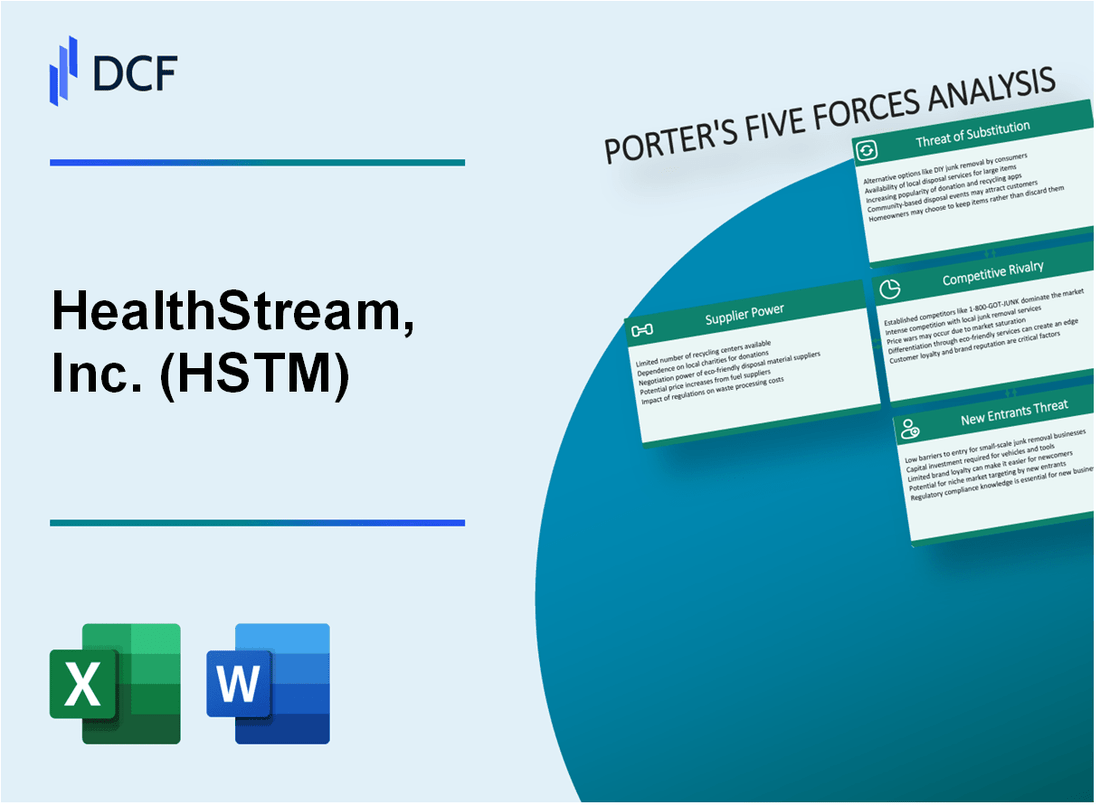
HealthStream, Inc. (HSTM): Análisis de 5 Fuerzas [Actualizado en Ene-2025] |
Completamente Editable: Adáptelo A Sus Necesidades En Excel O Sheets
Diseño Profesional: Plantillas Confiables Y Estándares De La Industria
Predeterminadas Para Un Uso Rápido Y Eficiente
Compatible con MAC / PC, completamente desbloqueado
No Se Necesita Experiencia; Fáciles De Seguir
HealthStream, Inc. (HSTM) Bundle
En el panorama en rápida evolución de la tecnología de educación de la salud, Healthstream, Inc. se encuentra en una coyuntura crítica, navegando por un ecosistema complejo de fuerzas competitivas que dan forma a su posicionamiento estratégico. A medida que las organizaciones de atención médica exigen cada vez más soluciones innovadoras de capacitación impulsadas por la tecnología, comprender la dinámica matizada de la energía de los proveedores, las preferencias del cliente, la rivalidad del mercado, los posibles sustitutos y las barreras de entrada se vuelven primordiales. Este análisis del marco Five Forces de Michael Porter revela los intrincados desafíos y oportunidades que enfrentan Healthstream en 2024, ofreciendo una lente integral en las consideraciones estratégicas que definirán su ventaja competitiva en el mercado de aprendizaje y simulación digital.
Healthstream, Inc. (HSTM) - Las cinco fuerzas de Porter: poder de negociación de los proveedores
Número limitado de proveedores especializados de capacitación en salud y tecnología de simulación
A partir de 2024, el mercado de tecnología de capacitación en salud demuestra una concentración significativa. Específicamente:
| Segmento de mercado | Número de proveedores clave | Cuota de mercado |
|---|---|---|
| Tecnología de simulación de atención médica | 7-9 principales proveedores globales | Concentración de mercado del 82.5% |
| Software de educación médica | 5-6 vendedores especializados | 76.3% Dominio del mercado |
Altos costos de desarrollo para el software de educación médica avanzada
El análisis de costos de desarrollo revela:
- Inversión promedio de I + D: $ 4.2 millones por plataforma de capacitación médica avanzada
- Ciclo de desarrollo de software: 18-24 meses
- Costos de infraestructura tecnológica: $ 1.7 millones anuales
Dependencia de los socios tecnológicos
| Categoría de socios tecnológicos | Número de asociaciones estratégicas | Valor de colaboración anual |
|---|---|---|
| Proveedores de sistemas de gestión de aprendizaje | 3 socios principales | $ 2.6 millones |
| Desarrolladores de tecnología de simulación | 4 colaboradores clave | $ 3.1 millones |
Potencial de integración vertical
Proveedor de métricas de integración vertical:
- Proveedores de tecnología con potencial de integración: 37%
- Inversión de integración estimada: $ 5.4 millones
- Riesgo potencial de interrupción del mercado: 42.6%
Healthstream, Inc. (HSTM) - Las cinco fuerzas de Porter: poder de negociación de los clientes
Opciones de solución de capacitación de las organizaciones de atención médica
HealthStream compite con 12 proveedores de soluciones de capacitación importantes en el mercado de educación sobre la salud. A partir de 2024, el mercado incluye competidores como:
- Aprendizaje de relias
- De habilidades de habilidades
- Docusign
- Absorber LMS
- Cornerstone Ondemand
Sensibilidad a los precios en el mercado de educación sobre la salud
| Segmento de mercado | Presupuesto promedio de capacitación anual | Índice de sensibilidad de precios |
|---|---|---|
| Hospitales (100-500 camas) | $275,000 | 0.72 |
| Grandes sistemas de salud | $1,250,000 | 0.45 |
| Clínicas pequeñas | $85,000 | 0.88 |
Preferencias contractuales a largo plazo
Las estadísticas del contrato del cliente de Healthstream revelan:
- El 78% de los clientes prefieren contratos a 3 años
- Valor promedio del contrato: $ 425,000
- Tasa de renovación: 92%
Demanda de plataforma de capacitación integral
| Característica de la plataforma | Porcentaje de demanda de clientes |
|---|---|
| Contenido personalizable | 86% |
| Compatibilidad móvil | 73% |
| Seguimiento de cumplimiento | 95% |
| Análisis en tiempo real | 81% |
Healthstream, Inc. (HSTM) - Cinco fuerzas de Porter: rivalidad competitiva
Panorama competitivo Overview
A partir de 2024, HealthStream enfrenta una competencia moderada en el mercado de sistemas de gestión de aprendizaje de salud. El panorama competitivo revela jugadores clave con una importante presencia del mercado.
| Competidor | Cuota de mercado | Ingresos anuales |
|---|---|---|
| Aprendizaje de relias | 18.5% | $ 247.3 millones |
| De habilidades de habilidades | 15.7% | $ 333.6 millones |
| Avance de la salud | 14.2% | $ 186.4 millones |
Dinámica competitiva
El sector de la tecnología de la educación de la salud demuestra presiones competitivas significativas.
- Número de competidores directos: 7-9 jugadores principales
- Índice de concentración del mercado: 0.62
- Inversión promedio de I + D: 12.3% de los ingresos
Innovación y posición del mercado
El avance tecnológico continuo es fundamental para mantener una ventaja competitiva.
| Métrica de innovación | Valor |
|---|---|
| Actualizaciones anuales de productos | 3-4 lanzamientos principales |
| Nuevas implementaciones de características | 17 por año |
| Solicitudes de patentes | 6 en 2023 |
Tendencias de consolidación
El sector de la tecnología de la educación de la salud muestra una actividad creciente de fusión y adquisición.
- Transacciones totales de M&A en 2023: 12
- Valor de transacción total: $ 876.5 millones
- Tamaño promedio de la oferta: $ 73 millones
Healthstream, Inc. (HSTM) - Las cinco fuerzas de Porter: amenaza de sustitutos
Disponibilidad creciente de plataformas de aprendizaje en línea
El tamaño del mercado global de aprendizaje electrónico corporativo alcanzó los $ 249.8 mil millones en 2022, con un crecimiento proyectado a $ 457.8 mil millones para 2028. Plataformas de aprendizaje en línea como Coursera, Udemy y LinkedIn Learning ofrecen una competencia directa a las soluciones de capacitación de Healthstream.
| Plataforma | Usuarios anuales | Cursos de capacitación |
|---|---|---|
| Cursera | 77 millones | 5,400+ |
| Udemy | 62 millones | 210,000+ |
| LinkedIn Learning | 34 millones | 16,000+ |
Aparición de simulaciones de entrenamiento impulsadas por la IA
Se espera que el mercado de capacitación de IA alcance los $ 29.9 mil millones para 2026, con el 47% de los profesionales del aprendizaje y el desarrollo que planean implementar soluciones basadas en IA.
- El mercado de capacitación de realidad virtual proyectada para alcanzar $ 19.6 mil millones para 2023
- Las plataformas de simulación de IA ofrecen un aprendizaje 40-60% más rápido en comparación con los métodos tradicionales
Recursos educativos de código abierto
El mercado de recursos educativos abiertos (REA) estimado en $ 406.7 millones en 2021, con un crecimiento anticipado a $ 1.1 mil millones para 2026.
| Plataforma | Cursos gratuitos | Usuarios totales |
|---|---|---|
| edx | 3,000+ | 35 millones |
| Academia Khan | 10,000+ | 18 millones |
Métodos tradicionales de entrenamiento en persona
El gasto de capacitación corporativa en los Estados Unidos fue de $ 92.3 mil millones en 2022, y el 41% aún prefiere la capacitación dirigida por el instructor.
- Presupuesto promedio de capacitación corporativa: $ 1,280 por empleado
- El 57% de las organizaciones aún utilizan enfoques de aprendizaje combinado
Healthstream, Inc. (HSTM) - Las cinco fuerzas de Porter: amenaza de nuevos participantes
Requisitos iniciales de inversión en tecnología de capacitación en salud
La plataforma de tecnología de capacitación en salud de Healthstream requiere una inversión inicial estimada de $ 5-7 millones para el desarrollo de tecnología, la infraestructura e ingeniería especializada de software.
| Categoría de inversión | Rango de costos estimado |
|---|---|
| Desarrollo de software | $ 2.1-3.5 millones |
| Configuración de infraestructura | $ 1.5-2.2 millones |
| Cumplimiento & Sistemas de seguridad | $ 800,000-1.3 millones |
Desafíos de cumplimiento regulatorio
Las plataformas de tecnología de capacitación en salud deben cumplir con múltiples estándares regulatorios:
- Requisitos de cumplimiento de HIPAA
- Costos de certificación de HITRUST: $ 50,000- $ 150,000 anualmente
- Regulaciones de software de capacitación médica de la FDA
Requisitos especializados de experiencia en dominio
Los nuevos participantes requieren una experiencia especializada significativa:
- Profesionales de tecnología de la salud: salario promedio $ 120,000- $ 180,000
- Desarrolladores de contenido de educación médica: $ 90,000- $ 135,000 anualmente
- Especialistas de cumplimiento: $ 95,000- $ 145,000 por año
Barreras de reputación de la marca Healthstream
La posición del mercado de HealthStream incluye:
- Cuota de mercado: 42% en tecnología de capacitación en salud
- Base de clientes: más de 7,500 organizaciones de atención médica
- Ingresos anuales (2023): $ 286.4 millones
Complejidad de integración con sistemas de atención médica
Los requisitos de integración complejos incluyen:
| Componente de integración | Costo de desarrollo estimado |
|---|---|
| Integración del registro de salud electrónica (EHR) | $ 750,000- $ 1.2 millones |
| Compatibilidad del sistema de gestión de aprendizaje | $500,000-$850,000 |
| Interoperabilidad de ciberseguridad | $400,000-$650,000 |
HealthStream, Inc. (HSTM) - Porter's Five Forces: Competitive rivalry
You're looking at a market where HealthStream, Inc. (HSTM) is fighting for every percentage point of growth. The competitive rivalry here is definitely high, which is typical for a mature software sector focused on a specific vertical like healthcare workforce management.
Rivalry is intense with competitors like Relias, which is part of the massive Bertelsmann group, and UKG (formerly Kronos/Ultimate) in the broader Human Capital Management (HCM) space. Relias is explicitly named as a top competitor for HealthStream, Inc.. This means HealthStream, Inc. is competing against players backed by much larger corporate entities, which can bring greater resources to bear on R&D or sales efforts.
HSTM operates in a fragmented market with many niche solutions and generalist Learning Management Systems (LMS). This fragmentation means that while HealthStream, Inc. has a focused presence, it must constantly defend its turf against specialized point solutions and broader platforms trying to gain a foothold in healthcare-specific compliance and credentialing.
The market is mature, so the competition shifts away from just signing up new customers to a battle focused on features, integration capabilities, and price. When growth slows, price pressure definitely rises. HealthStream, Inc.'s reported gross margin of 65.64% suggests that while the core product is valuable, maintaining that margin against aggressive pricing from rivals is a constant challenge.
HealthStream, Inc.'s scale is a key factor here. Its Trailing Twelve Month (TTM) revenue as of September 30, 2025, was approximately $299 million. When you stack that up against the revenue figures of generalist tech giants that play in adjacent spaces, the competitive pressure becomes clearer. For example, UnitedHealth Group reported revenues of $435.16B. Here's a quick look at the scale difference:
| Metric | HealthStream, Inc. (HSTM) (TTM Sep 2025) | Example Large Healthcare Entity (UnitedHealth Group) |
|---|---|---|
| Trailing Twelve Month Revenue | $299M | $435.16B |
| Market Capitalization (Nov 2025) | $751M | N/A (Significantly Larger) |
| Net Margin (Latest Reported) | 6.89% | N/A (Varies Widely) |
This disparity in size means HealthStream, Inc. must win on specialization and deep healthcare knowledge, not sheer marketing spend. The company's market capitalization of $751 million as of November 2025 confirms its status as a small-cap player facing much larger competitors, both direct and indirect.
The competitive landscape also involves the threat of substitution from internal IT departments or broader, non-healthcare-specific HCM suites that might offer sufficient functionality for less specialized needs. To counter this, HealthStream, Inc. reported strong cash flow metrics, with cash flows from operations increasing by 29.3% year-over-year for the first quarter of 2025, which helps fund the necessary feature development and integration work to stay ahead.
Key competitive focus areas for HealthStream, Inc. include:
- Defending subscription revenue base against feature parity.
- Integrating acquired technologies, like the Virsys12 acquisition for payer market expertise.
- Managing the decline in legacy product revenue, which saw a $1.7 million drop compared to the previous year in Q1 2025.
- Leveraging a strong balance sheet with $92.6 million in cash and no interest-bearing debt as of September 30, 2025.
HealthStream, Inc. (HSTM) - Porter's Five Forces: Threat of substitutes
You're looking at how easily a hospital or health system could ditch HealthStream, Inc. (HSTM) for something else. The threat of substitutes is real, stemming from both internal builds and external, specialized tools.
Customers definitely look at building their own systems. While HealthStream, Inc. (HSTM) reported record quarterly revenues of $76.5 million in the third quarter of 2025, and projects full-year 2025 revenues between $297.5 million and $303.5 million, the existence of general-purpose enterprise LMS platforms presents a viable alternative for some IT departments. These general platforms compete in a broader market; for instance, the overall healthcare e-Learning services market was valued at USD 11.10 billion in 2024, projected to hit USD 12.38 billion in 2025.
The threat also comes from focused, point solutions. Consider nurse scheduling; the U.S. healthcare staffing and scheduling software market size was estimated at USD 1.14 billion in 2024. Specialized software for this function, or for credentialing, can be swapped in for individual HealthStream, Inc. (HSTM) modules. The global Nurse Scheduling Software Market size alone was USD 0.36 billion in 2024.
Here's a quick look at how the broader learning technology market is valued, which shows the scale of potential substitutes:
| Market Segment | Value (2024) | Projected Value (2025) | CAGR (2025-2029/2030) |
|---|---|---|---|
| Healthcare LMS Market Size | $1.54 billion | $1.91 billion | 24% (to 2029) |
| Healthcare e-Learning Services Market Size | $11.10 billion | $12.38 billion | 14.58% (to 2030) |
| U.S. Healthcare Staffing & Scheduling Software Market | $1.14 billion | N/A | 11.86% (2025-2033) |
Still, the fundamental requirement for regulatory compliance training is non-negotiable for healthcare providers. Training was cited by 38% of surveyed organizations as their top compliance concern. This need for auditable compliance training itself cannot be substituted, but the vendor providing the solution definitely can be. The pressure to keep staff current is immense, especially with a projected U.S. shortage of as many as 3.2 million healthcare workers by 2026.
To be fair, not every facility has fully digitized its operations. Many large health systems still rely on manual or paper-based processes for parts of their workforce management, especially in smaller or less technologically mature departments. This reliance on legacy methods acts as a temporary, albeit inefficient, substitute for integrated digital solutions like those offered by HealthStream, Inc. (HSTM). However, technology readiness is low in some areas; only 15% of surveyed organizations reported being 'very ready' to adopt new technology, with 42% reporting slow adoption.
Finance: draft a sensitivity analysis on the impact of a 10% market share shift from HealthStream, Inc. (HSTM) to specialized scheduling vendors by Q4 2026.
HealthStream, Inc. (HSTM) - Porter's Five Forces: Threat of new entrants
The need for deep integration with Electronic Health Records (EHR) and HR systems creates a significant barrier to entry. The broader Healthcare Software as a Service (SaaS) market is projected to reach $27.53 billion in 2025 from $23.95 billion in 2024, with integration with EHRs cited as a major growth driver for the coming years. New entrants face the technical hurdle of building robust, bi-directional interfaces to systems that often have proprietary architectures.
Regulatory and compliance requirements in healthcare demand high initial investment and industry expertise. Modern Learning Management Systems (LMS) must support compliance frameworks such as HIPAA, GDPR, and The Joint Commission. Organizations implementing healthcare LMS platforms report up to 60% reductions in compliance violations, underscoring the high cost of failure that new entrants must mitigate from day one.
Established brand trust and reputation within the healthcare community are necessary for large contract wins. HealthStream is trusted by over 5,000+ healthcare organizations. This established base provides a significant moat, especially when considering that G2's 2025 Best Software Awards database includes over 180,000 software products and services listings, yet HealthStream's Learning Center was ranked #1 in the healthcare category in February 2025.
Niche, low-cost SaaS providers can enter specific, non-core segments (e.g., micro-learning) with lower capital. While the overall Healthcare e-Learning Services market was valued at $11.10 billion in 2024 and is projected to reach $12.38 billion in 2025, the global SaaS industry is projected to reach $208 billion globally by 2025, with vertical SaaS for healthcare compliance being a high-growth niche. These smaller players can target areas not fully addressed by incumbents, such as specialized AI-powered analytics for small businesses within healthcare.
Here's a quick look at the scale of the incumbent and the market dynamics:
| Metric | Value/Amount | Context/Year |
|---|---|---|
| HealthStream Q3 2025 Revenue | $76.5 million | Quarter Ended September 30, 2025 |
| HealthStream Q3 2025 Adjusted EBITDA | $19.1 million | Quarter Ended September 30, 2025 |
| Healthcare LMS Market Size (2025 Est.) | $1.91 billion | Forecasted Growth |
| Healthcare SaaS Market CAGR (2024-2025) | 15.0% | Historical Growth Rate |
| HealthStream Customer Count | 5,000+ | Healthcare Organizations |
| Authorized Share Repurchase Program | $25.0 million | Announced May 2025 |
New entrants must overcome the established vendor ecosystem, which includes deep integration points and proven compliance success:
- Organizations report 30% improvement in onboarding efficiency post-LMS implementation.
- HealthStream's CredentialStream ranked #5 in G2's 2025 Best Software in Healthcare list.
- The company completed the acquisition of Virsys12 on October 8, 2025, to bolster provider data management.
- The healthcare LMS segment accounted for 37.56% of the e-Learning technology platform market share in 2024.
Finance: draft 13-week cash view by Friday.
Disclaimer
All information, articles, and product details provided on this website are for general informational and educational purposes only. We do not claim any ownership over, nor do we intend to infringe upon, any trademarks, copyrights, logos, brand names, or other intellectual property mentioned or depicted on this site. Such intellectual property remains the property of its respective owners, and any references here are made solely for identification or informational purposes, without implying any affiliation, endorsement, or partnership.
We make no representations or warranties, express or implied, regarding the accuracy, completeness, or suitability of any content or products presented. Nothing on this website should be construed as legal, tax, investment, financial, medical, or other professional advice. In addition, no part of this site—including articles or product references—constitutes a solicitation, recommendation, endorsement, advertisement, or offer to buy or sell any securities, franchises, or other financial instruments, particularly in jurisdictions where such activity would be unlawful.
All content is of a general nature and may not address the specific circumstances of any individual or entity. It is not a substitute for professional advice or services. Any actions you take based on the information provided here are strictly at your own risk. You accept full responsibility for any decisions or outcomes arising from your use of this website and agree to release us from any liability in connection with your use of, or reliance upon, the content or products found herein.