

|
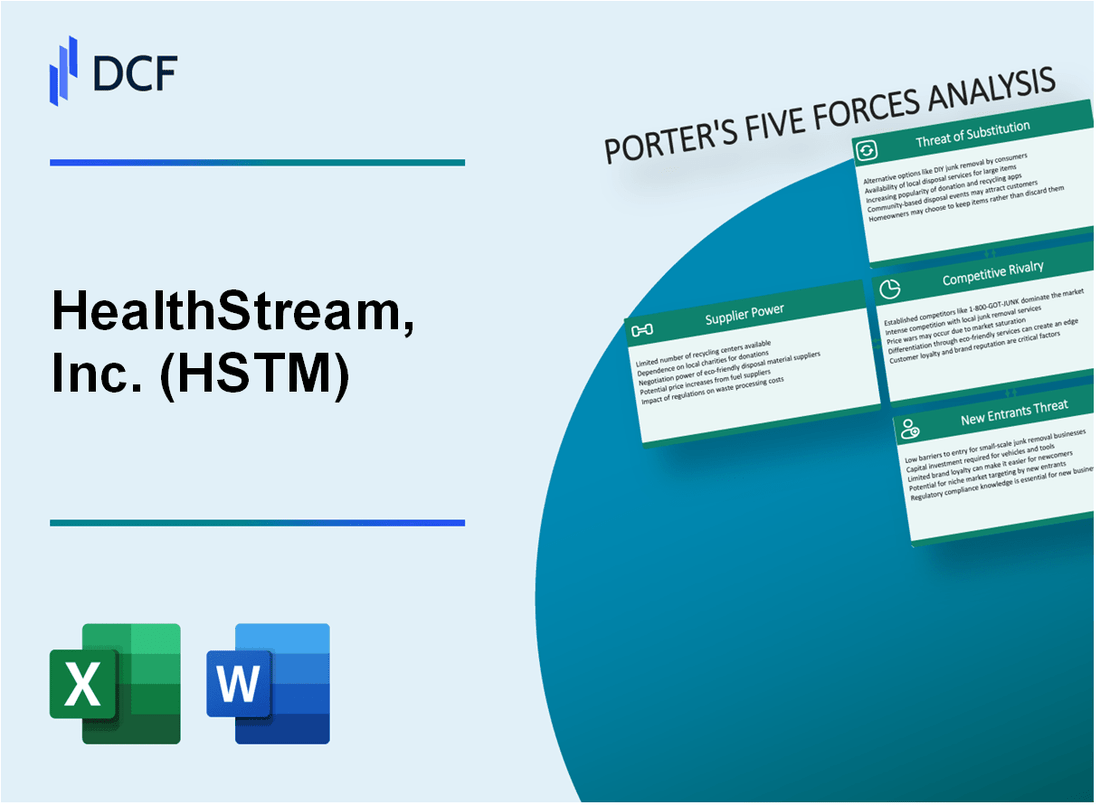
HealthStream, Inc. (HSTM): 5 Analyse des forces [Jan-2025 Mise à jour] |
Entièrement Modifiable: Adapté À Vos Besoins Dans Excel Ou Sheets
Conception Professionnelle: Modèles Fiables Et Conformes Aux Normes Du Secteur
Pré-Construits Pour Une Utilisation Rapide Et Efficace
Compatible MAC/PC, entièrement débloqué
Aucune Expertise N'Est Requise; Facile À Suivre
HealthStream, Inc. (HSTM) Bundle
Dans le paysage rapide de la technologie de l'éducation des soins de santé, HealthStream, Inc. se dresse à un moment critique, naviguant dans un écosystème complexe de forces compétitives qui façonnent son positionnement stratégique. Comme les organisations de soins de santé exigent de plus en plus des solutions de formation innovantes et axées sur la technologie, la compréhension de la dynamique nuancée de la puissance des fournisseurs, des préférences des clients, de la rivalité du marché, des substituts potentiels et des obstacles à l'entrée deviennent primordiaux. Cette analyse du cadre des cinq forces de Michael Porter révèle les défis et les opportunités complexes auxquels est confrontée HealthStream en 2024, offrant un objectif complet dans les considérations stratégiques qui définiront son avantage concurrentiel sur le marché numérique de l'apprentissage et de la simulation.
HealthStream, Inc. (HSTM) - Porter's Five Forces: Bargaining Power of Fournissers
Nombre limité de fournisseurs de technologies de formation et de technologie de simulation spécialisées
En 2024, le marché des technologies de formation des soins de santé démontre une concentration importante. Spécifiquement:
| Segment de marché | Nombre de fournisseurs clés | Part de marché |
|---|---|---|
| Technologie de simulation de soins de santé | 7-9 Provideurs mondiaux majeurs | 82,5% de concentration du marché |
| Logiciel de formation médicale | 5-6 vendeurs spécialisés | 76,3% de domination du marché |
Coûts de développement élevés pour les logiciels de formation médicale avancés
L'analyse des coûts de développement révèle:
- Investissement moyen de R&D: 4,2 millions de dollars par plateforme de formation médicale avancée
- Cycle de développement des logiciels: 18-24 mois
- Coûts d'infrastructure technologique: 1,7 million de dollars par an
Dépendance à l'égard des partenaires technologiques
| Catégorie de partenaires technologiques | Nombre de partenariats stratégiques | Valeur de collaboration annuelle |
|---|---|---|
| Fournisseurs de systèmes de gestion d'apprentissage | 3 partenaires principaux | 2,6 millions de dollars |
| Développeurs de technologies de simulation | 4 collaborateurs clés | 3,1 millions de dollars |
Potentiel d'intégration verticale
Métriques d'intégration verticale du fournisseur:
- Fournisseurs de technologie avec potentiel d'intégration: 37%
- Investissement de l'intégration estimée: 5,4 millions de dollars
- Risque potentiel de perturbation du marché: 42,6%
HealthStream, Inc. (HSTM) - Porter's Five Forces: Bargaining Power of Clients
Options de solution de formation des organisations de soins de santé
HealthStream rivalise avec 12 principaux fournisseurs de solutions de formation sur le marché de l'éducation des soins de santé. En 2024, le marché comprend des concurrents tels que:
- Relias Learning
- Skillsoft
- Docusign
- Absorber LMS
- Cornerstone ondemand
Sensibilité aux prix sur le marché de l'éducation des soins de santé
| Segment de marché | Budget de formation annuel moyen | Indice de sensibilité aux prix |
|---|---|---|
| Hôpitaux (100-500 lits) | $275,000 | 0.72 |
| Grands systèmes de santé | $1,250,000 | 0.45 |
| Petites cliniques | $85,000 | 0.88 |
Préférences contractuelles à long terme
Les statistiques du contrat client de HealthStream révèlent:
- 78% des clients préfèrent les contrats de 3 ans
- Valeur du contrat moyen: 425 000 $
- Taux de renouvellement: 92%
Demande complète de la plate-forme de formation
| Fonctionnalité de plate-forme | Pourcentage de demande des clients |
|---|---|
| Contenu personnalisable | 86% |
| Compatibilité mobile | 73% |
| Suivi de la conformité | 95% |
| Analytique en temps réel | 81% |
HealthStream, Inc. (HSTM) - Porter's Five Forces: Rivalité compétitive
Paysage compétitif Overview
En 2024, HealthStream fait face à une concurrence modérée sur le marché des systèmes de gestion de l'apprentissage des soins de santé. Le paysage concurrentiel révèle des acteurs clés avec une présence importante sur le marché.
| Concurrent | Part de marché | Revenus annuels |
|---|---|---|
| Relias Learning | 18.5% | 247,3 millions de dollars |
| Skillsoft | 15.7% | 333,6 millions de dollars |
| Santé | 14.2% | 186,4 millions de dollars |
Dynamique compétitive
Le secteur des technologies de l'éducation des soins de santé démontre des pressions concurrentielles importantes.
- Nombre de concurrents directs: 7-9 acteurs majeurs
- Indice de concentration du marché: 0,62
- Investissement moyen de R&D: 12,3% des revenus
Innovation et position du marché
L'avancement technologique continu est essentiel pour maintenir un avantage concurrentiel.
| Métrique d'innovation | Valeur |
|---|---|
| Mises à jour annuelles du produit | 3-4 versions majeures |
| Nouvelles implémentations de fonctionnalités | 17 par an |
| Demandes de brevet | 6 en 2023 |
Tendances de consolidation
Le secteur des technologies de l'éducation des soins de santé montre une augmentation de l'activité de fusion et d'acquisition.
- Total des transactions de fusions et acquisitions en 2023: 12
- Valeur totale de la transaction: 876,5 millions de dollars
- Taille moyenne de l'accord: 73 millions de dollars
HealthStream, Inc. (HSTM) - Five Forces de Porter: menace de substituts
Disponibilité croissante des plateformes d'apprentissage en ligne
La taille mondiale du marché de l'e-learning d'entreprise a atteint 249,8 milliards de dollars en 2022, avec une croissance projetée à 457,8 milliards de dollars d'ici 2028. Des plateformes d'apprentissage en ligne comme Coursera, Udemy et LinkedIn apprennent une concurrence directe aux solutions de formation de Healthstream.
| Plate-forme | Utilisateurs annuels | Cours de formation |
|---|---|---|
| Parcours | 77 millions | 5,400+ |
| Udemy | 62 millions | 210,000+ |
| LinkedIn Learning | 34 millions | 16,000+ |
Émergence de simulations d'entraînement axées sur l'IA
Le marché de la formation en IA devrait atteindre 29,9 milliards de dollars d'ici 2026, 47% des professionnels de l'apprentissage et du développement prévoyant de mettre en œuvre des solutions basées sur l'IA.
- Marché de la formation de la réalité virtuelle qui devrait atteindre 19,6 milliards de dollars d'ici 2023
- Les plateformes de simulation d'IA offrent 40 à 60% d'apprentissage plus rapide par rapport aux méthodes traditionnelles
Ressources éducatives open source
Marché des ressources éducatives ouvertes (OER) a estimé 406,7 millions de dollars en 2021, avec une croissance prévue à 1,1 milliard de dollars d'ici 2026.
| Plate-forme | Cours gratuits | Total utilisateurs |
|---|---|---|
| EDX | 3,000+ | 35 millions |
| Académie Khan | 10,000+ | 18 millions |
Méthodes de formation traditionnelles en personne
Les dépenses de formation des entreprises aux États-Unis étaient de 92,3 milliards de dollars en 2022, 41% préférant toujours une formation dirigée par l'instructeur.
- Budget moyen de formation en entreprise: 1 280 $ par employé
- 57% des organisations utilisent toujours des approches d'apprentissage mixte
HealthStream, Inc. (HSTM) - Five Forces de Porter: menace de nouveaux entrants
Exigences d'investissement initiales dans la technologie de formation des soins de santé
La plate-forme de technologie de formation des soins de santé de HealthStream nécessite un investissement initial estimé de 5 à 7 millions de dollars pour le développement de la technologie, l'infrastructure et l'ingénierie logicielle spécialisée.
| Catégorie d'investissement | Plage de coûts estimés |
|---|---|
| Développement de logiciels | 2,1 à 3,5 millions de dollars |
| Configuration de l'infrastructure | 1,5 à 2,2 millions de dollars |
| Conformité & Systèmes de sécurité | 800 000 à 1,3 million de dollars |
Défis de conformité réglementaire
Les plateformes de technologie de formation des soins de santé doivent se conformer à plusieurs normes réglementaires:
- Exigences de conformité HIPAA
- Coûts de certification HitRust: 50 000 $ à 150 000 $ par an
- Règlement sur les logiciels de formation médicale de la FDA
Exigences d'expertise du domaine spécialisé
Les nouveaux participants nécessitent une expertise spécialisée importante:
- Professionnels de la technologie de la santé: salaire moyen 120 000 $ - 180 000 $
- Développeurs de contenu en éducation médicale: 90 000 $ - 135 000 $ par an
- Spécialistes de la conformité: 95 000 $ - 145 000 $ par an
Les barrières de réputation de la marque de HealthStream
La position du marché de HealthStream comprend:
- Part de marché: 42% dans la technologie de formation des soins de santé
- Base de clients: plus de 7 500 organisations de soins de santé
- Revenus annuels (2023): 286,4 millions de dollars
Complexité d'intégration avec les systèmes de santé
Les exigences d'intégration complexes comprennent:
| Composant d'intégration | Coût de développement estimé |
|---|---|
| Intégration du dossier de santé électronique (DSE) | 750 000 $ - 1,2 million de dollars |
| Compatibilité du système de gestion de l'apprentissage | $500,000-$850,000 |
| Interopérabilité de cybersécurité | $400,000-$650,000 |
HealthStream, Inc. (HSTM) - Porter's Five Forces: Competitive rivalry
You're looking at a market where HealthStream, Inc. (HSTM) is fighting for every percentage point of growth. The competitive rivalry here is definitely high, which is typical for a mature software sector focused on a specific vertical like healthcare workforce management.
Rivalry is intense with competitors like Relias, which is part of the massive Bertelsmann group, and UKG (formerly Kronos/Ultimate) in the broader Human Capital Management (HCM) space. Relias is explicitly named as a top competitor for HealthStream, Inc.. This means HealthStream, Inc. is competing against players backed by much larger corporate entities, which can bring greater resources to bear on R&D or sales efforts.
HSTM operates in a fragmented market with many niche solutions and generalist Learning Management Systems (LMS). This fragmentation means that while HealthStream, Inc. has a focused presence, it must constantly defend its turf against specialized point solutions and broader platforms trying to gain a foothold in healthcare-specific compliance and credentialing.
The market is mature, so the competition shifts away from just signing up new customers to a battle focused on features, integration capabilities, and price. When growth slows, price pressure definitely rises. HealthStream, Inc.'s reported gross margin of 65.64% suggests that while the core product is valuable, maintaining that margin against aggressive pricing from rivals is a constant challenge.
HealthStream, Inc.'s scale is a key factor here. Its Trailing Twelve Month (TTM) revenue as of September 30, 2025, was approximately $299 million. When you stack that up against the revenue figures of generalist tech giants that play in adjacent spaces, the competitive pressure becomes clearer. For example, UnitedHealth Group reported revenues of $435.16B. Here's a quick look at the scale difference:
| Metric | HealthStream, Inc. (HSTM) (TTM Sep 2025) | Example Large Healthcare Entity (UnitedHealth Group) |
|---|---|---|
| Trailing Twelve Month Revenue | $299M | $435.16B |
| Market Capitalization (Nov 2025) | $751M | N/A (Significantly Larger) |
| Net Margin (Latest Reported) | 6.89% | N/A (Varies Widely) |
This disparity in size means HealthStream, Inc. must win on specialization and deep healthcare knowledge, not sheer marketing spend. The company's market capitalization of $751 million as of November 2025 confirms its status as a small-cap player facing much larger competitors, both direct and indirect.
The competitive landscape also involves the threat of substitution from internal IT departments or broader, non-healthcare-specific HCM suites that might offer sufficient functionality for less specialized needs. To counter this, HealthStream, Inc. reported strong cash flow metrics, with cash flows from operations increasing by 29.3% year-over-year for the first quarter of 2025, which helps fund the necessary feature development and integration work to stay ahead.
Key competitive focus areas for HealthStream, Inc. include:
- Defending subscription revenue base against feature parity.
- Integrating acquired technologies, like the Virsys12 acquisition for payer market expertise.
- Managing the decline in legacy product revenue, which saw a $1.7 million drop compared to the previous year in Q1 2025.
- Leveraging a strong balance sheet with $92.6 million in cash and no interest-bearing debt as of September 30, 2025.
HealthStream, Inc. (HSTM) - Porter's Five Forces: Threat of substitutes
You're looking at how easily a hospital or health system could ditch HealthStream, Inc. (HSTM) for something else. The threat of substitutes is real, stemming from both internal builds and external, specialized tools.
Customers definitely look at building their own systems. While HealthStream, Inc. (HSTM) reported record quarterly revenues of $76.5 million in the third quarter of 2025, and projects full-year 2025 revenues between $297.5 million and $303.5 million, the existence of general-purpose enterprise LMS platforms presents a viable alternative for some IT departments. These general platforms compete in a broader market; for instance, the overall healthcare e-Learning services market was valued at USD 11.10 billion in 2024, projected to hit USD 12.38 billion in 2025.
The threat also comes from focused, point solutions. Consider nurse scheduling; the U.S. healthcare staffing and scheduling software market size was estimated at USD 1.14 billion in 2024. Specialized software for this function, or for credentialing, can be swapped in for individual HealthStream, Inc. (HSTM) modules. The global Nurse Scheduling Software Market size alone was USD 0.36 billion in 2024.
Here's a quick look at how the broader learning technology market is valued, which shows the scale of potential substitutes:
| Market Segment | Value (2024) | Projected Value (2025) | CAGR (2025-2029/2030) |
|---|---|---|---|
| Healthcare LMS Market Size | $1.54 billion | $1.91 billion | 24% (to 2029) |
| Healthcare e-Learning Services Market Size | $11.10 billion | $12.38 billion | 14.58% (to 2030) |
| U.S. Healthcare Staffing & Scheduling Software Market | $1.14 billion | N/A | 11.86% (2025-2033) |
Still, the fundamental requirement for regulatory compliance training is non-negotiable for healthcare providers. Training was cited by 38% of surveyed organizations as their top compliance concern. This need for auditable compliance training itself cannot be substituted, but the vendor providing the solution definitely can be. The pressure to keep staff current is immense, especially with a projected U.S. shortage of as many as 3.2 million healthcare workers by 2026.
To be fair, not every facility has fully digitized its operations. Many large health systems still rely on manual or paper-based processes for parts of their workforce management, especially in smaller or less technologically mature departments. This reliance on legacy methods acts as a temporary, albeit inefficient, substitute for integrated digital solutions like those offered by HealthStream, Inc. (HSTM). However, technology readiness is low in some areas; only 15% of surveyed organizations reported being 'very ready' to adopt new technology, with 42% reporting slow adoption.
Finance: draft a sensitivity analysis on the impact of a 10% market share shift from HealthStream, Inc. (HSTM) to specialized scheduling vendors by Q4 2026.
HealthStream, Inc. (HSTM) - Porter's Five Forces: Threat of new entrants
The need for deep integration with Electronic Health Records (EHR) and HR systems creates a significant barrier to entry. The broader Healthcare Software as a Service (SaaS) market is projected to reach $27.53 billion in 2025 from $23.95 billion in 2024, with integration with EHRs cited as a major growth driver for the coming years. New entrants face the technical hurdle of building robust, bi-directional interfaces to systems that often have proprietary architectures.
Regulatory and compliance requirements in healthcare demand high initial investment and industry expertise. Modern Learning Management Systems (LMS) must support compliance frameworks such as HIPAA, GDPR, and The Joint Commission. Organizations implementing healthcare LMS platforms report up to 60% reductions in compliance violations, underscoring the high cost of failure that new entrants must mitigate from day one.
Established brand trust and reputation within the healthcare community are necessary for large contract wins. HealthStream is trusted by over 5,000+ healthcare organizations. This established base provides a significant moat, especially when considering that G2's 2025 Best Software Awards database includes over 180,000 software products and services listings, yet HealthStream's Learning Center was ranked #1 in the healthcare category in February 2025.
Niche, low-cost SaaS providers can enter specific, non-core segments (e.g., micro-learning) with lower capital. While the overall Healthcare e-Learning Services market was valued at $11.10 billion in 2024 and is projected to reach $12.38 billion in 2025, the global SaaS industry is projected to reach $208 billion globally by 2025, with vertical SaaS for healthcare compliance being a high-growth niche. These smaller players can target areas not fully addressed by incumbents, such as specialized AI-powered analytics for small businesses within healthcare.
Here's a quick look at the scale of the incumbent and the market dynamics:
| Metric | Value/Amount | Context/Year |
|---|---|---|
| HealthStream Q3 2025 Revenue | $76.5 million | Quarter Ended September 30, 2025 |
| HealthStream Q3 2025 Adjusted EBITDA | $19.1 million | Quarter Ended September 30, 2025 |
| Healthcare LMS Market Size (2025 Est.) | $1.91 billion | Forecasted Growth |
| Healthcare SaaS Market CAGR (2024-2025) | 15.0% | Historical Growth Rate |
| HealthStream Customer Count | 5,000+ | Healthcare Organizations |
| Authorized Share Repurchase Program | $25.0 million | Announced May 2025 |
New entrants must overcome the established vendor ecosystem, which includes deep integration points and proven compliance success:
- Organizations report 30% improvement in onboarding efficiency post-LMS implementation.
- HealthStream's CredentialStream ranked #5 in G2's 2025 Best Software in Healthcare list.
- The company completed the acquisition of Virsys12 on October 8, 2025, to bolster provider data management.
- The healthcare LMS segment accounted for 37.56% of the e-Learning technology platform market share in 2024.
Finance: draft 13-week cash view by Friday.
Disclaimer
All information, articles, and product details provided on this website are for general informational and educational purposes only. We do not claim any ownership over, nor do we intend to infringe upon, any trademarks, copyrights, logos, brand names, or other intellectual property mentioned or depicted on this site. Such intellectual property remains the property of its respective owners, and any references here are made solely for identification or informational purposes, without implying any affiliation, endorsement, or partnership.
We make no representations or warranties, express or implied, regarding the accuracy, completeness, or suitability of any content or products presented. Nothing on this website should be construed as legal, tax, investment, financial, medical, or other professional advice. In addition, no part of this site—including articles or product references—constitutes a solicitation, recommendation, endorsement, advertisement, or offer to buy or sell any securities, franchises, or other financial instruments, particularly in jurisdictions where such activity would be unlawful.
All content is of a general nature and may not address the specific circumstances of any individual or entity. It is not a substitute for professional advice or services. Any actions you take based on the information provided here are strictly at your own risk. You accept full responsibility for any decisions or outcomes arising from your use of this website and agree to release us from any liability in connection with your use of, or reliance upon, the content or products found herein.