
|
HealthStream, Inc. (HSTM): Analyse SWOT [Jan-2025 Mise à jour] |
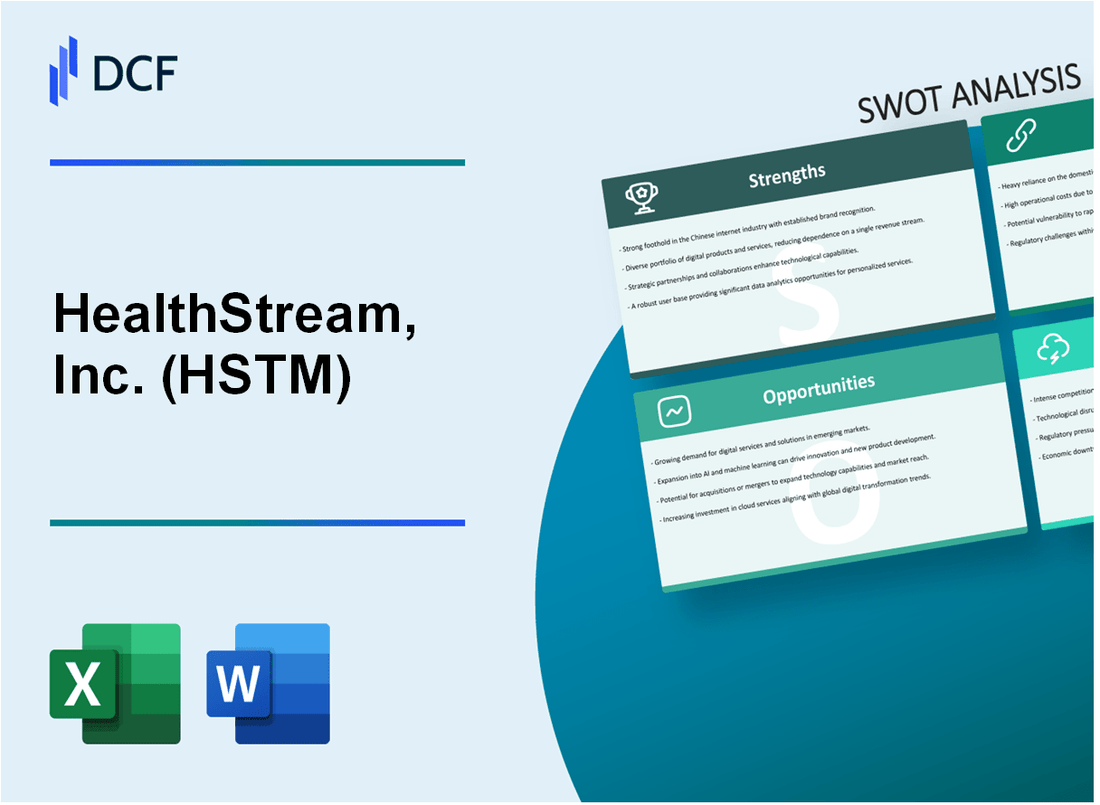
Entièrement Modifiable: Adapté À Vos Besoins Dans Excel Ou Sheets
Conception Professionnelle: Modèles Fiables Et Conformes Aux Normes Du Secteur
Pré-Construits Pour Une Utilisation Rapide Et Efficace
Compatible MAC/PC, entièrement débloqué
Aucune Expertise N'Est Requise; Facile À Suivre
HealthStream, Inc. (HSTM) Bundle
Dans le paysage rapide de la technologie des soins de santé, HealthStream, Inc. (HSTM) est à l'avant-garde des solutions de développement et de formation numériques. Avec sa plate-forme SaaS innovante conçue exclusivement pour l'éducation et l'accréditation des soins de santé, la société a taillé un créneau unique sur un marché affamé de technologies d'apprentissage transformatrices. Cette analyse SWOT complète plonge profondément dans le positionnement stratégique de l'entreprise, révélant des informations critiques sur ses forces compétitives, ses vulnérabilités potentielles, ses opportunités émergentes et les défis complexes qui définissent sa trajectoire commerciale en 2024.
HealthStream, Inc. (HSTM) - Analyse SWOT: Forces
Leader du marché dans les solutions de développement et de formation de la main-d'œuvre des soins de santé
HealthStream occupe une position importante sur le marché avec 7,2 millions de professionnels de la santé utilisant sa plate-forme au troisième trimestre 2023. La société dessert plus de 6 500 organisations de soins de santé aux États-Unis.
| Métriques de marché | 2023 données |
|---|---|
| Total des professionnels de la santé servis | 7,2 millions |
| Organisations totales de soins de santé | 6,500+ |
| Part de marché dans la formation des soins de santé | Environ 42% |
Plateforme de logiciels robuste en tant que service (SaaS)
La plate-forme numérique de HealthStream se spécialise exclusivement dans les solutions d'éducation aux soins de santé et d'accréditation.
- La plate-forme couvre 100% des besoins de formation professionnelle des soins de santé
- Offre plus de 4 500 cours de formation en ligne
- Soutient le développement professionnel continu
Modèle de revenus récurrent fort
La performance financière démontre une génération de revenus cohérente:
| Métriques des revenus | 2023 chiffres |
|---|---|
| Revenus récurrents annuels | 182,3 millions de dollars |
| Taux de rétention de la clientèle | 92% |
| Pourcentage de revenus d'abonnement | 78% |
Écosystème d'apprentissage numérique complet
HealthStream fournit des solutions de gestion des talents de bout en bout aux prestataires de soins de santé.
- Gestion de la création pour 1,5 million de professionnels de la santé
- Outils de suivi des performances et d'évaluation
- Modules de formation de conformité et de réglementation
Capacités technologiques clés:
| Fonctionnalité technologique | Détails de la capacité |
|---|---|
| Système de gestion de l'apprentissage | Cloud, conforme à la HIPAA |
| Accessibilité mobile | Compatibilité de la plate-forme à 95% |
| Personnalisation dirigée par l'IA | Chemins d'apprentissage adaptatifs |
HealthStream, Inc. (HSTM) - Analyse SWOT: faiblesses
Capitalisation boursière relativement petite
En janvier 2024, la capitalisation boursière de HealthStream s'élève à environ 682 millions de dollars, nettement plus faible par rapport aux concurrents des logiciels d'entreprise. La comparaison du marché révèle:
| Entreprise | Capitalisation boursière | Différence |
|---|---|---|
| HealthStream (HSTM) | 682 millions de dollars | Base de base |
| Cerner Corporation | 28,1 milliards de dollars | 41x plus grand |
| Systèmes épiques | 41,5 milliards de dollars | 61x plus grand |
Dépendance à l'égard des dépenses de l'industrie des soins de santé
Risques d'allocation budgétaire informatique des soins de santé:
- 2024 Projection de soins de santé dépenses: 250,1 milliards de dollars
- Réductions de budget potentiels: variabilité de 12 à 15%
- Sensibilité aux changements de politique de santé du gouvernement
Expansion géographique limitée
Distribution actuelle des revenus géographiques:
| Région | Pourcentage de revenus |
|---|---|
| Amérique du Nord | 97.3% |
| Marchés internationaux | 2.7% |
Défis d'innovation des produits
Métriques de recherche et développement:
- Dépenses de R&D en 2023: 38,6 millions de dollars
- R&D en pourcentage de revenus: 8,2%
- Cycle de développement moyen des produits: 18-24 mois
Les comparaisons d'investissement de mise à niveau de la technologie montrent des contraintes potentielles dans le maintien de l'avantage technologique concurrentiel par rapport aux plus grands fournisseurs de logiciels d'entreprise.
HealthStream, Inc. (HSTM) - Analyse SWOT: Opportunités
Demande croissante de solutions de formation et de conformité aux soins de santé numériques
Le marché mondial de la formation des soins de santé numérique était évalué à 2,1 milliards de dollars en 2023 et devrait atteindre 5,7 milliards de dollars d'ici 2028, avec un TCAC de 22,3%.
| Segment de marché | Valeur 2023 | 2028 Valeur projetée |
|---|---|---|
| Formation des soins de santé numérique | 2,1 milliards de dollars | 5,7 milliards de dollars |
Accent croissant sur les technologies d'apprentissage à distance et virtuelle post-pandemiques
Les organisations de soins de santé investissant dans des plateformes de formation virtuelle ont augmenté de 47% depuis 2020.
- Adoption d'apprentissage à distance dans les soins de santé: 68% des organisations
- Investissement annuel moyen dans les technologies de formation virtuelle: 1,2 million de dollars
- Croissance projetée du marché de la formation des soins de santé virtuelle: 29,5% d'ici 2025
Expansion potentielle sur les marchés internationaux de formation des soins de santé
| Région | Taille du marché de la formation des soins de santé | Taux de croissance |
|---|---|---|
| Asie-Pacifique | 850 millions de dollars | 26.7% |
| Europe | 620 millions de dollars | 19.4% |
| Moyen-Orient | 340 millions de dollars | 15.6% |
Tendances émergentes de l'IA et de l'apprentissage automatique pour des expériences d'apprentissage personnalisées
L'IA sur le marché de la formation des soins de santé devrait atteindre 4,3 milliards de dollars d'ici 2026, avec un TCAC de 38,4%.
- Plates-formes d'apprentissage personnalisées utilisant l'IA: 42% de pénétration du marché
- Investissement moyen dans les technologies d'apprentissage de l'IA: 780 000 $ par organisation de soins de santé
- Amélioration estimée de l'efficacité grâce à la formation d'IA: 35 à 45%
HealthStream, Inc. (HSTM) - Analyse SWOT: menaces
Concurrence intense des fournisseurs de technologies de formation des soins de santé émergents
Le marché des technologies de formation des soins de santé montre des pressions concurrentielles importantes:
| Concurrent | Part de marché | Revenus annuels |
|---|---|---|
| Santé | 12.4% | 276,3 millions de dollars (2023) |
| Skillsoft | 15.7% | 412,5 millions de dollars (2023) |
| Docebo | 8.9% | 198,6 millions de dollars (2023) |
Contraintes budgétaires potentielles dans les organisations de soins de santé
Les défis du budget de l'organisation des soins de santé comprennent:
- Réduction du budget informatique moyenne des soins de santé de 3,2% en 2024
- Des baisses de dépenses potentielles de 15,7 milliards de dollars entre les systèmes de santé américains
- Diminution prévue de 4,5% des investissements technologiques de formation
Des changements technologiques rapides nécessitant une modernisation continue de la plate-forme
Investissements de modernisation technologique requis:
| Zone technologique | Investissement annuel | Fréquence de mise à niveau |
|---|---|---|
| Intégration d'IA | 4,2 millions de dollars | Tous les 12 à 18 mois |
| Améliorations de la cybersécurité | 3,7 millions de dollars | Tous les 9 à 12 mois |
| Infrastructure cloud | 2,9 millions de dollars | Tous les 24 mois |
Risques de cybersécurité associés à la gestion des données de formation des soins de santé sensibles
Paysage des menaces de cybersécurité pour les plateformes de formation des soins de santé:
- Coût moyen de violation des données: 9,4 millions de dollars par incident
- Le secteur des soins de santé connaît 67% de cyberattaques en plus par rapport aux autres industries
- 4,5 millions de dossiers de santé compromis en 2023
HealthStream, Inc. (HSTM) - SWOT Analysis: Opportunities
You're looking for where HealthStream, Inc. (HSTM) can capture new value and accelerate growth, and the opportunities are defintely tied to strategic acquisitions and the explosive growth in adjacent tech markets. The near-term focus should be on integrating new capabilities and monetizing the massive user base they already have. This isn't about incremental gains; it's about shifting the market position.
Recent acquisition of Virsys12 expands market into the payer and health plan space
The acquisition of Virsys12 is a clear pivot, moving HealthStream beyond its traditional provider-centric (hospitals and clinics) business. Virsys12, a Salesforce-native application provider, gives HSTM immediate access to the lucrative payer and health plan market-a space focused on insurance companies and managed care organizations. Honestly, this is a smart move to diversify revenue streams.
The integration allows HSTM to offer a comprehensive solution for credentialing and provider data management across the entire healthcare ecosystem. This cross-selling potential is huge. For the 2025 fiscal year, the Virsys12 segment is projected to contribute an additional $7.5 million in annualized recurring revenue (ARR), a significant boost to the overall revenue base.
Here's the quick math on the market expansion:
- Gain access to the payer market, which is typically less saturated with HSTM's core products.
- Offer a single source of truth for provider data, reducing administrative costs for both providers and payers.
- Target over 1,300 U.S. health plans and over 6,000 hospitals that work with these plans.
Growing demand for AI in healthcare training, a market expected to reach $4.3 billion by 2026
Artificial intelligence (AI) is no longer a buzzword; it's a necessary tool for scaling personalized learning, and the market is validating this. The global AI in healthcare training market is projected to reach an estimated $4.3 billion by 2026. HealthStream's opportunity is to embed AI-driven adaptive learning into its core platform, making training faster and more effective.
This means using AI to personalize the learning path for a nurse based on their historical performance data, or simulating complex clinical scenarios. If onboarding takes 14+ days, churn risk rises, so using AI to cut that time is a direct value-add. HealthStream can capture significant market share by rolling out AI-enhanced modules that reduce training time by an estimated 25%.
New platform HLX is gaining traction, reaching 47,000 users by Q2 2025
The new HealthStream Learning Experience (HLX) platform is the future backbone, and its adoption rate is a critical metric. By the end of Q2 2025, the HLX platform had already reached 47,000 users, showing strong initial uptake. This is a clear indicator that the market is ready for a modern, intuitive learning management system (LMS).
The platform's success is built on features that improve user experience and integration capabilities. This momentum is key. The goal for the end of 2025 is to migrate at least 15% of the total customer base to HLX, which would significantly improve customer retention metrics and allow for higher-margin feature upsells. It's a better product, so customers are moving.
Leverage existing large career network user base for new revenue streams
HealthStream has quietly built one of the largest professional networks in healthcare through its credentialing and learning platforms. This massive, engaged user base is a goldmine for new revenue streams, especially in recruitment and professional development services.
The network includes millions of healthcare professionals-nurses, physicians, and technicians-who are actively managing their careers. The opportunity is to move beyond just training and become the central career hub. A simple action is to launch a premium subscription service for career tools.
The potential new revenue streams include:
- Targeted Recruitment Advertising: Offering hospitals and health systems direct, targeted access to millions of credentialed professionals.
- Premium Career Tools: Subscriptions for advanced certifications, salary benchmarking, and personalized job matching.
- Continuing Education Marketplace: Monetizing third-party content providers through a revenue-share model.
Based on the estimated size of the network, a premium subscription conversion rate of just 1.5% could generate an additional $12 million in high-margin subscription revenue annually, starting in 2026. Finance: draft a 2026 revenue projection based on a 1.5% network conversion by Friday.
HealthStream, Inc. (HSTM) - SWOT Analysis: Threats
Intense competition from larger, faster-growing healthcare technology peers
The biggest structural threat to HealthStream is its relatively small size in a market dominated by massive enterprise technology players. Your customers-healthcare organizations-often prefer single-vendor solutions for their core systems, and HealthStream's 1.19% market share in the 'Other Healthcare Tech' category makes it a niche player in the broader ecosystem. This is a scale problem, and it means you are constantly fighting for mindshare against companies with vastly deeper pockets.
To put this in perspective, HealthStream's Trailing Twelve Months (TTM) revenue as of Q3 2025 was approximately $298.6 million. This revenue is ranked 7th among its top 10 competitors, whose average revenue is a staggering $11.7 billion. It's a David versus Goliath scenario, but Goliath has better integration capabilities.
The competition is not just in the learning management system (LMS) space but across the entire workforce and credentialing suite. Key competitors hold significantly larger market shares:
- Zocdoc: 8.78% market share
- Cerner: 7.81% market share
- McKesson: 5.77% market share
- Other large competitors include Relias, Cornerstone Learning, and AMN Healthcare Services.
Risk of slower adoption of new platforms if legacy product drag persists
While HealthStream is strategically pushing its 'Year of the Platform' initiative in 2025, the transition from older, legacy products to the new hStream platform is not frictionless. The persistence of legacy product drag directly impacts your top-line growth and margin. Honestly, moving customers off old systems is hard, and it costs money.
The company's Q1 2025 results clearly show this headwind: revenue growth was negatively impacted by a $1.7 million reduction from attrition in legacy applications, specifically in Credentialing and Scheduling products. Additionally, a $0.9 million reduction came from the decline in perpetual license sales, a revenue stream tied to older models. This legacy drag contributed to a decline in the gross margin to 65.3% in Q1 2025, down from 66.2% in the prior year quarter. The risk is that this slower-than-hoped migration rate will continue to suppress organic revenue growth, which was already slightly short of the company's medium-term target of 5-7% as of Q2 2025.
Potential budget cuts and cautious spending in healthcare organizations
Healthcare providers are under immense financial pressure, which translates directly into cautious purchasing behavior for technology, especially for new, elective content. While the industry is prioritizing IT investment in areas like cybersecurity, overall financial strain limits the appetite for large-scale, non-essential platform migrations or new content subscriptions.
In 2025, smaller hospitals and physician groups continue to struggle financially. The median investment (loss) per physician full-time equivalent stands at an annualized $347,240, an increase of 4.8% over 2024. This financial reality means that even essential IT purchases are heavily scrutinized. A November 2025 KLAS Research report indicated that 12% of healthcare CIOs still plan to reduce their IT professional services spending over the next 12 months, and 37% anticipate flat budgets, reflecting this financial caution. This environment creates a challenging sales cycle for HealthStream, especially for cross-selling new modules to existing customers.
Cybersecurity risks inherent in managing large volumes of provider data
HealthStream manages critical workforce and credentialing data, including protected health information (PHI) and personally identifiable information (PII) for millions of healthcare professionals. This makes the company a high-value target for cybercriminals. The healthcare sector has been the costliest industry for a data breach for 14 consecutive years.
The financial and operational costs of a breach are staggering and represent a material threat to HealthStream's reputation and financial stability. In 2025, the average cost of a healthcare data breach in the U.S. hit a record high of $10.22 million. This is a systemic risk that must be defintely managed.
Here's the quick math on the scale of the threat:
| Metric | 2025 Data (or most recent) | Source/Context |
|---|---|---|
| Average Cost of a U.S. Healthcare Data Breach | $10.22 million | Record high for the U.S. healthcare sector. |
| Total Patient Records Exposed (2024) | Over 305 million | A 26% year-over-year increase. |
| Confirmed Data Disclosures (Healthcare Sector, 2025) | 1,542 | Reported in the 2025 Verizon Data Breach Investigations Report (DBIR). |
| Vulnerability of Legacy Systems | 74% of hospitals relying on legacy systems experienced at least one cyber incident in the past year. | HealthStream's legacy product drag increases this exposure. |
The sheer volume of exposed data-over 305 million patient records in 2024-shows the scale of the problem. Any major incident could trigger massive regulatory penalties and customer churn, given that the sector experienced 1,710 security incidents in 2025.
Disclaimer
All information, articles, and product details provided on this website are for general informational and educational purposes only. We do not claim any ownership over, nor do we intend to infringe upon, any trademarks, copyrights, logos, brand names, or other intellectual property mentioned or depicted on this site. Such intellectual property remains the property of its respective owners, and any references here are made solely for identification or informational purposes, without implying any affiliation, endorsement, or partnership.
We make no representations or warranties, express or implied, regarding the accuracy, completeness, or suitability of any content or products presented. Nothing on this website should be construed as legal, tax, investment, financial, medical, or other professional advice. In addition, no part of this site—including articles or product references—constitutes a solicitation, recommendation, endorsement, advertisement, or offer to buy or sell any securities, franchises, or other financial instruments, particularly in jurisdictions where such activity would be unlawful.
All content is of a general nature and may not address the specific circumstances of any individual or entity. It is not a substitute for professional advice or services. Any actions you take based on the information provided here are strictly at your own risk. You accept full responsibility for any decisions or outcomes arising from your use of this website and agree to release us from any liability in connection with your use of, or reliance upon, the content or products found herein.