

|
Innovative Industrial Properties, Inc. (IIPR): Análisis de 5 Fuerzas [Actualizado en Ene-2025] |
Completamente Editable: Adáptelo A Sus Necesidades En Excel O Sheets
Diseño Profesional: Plantillas Confiables Y Estándares De La Industria
Predeterminadas Para Un Uso Rápido Y Eficiente
Compatible con MAC / PC, completamente desbloqueado
No Se Necesita Experiencia; Fáciles De Seguir
Innovative Industrial Properties, Inc. (IIPR) Bundle
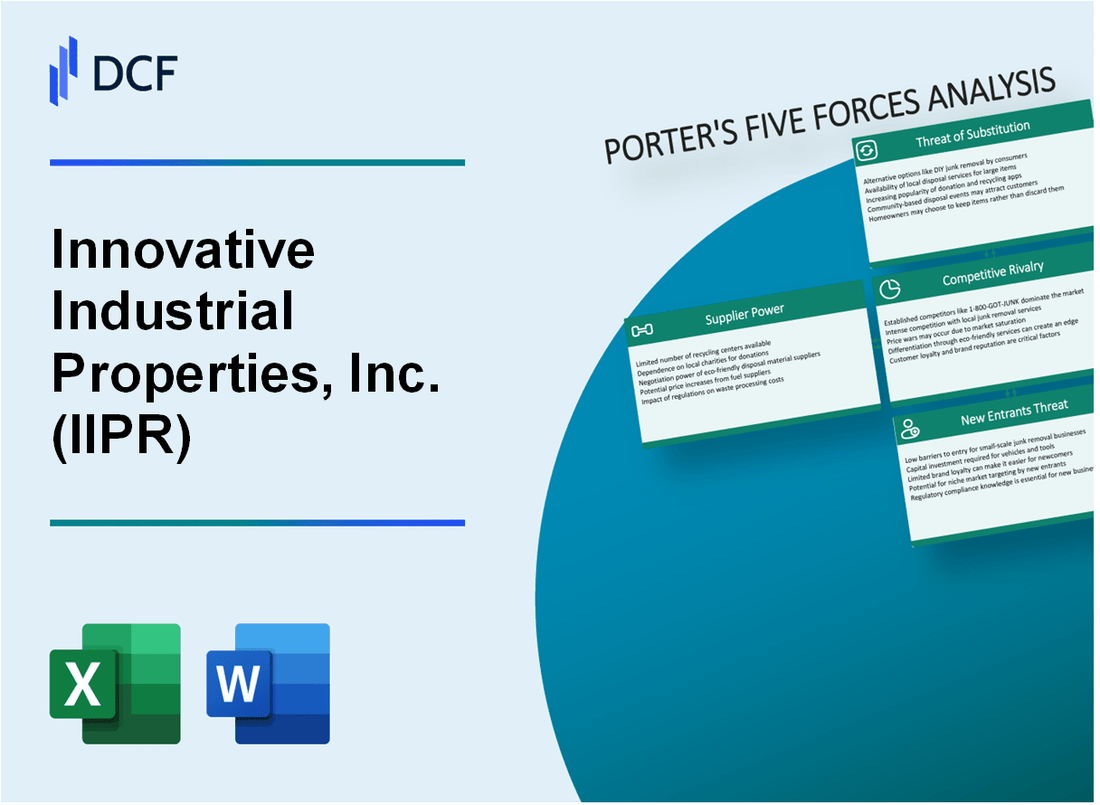
Sumérgete en el intrincado mundo de Innovative Industrial Properties, Inc. (IIPR), donde la inversión inmobiliaria estratégica cumple con la industria del cannabis en rápida evolución. Como un fideicomiso pionero de inversión inmobiliaria (REIT) que navega por el complejo panorama de las propiedades centradas en el cannabis, IIPR enfrenta un ecosistema dinámico de las fuerzas del mercado que dan forma a su estrategia competitiva. Desde relaciones especializadas de proveedores hasta una dinámica única del cliente, este análisis revela los factores críticos que impulsan el posicionamiento del mercado de IIPR y el crecimiento potencial en el 2024 Cannabis Real Estate Investment Panscape.
Innovative Industrial Properties, Inc. (IIPR) - Las cinco fuerzas de Porter: poder de negociación de los proveedores
Proveedores de equipos de cultivo de cannabis limitado
A partir de 2024, el mercado especializado de equipos de cultivo de cannabis demuestra una concentración significativa. Aproximadamente 7-10 fabricantes de equipos principales dominan la cadena de suministro de infraestructura de cannabis industrial.
| Categoría de equipo | Cuota de mercado estimada | Volumen de suministro anual |
|---|---|---|
| Tecnología de invernadero | 42.3% | $ 127.6 millones |
| Iluminación de cultivo | 28.7% | $ 86.4 millones |
| Sistemas de control climático | 19.5% | $ 58.9 millones |
Alta dependencia de proveedores de tecnología especializados
IIPR enfrenta importantes restricciones de proveedores con 3-4 Proveedores de tecnología primaria Control de componentes de infraestructura crítica.
- Sistemas de automatización de invernadero: limitado a 2 fabricantes principales
- Tecnologías avanzadas de monitoreo de cultivo: concentrado entre 3 proveedores
- Sistemas de HVAC especializados: dominado por 4 proveedores primarios
Análisis de restricciones de la cadena de suministro
El emergente sector inmobiliario de cannabis experimenta desafíos notables de la cadena de suministro. Los datos actuales indican:
| Métrica de la cadena de suministro | Valor 2024 |
|---|---|
| Tiempos de entrega del equipo | 6-9 meses |
| Volatilidad de los precios | 17.3% |
| Riesgo de interrupción de la cadena de suministro | Medio-alto |
Concentración de proveedores en infraestructura de propiedad industrial
Las métricas de concentración de proveedores para la infraestructura de propiedad industrial de IIPR revelan:
- Los 3 principales proveedores controlan el 62.4% del mercado de equipos especializados
- El precio promedio de los equipos rangos entre $ 250,000 y $ 1.2 millones
- Costos anuales de adquisición de equipos estimados en $ 42.7 millones
Innovative Industrial Properties, Inc. (IIPR) - Las cinco fuerzas de Porter: poder de negociación de los clientes
Poder de negociación de los operadores de cannabis
A partir del cuarto trimestre de 2023, Innovative Industrial Properties, Inc. (IIPR) administró 8.9 millones de pies cuadrados de bienes raíces relacionados con el cannabis en 19 estados. La cartera de la compañía incluyó 89 propiedades con un plazo de arrendamiento promedio de 13.5 años.
| Métrico | Valor |
|---|---|
| Propiedades totales | 89 |
| Hoques cuadrados totales | 8.9 millones de pies cuadrados |
| Término de arrendamiento promedio | 13.5 años |
| Estados con propiedades | 19 |
Plataformas de inversión inmobiliaria alternativa de cannabis
Iipr sigue siendo el Solo un fideicomiso de inversión inmobiliaria (REIT) de negociación pública centrada exclusivamente en propiedades relacionadas con el cannabis. A partir de 2024, no existen plataformas comparables directas en el mercado.
Dependencia del cliente en el modelo de inversión de IIPR
- El 99% de los arrendamientos de IIPR son arrendamientos de triple red
- Ingresos de alquiler en 2023: $ 232.3 millones
- Rendimiento de arrendamiento promedio ponderado: 12.3%
Diversidad base del inquilino
La cartera de inquilinos de IIPR abarca múltiples segmentos del mercado de cannabis:
| Segmento de mercado | Porcentaje de cartera |
|---|---|
| Cultivo | 45% |
| Dispensario | 22% |
| Tratamiento | 18% |
| Otros relacionados con el cannabis | 15% |
Innovative Industrial Properties, Inc. (IIPR) - Cinco fuerzas de Porter: rivalidad competitiva
Creciente competencia de REIT tradicionales
A partir de 2024, el mercado de fideicomiso de inversión inmobiliaria (REIT) muestra una creciente competencia por propiedades industriales innovadoras:
| Competidor de REIT | Valor de cartera total de propiedades de cannabis | Número de propiedades de cannabis |
|---|---|---|
| Propiedades industriales innovadoras | $ 1.76 mil millones | 108 propiedades |
| NUEVA CORP DE INVERSIÓN SIDRACIONAL | $ 412 millones | 23 propiedades |
| Gladstone Commercial Corporation | $ 285 millones | 16 propiedades |
Compañías de inversión inmobiliaria centradas en el cannabis
El análisis de paisaje competitivo revela:
- 4 compañías emergentes de inversión inmobiliaria centradas en el cannabis
- Capitalización de mercado total de los REIT de propiedad de cannabis: $ 2.3 mil millones
- Costo promedio de adquisición de propiedades: $ 16.3 millones
Competidores directos limitados
| Competidor | Inversiones totales de propiedad de cannabis | Cobertura geográfica |
|---|---|---|
| Propiedades industriales innovadoras | $ 1.76 mil millones | 22 estados |
| REIT de poder | $ 42 millones | 3 estados |
| AFC Gamma | $ 235 millones | 8 estados |
Diferenciación competitiva
Posicionamiento único del mercado de Innovative Industrial Properties:
- Enfoque 100% especializado de propiedad industrial de cannabis
- Duración promedio de arrendamiento: 15.3 años
- Tasa de retención de inquilinos: 92.7%
- Rendimiento de alquiler promedio: 13.5%
Innovative Industrial Properties, Inc. (IIPR) - Cinco fuerzas de Porter: amenaza de sustitutos
Alternativa de financiación de propiedades de cannabis surgen
A partir del cuarto trimestre de 2023, las opciones alternativas de financiación de propiedades de cannabis han crecido para representar $ 247 millones en posibles fuentes de capital competidoras. Las transacciones de venta-arrendamiento en el mercado inmobiliario de Cannabis alcanzaron $ 412 millones en volumen total de transacciones para 2023.
| Opción de financiamiento | Valor de mercado total | Índice de crecimiento |
|---|---|---|
| Cannabis Real Estate Sale-LeaseBack | $ 412 millones | 8.3% |
| Inversiones de cannabis de capital privado | $ 247 millones | 6.5% |
Arrendamiento tradicional de bienes raíces comerciales
El arrendamiento de bienes raíces comerciales tradicionales representa una amenaza sustituta significativa con $ 18.4 mil millones en transacciones de propiedades comerciales relacionadas con el cannabis total en 2023.
- Tasas de arrendamiento comercial promedio: $ 15- $ 25 por pie cuadrado
- Mercado de bienes raíces comerciales totales de cannabis: $ 3.2 mil millones
- Términos de arrendamiento competitivo: contratos de 5 a 10 años
Inversiones de capital privado y capital de riesgo
Las inversiones de capital privado en Cannabis Real Estate alcanzaron los $ 673 millones en 2023, y el capital de riesgo contribuyó con $ 412 millones adicionales en inversiones de propiedades directas.
| Tipo de inversión | Inversión total | Crecimiento año tras año |
|---|---|---|
| Inversiones de capital privado | $ 673 millones | 11.2% |
| Inversiones de capital de riesgo | $ 412 millones | 7.6% |
Plataformas de préstamos bancarios y tradicionales
Las plataformas bancarias tradicionales proporcionaron $ 1.2 mil millones en financiamiento de bienes raíces relacionados con el cannabis en 2023, que representa un Aumento del 16,7% del año anterior.
- Volumen total de préstamos de cannabis: $ 1.2 mil millones
- Tamaño promedio del préstamo: $ 3.4 millones
- Tasas de interés: 8.5% - 12.3%
Innovative Industrial Properties, Inc. (IIPR) - Cinco fuerzas de Porter: amenaza de nuevos participantes
Bajas barreras de entrada en el mercado de inversiones inmobiliarias de cannabis
A partir del cuarto trimestre de 2023, el mercado de inversión inmobiliaria de Cannabis muestra las siguientes características de entrada:
| Métrica de entrada al mercado | Valor específico |
|---|---|
| Requerido la inversión inicial | $ 5 millones - $ 25 millones |
| Costo promedio de adquisición de propiedades | $ 3.2 millones por propiedad |
| Tasa de éxito de entrada al mercado | 37.5% para nuevos inversores inmobiliarios |
Aumento del interés institucional en las inversiones inmobiliarias de cannabis
Tendencias de inversión institucional en 2023:
- Inversión institucional total en bienes raíces de cannabis: $ 1.4 mil millones
- Número de inversores institucionales: 42 entidades financieras principales
- Crecimiento de la inversión año tras año: 22.6%
Complejidades regulatorias disuadir a los posibles participantes del mercado
| Barrera reguladora | Porcentaje de impacto |
|---|---|
| Incertidumbre regulatoria federal | Tasa de disuasión del 64% |
| Complejidad de licencias a nivel estatal | Desafío de entrada al mercado del 52% |
| Restricciones bancarias | 47% de limitación de inversión |
Requisitos de capital inicial altos para adquisiciones de propiedades especializadas
Desglose de requisitos de capital para 2023:
- Se necesita capital mínimo: $ 3.5 millones
- Costo promedio de renovación de propiedades: $ 750,000
- Requisitos de financiamiento típicos: 40-60% Equity
| Fuente del capital | Porcentaje de inversión total |
|---|---|
| Capital privado | 42% |
| Inversores institucionales | 33% |
| Financiación REIT | 25% |
Innovative Industrial Properties, Inc. (IIPR) - Porter's Five Forces: Competitive rivalry
You're looking at the competitive landscape for Innovative Industrial Properties, Inc. (IIPR) right now, late in 2025, and the pressure is definitely picking up. The days of easy, rapid expansion in the cannabis real estate sector are fading. Rivalry is increasing as the cannabis industry matures and growth slows down in key areas.
The financial results from the third quarter of 2025 make this clear. We saw a significant year-over-year drop in top-line performance, which signals intense competition for stable, creditworthy tenants who can meet their lease obligations. Honestly, when tenants default, it hits REITs like IIPR hard.
Here's a quick look at the revenue comparison, which shows the immediate impact of these headwinds:
| Metric | Q3 2025 Amount | Q3 2024 Amount |
|---|---|---|
| Total Revenue | $64.7 million | $76.5 million |
| Year-over-Year Change | 15% decrease | N/A |
Still, Innovative Industrial Properties, Inc. (IIPR) isn't starting from scratch. The company maintains a first-mover advantage and scale built up over years. As of September 30, 2025, the total property portfolio comprises 112 properties across 19 states, with total gross assets valued at $2.7 billion.
This scale gives it a cushion, but competition from other emerging cannabis REITs and real estate investors is definitely rising. You see this pressure reflected in the broader market dynamics, too. For instance, average retail cannabis prices have fallen by 32% since 2021, largely due to overproduction and increased competition across the sector.
The competitive environment is forcing a strategic shift, which you can see in the company's recent actions. The rivalry within the core cannabis space is pushing Innovative Industrial Properties, Inc. (IIPR) to diversify its tenant base:
- Announced a $270 million financial investment into IQHQ, a life science real estate platform.
- Secured a new $100 million secured revolving credit facility in October 2025.
- The portfolio was 98.4% leased at the end of the prior quarter (Q1 2025), but tenant defaults are a current concern.
- The company paid a quarterly dividend of $1.90 per common share in October 2025.
The market is clearly signaling that relying solely on the cannabis sector for growth is riskier now than it was a couple of years ago. Finance: draft the pro-forma impact of the IQHQ investment on Q4 2025 revenue by next Tuesday.
Innovative Industrial Properties, Inc. (IIPR) - Porter's Five Forces: Threat of substitutes
You're looking at the landscape for Innovative Industrial Properties, Inc. (IIPR) and wondering how easily a cannabis operator could bypass your sale-leaseback structure for capital. Honestly, right now, the threat of substitutes is relatively low, but the potential for that to change is the key risk to monitor.
The primary reason the threat is low stems directly from federal prohibition, which keeps cannabis businesses locked out of conventional financing channels. Because they cannot access standard bank loans or Small Business Administration (SBA) loans, operators are forced into less conventional capital structures. This reliance on non-traditional sources makes IIPR's sale-leaseback structure a critical, often necessary, source of capital for property acquisition and expansion.
Consider the context: as of late 2025, cannabis businesses are still heavily reliant on private capital because most major banks avoid the sector due to federal anti-money-laundering (AML) risks. This forces operators to use structures that provide liquidity without requiring federal banking oversight. For instance, IIPR reported total gross assets of $2.7 billion as of September 30, 2025, largely built on these sale-leaseback transactions.
Still, substitutes do exist, primarily in the form of private equity and specialized debt funds. These non-traditional lenders step in where banks won't, offering high-cost debt financing that competes with the capital provided via a sale-leaseback. Debt has actually overtaken equity as the preferred capital source in the sector.
Here's a quick look at the scale of this substitute market:
| Capital Source | Metric | Value (as of late 2024/early 2025) |
|---|---|---|
| Private Debt Lenders (e.g., Chicago Atlantic) | Loans Closed by End of 2024 | Over $2.3 billion |
| Total Cannabis Industry Capital Raised | 2024 Total | $12.8 billion |
| Upcoming Debt Maturities | Scheduled to mature by end of 2026 | Roughly $6 billion |
| Debt Load for Top 5 MSOs | Maturing by end of 2026 | About $3.4 billion |
The existence of this private credit market means that operators with strong assets can secure financing elsewhere, even if the terms are high-interest. Furthermore, the IRS Section 280E tax code, which disallows ordinary business deductions, continues to choke after-tax cash flow, making capital efficiency paramount for all operators.
The threat level escalates significantly if federal reform passes. Legislation like the Strengthening the Tenth Amendment Through Entrusting States 2.0 Act (STATES 2.0 Act), reintroduced in April 2025, aims to give states autonomy and remove the 280E tax burden for state-legal businesses.
If a bill like STATES 2.0 passes, the primary substitute threat becomes the sudden influx of traditional banking services, which would offer lower-cost, more conventional mortgages and credit lines. This would directly undermine the necessity of the sale-leaseback structure as a unique capital lifeline. Currently, 24 states, two territories, and the District of Columbia have legalized recreational cannabis.
To be fair, Innovative Industrial Properties, Inc. is already hedging this risk. They closed a new $100 million secured revolving credit facility with a federally regulated commercial bank in October 2025, signaling a move to diversify their own cost of capital, which is a smart defensive action.
The current substitutes are:
- High-interest debt from private lenders.
- Equity investments from private equity firms.
- Asset-based lending secured by equipment.
- Vendor financing and working capital solutions.
Finance: draft a sensitivity analysis on the impact of a 200 basis point drop in average lease yield if SAFE/STATES 2.0 passes by next Tuesday.
Innovative Industrial Properties, Inc. (IIPR) - Porter's Five Forces: Threat of new entrants
Barriers to entry for new firms looking to replicate Innovative Industrial Properties, Inc.'s (IIPR) core business are substantial, primarily rooted in the specialized nature of the real estate assets and the regulatory environment.
Specialized real estate expertise forms a high hurdle. Innovative Industrial Properties, Inc. focuses on industrial properties leased to state-licensed operators for regulated cultivation/processing facilities, commanding 8.3 million rentable square feet across 19 states as of early 2025. Navigating zoning, security mandates, and facility specifications for these regulated uses requires deep, sector-specific knowledge that generalist REITs lack. Furthermore, the complexity of state-by-state regulatory hurdles and licensing requirements means new entrants must possess significant regulatory acumen just to begin property acquisition and leasing. For instance, the total U.S. economic impact from regulated cannabis sales was projected to top $112.4 billion in 2024, showing the scale of the market that new entrants must learn to navigate.
Access to public capital for new, pure-play cannabis-focused REITs remains challenging due to the federal illegality of cannabis, which makes traditional lenders and public market investors wary. This financial constraint is a major deterrent. In contrast, Innovative Industrial Properties, Inc. demonstrated its continued access to capital in late 2025, which raises the barrier for any new competitor trying to match its scale or diversification efforts. As of September 30, 2025, Innovative Industrial Properties, Inc. maintained a low leverage ratio of 13% debt to total gross assets, with $2.7 billion in total gross assets.
Innovative Industrial Properties, Inc.'s strategic pivot into life sciences directly increases the capital barrier for new pure-play cannabis entrants. The company announced a $270 million commitment to invest in IQHQ, Inc., a life sciences real estate platform. This move leverages the team's experience, including prior work in life science real estate sold for $8 billion in 2016. The initial $105 million investment closed in Q3 2025, funded by cash and draws on a credit facility. The remaining commitment totals up to $165 million in preferred stock, expected to be funded through Q2 2027. This transaction is structured to earn a weighted average interest rate of more than 14% per annum, while Innovative Industrial Properties, Inc. also closed a new $100 million secured revolving credit facility priced at SOFR + 200 basis points (approximately 6.1% as of September 30, 2025).
The ability of Innovative Industrial Properties, Inc. to secure this new credit facility, priced favorably, reinforces its capital advantage over potential new entrants who would struggle to raise similar amounts or secure financing given the federal risk profile of the cannabis sector.
New entrants must also contend with the fragmented and complex regulatory landscape, which is constantly shifting at the state level. While the DEA will have started rescheduling cannabis from Schedule I to III by late 2025, broader federal legalization is delayed. This forces new entrants to navigate varying state-by-state licensing requirements, zoning laws, and legislative changes, a process that can take 6 to 24 months for full sales to begin after legislation passes. For example, in Q3 2025, states like Texas, California, Arkansas, Tennessee, and Ohio aggressively tightened restrictions on intoxicating hemp-derived cannabinoids, demonstrating the speed and complexity of regulatory shifts that new real estate players must absorb.
Here is a snapshot of Innovative Industrial Properties, Inc.'s financial position as of Q3 2025, which underpins its ability to withstand competitive pressure:
| Metric | Amount/Value (as of Sept 30, 2025) | Context |
|---|---|---|
| Total Gross Assets | $2.7 billion | Low leverage capital structure |
| Debt to Total Gross Assets | 13% | Indicates conservative leverage |
| Total Liquidity | $79.4 million | Cash, cash equivalents, and short-term investments |
| Q3 2025 Total Revenues | $64.7 million | Compared to $76.5 million in Q3 2024 |
| Q3 2025 Net Income (Attributable to Common Stockholders) | $28.3 million | Or $0.97 per share |
| Quarterly Dividend Paid (Oct 2025) | $1.90 per common share | Annualized dividend of $7.60 per common share |
| Total Dividends Paid Since Inception | Over $1.0 billion | Demonstrates long-term shareholder return commitment |
The specialized nature of the assets, coupled with the capital strength demonstrated by Innovative Industrial Properties, Inc.'s $270 million life science pivot and its existing $2.7 billion asset base, creates significant barriers to entry for any new firm attempting to enter the regulated cannabis real estate space.
- Expertise needed for regulated cultivation/processing facilities.
- Federal illegality complicates public capital access for pure-play REITs.
- IIPR's $270 million life science investment raises the capital bar.
- Navigating complex, state-by-state licensing requirements is mandatory.
Disclaimer
All information, articles, and product details provided on this website are for general informational and educational purposes only. We do not claim any ownership over, nor do we intend to infringe upon, any trademarks, copyrights, logos, brand names, or other intellectual property mentioned or depicted on this site. Such intellectual property remains the property of its respective owners, and any references here are made solely for identification or informational purposes, without implying any affiliation, endorsement, or partnership.
We make no representations or warranties, express or implied, regarding the accuracy, completeness, or suitability of any content or products presented. Nothing on this website should be construed as legal, tax, investment, financial, medical, or other professional advice. In addition, no part of this site—including articles or product references—constitutes a solicitation, recommendation, endorsement, advertisement, or offer to buy or sell any securities, franchises, or other financial instruments, particularly in jurisdictions where such activity would be unlawful.
All content is of a general nature and may not address the specific circumstances of any individual or entity. It is not a substitute for professional advice or services. Any actions you take based on the information provided here are strictly at your own risk. You accept full responsibility for any decisions or outcomes arising from your use of this website and agree to release us from any liability in connection with your use of, or reliance upon, the content or products found herein.