

|
Innovative Industrial Properties, Inc. (IIPR): 5 Analyse des forces [Jan-2025 MISE À JOUR] |
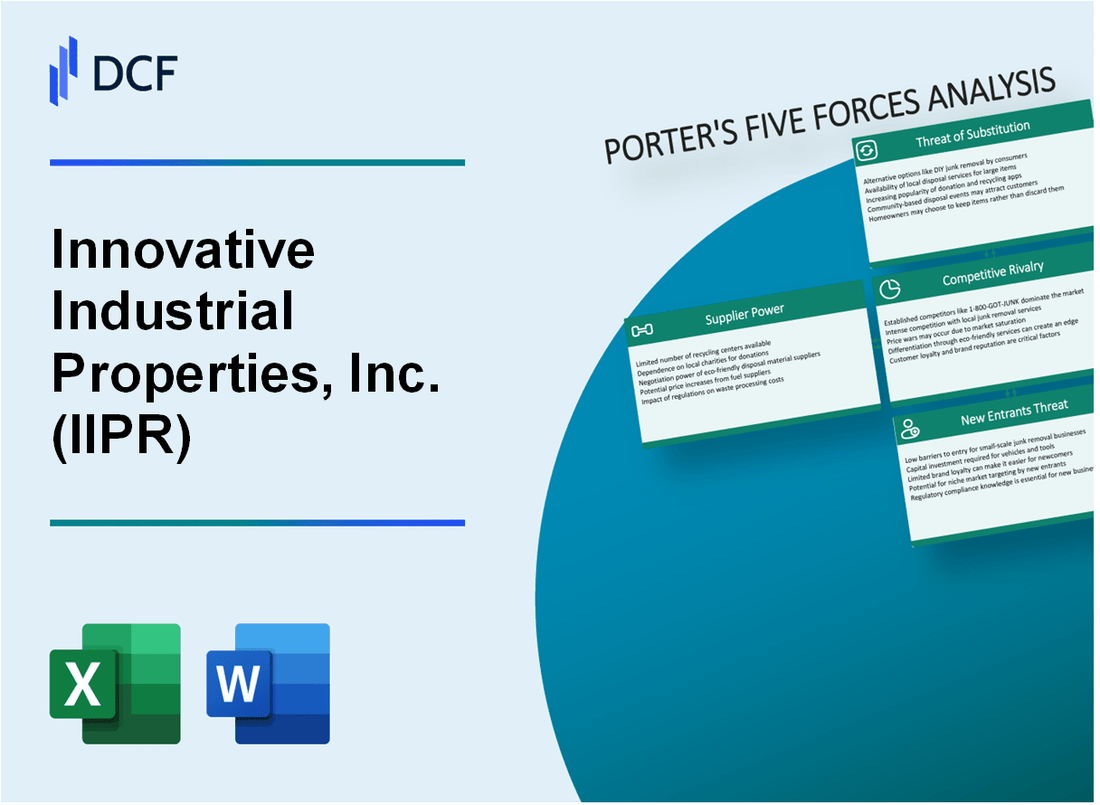
Entièrement Modifiable: Adapté À Vos Besoins Dans Excel Ou Sheets
Conception Professionnelle: Modèles Fiables Et Conformes Aux Normes Du Secteur
Pré-Construits Pour Une Utilisation Rapide Et Efficace
Compatible MAC/PC, entièrement débloqué
Aucune Expertise N'Est Requise; Facile À Suivre
Innovative Industrial Properties, Inc. (IIPR) Bundle
Plongez dans le monde complexe de Innovative Industrial Properties, Inc. (IIPR), où l'investissement immobilier stratégique répond à l'industrie du cannabis en évolution rapide. En tant que pionnier de la fiducie de placement immobilier (REIT) naviguant dans le paysage complexe des propriétés axées sur le cannabis, l'IIPR fait face à un écosystème dynamique de forces du marché qui façonnent sa stratégie concurrentielle. Des relations spécialisées des fournisseurs à la dynamique unique des clients, cette analyse dévoile les facteurs critiques stimulant le positionnement du marché de l'IIPR et la croissance potentielle dans le 2024 Paysage d'investissement immobilier sur le cannabis.
Innovative Industrial Properties, Inc. (IIPR) - Porter's Five Forces: Bargaining Power des fournisseurs
Fournisseurs d'équipements de culture de cannabis limités
En 2024, le marché spécialisé des équipements de culture du cannabis démontre une concentration importante. Environ 7 à 10 principaux fabricants d'équipements dominent la chaîne d'approvisionnement de l'infrastructure du cannabis industriel.
| Catégorie d'équipement | Part de marché estimé | Volume de l'offre annuelle |
|---|---|---|
| Technologie de serre | 42.3% | 127,6 millions de dollars |
| Éclairage de culture | 28.7% | 86,4 millions de dollars |
| Systèmes de climatisation | 19.5% | 58,9 millions de dollars |
Haute dépendance à l'égard des fournisseurs de technologies spécialisées
IIPR fait face à des contraintes de fournisseur importantes avec 3-4 fournisseurs de technologies primaires Contrôle des composants d'infrastructure critiques.
- Systèmes d'automatisation à la serre: limité à 2 grands fabricants
- Technologies de surveillance des cultivations avancées: concentré parmi 3 fournisseurs
- Systèmes HVAC spécialisés: dominé par 4 fournisseurs primaires
Analyse des contraintes de la chaîne d'approvisionnement
Le secteur immobilier émergent du cannabis éprouve des défis notables en chaîne d'approvisionnement. Les données actuelles indiquent:
| Métrique de la chaîne d'approvisionnement | Valeur 2024 |
|---|---|
| Temps de plomb de l'équipement | 6-9 mois |
| Volatilité des prix | 17.3% |
| Risque de perturbation de la chaîne d'approvisionnement | Moyen-élevé |
Concentration des fournisseurs dans l'infrastructure de propriété industrielle
Les mesures de concentration des fournisseurs pour l'infrastructure de propriété industrielle de l'IIPR révèlent:
- Les 3 meilleurs fournisseurs contrôlent 62,4% du marché des équipements spécialisés
- La tarification moyenne des équipements varie entre 250 000 $ et 1,2 million de dollars
- Coûts de l'approvisionnement en équipement annuel estimé à 42,7 millions de dollars
Innovative Industrial Properties, Inc. (IIPR) - Porter's Five Forces: Bargaining Power of Clients
Pouvoir de négociation des opérateurs de cannabis
Depuis le quatrième trimestre 2023, Innovative Industrial Properties, Inc. (IIPR) a géré 8,9 millions de pieds carrés d'immobilier lié au cannabis dans 19 États. Le portefeuille de la société comprenait 89 propriétés avec une durée de location moyenne de 13,5 ans.
| Métrique | Valeur |
|---|---|
| Propriétés totales | 89 |
| Total en pieds carrés | 8,9 millions de pieds carrés |
| Terme de location moyenne | 13,5 ans |
| États à propriété | 19 |
Plateformes d'investissement immobilier alternative au cannabis
IIPR reste le Seule la fiducie de placement immobilier (REIT) cotée en bourse s'est concentrée exclusivement sur les propriétés liées au cannabis. En 2024, aucune plateforme comparable directe n'existe sur le marché.
Dépendance des clients sur le modèle d'investissement d'IIPR
- 99% des baux de l'IIPR sont des baux à triple net
- Revenus locatifs en 2023: 232,3 millions de dollars
- Rendement de bail moyen pondéré: 12,3%
Diversité de la base des locataires
Le portefeuille de locataires de l'IIPR s'étend sur plusieurs segments de marché de cannabis:
| Segment de marché | Pourcentage de portefeuille |
|---|---|
| Cultivation | 45% |
| Dispensaires | 22% |
| Traitement | 18% |
| Autres liés au cannabis | 15% |
Innovative Industrial Properties, Inc. (IIPR) - Five Forces de Porter: Rivalité compétitive
Concurrence croissante des FPI traditionnels
En 2024, le marché de la fiducie de placement immobilier (REIT) montre une concurrence croissante pour les propriétés industrielles innovantes:
| Concurrent du FPI | Valeur du portefeuille de propriétés de cannabis total | Nombre de propriétés de cannabis |
|---|---|---|
| Propriétés industrielles innovantes | 1,76 milliard de dollars | 108 propriétés |
| Nouveau corp d'investissement résidentiel | 412 millions de dollars | 23 propriétés |
| Gladstone Commercial Corporation | 285 millions de dollars | 16 propriétés |
Sociétés d'investissement immobilier axé sur le cannabis
L'analyse du paysage concurrentiel révèle:
- 4 sociétés d'investissement immobilier axées sur le cannabis émergentes
- Capitalisation boursière totale des foyers de la propriété du cannabis: 2,3 milliards de dollars
- Coût moyen d'acquisition de propriétés: 16,3 millions de dollars
Concurrents directs limités
| Concurrent | Investissements immobiliers totaux de cannabis | Couverture géographique |
|---|---|---|
| Propriétés industrielles innovantes | 1,76 milliard de dollars | 22 États |
| Power REIT | 42 millions de dollars | 3 États |
| AFC Gamma | 235 millions de dollars | 8 États |
Différenciation compétitive
Positionnement unique du marché des propriétés innovantes:
- Focus de la propriété industrielle à 100% spécialisée
- Durée du bail moyenne: 15,3 ans
- Taux de rétention des locataires: 92,7%
- Rendement de location moyen: 13,5%
Innovative Industrial Properties, Inc. (IIPR) - Five Forces de Porter: Menace de substituts
Options de financement de la propriété du cannabis alternatif émergeant
Au quatrième trimestre 2023, des options alternatives de financement des biens de cannabis ont augmenté pour représenter 247 millions de dollars de sources de capital concurrentes potentielles. Les transactions de lease-linge sur le marché immobilier du cannabis ont atteint 412 millions de dollars de volume de transactions totales pour 2023.
| Option de financement | Valeur marchande totale | Taux de croissance |
|---|---|---|
| Sale-location immobilier du cannabis | 412 millions de dollars | 8.3% |
| Investissements de cannabis de capital-investissement | 247 millions de dollars | 6.5% |
Location immobilière commerciale traditionnelle
La location immobilière commerciale traditionnelle représente une menace de substitut importante avec 18,4 milliards de dollars de transactions de propriétés commerciales liées au cannabis en 2023.
- Taux de location commerciale moyens: 15 $ à 25 $ par pied carré
- Total du marché immobilier commercial sur le cannabis: 3,2 milliards de dollars
- Conditions de location compétitives: Contrats de 5 à 10 ans
Investissements en capital-investissement et en capital-risque
Les investissements en capital-investissement dans l'immobilier de cannabis ont atteint 673 millions de dollars en 2023, le capital-risque, ce qui contribue à 412 millions de dollars supplémentaires d'investissements immobiliers directs.
| Type d'investissement | Investissement total | Croissance d'une année à l'autre |
|---|---|---|
| Investissements de capital-investissement | 673 millions de dollars | 11.2% |
| Investissements en capital-risque | 412 millions de dollars | 7.6% |
Banques et plateformes de prêt traditionnelles
Les plateformes bancaires traditionnelles ont fourni 1,2 milliard de dollars de financement immobilier lié au cannabis en 2023, représentant un Augmentation de 16,7% de l'année précédente.
- Volume total de prêts au cannabis: 1,2 milliard de dollars
- Taille moyenne du prêt: 3,4 millions de dollars
- Taux d'intérêt: 8,5% - 12,3%
Innovative Industrial Properties, Inc. (IIPR) - Five Forces de Porter: Menace de nouveaux entrants
Faible barrière à l'entrée sur le marché des investissements immobiliers du cannabis
Au quatrième trimestre 2023, le marché des investissements immobiliers du cannabis montre les caractéristiques d'entrée suivantes:
| Métrique d'entrée du marché | Valeur spécifique |
|---|---|
| Investissement initial requis | 5 millions de dollars - 25 millions de dollars |
| Coût moyen d'acquisition de propriétés | 3,2 millions de dollars par propriété |
| Taux de réussite de l'entrée du marché | 37,5% pour les nouveaux investisseurs immobiliers |
Augmentation des intérêts institutionnels dans les investissements immobiliers au cannabis
Tendances d'investissement institutionnelles en 2023:
- Investissement institutionnel total dans l'immobilier du cannabis: 1,4 milliard de dollars
- Nombre d'investisseurs institutionnels: 42 entités financières majeures
- Croissance des investissements d'une année à l'autre: 22,6%
Complexités réglementaires dissuader les acteurs du marché potentiels
| Barrière réglementaire | Pourcentage d'impact |
|---|---|
| Incertitude réglementaire fédérale | Taux de dissuasion de 64% |
| Complexité de licence au niveau de l'État | Défi de l'entrée sur le marché de 52% |
| Restrictions bancaires | 47% Limitation d'investissement |
Exigences de capital initial élevées pour les acquisitions de propriétés spécialisées
Répartition des besoins en capital pour 2023:
- Capital minimum nécessaire: 3,5 millions de dollars
- Coût moyen de rénovation de la propriété: 750 000 $
- Exigences de financement typiques: 40 à 60% de capitaux propres
| Source de capital | Pourcentage de l'investissement total |
|---|---|
| Capital-investissement | 42% |
| Investisseurs institutionnels | 33% |
| Financement du FPI | 25% |
Innovative Industrial Properties, Inc. (IIPR) - Porter's Five Forces: Competitive rivalry
You're looking at the competitive landscape for Innovative Industrial Properties, Inc. (IIPR) right now, late in 2025, and the pressure is definitely picking up. The days of easy, rapid expansion in the cannabis real estate sector are fading. Rivalry is increasing as the cannabis industry matures and growth slows down in key areas.
The financial results from the third quarter of 2025 make this clear. We saw a significant year-over-year drop in top-line performance, which signals intense competition for stable, creditworthy tenants who can meet their lease obligations. Honestly, when tenants default, it hits REITs like IIPR hard.
Here's a quick look at the revenue comparison, which shows the immediate impact of these headwinds:
| Metric | Q3 2025 Amount | Q3 2024 Amount |
|---|---|---|
| Total Revenue | $64.7 million | $76.5 million |
| Year-over-Year Change | 15% decrease | N/A |
Still, Innovative Industrial Properties, Inc. (IIPR) isn't starting from scratch. The company maintains a first-mover advantage and scale built up over years. As of September 30, 2025, the total property portfolio comprises 112 properties across 19 states, with total gross assets valued at $2.7 billion.
This scale gives it a cushion, but competition from other emerging cannabis REITs and real estate investors is definitely rising. You see this pressure reflected in the broader market dynamics, too. For instance, average retail cannabis prices have fallen by 32% since 2021, largely due to overproduction and increased competition across the sector.
The competitive environment is forcing a strategic shift, which you can see in the company's recent actions. The rivalry within the core cannabis space is pushing Innovative Industrial Properties, Inc. (IIPR) to diversify its tenant base:
- Announced a $270 million financial investment into IQHQ, a life science real estate platform.
- Secured a new $100 million secured revolving credit facility in October 2025.
- The portfolio was 98.4% leased at the end of the prior quarter (Q1 2025), but tenant defaults are a current concern.
- The company paid a quarterly dividend of $1.90 per common share in October 2025.
The market is clearly signaling that relying solely on the cannabis sector for growth is riskier now than it was a couple of years ago. Finance: draft the pro-forma impact of the IQHQ investment on Q4 2025 revenue by next Tuesday.
Innovative Industrial Properties, Inc. (IIPR) - Porter's Five Forces: Threat of substitutes
You're looking at the landscape for Innovative Industrial Properties, Inc. (IIPR) and wondering how easily a cannabis operator could bypass your sale-leaseback structure for capital. Honestly, right now, the threat of substitutes is relatively low, but the potential for that to change is the key risk to monitor.
The primary reason the threat is low stems directly from federal prohibition, which keeps cannabis businesses locked out of conventional financing channels. Because they cannot access standard bank loans or Small Business Administration (SBA) loans, operators are forced into less conventional capital structures. This reliance on non-traditional sources makes IIPR's sale-leaseback structure a critical, often necessary, source of capital for property acquisition and expansion.
Consider the context: as of late 2025, cannabis businesses are still heavily reliant on private capital because most major banks avoid the sector due to federal anti-money-laundering (AML) risks. This forces operators to use structures that provide liquidity without requiring federal banking oversight. For instance, IIPR reported total gross assets of $2.7 billion as of September 30, 2025, largely built on these sale-leaseback transactions.
Still, substitutes do exist, primarily in the form of private equity and specialized debt funds. These non-traditional lenders step in where banks won't, offering high-cost debt financing that competes with the capital provided via a sale-leaseback. Debt has actually overtaken equity as the preferred capital source in the sector.
Here's a quick look at the scale of this substitute market:
| Capital Source | Metric | Value (as of late 2024/early 2025) |
|---|---|---|
| Private Debt Lenders (e.g., Chicago Atlantic) | Loans Closed by End of 2024 | Over $2.3 billion |
| Total Cannabis Industry Capital Raised | 2024 Total | $12.8 billion |
| Upcoming Debt Maturities | Scheduled to mature by end of 2026 | Roughly $6 billion |
| Debt Load for Top 5 MSOs | Maturing by end of 2026 | About $3.4 billion |
The existence of this private credit market means that operators with strong assets can secure financing elsewhere, even if the terms are high-interest. Furthermore, the IRS Section 280E tax code, which disallows ordinary business deductions, continues to choke after-tax cash flow, making capital efficiency paramount for all operators.
The threat level escalates significantly if federal reform passes. Legislation like the Strengthening the Tenth Amendment Through Entrusting States 2.0 Act (STATES 2.0 Act), reintroduced in April 2025, aims to give states autonomy and remove the 280E tax burden for state-legal businesses.
If a bill like STATES 2.0 passes, the primary substitute threat becomes the sudden influx of traditional banking services, which would offer lower-cost, more conventional mortgages and credit lines. This would directly undermine the necessity of the sale-leaseback structure as a unique capital lifeline. Currently, 24 states, two territories, and the District of Columbia have legalized recreational cannabis.
To be fair, Innovative Industrial Properties, Inc. is already hedging this risk. They closed a new $100 million secured revolving credit facility with a federally regulated commercial bank in October 2025, signaling a move to diversify their own cost of capital, which is a smart defensive action.
The current substitutes are:
- High-interest debt from private lenders.
- Equity investments from private equity firms.
- Asset-based lending secured by equipment.
- Vendor financing and working capital solutions.
Finance: draft a sensitivity analysis on the impact of a 200 basis point drop in average lease yield if SAFE/STATES 2.0 passes by next Tuesday.
Innovative Industrial Properties, Inc. (IIPR) - Porter's Five Forces: Threat of new entrants
Barriers to entry for new firms looking to replicate Innovative Industrial Properties, Inc.'s (IIPR) core business are substantial, primarily rooted in the specialized nature of the real estate assets and the regulatory environment.
Specialized real estate expertise forms a high hurdle. Innovative Industrial Properties, Inc. focuses on industrial properties leased to state-licensed operators for regulated cultivation/processing facilities, commanding 8.3 million rentable square feet across 19 states as of early 2025. Navigating zoning, security mandates, and facility specifications for these regulated uses requires deep, sector-specific knowledge that generalist REITs lack. Furthermore, the complexity of state-by-state regulatory hurdles and licensing requirements means new entrants must possess significant regulatory acumen just to begin property acquisition and leasing. For instance, the total U.S. economic impact from regulated cannabis sales was projected to top $112.4 billion in 2024, showing the scale of the market that new entrants must learn to navigate.
Access to public capital for new, pure-play cannabis-focused REITs remains challenging due to the federal illegality of cannabis, which makes traditional lenders and public market investors wary. This financial constraint is a major deterrent. In contrast, Innovative Industrial Properties, Inc. demonstrated its continued access to capital in late 2025, which raises the barrier for any new competitor trying to match its scale or diversification efforts. As of September 30, 2025, Innovative Industrial Properties, Inc. maintained a low leverage ratio of 13% debt to total gross assets, with $2.7 billion in total gross assets.
Innovative Industrial Properties, Inc.'s strategic pivot into life sciences directly increases the capital barrier for new pure-play cannabis entrants. The company announced a $270 million commitment to invest in IQHQ, Inc., a life sciences real estate platform. This move leverages the team's experience, including prior work in life science real estate sold for $8 billion in 2016. The initial $105 million investment closed in Q3 2025, funded by cash and draws on a credit facility. The remaining commitment totals up to $165 million in preferred stock, expected to be funded through Q2 2027. This transaction is structured to earn a weighted average interest rate of more than 14% per annum, while Innovative Industrial Properties, Inc. also closed a new $100 million secured revolving credit facility priced at SOFR + 200 basis points (approximately 6.1% as of September 30, 2025).
The ability of Innovative Industrial Properties, Inc. to secure this new credit facility, priced favorably, reinforces its capital advantage over potential new entrants who would struggle to raise similar amounts or secure financing given the federal risk profile of the cannabis sector.
New entrants must also contend with the fragmented and complex regulatory landscape, which is constantly shifting at the state level. While the DEA will have started rescheduling cannabis from Schedule I to III by late 2025, broader federal legalization is delayed. This forces new entrants to navigate varying state-by-state licensing requirements, zoning laws, and legislative changes, a process that can take 6 to 24 months for full sales to begin after legislation passes. For example, in Q3 2025, states like Texas, California, Arkansas, Tennessee, and Ohio aggressively tightened restrictions on intoxicating hemp-derived cannabinoids, demonstrating the speed and complexity of regulatory shifts that new real estate players must absorb.
Here is a snapshot of Innovative Industrial Properties, Inc.'s financial position as of Q3 2025, which underpins its ability to withstand competitive pressure:
| Metric | Amount/Value (as of Sept 30, 2025) | Context |
|---|---|---|
| Total Gross Assets | $2.7 billion | Low leverage capital structure |
| Debt to Total Gross Assets | 13% | Indicates conservative leverage |
| Total Liquidity | $79.4 million | Cash, cash equivalents, and short-term investments |
| Q3 2025 Total Revenues | $64.7 million | Compared to $76.5 million in Q3 2024 |
| Q3 2025 Net Income (Attributable to Common Stockholders) | $28.3 million | Or $0.97 per share |
| Quarterly Dividend Paid (Oct 2025) | $1.90 per common share | Annualized dividend of $7.60 per common share |
| Total Dividends Paid Since Inception | Over $1.0 billion | Demonstrates long-term shareholder return commitment |
The specialized nature of the assets, coupled with the capital strength demonstrated by Innovative Industrial Properties, Inc.'s $270 million life science pivot and its existing $2.7 billion asset base, creates significant barriers to entry for any new firm attempting to enter the regulated cannabis real estate space.
- Expertise needed for regulated cultivation/processing facilities.
- Federal illegality complicates public capital access for pure-play REITs.
- IIPR's $270 million life science investment raises the capital bar.
- Navigating complex, state-by-state licensing requirements is mandatory.
Disclaimer
All information, articles, and product details provided on this website are for general informational and educational purposes only. We do not claim any ownership over, nor do we intend to infringe upon, any trademarks, copyrights, logos, brand names, or other intellectual property mentioned or depicted on this site. Such intellectual property remains the property of its respective owners, and any references here are made solely for identification or informational purposes, without implying any affiliation, endorsement, or partnership.
We make no representations or warranties, express or implied, regarding the accuracy, completeness, or suitability of any content or products presented. Nothing on this website should be construed as legal, tax, investment, financial, medical, or other professional advice. In addition, no part of this site—including articles or product references—constitutes a solicitation, recommendation, endorsement, advertisement, or offer to buy or sell any securities, franchises, or other financial instruments, particularly in jurisdictions where such activity would be unlawful.
All content is of a general nature and may not address the specific circumstances of any individual or entity. It is not a substitute for professional advice or services. Any actions you take based on the information provided here are strictly at your own risk. You accept full responsibility for any decisions or outcomes arising from your use of this website and agree to release us from any liability in connection with your use of, or reliance upon, the content or products found herein.