

|
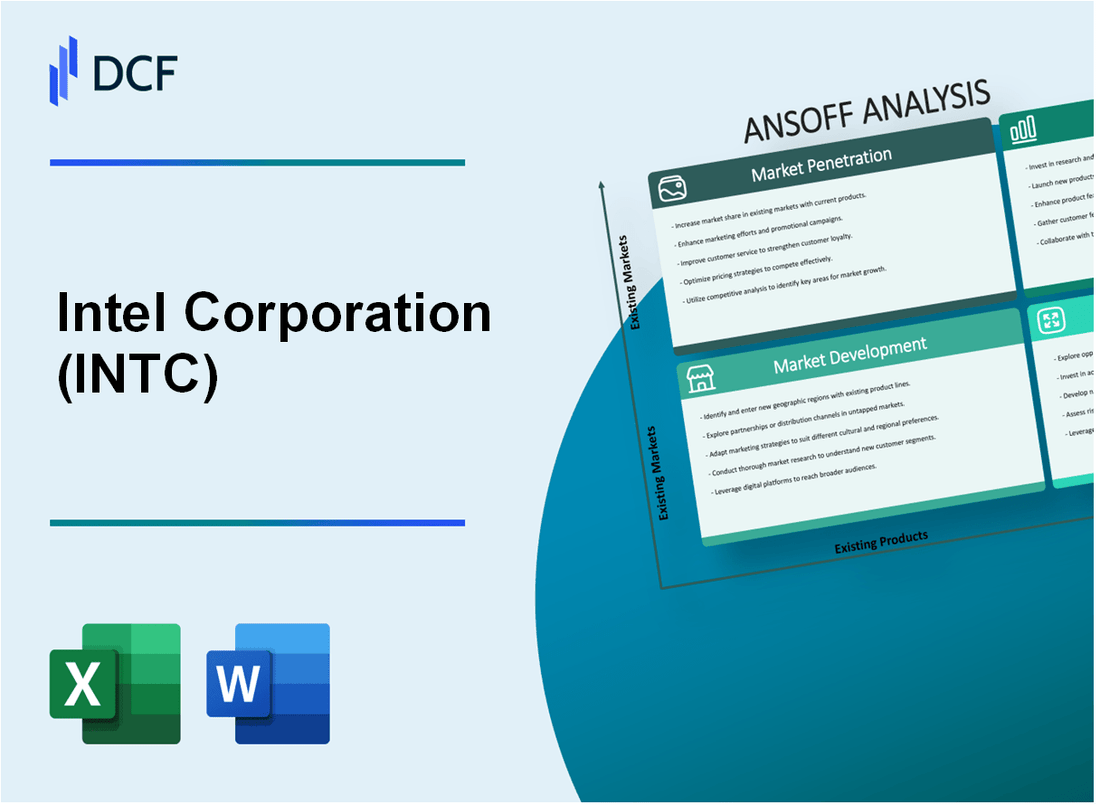
Intel Corporation (INTC): ANSOFF MATRIX [Apr-2026 Updated] |
Completamente Editable: Adáptelo A Sus Necesidades En Excel O Sheets
Diseño Profesional: Plantillas Confiables Y Estándares De La Industria
Predeterminadas Para Un Uso Rápido Y Eficiente
Compatible con MAC / PC, completamente desbloqueado
No Se Necesita Experiencia; Fáciles De Seguir
Intel Corporation (INTC) Bundle
You're looking at Intel Corporation's massive $18 billion gross capital expenditure plan for 2025 and wondering where the real growth levers are hiding. Honestly, the strategy is a full-court press across every quadrant of the Ansoff Matrix, from aggressively pricing existing Xeon platforms to defend that 55% server market share, to launching Panther Lake on the 18A node to reclaim performance leadership. We've mapped out exactly how they plan to use that capital-whether it's boosting AI PC volume with channel incentives, targeting new telecom customers with existing Network and Edge Group products, or scaling Intel Foundry Services by securing external volume from partners like Microsoft and Amazon-so you can see the near-term risks and concrete opportunities in their product and market plays. Dive in below to see the specific actions driving their next phase.
Intel Corporation (INTC) - Ansoff Matrix: Market Penetration
Market Penetration for Intel Corporation (INTC) focuses on selling more of what you already make into markets you already serve. For INTC, this means defending and growing share in the server and client computing spaces with current or near-term product lines.
Aggressively price existing Xeon platforms to stabilize the 55% server market share. You know the competition from AMD has been fierce; in the second quarter of 2025, Intel executives conceded that the company held roughly 55% of the server CPU market. The goal here is to stop the bleeding and solidify the installed base. Still, by the third quarter of 2025, the server CPU market share was reported at 63.3%, suggesting some stabilization or recovery efforts are taking hold, but the fight for every socket continues.
Increase channel incentives for AI PC platforms to drive volume in the Client Computing Group (CCG). The CCG was a significant contributor, posting revenue of $7.6 billion in the first quarter of 2025, which was over half of the total sales that quarter. To maintain this momentum, Intel is pushing hard on the AI PC narrative, aiming to ship processors for over 100 million AI PCs globally by the end of 2025. This volume target is set against a total PC TAM (Total Addressable Market) projected at 290 million units for 2025.
Leverage the $17 billion non-GAAP operating expense target for 2025 to fund targeted marketing campaigns. You're looking to fund these aggressive market plays by maintaining strict cost discipline. Intel has been driving efficiency, initially targeting non-GAAP operating expenses of $17 billion for 2025, later revising this down to $16.8 billion to reflect the Altera deconsolidation. This controlled spending is meant to fuel the necessary marketing spend to win in the existing markets.
Bundle Arc GPUs with core CPUs to increase average selling price (ASP) in the consumer segment. This is about increasing the value proposition of the core CPU sale by including discrete graphics. Intel is pushing its Arc technology, with the Intel Arc Pro B60 GPU sampling in June 2025 and the Arc Pro B50 GPU following in July 2025. The hope is that bundling these with Core Ultra CPUs will lift the overall transaction value, even if the consumer segment faces intense competition.
Here are the key 2025 financial and operational targets that underpin this market penetration strategy:
| Metric | Target/Figure | Source Context |
| Non-GAAP Operating Expense Target (Initial/Reiterated) | $17 billion | 2025 Full Year Target |
| Non-GAAP Operating Expense Target (Revised) | $16.8 billion | Revised Post-Altera Deconsolidation |
| Server CPU Market Share (Q2 2025 Acknowledged) | 55% | Figure Intel Executives Conceded |
| Server CPU Market Share (Q3 2025 Reported) | 63.3% | Latest Reported Figure |
| AI PC Shipment Goal | Over 100 million units | By end of 2025 |
| Total PC TAM Projection | 290 million units | For 2025 |
| CCG Revenue (Q1 2025) | $7.6 billion | Accounted for over half of total sales |
The Arc Pro B-Series sampling dates are also relevant for driving adoption in the professional/consumer overlap:
- Intel Arc Pro B60 GPU sampling: starting June 2025.
- Intel Arc Pro B50 GPU availability: starting July 2025.
You're pushing volume with pricing on Xeon and driving attach rates with incentives and bundles on the CCG side, all while keeping a tight lid on overhead, targeting that $16.8 billion to $17 billion OpEx range. Finance: draft the Q4 2025 OpEx variance analysis by next Tuesday.
Intel Corporation (INTC) - Ansoff Matrix: Market Development
You're looking at how Intel Corporation is pushing its current products into new territories, which is the essence of Market Development here. The overall business is showing signs of stabilization, with third-quarter 2025 total revenues hitting $13.7 billion, representing a 3% YoY growth. This modest top-line increase suggests that efforts to find new revenue streams outside of the traditional, slower-growing PC segment are starting to matter.
The strategy involves aggressively targeting international areas where PC saturation isn't as high as in mature Western markets. This is happening while the core Client Computing Group (CCG) saw revenue up +5% in Q3 2025, showing the mature market isn't completely dead, but the focus must shift. To support these growth initiatives, Intel is driving operational efficiency, targeting non-GAAP operating expenses of approximately $17 billion for 2025.
Targeting the telecommunications sector with existing Network and Edge Group (NEX) products for 5G infrastructure is a key part of this, though the unit is under strategic review. The NEX Group generated $5.8 billion in revenue in 2024, which was about 11% of total sales. Despite this scale, reports indicate Intel is weighing a potential exit or spin-off of the NEX division to sharpen focus on core CPU markets. Still, the products, like AI-optimized scale-out Ethernet solutions, are positioned for 5G infrastructure needs.
Driving adoption of Infrastructure Processing Units (IPUs) in new hyperscaler accounts is aimed at bolstering the Data Center and AI segment. While the Data Center and AI division revenue dropped 1% year-over-year in Q3 2025, the introduction of IPU adaptors, which are now broadly available, is expected to help drive AI data center growth and profitability in 2025 and beyond.
Positioning current-gen Atom and Core processors for industrial IoT and edge AI applications globally is a direct play for new market segments. Intel launched the Core Ultra (Series 2) processors at CES 2025, explicitly designed for edge computing, offering superior performance in metrics like media processing and AI analytics compared to previous generations. For instance, the high-end Core Ultra 9 shows performance gains in AI workloads. Conversely, the search volume trend for the lower-power Atom processors remained consistently low, registering between 12-15 from June 2024 to May 2025, suggesting minimal current demand traction in the areas where Intel is trying to expand.
Here's a snapshot of the product and market context:
| Metric/Segment | Value/Figure | Year/Period | Source Context |
| Total Revenue | $13.7 billion | Q3 2025 | |
| Total Revenue YoY Growth | 3% | Q3 2025 | |
| NEX Group Revenue | $5.8 billion | 2024 | |
| PC CPU Market Share | 68% | 2025 Context | |
| Non-GAAP Operating Expenses Target | $17 billion | 2025 | |
| Atom Processor Search Volume (Normalized) | 12-15 | June 2024-May 2025 |
The push into edge AI is supported by new silicon like the Core Ultra 200V series, which features an updated Neural Processing Unit (NPU) with up to 48 TOPS (Trillions Operations Per Second).
- Expand sales efforts in emerging international markets to offset slower growth in mature PC markets.
- Target the telecommunications sector with existing NEX products for 5G infrastructure.
- Drive adoption of IPUs in new hyperscaler accounts.
- Position current-gen Atom and Core processors for industrial IoT and edge AI applications globally.
Intel Corporation (INTC) - Ansoff Matrix: Product Development
Intel Corporation (INTC) is driving product development across its client and data center portfolios, leveraging new process nodes and advanced packaging.
The launch of Panther Lake client CPUs on the new 18A process node is scheduled for high-volume production in the second half of 2025. Panther Lake processors are expected to consist of 70 percent Intel silicon, which is projected to boost profit margins. Performance projections suggest these chips can deliver 50% more performance at similar power compared to Lunar Lake chips or reduce power by 30% in multi-threaded work versus Arrow Lake-H processors.
The Data Center and AI (DCAI) customer base is being introduced to new Xeon 6 processors, which launched in February 2025. The Xeon 6 family includes the 6700P and 6500P series P-core processors. The DCAI segment revenue in the first quarter of 2025 was $4.1 billion, up from $3.8 billion in Q1 2024, with an operating margin of 13.9%. For the second quarter of 2025, the DCAI operating income reached $633m, representing an operating margin of 16.1%.
The rollout of the Granite Rapids server CPU is being accelerated, though its successor, Clearwater Forest, has been pushed to 2026. Granite Rapids, built on the Intel 3 process, maxed out at 128 cores, following Sierra Forest which offered up to 144 cores.
Advanced packaging technologies like Foveros Direct are being integrated into new products. Foveros Direct 3D technology, which uses copper bonding, is expected to debut in a future Intel Xeon processor in 2025. The first generation of Foveros Direct 3D will use a pitch of 9um, with the second generation shrinking this to 3um. The Intel 18A-PT variant can connect to a top die using Foveros Direct 3D with an interconnect pitch less than 5 micrometers (µm).
Here are key performance and financial metrics related to these product developments:
| Product/Metric | Value | Context |
|---|---|---|
| Panther Lake Silicon In-House Mix | 70 percent | Percentage of Intel silicon in Panther Lake processors |
| Panther Lake Performance vs. Lunar Lake (at similar power) | 50% more performance | Claimed improvement for Panther Lake |
| Panther Lake Power Reduction vs. Arrow Lake-H (multi-threaded) | 30% reduction | Claimed improvement for Panther Lake |
| Xeon 6 Enterprise Task Performance vs. Previous Gen | 1.4 times better | Performance gain across enterprise tasks |
| Xeon 6 RAN Capacity Increase vs. Previous Gen | Up to 2.4 times more | RAN capacity improvement |
| Xeon 6 AI RAN Performance vs. Previous Gen | Up to 3.2 times better | Performance for AI-driven radio access networks |
| Xeon 6 P-Core Cores Max | Up to 128 cores | Maximum core count per CPU in the Xeon 6 family |
| Xeon 6 Memory Bandwidth vs. Epyc | Up to 30 percent higher speed | Relative memory bandwidth advantage |
| Foveros Direct 3D Interconnect Pitch (Gen 1) | 9um | Copper bonding pitch for the first generation |
| DCAI Q1 2025 Revenue | $4.1 billion | Revenue for the Data Center and AI segment |
| 2025 Non-GAAP Operating Expense Target | $17 billion | Intel's target for operating expenses for the year |
The integration of these new products is supported by the following operational and technology milestones:
- Launch of Panther Lake client CPUs on 18A in the second half of 2025.
- Xeon 6 processors launched in February 2025.
- Granite Rapids-D server CPUs targeted for launch in 2025.
- Foveros Direct 3D technology expected to debut in a 2025 Xeon processor.
- Intel's gross capital expenditures target for 2025 is set at $18 billion.
- The Xeon 6700P and 6500P series can outperform 5th Gen AMD EPYC by up to 1.5 times using one-third fewer cores.
Intel Corporation (INTC) - Ansoff Matrix: Diversification
You're looking at Intel Corporation's aggressive push into new markets and services, which is the core of the Diversification quadrant in the Ansoff Matrix.
Scale Intel Foundry Services (IFS) by securing external customer volume for the 18A node, building on wins like Microsoft and Amazon.
Intel Foundry Services is targeting break-even sometime in 2027. To get there, the unit needs to attract external customers generating low to mid-single-digit billions in revenue. For the second quarter of 2025, Intel Foundry delivered revenue of $4.4 billion, alongside an operating loss of $3.2 billion. In the first quarter of 2025, the foundry unit reported sales of $4.7 billion, marking an increase of 7% from the year-ago period. Despite these figures, the committed volume for external customers using the upcoming 18A technology was described as 'not significant' as of May 2025. The estimated external foundry revenue for the full calendar year 2025 is only $120 million. The overall gross Capital Expenditure guidance for 2025 is set at $18 billion, with net CapEx expected between $8 billion to $11 billion. Operating expense targets for 2025 are set at $17 billion.
The Amazon Web Services (AWS) deal is a cornerstone, structured as a multi-year, multi-billion-dollar framework to produce custom AI chips on the 18A process node. This collaboration is supported by AWS's plan to invest $7.8 billion to expand its data center footprint in Ohio. Intel also inked a similar partnership with Microsoft earlier in 2024.
Develop purpose-built AI accelerators (e.g., Gaudi 3) for high-end AI training, a new market segment.
Intel Corporation is competing in the AI accelerator space where market leader Nvidia reported data center revenue exceeding $26 billion per quarter in late 2024. Rival AMD was expected to sell $4.5 billion worth of AI accelerators in 2024. Intel's Gaudi 3 accelerator faced software adoption hurdles, leading to a missed revenue target of $500 million for 2024. The shipment target for Gaudi 3 in 2025 was revised downward by over 30%, from an initial projection of 300K to 350K units down to 200K to 250K units. A partnership with IBM in 2025 will see Gaudi 3 chips deployed in IBM's cloud data centers. Intel claims an AI package with eight Gaudi 3 chips costs only two-thirds the price of comparable competitive platforms.
Pursue the reported deal to manufacture low-end Apple M-series chips, validating the 18A process for a new customer and product line.
Analyst Ming-Chi Kuo reported that Apple is preparing to certify its entry-level M-series chips on Intel's 18A process, having already signed a confidential foundry agreement and received the 18AP PDK 0.9.1GA. If development proceeds as planned, Intel could begin mass production for Apple as early as the second or third quarter of 2027. The chips targeted are for devices like the MacBook Air and iPad Pro, which accounted for roughly 20 million units in shipments in 2025. Annual demand for this entry-level line is projected to stabilize between 15 and 20 million units from 2026 to 2027.
Monetize advanced packaging as a standalone service for fabless companies, separate from full wafer manufacturing.
Revenue from Intel's advanced packaging services is expected to begin picking up in the second half of 2025. This service contributed to the Intel Foundry business generating $311 million in revenue during the third quarter of 2023, representing a growth of 299% year-over-year.
| Metric | Value/Target | Timeframe/Context |
| IFS External Revenue Target for Break-even | Low to mid-single-digit billions | By 2027 |
| Intel Foundry Revenue (Q2 2025) | $4.4 billion | Q2 2025 |
| Intel Foundry Operating Loss (Q2 2025) | $3.2 billion | Q2 2025 |
| Estimated External Foundry Revenue | $120 million | CY2025 |
| Gross CapEx Guidance | $18 billion | 2025 |
| Net CapEx Guidance Range | $8 billion to $11 billion | 2025 |
| Operating Expense Target | $17 billion | 2025 |
| Projected Apple M-series Chip Volume (Low-End) | 15 million to 20 million units | 2026 and 2027 |
| Projected Gaudi 3 Shipments (Revised Target) | 200K to 250K units | 2025 |
| Gaudi 3 Revenue Goal Missed | $500 million | 2024 |
The IFS unit is structured as an independent subsidiary to help attract these external opportunities.
- Signed multi-year, multi-billion-dollar framework with Amazon Web Services (AWS) for 18A chips.
- Secured contract to build Microsoft's Maia 2 AI processor on 18A/18A-P node.
- Apple is reportedly preparing to qualify the 18A process for low-end M-series chips.
- Advanced packaging revenue expected to ramp in the second half of 2025.
Disclaimer
All information, articles, and product details provided on this website are for general informational and educational purposes only. We do not claim any ownership over, nor do we intend to infringe upon, any trademarks, copyrights, logos, brand names, or other intellectual property mentioned or depicted on this site. Such intellectual property remains the property of its respective owners, and any references here are made solely for identification or informational purposes, without implying any affiliation, endorsement, or partnership.
We make no representations or warranties, express or implied, regarding the accuracy, completeness, or suitability of any content or products presented. Nothing on this website should be construed as legal, tax, investment, financial, medical, or other professional advice. In addition, no part of this site—including articles or product references—constitutes a solicitation, recommendation, endorsement, advertisement, or offer to buy or sell any securities, franchises, or other financial instruments, particularly in jurisdictions where such activity would be unlawful.
All content is of a general nature and may not address the specific circumstances of any individual or entity. It is not a substitute for professional advice or services. Any actions you take based on the information provided here are strictly at your own risk. You accept full responsibility for any decisions or outcomes arising from your use of this website and agree to release us from any liability in connection with your use of, or reliance upon, the content or products found herein.