
|
Intel Corporation (INTC): Análisis PESTLE [Actualizado en Ene-2025] |
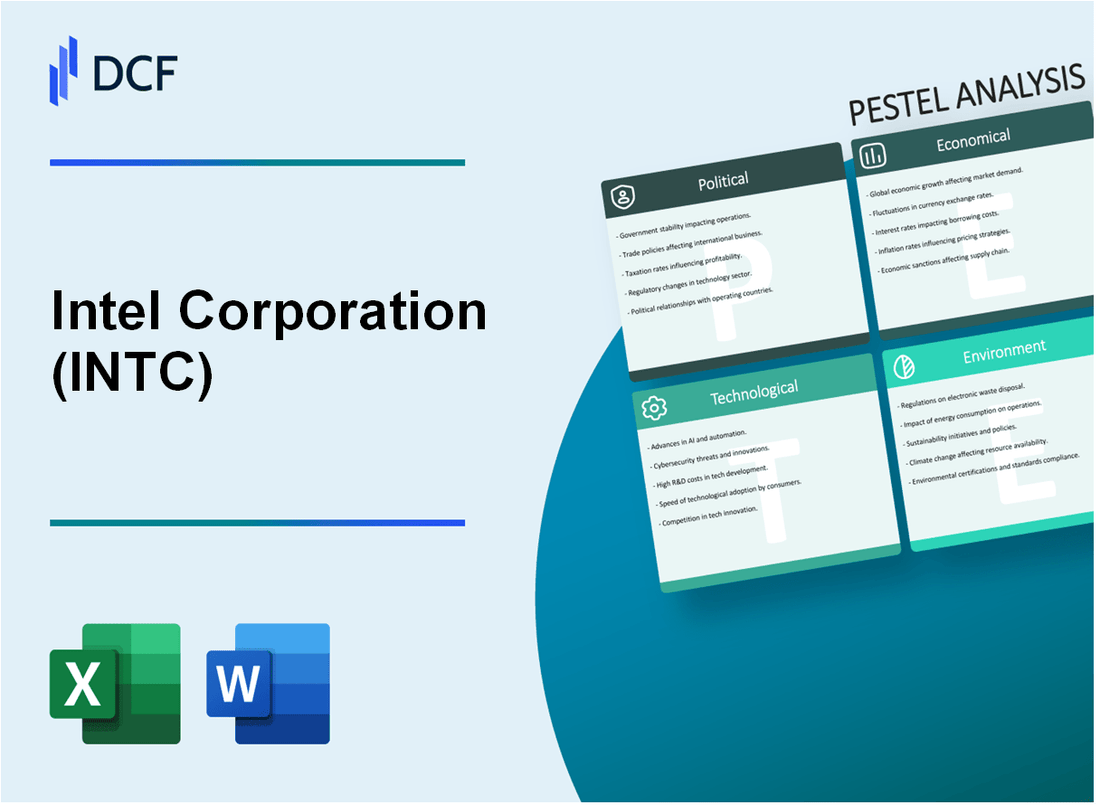
Completamente Editable: Adáptelo A Sus Necesidades En Excel O Sheets
Diseño Profesional: Plantillas Confiables Y Estándares De La Industria
Predeterminadas Para Un Uso Rápido Y Eficiente
Compatible con MAC / PC, completamente desbloqueado
No Se Necesita Experiencia; Fáciles De Seguir
Intel Corporation (INTC) Bundle
En el mundo dinámico de la tecnología de semiconductores, Intel Corporation se encuentra en una encrucijada crítica, navegando por un panorama complejo de desafíos globales y oportunidades transformadoras. Desde las intrincadas tensiones geopolíticas que dan forma al comercio internacional hasta las implacables innovaciones tecnológicas que impulsan el poder informático, el posicionamiento estratégico de Intel revela una narrativa multifacética de resistencia, adaptación y liderazgo tecnológico. Este análisis integral de mano de mortero retira las capas de factores externos que influyen en una de las compañías de tecnología más influyentes del mundo, ofreciendo ideas sin precedentes sobre el intrincado ecosistema que define el viaje corporativo de Intel.
Intel Corporation (INTC) - Análisis de mortero: factores políticos
Actualización de fabricación de semiconductores del gobierno de los Estados Unidos a través de la Ley de chips
La Ley de Chips y Ciencias, firmada el 9 de agosto de 2022, asignada $ 52.7 mil millones para la fabricación e investigación de semiconductores en los Estados Unidos. Intel recibirá fondos significativos para su expansión de fabricación.
| Ubicación | Monto de la inversión | Instalación planificada |
|---|---|---|
| Ohio | $ 20 mil millones | Nueva instalación de fabricación de semiconductores |
| Arizona | $ 3 mil millones | Expansión del complejo de fabricación existente |
Tensiones comerciales de US-China que afectan las cadenas de suministro de semiconductores
El gobierno de EE. UU. Implementó controles de exportación en tecnología avanzada de semiconductores a China, impactando las estrategias de fabricación global de Intel.
- Restricciones de exportación en equipos avanzados de fabricación de chips
- Limitaciones en las transferencias de tecnología a compañías de semiconductores chinos
- Impacto potencial de ingresos de $ 3.5 mil millones a $ 4 mil millones en 2023 debido a restricciones de exportación
Riesgos geopolíticos en fabricación de tecnología internacional
Intel enfrenta importantes desafíos geopolíticos en sus operaciones de fabricación global.
| Región | Factor de riesgo político | Impacto potencial |
|---|---|---|
| Taiwán | Conflicto potencial de China-Taiwán | Interrupción de la cadena de suministro |
| Israel | Inestabilidad política regional | Riesgos de seguridad de la instalación de fabricación |
Entorno regulatorio para la tecnología y la propiedad intelectual de los semiconductores
Intel navega por las complejas regulaciones internacionales de propiedad intelectual y el escrutinio del gobierno.
- Cumplimiento de 54 Diferentes regímenes de control de exportación de tecnología nacional
- Litigios de patentes continuos y desafíos de protección de propiedad intelectual
- Costos de cumplimiento legales y regulatorios totales estimados en $ 275 millones anualmente
Intel Corporation (INTC) - Análisis de mortero: factores económicos
Una demanda global significativa de chips de semiconductores
El tamaño del mercado global de semiconductores alcanzó los $ 595.78 mil millones en 2022, con un crecimiento proyectado a $ 765.94 mil millones para 2027, lo que representa una tasa compuesta anual del 5.2%.
| Segmento de mercado | Demanda de semiconductores (2022) | Crecimiento proyectado |
|---|---|---|
| Computación | $ 196.5 mil millones | 6.3% CAGR |
| Electrónica automotriz | $ 62.3 mil millones | 8.7% CAGR |
| Electrónica de consumo | $ 134.6 mil millones | 4.9% CAGR |
Naturaleza cíclica del mercado de semiconductores
Los ingresos de Intel en 2022 fueron de $ 63.1 mil millones, un 20.4% menos que de 2021 $ 79.0 mil millones, lo que refleja la volatilidad del mercado.
| Año | Ganancia | Lngresos netos | Condición de mercado |
|---|---|---|---|
| 2021 | $ 79.0 mil millones | $ 20.0 mil millones | Alta demanda |
| 2022 | $ 63.1 mil millones | $ 8.0 mil millones | Recesión del mercado |
Requisitos de gasto de capital
El gasto de capital de Intel en 2022 fue de $ 25.9 mil millones, con inversiones planificadas de $ 100 mil millones en instalaciones de fabricación de semiconductores en los Estados Unidos.
| Ubicación | Inversión | Tipo de instalación |
|---|---|---|
| Ohio, Estados Unidos | $ 20 mil millones | Fab de semiconductores |
| Arizona, EE. UU. | $ 3 mil millones | Expansión |
| Nuevo Méjico | $ 3.5 mil millones | Centro de investigación |
Presiones competitivas
Comparación de participación de mercado para los principales fabricantes de semiconductores en 2022:
| Compañía | Cuota de mercado | Ganancia |
|---|---|---|
| TSMC | 53.1% | $ 68.5 mil millones |
| Intel | 15.7% | $ 63.1 mil millones |
| Amd | 10.4% | $ 23.6 mil millones |
Intel Corporation (INTC) - Análisis de mortero: factores sociales
Iniciativas de diversidad e inclusión de la fuerza laboral creciente
A partir de 2023, Intel informó las siguientes estadísticas de diversidad de la fuerza laboral:
| Categoría demográfica | Porcentaje |
|---|---|
| Mujeres en la fuerza laboral global | 27.7% |
| Mujeres en roles de liderazgo | 24.4% |
| Minorías subrepresentadas en la fuerza laboral de EE. UU. | 21.3% |
| Minorías subrepresentadas en el liderazgo de los Estados Unidos | 12.5% |
Aumento de la demanda de fabricación de tecnología sostenible y ética
Inversiones de sostenibilidad de Intel en 2023:
| Métrica de sostenibilidad | Valor |
|---|---|
| Uso total de energía renovable | 85% |
| Inversión en conservación del agua | $ 60 millones |
| Objetivo de reducción de emisiones de carbono | 90% para 2040 |
Competencia de talento en sectores de ingeniería e investigación de alta tecnología
Adquisición de talento de Intel y métricas de inversión de I + D:
| Talento métrico | 2023 datos |
|---|---|
| Gastos anuales de I + D | $ 19.3 mil millones |
| Número de patentes archivadas | 2,661 |
| Salario promedio de ingeniero | $132,000 |
Cambiando las preferencias del consumidor hacia las tecnologías informáticas de eficiencia energética
Preferencias del consumidor en computación eficiente en energía:
| Métrica de eficiencia energética | Porcentaje/valor |
|---|---|
| Preferencia del consumidor por procesadores de eficiencia energética | 68% |
| Cuota de mercado de procesadores de computadoras portátiles de eficiencia energética | 42% |
| Inversión anual en tecnología energéticamente eficiente | $ 1.2 mil millones |
Intel Corporation (INTC) - Análisis de mortero: factores tecnológicos
Inversión continua en investigación y desarrollo de semiconductores avanzados
Intel invirtió $ 19.4 mil millones en investigación y desarrollo en 2022. El gasto de I + D de la compañía como porcentaje de ingresos fue del 22.3% en el mismo año.
| Año | Inversión de I + D | I + D como % de ingresos |
|---|---|---|
| 2022 | $ 19.4 mil millones | 22.3% |
| 2021 | $ 15.2 mil millones | 19.7% |
Liderazgo en microprocesador y tecnologías de fabricación de chips
Intel mantiene una participación de mercado significativa en la fabricación del procesador X86, con aproximadamente el 80.1% del mercado de CPU de escritorio en el cuarto trimestre de 2022.
| Categoría de procesador | Cuota de mercado |
|---|---|
| CPU de escritorio | 80.1% |
| CPU del servidor | 69.4% |
Expandir el enfoque en la inteligencia artificial y las innovaciones de computación cuántica
Intel invirtió $ 3.5 mil millones en investigación de computación cuántica a través de su división de sistemas cuánticos Intel en 2022. La Compañía ha desarrollado procesadores cuánticos de 49 quits.
| IA/inversión cuántica | Cantidad |
|---|---|
| Investigación de computación cuántica | $ 3.5 mil millones |
| Qubits de procesador cuántico | 49 QUBITS |
Desarrollo de soluciones informáticas de alto rendimiento y eficiente en energía
Los procesadores de 12ª generación de Intel demuestran una mejora del rendimiento del 19% en las generaciones anteriores, al tiempo que mantienen un 30% de eficiencia energética mejor.
| Métrico de rendimiento | Mejora |
|---|---|
| Mejora del rendimiento | 19% |
| Eficiencia energética | 30% mejor |
Intel Corporation (INTC) - Análisis de mortero: factores legales
Estrategias complejas de protección de propiedad intelectual
A partir de 2024, Intel posee 51,950 patentes activas a nivel mundial. La compañía gastó $ 15.2 mil millones en investigación y desarrollo en 2023, apoyando directamente sus estrategias de protección de propiedad intelectual.
| Categoría de patente | Número de patentes | Distribución geográfica |
|---|---|---|
| Tecnología de semiconductores | 22,375 | Estados Unidos |
| Arquitectura del procesador | 15,620 | Asia Pacífico |
| Procesos de fabricación | 8,955 | Europa |
Cumplimiento de las regulaciones internacionales de comercio de tecnología
Intel enfrentó $ 2.18 mil millones en posibles costos de cumplimiento de la exportación en 2023 relacionados con las restricciones comerciales internacionales, particularmente que involucran controles de exportación de China y semiconductores.
| Región reguladora | Inversión de cumplimiento | Enfoque regulatorio |
|---|---|---|
| Estados Unidos | $ 875 millones | Cumplimiento de control de exportación |
| unión Europea | $ 412 millones | Regulaciones de transferencia de tecnología |
| Porcelana | $ 893 millones | Gestión de restricciones comerciales |
Desafíos potenciales de ley antimonopolio y competencia
Intel ha asignado $ 1.45 mil millones para posibles acuerdos legales y defensa antimonopolio en 2024. Los procedimientos legales actuales actuales implican múltiples jurisdicciones que cuestionan el dominio del mercado.
Requisitos de cumplimiento regulatorio de privacidad de datos y ciberseguridad
Intel invirtió $ 623 millones en mecanismos de cumplimiento de ciberseguridad y protección de datos en 2023. La Compañía mantiene el cumplimiento de GDPR, CCPA y otros marcos internacionales de protección de datos.
| Marco regulatorio | Inversión de cumplimiento | Áreas de enfoque clave |
|---|---|---|
| GDPR | $ 215 millones | Protección de datos europeo |
| CCPA | $ 178 millones | Privacidad del consumidor de California |
| Normas globales de ciberseguridad | $ 230 millones | Cumplimiento de la jurisdicción |
Intel Corporation (INTC) - Análisis de mortero: factores ambientales
Compromiso con los objetivos de energía renovable y neutralidad de carbono
Intel invirtió $ 300 millones en proyectos de energía renovable en 2023. La Compañía logró electricidad 100% renovable para operaciones globales en las regiones de los Estados Unidos, Europa y Asia Pacífico. Para 2030, Intel tiene como objetivo reducir las emisiones de gases de efecto invernadero en un 55% en comparación con los niveles de referencia de 2019.
| Año | Inversión de energía renovable | Objetivo de reducción de carbono |
|---|---|---|
| 2023 | $ 300 millones | 55% de reducción para 2030 |
| 2022 | $ 250 millones | 45% de progreso de reducción |
Mejoras de procesos de fabricación sostenibles
Intel redujo el consumo de energía de fabricación en un 7,2% en 2023. La compañía implementó tecnologías avanzadas de eficiencia energética en sus instalaciones de fabricación, lo que resultó en $ 127 millones en ahorros de costos de energía.
| Métrico | 2023 rendimiento |
|---|---|
| Reducción del consumo de energía | 7.2% |
| Ahorro de costos de energía | $ 127 millones |
Reducción del consumo de agua y desechos electrónicos
Intel recicló el 82% de los desechos totales generados en 2023. El consumo de agua disminuyó en 13.6 millones de galones en comparación con el año anterior. La compañía recuperó el 100% del agua del proceso en las instalaciones de fabricación de semiconductores.
| Métrica de gestión de residuos | 2023 rendimiento |
|---|---|
| Tasa de reciclaje de residuos | 82% |
| Reducción del consumo de agua | 13.6 millones de galones |
| Proceso de recuperación del agua | 100% |
Implementación de principios de economía circular en producción tecnológica
Intel invirtió $ 75 millones en iniciativas de economía circular en 2023. La compañía desarrolló programas de reciclaje para componentes electrónicos, recuperando el 92% de los metales de tierras raras de los productos de semiconductores usados.
| Métrica de economía circular | 2023 rendimiento |
|---|---|
| Inversión en economía circular | $ 75 millones |
| Tasa de recuperación de metal de tierras raras | 92% |
Intel Corporation (INTC) - PESTLE Analysis: Social factors
You're looking at Intel Corporation's social landscape, and honestly, it's a study in contrasts. On one side, you have the harsh reality of cost-cutting and layoffs affecting thousands of employees. But on the other, you see a deep commitment to societal impact through diversity and crucial AI skills training. The near-term risk is employee morale; the long-term opportunity is a stronger, more representative workforce building products the world actually needs.
Significant workforce reduction, including 24,000 planned layoffs in 2025, to cut costs.
The biggest social factor hitting Intel Corporation right now is the massive, necessary workforce restructuring. To hit its ambitious cost-saving targets, the company is executing a significant reduction plan, which includes a planned cut of up to 24,000 positions in the 2025 fiscal year. Here's the quick math: with a global workforce of around 124,800 people as of late 2024, this represents a reduction of nearly 20% of its total staff.
This isn't just a number; it's a culture shock. While the goal is to save billions-part of the broader $8 billion to $10 billion in cost reductions by the end of 2025-the human cost is high. If severance packages and outplacement services aren't handled with extreme care, the risk to the remaining employee morale and Intel Corporation's reputation as an employer of choice rises defintely.
The company is streamlining, but they need to make sure they don't lose key talent in the process. That's the tightrope walk.
Strong societal demand for energy-efficient chips drives product design focus.
Societal values are directly influencing Intel Corporation's product roadmap, which is a good thing. The global push for sustainability and the explosion of power-hungry AI workloads have created a strong demand for energy-efficient chips. This isn't a niche market; it's the mainstream expectation for both data centers and consumer devices.
Intel Corporation is responding by focusing its design efforts on power-per-watt performance across its entire portfolio, from the latest Xeon processors for the data center to Core Ultra chips for laptops. For example, the new generation of processors is targeting a 25% improvement in performance-per-watt over prior generations, directly addressing this societal pressure. This focus translates into a competitive advantage and better public perception.
The world wants to compute more while consuming less power.
Commitment to full representation of women and underrepresented groups in leadership by 2030.
Intel Corporation has set a clear, public goal to achieve full representation of women and underrepresented groups in leadership roles by 2030. This is a critical social commitment that impacts everything from recruitment to internal promotion structures. As of the latest reporting, the company has made measurable progress, but it still has ground to cover.
To be fair, this is a long-term structural change, not a quick fix. The current representation figures show the challenge ahead:
| Metric | 2024 Baseline (Approx.) | 2030 Goal |
|---|---|---|
| Women in Leadership | 24.5% | Full Representation (Parity) |
| Underrepresented Minorities in Leadership (US) | 13.7% | Full Representation (Parity) |
| Technical Roles Held by Women | 26.1% | Full Representation (Parity) |
The company is tracking this closely, and the pressure is on to increase the pipeline of diverse talent. This commitment is a key differentiator for attracting younger, diverse employees who prioritize corporate social responsibility.
Digital Readiness Programs trained 8 million people in AI skills globally.
Intel Corporation's social contribution extends beyond its own walls through its Digital Readiness Programs. The company has made a significant global impact by training 8 million people in essential AI skills. This initiative directly addresses the global talent gap in artificial intelligence, which is a major societal and economic bottleneck.
This program focuses on democratizing access to AI education, from students to workers needing to reskill. The training covers practical applications of AI, not just theory. This effort builds goodwill and, more strategically, creates a broader ecosystem of developers and users familiar with Intel Corporation's technologies. It's a smart way to invest in future market growth.
The program's reach is global, with key initiatives in regions like India, the US, and Brazil, focusing on:
- Providing hardware and curriculum to underserved schools.
- Offering free online courses for AI certification.
- Partnering with governments to integrate AI literacy into national education plans.
The next concrete step is for the HR and Finance departments to model the long-term cost-benefit of the workforce reduction against the retention risk of high-performing employees, specifically those in AI and power-efficiency R&D, by the end of next week.
Intel Corporation (INTC) - PESTLE Analysis: Technological factors
The core of Intel Corporation's technological risk and opportunity in 2025 is a dual challenge: reclaiming manufacturing leadership through the IDM 2.0 strategy while simultaneously defending its x86 dominance against a two-front assault from Advanced Micro Devices (AMD) and the rising tide of Arm-based chips. The company's future hinges on the successful, timely rollout of its next-generation process node and effectively leveraging the massive AI investment from NVIDIA.
Fierce competition from Advanced Micro Devices, which holds 36.5% of the server CPU market in Q3 2025.
You are seeing a relentless erosion of Intel's long-held data center dominance, and the numbers from Q3 2025 confirm the competitive pressure is intense. Advanced Micro Devices (AMD) has continued to chip away at the x86 server market, driven by its high-core-count EPYC processors. Mercury Research data shows that AMD's server CPU unit share climbed to 27.8% in Q3 2025, up from 27.3% in Q2 2025, while Intel's unit share slipped to 72.2%.
Here's the quick math: while Intel still ships the majority of units, analysts forecast AMD's revenue share-the value of the chips sold-will grow to approximately 36% by the end of 2025, with Intel dropping to around 55% of the revenue pie. This difference between unit and revenue share highlights that AMD is capturing the high-value, high-margin segments, forcing Intel to compete aggressively with its Xeon 6 'Granite Rapids' lineup. The competition is defintely not slowing down.
| Server CPU Market Share Metric (Q3 2025) | Intel Corporation | Advanced Micro Devices (AMD) |
|---|---|---|
| Unit Share (Mercury Research) | 72.2% | 27.8% |
| Revenue Share Forecast (2025) | ~55% | ~36% |
IDM 2.0 strategy hinges on successfully launching the 18A (1.8nm class) process node.
The Integrated Device Manufacturing 2.0 (IDM 2.0) strategy is Intel's multi-billion-dollar bet on regaining process leadership. The entire plan is pinned on the successful, on-time launch of the Intel 18A (1.8nm class) process node. This node is critical because it will be the first to feature two groundbreaking technologies: RibbonFET (Gate-All-Around transistor architecture) and PowerVia (backside power delivery).
The good news is that the 18A node entered risk production in Q2 2025, a key milestone. Intel has confirmed its first 18A-based products, the client CPU 'Panther Lake' and the server CPU 'Clearwater Forest,' are on track to begin production in the second half of 2025. Securing external customers is paramount for the Intel Foundry Services (IFS) division, which reported a 3% year-over-year revenue increase to $4.4 billion in Q2 2025, despite an operating loss of $2.3 billion in Q3 2025. A major validation came from Microsoft, which committed to producing a chip design on the 18A process, and is a significant step toward validating the foundry model.
AI-driven demand is a primary growth catalyst; NVIDIA invested $5 billion in Intel in 2025.
The massive, AI-driven demand for accelerated computing is Intel's biggest growth catalyst, and a major strategic move was the $5 billion investment from NVIDIA, announced in September 2025. This deal is a significant vote of confidence, with NVIDIA acquiring Intel common stock at $23.28 a share.
The investment is tied to a technical collaboration focused on co-developing custom products for both data centers and personal computers. This partnership is designed to tightly couple NVIDIA's AI and accelerated computing stack with Intel's x86 CPUs, specifically by integrating technologies like NVIDIA NVLink for faster communication between CPUs and GPUs in data center platforms. This strategic alignment provides Intel with a much-needed lifeline in the high-growth AI infrastructure market where it has lagged behind.
Increasing market penetration of Arm-based chips challenges the x86 architecture dominance.
Beyond the direct rivalry with AMD, Intel faces a structural threat from the increasing market penetration of Arm-based chips, particularly in the server space. The x86 architecture (Intel Xeon and AMD EPYC) is no longer the sole option for data centers.
The shift is being driven by hyperscalers like Amazon Web Services (AWS) with their custom Graviton CPUs. Analysts project Arm-based servers will account for approximately 20% to 23% of the global server market by the end of 2025. This growth is fueled by Arm's superior energy efficiency, which can deliver up to 45% lower power consumption per core compared to conventional x86 systems.
- AWS alone is set to deploy over 1.2 million Arm CPUs in their servers in 2025.
- The U.S. Arm-Based Server market size is projected at $4534.74 million in 2025.
- Arm's momentum is strongest in servers, with shipments rising 16% quarter-over-quarter in Q3 2025.
This is a long-term architectural challenge, forcing Intel to innovate rapidly on power efficiency as much as raw performance.
Intel Corporation (INTC) - PESTLE Analysis: Legal factors
Ongoing EU legal disputes regarding past anti-competitive practices carry fine risk.
You're watching Intel Corporation's European Union (EU) antitrust saga because it's a clear, near-term financial risk that could hit the income statement. The core dispute, dating back to 2009, involves allegations of anti-competitive practices, specifically 'naked restrictions' where Intel made payments to manufacturers like HP, Acer, and Lenovo to delay or block rival products. This isn't just old news; it's an active liability.
As of 2025, Intel is challenging a re-imposed EU fine of €376 million (approximately $421.4 million). To be fair, this is a significant reduction from the original €1.06 billion penalty, but the legal battle continues in the EU courts. A final resolution is anticipated soon, and while Intel has strong legal arguments, the risk of having to pay this substantial amount remains a clear line item on the risk register. It's a good reminder that past business practices can have a very long tail.
Complex global data privacy laws like GDPR and CCPA require continuous compliance investment.
The regulatory landscape for data privacy is a global maze, and for a multinational like Intel, compliance isn't a one-time project-it's a continuous, multi-billion dollar operational cost embedded in R&D and IT spending. You have to continually invest to meet the ever-changing standards of the EU's General Data Protection Regulation (GDPR) and the California Consumer Privacy Act (CCPA), plus its amendment, the California Privacy Rights Act (CPRA).
Intel's total Research and Development (R&D) expenses for the twelve months ending September 30, 2025, were $14.431 billion, and a portion of this massive budget goes directly into embedding security and privacy-by-design into every product and process. The real financial threat here is the potential penalty for a breach or non-compliance, which can be staggering.
Here's the quick math on the potential exposure:
- GDPR Fines: Up to 4% of annual global turnover or €20 million, whichever is higher, for the most serious violations.
- CCPA/CPRA Fines: Between $2,500 per violation and $7,500 for intentional violation.
Plus, new CCPA/CPRA regulations regarding Automated Decision-Making Technology (ADMT), risk assessments, and cybersecurity audits were finalized in 2025, with compliance deadlines starting January 1, 2026. This means an immediate need for internal policy and systems updates. You can't defintely afford to get this wrong.
Holds a substantial Intellectual Property portfolio with 51,950 active patents globally.
Intel's Intellectual Property (IP) portfolio is its crown jewel, serving as a massive defensive and offensive legal asset. This vast collection of patents is a critical barrier to entry for competitors and a source of licensing revenue. As of 2025, Intel holds over 102,821 active patents globally, making it one of the largest and most valuable IP portfolios in the semiconductor industry.
However, Intel is actively engaged in a strategic shift, which includes aggressive 'patent pruning.' This calculated move is designed to streamline the portfolio, reduce maintenance costs, and focus resources on core, high-growth areas like Artificial Intelligence (AI) and advanced foundry services. This is a smart move, but it requires careful legal management to avoid divesting critical, foundational technology.
The strategic value of this portfolio is best seen in its composition:
| IP Portfolio Metric | Value (Approx. 2025) | Strategic Implication |
|---|---|---|
| Total Active Patents (Globally) | Over 102,821 | Strong defensive moat against infringement lawsuits. |
| Strategic Focus Area | AI, Advanced Foundry Services (e.g., 18A process) | Aligns legal protection with the $14.431 billion annual R&D spend. |
| Recent Legal Strategy | Aggressive Patent Pruning | Reduces costs on legacy IP; monetizes non-core assets. |
Accounting uncertainty exists over the classification of the large Q3 2025 government funding.
A major legal and accounting challenge in the latter half of the 2025 fiscal year stems from the large-scale government funding Intel secured. This is a good problem to have, but it introduces significant complexity because there is limited precedent for the accounting treatment of these transactions.
The funding, primarily from the U.S. CHIPS and Science Act, includes over $7.8 billion in direct funding for manufacturing and R&D, plus an additional $3.2 billion in Secure Enclave grants. This totals over $11 billion in government support. The deal also involves the U.S. government taking a 10% stake in Intel, making it a major, albeit non-voting, shareholder.
Intel reported its Q3 2025 results using an accounting approach it believes is correct, but the company has initiated a consultation with the staff of the Securities and Exchange Commission (SEC) to confirm the classification. What this estimate hides is the risk that the SEC may disagree with Intel's accounting treatment, which could force a material revision to the Q3 2025 financial results. This uncertainty will hang over the stock until the SEC consultation is concluded.
Next Step: Finance: Continue close coordination with the SEC staff to resolve the accounting treatment of the government funding and prepare a contingency plan for a material revision to the Q3 2025 financial statements by the end of the fiscal year.
Intel Corporation (INTC) - PESTLE Analysis: Environmental factors
You're looking at Intel Corporation (INTC) and its environmental footprint, which is a massive, complex risk area for any chip manufacturer. The direct takeaway is that Intel is aggressively pursuing a net-zero operational goal by 2040, but the near-term focus in 2025 is on driving sustainability deep into their supply chain and maintaining near-perfect renewable electricity use despite significant manufacturing expansion.
Goal to achieve net-zero Scope 1 and 2 greenhouse gas (GHG) emissions by 2040.
Intel has committed to achieving net-zero greenhouse gas (GHG) emissions for its global operations (Scope 1 and 2) by 2040. This is a critical, long-term anchor for their climate action plan. Scope 1 emissions are direct releases from their facilities, and Scope 2 are indirect releases from purchased electricity. Honestly, given the massive energy demands of new fabrication plants (fabs), this is a defintely ambitious target.
To show you the scale of their current footprint, the total operational GHG emissions (Scope 1 and 2) for 2023 amounted to approximately 3,975,000 metric tons of CO2 equivalent (CO2e). Here's the quick math: Intel's actions in 2024 reduced their Scope 1 and 2 GHG emissions by 29,000 metric tons of CO2e, exceeding their internal goal of 25,000 metric tons for the year. This reduction is largely driven by their aggressive renewable energy procurement, which translates directly into lower Scope 2 emissions.
Achieved 98% renewable electricity globally in 2024, targeting 100% by 2030.
The company is nearly at its 2030 goal of 100% renewable electricity (RE) globally. As of 2024, Intel achieved 98% renewable electricity use across its global operations. This is a huge win, especially considering the massive increase in manufacturing capacity with new fabs in the US and Europe. They are essentially decarbonizing their purchased power, which is the biggest lever they have for Scope 2 reductions.
What this near-perfect score hides is the regional variability. For example, in 2024, they hit 100% RE in Europe, Israel, Malaysia, Vietnam, and China, but 98% in the US and 87% in Costa Rica. The final 2% to reach the 100% target by 2030 will require complex, localized solutions in those remaining regions.
Aims for net positive water and zero waste to landfill by 2030.
Beyond climate, Intel's 2030 goals focus on resource circularity, which is essential given the water-intensive nature of semiconductor manufacturing. They aim for net positive water and zero waste to landfill by 2030.
Net positive water means they will return or restore more fresh water to local watersheds than they consume. In 2023, Intel saved 10.2 billion gallons of water through conservation projects. Zero waste to landfill is defined as less than 1% of total waste going to landfill. In 2023, Intel upcycled 63% of its manufacturing waste, which is a strong starting point but shows the distance they still need to cover to hit that zero-waste mark.
| 2030 Environmental Goal | 2024 Performance/Latest Data | Key Metric |
|---|---|---|
| Net-Zero Scope 1 & 2 GHG Emissions by 2040 | Reduced Scope 1 & 2 by 29,000 metric tons CO2e in 2024 | Absolute emissions reduction |
| 100% Global Renewable Electricity | Achieved 98% globally in 2024 | Global % of electricity from RE sources |
| Net Positive Water Use | 10.2 billion gallons of water conserved in 2023 | Water conservation/restoration volume |
| Zero Waste to Landfill | 63% of manufacturing waste upcycled in 2023 | Manufacturing waste upcycled % |
Requires 90% of key suppliers to set science-based emissions targets by 2025.
The biggest risk to Intel's overall carbon footprint is Scope 3, which includes the supply chain. To tackle this, Intel set a crucial near-term target for 2025: requiring 90% of its key suppliers to set science-based emissions reduction targets. This is where the rubber meets the road in 2025, as it forces decarbonization across the entire value chain.
This requirement is backed by the goal to achieve net-zero upstream Scope 3 GHG emissions by 2050. To drive this 2025 target, Intel is focused on collaboration through programs like the Semiconductor Climate Consortium (SCC) and Catalyze, a renewable electricity accelerator for the supply chain. This push means suppliers must:
- Set verifiable, science-based emissions targets.
- Increase their own focus on energy conservation.
- Accelerate renewable electricity sourcing.
This supply chain pressure is a significant competitive factor for Intel in 2025, as it shifts the environmental compliance burden to their partners, but also helps mitigate their own long-term Scope 3 risk.
Disclaimer
All information, articles, and product details provided on this website are for general informational and educational purposes only. We do not claim any ownership over, nor do we intend to infringe upon, any trademarks, copyrights, logos, brand names, or other intellectual property mentioned or depicted on this site. Such intellectual property remains the property of its respective owners, and any references here are made solely for identification or informational purposes, without implying any affiliation, endorsement, or partnership.
We make no representations or warranties, express or implied, regarding the accuracy, completeness, or suitability of any content or products presented. Nothing on this website should be construed as legal, tax, investment, financial, medical, or other professional advice. In addition, no part of this site—including articles or product references—constitutes a solicitation, recommendation, endorsement, advertisement, or offer to buy or sell any securities, franchises, or other financial instruments, particularly in jurisdictions where such activity would be unlawful.
All content is of a general nature and may not address the specific circumstances of any individual or entity. It is not a substitute for professional advice or services. Any actions you take based on the information provided here are strictly at your own risk. You accept full responsibility for any decisions or outcomes arising from your use of this website and agree to release us from any liability in connection with your use of, or reliance upon, the content or products found herein.