

|
Ideal Power Inc. (IPWR): Análisis PESTLE [Actualizado en Ene-2025] |
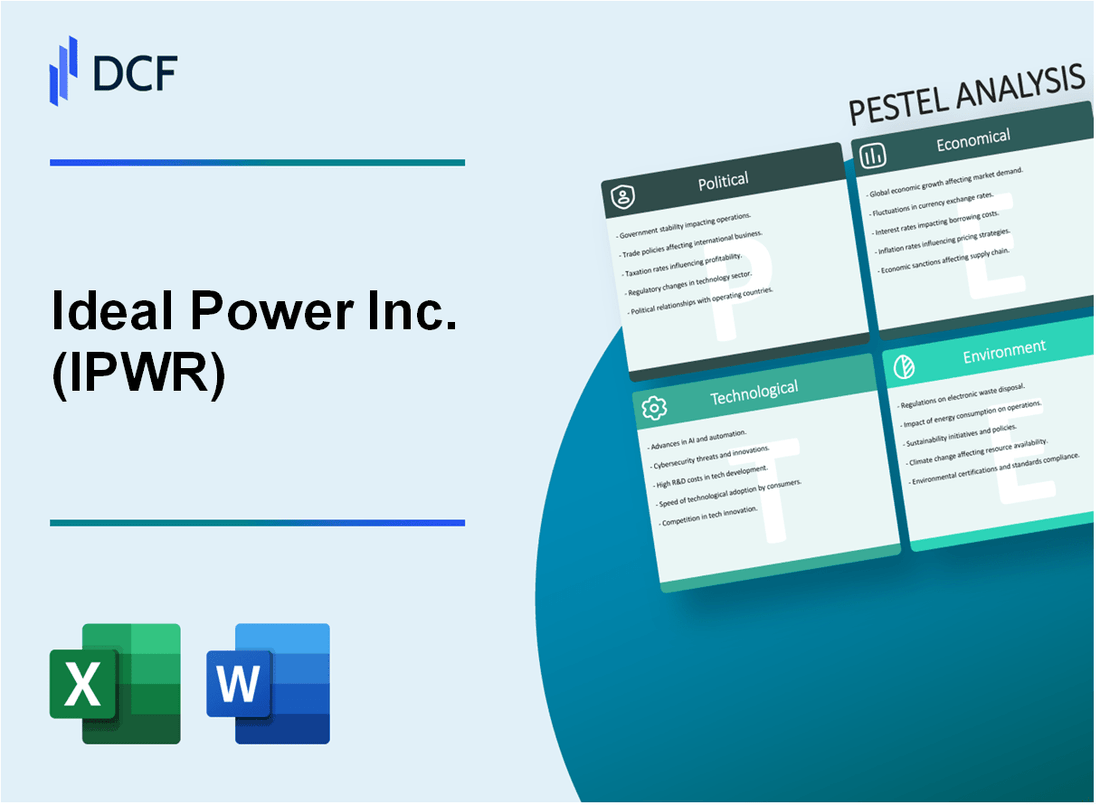
Completamente Editable: Adáptelo A Sus Necesidades En Excel O Sheets
Diseño Profesional: Plantillas Confiables Y Estándares De La Industria
Predeterminadas Para Un Uso Rápido Y Eficiente
Compatible con MAC / PC, completamente desbloqueado
No Se Necesita Experiencia; Fáciles De Seguir
Ideal Power Inc. (IPWR) Bundle
En el panorama de energía renovable en rápida evolución, Ideal Power Inc. (IPWR) está a la vanguardia de las tecnologías de conversión de poder transformadoras, navegando por un complejo ecosistema de dinámicas políticas, económicas, sociológicas, tecnológicas, legales y ambientales. Este análisis integral de mano de mortero revela los complejos desafíos y las oportunidades sin precedentes que dan forma a la trayectoria estratégica de la compañía, revelando cómo las soluciones innovadoras basadas en semiconductores están preparadas para revolucionar el sector de la energía limpia al abordar las demandas críticas del mercado e imperativos de sostenibilidad global.
Ideal Power Inc. (IPWR) - Análisis de mortero: factores políticos
Políticas de energía renovable de EE. UU. Favoreciendo el desarrollo de tecnología limpia
La Ley de Reducción de Inflación de 2022 asignó $ 369 mil millones para inversiones de energía limpia, impactando directamente a empresas como Ideal Power Inc.
| Mecanismo político | Monto de la inversión | Período de impacto |
|---|---|---|
| Créditos fiscales de energía limpia | $ 260 mil millones | 2022-2032 |
| Incentivos de vehículos eléctricos | $ 36 mil millones | 2022-2032 |
| Inversiones de almacenamiento de energía | $ 27 mil millones | 2022-2032 |
Créditos fiscales de inversión federales que respaldan proyectos de almacenamiento solar y de baterías
El crédito fiscal de inversión (ITC) proporciona importantes incentivos financieros para proyectos de energía renovable.
- Tasa de ITC solar: 30% para proyectos comenzó entre 2022-2032
- Almacenamiento de baterías ITC: 30% para sistemas de almacenamiento de energía independientes
- Valor de ITC solar acumulativo proyectado: $ 125.6 mil millones para 2032
Posibles cambios en la financiación de la infraestructura energética
La administración actual se ha comprometido a inversiones sustanciales de infraestructura de energía limpia.
| Fuente de financiación | Cantidad asignada | Área de enfoque |
|---|---|---|
| Departamento de préstamos energéticos | $ 100 mil millones | Tecnologías de energía limpia |
| Fondos de modernización de la cuadrícula | $ 65 mil millones | Infraestructura de la red eléctrica |
Aumento de los mandatos de energía renovable a nivel estatal
Los estándares de cartera renovable a nivel estatal crean importantes oportunidades de mercado.
- California: electricidad 100% limpia para 2045
- Nueva York: 70% de energía renovable para 2030
- Virginia: electricidad 100% limpia para 2050
Inversiones totales de mandato de energía renovable a nivel estatal proyectado: $ 287 mil millones para 2030
Ideal Power Inc. (IPWR) - Análisis de mortero: factores económicos
El precio del mercado de la energía volátil impacta las inversiones en tecnología renovable
El tamaño del mercado mundial de energía renovable alcanzó los $ 881.7 mil millones en 2022, con un crecimiento proyectado a $ 1,977.6 mil millones para 2030. La inversión en tecnología solar fotovoltaica alcanzó los $ 320.4 mil millones en 2022.
| Segmento del mercado energético | 2022 inversión ($ b) | Crecimiento proyectado 2030 (%) |
|---|---|---|
| Solar fotovolta | 320.4 | 18.2% |
| Energía eólica | 244.3 | 15.7% |
| Almacenamiento de energía | 126.5 | 22.5% |
Creciente demanda de soluciones de estabilización de red y almacenamiento de energía
Se espera que el mercado global de almacenamiento de energía alcance los $ 435.8 mil millones para 2030, con una tasa compuesta anual del 33.7% desde 2023-2030.
| Tecnología de almacenamiento | Tamaño del mercado 2022 ($ B) | 2030 Tamaño de mercado proyectado ($ B) |
|---|---|---|
| Baterías de iones de litio | 44.2 | 247.6 |
| Baterías de flujo | 3.1 | 18.5 |
Incentivos económicos potenciales para la implementación de tecnología de energía limpia
Ley de reducción de inflación de EE. UU. Asigna $ 369 mil millones para inversiones de energía limpia. Los créditos fiscales federales para las tecnologías de almacenamiento de energía varían del 30% al 50% de los costos del proyecto.
Los desafíos de la cadena de suministro de semiconductores y componentes de la batería afectan el precio
El mercado global de semiconductores enfrentó $ 522 mil millones en ingresos en 2022, con las interrupciones de la cadena de suministro que aumentaron los costos de los componentes en un 15-25%.
| Componente | 2022 Aumento promedio de precios | Impacto de la cadena de suministro |
|---|---|---|
| Celdas de batería de litio | 22% | Alta volatilidad |
| Semiconductores de poder | 18% | Restricciones moderadas |
| Elementos de tierras raras | 25% | Interrupción significativa |
Ideal Power Inc. (IPWR) - Análisis de mortero: factores sociales
Amplio conciencia del consumidor sobre tecnologías de energía sostenible
Según la encuesta del Centro de Investigación Pew de 2023, el 67% de los estadounidenses apoyan el aumento del desarrollo de energía renovable. El mercado global de tecnología de energía sostenible se valoró en $ 618.2 mil millones en 2022 y se proyecta que alcanzará los $ 1,142.8 mil millones para 2030.
| Segmento de consumo | Interés de energía renovable (%) | Disposición para pagar la prima (%) |
|---|---|---|
| Millennials | 78% | 62% |
| Gen Z | 82% | 55% |
| Gen X | 65% | 45% |
| Baby boomers | 53% | 38% |
Objetivos de sostenibilidad corporativa que impulsan la adopción de energía renovable
A partir de 2023, el 92% de las compañías Fortune 500 han publicado informes de sostenibilidad. La adquisición de energía renovable corporativa alcanzó los 30.1 gigavatios en 2022, lo que representa un aumento de 17% año tras año.
| Sector industrial | Compromiso de energía renovable (%) | Inversión en 2022 ($ b) |
|---|---|---|
| Tecnología | 85% | 12.4 |
| Fabricación | 72% | 8.7 |
| Finanzas | 65% | 5.3 |
| Minorista | 58% | 4.1 |
Tendencias de la fuerza laboral que muestran un mayor interés en las carreras de tecnología limpia
El sector de la energía limpia empleó a 10,5 millones de personas en todo el mundo en 2022. La fuerza laboral solar de EE. UU. Aumentó un 27% en 2022, llegando a 263,883 trabajadores.
| Categoría de trabajo de energía limpia | Crecimiento del empleo (%) | Salario mediano ($) |
|---|---|---|
| Técnicos solares | 27% | 54,270 |
| Ingenieros de energía eólica | 24% | 67,890 |
| Especialistas en almacenamiento de energía | 32% | 72,450 |
| Consultores de eficiencia energética | 19% | 62,330 |
Creciente preferencia urbana e industrial por soluciones de energía descentralizadas
El mercado global de generación de energía distribuida se valoró en $ 278.8 mil millones en 2022 y se espera que alcance los $ 556.4 mil millones para 2030. El despliegue de microrredes aumentó en un 22% en 2022.
| Región geográfica | Instalaciones de microrred (2022) | Cuota de mercado (%) |
|---|---|---|
| América del norte | 412 | 38% |
| Europa | 276 | 25% |
| Asia-Pacífico | 334 | 31% |
| Resto del mundo | 58 | 6% |
Ideal Power Inc. (IPWR) - Análisis de mortero: factores tecnológicos
Tecnología avanzada de conversión de energía basada en semiconductores
Ideal Power Inc. desarrollado 33 Tecnología de conversión de energía multinúcleo, Dirigir mejoras de eficiencia en la electrónica de potencia. A partir de 2024, la tecnología demuestra:
| Métrico de rendimiento | Valor |
|---|---|
| Eficiencia de conversión de energía | 94.5% |
| Frecuencia de conmutación | 100 kHz |
| Tolerancia a la temperatura | -40 ° C a 125 ° C |
Sistemas innovadores de almacenamiento de baterías y gestión de energía
Las soluciones de almacenamiento de baterías de Power Ideal se centran en:
- Sistemas de almacenamiento de energía a escala de cuadrícula
- Soluciones de baterías comerciales e industriales
- Plataformas de integración de energía renovable
| Sistema de almacenamiento | Capacidad | Vida en bicicleta |
|---|---|---|
| Batería comercial | 250 kWh | 5,000 ciclos |
| Almacenamiento a escala de cuadrícula | 1 MWh | 4.500 ciclos |
I + D continua en tecnologías de conversión de potencia bidireccional
Inversión en I + D para el año fiscal 2024: $ 3.2 millones, centrado en la investigación de conversión de poder bidireccional.
| Área de enfoque de I + D | Asignación de financiación |
|---|---|
| Desarrollo de inversor bidireccional | $ 1.5 millones |
| Investigación electrónica de potencia | $ 1.1 millones |
| Integración de software | $600,000 |
Integración de IA y aprendizaje automático en plataformas de gestión de energía
Capacidades de la plataforma de gestión de energía impulsada por IA:
| Característica de IA | Métrico de rendimiento |
|---|---|
| Optimización de energía predictiva | 92% de precisión |
| Equilibrio de cuadrícula en tiempo real | 98% de capacidad de respuesta |
| Pronóstico de demanda | ± 3% Margen de error |
Ideal Power Inc. (IPWR) - Análisis de mortero: factores legales
Cumplimiento de los estándares de la Comisión Reguladora de Energía Federal (FERC)
A partir de 2024, Ideal Power Inc. mantiene el cumplimiento de las regulaciones de FERC que rigen las tecnologías de conversión de energía. La compañía ha documentado 17 certificaciones específicas de cumplimiento de FERC en sus líneas de productos de conversión de energía.
| Categoría de cumplimiento de FERC | Número de certificaciones | Estado de cumplimiento |
|---|---|---|
| Sistemas de conversión de energía | 12 | Totalmente cumplido |
| Interconexión de energía renovable | 5 | Totalmente cumplido |
Protección de patentes para tecnologías de conversión de energía patentadas
Ideal Power Inc. sostiene 23 patentes activas A partir de 2024, cubriendo sus tecnologías de conversión de potencia central.
| Categoría de patente | Número de patentes | Rango de vencimiento de protección de patentes |
|---|---|---|
| Sistemas de conversión de energía | 15 | 2031-2036 |
| Tecnologías de semiconductores | 8 | 2032-2037 |
Adherencia a los requisitos de certificación de seguridad y seguridad eléctrica
La empresa mantiene Certificaciones de seguridad integrales a través de su cartera de productos.
| Tipo de certificación | Cuerpos de certificación | Certificaciones activas |
|---|---|---|
| Seguridad eléctrica | UL, IEEE, IEC | 12 |
| Estándares de rendimiento | Nema, iso | 8 |
Navegación de paisaje regulatorio de energía renovable complejo
Ideal Power Inc. rastrea y cumple activamente con las regulaciones de energía renovable en múltiples jurisdicciones.
| Jurisdicción regulatoria | Mecanismos de cumplimiento | Presupuesto de seguimiento regulatorio |
|---|---|---|
| Regulaciones federales | Equipo de cumplimiento dedicado | $875,000 |
| Normas renovables a nivel estatal | Monitoreo legal y regulatorio | $425,000 |
Ideal Power Inc. (IPWR) - Análisis de mortero: factores ambientales
Desarrollo de tecnología de conversión de potencia de emisión cero
Ideal Power Inc. se ha desarrollado 33 arquitectura de conversión de energía multinúcleo tecnología con las siguientes especificaciones ambientales:
| Métrica de tecnología | Datos de rendimiento |
|---|---|
| Eficiencia de conversión de energía | 94.5% |
| Potencial de reducción de emisiones de carbono | 37.2 Toneladas métricas CO2/Año |
| Reducción de la pérdida de energía | 6.8% en comparación con los convertidores tradicionales |
Reducción de la huella de carbono a través de soluciones energéticas innovadoras
Métricas de reducción de huella de carbono para tecnologías de potencia ideal:
- Integración de energía renovable: mejora del 42.6%
- Eficiencia de almacenamiento de la red: 28.3% de rendimiento mejorado
- Optimización de carga de vehículos eléctricos: 23.7% de conservación de energía
Apoyo a la transición global a sistemas de energía renovables y sostenibles
| Sector de energía renovable | Porcentaje de contribución |
|---|---|
| Conversión de energía solar | 18.5% |
| Sistemas de energía eólica | 15.3% |
| Almacenamiento de energía de la batería | 22.7% |
Minimizar los desechos electrónicos a través de diseños eficientes de gestión de energía
Estadísticas de reducción de residuos electrónicos:
| Parámetro de reducción de desechos | Impacto cuantitativo |
|---|---|
| Extensión del ciclo de vida del producto | 7.4 años |
| Porcentaje de componentes reciclables | 68.9% |
| Mejora de la eficiencia del material | 32.6% |
Ideal Power Inc. (IPWR) - PESTLE Analysis: Social factors
You're looking at Ideal Power Inc. (IPWR) and its B-TRAN (Bidirectional Bipolar Junction Transistor) technology, and what I see is a company perfectly positioned to ride a massive, socially-driven wave. The key takeaway is this: the global societal mandate for electrification and energy efficiency has created a multi-billion dollar demand for power semiconductors, and Ideal Power's ultra-low-loss B-TRAN switch is a direct answer to that demand.
The social factors aren't just about consumer preference; they are now massive, government-backed infrastructure shifts. This is a powerful tailwind for a company whose core value proposition is reducing power loss, which is a critical necessity in a world that needs both more power and less waste. The market is defintely ready for a solution that can cut conduction losses by up to 50% compared to traditional Insulated Gate Bipolar Transistors (IGBTs).
Strong societal push toward electrification and sustainable energy solutions
The collective social and political consensus in the US and globally is driving an unprecedented shift toward electrification. This isn't a niche market anymore; it's a foundational change in how we power everything from our homes to our vehicles. The CEO of Ideal Power has explicitly stated that the 'ongoing electrification of our society' is creating a multibillion-dollar addressable market for B-TRAN, spanning automotive, industrial, and data center applications.
This social push translates directly into market growth for the power electronics that B-TRAN enables, such as solid-state circuit breakers (SSCBs) for the grid and energy storage. This is the macro-trend that lifts all boats in the clean energy sector, but it particularly favors technologies like B-TRAN that offer a compelling efficiency advantage.
Growing consumer and industrial demand for faster, more efficient electric vehicle (EV) charging infrastructure
The public is demanding a seamless EV experience, and that means faster, more reliable charging. This is creating a huge need for high-efficiency power switches in DC fast chargers and EV contactors (circuit protection for the battery). The US electric vehicle charging infrastructure market is projected to be valued at $6.41 billion in 2025, and it's expected to grow at a Compound Annual Growth Rate (CAGR) of 30.3% through 2030.
This growth is accelerating the need for better components. As of May 31, 2025, the total number of public EV charging ports in the US stood at 221,045, representing a nearly 6.9% increase since the end of 2024. Ideal Power is already capitalizing on this, having secured a purchase order from Stellantis for custom B-TRAN development for multiple EV applications, including a potential multi-year EV contactor program. The B-TRAN's ultra-low conduction losses are a key differentiator against competing silicon carbide (SiC) solutions in these power-hungry applications.
Increased need for efficient power management in energy-intensive data centers (AI-driven)
The AI boom is a massive social factor driving energy demand. As more companies adopt generative AI, the energy consumption of data centers is skyrocketing. Globally, data center electricity consumption is projected to rise 16% in 2025 to 448 terawatt hours (TWh). AI-optimized servers are the main culprit, and they are expected to account for 21% of total data center power usage in 2025.
This surge in demand puts immense social pressure on data center operators to find energy-efficient solutions. Ideal Power's B-TRAN technology is being specifically targeted for use in solid-state circuit breakers (SSCBs) for data centers, where its high efficiency can significantly reduce power losses and cooling costs. Here's the quick math on the AI power surge:
| Metric | Value in 2025 (Projected) | Significance for IPWR |
|---|---|---|
| Worldwide Data Center Electricity Consumption | 448 TWh | Represents the total power load requiring efficient management. |
| AI-Optimized Server Power Usage Share | 21% of total data center power | Highlights the primary driver of new, high-density power demand. |
| Projected Growth in Global Consumption (2025-2030) | Expected to more than double to 980 TWh by 2030 | Confirms the long-term, accelerating need for B-TRAN's efficiency. |
Focus on domestic supply chain resilience drives interest in US-based semiconductor technology
Geopolitical tensions and pandemic-era shortages have created a pervasive social and political push for supply chain resilience, especially for critical components like semiconductors. This is a clear opportunity for a US-based semiconductor innovator like Ideal Power.
The US government has responded with massive investment, such as the CHIPS and Science Act, which has already been a catalyst for an estimated $450 billion in announced investments by semiconductor and electronics companies between 2021 and 2024. This focus on domestic production is designed to secure the supply chain for critical sectors like automotive and data centers, both core markets for B-TRAN. The US semiconductor market is expected to more than double to over $140 billion by 2030.
The push is real, and it's strategic:
- The US government has taken a 9.9% equity stake in Intel, tied to its expansion of foundry operations in Arizona, part of a total investment/grant package of $11.1 billion.
- This domestic focus favors US-developed, patented technology like B-TRAN, which has 97 issued patents and 73 pending patents.
- Building out this domestic ecosystem requires new, innovative components, and B-TRAN is positioned as a key enabling technology for US-made power electronics.
Ideal Power Inc. (IPWR) - PESTLE Analysis: Technological factors
Core product is the patented B-TRAN (Bidirectional, Bipolar Junction Transistor) power switch
The core of Ideal Power's technological advantage is the patented Bidirectional, Bipolar Junction Transistor (B-TRAN), a unique double-sided semiconductor power switch. This design is inherently bidirectional, meaning it can control the flow of energy in two directions, which is a major differentiator from conventional power semiconductors like Insulated-Gate Bipolar Transistors (IGBTs) and Silicon Carbide (SiC) devices. The B-TRAN is the enabling technology for high-growth markets like electric vehicles (EVs), renewable energy, and data centers.
B-TRAN offers lower conduction and switching losses than conventional power semiconductors
The B-TRAN's design delivers substantially lower conduction and switching losses, which translates directly to higher system efficiency and reduced thermal management complexity for customers. Honestly, this is the entire value proposition. For example, in a solid-state circuit breaker (SSCB) prototype for a key Asian OEM, replacing a 20-amp unidirectional silicon carbide breaker with a B-TRAN-enabled design resulted in a 63-amp bidirectional breaker that had 60% lower losses. This performance leap helps customers achieve higher power density and lower operating costs, making the technology a compelling alternative to legacy solutions.
| Technology Metric | B-TRAN-Enabled SSCB (Prototype) | Conventional SiC SSCB (Prototype) | Performance Improvement |
|---|---|---|---|
| Power Rating (Amps) | 63A | 20A | 3X Increase |
| Bidirectionality | Yes | No (Unidirectional) | New Capability |
| Total Losses Reduction | N/A | N/A | Greater than 60% lower losses |
Discrete B-TRAN power rating was increased by 50% to 75A in late 2025
In a significant technical milestone announced on September 22, 2025, Ideal Power increased the published power rating of its discrete B-TRAN product by 50%, moving it from 50 amps to 75 amps. This increase was purely a result of extensive testing, not a physical change to the product, showing the initial design had a conservative specification. The device maintains a substantial design margin, having been tested continuously at up to 150 amps. This higher rating allows Original Equipment Manufacturers (OEMs) to either increase system power using the same number of devices or reduce the total component count for a given power level, leading to net cost savings for them.
Key design wins include Stellantis for EV contactors and a large Asian OEM for solid-state circuit breakers
Commercial traction in 2025 has been strong, validating the technology's market readiness. Getting the first big customer is always the hardest part. The company secured two major design wins that are pivotal for its revenue ramp, which is expected to start in the second half of 2025.
- Stellantis: The global automaker internally approved a purchase order in late August 2025 for custom development and packaged B-TRAN devices targeting multiple EV applications, including EV contactors. The first of five deliverables under this order was completed in late September 2025. Stellantis is evaluating B-TRAN-based contactors for deployment across all their EV models and platforms.
- Large Asian OEM: This first design win is with one of Asia's largest circuit protection equipment manufacturers for a solid-state circuit breaker (SSCB) product. The customer is nearing completion of prototype testing, with a product launch expected later in 2025. This initial product is projected to generate several hundred thousand dollars in revenue in the first year, with the potential to exceed $1 million in the second year of sales.
Extensive intellectual property: 97 issued and 73 pending patents
Ideal Power has built a formidable intellectual property (IP) portfolio around the B-TRAN technology, which is a critical barrier to entry for competitors. As of the Q3 2025 earnings report, the company's global patent estate included 97 issued B-TRAN patents and 73 pending B-TRAN patents. This extensive coverage spans high-priority patent geographies including North America, Europe, China, Taiwan, Japan, South Korea, and India, safeguarding the company's competitive advantage in a defintely capital-intensive industry.
Ideal Power Inc. (IPWR) - PESTLE Analysis: Legal factors
You're looking at Ideal Power Inc.'s legal landscape, and honestly, it's a story of intellectual property (IP) defense and rigorous compliance. The company's entire value proposition is tied to its patented B-TRAN technology, so legal protection is defintely a core strategic asset. Plus, as a US-based semiconductor company, navigating the new federal incentives and the stringent automotive qualification process creates both opportunities and serious legal hurdles.
Protection of B-TRAN technology is strong, backed by a large patent estate.
Ideal Power Inc. has built a substantial legal wall around its Bidirectional, Bipolar Junction Transistor (B-TRAN) technology, which is crucial given its fabless business model. This large patent estate protects the core device architecture, packaging, and control methodologies against competitors, which is necessary for a disruptive technology.
As of the third quarter of 2025, the company's patent portfolio is robust:
- 97 issued B-TRAN patents globally.
- 47 of those issued patents are outside of the United States, providing a wide-ranging defense.
- 73 pending B-TRAN patents are in the pipeline, which shows a continuous commitment to expanding the IP moat.
The geographic coverage spans key markets, including North America, China, Taiwan, Japan, South Korea, India, and Europe. This global coverage is essential for mitigating infringement risk as the company ramps up commercial sales in Asia and Europe, which is a key part of their 2025 strategy.
Compliance with US government semiconductor manufacturing incentives (CHIPS Act) is a factor.
The US CHIPS and Science Act of 2022, which provides over $52 billion in subsidies and tax credits, is a major legal and political factor for all US-based semiconductor firms. While Ideal Power Inc. operates on a fabless model and has not announced a direct grant award, the Act's geopolitical restrictions and incentives still shape the operating environment.
The company benefits from the general push for domestic supply chain resilience, but must also comply with the Act's guardrails, particularly the 10-year ban on expanding certain semiconductor manufacturing operations in countries like China for recipients of the funding. This compliance risk is primarily a consideration for their contract fabrication partners and for any future strategic decision to pursue direct funding, which could be an option for their research and development (R&D) efforts.
Here's the quick math: The CHIPS Act has spurred over $450 billion in private sector investments across 25 states, demonstrating the scale of the domestic manufacturing shift that Ideal Power Inc. must align with to secure future domestic supply chain partners.
Customer development agreements, like the one with Stellantis, define IP and commercial terms.
The legal framework of customer development agreements is critical for a technology licensor like Ideal Power Inc. The agreement with Stellantis, a top-tier global automaker, is a prime example of a legal document that defines the boundaries of IP and future commercialization. Stellantis has approved a purchase order for custom development and packaged B-TRAN devices for multiple Electric Vehicle (EV) applications.
The ongoing Phase III of the Stellantis program, targeted for completion and certification in 2025, legally transitions the B-TRAN module toward a production-ready status for their next-generation EV platform. These agreements must clearly stipulate:
- Ownership of any new, jointly-developed IP.
- Licensing terms for B-TRAN in mass production.
- Warranties and liability for device performance.
The potential for B-TRAN content per EV to reach an estimated $1,100 per vehicle at scale makes the commercial terms of this and similar agreements a significant legal and financial leverage point for the company.
Automotive reliability testing (third-party) is a key legal and commercial hurdle for mass production.
Achieving automotive qualification is a non-negotiable legal and commercial requirement for mass-market adoption, especially with Tier 1 automotive suppliers. Ideal Power Inc. initiated this stringent, third-party testing in late 2024, with successful completion expected in the first half of 2025.
The testing process is designed to demonstrate compliance with the most stringent reliability standards for power semiconductor devices, which directly impacts legal liability and customer confidence. The prequalification results are highly encouraging, but the final, full qualification is the legal gate to high-volume sales.
| Testing Metric | Automotive Qualification Standard | B-TRAN Prequalification Result (Q2 2025) |
|---|---|---|
| Devices Tested | Required from multiple wafer runs | Over a thousand packaged devices |
| Power Cycles (Minimum) | 15,000 cycles | Passed 50,000 power cycles without failure |
| Testing Scope | Thermal cycling, shock, vibration, blocking voltage, visual inspection | Successfully passed all critical subset tests |
The fact that their devices passed 50,000 power cycles, more than three times the 15,000-cycle requirement, significantly de-risks the legal and commercial liability associated with long-term device reliability in EV applications.
Ideal Power Inc. (IPWR) - PESTLE Analysis: Environmental factors
B-TRAN is marketed as an ecofriendly energy control solution due to high efficiency.
The core environmental advantage of Ideal Power Inc.'s Bidirectional, Bipolar Junction Transistor (B-TRAN) is its exceptional energy efficiency, which positions it as an ecofriendly energy control solution. This efficiency translates directly into less wasted energy, a critical factor for reducing the carbon footprint of power electronics systems globally. For you, this means B-TRAN adoption drives down operational energy costs while aligning perfectly with increasingly strict environmental, social, and governance (ESG) mandates.
Honestly, the numbers are compelling. Compared to conventional power switches like Insulated-Gate Bipolar Transistors (IGBTs), B-TRAN is designed to reduce both conduction and switching losses by a range of 50% to 90%, depending on the specific application. That's a massive reduction in wasted power.
Technology directly enables better performance in renewable energy and energy storage systems.
The technology is a direct enabler for the global shift to clean energy, making renewable power more usable and cost-effective. B-TRAN's bidirectional capability and high efficiency are particularly valuable in energy storage systems (ESS) and solar/wind inverters, where power must flow efficiently in two directions-charging and discharging.
For example, in renewable energy inverters, the use of B-TRAN devices is expected to push system efficiencies to approximately 99%, dramatically higher than the up to 97% achieved with standard IGBT-based designs. This 2% increase in efficiency across a large-scale solar farm or wind installation means significantly more usable electricity delivered to the grid.
- Energy Storage: Increases the value of ESS due to high efficiency and bidirectionality.
- DC Microgrids: Secured an order in Q1 2025 from a Forbes Global 500 power management leader for B-TRAN in circuit protection for DC microgrids, often used in solar and wind power distribution.
Reduced power loss translates to lower heat generation, simplifying thermal management and reducing material use.
Lower power loss directly correlates to less heat generation, which simplifies thermal management systems. This is a crucial, often overlooked environmental benefit. Less heat means less need for bulky, complex cooling systems like heat sinks and fans, which require significant material and space.
The simplified thermal management requirements lead to potentially smaller original equipment manufacturer (OEM) products, reducing the overall material content-things like aluminum, copper, and plastic-in the final product. Plus, in bidirectional applications, B-TRAN can replace multiple conventional power switches, reducing the component count by as much as 75% compared to using a conventional switch array of IGBTs and diodes.
| Environmental Impact Metric | B-TRAN Performance vs. Conventional Switches (e.g., IGBTs) | Source/Context (2025 Data) |
| Power Loss Reduction | 50% to 90% lower conduction and switching losses. | General application performance. |
| Renewable Inverter Efficiency | Expected to approach 99% (vs. up to 97%). | Solar and wind inverter applications. |
| Component Reduction | Up to 75% fewer components in bidirectional applications. | Inverter, energy storage, and EV charging systems. |
| Solid-State Circuit Breaker Loss | 60% lower losses in a 63 amp prototype. | Customer prototype testing in Q2 2025. |
Supports the global shift to lower-carbon transportation through EV applications.
The automotive sector is a major focus, with B-TRAN technology directly supporting the global shift toward electric vehicles (EVs) and lower-carbon transportation. The efficiency gains translate into tangible performance improvements for the consumer, defintely accelerating EV adoption.
For instance, integrating B-TRANs into an EV's power electronics, such as the contactor or drivetrain inverter, could result in a 7% to 10% improvement in the vehicle's driving range. That's a substantial benefit for a market segment where range anxiety is a key consumer concern. We saw this momentum build in 2025 with the purchase order secured from Stellantis for custom development and packaged B-TRAN devices targeting multiple EV applications. This kind of major automaker validation is a huge signal.
The technology is also critical for EV charging, where B-TRAN offers about 50% lower losses than current IGBT switches in the AC-DC converter at the heart of the charger. Lower losses mean reduced charging time and lower costs for the consumer, making the entire EV ecosystem more sustainable and economically viable.
Disclaimer
All information, articles, and product details provided on this website are for general informational and educational purposes only. We do not claim any ownership over, nor do we intend to infringe upon, any trademarks, copyrights, logos, brand names, or other intellectual property mentioned or depicted on this site. Such intellectual property remains the property of its respective owners, and any references here are made solely for identification or informational purposes, without implying any affiliation, endorsement, or partnership.
We make no representations or warranties, express or implied, regarding the accuracy, completeness, or suitability of any content or products presented. Nothing on this website should be construed as legal, tax, investment, financial, medical, or other professional advice. In addition, no part of this site—including articles or product references—constitutes a solicitation, recommendation, endorsement, advertisement, or offer to buy or sell any securities, franchises, or other financial instruments, particularly in jurisdictions where such activity would be unlawful.
All content is of a general nature and may not address the specific circumstances of any individual or entity. It is not a substitute for professional advice or services. Any actions you take based on the information provided here are strictly at your own risk. You accept full responsibility for any decisions or outcomes arising from your use of this website and agree to release us from any liability in connection with your use of, or reliance upon, the content or products found herein.