

|
Ideal Power Inc. (IPWR): PESTLE Analysis [Nov-2025 Updated] |
Fully Editable: Tailor To Your Needs In Excel Or Sheets
Professional Design: Trusted, Industry-Standard Templates
Investor-Approved Valuation Models
MAC/PC Compatible, Fully Unlocked
No Expertise Is Needed; Easy To Follow
Ideal Power Inc. (IPWR) Bundle
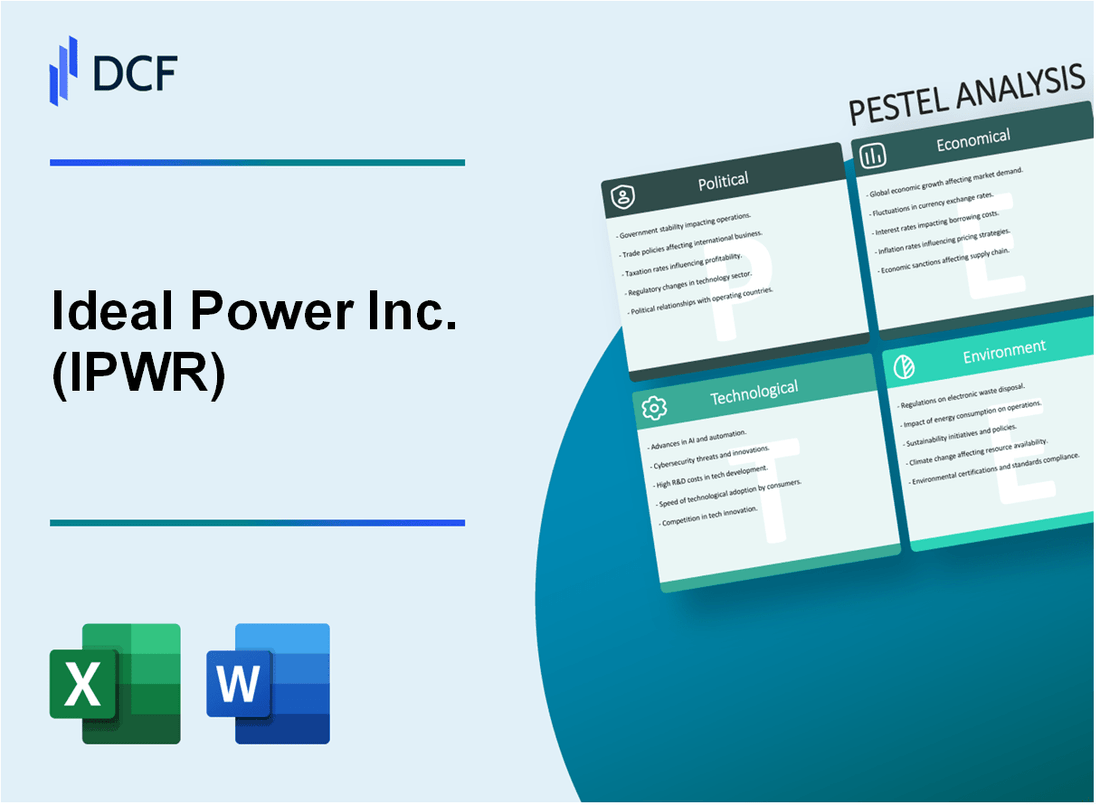
You're looking for a clear-eyed view of Ideal Power Inc. (IPWR), and the PESTLE (Political, Economic, Sociological, Technological, Legal, Environmental) framework is the right tool to map their near-term risks and opportunities. The core takeaway is this: the company's patented B-TRAN technology is gaining crucial commercial traction with major players like Stellantis, but their financial runway remains tight, making the 2026 revenue ramp absolutely critical.
Political Analysis: US Incentives vs. Funding Uncertainty
The political landscape is a significant tailwind for Ideal Power Inc. right now. The US CHIPS Act offers substantial tax credits, ranging from 25% to 30%, for domestic semiconductor manufacturing, which directly benefits their US-based technology. Plus, the New SEMI Investment Act, passed in November 2025, aims to expand that CHIPS tax credit to upstream materials, potentially lowering their input costs. Still, you have to be a realist: political uncertainty surrounds the future level of CHIPS Act funding and grants under the new administration. Minimal impact is expected from new tariffs, honestly, because power semiconductors largely have existing exemptions. This is a clear, near-term opportunity.
Economic Analysis: Tight Runway Meets Multi-Billion Market
The economic picture is a classic high-risk, high-reward scenario. Ideal Power Inc. is targeting a multi-billion dollar addressable market across EV, data center, and industrial applications. But the cash burn is the immediate concern. The company reported a high cash burn rate of $2.7 million in Q3 2025 from operating and investing activities, projecting a full-year 2025 burn of approximately $10 million. With only $8.4 million in cash as of September 30, 2025, their liquidity is constrained, funding operations only through mid-2026 without new financing. Their Q3 2025 revenue was a minimal $24.45 thousand, which shows commercialization is just starting. The clock is ticking for a major revenue ramp.
Sociological Analysis: Electrification and Data Center Demand
Societal trends are firmly behind Ideal Power Inc. You see a strong, global push toward electrification and sustainable energy solutions, which is their core business. This translates into growing consumer and industrial demand for faster, more efficient electric vehicle (EV) charging infrastructure. Also, the AI boom means an increased need for efficient power management in energy-intensive data centers. Plus, the focus on domestic supply chain resilience, post-pandemic, drives interest in US-based semiconductor technology like theirs. This is a powerful, long-term demand signal.
Technological Analysis: Patented B-TRAN Traction
The technology is the company's biggest asset. Their core product is the patented B-TRAN (Bidirectional, Bipolar Junction Transistor) power switch. It's a genuine technical leap, offering lower conduction and switching losses than conventional power semiconductors. To be fair, they are constantly improving it: the discrete B-TRAN power rating was increased by 50% to 75A in late 2025. They've secured key design wins, including Stellantis for EV contactors and a large Asian OEM for solid-state circuit breakers. With 97 issued and 73 pending patents, the intellectual property moat is extensive. They have a real product, not just a concept.
Legal Analysis: IP Moat vs. Automotive Qualification
From a legal standpoint, the protection of the B-TRAN technology is strong, backed by that large patent estate. This is defintely a good foundation. Compliance with US government semiconductor manufacturing incentives, specifically the CHIPS Act, is a factor they must manage to secure funding. Crucially, customer development agreements, like the one with Stellantis, define the Intellectual Property (IP) and commercial terms for their future revenue. The biggest hurdle right now is the third-party automotive reliability testing, which is a key legal and commercial gate they must clear for mass production contracts.
Environmental Analysis: Efficiency as a Green Solution
The Environmental factor is a clear positive for Ideal Power Inc. The B-TRAN is marketed as an ecofriendly energy control solution because of its high efficiency. Reduced power loss translates directly to lower heat generation, which simplifies thermal management and cuts down on material use in end products. Plus, the technology directly enables better performance in renewable energy and energy storage systems. Ultimately, it supports the global shift to lower-carbon transportation through its electric vehicle (EV) applications. They are selling efficiency, which is a green solution.
Ideal Power Inc. (IPWR) - PESTLE Analysis: Political factors
You need to understand how Washington's current focus on domestic chip manufacturing directly impacts Ideal Power Inc.'s (IPWR) bottom line and strategic planning. The core takeaway is this: US government policy provides a massive financial tailwind for domestic production via tax credits, but political uncertainty around grant funding is a real risk you need to model into your cash flow projections.
US CHIPS Act offers tax credits (25% to 30%) for domestic semiconductor manufacturing.
The CHIPS and Science Act is a substantial, immediate financial benefit for any company building or expanding semiconductor fabrication in the US. The Advanced Manufacturing Investment Tax Credit (Section 48D) currently allows for a direct tax credit of 25% of the qualified investment in a new or expanded facility. This isn't a loan; it's a dollar-for-dollar reduction in your tax bill.
To be fair, the political conversation is still moving. While the current law is 25%, a Senate-passed tax bill in July 2025 proposed raising this credit to as high as 35%, which would be an enormous boost for large-scale domestic capital expenditure. This incentive is the cornerstone of the government's push to onshore production, backed by a total of $52.7 billion in federal funding for the industry.
| CHIPS Act Financial Incentives (2025 Fiscal Year) | Amount/Rate | Status |
|---|---|---|
| Advanced Manufacturing Investment Tax Credit (Section 48D) | 25% of Qualified Investment | Current Law (Through 2026) |
| Total Federal Funding Allocation | $52.7 billion | Appropriated |
| Manufacturing Incentives (Grants/Loans) | $39 billion | Designated for Semiconductor Manufacturing |
| Proposed Tax Credit Increase (via July 2025 Senate Bill) | Up to 35% | Pending Legislation |
New SEMI Investment Act (Nov 2025) aims to expand CHIPS tax credit to upstream materials.
A significant development for the entire supply chain, including Ideal Power Inc.'s partners, is the bipartisan Strengthening Essential Manufacturing and Industrial (SEMI) Investment Act, introduced in November 2025. This legislation aims to close a critical gap in the original CHIPS Act by expanding the Section 48D tax credit's eligibility to include essential upstream materials suppliers.
This is defintely a positive structural change. It means the domestic supply chain for specialized materials-like the ones needed for Ideal Power Inc.'s B-TRAN™ solid-state switch technology-will also receive federal support, strengthening US-based sourcing and reducing reliance on foreign, high-risk suppliers. The bill also proposes extending the tax credit through 2031, giving long-term certainty for capital investment planning.
Political uncertainty surrounds future CHIPS Act funding and grants under the new administration.
While the tax credits are a statutory benefit, the direct grant funding is under a cloud of political uncertainty. The new administration has been vocal in its criticism of the CHIPS Act's grant component, with the President calling it a 'horrible, horrible thing.' This skepticism has led to the Commerce Department reviewing and scrutinizing previously announced awards, creating a slowdown.
Here's the quick math: of the $39 billion in manufacturing incentives, only a fraction has been disbursed, even though the full amount is appropriated through fiscal year 2026. This uncertainty primarily affects companies seeking new or renegotiated grants, as the administration can 'slow-walk' disbursements or change contract terms, even if they are legally obligated to spend the money.
Minimal impact expected from new tariffs due to existing power semiconductor exemptions.
The new, broad US tariff policy enacted in 2025, which included a universal 10% baseline tariff on most imports and a 100% tariff on imported semiconductors announced in August 2025, has a minimal direct impact on Ideal Power Inc. right now. Why? Semiconductors and various related components have been granted temporary exemptions from these new duties.
The key is the exemption for companies manufacturing in the US, which directly benefits a domestic-focused company like Ideal Power Inc. Still, the exemption is temporary, and the administration has stated that tariffs on chips will be implemented in the 'not distant future.' This means the threat of a 100% tariff on foreign-made chips remains a powerful, though currently deferred, incentive for customers to shift to domestic suppliers.
- Model grant funding as high-risk revenue.
- Factor the 25% tax credit into capital expenditure planning.
- Monitor the SEMI Investment Act for supply chain stability.
Ideal Power Inc. (IPWR) - PESTLE Analysis: Economic factors
The economic landscape for Ideal Power Inc. (IPWR) in 2025 is defined by a high-growth, multi-billion dollar market opportunity colliding with the immediate, cold reality of a pre-revenue, high-cash-burn business model. You are looking at a classic venture-stage financial profile: massive potential, but a defintely constrained near-term liquidity runway.
The core economic factor is the cash flow dynamic, which shows the company is deep in the commercialization phase. This means spending heavily on development and fabrication to secure future revenue. Here's the quick math on the near-term financial reality:
| Financial Metric (as of Q3 2025) | Amount/Value | Implication |
|---|---|---|
| Q3 2025 Cash Burn (Operating & Investing) | $2.7 million | High R&D and fabrication costs to advance B-TRAN. |
| Full-Year 2025 Cash Burn (Projected) | Approximately $10 million | Increased spending over 2024's $9.2 million burn, driven by semiconductor fabrication and hiring. |
| Cash and Cash Equivalents (Sept 30, 2025) | $8.4 million | Crucial liquidity to bridge to commercial sales. |
| Q3 2025 Revenue | $24.45 thousand | Minimal revenue, up from $554 in Q3 2024, reflecting the very early stage of commercialization. |
High Cash Burn Rate
The company's cash burn from operating and investing activities hit $2.7 million in the third quarter of 2025. This is an expected, but still significant, expense for a semiconductor company moving from R&D to production. The full-year 2025 cash burn is projected to be approximately $10 million. This higher burn rate compared to the prior year is directly tied to increased semiconductor fabrication spending and the necessary hiring to support the commercial roadmap.
This spending is a direct investment in future revenue, but still, you have to watch the clock.
Liquidity and Runway
Liquidity is the immediate risk. With $8.4 million in cash and cash equivalents as of September 30, 2025, and a projected annual burn of $10 million, the current capital structure is clean-no long-term debt-but the runway is short. Management estimates this cash can fund operations only through mid-2026 without securing new financing. This creates a hard deadline for securing a major design win that translates into significant production revenue or for executing a successful capital raise.
The low Q3 2025 revenue of only $24.45 thousand underscores this constraint, as it confirms commercialization is just starting, and revenue is not yet offsetting the burn.
Multi-billion Dollar Addressable Market
The economic opportunity is the flip side of the liquidity risk. Ideal Power Inc.'s B-TRAN technology targets a multi-billion dollar addressable market. This massive scale is what justifies the current cash burn and investor risk. The applications for B-TRAN are in high-growth, high-power segments that are central to global electrification trends:
- Electric Vehicles (EV) for contactors and power solutions.
- AI Data Centers, utilizing B-TRAN-enabled solid-state circuit breakers (SSCBs).
- Industrial Applications, including renewable energy and energy storage.
The company has secured a purchase order from Stellantis for custom development in EV applications and is working on a B-TRAN-enabled product launch targeting AI data center customers with its first design win partner. These are concrete examples of tapping into that huge market, but the economic factor remains: the market size is irrelevant until the company can successfully transition from evaluation orders to high-volume production and sustainable revenue.
Ideal Power Inc. (IPWR) - PESTLE Analysis: Social factors
You're looking at Ideal Power Inc. (IPWR) and its B-TRAN (Bidirectional Bipolar Junction Transistor) technology, and what I see is a company perfectly positioned to ride a massive, socially-driven wave. The key takeaway is this: the global societal mandate for electrification and energy efficiency has created a multi-billion dollar demand for power semiconductors, and Ideal Power's ultra-low-loss B-TRAN switch is a direct answer to that demand.
The social factors aren't just about consumer preference; they are now massive, government-backed infrastructure shifts. This is a powerful tailwind for a company whose core value proposition is reducing power loss, which is a critical necessity in a world that needs both more power and less waste. The market is defintely ready for a solution that can cut conduction losses by up to 50% compared to traditional Insulated Gate Bipolar Transistors (IGBTs).
Strong societal push toward electrification and sustainable energy solutions
The collective social and political consensus in the US and globally is driving an unprecedented shift toward electrification. This isn't a niche market anymore; it's a foundational change in how we power everything from our homes to our vehicles. The CEO of Ideal Power has explicitly stated that the 'ongoing electrification of our society' is creating a multibillion-dollar addressable market for B-TRAN, spanning automotive, industrial, and data center applications.
This social push translates directly into market growth for the power electronics that B-TRAN enables, such as solid-state circuit breakers (SSCBs) for the grid and energy storage. This is the macro-trend that lifts all boats in the clean energy sector, but it particularly favors technologies like B-TRAN that offer a compelling efficiency advantage.
Growing consumer and industrial demand for faster, more efficient electric vehicle (EV) charging infrastructure
The public is demanding a seamless EV experience, and that means faster, more reliable charging. This is creating a huge need for high-efficiency power switches in DC fast chargers and EV contactors (circuit protection for the battery). The US electric vehicle charging infrastructure market is projected to be valued at $6.41 billion in 2025, and it's expected to grow at a Compound Annual Growth Rate (CAGR) of 30.3% through 2030.
This growth is accelerating the need for better components. As of May 31, 2025, the total number of public EV charging ports in the US stood at 221,045, representing a nearly 6.9% increase since the end of 2024. Ideal Power is already capitalizing on this, having secured a purchase order from Stellantis for custom B-TRAN development for multiple EV applications, including a potential multi-year EV contactor program. The B-TRAN's ultra-low conduction losses are a key differentiator against competing silicon carbide (SiC) solutions in these power-hungry applications.
Increased need for efficient power management in energy-intensive data centers (AI-driven)
The AI boom is a massive social factor driving energy demand. As more companies adopt generative AI, the energy consumption of data centers is skyrocketing. Globally, data center electricity consumption is projected to rise 16% in 2025 to 448 terawatt hours (TWh). AI-optimized servers are the main culprit, and they are expected to account for 21% of total data center power usage in 2025.
This surge in demand puts immense social pressure on data center operators to find energy-efficient solutions. Ideal Power's B-TRAN technology is being specifically targeted for use in solid-state circuit breakers (SSCBs) for data centers, where its high efficiency can significantly reduce power losses and cooling costs. Here's the quick math on the AI power surge:
| Metric | Value in 2025 (Projected) | Significance for IPWR |
|---|---|---|
| Worldwide Data Center Electricity Consumption | 448 TWh | Represents the total power load requiring efficient management. |
| AI-Optimized Server Power Usage Share | 21% of total data center power | Highlights the primary driver of new, high-density power demand. |
| Projected Growth in Global Consumption (2025-2030) | Expected to more than double to 980 TWh by 2030 | Confirms the long-term, accelerating need for B-TRAN's efficiency. |
Focus on domestic supply chain resilience drives interest in US-based semiconductor technology
Geopolitical tensions and pandemic-era shortages have created a pervasive social and political push for supply chain resilience, especially for critical components like semiconductors. This is a clear opportunity for a US-based semiconductor innovator like Ideal Power.
The US government has responded with massive investment, such as the CHIPS and Science Act, which has already been a catalyst for an estimated $450 billion in announced investments by semiconductor and electronics companies between 2021 and 2024. This focus on domestic production is designed to secure the supply chain for critical sectors like automotive and data centers, both core markets for B-TRAN. The US semiconductor market is expected to more than double to over $140 billion by 2030.
The push is real, and it's strategic:
- The US government has taken a 9.9% equity stake in Intel, tied to its expansion of foundry operations in Arizona, part of a total investment/grant package of $11.1 billion.
- This domestic focus favors US-developed, patented technology like B-TRAN, which has 97 issued patents and 73 pending patents.
- Building out this domestic ecosystem requires new, innovative components, and B-TRAN is positioned as a key enabling technology for US-made power electronics.
Ideal Power Inc. (IPWR) - PESTLE Analysis: Technological factors
Core product is the patented B-TRAN (Bidirectional, Bipolar Junction Transistor) power switch
The core of Ideal Power's technological advantage is the patented Bidirectional, Bipolar Junction Transistor (B-TRAN), a unique double-sided semiconductor power switch. This design is inherently bidirectional, meaning it can control the flow of energy in two directions, which is a major differentiator from conventional power semiconductors like Insulated-Gate Bipolar Transistors (IGBTs) and Silicon Carbide (SiC) devices. The B-TRAN is the enabling technology for high-growth markets like electric vehicles (EVs), renewable energy, and data centers.
B-TRAN offers lower conduction and switching losses than conventional power semiconductors
The B-TRAN's design delivers substantially lower conduction and switching losses, which translates directly to higher system efficiency and reduced thermal management complexity for customers. Honestly, this is the entire value proposition. For example, in a solid-state circuit breaker (SSCB) prototype for a key Asian OEM, replacing a 20-amp unidirectional silicon carbide breaker with a B-TRAN-enabled design resulted in a 63-amp bidirectional breaker that had 60% lower losses. This performance leap helps customers achieve higher power density and lower operating costs, making the technology a compelling alternative to legacy solutions.
| Technology Metric | B-TRAN-Enabled SSCB (Prototype) | Conventional SiC SSCB (Prototype) | Performance Improvement |
|---|---|---|---|
| Power Rating (Amps) | 63A | 20A | 3X Increase |
| Bidirectionality | Yes | No (Unidirectional) | New Capability |
| Total Losses Reduction | N/A | N/A | Greater than 60% lower losses |
Discrete B-TRAN power rating was increased by 50% to 75A in late 2025
In a significant technical milestone announced on September 22, 2025, Ideal Power increased the published power rating of its discrete B-TRAN product by 50%, moving it from 50 amps to 75 amps. This increase was purely a result of extensive testing, not a physical change to the product, showing the initial design had a conservative specification. The device maintains a substantial design margin, having been tested continuously at up to 150 amps. This higher rating allows Original Equipment Manufacturers (OEMs) to either increase system power using the same number of devices or reduce the total component count for a given power level, leading to net cost savings for them.
Key design wins include Stellantis for EV contactors and a large Asian OEM for solid-state circuit breakers
Commercial traction in 2025 has been strong, validating the technology's market readiness. Getting the first big customer is always the hardest part. The company secured two major design wins that are pivotal for its revenue ramp, which is expected to start in the second half of 2025.
- Stellantis: The global automaker internally approved a purchase order in late August 2025 for custom development and packaged B-TRAN devices targeting multiple EV applications, including EV contactors. The first of five deliverables under this order was completed in late September 2025. Stellantis is evaluating B-TRAN-based contactors for deployment across all their EV models and platforms.
- Large Asian OEM: This first design win is with one of Asia's largest circuit protection equipment manufacturers for a solid-state circuit breaker (SSCB) product. The customer is nearing completion of prototype testing, with a product launch expected later in 2025. This initial product is projected to generate several hundred thousand dollars in revenue in the first year, with the potential to exceed $1 million in the second year of sales.
Extensive intellectual property: 97 issued and 73 pending patents
Ideal Power has built a formidable intellectual property (IP) portfolio around the B-TRAN technology, which is a critical barrier to entry for competitors. As of the Q3 2025 earnings report, the company's global patent estate included 97 issued B-TRAN patents and 73 pending B-TRAN patents. This extensive coverage spans high-priority patent geographies including North America, Europe, China, Taiwan, Japan, South Korea, and India, safeguarding the company's competitive advantage in a defintely capital-intensive industry.
Ideal Power Inc. (IPWR) - PESTLE Analysis: Legal factors
You're looking at Ideal Power Inc.'s legal landscape, and honestly, it's a story of intellectual property (IP) defense and rigorous compliance. The company's entire value proposition is tied to its patented B-TRAN technology, so legal protection is defintely a core strategic asset. Plus, as a US-based semiconductor company, navigating the new federal incentives and the stringent automotive qualification process creates both opportunities and serious legal hurdles.
Protection of B-TRAN technology is strong, backed by a large patent estate.
Ideal Power Inc. has built a substantial legal wall around its Bidirectional, Bipolar Junction Transistor (B-TRAN) technology, which is crucial given its fabless business model. This large patent estate protects the core device architecture, packaging, and control methodologies against competitors, which is necessary for a disruptive technology.
As of the third quarter of 2025, the company's patent portfolio is robust:
- 97 issued B-TRAN patents globally.
- 47 of those issued patents are outside of the United States, providing a wide-ranging defense.
- 73 pending B-TRAN patents are in the pipeline, which shows a continuous commitment to expanding the IP moat.
The geographic coverage spans key markets, including North America, China, Taiwan, Japan, South Korea, India, and Europe. This global coverage is essential for mitigating infringement risk as the company ramps up commercial sales in Asia and Europe, which is a key part of their 2025 strategy.
Compliance with US government semiconductor manufacturing incentives (CHIPS Act) is a factor.
The US CHIPS and Science Act of 2022, which provides over $52 billion in subsidies and tax credits, is a major legal and political factor for all US-based semiconductor firms. While Ideal Power Inc. operates on a fabless model and has not announced a direct grant award, the Act's geopolitical restrictions and incentives still shape the operating environment.
The company benefits from the general push for domestic supply chain resilience, but must also comply with the Act's guardrails, particularly the 10-year ban on expanding certain semiconductor manufacturing operations in countries like China for recipients of the funding. This compliance risk is primarily a consideration for their contract fabrication partners and for any future strategic decision to pursue direct funding, which could be an option for their research and development (R&D) efforts.
Here's the quick math: The CHIPS Act has spurred over $450 billion in private sector investments across 25 states, demonstrating the scale of the domestic manufacturing shift that Ideal Power Inc. must align with to secure future domestic supply chain partners.
Customer development agreements, like the one with Stellantis, define IP and commercial terms.
The legal framework of customer development agreements is critical for a technology licensor like Ideal Power Inc. The agreement with Stellantis, a top-tier global automaker, is a prime example of a legal document that defines the boundaries of IP and future commercialization. Stellantis has approved a purchase order for custom development and packaged B-TRAN devices for multiple Electric Vehicle (EV) applications.
The ongoing Phase III of the Stellantis program, targeted for completion and certification in 2025, legally transitions the B-TRAN module toward a production-ready status for their next-generation EV platform. These agreements must clearly stipulate:
- Ownership of any new, jointly-developed IP.
- Licensing terms for B-TRAN in mass production.
- Warranties and liability for device performance.
The potential for B-TRAN content per EV to reach an estimated $1,100 per vehicle at scale makes the commercial terms of this and similar agreements a significant legal and financial leverage point for the company.
Automotive reliability testing (third-party) is a key legal and commercial hurdle for mass production.
Achieving automotive qualification is a non-negotiable legal and commercial requirement for mass-market adoption, especially with Tier 1 automotive suppliers. Ideal Power Inc. initiated this stringent, third-party testing in late 2024, with successful completion expected in the first half of 2025.
The testing process is designed to demonstrate compliance with the most stringent reliability standards for power semiconductor devices, which directly impacts legal liability and customer confidence. The prequalification results are highly encouraging, but the final, full qualification is the legal gate to high-volume sales.
| Testing Metric | Automotive Qualification Standard | B-TRAN Prequalification Result (Q2 2025) |
|---|---|---|
| Devices Tested | Required from multiple wafer runs | Over a thousand packaged devices |
| Power Cycles (Minimum) | 15,000 cycles | Passed 50,000 power cycles without failure |
| Testing Scope | Thermal cycling, shock, vibration, blocking voltage, visual inspection | Successfully passed all critical subset tests |
The fact that their devices passed 50,000 power cycles, more than three times the 15,000-cycle requirement, significantly de-risks the legal and commercial liability associated with long-term device reliability in EV applications.
Ideal Power Inc. (IPWR) - PESTLE Analysis: Environmental factors
B-TRAN is marketed as an ecofriendly energy control solution due to high efficiency.
The core environmental advantage of Ideal Power Inc.'s Bidirectional, Bipolar Junction Transistor (B-TRAN) is its exceptional energy efficiency, which positions it as an ecofriendly energy control solution. This efficiency translates directly into less wasted energy, a critical factor for reducing the carbon footprint of power electronics systems globally. For you, this means B-TRAN adoption drives down operational energy costs while aligning perfectly with increasingly strict environmental, social, and governance (ESG) mandates.
Honestly, the numbers are compelling. Compared to conventional power switches like Insulated-Gate Bipolar Transistors (IGBTs), B-TRAN is designed to reduce both conduction and switching losses by a range of 50% to 90%, depending on the specific application. That's a massive reduction in wasted power.
Technology directly enables better performance in renewable energy and energy storage systems.
The technology is a direct enabler for the global shift to clean energy, making renewable power more usable and cost-effective. B-TRAN's bidirectional capability and high efficiency are particularly valuable in energy storage systems (ESS) and solar/wind inverters, where power must flow efficiently in two directions-charging and discharging.
For example, in renewable energy inverters, the use of B-TRAN devices is expected to push system efficiencies to approximately 99%, dramatically higher than the up to 97% achieved with standard IGBT-based designs. This 2% increase in efficiency across a large-scale solar farm or wind installation means significantly more usable electricity delivered to the grid.
- Energy Storage: Increases the value of ESS due to high efficiency and bidirectionality.
- DC Microgrids: Secured an order in Q1 2025 from a Forbes Global 500 power management leader for B-TRAN in circuit protection for DC microgrids, often used in solar and wind power distribution.
Reduced power loss translates to lower heat generation, simplifying thermal management and reducing material use.
Lower power loss directly correlates to less heat generation, which simplifies thermal management systems. This is a crucial, often overlooked environmental benefit. Less heat means less need for bulky, complex cooling systems like heat sinks and fans, which require significant material and space.
The simplified thermal management requirements lead to potentially smaller original equipment manufacturer (OEM) products, reducing the overall material content-things like aluminum, copper, and plastic-in the final product. Plus, in bidirectional applications, B-TRAN can replace multiple conventional power switches, reducing the component count by as much as 75% compared to using a conventional switch array of IGBTs and diodes.
| Environmental Impact Metric | B-TRAN Performance vs. Conventional Switches (e.g., IGBTs) | Source/Context (2025 Data) |
| Power Loss Reduction | 50% to 90% lower conduction and switching losses. | General application performance. |
| Renewable Inverter Efficiency | Expected to approach 99% (vs. up to 97%). | Solar and wind inverter applications. |
| Component Reduction | Up to 75% fewer components in bidirectional applications. | Inverter, energy storage, and EV charging systems. |
| Solid-State Circuit Breaker Loss | 60% lower losses in a 63 amp prototype. | Customer prototype testing in Q2 2025. |
Supports the global shift to lower-carbon transportation through EV applications.
The automotive sector is a major focus, with B-TRAN technology directly supporting the global shift toward electric vehicles (EVs) and lower-carbon transportation. The efficiency gains translate into tangible performance improvements for the consumer, defintely accelerating EV adoption.
For instance, integrating B-TRANs into an EV's power electronics, such as the contactor or drivetrain inverter, could result in a 7% to 10% improvement in the vehicle's driving range. That's a substantial benefit for a market segment where range anxiety is a key consumer concern. We saw this momentum build in 2025 with the purchase order secured from Stellantis for custom development and packaged B-TRAN devices targeting multiple EV applications. This kind of major automaker validation is a huge signal.
The technology is also critical for EV charging, where B-TRAN offers about 50% lower losses than current IGBT switches in the AC-DC converter at the heart of the charger. Lower losses mean reduced charging time and lower costs for the consumer, making the entire EV ecosystem more sustainable and economically viable.
Disclaimer
All information, articles, and product details provided on this website are for general informational and educational purposes only. We do not claim any ownership over, nor do we intend to infringe upon, any trademarks, copyrights, logos, brand names, or other intellectual property mentioned or depicted on this site. Such intellectual property remains the property of its respective owners, and any references here are made solely for identification or informational purposes, without implying any affiliation, endorsement, or partnership.
We make no representations or warranties, express or implied, regarding the accuracy, completeness, or suitability of any content or products presented. Nothing on this website should be construed as legal, tax, investment, financial, medical, or other professional advice. In addition, no part of this site—including articles or product references—constitutes a solicitation, recommendation, endorsement, advertisement, or offer to buy or sell any securities, franchises, or other financial instruments, particularly in jurisdictions where such activity would be unlawful.
All content is of a general nature and may not address the specific circumstances of any individual or entity. It is not a substitute for professional advice or services. Any actions you take based on the information provided here are strictly at your own risk. You accept full responsibility for any decisions or outcomes arising from your use of this website and agree to release us from any liability in connection with your use of, or reliance upon, the content or products found herein.