

|
JD.com, Inc. (JD): Análisis PESTLE [Actualizado en Ene-2025] |
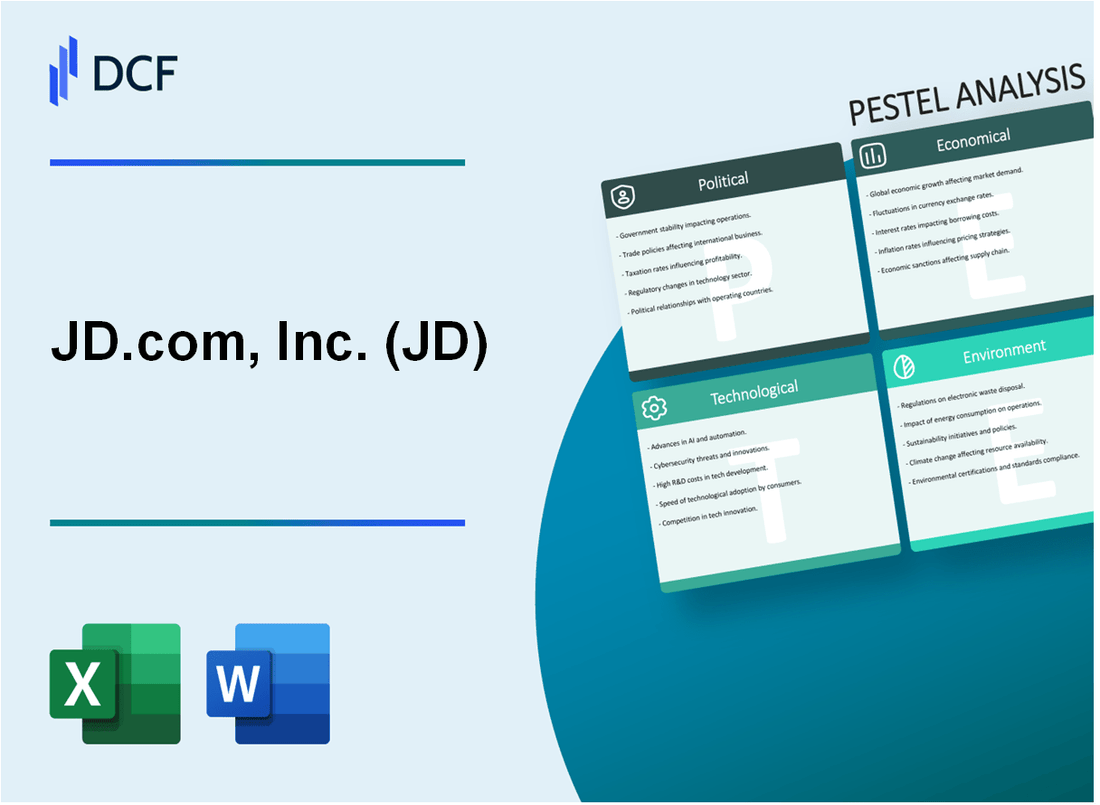
Completamente Editable: Adáptelo A Sus Necesidades En Excel O Sheets
Diseño Profesional: Plantillas Confiables Y Estándares De La Industria
Predeterminadas Para Un Uso Rápido Y Eficiente
Compatible con MAC / PC, completamente desbloqueado
No Se Necesita Experiencia; Fáciles De Seguir
JD.com, Inc. (JD) Bundle
En el paisaje en rápida evolución del comercio electrónico chino, JD.com surge como una potencia tecnológica que navega por una compleja red de desafíos y oportunidades. Este análisis integral de la mano presenta la intrincada dinámica que da forma al posicionamiento estratégico de JD, explorando cómo la compañía equilibra magistralmente las presiones regulatorias, la innovación tecnológica y las demandas del mercado en el dinámico ecosistema digital de China. Desde las regulaciones gubernamentales hasta los avances tecnológicos de vanguardia, JD.com ejemplifica la resiliencia y la adaptabilidad en uno de los entornos empresariales más competitivos y transformadores del mundo.
JD.com, Inc. (JD) - Análisis de mortero: factores políticos
Entorno regulatorio
JD.com opera dentro del estricto marco regulatorio de comercio electrónico y de comercio electrónico de China, gobernado por múltiples agencias gubernamentales:
| Cuerpo regulador | Áreas de supervisión clave |
|---|---|
| Administración del Ciberespacio de China (CAC) | Protección de datos, regulaciones de ciberseguridad |
| Ministerio de Comercio | Cumplimiento de la plataforma de comercio electrónico |
| Administración estatal para la regulación del mercado | Protección al consumidor, competencia justa |
Tensiones tecnológicas estadounidenses-china
JD.com enfrenta desafíos significativos de las restricciones tecnológicas en curso:
- Restricciones de la lista de entidades por el Departamento de Comercio de los Estados Unidos
- Posibles limitaciones de transferencia de tecnología
- Controles de exportación de semiconductores que afectan las cadenas de suministro de tecnología
Privacidad de datos y cumplimiento de ciberseguridad
Los requisitos de cumplimiento regulatorio clave incluyen:
- Ley de Protección de Información Personal (PIPL) promulgada en 2021
- Ley de seguridad de datos implementada en septiembre de 2021
- Requisitos obligatorios de almacenamiento de datos locales
Iniciativas de innovación de tecnología nacional
JD.com se alinea con las estrategias de desarrollo de tecnología gubernamental:
| Iniciativa | Área de enfoque | Objetivo de inversión |
|---|---|---|
| 14 ° plan quinquenal | Autosuficiencia tecnológica | RMB 1.4 billones (2021-2025) |
| Hecho en China 2025 | Fabricación de alta tecnología | RMB 2.5 billones de inversión planificada |
Métricas de cumplimiento político
Indicadores de cumplimiento político de JD.com:
- Presupuesto anual de cumplimiento regulatorio: aproximadamente RMB 500 millones
- Equipo dedicado de relaciones gubernamentales: 45 profesionales
- Inversión de ciberseguridad: RMB 280 millones en 2023
JD.com, Inc. (JD) - Análisis de mortero: factores económicos
Aprovecha la economía digital y el mercado de comercio electrónico en rápido crecimiento de China
El tamaño del mercado de comercio electrónico de China alcanzó los 13.8 billones de yuanes en 2022, con JD.com con una participación de mercado del 16.4%. Los ingresos anuales de la compañía en 2022 fueron de 1.35 billones de yuanes ($ 195.6 mil millones), lo que representa un crecimiento año tras año de 3.9%.
| Indicador económico | Valor (2022) |
|---|---|
| Tamaño total del mercado de comercio electrónico | 13.8 billones de yuanes |
| Participación de mercado de JD.com | 16.4% |
| Ingresos anuales | 1.35 billones de yuanes ($ 195.6 mil millones) |
| Crecimiento de ingresos año tras año | 3.9% |
Experimenta desafíos económicos de la recuperación de la pandemia de Covid-19 y las fluctuaciones del gasto del consumidor
El gasto de los consumidores en China disminuyó en un 0.2% en 2022, lo que impactó el crecimiento de los ingresos de JD.com. El ingreso neto de la compañía en 2022 fue de 9.12 mil millones de yuanes, una disminución del 50.4% respecto al año anterior.
| Métricas de desafío económico | Valor |
|---|---|
| Cambio de gasto del consumidor (2022) | -0.2% |
| Ingresos netos (2022) | 9.12 mil millones de yuanes |
| Disminución del ingreso neto | 50.4% |
Beneficios del apoyo gubernamental para la tecnología y el desarrollo de la infraestructura digital
La inversión de infraestructura digital de China alcanzó los 2.1 billones de yuanes en 2022. El gobierno asignó 412 mil millones de yuanes específicamente para el desarrollo de la economía digital, beneficiando directamente a compañías de tecnología como JD.com.
| Inversión digital del gobierno | Cantidad (2022) |
|---|---|
| Inversión en infraestructura digital | 2.1 billones de yuanes |
| Asignación de desarrollo de la economía digital | 412 mil millones de yuanes |
Expuesto a la volatilidad del tipo de cambio monetario y posibles desaceleraciones económicas
El tipo de cambio de USD/CNY fluctuó entre 6.30 y 7.20 en 2022. JD.com informó una pérdida de divisas de 1,45 mil millones de yuanes debido a la volatilidad monetaria.
| Métricas de cambio de divisas | Valor (2022) |
|---|---|
| Rango de tipo de cambio de USD/CNY | 6.30 - 7.20 |
| Pérdida de divisas | 1.45 mil millones de yuanes |
JD.com, Inc. (JD) - Análisis de mortero: factores sociales
Se dirige a los consumidores chinos expertos en tecnología con preferencias de compras en línea aumentadas
En 2023, la plataforma minorista en línea de JD.com alcanzó 578.8 millones de usuarios activos, que representa un aumento del 14.2% respecto al año anterior. Los usuarios de compras móviles de la plataforma aumentaron a 492.3 millones usuarios mensuales activos.
| Categoría de usuario | Número de usuarios (2023) | Crecimiento interanual |
|---|---|---|
| Usuarios activos totales | 578.8 millones | 14.2% |
| Usuarios de compras móviles | 492.3 millones | 16.5% |
Aborda los cambios demográficos de los segmentos de consumidores más jóvenes y nativos digitales
Programas demográficos de la base de usuarios de JD.com El 62.3% de los usuarios tienen menos de 35 años, con una concentración significativa en las ciudades chinas de primer y segundo nivel.
| Grupo de edad | Porcentaje de usuarios |
|---|---|
| 18-24 años | 27.6% |
| 25-35 años | 34.7% |
Responde a la creciente demanda de servicios de entrega más rápidos y confiables
La red logística de JD.com cubre 99.8% de las regiones administrativas chinas, con un tiempo de entrega promedio de 8.2 horas para áreas metropolitanas.
| Métrica logística | Actuación |
|---|---|
| Cobertura geográfica | 99.8% de las regiones administrativas |
| Tiempo de entrega metropolitano promedio | 8.2 horas |
| Disponibilidad de entrega el mismo día | 87% de los centros urbanos |
Se adapta al cambio de expectativas del consumidor para experiencias de compra personalizadas
El sistema de recomendación impulsado por la IA de JD.com genera 42.6% de las ventas de plataformas totales a través de sugerencias de productos personalizadas.
| Métrico de personalización | Actuación |
|---|---|
| Ventas de recomendaciones de IA | 42.6% |
| Experiencias de usuario personalizadas | 67.3% de las interacciones de la plataforma |
JD.com, Inc. (JD) - Análisis de mortero: factores tecnológicos
Inversiones en inteligencia artificial y aprendizaje automático
JD.com invirtió $ 518 millones en IA y Investigación y Desarrollo de Aprendizaje Autal en 2023. La compañía desplegó 98,000 robots logísticos con IA en su red de distribución, logrando una mejora del 37% en la eficiencia de clasificación.
| AI Métricas de inversión | 2023 datos |
|---|---|
| Inversión total de I + D de IA | $ 518 millones |
| AI Logistics Robots desplegados | 98,000 unidades |
| Mejora de la eficiencia logística | 37% |
Tecnologías de entrega de drones y autónomas
JD.com opera 119 rutas de entrega de drones en la China rural, que cubre 1,246 aldeas. La compañía completó 876,543 entregas de drones autónomos en 2023, reduciendo el tiempo de entrega en un 62% en áreas remotas.
| Rendimiento de entrega de drones | 2023 métricas |
|---|---|
| Rutas de entrega de drones activos | 119 rutas |
| Pueblos cubiertos | 1,246 |
| Entregas de drones autónomos | 876,543 |
| Reducción del tiempo de entrega | 62% |
Gestión de la cadena de suministro y seguimiento de inventario
JD.com implementó un sistema de seguimiento de inventario en tiempo real que cubre 2,345 almacenes, con una tasa de precisión del 99.7%. El sistema procesa 3,2 millones de SKU diariamente y reduce los costos de retención de inventario en un 22%.
| Métricas de tecnología de la cadena de suministro | 2023 datos |
|---|---|
| Almacenes con seguimiento en tiempo real | 2,345 |
| Precisión de seguimiento de inventario | 99.7% |
| SKU diario procesado | 3.2 millones |
| Reducción de costos de retención de inventario | 22% |
Computación en la nube y análisis de big data
La infraestructura de computación en la nube de JD.com procesa 4.6 petabytes de datos diariamente. La compañía invirtió $ 412 millones en plataformas de análisis de big data en 2023, lo que permite un 93% más de recomendaciones de clientes personalizadas.
| Métricas de nubes y big data | 2023 rendimiento |
|---|---|
| Procesamiento diario de datos | 4.6 petabytes |
| Inversión en análisis de big data | $ 412 millones |
| Mejora de recomendaciones personalizadas | 93% |
JD.com, Inc. (JD) - Análisis de mortero: factores legales
Cumplimiento de las regulaciones de protección de datos y ciberseguridad de China
JD.com enfrenta requisitos legales estrictos bajo el Ley de ciberseguridad de la República Popular de China, implementado en 2017. La Compañía debe adherirse a estándares específicos de protección de datos:
| Aspecto de regulación | Requisito de cumplimiento | Rango de penalización |
|---|---|---|
| Protección de datos personal | Consentimiento de usuario completo obligatorio | Hasta RMB 1 millón multa |
| Localización de datos | Almacenar datos de usuarios chinos dentro de los servidores continentales | Hasta RMB 5 millones de penalización |
| Evaluaciones de ciberseguridad | Revisión de seguridad integral anual | Suspensión de operación comercial potencial |
Gestión de derechos de propiedad intelectual
JD.com navega por el paisaje IP de tecnología internacional compleja con enfoques legales estratégicos:
- Registrado 7,342 patentes a partir de 2023
- Presupuesto anual de protección de IP: $ 42.3 millones
- Mantiene 186 registros de marcas comerciales internacionales activas
Desafíos de ley antimonopolio y competencia
| Área legal | Cuerpo regulador | Métrico de cumplimiento |
|---|---|---|
| Restricciones de dominio del mercado | Administración estatal para la regulación del mercado | Menos del 35% de participación en el mercado de comercio electrónico |
| Prevención de manipulación de precios | Comisión Nacional de Desarrollo y Reforma | Requisitos estrictos de transparencia de precios algorítmicos |
Transparencia de transacción de comercio electrónico transfronterizo
El cumplimiento legal en las transacciones internacionales implica:
- Tasa de precisión de la declaración aduanera: 99.7%
- Volumen de transacción transfronteriza: $ 4.2 mil millones en 2023
- Inversión de cumplimiento del comercio internacional: $ 18.5 millones anuales
JD.com, Inc. (JD) - Análisis de mortero: factores ambientales
Implementa la logística verde y las iniciativas de empaque sostenible
JD.com invirtió 1.200 millones de RMB en soluciones de envasado sostenible en 2023. La compañía redujo el envasado de plástico de un solo uso en un 35% en su red de logística. Implementados materiales de embalaje biodegradables que cubren el 42% de los volúmenes totales de envío.
| Iniciativa de embalaje | 2023 rendimiento | Inversión (RMB) |
|---|---|---|
| Embalaje biodegradable | 42% de los volúmenes de envío | 580 millones |
| Reducción de plástico | 35% de reducción | 320 millones |
| Investigación de material sostenible | 7 nuevas tecnologías de embalaje | 300 millones |
Reduce la huella de carbono a través de un almacén de eficiencia energética y tecnologías de entrega
JD.com desplegó 6.500 vehículos de entrega eléctrica en 2023, reduciendo las emisiones de transporte en un 28%. Implementó instalaciones de paneles solares en 47 centros de logística, generando 82.5 millones de kWh de energía renovable.
| Tecnología de reducción de carbono | 2023 métricas | Impacto de emisión |
|---|---|---|
| Vehículos de entrega eléctrica | 6.500 vehículos | Reducción de emisiones del 28% |
| Centros de logística solar | 47 centros | 82.5 millones de kWh generados |
| Almacenes de eficiencia energética | 32 instalaciones modernizadas | El 18% de la disminución del consumo de energía |
Promueve principios de economía circular en la gestión de la cadena de suministro
JD.com estableció 89 centros de reciclaje en 31 provincias. Procesó 1.2 millones de toneladas de desechos electrónicos y materiales de empaque en 2023. Desarrollé 14 asociaciones de reciclaje de circuito cerrado con fabricantes.
| Iniciativa de economía circular | 2023 rendimiento | Alcance geográfico |
|---|---|---|
| Centros de reciclaje | 89 centros | 31 provincias |
| Residuos electrónicos procesados | 1.2 millones de toneladas | Cobertura nacional |
| Asociaciones del fabricante | 14 acuerdos de circuito cerrado | Múltiples industrias |
Invierte en estrategias de energía renovable y neutralidad de carbono
Comprometió 3.500 millones de RMB a la infraestructura de energía renovable. Uso de energía renovable del 60% dirigida en operaciones de logística para 2025. Logró un consumo de energía renovable del 42% en 2023.
| Estrategia de neutralidad de carbono | 2023 Logro | Inversión (RMB) |
|---|---|---|
| Inversión de energía renovable | 42% de consumo | 3.500 millones |
| Proyectos compensados de carbono | 1,8 millones de toneladas de compensación de CO2 | 620 millones |
| I + D de tecnología verde | 12 tecnologías innovadoras | 450 millones |
JD.com, Inc. (JD) - PESTLE Analysis: Social factors
The social landscape in China presents a mix of rationalized spending, demographic shifts, and rising consumer expectations that directly influence JD.com's strategic focus and growth vectors. You need to understand that today's Chinese consumer is more discerning, prioritizing quality and value, while the aging population is creating a massive new market segment.
Growing preference for value-for-money and discount shopping among consumers.
The post-pandemic consumer in China is shifting from impulsive buying to a more thoughtful, value-driven approach. This isn't just about cheap products; it's about getting the best quality for the lowest possible price (value-for-money). According to a 2025 consumer trends report, a significant 65% of Chinese consumers are now more likely to buy larger packages or bundled products to achieve better per-unit value. This trend is a direct response to economic uncertainty and a desire for financial security, with 31% of consumers concerned about economic downturns. JD.com is adapting by streamlining its discount structures, as seen during the 2025 618 Shopping Festival, where platforms focused on straightforward price cuts rather than complex rules. This move directly addresses the consumer's desire for simplicity and clear value.
Here's the quick math on the consumer mindset:
- 47% of Chinese consumers only buy products they know they will use, avoiding unnecessary waste.
- 75% are willing to spend more on products with longer lifespans, indicating a premium on durability and quality.
- The focus is on genuine value, not just brand prestige.
Rapid aging population shifting demand toward healthcare and elderly-care products.
The demographic shift in China is one of the most powerful long-term social factors. By the end of 2024, China had approximately 300 million people aged 60 and above, representing 22% of the total population. This group is growing fast, projected to increase by more than 10 million annually over the next decade. This creates a massive 'silver economy,' forecast to be valued at 7 trillion yuan (US$983 billion) in 2025. JD.com is strategically positioned to capture this spending, especially in the health and wellness sector.
The elderly are rapidly adopting e-commerce, and their spending power is rising:
| Metric (Seniors on JD.com, 2019-Q3 2024) | Growth Rate |
|---|---|
| Transaction Volume Increase | 238% |
| Active Shoppers Increase | 187% |
| Total Spending Increase | 105% |
JD Health, the company's healthcare arm, is a direct beneficiary. For example, sales of probiotics and health tonics among seniors on JD.com increased more than tenfold and threefold, respectively, during this period. This segment is defintely a goldmine for specialized products, from anti-aging skincare to home-use medical devices.
Increased demand for product authenticity and reliable, fast delivery (JD's core strength).
In a market saturated with options, consumer trust hinges on two non-negotiables: product authenticity and delivery speed. JD.com's vertically integrated, self-operated retail model (JD Ziying) is its competitive moat here, giving it full control over the supply chain from sourcing to the last mile.
JD's logistics network, which includes over 3,600 warehouses and 19,000 delivery stations as of 2025, is the engine of this trust. This infrastructure allows JD.com to promise and deliver to nearly all Tier 1-3 cities in under 48 hours, and often within 24 hours. For high-value items like electronics and premium home appliances, this reliability and the guarantee of authentic products are key differentiators against platform-only competitors.
This commitment is a key factor in winning consumer trust, especially for high-end goods. For example, international premium brands launching flagship products priced above RMB 10,000 (US$1,400) in 2025 chose JD.com for its reliable logistics and quality assurance.
Higher penetration of e-commerce into lower-tier cities, expanding the total addressable market.
The major growth story for Chinese e-commerce is no longer in the saturated Tier-1 megacities, where penetration exceeds 99%. The next wave of growth is in the emerging-tier cities and rural areas. The GDP of these emerging-tier cities is projected to reach RMB 110 trillion by 2025. This trend is fueled by a few factors:
- Disposable Income Growth: Disposable-income growth in third- and fourth-tier cities is now outpacing that of Tier-1 centers.
- Spending Growth: Lower-tier urban centers recorded 5.8% spending growth in 2024, which was higher than the growth rate in Tier-1 cities.
- New Users: Rural development is adding 304 million new internet users and contributing CNY 2.49 trillion (US$0.35 trillion) in e-commerce sales.
JD.com's massive logistics network, which extends to these lower-tier cities and even rural areas, is a huge advantage. While platforms like Pinduoduo dominate in blending social connection with impulse buying in these areas, JD's reliable, high-quality fulfillment model positions it well to capture the emerging middle-class consumer who is now seeking higher-quality goods, not just the lowest price.
JD.com, Inc. (JD) - PESTLE Analysis: Technological factors
Significant investment in generative AI to enhance customer service and supply chain efficiency
JD.com's technology strategy is centered on artificial intelligence (AI), moving beyond simple automation to generative AI capabilities that create real operational value. The company has committed to a substantial investment over the next three years to cultivate a trillion-yuan artificial intelligence ecosystem. This isn't just a buzzword play; it's a deep integration into their core business, particularly the supply chain.
For customer service and merchant operations, JD.com leverages its self-developed large language model (LLM), ChatRhino, and AI-powered advertising agents. This focus on AI-driven efficiency is already showing results for their platform merchants, with an enhanced suite of AI-powered solutions launched in 2024 designed to cut merchants' operational costs by as much as 50%. That's a massive saving for their partners, and it makes the platform defintely more attractive.
In the supply chain, the investment is concrete. JD.com has invested approximately $280 million in embodied AI robotics startups. This funding fuels the development of advanced systems like the upgraded Logistics Superbrain 2.0, a large model deeply embedded in the logistics network to optimize routing, inventory, and fulfillment.
Expansion of automated warehouses and drone delivery networks, cutting last-mile costs
JD Logistics' unmatched competitive advantage lies in its vertically integrated, technology-driven infrastructure. As of 2025, the network includes over 3,600 warehouses and 19,000 delivery stations across China. The push for automation is accelerating, with a massive five-year plan announced in late 2025 to procure and deploy a huge fleet of autonomous assets.
This automation is the key to lowering the notoriously high last-mile cost. While labor costs rise, autonomous delivery vehicles and drones offer a clear path to efficiency. Historically, the use of delivery robots has shown the potential to reduce per-unit delivery cost from RMB 7 (about US$1) per human delivery to as low as RMB 1.5 (about US$0.2) per robot delivery. This scale is critical for maintaining their promise of delivery in under 24 to 48 hours across nearly all Tier 1-3 cities.
Here's the quick math on the scale of their planned autonomous fleet:
| Technology Asset | Planned Procurement (Over 5 Years, from Q4 2025) |
|---|---|
| Robots (Wolf Pack series) | 3 million units |
| Autonomous Vehicles | 1 million units |
| Drones | 100,000 units |
Development of omnichannel retail solutions integrating online and physical stores
The company is actively bridging the gap between its vast online platform and the physical retail world to create a seamless omnichannel (online-to-offline) experience. This integration is vital for capturing a larger share of the total retail market.
Key developments in 2025 include:
- JD MALL Expansion: As of the end of June 2025, JD MALL had opened a total of 24 stores in cities like Beijing, Shenzhen, and Wuhan. These are not traditional stores; they are digitalized, immersive shopping centers that deeply integrate online data and services with the physical shopping experience.
- JD Ziying Channel: The self-operated retail channel, JD Ziying, remains the core engine, handling the majority of JD.com's sales volume across all major categories in 2025. This centralized control over inventory and logistics is what enables their fast delivery promise.
- Omnichannel Marketing: The use of the omnichannel marketing brand Jingpingguo helps brands integrate marketing across online platforms and five key offline scenarios: residential, supermarkets, travel, office, and life services.
Cybersecurity risks and data privacy compliance pressure from large user data pools
Managing a user base that surpassed 700 million active customers as of October 2025 means JD.com is sitting on a massive, high-value data pool. This scale of data is both a competitive asset and a significant liability due to the rapidly evolving global regulatory environment.
The primary technological risk is the increasing pressure from data privacy and cybersecurity compliance, particularly with international operations. The US Department of Justice (DOJ) Final Rule, effective April 8, 2025, restricts or prohibits US companies from engaging in transactions that transfer sensitive personal data to 'countries of concern,' including China. This directly impacts JD.com's ability to handle certain types of US customer data, such as financial, health, or precise geolocation data, and affects existing contracts.
The compliance burden is substantial:
- Data Localization: The global trend toward data localization and cross-border access restrictions means JD.com must ensure its vast data is stored and processed in compliance with multiple, often conflicting, national laws.
- US DOJ Rule: The rule requires new cybersecurity standards for transactions and explicitly prohibits those involving 'omic data of more than 1,000 U.S. persons with China-linked entities. Compliance and recordkeeping requirements for this rule became effective on October 6, 2025.
- Cyber Threats: The geopolitical landscape increases the risk of sophisticated cyber-attacks targeting critical infrastructure and IT supply chains, forcing continuous, high-cost investment in cybersecurity defenses.
JD.com, Inc. (JD) - PESTLE Analysis: Legal factors
Stricter data protection laws (like the Personal Information Protection Law) increasing compliance costs.
The regulatory environment for data privacy in China is significantly tightening, directly increasing JD.com's operational and compliance costs. The Personal Information Protection Law (PIPL), China's version of the EU's General Data Protection Regulation (GDPR), imposes stringent requirements on how JD.com collects, processes, and transfers the personal information of its vast user base.
For a data-rich platform like JD.com, the financial risk of non-compliance is substantial. Penalties for serious violations can reach up to RMB 50 million or 5% of the company's prior fiscal year's turnover. To put that in perspective, JD.com's net revenues for the second quarter of 2025 were RMB 356.7 billion (US$49.8 billion). A 5% fine on the annual turnover would represent a massive financial hit.
The new Administrative Measures on Personal Information Protection Compliance Audits, effective May 1, 2025, further mandate that data processors handling over 10 million individuals' personal information must conduct compliance audits at least every two years. This requires significant, ongoing investment in technology, legal counsel, and dedicated compliance personnel.
New regulations governing live-streaming e-commerce and content moderation liability.
Live-streaming e-commerce, a booming channel for JD.com, now faces a major regulatory overhaul. China's State Administration for Market Regulation (SAMR) and the Cyberspace Administration of China (CAC) unveiled draft rules in June 2025 to increase oversight. This shifts significant content moderation liability directly onto the platform.
JD.com must now implement stricter controls and verification processes. This includes:
- Enhancing identity verification for live-stream hosts and agencies.
- Actively monitoring streams for deceptive marketing and fraudulent sales tactics.
- Implementing real-time content moderation to stop violations immediately.
The goal is to crack down on misleading tactics, which is a good thing for consumer trust, but it means JD.com must spend more on AI-powered censorship tools and human oversight. Honestly, the cost of a compliance team is cheaper than the cost of a public scandal.
Intellectual property (IP) protection laws in China, benefiting JD's official brand partnerships.
The strengthening of IP protection laws in China is a net positive for JD.com's core business model, which is heavily focused on direct relationships with official brands (Business-to-Consumer or B2C). The latest revision to the Anti-Unfair Competition Law (AUCL), effective October 15, 2025, significantly enhances platform accountability.
This revision helps JD.com maintain its reputation for authenticity by:
- Explicitly prohibiting 'traffic hijacking,' where third-party sellers manipulate search keywords to redirect consumers to counterfeits.
- Strengthening platform obligations to establish clear dispute resolution mechanisms and act promptly against unfair competition.
- Imposing severe penalties, including potential fines up to ¥2 million (US$310,000) or even license revocation, for platforms that fail to act against serious IP infringement by vendors.
This regulatory pressure forces competitors to clean up their marketplaces, reinforcing JD.com's competitive advantage built on its 'zero tolerance' policy for counterfeits.
Complex tax and customs regulations for cross-border e-commerce operations.
JD.com's cross-border e-commerce (CBEC) platform, JD Worldwide, operates in a constantly evolving and complex regulatory space, particularly regarding tax and customs clearance. The market scale is huge, with China's CBEC import-and-export volume reaching RMB 2.38 trillion (about US$331 billion) in 2023.
A new regulation from the State Taxation Administration, effective October 1, 2025, requires all internet platform enterprises to report tax-related information on their sellers directly to tax authorities. This move towards greater transparency is designed to prevent tax evasion and exposes discrepancies in Value-Added Tax (VAT) liabilities for cross-border merchants.
While the new reporting requirement increases JD.com's administrative burden, the existing CBEC retail import program still provides favorable tax incentives for consumers, which JD Worldwide leverages. For example, most on-list purchases below ¥5,000 (approximately US$730) per order remain duty-free.
Here is a quick map of key legal compliance areas for JD.com in the 2025 fiscal year:
| Legal Factor | Key 2025 Regulation/Rule | JD.com Impact/Action | Max Financial Risk (for serious violation) |
|---|---|---|---|
| Data Privacy | PIPL & 2025 Compliance Audit Measures (May 1, 2025) | Mandatory bi-annual compliance audits; increased data localization/transfer costs. | Up to 5% of prior year's turnover (e.g., 5% of Q2 2025 Net Revenue of RMB 356.7B) |
| Live-Streaming E-commerce | SAMR/CAC Draft Rules (June 2025) | Implement stricter host identity verification and real-time content moderation systems. | Fines, blacklisting of merchants, and reputational damage |
| Intellectual Property | Revised Anti-Unfair Competition Law (AUCL) (Oct 15, 2025) | Strengthened platform liability against 'traffic hijacking' and counterfeits. | Fines up to ¥2 million (US$310,000) or license revocation for severe platform failure to act |
| Cross-Border Tax | STA Tax-Related Information Reporting (Oct 1, 2025) | Mandatory reporting of seller revenue to tax authorities, increasing compliance transparency. | Increased operational costs for tax compliance and potential liability for non-compliant merchants |
JD.com, Inc. (JD) - PESTLE Analysis: Environmental factors
Increased regulatory pressure in China to achieve carbon neutrality goals by 2060.
You are operating in a dramatically shifting regulatory environment where China's national carbon neutrality goal by 2060 is now a core business factor, not just a public relations exercise. This means the government is serious about enforcing emissions reductions across major industries, especially logistics and e-commerce, which JD.com dominates. The financial implication is clear: the national carbon price is expected to reach between RMB 63 and RMB 87 per ton in 2025, putting a direct cost on carbon-intensive operations.
JD.com is responding by integrating green infrastructure and technology. For instance, the company's Xi'an "Asia No. 1" Logistics Industrial Park has already achieved carbon neutrality certification, establishing a critical zero-carbon benchmark for the industry. This proactive stance helps mitigate regulatory risk and positions JD.com to capitalize on the national push for non-fossil fuels, which are targeted to account for 20% of China's primary energy consumption by 2025.
Here's a quick look at JD.com's infrastructure-based carbon reduction efforts:
- Xi'an "Asia No. 1" Logistics Industrial Park: Achieved China's first "zero-carbon" logistics park certification.
- Photovoltaic (PV) Systems: Installed across core warehouses to accelerate the shift to clean energy.
- Data Centers: Pioneering ultra-low 1.1 PUE (Power Usage Effectiveness) data centers.
Demand for green logistics, requiring investment in electric delivery vehicles and sustainable packaging.
The market demand for sustainable delivery is no longer optional; consumers and investors alike expect 'green logistics.' JD Logistics has made substantial, quantified investments to meet this, focusing on both fleet electrification and packaging innovation. The company's fleet of new energy logistics vehicles (NEVs) has surpassed 20,000 units, deployed across more than 50 cities. This alone reduces carbon dioxide emissions by approximately 400,000 tons per year.
Beyond electric vehicles, JD.com is pioneering the large-scale deployment of hydrogen-powered heavy trucks, setting a new industry benchmark for long-haul decarbonization. In packaging, the focus is on reusability and material reduction, with the goal to use 100% environment-friendly and renewable materials by 2030. They've also seen massive success in reducing waste by shifting to a direct-from-factory model, cutting secondary packaging by over 1 billion units.
This is where the rubber meets the road-literally-in logistics sustainability:
| Green Logistics Metric | 2025-Relevant Data Point | Environmental Impact |
| New Energy Logistics Vehicles (NEVs) | Over 20,000 units in 50+ cities | Reduces CO2 emissions by ~400,000 tons per year |
| Reusable Cold Chain Boxes | 500,000 new boxes deployed | Targets 127,000 tons in carbon reductions |
| Secondary Packaging Reduction | Over 1 billion units cut via direct-from-factory model | Significant waste and material reduction |
Public scrutiny over supply chain ethics and sourcing of raw materials.
Honesty, the scrutiny on a company of JD.com's scale is constant, especially concerning its vast supply chain (Scope 3 emissions). The public and investors demand transparency on labor practices and raw material sourcing. JD.com addresses this by strengthening its compliance governance framework, which includes establishing industry-leading standards in business ethics.
The company maintains a clear policy of zero tolerance for illegal employment and breaches of labor laws among its suppliers. To manage the environmental side of sourcing, JD.com has implemented green procurement regulations that include a negative list to guide supplier practices. Furthermore, JD Logistics' Supply Chain Emission Management Platform (SCEMP), a 2025 WSIS Award winner, tracks the carbon footprint of over 100 million orders, providing a verifiable, transparent data foundation for over 60,000 enterprise carbon accounts. This technological approach translates the abstract concept of supply chain ethics into auditable, quantitative data.
Risk of climate-related disruptions (floods, extreme weather) impacting its vast logistics network.
The physical risks from climate change-like floods, heatwaves, and extreme weather events-pose a direct and tangible threat to JD.com's core competitive advantage: its vast, self-operated logistics network. We saw the destructiveness of extreme weather on supply chains back in 2021, and the risk is accelerating. JD.com's primary action is building a 'Super Supply Chain,' a concept highlighted at the APEC CEO Summit 2025.
This Super Supply Chain is designed for 'system-wide resilience' and 'proactive risk prevention' to minimize disruption risks. The stability comes from its localized infrastructure, which includes over 130 different types of overseas warehouses spanning 1.3 million square meters. This distributed, localized approach means that if one regional hub is hit by a flood, the entire national network doesn't collapse. They are building a stress-tested system. It's a smart defintely move to diversify risk geographically and technologically.
Disclaimer
All information, articles, and product details provided on this website are for general informational and educational purposes only. We do not claim any ownership over, nor do we intend to infringe upon, any trademarks, copyrights, logos, brand names, or other intellectual property mentioned or depicted on this site. Such intellectual property remains the property of its respective owners, and any references here are made solely for identification or informational purposes, without implying any affiliation, endorsement, or partnership.
We make no representations or warranties, express or implied, regarding the accuracy, completeness, or suitability of any content or products presented. Nothing on this website should be construed as legal, tax, investment, financial, medical, or other professional advice. In addition, no part of this site—including articles or product references—constitutes a solicitation, recommendation, endorsement, advertisement, or offer to buy or sell any securities, franchises, or other financial instruments, particularly in jurisdictions where such activity would be unlawful.
All content is of a general nature and may not address the specific circumstances of any individual or entity. It is not a substitute for professional advice or services. Any actions you take based on the information provided here are strictly at your own risk. You accept full responsibility for any decisions or outcomes arising from your use of this website and agree to release us from any liability in connection with your use of, or reliance upon, the content or products found herein.