

|
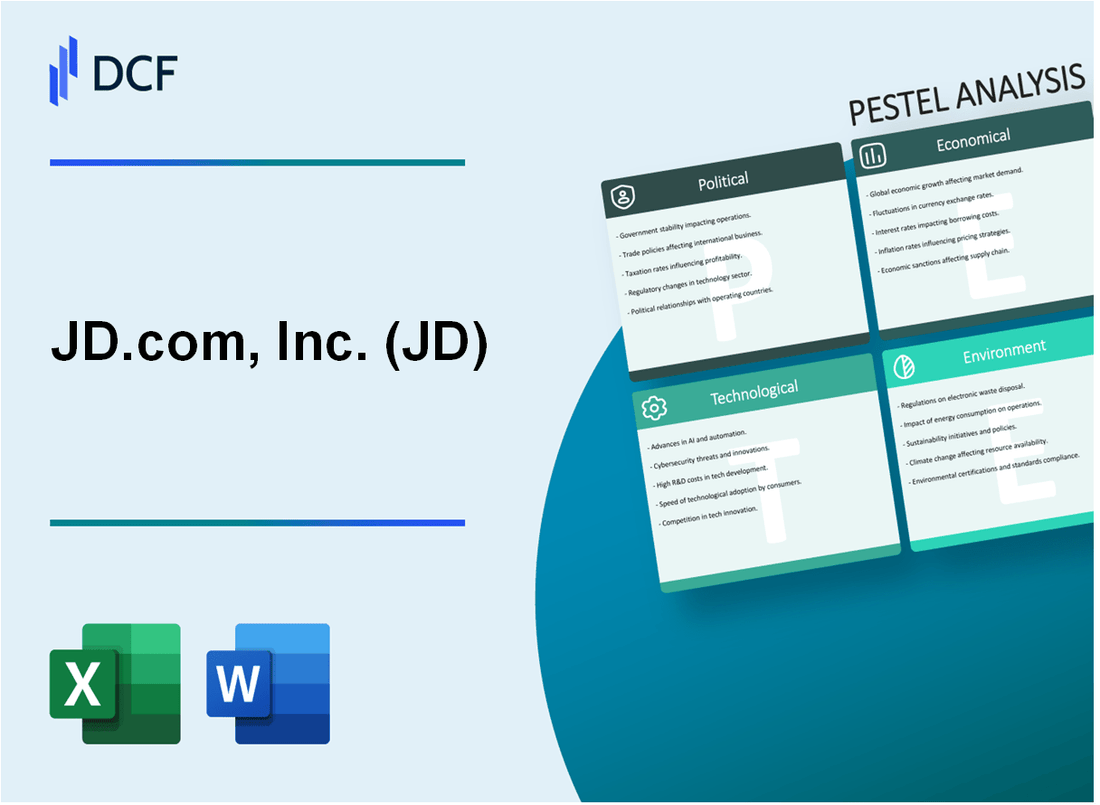
JD.com, Inc. (JD): Análise de Pestle [Jan-2025 Atualizado] |
Totalmente Editável: Adapte-Se Às Suas Necessidades No Excel Ou Planilhas
Design Profissional: Modelos Confiáveis E Padrão Da Indústria
Pré-Construídos Para Uso Rápido E Eficiente
Compatível com MAC/PC, totalmente desbloqueado
Não É Necessária Experiência; Fácil De Seguir
JD.com, Inc. (JD) Bundle
No cenário em rápida evolução do comércio eletrônico chinês, o JD.com surge como uma potência tecnológica que navega em uma complexa rede de desafios e oportunidades. Essa análise abrangente de pestles revela a intrincada dinâmica que molda o posicionamento estratégico da JD, explorando como a empresa equilibra magistralmente pressões regulatórias, inovação tecnológica e demandas de mercado no ecossistema digital dinâmico da China. De regulamentos governamentais a avanços tecnológicos de ponta, o JD.com exemplifica a resiliência e a adaptabilidade em um dos ambientes de negócios mais competitivos e transformadores do mundo.
JD.com, Inc. (JD) - Análise de Pestle: Fatores Políticos
Ambiente Regulatório
O JD.com opera dentro da rigorosa estrutura regulatória de comércio eletrônico e tecnologia da China, governado por várias agências governamentais:
| Órgão regulatório | Principais áreas de supervisão |
|---|---|
| Administração do ciberespaço da China (CAC) | Proteção de dados, regulamentos de segurança cibernética |
| Ministério do Comércio | Conformidade da plataforma de comércio eletrônico |
| Administração estadual para regulamentação de mercado | Proteção ao consumidor, concorrência justa |
Tensões de tecnologia americanas-china
O JD.com enfrenta desafios significativos das restrições tecnológicas em andamento:
- Lista de entidades Restrições pelo Departamento de Comércio dos EUA
- Limitações potenciais de transferência de tecnologia
- Controles de exportação de semicondutores impactando as cadeias de suprimentos de tecnologia
Privacidade de dados e conformidade de segurança cibernética
Os principais requisitos de conformidade regulatória incluem:
- Lei de Proteção de Informações Pessoais (PIPL) promulgada em 2021
- Lei de segurança de dados implementada em setembro de 2021
- Requisitos obrigatórios de armazenamento de dados locais
Iniciativas nacionais de inovação em tecnologia
JD.com alinha -se com estratégias de desenvolvimento de tecnologia do governo:
| Iniciativa | Área de foco | Meta de investimento |
|---|---|---|
| 14º plano de cinco anos | Auto-suficiência tecnológica | RMB 1,4 trilhão (2021-2025) |
| Feito na China 2025 | Fabricação de alta tecnologia | RMB 2,5 trilhões de investimento planejado |
Métricas de conformidade política
Indicadores de conformidade política do JD.com:
- Orçamento anual de conformidade regulatória: aproximadamente RMB 500 milhões
- Equipe dedicada de relações governamentais: 45 profissionais
- Investimento de segurança cibernética: RMB 280 milhões em 2023
JD.com, Inc. (JD) - Análise de Pestle: Fatores Econômicos
Aproveita a economia digital e o comércio eletrônico em rápido crescimento da China
O tamanho do mercado de comércio eletrônico da China atingiu 13,8 trilhões de yuan em 2022, com o JD.com com uma participação de 16,4% no mercado. A receita anual da empresa em 2022 foi de 1,35 trilhão de yuans (US $ 195,6 bilhões), representando um crescimento de 3,9% ano a ano.
| Indicador econômico | Valor (2022) |
|---|---|
| Tamanho total do mercado de comércio eletrônico | 13,8 trilhões de yuan |
| JD.com Participação de mercado | 16.4% |
| Receita anual | 1,35 trilhão de yuan (US $ 195,6 bilhões) |
| Crescimento de receita ano a ano | 3.9% |
Experimenta desafios econômicos da Recuperação Pandêmica Covid-19 e Flutuações de Gastos do Consumidor
Os gastos do consumidor na China diminuíram 0,2% em 2022, impactando o crescimento da receita do JD.com. O lucro líquido da empresa em 2022 foi de 9,12 bilhões de yuan, um declínio de 50,4% em relação ao ano anterior.
| Metrics de desafio econômico | Valor |
|---|---|
| Mudança de gastos do consumidor (2022) | -0.2% |
| Lucro líquido (2022) | 9,12 bilhões de yuan |
| Declínio do lucro líquido | 50.4% |
Benefícios do apoio do governo à tecnologia e desenvolvimento de infraestrutura digital
O investimento em infraestrutura digital da China atingiu 2,1 trilhões de yuans em 2022. O governo alocou 412 bilhões de yuan especificamente para o desenvolvimento da economia digital, beneficiando diretamente empresas de tecnologia como o JD.com.
| Investimento digital do governo | Valor (2022) |
|---|---|
| Investimento de infraestrutura digital | 2,1 trilhões de yuan |
| Alocação de desenvolvimento da economia digital | 412 bilhões de yuan |
Exposto à volatilidade da taxa de câmbio e potencial desaceleração econômica
A taxa de câmbio USD/CNY flutuou entre 6,30 e 7,20 em 2022. O JD.com relatou uma perda cambial de 1,45 bilhão de yuans devido à volatilidade da moeda.
| Métricas de troca de moeda | Valor (2022) |
|---|---|
| Faixa de taxa de câmbio USD/CNY | 6.30 - 7.20 |
| Perda de câmbio | 1,45 bilhão de yuan |
JD.com, Inc. (JD) - Análise de Pestle: Fatores sociais
Visa os consumidores chineses com experiência em tecnologia com preferências de compras on-line crescentes
Em 2023, a plataforma de varejo on -line do JD.com alcançou 578,8 milhões de usuários ativos, representando um aumento de 14,2% em relação ao ano anterior. Os usuários de compras móveis da plataforma aumentaram para 492,3 milhões usuários mensais ativos.
| Categoria de usuário | Número de usuários (2023) | Crescimento ano a ano |
|---|---|---|
| Usuários ativos totais | 578,8 milhões | 14.2% |
| Usuários de compras móveis | 492,3 milhões | 16.5% |
Aborda a mudança demográfica de segmentos de consumo mais jovens e digitais nativos
Shows demográficos da base de usuários do JD.com 62,3% dos usuários têm menos de 35 anos, com uma concentração significativa nas cidades chinesas de primeiro e segundo nível.
| Faixa etária | Porcentagem de usuários |
|---|---|
| 18-24 anos | 27.6% |
| 25-35 anos | 34.7% |
Responde à crescente demanda por serviços de entrega mais rápidos e confiáveis
Capas de rede de logística do JD.com 99,8% das regiões administrativas chinesas, com um tempo médio de entrega de 8,2 horas para áreas metropolitanas.
| Métrica de logística | Desempenho |
|---|---|
| Cobertura geográfica | 99,8% das regiões administrativas |
| Tempo médio de entrega metropolitana | 8,2 horas |
| Disponibilidade de entrega no mesmo dia | 87% dos centros urbanos |
Adapta -se à mudança de expectativas do consumidor para experiências de compras personalizadas
O sistema de recomendação orientado a AI da JD.com gera 42,6% do total de vendas de plataforma através de sugestões personalizadas de produtos.
| Métrica de personalização | Desempenho |
|---|---|
| Vendas de recomendações de IA | 42.6% |
| Experiências personalizadas do usuário | 67,3% das interações da plataforma |
JD.com, Inc. (JD) - Análise de Pestle: Fatores tecnológicos
Investimentos em inteligência artificial e aprendizado de máquina
A JD.com investiu US $ 518 milhões em pesquisa e desenvolvimento de AI e aprendizado de máquina em 2023. A empresa implantou 98.000 robôs de logística de IA em sua rede de distribuição, alcançando uma melhoria de 37% na eficiência de classificação.
| Métricas de investimento da IA | 2023 dados |
|---|---|
| Investimento total de P&D da AI | US $ 518 milhões |
| Robôs logísticos da IA implantados | 98.000 unidades |
| Melhoria da eficiência logística | 37% |
Tecnologias de entrega de drones e autônomos
O JD.com opera 119 rotas de entrega de drones na China rural, cobrindo 1.246 aldeias. A empresa concluiu 876.543 entregas de drones autônomos em 2023, reduzindo o tempo de entrega em 62% em áreas remotas.
| Desempenho de entrega de drones | 2023 Métricas |
|---|---|
| Rotas de entrega de drones ativos | 119 rotas |
| Aldeias cobertas | 1,246 |
| Entregas de drones autônomos | 876,543 |
| Redução do tempo de entrega | 62% |
Gerenciamento da cadeia de suprimentos e rastreamento de estoque
O JD.com implementou um sistema de rastreamento de inventário em tempo real, cobrindo 2.345 armazéns, com uma taxa de precisão de 99,7%. O sistema processa 3,2 milhões de SKUs diariamente e reduz os custos de retenção de estoque em 22%.
| Métricas de tecnologia da cadeia de suprimentos | 2023 dados |
|---|---|
| Armazéns com rastreamento em tempo real | 2,345 |
| Precisão de rastreamento de inventário | 99.7% |
| SKUs diários processados | 3,2 milhões |
| Redução de custo de retenção de inventário | 22% |
Computação em nuvem e análise de big data
Infraestrutura de computação em nuvem do JD.com Processos de dados 4.6 Petabytes de dados diariamente. A empresa investiu US $ 412 milhões em plataformas de análise de big data em 2023, permitindo 93% mais recomendações de clientes personalizadas.
| Métricas de nuvem e big data | 2023 desempenho |
|---|---|
| Processamento de dados diários | 4.6 Petabytes |
| Big Data Analytics Investment | US $ 412 milhões |
| Melhoria de recomendação personalizada | 93% |
JD.com, Inc. (JD) - Análise de Pestle: Fatores Legais
Conformidade com os regulamentos de proteção de dados e cibersegurança da China
JD.com enfrenta requisitos legais rígidos sob o Lei de segurança cibernética da República Popular da China, implementado em 2017. A Companhia deve aderir aos padrões específicos de proteção de dados:
| Aspecto de regulamentação | Requisito de conformidade | Faixa de penalidade |
|---|---|---|
| Proteção de dados pessoal | Consentimento completo de usuário obrigatório | Até RMB 1 milhão de multa |
| Localização de dados | Armazene os dados do usuário chinês nos servidores do continente | Até RMB 5 milhões de penalidade |
| Avaliações de segurança cibernética | Revisão anual de segurança abrangente | Suspensão de operação comercial potencial |
Gestão de direitos de propriedade intelectual
JD.com navega no cenário de IP de tecnologia internacional complexa com abordagens legais estratégicas:
- Registrado 7.342 patentes a partir de 2023
- Orçamento anual de proteção de IP: US $ 42,3 milhões
- Mantém 186 registros ativos de marca internacional
Desafios antitruste e da concorrência
| Área legal | Órgão regulatório | Métrica de conformidade |
|---|---|---|
| Restrições de domínio do mercado | Administração estadual para regulamentação de mercado | Menos de 35% de participação de mercado de comércio eletrônico |
| Prevenção de manipulação de preços | Comissão Nacional de Desenvolvimento e Reforma | Requisitos de transparência de preços algorítmicos rigorosos |
Transparência de transação de comércio eletrônico transfronteiriço
A conformidade legal nas transações internacionais envolve:
- Taxa de precisão da declaração aduaneira: 99,7%
- Volume de transação transfronteiriça: US $ 4,2 bilhões em 2023
- Investimento internacional de conformidade comercial: US $ 18,5 milhões anualmente
JD.com, Inc. (JD) - Análise de Pestle: Fatores Ambientais
Implementa a logística verde e iniciativas de embalagem sustentável
A JD.com investiu 1,2 bilhão de RMB em soluções de embalagens sustentáveis em 2023. A empresa reduziu as embalagens plásticas de uso único em 35% em sua rede de logística. Materiais de embalagem biodegradáveis implementados, cobrindo 42% do total de volumes de remessa.
| Iniciativa de embalagem | 2023 desempenho | Investimento (RMB) |
|---|---|---|
| Embalagem biodegradável | 42% dos volumes de remessa | 580 milhões |
| Redução de plástico | Redução de 35% | 320 milhões |
| Pesquisa de materiais sustentáveis | 7 novas tecnologias de embalagem | 300 milhões |
Reduz a pegada de carbono através de armazém e tecnologias de entrega com eficiência energética
O JD.com implantou 6.500 veículos de entrega elétrica em 2023, reduzindo as emissões de transporte em 28%. Implementou instalações de painel solar em 47 centros de logística, gerando 82,5 milhões de kWh de energia renovável.
| Tecnologia de redução de carbono | 2023 Métricas | Impacto de emissão |
|---|---|---|
| Veículos de entrega elétrica | 6.500 veículos | 28% de redução de emissões |
| Centros de logística solar | 47 centros | 82,5 milhões de kwh gerados |
| Armazéns com eficiência energética | 32 Instalações adaptadas | Diminuição do consumo de energia de 18% |
Promove os princípios da economia circular no gerenciamento da cadeia de suprimentos
O JD.com estabeleceu 89 centros de reciclagem em 31 províncias. Processou 1,2 milhão de toneladas de resíduos eletrônicos e materiais de embalagem em 2023. Desenvolveu 14 parcerias de reciclagem de circuito fechado com fabricantes.
| Iniciativa de Economia Circular | 2023 desempenho | Escopo geográfico |
|---|---|---|
| Centros de reciclagem | 89 centros | 31 Províncias |
| Resíduos eletrônicos processados | 1,2 milhão de toneladas | Cobertura nacional |
| Parcerias do fabricante | 14 acordos de circuito fechado | Múltiplas indústrias |
Investe em estratégias de energia renovável e neutralidade de carbono
Comprometido 3,5 bilhões de RMB com a infraestrutura de energia renovável. Uso de energia renovável de 60% direcionado em operações logísticas até 2025. Obteve 42% de consumo de energia renovável em 2023.
| Estratégia de neutralidade de carbono | 2023 Realização | Investimento (RMB) |
|---|---|---|
| Investimento de energia renovável | 42% de consumo | 3,5 bilhões |
| Projetos de compensação de carbono | 1,8 milhão de toneladas de deslocamento de CO2 | 620 milhões |
| Tecnologia verde P&D | 12 tecnologias inovadoras | 450 milhões |
JD.com, Inc. (JD) - PESTLE Analysis: Social factors
The social landscape in China presents a mix of rationalized spending, demographic shifts, and rising consumer expectations that directly influence JD.com's strategic focus and growth vectors. You need to understand that today's Chinese consumer is more discerning, prioritizing quality and value, while the aging population is creating a massive new market segment.
Growing preference for value-for-money and discount shopping among consumers.
The post-pandemic consumer in China is shifting from impulsive buying to a more thoughtful, value-driven approach. This isn't just about cheap products; it's about getting the best quality for the lowest possible price (value-for-money). According to a 2025 consumer trends report, a significant 65% of Chinese consumers are now more likely to buy larger packages or bundled products to achieve better per-unit value. This trend is a direct response to economic uncertainty and a desire for financial security, with 31% of consumers concerned about economic downturns. JD.com is adapting by streamlining its discount structures, as seen during the 2025 618 Shopping Festival, where platforms focused on straightforward price cuts rather than complex rules. This move directly addresses the consumer's desire for simplicity and clear value.
Here's the quick math on the consumer mindset:
- 47% of Chinese consumers only buy products they know they will use, avoiding unnecessary waste.
- 75% are willing to spend more on products with longer lifespans, indicating a premium on durability and quality.
- The focus is on genuine value, not just brand prestige.
Rapid aging population shifting demand toward healthcare and elderly-care products.
The demographic shift in China is one of the most powerful long-term social factors. By the end of 2024, China had approximately 300 million people aged 60 and above, representing 22% of the total population. This group is growing fast, projected to increase by more than 10 million annually over the next decade. This creates a massive 'silver economy,' forecast to be valued at 7 trillion yuan (US$983 billion) in 2025. JD.com is strategically positioned to capture this spending, especially in the health and wellness sector.
The elderly are rapidly adopting e-commerce, and their spending power is rising:
| Metric (Seniors on JD.com, 2019-Q3 2024) | Growth Rate |
|---|---|
| Transaction Volume Increase | 238% |
| Active Shoppers Increase | 187% |
| Total Spending Increase | 105% |
JD Health, the company's healthcare arm, is a direct beneficiary. For example, sales of probiotics and health tonics among seniors on JD.com increased more than tenfold and threefold, respectively, during this period. This segment is defintely a goldmine for specialized products, from anti-aging skincare to home-use medical devices.
Increased demand for product authenticity and reliable, fast delivery (JD's core strength).
In a market saturated with options, consumer trust hinges on two non-negotiables: product authenticity and delivery speed. JD.com's vertically integrated, self-operated retail model (JD Ziying) is its competitive moat here, giving it full control over the supply chain from sourcing to the last mile.
JD's logistics network, which includes over 3,600 warehouses and 19,000 delivery stations as of 2025, is the engine of this trust. This infrastructure allows JD.com to promise and deliver to nearly all Tier 1-3 cities in under 48 hours, and often within 24 hours. For high-value items like electronics and premium home appliances, this reliability and the guarantee of authentic products are key differentiators against platform-only competitors.
This commitment is a key factor in winning consumer trust, especially for high-end goods. For example, international premium brands launching flagship products priced above RMB 10,000 (US$1,400) in 2025 chose JD.com for its reliable logistics and quality assurance.
Higher penetration of e-commerce into lower-tier cities, expanding the total addressable market.
The major growth story for Chinese e-commerce is no longer in the saturated Tier-1 megacities, where penetration exceeds 99%. The next wave of growth is in the emerging-tier cities and rural areas. The GDP of these emerging-tier cities is projected to reach RMB 110 trillion by 2025. This trend is fueled by a few factors:
- Disposable Income Growth: Disposable-income growth in third- and fourth-tier cities is now outpacing that of Tier-1 centers.
- Spending Growth: Lower-tier urban centers recorded 5.8% spending growth in 2024, which was higher than the growth rate in Tier-1 cities.
- New Users: Rural development is adding 304 million new internet users and contributing CNY 2.49 trillion (US$0.35 trillion) in e-commerce sales.
JD.com's massive logistics network, which extends to these lower-tier cities and even rural areas, is a huge advantage. While platforms like Pinduoduo dominate in blending social connection with impulse buying in these areas, JD's reliable, high-quality fulfillment model positions it well to capture the emerging middle-class consumer who is now seeking higher-quality goods, not just the lowest price.
JD.com, Inc. (JD) - PESTLE Analysis: Technological factors
Significant investment in generative AI to enhance customer service and supply chain efficiency
JD.com's technology strategy is centered on artificial intelligence (AI), moving beyond simple automation to generative AI capabilities that create real operational value. The company has committed to a substantial investment over the next three years to cultivate a trillion-yuan artificial intelligence ecosystem. This isn't just a buzzword play; it's a deep integration into their core business, particularly the supply chain.
For customer service and merchant operations, JD.com leverages its self-developed large language model (LLM), ChatRhino, and AI-powered advertising agents. This focus on AI-driven efficiency is already showing results for their platform merchants, with an enhanced suite of AI-powered solutions launched in 2024 designed to cut merchants' operational costs by as much as 50%. That's a massive saving for their partners, and it makes the platform defintely more attractive.
In the supply chain, the investment is concrete. JD.com has invested approximately $280 million in embodied AI robotics startups. This funding fuels the development of advanced systems like the upgraded Logistics Superbrain 2.0, a large model deeply embedded in the logistics network to optimize routing, inventory, and fulfillment.
Expansion of automated warehouses and drone delivery networks, cutting last-mile costs
JD Logistics' unmatched competitive advantage lies in its vertically integrated, technology-driven infrastructure. As of 2025, the network includes over 3,600 warehouses and 19,000 delivery stations across China. The push for automation is accelerating, with a massive five-year plan announced in late 2025 to procure and deploy a huge fleet of autonomous assets.
This automation is the key to lowering the notoriously high last-mile cost. While labor costs rise, autonomous delivery vehicles and drones offer a clear path to efficiency. Historically, the use of delivery robots has shown the potential to reduce per-unit delivery cost from RMB 7 (about US$1) per human delivery to as low as RMB 1.5 (about US$0.2) per robot delivery. This scale is critical for maintaining their promise of delivery in under 24 to 48 hours across nearly all Tier 1-3 cities.
Here's the quick math on the scale of their planned autonomous fleet:
| Technology Asset | Planned Procurement (Over 5 Years, from Q4 2025) |
|---|---|
| Robots (Wolf Pack series) | 3 million units |
| Autonomous Vehicles | 1 million units |
| Drones | 100,000 units |
Development of omnichannel retail solutions integrating online and physical stores
The company is actively bridging the gap between its vast online platform and the physical retail world to create a seamless omnichannel (online-to-offline) experience. This integration is vital for capturing a larger share of the total retail market.
Key developments in 2025 include:
- JD MALL Expansion: As of the end of June 2025, JD MALL had opened a total of 24 stores in cities like Beijing, Shenzhen, and Wuhan. These are not traditional stores; they are digitalized, immersive shopping centers that deeply integrate online data and services with the physical shopping experience.
- JD Ziying Channel: The self-operated retail channel, JD Ziying, remains the core engine, handling the majority of JD.com's sales volume across all major categories in 2025. This centralized control over inventory and logistics is what enables their fast delivery promise.
- Omnichannel Marketing: The use of the omnichannel marketing brand Jingpingguo helps brands integrate marketing across online platforms and five key offline scenarios: residential, supermarkets, travel, office, and life services.
Cybersecurity risks and data privacy compliance pressure from large user data pools
Managing a user base that surpassed 700 million active customers as of October 2025 means JD.com is sitting on a massive, high-value data pool. This scale of data is both a competitive asset and a significant liability due to the rapidly evolving global regulatory environment.
The primary technological risk is the increasing pressure from data privacy and cybersecurity compliance, particularly with international operations. The US Department of Justice (DOJ) Final Rule, effective April 8, 2025, restricts or prohibits US companies from engaging in transactions that transfer sensitive personal data to 'countries of concern,' including China. This directly impacts JD.com's ability to handle certain types of US customer data, such as financial, health, or precise geolocation data, and affects existing contracts.
The compliance burden is substantial:
- Data Localization: The global trend toward data localization and cross-border access restrictions means JD.com must ensure its vast data is stored and processed in compliance with multiple, often conflicting, national laws.
- US DOJ Rule: The rule requires new cybersecurity standards for transactions and explicitly prohibits those involving 'omic data of more than 1,000 U.S. persons with China-linked entities. Compliance and recordkeeping requirements for this rule became effective on October 6, 2025.
- Cyber Threats: The geopolitical landscape increases the risk of sophisticated cyber-attacks targeting critical infrastructure and IT supply chains, forcing continuous, high-cost investment in cybersecurity defenses.
JD.com, Inc. (JD) - PESTLE Analysis: Legal factors
Stricter data protection laws (like the Personal Information Protection Law) increasing compliance costs.
The regulatory environment for data privacy in China is significantly tightening, directly increasing JD.com's operational and compliance costs. The Personal Information Protection Law (PIPL), China's version of the EU's General Data Protection Regulation (GDPR), imposes stringent requirements on how JD.com collects, processes, and transfers the personal information of its vast user base.
For a data-rich platform like JD.com, the financial risk of non-compliance is substantial. Penalties for serious violations can reach up to RMB 50 million or 5% of the company's prior fiscal year's turnover. To put that in perspective, JD.com's net revenues for the second quarter of 2025 were RMB 356.7 billion (US$49.8 billion). A 5% fine on the annual turnover would represent a massive financial hit.
The new Administrative Measures on Personal Information Protection Compliance Audits, effective May 1, 2025, further mandate that data processors handling over 10 million individuals' personal information must conduct compliance audits at least every two years. This requires significant, ongoing investment in technology, legal counsel, and dedicated compliance personnel.
New regulations governing live-streaming e-commerce and content moderation liability.
Live-streaming e-commerce, a booming channel for JD.com, now faces a major regulatory overhaul. China's State Administration for Market Regulation (SAMR) and the Cyberspace Administration of China (CAC) unveiled draft rules in June 2025 to increase oversight. This shifts significant content moderation liability directly onto the platform.
JD.com must now implement stricter controls and verification processes. This includes:
- Enhancing identity verification for live-stream hosts and agencies.
- Actively monitoring streams for deceptive marketing and fraudulent sales tactics.
- Implementing real-time content moderation to stop violations immediately.
The goal is to crack down on misleading tactics, which is a good thing for consumer trust, but it means JD.com must spend more on AI-powered censorship tools and human oversight. Honestly, the cost of a compliance team is cheaper than the cost of a public scandal.
Intellectual property (IP) protection laws in China, benefiting JD's official brand partnerships.
The strengthening of IP protection laws in China is a net positive for JD.com's core business model, which is heavily focused on direct relationships with official brands (Business-to-Consumer or B2C). The latest revision to the Anti-Unfair Competition Law (AUCL), effective October 15, 2025, significantly enhances platform accountability.
This revision helps JD.com maintain its reputation for authenticity by:
- Explicitly prohibiting 'traffic hijacking,' where third-party sellers manipulate search keywords to redirect consumers to counterfeits.
- Strengthening platform obligations to establish clear dispute resolution mechanisms and act promptly against unfair competition.
- Imposing severe penalties, including potential fines up to ¥2 million (US$310,000) or even license revocation, for platforms that fail to act against serious IP infringement by vendors.
This regulatory pressure forces competitors to clean up their marketplaces, reinforcing JD.com's competitive advantage built on its 'zero tolerance' policy for counterfeits.
Complex tax and customs regulations for cross-border e-commerce operations.
JD.com's cross-border e-commerce (CBEC) platform, JD Worldwide, operates in a constantly evolving and complex regulatory space, particularly regarding tax and customs clearance. The market scale is huge, with China's CBEC import-and-export volume reaching RMB 2.38 trillion (about US$331 billion) in 2023.
A new regulation from the State Taxation Administration, effective October 1, 2025, requires all internet platform enterprises to report tax-related information on their sellers directly to tax authorities. This move towards greater transparency is designed to prevent tax evasion and exposes discrepancies in Value-Added Tax (VAT) liabilities for cross-border merchants.
While the new reporting requirement increases JD.com's administrative burden, the existing CBEC retail import program still provides favorable tax incentives for consumers, which JD Worldwide leverages. For example, most on-list purchases below ¥5,000 (approximately US$730) per order remain duty-free.
Here is a quick map of key legal compliance areas for JD.com in the 2025 fiscal year:
| Legal Factor | Key 2025 Regulation/Rule | JD.com Impact/Action | Max Financial Risk (for serious violation) |
|---|---|---|---|
| Data Privacy | PIPL & 2025 Compliance Audit Measures (May 1, 2025) | Mandatory bi-annual compliance audits; increased data localization/transfer costs. | Up to 5% of prior year's turnover (e.g., 5% of Q2 2025 Net Revenue of RMB 356.7B) |
| Live-Streaming E-commerce | SAMR/CAC Draft Rules (June 2025) | Implement stricter host identity verification and real-time content moderation systems. | Fines, blacklisting of merchants, and reputational damage |
| Intellectual Property | Revised Anti-Unfair Competition Law (AUCL) (Oct 15, 2025) | Strengthened platform liability against 'traffic hijacking' and counterfeits. | Fines up to ¥2 million (US$310,000) or license revocation for severe platform failure to act |
| Cross-Border Tax | STA Tax-Related Information Reporting (Oct 1, 2025) | Mandatory reporting of seller revenue to tax authorities, increasing compliance transparency. | Increased operational costs for tax compliance and potential liability for non-compliant merchants |
JD.com, Inc. (JD) - PESTLE Analysis: Environmental factors
Increased regulatory pressure in China to achieve carbon neutrality goals by 2060.
You are operating in a dramatically shifting regulatory environment where China's national carbon neutrality goal by 2060 is now a core business factor, not just a public relations exercise. This means the government is serious about enforcing emissions reductions across major industries, especially logistics and e-commerce, which JD.com dominates. The financial implication is clear: the national carbon price is expected to reach between RMB 63 and RMB 87 per ton in 2025, putting a direct cost on carbon-intensive operations.
JD.com is responding by integrating green infrastructure and technology. For instance, the company's Xi'an "Asia No. 1" Logistics Industrial Park has already achieved carbon neutrality certification, establishing a critical zero-carbon benchmark for the industry. This proactive stance helps mitigate regulatory risk and positions JD.com to capitalize on the national push for non-fossil fuels, which are targeted to account for 20% of China's primary energy consumption by 2025.
Here's a quick look at JD.com's infrastructure-based carbon reduction efforts:
- Xi'an "Asia No. 1" Logistics Industrial Park: Achieved China's first "zero-carbon" logistics park certification.
- Photovoltaic (PV) Systems: Installed across core warehouses to accelerate the shift to clean energy.
- Data Centers: Pioneering ultra-low 1.1 PUE (Power Usage Effectiveness) data centers.
Demand for green logistics, requiring investment in electric delivery vehicles and sustainable packaging.
The market demand for sustainable delivery is no longer optional; consumers and investors alike expect 'green logistics.' JD Logistics has made substantial, quantified investments to meet this, focusing on both fleet electrification and packaging innovation. The company's fleet of new energy logistics vehicles (NEVs) has surpassed 20,000 units, deployed across more than 50 cities. This alone reduces carbon dioxide emissions by approximately 400,000 tons per year.
Beyond electric vehicles, JD.com is pioneering the large-scale deployment of hydrogen-powered heavy trucks, setting a new industry benchmark for long-haul decarbonization. In packaging, the focus is on reusability and material reduction, with the goal to use 100% environment-friendly and renewable materials by 2030. They've also seen massive success in reducing waste by shifting to a direct-from-factory model, cutting secondary packaging by over 1 billion units.
This is where the rubber meets the road-literally-in logistics sustainability:
| Green Logistics Metric | 2025-Relevant Data Point | Environmental Impact |
| New Energy Logistics Vehicles (NEVs) | Over 20,000 units in 50+ cities | Reduces CO2 emissions by ~400,000 tons per year |
| Reusable Cold Chain Boxes | 500,000 new boxes deployed | Targets 127,000 tons in carbon reductions |
| Secondary Packaging Reduction | Over 1 billion units cut via direct-from-factory model | Significant waste and material reduction |
Public scrutiny over supply chain ethics and sourcing of raw materials.
Honesty, the scrutiny on a company of JD.com's scale is constant, especially concerning its vast supply chain (Scope 3 emissions). The public and investors demand transparency on labor practices and raw material sourcing. JD.com addresses this by strengthening its compliance governance framework, which includes establishing industry-leading standards in business ethics.
The company maintains a clear policy of zero tolerance for illegal employment and breaches of labor laws among its suppliers. To manage the environmental side of sourcing, JD.com has implemented green procurement regulations that include a negative list to guide supplier practices. Furthermore, JD Logistics' Supply Chain Emission Management Platform (SCEMP), a 2025 WSIS Award winner, tracks the carbon footprint of over 100 million orders, providing a verifiable, transparent data foundation for over 60,000 enterprise carbon accounts. This technological approach translates the abstract concept of supply chain ethics into auditable, quantitative data.
Risk of climate-related disruptions (floods, extreme weather) impacting its vast logistics network.
The physical risks from climate change-like floods, heatwaves, and extreme weather events-pose a direct and tangible threat to JD.com's core competitive advantage: its vast, self-operated logistics network. We saw the destructiveness of extreme weather on supply chains back in 2021, and the risk is accelerating. JD.com's primary action is building a 'Super Supply Chain,' a concept highlighted at the APEC CEO Summit 2025.
This Super Supply Chain is designed for 'system-wide resilience' and 'proactive risk prevention' to minimize disruption risks. The stability comes from its localized infrastructure, which includes over 130 different types of overseas warehouses spanning 1.3 million square meters. This distributed, localized approach means that if one regional hub is hit by a flood, the entire national network doesn't collapse. They are building a stress-tested system. It's a smart defintely move to diversify risk geographically and technologically.
Disclaimer
All information, articles, and product details provided on this website are for general informational and educational purposes only. We do not claim any ownership over, nor do we intend to infringe upon, any trademarks, copyrights, logos, brand names, or other intellectual property mentioned or depicted on this site. Such intellectual property remains the property of its respective owners, and any references here are made solely for identification or informational purposes, without implying any affiliation, endorsement, or partnership.
We make no representations or warranties, express or implied, regarding the accuracy, completeness, or suitability of any content or products presented. Nothing on this website should be construed as legal, tax, investment, financial, medical, or other professional advice. In addition, no part of this site—including articles or product references—constitutes a solicitation, recommendation, endorsement, advertisement, or offer to buy or sell any securities, franchises, or other financial instruments, particularly in jurisdictions where such activity would be unlawful.
All content is of a general nature and may not address the specific circumstances of any individual or entity. It is not a substitute for professional advice or services. Any actions you take based on the information provided here are strictly at your own risk. You accept full responsibility for any decisions or outcomes arising from your use of this website and agree to release us from any liability in connection with your use of, or reliance upon, the content or products found herein.