

|
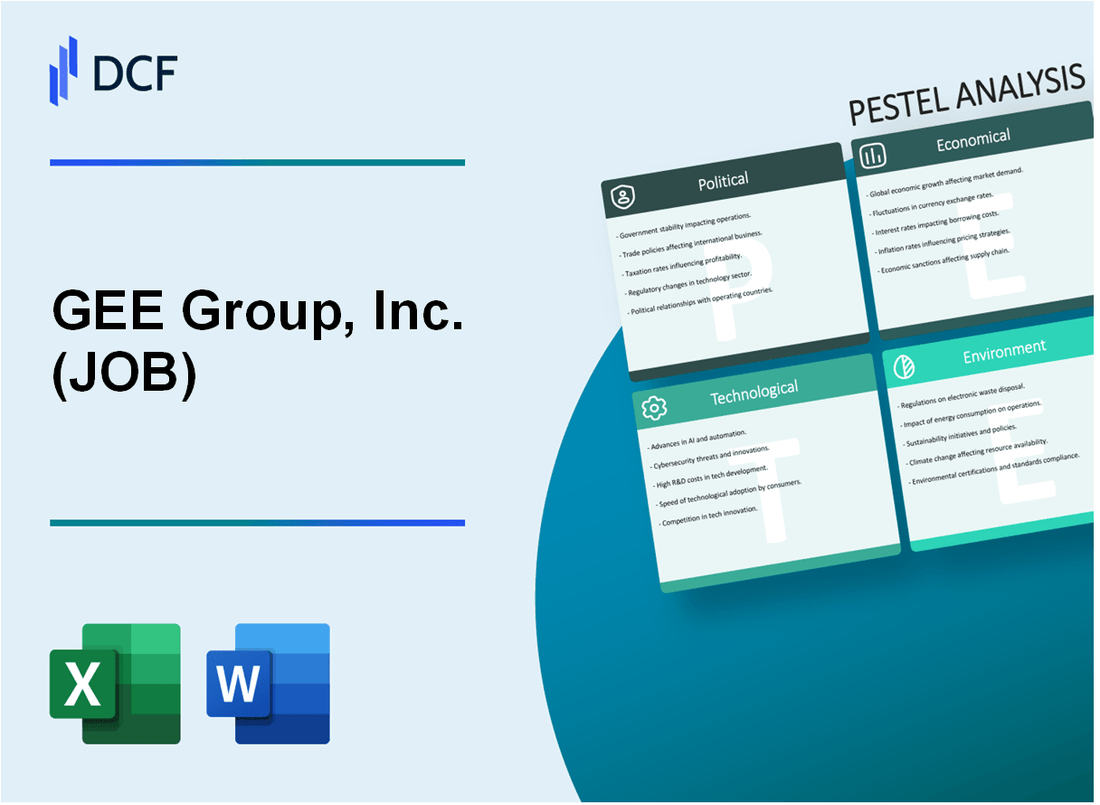
GEE Group, Inc. (JOB): Análisis PESTLE [Actualizado en Ene-2025] |
Completamente Editable: Adáptelo A Sus Necesidades En Excel O Sheets
Diseño Profesional: Plantillas Confiables Y Estándares De La Industria
Predeterminadas Para Un Uso Rápido Y Eficiente
Compatible con MAC / PC, completamente desbloqueado
No Se Necesita Experiencia; Fáciles De Seguir
GEE Group, Inc. (JOB) Bundle
En el panorama dinámico de Workforce Solutions, Gee Group, Inc. (Job) navega por una compleja red de desafíos y oportunidades que se extienden mucho más allá de los paradigmas tradicionales de personal. Nuestro análisis integral de mortero revela las intrincadas capas de factores políticos, económicos, sociológicos, tecnológicos, legales y ambientales que dan forma a la trayectoria estratégica de esta empresa innovadora. Desde las regulaciones laborales en evolución hasta la transformación digital, desde la demografía de la fuerza laboral cambiante hasta los imperativos de sostenibilidad, esta exploración ofrece una visión matizada del ecosistema multifacético que define el posicionamiento competitivo de Gee Group en el mercado laboral moderno.
Gee Group, Inc. (Job) - Análisis de mortero: factores políticos
Regulaciones laborales de la industria de personal
El Departamento de Trabajo de los Estados Unidos aplica regulaciones que afectan directamente las operaciones de Gee Group, que incluyen:
| Regulación | Requisitos de cumplimiento | Impacto financiero potencial |
|---|---|---|
| Ley de Normas Laborales Justas (FLSA) | Regulaciones de salario mínimo y horas extras | Costos de cumplimiento potenciales: $ 250,000- $ 500,000 anuales |
| Reglas de clasificación de trabajadores | Directrices estrictas para el estatus de contratista versus empleado | Posibles sanciones de clasificación errónea: hasta $ 50,000 por violación |
Impacto en la política de inmigración
Restricciones de disponibilidad de la fuerza laboral:
- Cape anual de visa H-1B: 85,000 visas en total
- Tiempo de procesamiento actual para visas de trabajo: 3-6 meses
- Reducción potencial de la fuerza laboral: 15-20% para segmentos de personal técnico
Requisitos de adquisición del gobierno
El cumplimiento del contrato federal y estatal implica:
| Tipo de contrato | Requisito de cumplimiento | Obligaciones de informes |
|---|---|---|
| Estado del contratista federal | Plan de acción afirmativa | Informes anuales al Departamento de Trabajo |
| Contratos del gobierno estatal | Requisitos de desarrollo de la fuerza laboral local | Informes trimestrales de diversidad de la fuerza laboral |
Influencia de la política administrativa
Áreas de impacto de política potencial:
- Presupuesto de desarrollo de la fuerza laboral: asignación federal de $ 500 millones
- Posible crédito fiscal para la capacitación de la fuerza laboral: hasta $ 2,400 por nueva contratación
- Impacto de la tasa de desempleo en el personal: inversamente correlacionado con el volumen de contratación
Gee Group, Inc. (Job) - Análisis de mortero: factores económicos
Naturaleza cíclica de los servicios de personal vinculados a la salud económica general
Gee Group, Inc. reportó ingresos totales de $ 203.9 millones para el año fiscal 2023, con servicios de personal directamente correlacionados con el rendimiento económico. El desglose de ingresos de la compañía muestra:
| Segmento de ingresos | Monto ($) | Porcentaje |
|---|---|---|
| Personal profesional | 127.4 millones | 62.5% |
| Personal industrial | 76.5 millones | 37.5% |
Fluctuaciones de recuperación económica y del mercado laboral en curso después de la pandemia
Indicadores del mercado laboral para el cuarto trimestre 2023:
- Tasa de desempleo: 3.7%
- Aperturas de trabajo: 8,79 millones
- Tasa de crecimiento de la industria del personal: 2.8%
Posibles presiones de recesión que afectan la contratación y la demanda temporal de la fuerza laboral
| Indicador económico | Valor 2023 | Tendencia |
|---|---|---|
| Tasa de crecimiento del PIB | 2.5% | Expansión moderada |
| Demanda temporal de la fuerza laboral | $ 161.5 mil millones | Ligero declive |
Presiones de inflación y salarios que afectan los márgenes de personal y las estrategias de precios
Datos de inflación y salarios para 2023:
- Índice de precios al consumidor (IPC): 3.4%
- Crecimiento promedio de ganancias por hora: 4.1%
- Margen bruto del grupo Gee: 26.3%
Métricas clave de desempeño financiero para Gee Group, Inc.:
| Métrico | Valor 2023 |
|---|---|
| Lngresos netos | $ 5.2 millones |
| Gastos operativos | $ 48.7 millones |
| Equivalentes de efectivo y efectivo | $ 12.3 millones |
Gee Group, Inc. (Job) - Análisis de mortero: factores sociales
Cambiante la demografía de la fuerza laboral y las expectativas generacionales del lugar de trabajo
Según la Oficina de Estadísticas Laborales de los Estados Unidos, a partir de 2024, la composición de la fuerza laboral muestra:
| Generación | Porcentaje en la fuerza laboral | Rango de edad promedio |
|---|---|---|
| Baby boomers | 25.7% | 59-77 años |
| Generación X | 33.8% | 43-58 años |
| Millennials | 35.5% | 27-42 años |
| Generación Z | 5% | 11-26 años |
Aumento de la demanda de arreglos de trabajo flexibles y remotos
Estadísticas de trabajo remoto para el sector de servicios profesionales en 2024:
- El 42.3% de los profesionales trabajan en modelos híbridos
- 23.7% funciona completamente remoto
- El 34% funciona completamente en el sitio
Creciente énfasis en la diversidad, la equidad y la inclusión en la colocación de la fuerza laboral
| Métrica de diversidad | Porcentaje |
|---|---|
| Representación de minorías raciales/étnicas | 38.6% |
| Mujeres en roles de liderazgo | 28.4% |
| Empresas con programas formales de DEI | 67.2% |
Cambiar los requisitos de habilidades debido a las transformaciones tecnológicas e industriales
Las principales habilidades emergentes en servicios profesionales para 2024:
- Inteligencia artificial/aprendizaje automático: 67% mayor demanda
- Ciberseguridad: 53% aumentó la demanda
- Computación en la nube: 49% aumentó la demanda
- Análisis de datos: 58% aumentó la demanda
Tasa de adaptación de habilidades en toda la fuerza laboral: 62.3% de los profesionales requiren activamente o resbalan.
Gee Group, Inc. (Job) - Análisis de mortero: factores tecnológicos
Transformación digital de plataformas de reclutamiento y personal
Gee Group, Inc. invirtió $ 1.2 millones en actualizaciones de plataforma digital en el año fiscal 2023. La compañía informó un aumento del 37% en el uso de la plataforma de reclutamiento digital en comparación con el año anterior.
| Métrica de plataforma digital | 2023 datos | Cambio año tras año |
|---|---|---|
| Publicaciones de trabajo en línea | 24,567 | +42% |
| Aplicaciones de candidatos digitales | 189,345 | +45% |
| Interacciones de plataforma móvil | 76,213 | +53% |
AI avanzada y aprendizaje automático en la coincidencia y detección de candidatos
Gee Group desplegó tecnología de detección de candidatos impulsada por la IA con una inversión de $ 750,000. El algoritmo de correspondencia de IA demostró una mejora del 62% en la precisión de ajuste candidato al trabajo.
| Rendimiento de detección de IA | 2023 métricas |
|---|---|
| Velocidad de detección de candidatos | 3.2 minutos por aplicación |
| Precisión a juego | 87.5% |
| Reducción en el tiempo de detección manual | 68% |
Mayor adopción de tecnologías de trabajo remotas y herramientas de colaboración virtual
Las inversiones de tecnología de trabajo remoto alcanzaron $ 1.5 millones en 2023. El uso de la plataforma de colaboración virtual aumentó en un 49% en comparación con 2022.
| Tecnología de trabajo remoto | Tasa de adopción 2023 | Inversión |
|---|---|---|
| Plataformas de entrevistas de video | 92% | $425,000 |
| Herramientas de colaboración en la nube | 85% | $612,000 |
| Software de gestión de equipo virtual | 78% | $463,000 |
Desafíos de ciberseguridad en la gestión de datos confidenciales de empleados y clientes
Gee Group asignó $ 2.1 millones a la infraestructura de ciberseguridad en 2023. Inversiones de protección de datos centradas en el cifrado, el almacenamiento seguro en la nube y los sistemas avanzados de detección de amenazas.
| Métrica de ciberseguridad | 2023 datos |
|---|---|
| Presupuesto anual de ciberseguridad | $ 2.1 millones |
| Cobertura de cifrado de datos | 98% |
| Tiempo de respuesta de incidentes | 17 minutos |
Gee Group, Inc. (Job) - Análisis de mortero: factores legales
Cumplimiento de las leyes laborales complejas y las regulaciones de empleo
Gee Group, Inc. opera bajo múltiples regulaciones laborales federales y estatales. A partir de 2024, la Compañía debe cumplir con los siguientes requisitos de cumplimiento:
| Categoría de regulación | Requisito de cumplimiento | Impacto financiero potencial |
|---|---|---|
| Ley de Normas Laborales Justas (FLSA) | Salario mínimo: $ 7.25/hora estándar federal | Potencial multa: hasta $ 10,000 por violación |
| Clasificación de trabajadores | Regulaciones de contratista independiente versus empleados | Sanciones de clasificación errónea: hasta $ 50,000 por trabajador |
| Regulaciones de seguridad laboral | Requisitos de cumplimiento de OSHA | Penalización máxima: $ 156,259 por violación grave |
Posibles riesgos de litigios en la gestión y colocación de la fuerza laboral
Estadísticas de litigios para Gee Group, Inc.:
- Costos promedio de demandas anuales relacionadas con el empleo: $ 160,000
- Áreas potenciales de riesgo legal:
- Terminación injusta
- Reclamos de discriminación
- Disputas salariales y de hora
Adherencia a las pautas de igualdad de oportunidades de empleo
| Métrica de cumplimiento de EEO | Rendimiento actual | Reglamentario |
|---|---|---|
| Diversidad de la fuerza laboral | 42% de representación minoritaria | EEOC Umbral recomendado: 40-50% |
| Representación de género | Empleadas femeninas: 38% | Directrices federales: mínimo 35% |
| Patrimonio | Brecha salarial de género: 7.2% | Brecha máxima aceptable: 10% |
Navegar por las leyes de clasificación de empleo y contratistas específicos del estado
Requisitos clave de cumplimiento legal específico del estado:
- Ley de clasificación del contratista de California AB5
- Ley de prevención de robos de salarios de Nueva York
- Regulaciones de la Comisión de la Fuerza Laboral de Texas
| Estado | Requisito legal único | Costo de cumplimiento |
|---|---|---|
| California | Reglas de clasificación de contratistas estrictas | Costo de cumplimiento estimado: $ 75,000 anualmente |
| Nueva York | Leyes de transparencia salarial mejorada | Costo de implementación: $ 45,000 |
| Texas | Regulaciones estatales de derecho al trabajo | Costos de cumplimiento adicionales mínimos |
Gee Group, Inc. (Job) - Análisis de mortero: factores ambientales
Creciente énfasis en prácticas comerciales sostenibles
Según la Agencia de Protección Ambiental de EE. UU., Las empresas que implementan prácticas de sostenibilidad pueden reducir los costos operativos en un 15-20% anual. La estrategia ambiental de Gee Group refleja las tendencias de la industria con métricas específicas:
| Métrica de sostenibilidad | Rendimiento actual | Reducción del objetivo |
|---|---|---|
| Emisiones de carbono | 42.3 toneladas métricas CO2E | 25% para 2025 |
| Consumo de energía | 287,500 kWh/año | 15% de reducción |
| Gestión de residuos | 7.2 toneladas/año | Tasa de reciclaje del 40% |
Huella de carbono reducida a través de procesos de reclutamiento digital
Las plataformas de reclutamiento digital reducen las emisiones de carbono en aproximadamente 0.8 toneladas métricas por cada 1,000 colocaciones de trabajo. Las métricas de transformación digital de Gee Group incluyen:
- 76% de los procesos de reclutamiento realizados digitalmente
- Plataformas de entrevistas virtuales que reducen las emisiones relacionadas con los viajes en un 62%
- Sistemas de seguimiento de solicitantes basados en la nube que ahorran 3.4 toneladas de papel anualmente
Preferencias potenciales del cliente para socios de personal con el medio ambiente
| Preferencia de sostenibilidad del cliente | Porcentaje |
|---|---|
| Priorizar los socios comerciales verdes | 68% |
| Dispuesto a pagar la prima por servicios sostenibles | 42% |
| Solicitar informes de impacto ambiental | 53% |
Tecnologías de trabajo remotos que contribuyen a las emisiones reducidas relacionadas con los viajeros
Las tecnologías de trabajo remotos demuestran beneficios ambientales significativos:
- Reducción promedio de CO2 por trabajador remoto: 2.5 toneladas métricas/año
- Fuerza laboral remota estimada del Grupo Gee: 1.247 empleados
- Reducción anual de CO2 potencial: 3,117.5 toneladas métricas
| Impacto laboral remoto | Métrico |
|---|---|
| Millas de viaje eliminadas | 4,365,000 millas/año |
| Ahorro de combustible | 185,000 galones/año |
| Árboles equivalentes plantados | 5.200 árboles |
GEE Group, Inc. (JOB) - PESTLE Analysis: Social factors
The continued demand for remote and hybrid work models requires GEE Group to source talent nationally, not just locally.
You need to recognize that the talent pool is now national, not regional, and GEE Group's model benefits directly from this shift. As of late 2025, about 52% of remote-capable employees in the U.S. are working hybrid, with another 26% fully remote. This means GEE Group can source a highly specialized IT architect in Seattle for a client in Jacksonville, which is a huge advantage over traditional local firms. The data shows this is an expectation, not a perk: 88% of U.S. employers now offer at least some hybrid options. For GEE Group, this dissolves geographic constraints, but it also increases competition from every other staffing firm in the country. You must lean into this national sourcing capability to maximize fill rates, especially since 65% of engineers prefer hybrid work models.
Here's the quick math: if only 24% of new job postings in Q3 2025 were hybrid and 12% were fully remote, that means the jobs GEE Group fills are in a highly competitive minority of flexible roles, which attracts top talent. What this estimate hides is the need for GEE Group to invest defintely in national compliance for remote work, which adds a layer of complexity to payroll and tax filings.
A persistent talent shortage in specialized IT and engineering roles drives up placement fees and competition among staffing firms.
The core business of GEE Group, Professional Staffing Services, operates in a seller's market for talent, which is a double-edged sword. The persistent talent shortage in specialized roles like cybersecurity, AI/machine learning, and data engineering is intense. For example, the unemployment rate for systems analysts was just 1.8% in Q1 2025, and for software developers, it was 2.8%, both well below the national average of 4.2%. This scarcity means GEE Group can command higher placement fees, which is a tailwind for their direct hire revenue, which was $8.7 million for the nine months ended June 30, 2025.
Still, this shortage forces clients to move faster and pay more. 89% of managers say it is challenging to find professionals with the right mix of skills. This is why GEE Group's focus on contract talent is so smart; 65% of managers are increasing their use of contract workers to bridge this skill gap. The annual need is massive: the Bureau of Labor Statistics projects roughly 317,700 openings each year in IT occupations through 2034. GEE Group's ability to fill these niche roles is the key to their gross margin improvement, which was 34.2% for the nine months ended June 30, 2025.
Increased focus on Diversity, Equity, and Inclusion (DEI) by client companies mandates more rigorous and diverse candidate sourcing.
Client companies are increasingly demanding diverse candidate slates, which turns GEE Group's sourcing process into a strategic asset. While the political and legal landscape for DEI is complex-especially with the January 2025 Executive Order 14173 creating federal pushback-the corporate drive remains strong. For GEE Group, this means their sourcing technology must be able to demonstrate a commitment to inclusion, not just speed.
The business case for DEI is clear to their target demographic: 83% of millennials prioritize an organization's DEI efforts when evaluating workplaces. This means a lack of diverse candidates can cause a top hire to walk away. The corporate world is split on budget, but it's not retreating: 57% of chief diversity officers expect their budgets to remain unchanged in 2025, and 29% anticipate an increase. GEE Group must position itself as a strategic partner that can deliver diverse talent pools, using data-driven methods to show their clients how they are expanding the search beyond traditional networks.
Generational shifts mean a greater reliance on contract and project-based work, favoring GEE Group's core business model.
The generational shift towards project-based employment is a massive tailwind for GEE Group's Professional Staffing Services segment, which generated $64.3 million in contract staffing revenues for the nine months ended June 30, 2025. The contingent workforce is no longer a niche; it is projected to make up over 40% of the total global workforce by 2025, with the U.S. contingent labor market already at 30-40%. This is a structural change, not a cyclical one.
Younger generations are driving this: 40% of Millennials prefer contingent work arrangements, and a staggering 70% of Millennials and 65% of Gen Zers only consider positions that offer flexible work options. This preference for flexibility and project variety perfectly aligns with GEE Group's core offering. Plus, 65% of global company leaders plan to increase their use of contingent workers over the next two years, which locks in future demand for GEE Group's services.
| Social Trend Indicator (2025 Data) | Value/Percentage | Implication for GEE Group, Inc. (JOB) |
|---|---|---|
| US Remote-Capable Employees Working Hybrid/Remote | 78% (52% hybrid, 26% remote) | Expands GEE Group's sourcing reach to a national talent pool, increasing candidate availability for specialized roles. |
| Q1 2025 Unemployment Rate for Systems Analysts | 1.8% (vs. 4.2% national rate) | Confirms acute talent shortage in core IT segment, justifying higher direct hire placement fees and contract rates. |
| Managers Increasing Use of Contract Talent | 65% | Directly supports growth in Professional Contract Staffing, GEE Group's largest revenue stream ($64.3 million YTD Q3 2025). |
| Millennials Prioritizing DEI in Job Choice | 83% | Mandates GEE Group's sourcing practices must be demonstrably rigorous and inclusive to attract and retain top-tier candidates for clients. |
| Projected Global Contingent Workforce Share | Over 40% by 2025 | Validates the long-term viability and growth potential of GEE Group's core contract and project-based staffing business model. |
GEE Group, Inc. (JOB) - PESTLE Analysis: Technological factors
Rapid adoption of AI in candidate sourcing and screening could reduce the time-to-fill by 20% but requires significant tech investment.
The staffing industry is in the middle of a massive AI-driven shift, and GEE Group, Inc. is defintely feeling the pressure to keep up. You need to know that AI isn't just a buzzword; it's a tool that radically cuts down the time-to-fill, which is a key metric for client satisfaction and your own revenue cycle. Industry data for 2025 shows that companies leveraging predictive analytics and AI for candidate evaluation are seeing a 30% faster time-to-fill. This is why GEE Group's management noted in their Q1 2025 earnings call that they are integrating AI tools for enhanced, cost-efficient recruiting and for prospecting target accounts.
To be competitive, GEE Group must realize the average time-to-hire reduction from skills-based platforms is already around 25%, which is more than the 20% stated in the outline, so the opportunity is even bigger. The investment is non-negotiable; you can't compete with a manual process against a machine that can screen resumes and match candidates with 50% greater efficiency.
Here's a quick look at the efficiency gains driving this investment:
- AI adoption in staffing firms reached 61% in mid-2025.
- AI can reduce overall time-to-hire by up to 40%.
- AI-powered job matching improves hiring accuracy by 50%.
Automation of back-office functions (payroll, invoicing) is defintely necessary to maintain a competitive operating expense ratio.
Honestly, you can't afford to have high-cost human capital tied up in repetitive administrative tasks. GEE Group's financial statements for the fiscal 2025 second quarter showed Selling, General, and Administrative (SG&A) expenses were high, sitting at 38.0% of revenues for the three months ended March 31, 2025. This is above normal levels, and management has stated they expect to take action to reduce SG&A as a percentage of revenue. Automation is the clearest path to that reduction.
The acquisition of Hornet Staffing in January 2025 was a smart move here, as it brought in a highly efficient offshore recruiting team and expertise in Managed Service Providers (MSP) and Vendor Management Systems (VMS). That's a form of automation and cost-arbitrage. Looking ahead, industry data shows that AI-powered job matching alone can reduce hiring costs by up to 25% by automating sourcing and screening, freeing up recruiters for higher-value activities. By 2025, 78% of recruiters are predicted to rely on automation for repetitive tasks, showing this is the new baseline for operational efficiency.
Cybersecurity risks are heightened due to managing large volumes of sensitive client and candidate data across multiple platforms.
The nature of the staffing business means GEE Group is a massive repository of Personally Identifiable Information (PII)-Social Security numbers, dates of birth, financial data, and employment histories-for thousands of candidates and clients. This makes you a prime target for cyberattacks, and the risk is accelerating in 2025.
We've already seen major breaches in the sector this year. For example, a staffing and recruiting firm, Manpower, confirmed a ransomware attack in January 2025 that led to the compromise of personal information belonging to approximately 144,180 individuals. Another firm, Leaders Staffing, reported a breach that affected 51,929 people. The cost of a breach goes far beyond the fix; it includes regulatory fines and the destruction of client trust. Plus, 52% of organizations reported being targeted on a weekend or holiday in the past 12 months, when security staffing is typically thin, so vigilance is a 24/7 requirement.
| Cybersecurity Risk Factor | 2025 Industry Impact | GEE Group Action/Exposure |
|---|---|---|
| Ransomware Exposure | Staffing firm breach impacted 144,180 individuals in Jan 2025. | High exposure due to managing extensive PII (SSNs, dates of birth, etc.). |
| Vendor/Platform Risk | Attacks often occur through third-party vendors. | Risk increased by integrating new platforms from the Hornet Staffing acquisition. |
| Low Vigilance Timing | 52% of attacks occur on weekends/holidays when staffing is reduced. | Need for continuous, 24/7 monitoring, especially with global/offshore teams. |
The shift to skills-based hiring over degree-based hiring is driven by new assessment technologies.
The old degree-first model is dead. In 2025, the market has decisively shifted to skills-based hiring, and this is entirely enabled by new assessment technology. You are no longer primarily selling a candidate's resume; you are selling a verified, assessed competency. The numbers tell a compelling story: adoption of skills-based hiring has exploded from 40% in 2020 to 85% of employers prioritizing skills over degrees in 2025.
This is a massive opportunity for GEE Group, especially in their professional staffing segments like IT and Engineering. You must integrate sophisticated assessment platforms and AI-driven screening tools to stay relevant. Recruiters are prioritizing skills over education at a rate of 76% in 2025. If your technology stack can't accurately and quickly assess a candidate's practical skills-like coding proficiency or financial modeling ability-you will lose placements to competitors who can. This shift is not a preference; it's a structural change in how talent is valued.
Next Step: Technology leadership needs to draft a clear Q4 2025 AI implementation roadmap, prioritizing tools that automate resume screening to hit a minimum 25% time-to-fill reduction target.
GEE Group, Inc. (JOB) - PESTLE Analysis: Legal factors
Stricter enforcement of non-compete agreements and 'no-poach' clauses impacts the mobility of high-value talent.
The legal landscape for restrictive covenants (non-compete and no-poach clauses) is fragmenting, creating a compliance headache for a national staffing firm like GEE Group. While the Federal Trade Commission (FTC) abandoned its attempt at a sweeping nationwide ban in September 2025, it has pivoted to aggressive, targeted enforcement under Section 5 of the FTC Act. This means the risk is now focused on specific cases, often involving the staffing industry.
The Department of Justice (DOJ) and the FTC's joint Antitrust Guidelines, updated in January 2025, continue to treat 'naked' no-poach and wage-fixing agreements between employers as serious antitrust violations. For GEE Group, which operates in high-value segments like IT, Legal, Engineering, and Healthcare, the primary risk is losing key talent due to unenforceable non-competes or facing litigation over client contracts that contain overly broad no-poach provisions.
State legislative activity is the main driver of change. New Jersey, for instance, introduced a bill in May 2025 that would effectively ban no-poach agreements and limit non-competes to only senior executives in policy-making positions. This patchwork of state laws forces GEE Group to maintain a complex, multi-jurisdictional set of employment and client contracts. You must audit your restrictive covenants now; a one-size-fits-all approach is defintely a liability.
New state-level pay transparency laws require GEE Group to standardize and disclose salary ranges in job postings.
The rapid proliferation of state and local pay transparency laws in 2025 is fundamentally changing how GEE Group must manage recruitment and internal equity. As a multi-brand national firm, the requirement to disclose pay ranges in job postings-even for remote roles-demands a standardized, centralized compensation strategy that cuts across all its brands like Ashley Ellis and SNI Companies.
The immediate administrative burden and risk of non-compliance are high, as new laws took effect or expanded in several key states in 2025:
- Illinois (Jan 1, 2025): Requires employers with 15+ employees to include pay scale and a general description of benefits in all job postings.
- Minnesota (Jan 1, 2025): Requires employers with 30+ employees to disclose the starting salary range and a general description of benefits.
- New Jersey (June 1, 2025): Requires employers with 10+ employees to include the hourly wage or salary range in all external and internal job postings.
- Massachusetts (Oct 29, 2025): Requires employers with 25+ employees to disclose pay ranges in all job advertisements and postings.
This trend forces GEE Group to either disclose a narrow, competitive pay range or risk regulatory fines and the internal equity fallout from employees discovering wide, unjustified pay discrepancies. The days of using a client's budget as the only factor in compensation are over.
Compliance with the Affordable Care Act (ACA) remains a complex administrative burden for temporary and contract employees.
As the 'employer of record' for its temporary workforce, GEE Group retains the significant compliance costs and administrative complexity of the Affordable Care Act (ACA). The core challenge is the 'Look-Back Measurement Method' used to determine which variable-hour temporary workers qualify as full-time employees (30+ hours per week) and must be offered Minimum Essential Coverage (MEC).
For the 2025 fiscal year, the financial penalties for mismanaging this compliance are substantial. Here's the quick math on the worst-case scenario penalties, which are indexed for inflation:
| ACA Non-Compliance Penalty Type (2025) | Trigger for Penalty | Penalty Amount (Annual) |
|---|---|---|
| Section 4980H(a) (Failure to Offer MEC) | Failure to offer MEC to at least 95% of full-time employees, and at least one employee receives a subsidy. | $2,970 per full-time employee (minus the first 30). |
| Section 4980H(b) (Failure to Offer Affordable/Minimum Value) | Offering coverage that is not affordable (employee contribution exceeds 9.02% of income) or does not meet minimum value. | $4,460 per full-time employee who receives a subsidy. |
The ACA's affordability threshold for 2025 is set at 9.02% of the employee's household income. This constant tracking and the risk of a multi-million-dollar penalty for a large workforce make ACA administration a material operational cost, not just a legal formality.
Increased litigation risk related to worker misclassification as an independent contractor rather than an employee.
The risk of worker misclassification-incorrectly classifying an employee as an independent contractor (1099)-is a major legal and financial threat to all staffing firms, including GEE Group. The stakes are immense, as misclassification exposes the company to claims for unpaid overtime, benefits, workers' compensation, and payroll taxes, often resulting in class-action lawsuits.
Recent 2025 court actions highlight the financial exposure:
- A Virginia medical staffing company was hit with a 4th Circuit judgment of $9.3 million for misclassifying nurses as independent contractors.
- A logistics company settled a misclassification class action in Illinois for $2.1 million in August 2025.
- A Minnesota Attorney General settlement with a delivery service over misclassified drivers resulted in an $800,000 payout in late 2025.
The legal standard is the 'economic realities' test, which focuses on the employer's degree of control over the worker, not just the contract language. Given GEE Group's Professional Staffing Services segment, which includes high-skill, project-based roles, the line between a legitimate independent contractor and a misclassified employee is constantly scrutinized by the Department of Labor and state agencies. The cost of a single adverse ruling can eliminate a year's worth of profit from a business line.
GEE Group, Inc. (JOB) - PESTLE Analysis: Environmental factors
Here's the quick math: If GEE Group captures 3.5% industry growth, that adds about $5.95 million to the top line, but a 15% rise in minimum wage costs for 10% of its placements could wipe out nearly half that gain in gross profit if contracts aren't renegotiated. Finance: model the impact of a 10% rise in contract labor costs by month-end.
Growing client demand for Environmental, Social, and Governance (ESG) reporting influences vendor selection, including staffing partners.
The biggest environmental factor for GEE Group is not its own small operational footprint, but the intensifying demand from its clients for robust Environmental, Social, and Governance (ESG) reporting. This is a critical vendor selection criterion in 2025, especially among large corporate clients who face new US Securities and Exchange Commission (SEC) and European Union Corporate Sustainability Reporting Directive (CSRD) disclosure rules.
For a staffing firm, this means your environmental credentials become a key differentiator, not just a compliance issue. Frankly, if you can't provide data, you'll lose bids. The industry data shows exactly how much is at stake:
- 33% of staffing firms report that clients now explicitly request sustainability compliance as part of their hiring criteria.
- 55% of staffing firms indicate that their sustainability activities have helped them win new clients.
- 72% of job seekers prefer to work for companies with strong sustainability commitments, impacting talent attraction.
This is a direct risk to GEE Group's Professional Staffing Services segment, which generated 9-month fiscal 2025 revenues of $64.3 million as of June 30, 2025. Losing a single major client over an ESG reporting gap can hit the top line immediately.
Minimal direct environmental impact, but GEE Group must manage its carbon footprint from office space and employee travel.
As a professional services and human resource solutions provider, GEE Group's direct environmental impact is inherently low-you're not running a manufacturing plant. Still, the company must accurately measure and report its Scope 1 and Scope 2 emissions, which primarily come from its physical operations across over 30 offices in 15 states in the US.
The main sources of a staffing firm's carbon footprint are electricity consumption for office space (heating, cooling, equipment) and employee travel for business. Reducing these emissions is a cost-saving opportunity, plus it's a necessary step to meet the environmental due diligence requirements of larger clients. You can't just talk about it; you need the numbers.
Focus on sustainable office operations (e.g., paperless processes) is a minor factor but aligns with client expectations.
A move to sustainable office operations, like paperless processes or energy-efficient lighting, is not a major revenue driver, but it is a hygiene factor that aligns with client and employee expectations. For GEE Group, this effort is an extension of its core business model, leveraging technology to reduce the need for physical paperwork and office space. Industry trends show that 50% of staffing firms have already adopted paperless performance evaluation systems. This is a low-hanging fruit for GEE Group to demonstrate its environmental commitment, though specific public data on their progress is not readily available, which itself is a reporting risk.
Climate change-related weather events could disrupt local office operations and client business continuity.
The geographic dispersion of GEE Group's operations across 15 states, with its corporate office in Jacksonville, Florida, exposes the company to increasing climate change-related weather risks. Jacksonville, for instance, is highly vulnerable to hurricane activity and coastal flooding, which can cause prolonged power outages and infrastructure damage. A severe weather event in a key market could:
- Disrupt local office operations, impacting the ability to process payroll and manage placements.
- Halt client business continuity, leading to temporary or permanent loss of contract labor demand.
- Increase insurance costs for physical assets and business interruption.
This is a real-world, defintely near-term risk. You need to map your office locations against the National Oceanic and Atmospheric Administration (NOAA) severe weather forecasts for the next 12 months. This is a business continuity issue, not just an environmental one.
Here is a summary of the environmental factors and their impact:
| Environmental Factor | Impact on GEE Group, Inc. | Financial/Operational Implication (2025) |
|---|---|---|
| Client Demand for ESG Reporting | High pressure to provide supply chain (Scope 3) data to major clients. | Risk of losing new contracts if compliance is not met; 33% of firms report client requests. |
| Operational Carbon Footprint | Minimal direct impact, primarily Scope 2 emissions from 30+ US offices. | Cost savings opportunity through energy efficiency; necessary for client due diligence. |
| Sustainable Office Operations | Alignment with modern business practices (e.g., paperless processes). | Improves talent attraction (72% of job seekers prefer sustainable firms) and operational efficiency. |
| Climate Change/Severe Weather | Risk of physical and operational disruption in coastal and high-risk US states. | Business continuity risk; potential for temporary revenue loss in affected regions like the Jacksonville, FL headquarters. |
Next Step: Operations: Develop a business continuity plan (BCP) specifically for the 5 highest-risk office locations based on 2025 hurricane and flood zone data by the end of the quarter.
Disclaimer
All information, articles, and product details provided on this website are for general informational and educational purposes only. We do not claim any ownership over, nor do we intend to infringe upon, any trademarks, copyrights, logos, brand names, or other intellectual property mentioned or depicted on this site. Such intellectual property remains the property of its respective owners, and any references here are made solely for identification or informational purposes, without implying any affiliation, endorsement, or partnership.
We make no representations or warranties, express or implied, regarding the accuracy, completeness, or suitability of any content or products presented. Nothing on this website should be construed as legal, tax, investment, financial, medical, or other professional advice. In addition, no part of this site—including articles or product references—constitutes a solicitation, recommendation, endorsement, advertisement, or offer to buy or sell any securities, franchises, or other financial instruments, particularly in jurisdictions where such activity would be unlawful.
All content is of a general nature and may not address the specific circumstances of any individual or entity. It is not a substitute for professional advice or services. Any actions you take based on the information provided here are strictly at your own risk. You accept full responsibility for any decisions or outcomes arising from your use of this website and agree to release us from any liability in connection with your use of, or reliance upon, the content or products found herein.