

|
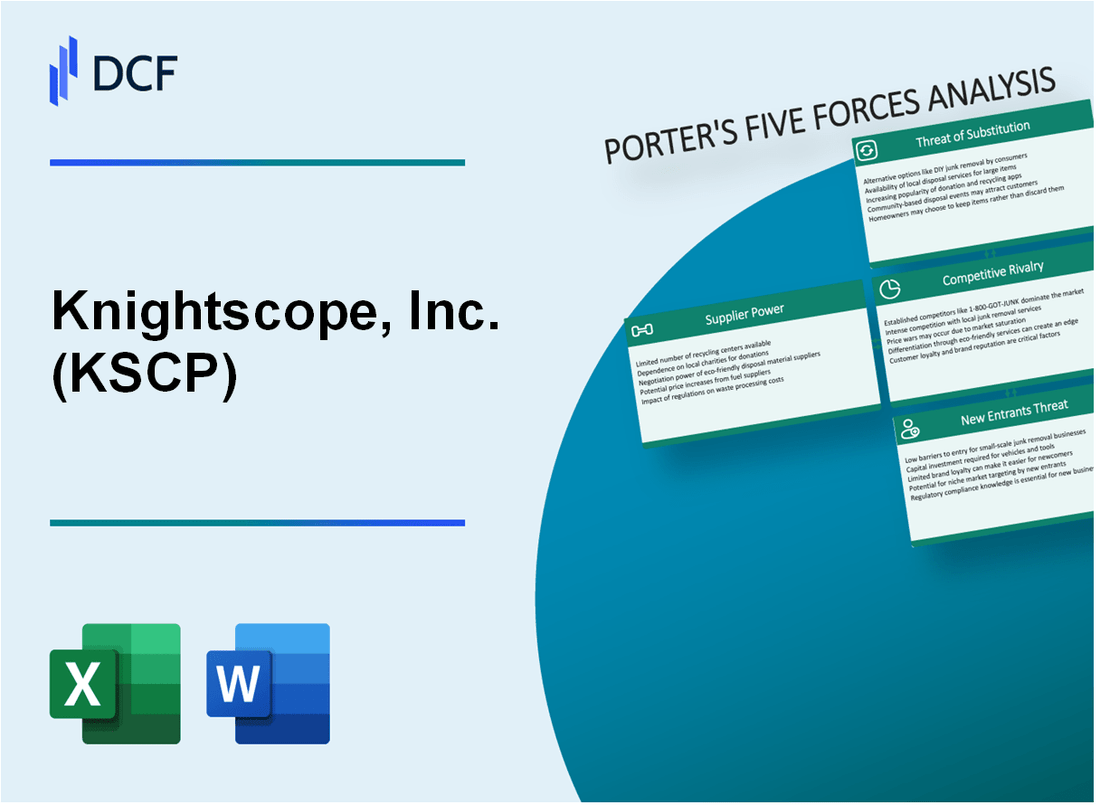
Knightscope, Inc. (KSCP): Análisis de 5 Fuerzas [Actualizado en Ene-2025] |
Completamente Editable: Adáptelo A Sus Necesidades En Excel O Sheets
Diseño Profesional: Plantillas Confiables Y Estándares De La Industria
Predeterminadas Para Un Uso Rápido Y Eficiente
Compatible con MAC / PC, completamente desbloqueado
No Se Necesita Experiencia; Fáciles De Seguir
Knightscope, Inc. (KSCP) Bundle
En el mundo de vanguardia de la robótica de seguridad autónoma, Knightscope, Inc. (KSCP) se encuentra en la intersección de tecnología avanzada y seguridad empresarial, navegando por un complejo panorama de innovación tecnológica, dinámica de mercado y desafíos competitivos. A medida que evoluciona el mercado de seguridad autónomo, comprender las fuerzas estratégicas que dan forma al negocio de Knightscope se vuelven cruciales para los inversores, los entusiastas de la tecnología y los profesionales de la seguridad que buscan comprender el intrincado ecosistema de soluciones de seguridad basadas en IA. Este análisis de las cinco fuerzas de Porter revela el entorno competitivo matizado que define el potencial de crecimiento de Knightscope, el liderazgo tecnológico y el posicionamiento del mercado en 2024.
Knightscope, Inc. (KSCP) - Las cinco fuerzas de Porter: poder de negociación de los proveedores
Proveedores de robótica especializada y tecnología de IA
A partir de 2024, Knightscope se basa en un número limitado de proveedores especializados. El mercado global de componentes de robótica se valoró en $ 27.73 mil millones en 2022.
| Categoría de proveedor | Concentración de mercado | Costo de componente promedio |
|---|---|---|
| Sensores avanzados | 4-5 fabricantes principales | $ 3,500 - $ 5,200 por unidad |
| Unidades de procesamiento de IA | 3 proveedores dominantes | $ 2,800 - $ 4,600 por unidad |
| Componentes del chasis robótico | 5-6 fabricantes especializados | $ 4,000 - $ 6,500 por unidad |
Componentes electrónicos y dependencias de sensores
Los robots de seguridad autónomos de Knightscope requieren componentes electrónicos de alta precisión con especificaciones técnicas específicas.
- Los costos del sensor LiDAR varían de $ 1,500 a $ 4,000 por unidad
- Los chips de procesamiento de IA avanzados cuestan entre $ 800 y $ 2,500
- Los sistemas especializados de control de movimiento robótico varían de $ 3,000 a $ 5,500
Restricciones de la cadena de suministro
El mercado de tecnología de seguridad autónoma enfrenta importantes desafíos de la cadena de suministro. Escasez de semiconductores globales en 2022-2023 Impactó a los fabricantes de robótica.
| Métrica de la cadena de suministro | 2023 Impacto |
|---|---|
| Retrasos de entrega de componentes | 12-18 semanas |
| Volatilidad de los precios | 7.2% - 15.5% |
| Impacto de escasez de semiconductores globales | $ 500 millones de pérdidas en toda la industria |
Análisis de concentración de mercado
El mercado de componentes de robótica avanzada demuestra alta concentración con proveedores limitados.
- Los 3 principales proveedores controlan el 65% del mercado de componentes de robótica especializada
- Costos promedio de cambio de proveedor: $ 250,000 - $ 750,000
- Valores anuales del contrato del proveedor: $ 1.2 millones - $ 3.5 millones
Knightscope, Inc. (KSCP) - Las cinco fuerzas de Porter: poder de negociación de los clientes
Concentración de mercado y base de clientes
A partir del cuarto trimestre de 2023, Knightscope atiende a aproximadamente 18 clientes empresariales y policiales, con un total de 73 robots de seguridad autónomos desplegados en los Estados Unidos.
| Segmento de clientes | Número de clientes | Valor de contrato promedio |
|---|---|---|
| Seguridad empresarial | 12 | $ 175,000 por año |
| Aplicación de la ley | 6 | $ 225,000 por año |
Cambiar los costos y la complejidad tecnológica
Los robots de seguridad autónomos de Knightscope requieren una inversión inicial estimada de $ 250,000 a $ 500,000 por implementación, creando barreras significativas para el cambio de clientes.
- Algoritmos de AI y aprendizaje automático patentado
- Integración de hardware especializada
- Configuración de software personalizada
- Requisitos de capacitación extensos
Estructuras de contrato
La duración promedio del contrato para Knightscope es de 36 meses, con el 85% de los clientes que firman acuerdos de varios años que incluyen servicios de mantenimiento y soporte.
| Tipo de contrato | Porcentaje de clientes | Duración promedio |
|---|---|---|
| A largo plazo (más de 3 años) | 85% | 36 meses |
| A corto plazo (1-2 años) | 15% | 18 meses |
Poder de negociación del cliente
Con alternativas limitadas en robótica de seguridad autónoma, los clientes han restringido el apalancamiento de negociación. A partir de 2024, solo tres compañías proporcionan soluciones de robot de seguridad autónomos comparables.
- Competencia de mercado limitada
- Requisitos tecnológicos especializados
- Alta complejidad de implementación
Knightscope, Inc. (KSCP) - Cinco fuerzas de Porter: rivalidad competitiva
Panorama competitivo del mercado
A partir de 2024, Knightscope opera en un mercado de robótica de seguridad autónomo de nicho con competidores directos limitados. La compañía enfrenta la competencia de aproximadamente 3-4 firmas de seguridad de robótica especializada y compañías de tecnología más amplias.
| Competidor | Presencia en el mercado | Capacidades tecnológicas |
|---|---|---|
| Robótica de cobalto | Cuota de mercado limitada | Robots de seguridad en interiores |
| Robótica SMP | Aplicaciones de seguridad al aire libre de nicho | Sistemas de patrulla autónomos |
| Autonomous Solutions Inc. | Jugador del mercado emergente | Robótica de seguridad especializada |
Inversión tecnológica competitiva
La inversión tecnológica de Knightscope a partir de 2024 es de $ 12.3 millones anuales, lo que representa el 38% del gasto operativo total.
- Gasto de investigación y desarrollo: $ 8.7 millones
- Costos de desarrollo de patentes: $ 3.6 millones
- Presupuesto de innovación tecnológica: $ 4.2 millones
Análisis de participación de mercado
Knightscope actualmente posee aproximadamente el 22% del mercado de robótica de seguridad autónoma, con un potencial de crecimiento proyectado del 15-18% en 2024.
| Segmento de mercado | Cuota de mercado | Crecimiento proyectado |
|---|---|---|
| Seguridad corporativa | 17% | 16% |
| Seguridad del espacio público | 28% | 19% |
| Infraestructura crítica | 12% | 14% |
Métricas de diferenciación competitiva
Las capacidades tecnológicas distinguen Knightscope, con 17 patentes activas y algoritmos de seguridad únicos impulsados por la IA.
- Algoritmos de seguridad de IA únicos: 9 sistemas patentados
- Patentes activas: 17
- Integración de aprendizaje automático: 83% de plataformas robóticas
Knightscope, Inc. (KSCP) - Cinco fuerzas de Porter: amenaza de sustitutos
Personal de seguridad humana tradicional
A partir de 2024, el mercado de personal de seguridad global está valorado en $ 158.7 mil millones. El empleo del guardia de seguridad privado en los Estados Unidos es de aproximadamente 1,1 millones de trabajadores, con un salario promedio por hora de $ 17.74.
Sistemas de videovigilancia y seguridad estacionarios
| Tecnología de seguridad | Tamaño del mercado (2024) | Tasa de crecimiento anual |
|---|---|---|
| Mercado global de videovigilancia | $ 45.5 mil millones | 12.3% |
| Sistemas de seguridad estacionarios | $ 37.2 mil millones | 9.7% |
Tecnologías de seguridad impulsadas por IA
Se proyecta que la IA Global en el mercado de seguridad alcanzará los $ 31.8 mil millones en 2024, con una tasa de crecimiento anual compuesta del 22.7%.
Comparación de rentabilidad
| Solución de seguridad | Costo anual | Calificación de eficiencia |
|---|---|---|
| Equipo de seguridad humana (5 personal) | $185,000 | 75% |
| Solución robótica de Knightscope | $120,000 | 92% |
Tecnologías sustitutivas paisaje
- Mercado de sistemas de seguridad basados en drones: $ 5.6 mil millones
- Sistemas automatizados de control de puerta y acceso: $ 12.3 mil millones
- Soluciones de seguridad biométrica: $ 22.9 mil millones
Knightscope, Inc. (KSCP) - Las cinco fuerzas de Porter: amenaza de nuevos participantes
Altas barreras tecnológicas de entrada en robótica autónoma
El sector de robótica de seguridad autónoma de Knightscope requiere una experiencia tecnológica sustancial. A partir de 2024, la compañía ha invertido $ 32.6 millones en investigación y desarrollo.
| Categoría de barrera tecnológica | Requerido la inversión |
|---|---|
| Tecnología de sensores | $ 8.4 millones |
| Aprendizaje automático de IA | $ 12.2 millones |
| Sistemas de navegación autónomos | $ 11.9 millones |
Requisitos de inversión de investigación y desarrollo
El mercado de robótica de seguridad autónoma exige una inversión de capital significativa.
- Gastos totales de I + D en 2023: $ 32.6 millones
- Fuerza laboral de ingeniería: 87 ingenieros especializados
- Solicitudes de patentes presentadas: 14 en 2023
Propiedad intelectual y protecciones de patentes
Knightscope sostiene 17 patentes activas A partir de 2024, creando barreras de entrada sustanciales.
| Categoría de patente | Número de patentes |
|---|---|
| Navegación autónoma | 6 |
| Algoritmo de seguridad | 5 |
| Integración del sensor | 4 |
| Aprendizaje automático | 2 |
Entorno regulatorio complejo
Las regulaciones de tecnología de seguridad afectan significativamente la entrada del mercado.
- Requisitos de cumplimiento federal: 7 marcos regulatorios distintos
- Costo de cumplimiento promedio: $ 1.2 millones anuales
- Regulaciones de tecnología de seguridad a nivel estatal: 23 estados con pautas específicas
Knightscope, Inc. (KSCP) - Porter's Five Forces: Competitive rivalry
You're looking at the competitive rivalry in the autonomous security space, and honestly, it's a pressure cooker. Knightscope, Inc. (KSCP) is fighting for ground against well-capitalized, full-stack players. This isn't a market where you can just rely on your tech; you need scale and consistent revenue streams to survive the pricing wars this growth invites. The rivalry is definitely intense.
When you stack Knightscope, Inc. (KSCP)'s recent top-line performance against the market size, the scale difference is stark. Knightscope, Inc. (KSCP)'s reported revenue for the third quarter of 2025 was just $3.1 million, up from $2.5 million in Q3 2024. To put that in perspective, the overall Security Robot Market is estimated to be valued at approximately USD 21.91 billion in 2025. That small revenue figure for Knightscope, Inc. (KSCP) in such a massive, expanding arena means the fight for customer acquisition is only going to get more aggressive.
This market expansion is the root cause of the pricing pressure. The security robot market is projected to grow at a compound annual growth rate (CAGR) of 14.93% between 2025 and 2034. When a market grows that fast, everyone wants a bigger slice, which often means undercutting on price to secure deployment contracts. This dynamic forces all players, including Knightscope, Inc. (KSCP), to constantly justify their premium or find a way to offer superior value that resists simple price matching.
The structure of competition is further complicated because rivals are actively pivoting their business models, which intensifies the fight for market share. Competitors are shifting focus to recurring revenue, which investors favor for its predictability. For instance, Artificial Intelligence Technology Solutions Inc. (AITX) is heavily focused on Recurring Monthly Revenue (RMR), expecting its RMR run rate to surpass $1 million by its fiscal year-end. This shift is systemic; in the broader commercial security robot market, software and services revenue streams are climbing at a 22.26% CAGR, with projections that software revenues will eventually overtake hardware sales. This move toward subscription-based or Solutions-as-a-Service models means the competition is no longer just about the initial hardware sale, but about locking in long-term customer relationships.
Here's a quick look at how some key players compare in scale and model focus as of late 2025:
| Metric | Knightscope, Inc. (KSCP) (Q3 2025) | Artificial Intelligence Technology Solutions Inc. (AITX) (FY 2025) | Cobalt Robotics (Est. 2025) |
|---|---|---|---|
| Revenue | $3.1 million (Q3) | $6.13 million (Annual) | Estimated between $15M and $53.3M (Annual Est.) |
| Recurring Revenue Focus | Implied in overall model, but less emphasized in recent reports | Explicit focus; RMR expected to exceed $1 million | Operates a RaaS-based platform |
| Sales Pipeline/Scale Indicator | Cash position of $20.4 million | Sales pipeline includes over 35 Fortune 500 companies | Total funding raised historically of $66.5M |
The pressure from well-funded rivals like Cobalt Robotics, which has raised total funding of $66.5M, and AITX, which is rapidly scaling its recurring base and has a pipeline touching 35+ Fortune 500 companies, means Knightscope, Inc. (KSCP) must execute flawlessly on its own scaling and service delivery. The market is clearly rewarding companies that can demonstrate predictable revenue streams over one-time hardware transactions.
Finance: draft 13-week cash view by Friday.
Knightscope, Inc. (KSCP) - Porter's Five Forces: Threat of substitutes
When you look at the competitive landscape for Knightscope, Inc. (KSCP), the threat of substitutes is significant because the core function-security presence and monitoring-can be achieved through several established, lower-tech, or different-tech means. You need to weigh the cost and capability of an Autonomous Security Robot (ASR) against what the market currently uses.
Traditional human security guards remain the most flexible and widely used alternative. They offer nuanced, on-the-spot judgment that technology still struggles to replicate perfectly. For many sites, a physical human presence is the baseline requirement, and the sheer number of guards employed nationally shows the scale of this substitute market. As of 2025, the national employment for security guards is reported at 1,202,940 individuals. You see a wide range in their cost structure:
- Unarmed security guard hourly rates generally range from \$15 to \$40.
- Armed security officers typically command \$30 to \$75 per hour, sometimes reaching \$100 or more for specialized roles.
- Executive protection, the highest tier of human substitute, can cost \$60 to \$120 per hour, with some specialized details exceeding \$150 per hour.
Advanced CCTV, video analytics, and stationary surveillance systems offer lower-cost options, especially for monitoring large, static areas where human patrols are inefficient. These systems are becoming smarter, with AI-powered surveillance revenue expected to exceed \$15 billion by 2025. The cost structure here is split between upfront hardware/installation and recurring software/storage fees.
For commercial settings, a mid-size system (about 16-64 cameras) might cost between \$8,000 and \$25,000 installed. High-end cameras with advanced features can cost \$400 to \$500 per camera, including installation. On the recurring side, cloud storage can run \$10 to \$30 per month per camera, while interactive remote video monitoring services might start as low as \$75 per camera per month for sites with low activity.
Autonomous drones (UAVs) are an emerging, highly effective substitute for perimeter patrols, offering aerial views and rapid deployment over wide areas. The Safety and Security Drones Market is valued around \$2.57 billion in 2025, showing significant market penetration and investment in this area. These systems often feature autonomous charging docks and AI analytics, directly competing with the mobile patrol function of Knightscope, Inc. (KSCP)'s ASRs.
The comparison hinges on capital expenditure versus operational expenditure. High initial ASR deployment cost, up to \$150,000 per unit as cited in the framework, makes human labor competitive, especially for clients preferring an operating expense model. To put Knightscope, Inc. (KSCP)'s current scale in context, their Q1 2025 service revenue was \$2.1 million, and they secured six-figure commitments toward 7 Autonomous Security Robots (ASRs) in new contracts announced in June 2025. This high initial capital outlay for the ASR hardware must be offset by the long-term recurring service revenue to beat the hourly rate of a guard or the lower initial cost of a fixed camera system.
Here is a comparative look at the cost structures for these primary substitutes versus the initial capital requirement for Knightscope, Inc. (KSCP)'s ASRs:
| Substitute/Solution | Typical Cost Metric | Real-Life Range/Amount (2025 Data) |
|---|---|---|
| Traditional Human Guard (Unarmed) | Hourly Rate | \$15 to \$40 per hour |
| Traditional Human Guard (Armed) | Hourly Rate | \$30 to \$100+ per hour |
| Advanced CCTV System (Mid-Size Commercial) | Installation Cost | \$8,000 to \$25,000 installed |
| AI Video Analytics Service | Monthly Cost (Per Camera) | As low as \$75 per month |
| Autonomous Security Drones Market Size | Market Valuation (2025) | USD 2,560.8 Mn |
| Knightscope, Inc. (KSCP) ASR | Initial Deployment Cost (Stated Framework Value) | Up to \$150,000 per unit |
If you are a client looking at a 24/7 security need, the math on human labor alone is stark: a single guard at \$40 per hour costs approximately \$105,600 annually (based on 2,640 operational hours). That annual operational cost is where the \$150,000 capital outlay for a Knightscope, Inc. (KSCP) unit must demonstrate its value proposition through reduced operating expenses and superior coverage.
Knightscope, Inc. (KSCP) - Porter's Five Forces: Threat of new entrants
The threat of new entrants into the autonomous security robotics space is currently moderated by several significant barriers to entry, which Knightscope, Inc. (KSCP) has already navigated. For you, as an analyst, understanding these hurdles shows where Knightscope has built its moat, even as a relatively young public company.
The initial capital outlay required to compete is substantial. New entrants must secure significant funding to cover hardware development, software refinement, and initial deployment scale. Knightscope has raised over $220.2 million to date, demonstrating the level of investment necessary to reach its current operational scale. This capital intensity immediately filters out smaller, less-resourced competitors.
Developing the core technology itself presents a major technical barrier. This isn't just about building a robot; it's about creating proprietary Artificial Intelligence (AI) for autonomous navigation and real-time threat detection in complex, real-world environments. Knightscope's continued investment shows this is an ongoing race. For instance, operating expenses in the third quarter of 2025 reached $7.9 million, significantly driven by strategic investments in research and development for next-generation autonomous systems. Compare that to the $7.1 million R&D expense reported for the full fiscal year 2024.
Regulatory compliance acts as a powerful gatekeeper, especially when targeting lucrative government contracts. Successfully navigating federal standards is a multi-year, resource-intensive process. Knightscope has successfully achieved the Authority to Operate (ATO) from the Federal Risk and Authorization Management Program (FedRAMP). Furthermore, through its July 2025 agreement with Palantir Technologies, Knightscope gained access to support for DoD Impact Level 5 infrastructure, which is critical for national security deployments.
Finally, the incumbent advantage built through operational experience and data accumulation is difficult for a newcomer to replicate quickly. New entrants lack the proven track record and the depth of real-world operational data that validates the technology's effectiveness. Knightscope has logged over 3+ million hours of autonomous operations across its deployed fleet. This accumulated operational history directly informs and improves the AI models, creating a data feedback loop that new entrants cannot immediately access.
Here's a quick look at the key barriers to entry:
- Capital Required: Over $220.2 million raised by Knightscope to date.
- R&D Intensity: Q3 2025 operating expenses included significant R&D investment.
- Regulatory Moat: Achieved FedRAMP ATO and DoD IL5 support access.
- Operational Scale: Established base of 3+ million autonomous operating hours.
The combination of high upfront capital, specialized R&D, stringent federal certification, and a growing operational data set means that while the market opportunity is large, the actual number of viable, immediate competitors remains small. Still, any well-funded startup with deep AI talent could attempt to tackle the R&D barrier.
| Barrier Component | Knightscope Metric / Data Point (as of late 2025) | Significance to New Entrants |
|---|---|---|
| Total Capital Raised | $220.2 million (as stated in outline requirement) | Sets a high initial fundraising benchmark. |
| Latest R&D Investment Indicator | Q3 2025 Operating Expenses: $7.9 million (driven by R&D) | Requires sustained, high-level spending on proprietary AI/navigation. |
| Regulatory Credibility | Achieved FedRAMP Authority to Operate (ATO) | Federal market access requires multi-year compliance validation. |
| Operational Experience | 3+ million hours of autonomous operation logged | New entrants lack the necessary real-world training data volume. |
If onboarding takes 14+ days, churn risk rises, but for new entrants, the time-to-market due to regulatory approval is the defintely longer delay.
Finance: draft 13-week cash view by Friday.
Disclaimer
All information, articles, and product details provided on this website are for general informational and educational purposes only. We do not claim any ownership over, nor do we intend to infringe upon, any trademarks, copyrights, logos, brand names, or other intellectual property mentioned or depicted on this site. Such intellectual property remains the property of its respective owners, and any references here are made solely for identification or informational purposes, without implying any affiliation, endorsement, or partnership.
We make no representations or warranties, express or implied, regarding the accuracy, completeness, or suitability of any content or products presented. Nothing on this website should be construed as legal, tax, investment, financial, medical, or other professional advice. In addition, no part of this site—including articles or product references—constitutes a solicitation, recommendation, endorsement, advertisement, or offer to buy or sell any securities, franchises, or other financial instruments, particularly in jurisdictions where such activity would be unlawful.
All content is of a general nature and may not address the specific circumstances of any individual or entity. It is not a substitute for professional advice or services. Any actions you take based on the information provided here are strictly at your own risk. You accept full responsibility for any decisions or outcomes arising from your use of this website and agree to release us from any liability in connection with your use of, or reliance upon, the content or products found herein.