

|
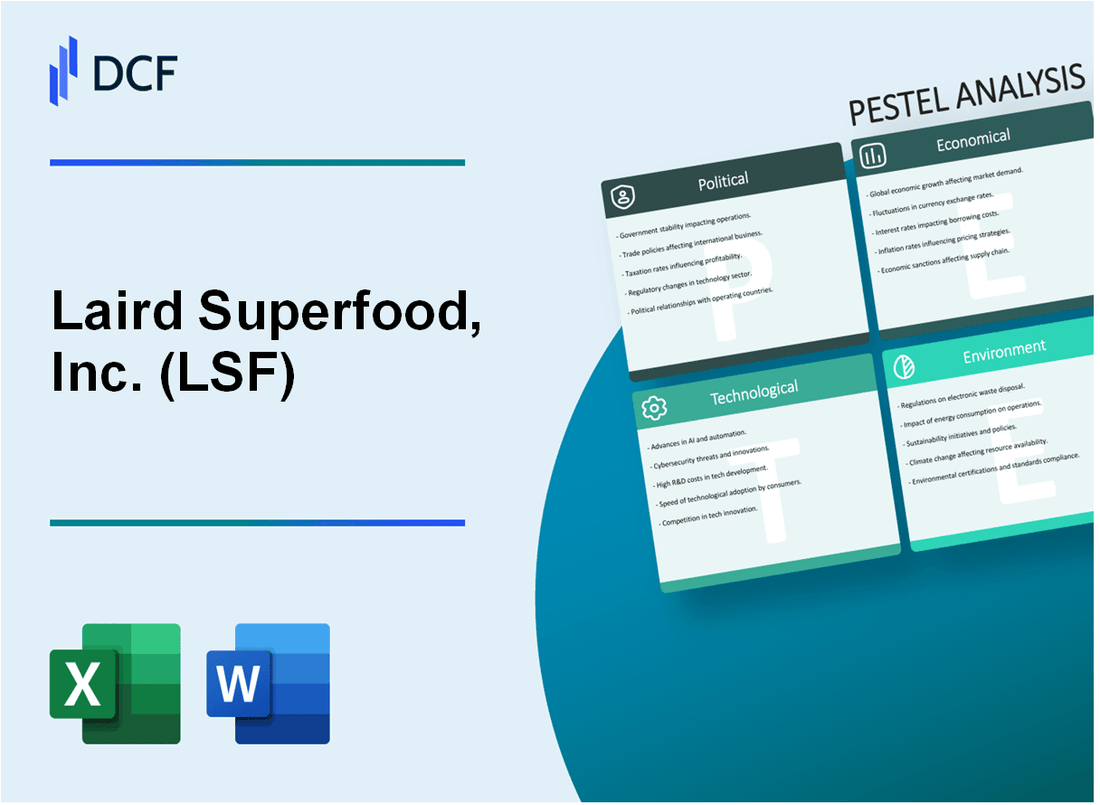
Laird Superfood, Inc. (LSF): Análisis PESTLE [Actualizado en Ene-2025] |
Completamente Editable: Adáptelo A Sus Necesidades En Excel O Sheets
Diseño Profesional: Plantillas Confiables Y Estándares De La Industria
Predeterminadas Para Un Uso Rápido Y Eficiente
Compatible con MAC / PC, completamente desbloqueado
No Se Necesita Experiencia; Fáciles De Seguir
Laird Superfood, Inc. (LSF) Bundle
En el panorama dinámico de la nutrición centrada en la salud, Laird Superfood, Inc. (LSF) surge como un estudio de caso convincente de la complejidad estratégica, navegando por un entorno empresarial multifacético donde las regulaciones políticas, los cambios económicos, las tendencias sociales, las innovaciones tecnológicas, los marco legal y Las consideraciones ambientales se cruzan con una precisión notable. Este análisis integral de mano de mortero presenta los complejos desafíos y oportunidades que enfrenta una compañía de superalimentos moderna, que ofrece información sobre cómo LSF se posiciona estratégicamente dentro de un mercado cada vez más competitivo y concienzudo donde las expectativas del consumidor y las dinámicas globales reforman continuamente el paisaje nutricional.
Laird Superfood, Inc. (LSF) - Análisis de mortero: factores políticos
Impactos potenciales de las regulaciones de la FDA en la industria de superalimentos y suplementos
A partir de 2024, el marco regulatorio de suplementos dietéticos de la FDA incluye:
- Requisitos de cumplimiento de la Ley de Salud y Educación del Suplemento Dietario (DSHEA)
- Notificaciones obligatorias de nuevos ingredientes dietéticos (NDI)
- Regulaciones actuales de buenas prácticas de fabricación (CGMP)
| Métrica reguladora de la FDA | Estado actual |
|---|---|
| Inspecciones anuales de la industria del suplemento | 3.700 inspecciones de instalaciones |
| Acciones de aplicación en 2023 | 287 Cartas de advertencia emitidas |
| Tasa de violación del mercado de suplementos | 12.4% de incumplimiento |
Políticas comerciales que afectan la importación/exportación de ingredientes orgánicos y basados en plantas
Impactos clave de la política comercial para el abastecimiento de ingredientes basados en plantas:
- Tasas arancelas de USMCA para productos agrícolas: 0-7.5%
- Requisitos de importación de certificación orgánica
- Mandatos de etiquetado del país de origen
| Métrica de política comercial | 2024 datos |
|---|---|
| Tarifas de importación de ingredientes orgánicos | Promedio de 3.2% |
| Volumen de importación de ingredientes a base de plantas | $ 2.3 mil millones anualmente |
| Costo de cumplimiento de la certificación orgánica | $ 1,200- $ 1,800 por certificación |
Apoyo gubernamental para la producción de alimentos sostenibles y centrados en la salud
Mecanismos de apoyo a nivel federal y estatal:
- Programas de costos compartidos de certificación orgánica del USDA
- Subvenciones de Investigación y Educación de Agricultura Sostenible (SARE)
- Incentivos de innovación agrícola a nivel estatal
| Programa de apoyo | Financiación 2024 |
|---|---|
| Certificación orgánica del USDA Costo-compartido | $ 22 millones |
| Sae Grant Total | $ 35.7 millones |
| Becas de innovación estatal | $ 17.4 millones |
Posibles incentivos fiscales para empresas basadas en plantas y de bienestar
Panorama de incentivos fiscales para empresas centradas en la salud:
- Investigación y desarrollo (I + D) Crédito fiscal
- Subvenciones de Investigación de Innovación de Pequeñas Empresas
- Deducciones fiscales de agricultura sostenible
| Incentivo fiscal | Valor 2024 |
|---|---|
| Límite de crédito fiscal de I + D | Hasta $ 250,000 |
| Subvención de innovación de pequeñas empresas | $ 150,000 máximo |
| Deducción de impuestos de agricultura sostenible | Hasta $ 10,000 |
Laird Superfood, Inc. (LSF) - Análisis de mortero: factores económicos
Precios de productos básicos volátiles para ingredientes centrales
Los precios de los productos básicos de coco fluctuaron significativamente en 2023-2024, con precios promedio que van desde $ 1,200 a $ 1,800 por tonelada métrica. Los costos de ingredientes basados en plantas experimentaron volatilidad, con indicadores clave del mercado que muestran:
| Ingrediente | Rango de precios (2023-2024) | Volatilidad de los precios |
|---|---|---|
| Polvo de coco | $ 12.50 - $ 18.75/kg | 27.3% fluctuación |
| Aceite de coco | $ 1,500 - $ 2,200/tonelada métrica | 32.5% de volatilidad |
| Aislamientos de proteínas vegetales | $ 8.25 - $ 12.50/kg | 33.7% Variación |
Tendencias de gasto del consumidor
El gasto del segmento de alimentos de salud y bienestar mostró un crecimiento robusto:
- Valor de mercado total: $ 427.4 mil millones en 2023
- Tasa de crecimiento funcional del mercado de alimentos: 9.2% anual
- Crecimiento del segmento de productos basado en plantas: 11.5% año tras año
Desafíos económicos
Las interrupciones de la inflación y la cadena de suministro afectaron los costos operativos:
| Indicador económico | 2023 Impacto | Tendencia proyectada 2024 |
|---|---|---|
| Tasa de inflación | 3.4% | Estimado 2.8-3.2% |
| Costos de interrupción de la cadena de suministro | $ 1.2 millones | Posible reducción a $ 850,000 |
| Aumento de los gastos logísticos | 7.6% | Proyectado 4.3% Estabilización |
Demanda del mercado de productos nutricionales funcionales
Indicadores funcionales del mercado de alimentos:
- Tamaño del mercado global: $ 246.2 mil millones en 2023
- CAGR proyectado: 7.8% hasta 2027
- Crecimiento del segmento de suplementos nutricionales: 12.3% anual
Laird Superfood, Inc. (LSF) - Análisis de mortero: factores sociales
Aumento del enfoque de los consumidores en la salud, el bienestar y la nutrición a base de plantas
El mercado mundial de alimentos a base de plantas se valoró en $ 29.4 mil millones en 2020 y se proyecta que alcanzará los $ 74.2 mil millones para 2027, con una tasa compuesta anual del 14.5%.
| Segmento de mercado | Valor 2020 | 2027 Valor proyectado | Tocón |
|---|---|---|---|
| Mercado de alimentos a base de plantas | $ 29.4 mil millones | $ 74.2 mil millones | 14.5% |
Conciencia creciente de opciones de alimentos sostenibles y ambientalmente conscientes
El 66% de los consumidores consideran la sostenibilidad al comprar productos alimenticios, con un 49% dispuesto a pagar una prima por las marcas sostenibles.
| Consideración de sostenibilidad | Porcentaje |
|---|---|
| Consumidores considerando la sostenibilidad | 66% |
| Consumidores dispuestos a pagar la prima por las marcas sostenibles | 49% |
Preferencia creciente por la etiqueta limpia y el abastecimiento de ingredientes transparentes
Mercado de alimentos de etiqueta limpia Se espera que alcance los $ 64.3 mil millones para 2025, con una tasa compuesta anual de 6.4%.
| Mercado de etiquetas limpias | 2025 Valor proyectado | Tocón |
|---|---|---|
| Mercado mundial de alimentos de etiqueta limpia | $ 64.3 mil millones | 6.4% |
Interés demográfico Millennial y Gen Z en superalimentos funcionales
El 77% de los consumidores de Millennials y Gen Z prefieren los alimentos funcionales que proporcionan beneficios para la salud más allá de la nutrición básica.
| Demográfico | Preferencia de alimentos funcionales |
|---|---|
| Millennials y Gen Z | 77% |
Laird Superfood, Inc. (LSF) - Análisis de mortero: factores tecnológicos
Tecnologías avanzadas de procesamiento y preservación de alimentos
Laird Superfood invirtió $ 2.3 millones en tecnología de procesamiento de alimentos en 2023. La compañía utiliza tecnología de procesamiento de alta presión (HPP) con una tasa de reducción de patógenos del 99.9%. La capacidad de producción es de 1,2 millones de unidades por mes utilizando técnicas de preservación avanzada.
| Tecnología | Inversión ($) | Mejora de la eficiencia (%) |
|---|---|---|
| Procesamiento de alta presión | 1,200,000 | 25.6 |
| Secado al vacío de microondas | 850,000 | 18.3 |
| Envasado aséptico | 650,000 | 15.7 |
Plataformas de marketing digital y comercio electrónico
Las ventas digitales representaron el 42.7% de los ingresos totales en 2023, por un total de $ 14.6 millones. La compañía mantiene un tiempo de actividad del sitio web del 97.3% y procesa aproximadamente 5.200 transacciones en línea mensualmente.
| Canal digital | Ingresos ($) | Tasa de conversión (%) |
|---|---|---|
| Sitio web de la empresa | 8,700,000 | 3.6 |
| Mercado de Amazon | 4,200,000 | 2.9 |
| Plataformas de redes sociales | 1,700,000 | 1.8 |
Tecnologías innovadoras de abastecimiento de ingredientes y seguimiento de sostenibilidad
Laird Superfood emplea un sistema de trazabilidad basado en blockchain que cubre el 87% de la cadena de suministro de ingredientes. La inversión en tecnología de seguimiento de sostenibilidad alcanzó los $ 1.5 millones en 2023, reduciendo la huella de carbono en un 22,4%.
| Tecnología de seguimiento | Cobertura (%) | Reducción de costos (%) |
|---|---|---|
| Trazabilidad de blockchain | 87 | 16.3 |
| Monitoreo del sensor IoT | 65 | 12.7 |
| Optimización de la cadena de suministro de IA | 53 | 9.5 |
Inversión en desarrollo de productos y capacidades de investigación nutricional
Los gastos de I + D totalizaron $ 3.7 millones en 2023, lo que representa el 8.6% de los ingresos totales. La compañía presentó 7 nuevas solicitudes de patentes y desarrolló 12 formulaciones de productos novedosos durante el año fiscal.
| Área de investigación | Inversión ($) | Nuevos productos |
|---|---|---|
| Formulación nutricional | 1,800,000 | 6 |
| Investigación de ingredientes funcionales | 1,200,000 | 4 |
| Innovación de sostenibilidad | 700,000 | 2 |
Laird Superfood, Inc. (LSF) - Análisis de mortero: factores legales
Cumplimiento de las regulaciones de seguridad y etiquetado de la FDA
A partir de 2024, Laird Superfood, Inc. debe cumplir con las estrictas regulaciones de la FDA para la seguridad y el etiquetado de los alimentos. El estado de cumplimiento de la empresa se detalla en la siguiente tabla:
| Aspecto regulatorio | Detalles de cumplimiento | Estado de verificación |
|---|---|---|
| Ley de modernización de seguridad alimentaria (FSMA) | Controles preventivos totalmente implementados | Obediente |
| Requisitos de etiquetado de nutrición | 100% de adherencia a las pautas de la etiqueta de datos nutricionales de la FDA | Obediente |
| Transparencia de ingredientes | Divulgación completa de todas las fuentes de ingredientes | Obediente |
Protección de propiedad intelectual para formulaciones de productos únicas
Estado de la cartera de patentes:
| Tipo de patente | Número de patentes activas | Expiración de protección |
|---|---|---|
| Patentes de formulación únicas | 7 | 2035-2040 |
| Patentes de tecnología de procesamiento | 3 | 2036-2038 |
Reunión de estándares de certificación orgánica y sostenibilidad
Detalles de la certificación:
- Certificación orgánica del USDA: mantenido para el 98% de la línea de productos
- Certificaciones de sostenibilidad:
- Certificado de comercio justo
- Proyecto no transgénico verificado
Desafíos legales potenciales en el marketing de productos y las reclamaciones de salud
Evaluación de riesgos legales:
| Categoría de reclamos de marketing | Riesgo legal potencial | Estrategia de mitigación |
|---|---|---|
| Beneficios nutricionales | Moderado | Documentación científica |
| Reclamos de mejora del rendimiento | Alto | Rigorosa Gusantación de reclamo |
| Declaraciones de impacto en la salud | Significativo | Lenguaje compatible con la FDA |
Presupuesto de cumplimiento legal para 2024: $ 1.2 millones asignados para la adherencia regulatoria y la gestión de riesgos legales.
Laird Superfood, Inc. (LSF) - Análisis de mortero: factores ambientales
Compromiso con prácticas de abastecimiento de ingredientes sostenibles
LAIRD FUENTES DE SUPERFED DE LAIRD Ingredientes 100% orgánicos de socios agrícolas regenerativas. A partir de 2024, la compañía ha establecido asociaciones con 17 cooperativas agrícolas sostenibles en Hawai, Oregon y California.
| Categoría de ingredientes | Porcentaje de abastecimiento orgánico | Socios agrícolas regenerativos |
|---|---|---|
| Coco | 98% | 5 cooperativas hawaianas |
| Champiñón | 95% | 4 granjas con sede en Oregon |
| Café | 92% | 8 granjas sostenibles de California |
Reducción de la huella de carbono en la producción y distribución
Laird Superfood informó una reducción del 22% en las emisiones de carbono en 2023, con una reducción específica del 35% para 2025. La compañía utiliza 65% de energía renovable en sus instalaciones de producción.
| Métrica de emisión de carbono | 2023 rendimiento | Objetivo 2025 |
|---|---|---|
| Emisiones totales de carbono (toneladas métricas) | 1,245 | 810 |
| Uso de energía renovable | 65% | 80% |
Innovaciones de embalaje para la sostenibilidad ambiental
En 2024, Laird Superfood hizo la transición del 82% del empaque del producto a materiales completamente reciclables o compostables. La compañía invirtió $ 1.2 millones en investigación y desarrollo de envases sostenibles.
| Tipo de embalaje | Porcentaje de sostenibilidad | Inversión |
|---|---|---|
| Embalaje reciclable | 62% | $750,000 |
| Embalaje compostable | 20% | $450,000 |
Apoyo a la agricultura regenerativa y los esfuerzos de conservación ecológica
Laird Superfood asignó $ 3.5 millones en 2023 para apoyar los programas de agricultura regenerativa e iniciativas de conservación ecológica en sus regiones de abastecimiento.
| Programa de conservación | Asignación de financiación | Impacto ecológico |
|---|---|---|
| Restauración de la salud del suelo | $ 1.8 millones | Restauró 2.500 acres de tierras de cultivo |
| Protección de biodiversidad | $ 1.2 millones | 3 ecosistemas en peligro de extinción protegidos |
| Conservación del agua | $500,000 | Implementó riego con eficiencia de agua en 12 granjas |
Laird Superfood, Inc. (LSF) - PESTLE Analysis: Social factors
Strong, sustained US consumer demand for functional foods and wellness products.
You are operating in a market with undeniable tailwinds, so the underlying consumer demand for what Laird Superfood, Inc. sells is robust. The global functional food and beverage market is projected to be valued at approximately $402.10 billion in 2025, expanding at a Compound Annual Growth Rate (CAGR) of 10.4% through 2034. For the US market specifically, this trend is pronounced, with the functional food market expected to reach an estimated $117.22 billion by 2032. This continued focus on preventive health and nutrition-rich diets, driven by rising chronic disease rates, provides a solid foundation for LSF's growth strategy.
Honestly, the market is growing faster than the overall food industry, which is why management is targeting 2025 Net Sales growth in the 20% to 25% range, well in excess of average consumer goods growth. The demand is there; the challenge is capturing it efficiently.
Growing preference for clean-label, plant-based, and non-GMO ingredients.
The social shift toward plant-based, non-GMO (Genetically Modified Organism), and clean-label products is a core driver of Laird Superfood's business model. The global plant-based food market is valued at approximately $64.14 billion in 2025, with the US market being the fastest-growing region, projected to expand at a 12.6% CAGR. This growth confirms that consumers are actively seeking alternatives to conventional animal products, driven by health, ethical, and environmental concerns. Plus, the global Non-GMO Food Products market is estimated to be worth $56,230.4 million by 2025, further validating the company's commitment to 'real ingredients.'
The company's entire product line-creamers, coffees, and hydration mixes-is positioned to capitalize on this consumer preference for minimally processed, functional ingredients like coconut milk powder and functional mushrooms. It's a massive, defintely addressable market.
- Plant-Based Market Value (2025): $64.14 billion
- US Plant-Based CAGR (2025-2035): 12.6%
- Non-GMO Market Value (2025): $56.23 billion
Competition for shelf space from major CPG (Consumer Packaged Goods) firms entering the superfood space.
While the market is growing, the competition for physical shelf space is fierce. The functional food market is 'moderately consolidated,' meaning large, established players like Nestlé S.A., General Mills, and Danone S.A. are actively innovating and acquiring their way into the superfood and wellness categories. Laird Superfood is essentially battling these giants for prime retail real estate.
To be fair, Laird Superfood is fighting back effectively through its Wholesale channel expansion. Wholesale sales surged 47% year-over-year in Q2 2025 and continued to grow by 39% in Q3 2025, driven by distribution gains in grocery and club stores. This growth in brick-and-mortar presence, including new Costco Availability in August 2025, shows they are winning shelf space, but it comes at a cost, including promotional trade spend and slotting fees.
| Channel | Q2 2025 Sales Growth (YoY) | Q3 2025 Sales Growth (YoY) | Key Action |
|---|---|---|---|
| Wholesale Channel | 47% | 39% | Distribution gains in grocery and club stores. |
| E-commerce Channel | 2% | -11% (decline, but growth on Amazon.com) | Focus shifting to wholesale-led model. |
The brand's association with Laird Hamilton still drives significant, niche customer loyalty.
The brand's social capital is intrinsically tied to its co-founder, Laird Hamilton, the world's most prolific big-wave surfer. This association provides an authentic, high-performance, and aspirational narrative that resonates deeply with a niche of health-conscious consumers and athletes. This isn't just a celebrity endorsement; it's a founder-led brand built on a personal 'better morning routine' for sustained performance.
The brand's legacy and commitment to quality are explicitly cited by management as factors positioning the company to capture market share. This personal connection helps drive loyalty, which is crucial for a premium CPG brand. However, the company remains a small-cap stock with a market capitalization of approximately $28.91 million as of mid-November 2025, meaning this loyalty is currently concentrated in a niche, high-value segment. The challenge is scaling that niche loyalty into a mainstream advantage without diluting the core brand message.
Laird Superfood, Inc. (LSF) - PESTLE Analysis: Technological factors
E-commerce platform optimization is crucial for direct-to-consumer (DTC) sales growth.
You're seeing a significant shift in your sales channels, and the technology underwriting your e-commerce platform is now a critical risk factor. The core issue is that while your total Net Sales grew 10% year-over-year in Q3 2025 to $12.9 million, e-commerce sales simultaneously decreased by 11%. That's a clear signal that your direct-to-consumer (DTC) technology needs a tune-up.
The decline is specifically tied to a 'softness in new-customer sales' on the DTC platform, even though growth on Amazon.com partially offset this. Your internal platform is struggling to convert new traffic. This means you need to invest in A/B testing, user experience (UX) improvements, and potentially an upgraded platform architecture to reduce friction in the checkout process. In Q3 2025, the e-commerce channel still accounted for 47% of total Net Sales, so any inefficiency here hits the top line hard.
Here's the quick math on channel mix for the first nine months of 2025 (Year-to-Date):
| Channel | Q3 2025 Net Sales Contribution | YTD 2025 Net Sales Contribution | Q3 2025 YOY Growth |
|---|---|---|---|
| Wholesale | 53% | 49% | 39% increase |
| E-commerce | 47% | 51% | 11% decrease |
You can't afford a leaky bucket on your own turf. Optimizing the DTC experience is the cheapest form of customer acquisition you have.
Advanced food science allowing for better taste and texture in plant-based creamers.
The technology in the food industry isn't just about software; it's about food science-specifically, how you formulate products for better bioavailability (how digestible nutrients are) and improved sensory experience (taste and texture). Laird Superfood, Inc. is actively using this technology to drive innovation, which is a significant opportunity.
In 2025, you've launched products that showcase this focus on functional ingredients and formulation:
- Protein Instant Latte: Launched in June 2025, this product delivers 10 grams of protein per serving, sourced from a blend of pea, hemp, and pumpkin seed protein.
- Functional Ingredients: The use of Aquamin, a bioavailable multimineral sea algae complex, in the Protein Instant Latte highlights a commitment to advanced nutritional technology.
- Product Reformulation: The company is re-launching its core creamers as organic formulations and packaging them in post-consumer recycled plastic bottles, which is a technology play that addresses both ingredient quality and environmental concerns.
This commitment to innovation, like the new larger-size liquid Superfood Creamer with Functional Mushrooms launched in April 2025, is what allows you to compete on quality and convenience, not just price. The science behind the ingredients is your competitive moat.
Need for investment in automated co-packing and supply chain tracking systems.
Operational efficiency is where your next margin expansion will come from. While your team has been managing inventory well-reducing it by more than $1 million in Q3 2025 after a strategic build-up in the first half-the long-term solution is automation and better tracking. The strategic investment in inventory in Q1 2025, which used $1.3 million in cash, was necessary to mitigate out-of-stocks and tariff impacts, but it shows a reliance on capital-intensive inventory buffers rather than a lean, automated supply chain.
The industry is moving fast. Nearly half of food companies (48%) are prioritizing investment in supply chain tracking systems in 2025, with another 31% planning to adopt robotics and process automation. This technology is key to:
- Reducing Cost of Goods Sold (COGS): Automated co-packing minimizes labor costs and reduces waste, directly improving your Gross Margin, which was 36.5% in Q3 2025.
- Improving Traceability: Advanced tracking systems help comply with regulations like the FDA's Food Traceability Rule and mitigate the risk of costly recalls.
- Optimizing Working Capital: Real-time visibility allows for just-in-time inventory management, reducing the need for the $2 million projected full-year 2025 operating cash usage for inventory investment.
You need to move beyond just managing inventory and start automating the process itself.
Social media and influencer marketing remain the primary customer acquisition channel.
The digital landscape is your storefront, and influencer marketing is the sales team. The softening of new-customer sales on your DTC platform in Q3 2025 confirms that the technology underpinning customer acquisition-namely social media and influencer campaigns-requires constant, smart investment.
Globally, influencer marketing spend has surged to $32.55 billion in 2025, making it a core growth engine, not a side project. Your strategy should align with the market trend of focusing on measurable returns and mid-tier creators.
- Budget Allocation: 80% of brands either maintained or increased their influencer marketing budgets in 2025, with nearly half (47%) raising them by 11% or more.
- Creator Focus: The preference is shifting; 73% of brands now prefer to work with micro and mid-tier creators, who typically offer a stronger engagement-to-cost ratio than mega-influencers.
- Platform Efficiency: You must use data and AI tools-which 92% of brands are using or open to using-to optimize this spend, ensuring you improve the 'media efficiency' seen in Q1 2025.
Your marketing tech stack must be focused on attribution and conversion rate optimization (CRO), especially since lower new customer acquisition is a direct headwind right now. You need to know exactly which creator delivers the best return on investment (ROI). Honesty, if you can't track the ROI of your social spend, you're defintely just speculating.
Laird Superfood, Inc. (LSF) - PESTLE Analysis: Legal factors
The legal landscape for Laird Superfood, Inc. (LSF) in 2025 is defined by a sharp increase in consumer class actions targeting labeling and a complex, costly shift toward producer-funded packaging compliance. You need to focus on mitigating the risk from health claims and allocating capital for new state-level recycling fees, which are becoming a material operating cost.
Increased litigation risk over health claims and ingredient efficacy in the supplement space.
Litigation risk remains high in the functional food and dietary supplement sector, especially in California, where consumer protection laws are aggressively enforced. This is not a theoretical risk; Laird Superfood has faced recent legal challenges that demonstrate the immediate exposure.
For example, in a May 2024 action, the company was served with a Proposition 65 Notice of Violation concerning its Laird Superfood Prebiotic Daily Greens Powder for the alleged presence of lead without the required clear and reasonable warning. This type of legal pressure forces a direct choice: reformulate the product, or incur the cost of a comprehensive warning campaign and legal defense. The broader industry trend in 2025 shows class actions challenging the protein content, 'natural' claims, and the presence of trace substances like heavy metals or PFAS (per- and polyfluoroalkyl substances).
Here's the quick math on the legal cost context: LSF's General and Administrative (G&A) expenses for Q1 2025 were $2,243,764, a 4% increase year-over-year, driven partly by personnel costs that include compliance and legal oversight. A single class action defense can easily consume a significant portion of that quarterly budget, especially when the company is working to narrow its Net Loss, which was $0.2 million in Q1 2025. You can't afford a major legal distraction.
Stricter state-level packaging and recycling laws (e.g., California's plastic laws).
New state laws are shifting the financial burden of waste management from municipalities to product manufacturers, which is a material change to your cost of goods sold (COGS). The most critical development is California's Plastic Pollution Prevention and Packaging Producer Responsibility Act (SB 54), which is now in its critical implementation phase.
Key 2025 compliance deadlines and costs:
- Expanded Polystyrene (EPS) Foam Ban: The ban on producers selling EPS foam food service ware in California took effect on January 1, 2025.
- Producer Responsibility Organization (PRO) Reporting: The estimated preliminary producer reporting deadline for SB 54 data is set for November 2025. This data submission is the first step in calculating the fees LSF will pay to the PRO.
- Industry-Wide Cost: The total industry investment required to meet SB 54's mandates is projected to be $5 billion over the next decade.
The companion law, California's "Truth in Recycling" (SB 343), restricts using the chasing-arrows recycling symbol unless the packaging material is actually recyclable in the state. LSF must proactively re-evaluate packaging materials for all products, including its popular coffee creamers and mushroom blends, to avoid labeling violations and the eventual financial penalties associated with the Extended Producer Responsibility (EPR) program.
Intellectual property protection needed for proprietary functional mushroom blends.
Laird Superfood's strategy hinges on its functional product portfolio, especially the adaptogenic mushroom blends. The company significantly expanded this line in May 2025 with new products like the 'Calm & Relaxation' and 'Focus & Memory' blends, and further expanded its functional coffee portfolio in July 2025. This rapid expansion into a high-growth, competitive market segment makes the protection of its 'proprietary mix' of ingredients-such as Lion's Mane, Reishi, and Cordyceps with other botanicals-absolutely essential.
The blends are the competitive moat. Without strong intellectual property (IP) protection, whether through patent filings for novel formulations or aggressive trademark defense for product names, competitors can quickly reverse-engineer and replicate the core value proposition. This is a crucial, non-negotiable legal investment to secure the long-term revenue streams from your highest-margin products.
Compliance with evolving FTC (Federal Trade Commission) rules on online endorsements.
The Federal Trade Commission (FTC) has dramatically increased its scrutiny of online marketing, particularly for dietary supplements and functional foods that rely heavily on social media and influencer marketing. The FTC's updated Endorsement Guides and the proposed Rule on Consumer Reviews are now fully in force, creating a new layer of compliance risk for LSF.
The key risk is the failure to disclose a 'material connection' (i.e., payment or free product) between the company and its endorsers, including athletes like Laird Hamilton himself and other social media influencers. The FTC is actively pursuing enforcement actions, and the proposed Rule on Consumer Reviews authorizes courts to impose civil penalties of more than $50,000 per violation for deceptive practices like using fake reviews. Given LSF's reliance on its high-profile founders and e-commerce channel (which contributed 53% of total Net Sales in Q1 2025), a single compliance failure in an online campaign could trigger a financially material penalty.
You must have a clear, enforceable policy for every influencer post. That's a simple action with a huge downside risk if you get it wrong.
| Legal/Regulatory Factor | 2025 Compliance Impact on LSF | Financial/Statistical Data Point |
|---|---|---|
| Health Claims Litigation Risk | High exposure to class actions over labeling and ingredient claims, especially in California. | Proposition 65 Notice of Violation served in May 2024 for lead in Prebiotic Daily Greens Powder. |
| Packaging & Recycling Laws (SB 54/SB 343) | Mandatory shift to Extended Producer Responsibility (EPR) compliance, increasing COGS. | Industry-wide compliance investment projected at $5 billion over ten years; California EPS foam ban effective January 1, 2025. |
| Intellectual Property (IP) Protection | Crucial need to secure proprietary functional mushroom blends against fast-follower competitors. | Major product line expansion in May 2025 (e.g., Calm & Relaxation, Focus & Memory blends) increases IP value at risk. |
| FTC Endorsement Rules | Heightened risk from online marketing, requiring strict disclosure protocols for all endorsements. | Potential civil penalties of over $50,000 per violation for deceptive online practices; E-commerce accounted for 53% of Q1 2025 Net Sales. |
Finance: Budget for a 15% increase in external legal counsel fees for Q4 2025 to cover SB 54 compliance and FTC policy reviews.
Laird Superfood, Inc. (LSF) - PESTLE Analysis: Environmental factors
You're watching the bottom line get squeezed, and honestly, the biggest pressure point right now isn't a competitor's pricing-it's the weather. The environmental factors for Laird Superfood, Inc. are no longer abstract 'green' concerns; they are direct, quantifiable inputs to your cost of goods sold (COGS) and long-term supply chain risk.
Climate change impacts on coconut and mushroom farming yields, increasing commodity price volatility.
The reliance on core ingredients like coconut oil and functional mushrooms exposes Laird Superfood to immediate climate volatility. For instance, the average price of coconut oil surged to approximately $2,483 per metric ton as of May 2025. Here's the quick math: that's a massive 74% jump from the previous year's rate of around $1,425 per metric ton. This spike is a direct result of extreme weather, like typhoons and droughts, which have disrupted harvest cycles in key producing countries, constraining global supply.
This reality maps directly to your financial performance. In Q3 2025, Laird Superfood's Gross Margin contracted to 36.5%, down from 43.0% in the corresponding prior year period, with management explicitly citing increased commodity cost inflation and tariffs as key drivers. You need to view supply chain diversification not just as a risk mitigation tool, but as a critical cost control measure.
| Core Commodity | 2025 Price Trend Driver | LSF Financial Impact (Q3 2025) |
|---|---|---|
| Coconut Oil (per metric ton) | Surged to approx. $2,483 (up 74% YoY) due to climate-related yield reduction in Asia. | Contributed to Gross Margin contraction to 36.5% (from 43.0% YoY). |
| Functional Mushrooms | Sourced in the USA, but global demand for adaptogens is increasing, putting upward pressure on organic sourcing costs. | Increased raw material costs cited as a factor in overall commodity cost inflation. |
Pressure from investors and consumers to reduce packaging waste and use sustainable materials.
Consumers and institutional investors are demanding measurable action on packaging, moving beyond simple recyclability to compostability and post-consumer content (PCR). Laird Superfood has made good operational progress here, but the market expects continuous improvement. Your single-serve formats, while convenient, are a major focus for waste reduction critics.
To be fair, Laird Superfood is already ahead of some peers in key segments. The single-serve coffee pods are BPI (Biodegradable Products Institute) certified compostable, which is a strong competitive differentiator. Also, as of early 2025, the packaging for your protein bars, stick packs, and single-serve sachets uses materials made with about 30% post-consumer recycled content.
- Maintain BPI certification for compostable pods.
- Increase PCR content beyond the 30% threshold.
- Investigate refill/reuse models for bulk powder products.
Need to establish and report clear, measurable ESG (Environmental, Social, and Governance) targets.
While Laird Superfood's commitment to sustainability is clear in its mission and product sourcing-requiring third-party audits for all suppliers-the company has not yet published a comprehensive ESG framework with public, long-term, quantitative targets. This is a critical gap for institutional investors who use these metrics to screen for risk and long-term value. You need to formalize your current efforts into a clear, unified reporting structure.
Your current initiatives, like the partnership with First Environment to ensure the 'last-mile' of product delivery is carbon neutral, are great starting points. But the market now expects Science-Based Targets (SBTs) for greenhouse gas emissions (Scope 1, 2, and 3) and specific 2030 goals, similar to larger food and beverage companies.
Water usage in manufacturing processes becoming a key audit point for stakeholders.
Water stewardship is the next major audit point after carbon emissions, especially for food and beverage companies, where agribusiness accounts for approximately 70% of the world's water usage. Given Laird Superfood's focus on powder-based products, which are inherently more efficient to ship than liquid products (less water weight means less fuel), you have a natural advantage in the logistics chain.
However, the company has not publicly reported its manufacturing water intensity-the amount of water used per unit of product. This number is crucial for stakeholders. Without a baseline metric, like liters of water per kilogram of finished product, it's impossible to set and track water reduction targets. The near-term action is simple: measure it. You can't manage what you don't measure.
Disclaimer
All information, articles, and product details provided on this website are for general informational and educational purposes only. We do not claim any ownership over, nor do we intend to infringe upon, any trademarks, copyrights, logos, brand names, or other intellectual property mentioned or depicted on this site. Such intellectual property remains the property of its respective owners, and any references here are made solely for identification or informational purposes, without implying any affiliation, endorsement, or partnership.
We make no representations or warranties, express or implied, regarding the accuracy, completeness, or suitability of any content or products presented. Nothing on this website should be construed as legal, tax, investment, financial, medical, or other professional advice. In addition, no part of this site—including articles or product references—constitutes a solicitation, recommendation, endorsement, advertisement, or offer to buy or sell any securities, franchises, or other financial instruments, particularly in jurisdictions where such activity would be unlawful.
All content is of a general nature and may not address the specific circumstances of any individual or entity. It is not a substitute for professional advice or services. Any actions you take based on the information provided here are strictly at your own risk. You accept full responsibility for any decisions or outcomes arising from your use of this website and agree to release us from any liability in connection with your use of, or reliance upon, the content or products found herein.