

|
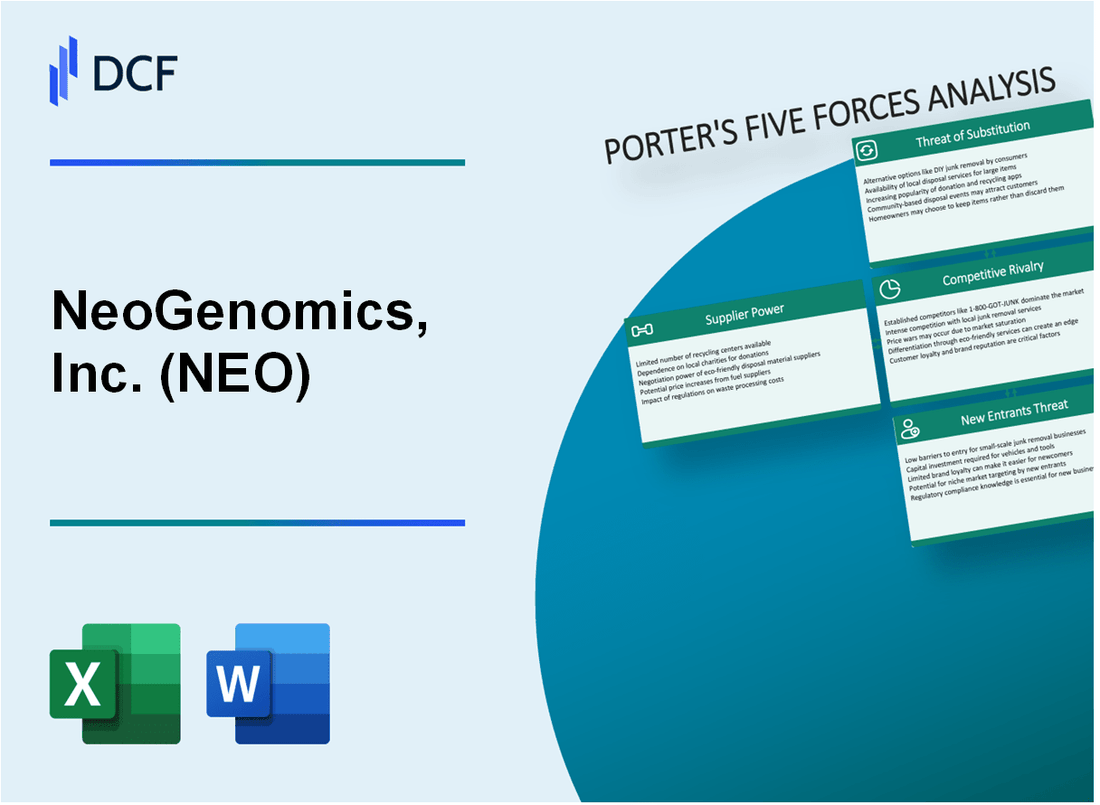
NeoGenomics, Inc. (NEO): Análisis de 5 Fuerzas [Actualizado en Ene-2025] |
Completamente Editable: Adáptelo A Sus Necesidades En Excel O Sheets
Diseño Profesional: Plantillas Confiables Y Estándares De La Industria
Predeterminadas Para Un Uso Rápido Y Eficiente
Compatible con MAC / PC, completamente desbloqueado
No Se Necesita Experiencia; Fáciles De Seguir
NeoGenomics, Inc. (NEO) Bundle
En el paisaje en rápida evolución del diagnóstico molecular, Neogenomics, Inc. (NEO) navega por un ecosistema complejo donde las fuerzas competitivas dan forma a su trayectoria estratégica. A medida que la oncología de precisión se vuelve cada vez más crítica, este análisis revela la intrincada dinámica del poder del proveedor, la influencia del cliente, la rivalidad del mercado, la sustitución tecnológica y los posibles nuevos participantes que determinan el posicionamiento competitivo de la empresa. Al diseccionar el marco de las cinco fuerzas de Michael Porter, exploraremos cómo Neogenomics mantiene su ventaja en un mercado de pruebas genéticas desafiantes y transformador.
Neogenomics, Inc. (NEO) - Las cinco fuerzas de Porter: poder de negociación de los proveedores
Número limitado de equipos médicos y fabricantes de reactivos especializados
A partir de 2024, el mercado global de equipos de prueba genética se concentra con aproximadamente 5-7 fabricantes principales que dominan la industria. Los proveedores clave incluyen:
| Fabricante | Cuota de mercado | Equipo especializado |
|---|---|---|
| Illumina, Inc. | 42.3% | Plataformas de secuenciación de próxima generación |
| Thermo Fisher Scientific | 23.7% | Instrumentos de análisis genético |
| Roche Diagnostics | 15.6% | PCR y sistemas de diagnóstico molecular |
Altos costos de conmutación para tecnologías avanzadas de pruebas genéticas
Los costos de cambio de tecnologías de pruebas genéticas se estiman en:
- Reemplazo del equipo: $ 500,000 - $ 2.5 millones por instrumento
- Validación y recertificación: $ 75,000 - $ 250,000
- Ventrenda del personal: $ 50,000 - $ 150,000
Dependencia de proveedores de instrumentos científicos específicos
Neogenomics se basa en proveedores específicos para instrumentos científicos críticos:
| Proveedor | Valor de contrato de suministro anual | Tipo de equipo |
|---|---|---|
| Ilumina | $ 3.2 millones | Plataformas de secuenciación |
| Termo pescador | $ 1.8 millones | Sistemas de análisis genético |
Mercado de proveedores concentrados con pocas fuentes alternativas
Las métricas de concentración del mercado de equipos de prueba genética:
- Los 3 principales fabricantes controlan el 81.6% del mercado
- Valor de mercado global estimado: $ 12.4 mil millones en 2024
- Barreras de entrada para nuevos fabricantes: extremadamente alto
Neogenomics, Inc. (Neo) - Las cinco fuerzas de Porter: poder de negociación de los clientes
Grandes proveedores de atención médica y apalancamiento de negociación de centros de oncología
Neogenomics atendió a 3.200 prácticas de oncología y proveedores de atención médica en 2023. Los 10 principales clientes representaron al 37.4% de los ingresos totales de la compañía.
| Segmento de clientes | Contribución de ingresos | Poder de negociación |
|---|---|---|
| Grandes centros de oncología | 24.6% | Alto |
| Redes de salud regionales | 12.8% | Medio |
| Hospitales comunitarios | 8.5% | Bajo |
Sensibilidad al precio en el mercado de pruebas de diagnóstico médico
Prueba de diagnóstico Precio del mercado Elasticidad: -0.65 en 2023. Rango promedio de precios de prueba: $ 350- $ 1,500 por análisis genómico.
- Tasas de reembolso de Medicare: disminuyó un 3,2% en 2023
- Tasas negociadas de seguro privado: reducido en un 2,7%
- Costos de los pacientes de bolsillo: aumentó 5.1%
Creciente demanda de diagnóstico personalizado de cáncer
Tamaño del mercado de pruebas de oncología personalizada: $ 12.4 mil millones en 2023, proyectado 14.6% CAGR hasta 2027.
Complejidad de cobertura de seguro
Métricas de complejidad de reclamo de seguro para neogenómica:
| Categoría de seguro | Tasa de aprobación de reclamación | Tiempo de procesamiento promedio |
|---|---|---|
| Seguro médico del estado | 86.3% | 22 días |
| Seguro privado | 79.5% | 18 días |
| Auto-pago | 62.7% | 35 días |
Neogenomics, Inc. (Neo) - Las cinco fuerzas de Porter: rivalidad competitiva
Panorama competitivo del mercado
A partir del cuarto trimestre de 2023, Neogenomics opera en un mercado de diagnóstico molecular altamente competitivo con la siguiente dinámica competitiva:
| Competidor | Capitalización de mercado | Ingresos anuales |
|---|---|---|
| Ciencias exactas | $ 4.92 mil millones | $ 2.1 mil millones |
| Salud de Buardant | $ 2.38 mil millones | $ 517.3 millones |
| Neogenómica | $ 725.6 millones | $ 498.7 millones |
Factores de intensidad competitivos
Los indicadores de rivalidad competitivos clave para la neogenómica incluyen:
- 8 competidores directos en pruebas de diagnóstico molecular
- 3 jugadores principales con una participación de mercado significativa
- Inversión promedio de I + D de 12-15% de los ingresos anuales
Métricas de concentración del mercado
Indicadores de concentración del mercado:
- Herfindahl-Hirschman Índice (HHI): 1,450 puntos
- Las 3 empresas principales controlan el 47% de la participación de mercado
- Actividad anual de fusión y adquisición: 6-8 transacciones
Neogenomics, Inc. (NEO) - Las cinco fuerzas de Porter: amenaza de sustitutos
Tecnologías emergentes de biopsia líquida
Guardant Health reportó ingresos de $ 518.3 millones en 2022, con un mercado de biopsia líquida proyectada para alcanzar los $ 7.5 mil millones para 2027.
| Tecnología de biopsia líquida | Cuota de mercado | Crecimiento proyectado |
|---|---|---|
| Prueba de ADN tumoral circulante | 42.3% | 15.7% CAGR |
| Análisis de células tumorales circulantes | 28.6% | 12.4% CAGR |
Enfoques alternativos de detección del cáncer
Foundation Medicine generó $ 388 millones en 2022 ingresos por pruebas genómicas.
- Prueba de detección temprana de múltiples cáncer de Galleri Grail con un precio de $ 949
- Prueba de cologuard de ciencias exactas reembolsada a $ 512 por detección
- Se espera que el mercado de pruebas genómicas alcance los $ 92.8 mil millones para 2028
IA avanzada y herramientas de diagnóstico de aprendizaje automático
IBM Watson Health invirtió $ 4.2 mil millones en desarrollo de tecnología de diagnóstico de IA.
| Tecnología de diagnóstico de IA | Valor comercial | Crecimiento anual |
|---|---|---|
| Detección de cáncer con IA | $ 2.1 mil millones | 45.2% |
| Diagnóstico de aprendizaje automático | $ 1.7 mil millones | 38.6% |
Alternativas de prueba genética no invasiva
23andMe reportó ingresos de $ 308 millones en 2022 de pruebas genéticas directas al consumidor.
- Ancestry.com Kit de pruebas genéticas con un precio de $ 99
- Mercado de pruebas prenatales no invasivas valorado en $ 6.2 mil millones
- Se espera que el mercado de pruebas genéticas alcance los $ 31.8 mil millones para 2027
Neogenomics, Inc. (NEO) - Las cinco fuerzas de Porter: amenaza de nuevos participantes
Barreras regulatorias de entrada
La neogenómica enfrenta obstáculos regulatorios sustanciales en las pruebas genéticas:
- Proceso de aprobación de la FDA que requiere 510 (k) autorización: costo promedio de $ 1,267,048 por envío
- Costo de certificación CLIA: $ 3,273 Tarifa de solicitud inicial
- Tarifa anual de acreditación de límite: $ 4,950 para solicitantes por primera vez
Requisitos de inversión de capital
| Componente de infraestructura | Inversión estimada |
|---|---|
| Equipo de secuenciación de próxima generación | $500,000 - $1,000,000 |
| Software de análisis genético | $250,000 - $500,000 |
| Sistema de gestión de información de laboratorio | $150,000 - $300,000 |
Costos de investigación y desarrollo
Gastos de I + D de Neogenomics en 2022: $ 46.4 millones
- La inversión anual de I + D representa el 11.7% de los ingresos totales
- Ciclo de desarrollo de pruebas genéticas: 3-5 años
- Costo promedio por nuevo desarrollo de pruebas de diagnóstico: $ 5.2 millones
Procesos de validación clínica
| Etapa de validación | Duración promedio | Costo estimado |
|---|---|---|
| Prueba preclínica | 12-18 meses | $ 1.5 millones |
| Fase de ensayo clínico | 24-36 meses | $ 3.8 millones |
| Presentación regulatoria | 6-12 meses | $750,000 |
Desafíos de entrada al mercado
La posición del mercado de Neogenomics demuestra altas barreras de entrada:
- Cuota de mercado en las pruebas genéticas oncológicas: 22.3%
- Portafolio de propiedad intelectual: 37 patentes activas
- Asociaciones clínicas establecidas: 68 redes de atención médica
NeoGenomics, Inc. (NEO) - Porter's Five Forces: Competitive rivalry
You see the rivalry in the specialized oncology diagnostics space is just fierce. It's not a quiet corner of healthcare; it's a battleground for precision testing.
NeoGenomics, Inc. definitely competes head-to-head with the giants like Quest Diagnostics and Labcorp. Those national labs have deeper pockets, which translates to bigger war chests for capital expenditures and market penetration.
Still, the most direct, specialized heat comes from other focused players. Take Guardant Health, for instance. Their competition is intense, especially as they keep raising the bar on their top-line expectations. Guardant Health's initial 2025 revenue guidance was in the $880M-$890M range, but they subsequently lifted that guidance to a range of $965M to $970M for the full year 2025.
NeoGenomics, Inc. is recognized as a 'top-three player in the U.S.' in this arena, but that status means you're constantly fighting on two fronts: price erosion from established players and the need to out-innovate everyone else.
Here's a quick look at how the revenue scale stacks up between NeoGenomics, Inc. and a key specialized rival based on their latest reported figures for the third quarter of 2025 and full-year 2025 guidance:
| Metric | NeoGenomics (NEO) Q3 2025 | Guardant Health (GH) Q3 2025 |
| Total Revenue (Q3) | $188 million | $265.2 million |
| 2025 Revenue Guidance (FY) | $720 million to $726 million | $965M to $970M (Raised) |
| Key Segment Growth (YoY) | 24% (NGS Revenue) | 31% (Oncology Revenue) |
This competitive pressure means NeoGenomics, Inc. has to keep pouring resources into its high-growth areas. You see the results of that investment in the numbers; NGS revenue growth was a very strong 24% year-over-year for Q3 2025.
That growth is critical because NGS now makes up approximately one-third, or 33%, of the company's total clinical revenue.
The competitive dynamics force NeoGenomics, Inc. to focus on specific operational achievements to maintain its standing:
- Clinical revenue grew 18% year-over-year in Q3 2025.
- Average revenue per clinical test hit $476 in Q3 2025.
- Clinical test volumes increased by 15% year-over-year in Q3 2025.
- The company is actively pursuing the Minimal Residual Disease (MRD) market, which management estimates as part of a more than $40 billion addressable opportunity.
The constant need to innovate, especially in areas like NGS and MRD, is what keeps the competitive rivalry high and demands continuous capital allocation away from immediate profitability.
NeoGenomics, Inc. (NEO) - Porter's Five Forces: Threat of substitutes
You're analyzing NeoGenomics, Inc.'s competitive position, and the threat of substitutes is definitely a major factor, especially with how fast diagnostics are changing. Let's look strictly at the numbers shaping this force as of late 2025.
The core diagnostic information-the specific molecular profile needed to guide targeted therapy-still has a relatively low substitution threat because the clinical pathway is established. However, the method of obtaining that information faces intense pressure. NeoGenomics' own clinical revenue growth in Q3 2025 was 18% year-over-year, with NGS revenue up 24% year-over-year, showing the current strength of their established molecular testing base, which is largely tissue-derived or advanced sequencing. Still, the company is actively preparing to launch its own liquid biopsy test, PanTracer LBx, under an early access program, signaling management recognizes this shift.
The threat from substitute testing modalities, specifically liquid biopsy (LBx), displacing traditional tissue biopsy is high. The global liquid biopsy market is already substantial, estimated at USD 6.39 billion in 2025, with projections to hit USD 25.43 billion by 2035 at a compound annual growth rate (CAGR) of 14.8%. Blood samples are the dominant sample type, capturing an estimated 87.4% of total market revenue by 2025. This non-invasive approach directly challenges the need for repeat tissue sampling, which is invasive and often impossible.
Alternative diagnostic technologies like AI-driven imaging and radiology are advancing rapidly, though direct substitution for comprehensive genomic profiling is not yet complete. The broader Next-Generation Cancer Diagnostics market, which encompasses these advanced technologies, is expected to be worth USD 19.16 billion globally in 2025. This indicates significant capital and innovation flowing into non-traditional diagnostic pathways that could eventually reduce the reliance on primary molecular testing for initial staging or monitoring.
Hospitals developing in-house advanced molecular testing is a constant, though capital-intensive, substitute. This move captures testing volume that might otherwise go to a reference lab like NeoGenomics, Inc. While setting up an in-house NGS lab requires significant investment, the U.S. Next-generation Cancer Diagnostics market itself is calculated at USD 5.50 billion in 2025. As a proxy for in-house capability, hospitals and clinics command a significant end-use share in related molecular testing segments; for instance, they held 36.6% of the monkeypox testing market share in 2025.
Here's a quick look at the scale of the competitive landscape this threat operates within:
| Metric | Value (2025) | Source Context |
| Global Liquid Biopsy Market Size | USD 6.39 billion | Estimated market value |
| Global Liquid Biopsy Market CAGR (to 2035) | 14.8% | Projected growth rate |
| Blood Sample Share of Liquid Biopsy Revenue | 87.4% | Projected share by 2025 |
| Global Next-Generation Cancer Diagnostics Market Size | USD 19.16 billion | Expected market value |
| NeoGenomics Q3 2025 NGS Revenue Share (Clinical) | 33% | Percentage of clinical revenue |
The pressure points you need to watch closely include:
- Liquid biopsy market size growth rate of 14.8% CAGR.
- The 87.4% market share held by blood-based testing.
- NeoGenomics' own NGS revenue growth at 24% in Q3 2025.
- The USD 5.50 billion U.S. next-gen diagnostics market size.
- The planned launch of PanTracer LBx by NeoGenomics.
NeoGenomics, Inc. (NEO) - Porter's Five Forces: Threat of new entrants
You're looking at setting up a molecular diagnostics lab today to compete directly with NeoGenomics, Inc. Honestly, the threat of new entrants is low, and that's because the barriers to entry are extremely high. It isn't just about having the science; it's about the infrastructure, the paperwork, and the established connections.
Significant capital expenditure is required for advanced NGS equipment and lab infrastructure. A new player can't just buy a sequencer; they need a full suite of high-end machinery and the physical lab space to support it. For context, NeoGenomics, Inc. purchased approximately $10.8 million in capital equipment, software, and leasehold improvements just in the first six months of 2025. They spent about $4.5 million in the first quarter alone. That upfront cash burn is a serious hurdle.
Regulatory hurdles are complex, requiring CLIA/CAP accreditation and FDA approvals for new tests. Every commercial test needs to clear a mountain of compliance. NeoGenomics, Inc. already operates multiple CLIA-certified and CAP-accredited laboratories across the US, plus a CAP-accredited facility in the UK. Navigating the initial setup is a time sink; getting full CLIA approval can take about 57 days from the project start, not including the initial regulatory navigation. Plus, developing and validating your own tests-Laboratory Developed Tests (LDTs)-adds to the expense; validating just one LDT can cost between $10,000 and $60,000.
Securing favorable reimbursement from major payers requires extensive clinical utility evidence. You can have the best test, but if no one pays for it, you don't have a business. NeoGenomics, Inc. has already built out this critical network, holding contracts with over 300 national payors covering millions of patient lives. Remember, achieving CLIA certification is a prerequisite to even bill federal and state programs, let alone most private insurers.
Here's a quick look at some of the initial financial and time commitments to even begin competing on the regulatory and infrastructure front:
| Barrier Component | Estimated Cost/Time | Source of Data |
| Single LDT Validation Cost | $10,000 - $60,000 | |
| Time to Full CLIA Approval (Post-Start) | Approx. 57 days (excluding outliers) | |
| NeoGenomics CapEx (6M 2025) | $10.8 million | |
| Payor Coverage (NeoGenomics) | Over 300 national payors |
NeoGenomics, Inc. leverages its established digital integration as another barrier. Integration into the Electronic Health Record (EHR) systems used by major hospitals is key for workflow adoption. NeoGenomics, Inc. is actively engaging with Epic Aura clients, with certain profiles set to be available on the Aura network in December 2025. This level of deep integration, connecting directly into workflows where physicians order tests, is hard for a startup to replicate quickly. For reference, the broader Epic ecosystem, through its Care Everywhere network, handles over 20 million daily record exchanges. Having this established digital footprint makes it much easier for ordering physicians to stick with NeoGenomics, Inc. than to onboard a new vendor.
The combination of massive required capital, the multi-step regulatory gauntlet, the need for payer contracts, and deep EHR integration definitely keeps the door shut for most potential new entrants. It's a tough market to break into without deep pockets and years of regulatory groundwork done. Finance: draft 13-week cash view by Friday.
Disclaimer
All information, articles, and product details provided on this website are for general informational and educational purposes only. We do not claim any ownership over, nor do we intend to infringe upon, any trademarks, copyrights, logos, brand names, or other intellectual property mentioned or depicted on this site. Such intellectual property remains the property of its respective owners, and any references here are made solely for identification or informational purposes, without implying any affiliation, endorsement, or partnership.
We make no representations or warranties, express or implied, regarding the accuracy, completeness, or suitability of any content or products presented. Nothing on this website should be construed as legal, tax, investment, financial, medical, or other professional advice. In addition, no part of this site—including articles or product references—constitutes a solicitation, recommendation, endorsement, advertisement, or offer to buy or sell any securities, franchises, or other financial instruments, particularly in jurisdictions where such activity would be unlawful.
All content is of a general nature and may not address the specific circumstances of any individual or entity. It is not a substitute for professional advice or services. Any actions you take based on the information provided here are strictly at your own risk. You accept full responsibility for any decisions or outcomes arising from your use of this website and agree to release us from any liability in connection with your use of, or reliance upon, the content or products found herein.