

|
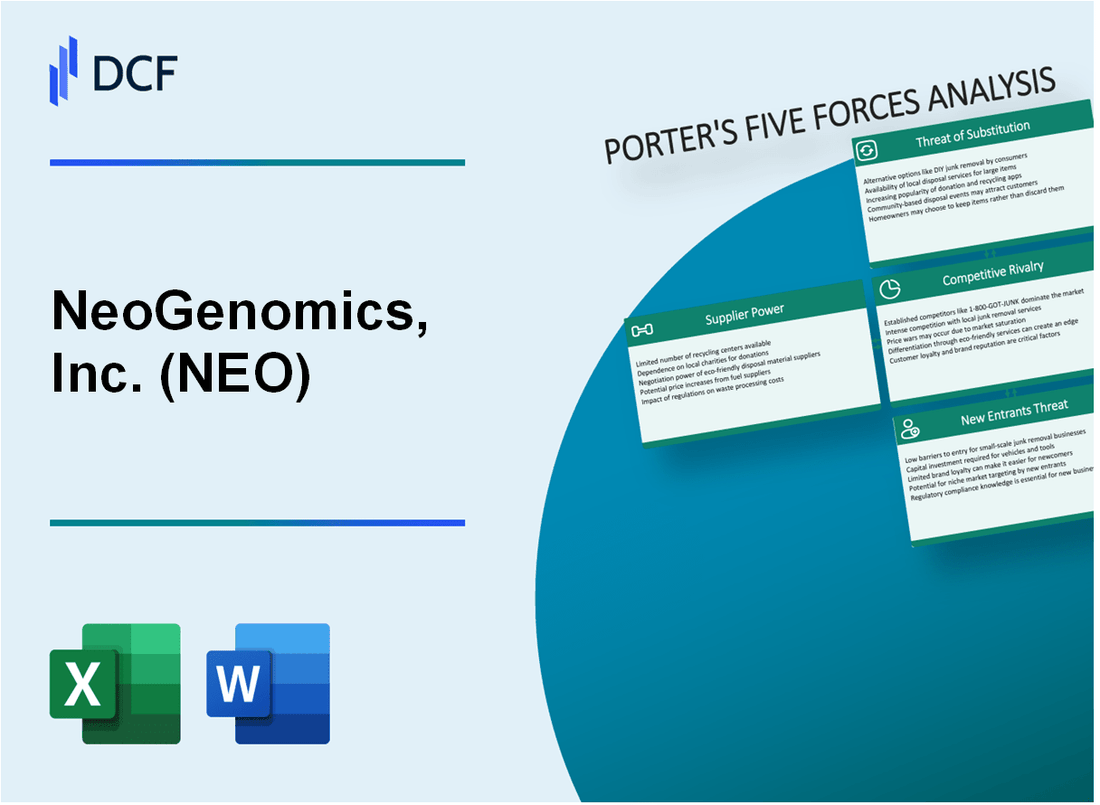
Neogenomics, Inc. (NEO): 5 forças Análise [Jan-2025 Atualizada] |
Totalmente Editável: Adapte-Se Às Suas Necessidades No Excel Ou Planilhas
Design Profissional: Modelos Confiáveis E Padrão Da Indústria
Pré-Construídos Para Uso Rápido E Eficiente
Compatível com MAC/PC, totalmente desbloqueado
Não É Necessária Experiência; Fácil De Seguir
NeoGenomics, Inc. (NEO) Bundle
Na paisagem em rápida evolução do diagnóstico molecular, a Neogenomics, Inc. (NEO) navega em um ecossistema complexo, onde forças competitivas moldam sua trajetória estratégica. À medida que a oncologia de precisão se torna cada vez mais crítica, essa análise revela a intrincada dinâmica do poder do fornecedor, influência do cliente, rivalidade de mercado, substituição tecnológica e novos participantes em potencial que determinam o posicionamento competitivo da empresa. Ao dissecar a estrutura das cinco forças de Michael Porter, exploraremos como a Neogenomics mantém sua vantagem em um mercado de testes genéticos desafiadores e transformadores.
Neogenomics, Inc. (NEO) - As cinco forças de Porter: poder de barganha dos fornecedores
Número limitado de equipamentos médicos especializados e fabricantes de reagentes
A partir de 2024, o mercado global de equipamentos de teste genético está concentrado com aproximadamente 5-7 grandes fabricantes dominando a indústria. Os principais fornecedores incluem:
| Fabricante | Quota de mercado | Equipamento especializado |
|---|---|---|
| Illumina, Inc. | 42.3% | Plataformas de sequenciamento de próxima geração |
| Thermo Fisher Scientific | 23.7% | Instrumentos de análise genética |
| Diagnóstico da Roche | 15.6% | PCR e sistemas de diagnóstico molecular |
Altos custos de comutação para tecnologias avançadas de testes genéticos
Os custos de troca de tecnologias de testes genéticos são estimados em:
- Substituição do equipamento: US $ 500.000 - US $ 2,5 milhões por instrumento
- Validação e recertificação: US $ 75.000 - US $ 250.000
- Reciclagem de funcionários: $ 50.000 - $ 150.000
Dependência de fornecedores específicos de instrumentos científicos
A Neogenômica depende de fornecedores específicos para instrumentos científicos críticos:
| Provedor | Valor anual do contrato de oferta | Tipo de equipamento |
|---|---|---|
| Ilumina | US $ 3,2 milhões | Plataformas de sequenciamento |
| Thermo Fisher | US $ 1,8 milhão | Sistemas de análise genética |
Mercado de fornecedores concentrados com poucas fontes alternativas
As métricas de concentração do mercado de equipamentos genéticos:
- Os 3 principais fabricantes controlam 81,6% do mercado
- Valor de mercado global estimado: US $ 12,4 bilhões em 2024
- Barreiras à entrada para novos fabricantes: extremamente alto
Neogenomics, Inc. (NEO) - As cinco forças de Porter: poder de barganha dos clientes
Grandes provedores de saúde e alavancagem de negociação dos centros de oncologia
A Neogenomics atendeu a 3.200 práticas de oncologia e prestadores de serviços de saúde em 2023. Os 10 principais clientes representaram 37,4% da receita total da empresa.
| Segmento de clientes | Contribuição da receita | Poder de negociação |
|---|---|---|
| Grandes centros de oncologia | 24.6% | Alto |
| Redes regionais de saúde | 12.8% | Médio |
| Hospitais comunitários | 8.5% | Baixo |
Sensibilidade ao preço no mercado de testes de diagnóstico médico
Elasticidade do preço de mercado de teste de diagnóstico: -0,65 em 2023. Faixa média de preço de teste: US $ 350 a US $ 1.500 por análise genômica.
- Taxas de reembolso do Medicare: diminuiu 3,2% em 2023
- Taxas negociadas de seguro privado: reduzido em 2,7%
- Custos do paciente diretamente: aumentou 5,1%
Crescente demanda por diagnóstico personalizado de câncer
Tamanho personalizado do mercado de testes de oncologia: US $ 12,4 bilhões em 2023, projetados 14,6% CAGR até 2027.
Complexidade da cobertura do seguro
Métricas de complexidade de reivindicações de seguros para neogenômica:
| Categoria de seguro | Taxa de aprovação de reclamação | Tempo médio de processamento |
|---|---|---|
| Medicare | 86.3% | 22 dias |
| Seguro privado | 79.5% | 18 dias |
| Auto-pagamento | 62.7% | 35 dias |
Neogenomics, Inc. (Neo) - As cinco forças de Porter: rivalidade competitiva
Cenário competitivo de mercado
A partir do quarto trimestre 2023, a neogenômica opera em um mercado de diagnóstico molecular altamente competitivo com a seguinte dinâmica competitiva:
| Concorrente | Capitalização de mercado | Receita anual |
|---|---|---|
| Ciências exatas | US $ 4,92 bilhões | US $ 2,1 bilhões |
| Saúde guardente | US $ 2,38 bilhões | US $ 517,3 milhões |
| Neogenômica | US $ 725,6 milhões | US $ 498,7 milhões |
Fatores de intensidade competitivos
Os principais indicadores de rivalidade competitiva para a neogenômica incluem:
- 8 concorrentes diretos em testes de diagnóstico molecular
- 3 grandes players com participação de mercado significativa
- Investimento médio de P&D de 12 a 15% da receita anual
Métricas de concentração de mercado
Indicadores de concentração de mercado:
- Herfindahl-Hirschman Index (HHI): 1.450 pontos
- As 3 principais empresas controlam 47% da participação de mercado
- Atividade anual de fusão e aquisição: 6-8 transações
Neogenomics, Inc. (Neo) - As cinco forças de Porter: ameaça de substitutos
Tecnologias emergentes de biópsia líquida
A Guardant Health reportou receita de US $ 518,3 milhões em 2022, com o mercado de biópsia líquida projetada para atingir US $ 7,5 bilhões até 2027.
| Tecnologia de biópsia líquida | Quota de mercado | Crescimento projetado |
|---|---|---|
| Teste de DNA de tumor circulante | 42.3% | 15,7% CAGR |
| Análise de células tumorais circulante | 28.6% | 12,4% CAGR |
Abordagens alternativas de triagem de câncer
A Fundação Medicine gerou US $ 388 milhões em 2022 receita de testes genômicos.
- Teste de detecção precoce da Galleri Multi-Cancer de Grail, ao preço de US $ 949
- Exato de Ciências Cologuard Teste reembolsado a US $ 512 por triagem
- O mercado de testes genômicos espera atingir US $ 92,8 bilhões até 2028
A IA avançada e as ferramentas de diagnóstico de aprendizado de máquina
A IBM Watson Health investiu US $ 4,2 bilhões em desenvolvimento de tecnologia de diagnóstico de IA.
| Tecnologia de diagnóstico de IA | Valor de mercado | Crescimento anual |
|---|---|---|
| Triagem de câncer movida a IA | US $ 2,1 bilhões | 45.2% |
| Diagnóstico de aprendizado de máquina | US $ 1,7 bilhão | 38.6% |
Alternativas de teste genéticas não invasivas
A 23andMe registrou receita de US $ 308 milhões em 2022 a partir de testes genéticos diretos ao consumidor.
- Kit de teste genético ancestry.com ao preço de US $ 99
- Mercado de testes pré-natais não invasivos no valor de US $ 6,2 bilhões
- O mercado de testes genéticos espera atingir US $ 31,8 bilhões até 2027
Neogenomics, Inc. (NEO) - As cinco forças de Porter: ameaça de novos participantes
Barreiras regulatórias à entrada
A neogenômica enfrenta obstáculos regulatórios substanciais em testes genéticos:
- Processo de aprovação da FDA que requer 510 (k) de folga: custo médio de US $ 1.267.048 por submissão
- Custo da certificação da CLIA: US $ 3.273 Taxa de inscrição inicial
- Taxa anual de credenciamento do CAP: US $ 4.950 para candidatos iniciantes
Requisitos de investimento de capital
| Componente de infraestrutura | Investimento estimado |
|---|---|
| Equipamento de sequenciamento de próxima geração | $500,000 - $1,000,000 |
| Software de análise genética | $250,000 - $500,000 |
| Sistema de gerenciamento de informações de laboratório | $150,000 - $300,000 |
Custos de pesquisa e desenvolvimento
Despesas de P&D da Neogenomics em 2022: US $ 46,4 milhões
- O investimento anual de P&D representa 11,7% da receita total
- Ciclo de desenvolvimento de testes genéticos: 3-5 anos
- Custo médio por novo desenvolvimento de teste de diagnóstico: US $ 5,2 milhões
Processos de validação clínica
| Estágio de validação | Duração média | Custo estimado |
|---|---|---|
| Teste pré -clínico | 12-18 meses | US $ 1,5 milhão |
| Fase de ensaios clínicos | 24-36 meses | US $ 3,8 milhões |
| Submissão regulatória | 6 a 12 meses | $750,000 |
Desafios de entrada no mercado
A posição de mercado da Neogenomics demonstra altas barreiras de entrada:
- Participação de mercado em testes genéticos de oncologia: 22,3%
- Portfólio de propriedade intelectual: 37 patentes ativas
- Parcerias clínicas estabelecidas: 68 redes de saúde
NeoGenomics, Inc. (NEO) - Porter's Five Forces: Competitive rivalry
You see the rivalry in the specialized oncology diagnostics space is just fierce. It's not a quiet corner of healthcare; it's a battleground for precision testing.
NeoGenomics, Inc. definitely competes head-to-head with the giants like Quest Diagnostics and Labcorp. Those national labs have deeper pockets, which translates to bigger war chests for capital expenditures and market penetration.
Still, the most direct, specialized heat comes from other focused players. Take Guardant Health, for instance. Their competition is intense, especially as they keep raising the bar on their top-line expectations. Guardant Health's initial 2025 revenue guidance was in the $880M-$890M range, but they subsequently lifted that guidance to a range of $965M to $970M for the full year 2025.
NeoGenomics, Inc. is recognized as a 'top-three player in the U.S.' in this arena, but that status means you're constantly fighting on two fronts: price erosion from established players and the need to out-innovate everyone else.
Here's a quick look at how the revenue scale stacks up between NeoGenomics, Inc. and a key specialized rival based on their latest reported figures for the third quarter of 2025 and full-year 2025 guidance:
| Metric | NeoGenomics (NEO) Q3 2025 | Guardant Health (GH) Q3 2025 |
| Total Revenue (Q3) | $188 million | $265.2 million |
| 2025 Revenue Guidance (FY) | $720 million to $726 million | $965M to $970M (Raised) |
| Key Segment Growth (YoY) | 24% (NGS Revenue) | 31% (Oncology Revenue) |
This competitive pressure means NeoGenomics, Inc. has to keep pouring resources into its high-growth areas. You see the results of that investment in the numbers; NGS revenue growth was a very strong 24% year-over-year for Q3 2025.
That growth is critical because NGS now makes up approximately one-third, or 33%, of the company's total clinical revenue.
The competitive dynamics force NeoGenomics, Inc. to focus on specific operational achievements to maintain its standing:
- Clinical revenue grew 18% year-over-year in Q3 2025.
- Average revenue per clinical test hit $476 in Q3 2025.
- Clinical test volumes increased by 15% year-over-year in Q3 2025.
- The company is actively pursuing the Minimal Residual Disease (MRD) market, which management estimates as part of a more than $40 billion addressable opportunity.
The constant need to innovate, especially in areas like NGS and MRD, is what keeps the competitive rivalry high and demands continuous capital allocation away from immediate profitability.
NeoGenomics, Inc. (NEO) - Porter's Five Forces: Threat of substitutes
You're analyzing NeoGenomics, Inc.'s competitive position, and the threat of substitutes is definitely a major factor, especially with how fast diagnostics are changing. Let's look strictly at the numbers shaping this force as of late 2025.
The core diagnostic information-the specific molecular profile needed to guide targeted therapy-still has a relatively low substitution threat because the clinical pathway is established. However, the method of obtaining that information faces intense pressure. NeoGenomics' own clinical revenue growth in Q3 2025 was 18% year-over-year, with NGS revenue up 24% year-over-year, showing the current strength of their established molecular testing base, which is largely tissue-derived or advanced sequencing. Still, the company is actively preparing to launch its own liquid biopsy test, PanTracer LBx, under an early access program, signaling management recognizes this shift.
The threat from substitute testing modalities, specifically liquid biopsy (LBx), displacing traditional tissue biopsy is high. The global liquid biopsy market is already substantial, estimated at USD 6.39 billion in 2025, with projections to hit USD 25.43 billion by 2035 at a compound annual growth rate (CAGR) of 14.8%. Blood samples are the dominant sample type, capturing an estimated 87.4% of total market revenue by 2025. This non-invasive approach directly challenges the need for repeat tissue sampling, which is invasive and often impossible.
Alternative diagnostic technologies like AI-driven imaging and radiology are advancing rapidly, though direct substitution for comprehensive genomic profiling is not yet complete. The broader Next-Generation Cancer Diagnostics market, which encompasses these advanced technologies, is expected to be worth USD 19.16 billion globally in 2025. This indicates significant capital and innovation flowing into non-traditional diagnostic pathways that could eventually reduce the reliance on primary molecular testing for initial staging or monitoring.
Hospitals developing in-house advanced molecular testing is a constant, though capital-intensive, substitute. This move captures testing volume that might otherwise go to a reference lab like NeoGenomics, Inc. While setting up an in-house NGS lab requires significant investment, the U.S. Next-generation Cancer Diagnostics market itself is calculated at USD 5.50 billion in 2025. As a proxy for in-house capability, hospitals and clinics command a significant end-use share in related molecular testing segments; for instance, they held 36.6% of the monkeypox testing market share in 2025.
Here's a quick look at the scale of the competitive landscape this threat operates within:
| Metric | Value (2025) | Source Context |
| Global Liquid Biopsy Market Size | USD 6.39 billion | Estimated market value |
| Global Liquid Biopsy Market CAGR (to 2035) | 14.8% | Projected growth rate |
| Blood Sample Share of Liquid Biopsy Revenue | 87.4% | Projected share by 2025 |
| Global Next-Generation Cancer Diagnostics Market Size | USD 19.16 billion | Expected market value |
| NeoGenomics Q3 2025 NGS Revenue Share (Clinical) | 33% | Percentage of clinical revenue |
The pressure points you need to watch closely include:
- Liquid biopsy market size growth rate of 14.8% CAGR.
- The 87.4% market share held by blood-based testing.
- NeoGenomics' own NGS revenue growth at 24% in Q3 2025.
- The USD 5.50 billion U.S. next-gen diagnostics market size.
- The planned launch of PanTracer LBx by NeoGenomics.
NeoGenomics, Inc. (NEO) - Porter's Five Forces: Threat of new entrants
You're looking at setting up a molecular diagnostics lab today to compete directly with NeoGenomics, Inc. Honestly, the threat of new entrants is low, and that's because the barriers to entry are extremely high. It isn't just about having the science; it's about the infrastructure, the paperwork, and the established connections.
Significant capital expenditure is required for advanced NGS equipment and lab infrastructure. A new player can't just buy a sequencer; they need a full suite of high-end machinery and the physical lab space to support it. For context, NeoGenomics, Inc. purchased approximately $10.8 million in capital equipment, software, and leasehold improvements just in the first six months of 2025. They spent about $4.5 million in the first quarter alone. That upfront cash burn is a serious hurdle.
Regulatory hurdles are complex, requiring CLIA/CAP accreditation and FDA approvals for new tests. Every commercial test needs to clear a mountain of compliance. NeoGenomics, Inc. already operates multiple CLIA-certified and CAP-accredited laboratories across the US, plus a CAP-accredited facility in the UK. Navigating the initial setup is a time sink; getting full CLIA approval can take about 57 days from the project start, not including the initial regulatory navigation. Plus, developing and validating your own tests-Laboratory Developed Tests (LDTs)-adds to the expense; validating just one LDT can cost between $10,000 and $60,000.
Securing favorable reimbursement from major payers requires extensive clinical utility evidence. You can have the best test, but if no one pays for it, you don't have a business. NeoGenomics, Inc. has already built out this critical network, holding contracts with over 300 national payors covering millions of patient lives. Remember, achieving CLIA certification is a prerequisite to even bill federal and state programs, let alone most private insurers.
Here's a quick look at some of the initial financial and time commitments to even begin competing on the regulatory and infrastructure front:
| Barrier Component | Estimated Cost/Time | Source of Data |
| Single LDT Validation Cost | $10,000 - $60,000 | |
| Time to Full CLIA Approval (Post-Start) | Approx. 57 days (excluding outliers) | |
| NeoGenomics CapEx (6M 2025) | $10.8 million | |
| Payor Coverage (NeoGenomics) | Over 300 national payors |
NeoGenomics, Inc. leverages its established digital integration as another barrier. Integration into the Electronic Health Record (EHR) systems used by major hospitals is key for workflow adoption. NeoGenomics, Inc. is actively engaging with Epic Aura clients, with certain profiles set to be available on the Aura network in December 2025. This level of deep integration, connecting directly into workflows where physicians order tests, is hard for a startup to replicate quickly. For reference, the broader Epic ecosystem, through its Care Everywhere network, handles over 20 million daily record exchanges. Having this established digital footprint makes it much easier for ordering physicians to stick with NeoGenomics, Inc. than to onboard a new vendor.
The combination of massive required capital, the multi-step regulatory gauntlet, the need for payer contracts, and deep EHR integration definitely keeps the door shut for most potential new entrants. It's a tough market to break into without deep pockets and years of regulatory groundwork done. Finance: draft 13-week cash view by Friday.
Disclaimer
All information, articles, and product details provided on this website are for general informational and educational purposes only. We do not claim any ownership over, nor do we intend to infringe upon, any trademarks, copyrights, logos, brand names, or other intellectual property mentioned or depicted on this site. Such intellectual property remains the property of its respective owners, and any references here are made solely for identification or informational purposes, without implying any affiliation, endorsement, or partnership.
We make no representations or warranties, express or implied, regarding the accuracy, completeness, or suitability of any content or products presented. Nothing on this website should be construed as legal, tax, investment, financial, medical, or other professional advice. In addition, no part of this site—including articles or product references—constitutes a solicitation, recommendation, endorsement, advertisement, or offer to buy or sell any securities, franchises, or other financial instruments, particularly in jurisdictions where such activity would be unlawful.
All content is of a general nature and may not address the specific circumstances of any individual or entity. It is not a substitute for professional advice or services. Any actions you take based on the information provided here are strictly at your own risk. You accept full responsibility for any decisions or outcomes arising from your use of this website and agree to release us from any liability in connection with your use of, or reliance upon, the content or products found herein.