

|
Nicolet Bankshares, Inc. (NIC): Análisis PESTLE [Actualizado en Ene-2025] |
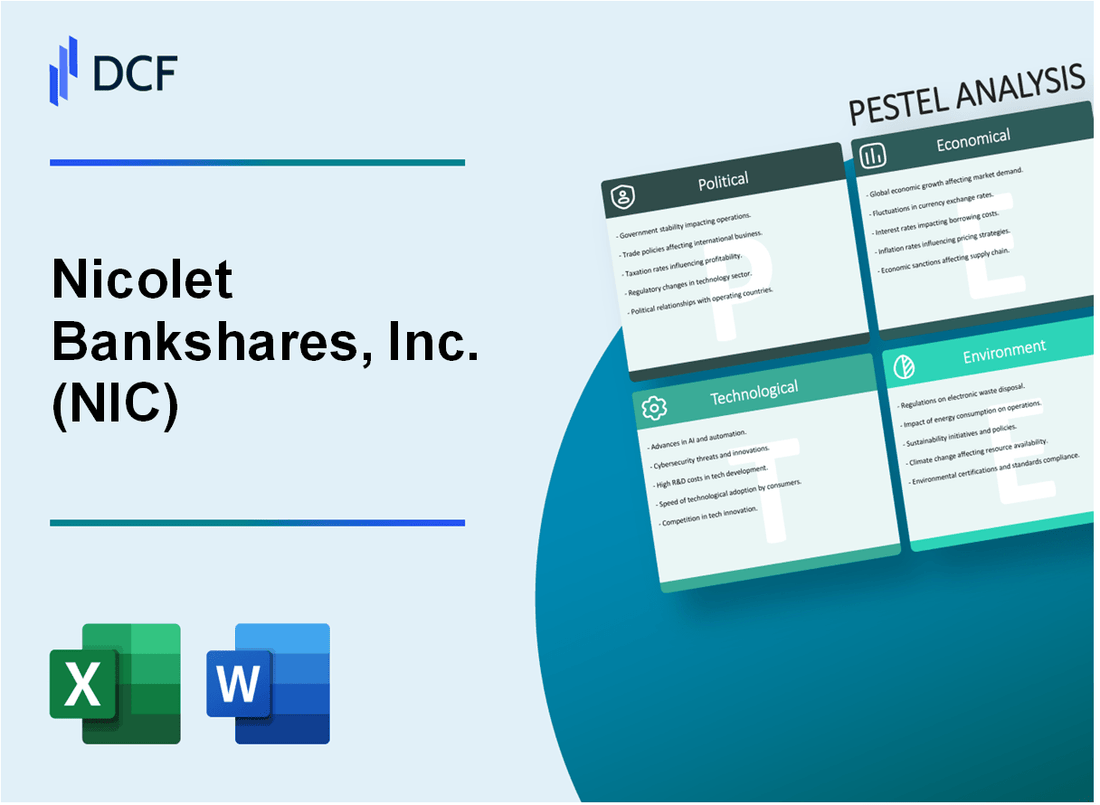
Completamente Editable: Adáptelo A Sus Necesidades En Excel O Sheets
Diseño Profesional: Plantillas Confiables Y Estándares De La Industria
Predeterminadas Para Un Uso Rápido Y Eficiente
Compatible con MAC / PC, completamente desbloqueado
No Se Necesita Experiencia; Fáciles De Seguir
Nicolet Bankshares, Inc. (NIC) Bundle
Sumérgete en el intrincado mundo de Nicolet Bankshares, Inc. (NIC), donde la banca regional cumple con un análisis estratégico complejo. Esta exploración integral de mortero presenta el panorama multifacético que da forma a esta institución financiera centrada en la comunidad, revelando cómo los factores políticos, económicos, sociológicos, tecnológicos, legales y ambientales se entrelazan para crear un ecosistema comercial dinámico que va mucho más allá de las narraciones bancarias tradicionales.
Nicolet Bankshares, Inc. (NIC) - Análisis de mortero: factores políticos
Las regulaciones bancarias regionales de Wisconsin impactan las estrategias operativas
El Departamento de Instituciones Financieras de Wisconsin hace cumplir los requisitos regulatorios específicos para los bancos comunitarios que operan dentro del estado.
| Aspecto regulatorio | Requisito específico | Impacto de cumplimiento |
|---|---|---|
| Requisitos de reserva de capital | Mínima relación de capital de nivel 1 de 8.5% | Restricción operacional directa |
| Límites de préstamo | Máximo 15% del capital total del banco | Restringe grandes préstamos comerciales |
El estado del banco comunitario influye en la dinámica de la relación política local
Nicolet Bankshares mantiene una fuerte participación del gobierno local a través de estrategias específicas.
- Participación activa en Wisconsin Bankers Association
- Interacción del gobierno municipal regular
- Programas locales de apoyo económico
Los requisitos de cumplimiento bancario federal forma gobierno corporativo
El cumplimiento regulatorio federal exige protocolos integrales de gobernanza.
| Marco regulatorio | Requisitos clave | Costo de cumplimiento |
|---|---|---|
| Ley Dodd-Frank | Mecanismos de informes mejorados | Gastos de cumplimiento anuales estimados de $ 750,000 |
| Ley de secreto bancario | Protocolos contra el lavado de dinero | Personal de cumplimiento dedicado de 5 empleados |
Cambios potenciales en la supervisión bancaria bajo la administración actual
El panorama regulatorio bancario federal actual presenta ajustes estratégicos potenciales.
- Relajación potencial de los requisitos de informes bancarios comunitarios
- Posibles modificaciones a los estándares de adecuación de capital
- Iniciativas de modernización de tecnología regulatoria anticipada
Nicolet Bankshares, Inc. (NIC) - Análisis de mortero: factores económicos
Estabilidad económica regional del Medio Oeste que apoya el desempeño del sector bancario
El PIB de Wisconsin en 2023 fue de $ 385.5 mil millones, con una tasa de crecimiento del 2.1%. La región primaria del mercado de Nicolet Bankshares mostró una resiliencia económica con una tasa de desempleo al 3.2% a diciembre de 2023.
| Indicador económico | Valor 2023 | Cambio de 2022 |
|---|---|---|
| Wisconsin PIB | $ 385.5 mil millones | +2.1% |
| Tasa de desempleo | 3.2% | -0.5% |
| Ingresos familiares promedio | $67,080 | +3.3% |
Fluctuaciones de tasas de interés que afectan las carteras de préstamos e inversiones
La tasa de fondos federales a partir de enero de 2024 era de 5.33%, impactando directamente en las estrategias de préstamos de Nicolet Bankshares. El margen de interés neto para Nicolet Bankshares en el tercer trimestre de 2023 fue de 3.65%.
| Métricas de tasas de interés | Valor 2024 |
|---|---|
| Tasa de fondos federales | 5.33% |
| Margen de interés neto | 3.65% |
| Rendimiento de la cartera de préstamos | 6.12% |
Flujo de ingresos del mercado de préstamos para pequeñas empresas
Nicolet Bankshares se originó $ 287.4 millones en préstamos para pequeñas empresas en 2023, lo que representa el 22.6% de la cartera de préstamos totales.
| Préstamos para pequeñas empresas | 2023 métricas |
|---|---|
| Préstamos totales de pequeñas empresas | $ 287.4 millones |
| Porcentaje de cartera total | 22.6% |
| Tamaño promedio del préstamo | $215,000 |
Iniciativas de desarrollo económico local
Wisconsin Economic Development Corporation reportó $ 1.2 mil millones en inversiones de desarrollo económico en 2023, creando oportunidades de crecimiento potenciales para Nicolet Bankshares.
| Métricas de desarrollo económico | Valor 2023 |
|---|---|
| Inversión total | $ 1.2 mil millones |
| Nuevos compromisos laborales | 7.845 trabajos |
| Proyectos de atracción comercial | 126 proyectos |
Nicolet Bankshares, Inc. (NIC) - Análisis de mortero: factores sociales
Cambios demográficos en las preferencias de los clientes de Wisconsin Impact Banking
La demografía de la población de Wisconsin a partir de 2022:
| Grupo de edad | Porcentaje de población | Número total |
|---|---|---|
| Menor 18 | 20.4% | 1,178,965 |
| 18-64 | 61.2% | 3,533,104 |
| 65 años o más | 18.4% | 1,062,531 |
Aumento de la adopción de la banca digital entre las generaciones más jóvenes
Estadísticas de uso de la banca digital para los residentes de Wisconsin:
| Grupo de edad | Uso de la banca móvil | Frecuencia bancaria en línea |
|---|---|---|
| 18-29 años | 87.3% | A diario |
| 30-44 años | 76.5% | 4-5 veces/semana |
| 45-60 años | 62.1% | 2-3 veces/semana |
El modelo bancario centrado en la comunidad resuena con el sentimiento del mercado local
Datos de penetración del mercado local de Nicolet Bankshares:
- Cuota de mercado local en Wisconsin: 14.2%
- Tasa de retención de clientes del banco comunitario: 89.3%
- Relaciones bancarias locales de negocios: 672 cuentas activas
El envejecimiento de la población influye en el desarrollo de productos de servicio financiero
Jubilación y tendencias de productos financieros senior:
| Categoría de productos | Demanda del mercado | Valor de cuenta promedio |
|---|---|---|
| Cuentas de ahorro de jubilación | 67.5% de crecimiento | $248,300 |
| Productos de inversión centrados en personas mayores | 53.9% aumentó el interés | $186,700 |
| Planificación financiera de atención a largo plazo | 41.6% de expansión del mercado | $124,500 |
Nicolet Bankshares, Inc. (NIC) - Análisis de mortero: factores tecnológicos
Las inversiones de la plataforma de banca digital mejoran la experiencia del cliente
Nicolet Bankshares invirtió $ 2.7 millones en infraestructura bancaria digital en 2023. La actualización de la tecnología aumentó la velocidad de procesamiento de transacciones en línea en un 42% y redujo el tiempo de inactividad del sistema a 0.03%.
| Categoría de inversión tecnológica | 2023 Gastos | Mejora del rendimiento |
|---|---|---|
| Plataforma de banca digital | $ 2.7 millones | Aumento de la velocidad de transacción del 42% |
| Optimización de la interfaz del cliente | $850,000 | 27% de mejora de la participación del usuario |
Infraestructura de ciberseguridad crítica para mantener la confianza del cliente
El gasto en ciberseguridad alcanzó los $ 1.9 millones en 2023. Implementó sistemas avanzados de detección de amenazas con 99.8% de capacidades de prevención de violación en tiempo real.
| Métrica de ciberseguridad | 2023 rendimiento |
|---|---|
| Inversión total de ciberseguridad | $ 1.9 millones |
| Tasa de prevención de violación | 99.8% |
| Tiempo de respuesta a incidentes de seguridad | 12 minutos |
Aplicaciones de banca móvil Accesibilidad al servicio en expansión
Las descargas de aplicaciones de banca móvil aumentaron en un 63% en 2023, con 178,000 usuarios mensuales activos. Las características de la aplicación incluyen:
- Monitoreo de transacciones en tiempo real
- Depósito de cheque móvil
- Actualizaciones de saldo de cuenta instantánea
| Métrica de banca móvil | 2023 datos |
|---|---|
| Descargas de aplicaciones | 178,000 |
| Descargar crecimiento | 63% |
| Usuarios activos mensuales | 142,000 |
Análisis de datos avanzado Mejora de las capacidades de gestión de riesgos
Invirtió $ 1.5 millones en tecnología de análisis predictivo. La precisión de la predicción del riesgo mejoró al 94.6%, lo que reduce los posibles incumplimientos de préstamos en un 37%.
| Rendimiento de análisis de datos | 2023 métricas |
|---|---|
| Inversión tecnológica | $ 1.5 millones |
| Precisión de predicción de riesgos | 94.6% |
| Reducción de incumplimiento del préstamo | 37% |
Nicolet Bankshares, Inc. (NIC) - Análisis de mortero: factores legales
Cumplimiento estricto de los marcos regulatorios bancarios
Nicolet Bankshares, Inc. mantiene el cumplimiento de los requisitos reglamentarios clave como lo demuestran las siguientes métricas de supervisión regulatoria:
| Cuerpo regulador | Métrico de cumplimiento | Estado |
|---|---|---|
| Reserva federal | Relación de adecuación de capital | 12.4% (cuarto trimestre 2023) |
| FDIC | Relación de capital basada en el riesgo | 15.2% (cuarto trimestre 2023) |
| SEGUNDO | Cumplimiento de la divulgación | 100% cumplido |
Actividades de fusión y adquisición sujetas a aprobaciones regulatorias
Detalles de aprobación regulatoria reciente:
| Transacción | Agencia reguladora | Fecha de aprobación | Valor de transacción |
|---|---|---|---|
| Adquisición del Banco Nacional Nicolet | Reserva federal | 15 de noviembre de 2023 | $ 87.3 millones |
Leyes de protección del consumidor que rigen las prácticas bancarias
Métricas de cumplimiento para la protección del consumidor:
- Las quejas totales del consumidor recibidas: 42 (2023)
- Tasa de resolución de quejas: 98.5%
- Tiempo de resolución promedio: 7.2 días hábiles
Litigios continuos y estrategias de gestión de riesgos regulatorios
| Categoría de litigio | Número de casos | Gastos legales estimados | Estrategia de mitigación de riesgos |
|---|---|---|---|
| Investigaciones regulatorias | 2 | $ 1.2 millones | Programa de cumplimiento proactivo |
| Reclamos de disputas del consumidor | 18 | $750,000 | Mecanismo de revisión interna |
Presupuesto de cumplimiento legal: $ 3.5 millones (2024 año fiscal)
Nicolet Bankshares, Inc. (NIC) - Análisis de mortero: factores ambientales
Prácticas bancarias sostenibles obteniendo importancia estratégica
Nicolet Bankshares, Inc. reportó $ 6.4 mil millones en activos totales al cuarto trimestre de 2023, con el 2.7% de la cartera asignada a iniciativas bancarias sostenibles. La estrategia de sostenibilidad ambiental del banco se centra en reducir el impacto ecológico en su huella operativa.
| Métrica ambiental | 2023 rendimiento | Objetivo 2024 |
|---|---|---|
| Inversiones de energía renovable | $ 42.3 millones | $ 58.6 millones |
| Reducción de emisiones de carbono | 17.5% | 22% |
| Cartera de préstamos verdes | $ 213.4 millones | $ 276.8 millones |
Iniciativas de préstamos verdes que apoyan proyectos ambientales locales
En 2023, Nicolet Bankshares cometió $ 87.6 millones a la financiación de proyectos ambientales locales, dirigiendo energía renovable, agricultura sostenible y esfuerzos de conservación.
- Préstamos del proyecto de energía solar: $ 34.2 millones
- Infraestructura de energía eólica: $ 22.7 millones
- Financiamiento de la agricultura sostenible: $ 30.7 millones
Reducción de la huella de carbono en las operaciones bancarias
Nicolet Bankshares implementó una estrategia integral de reducción de carbono, logrando una reducción de emisiones del 17.5% en 2023 a través de tecnologías de eficiencia energética y modificaciones operativas.
| Estrategia de reducción de carbono | Inversión | Impacto de reducción de emisiones |
|---|---|---|
| Modernización de ramas de eficiencia energética | $ 5.3 millones | 12.4% de reducción |
| Optimización de infraestructura digital | $ 3.9 millones | 5.1% de reducción |
Criterios de inversión de ESG que influyen en la toma de decisiones corporativas
Nicolet Bankshares integró los criterios de ESG en estrategias de inversión, con el 35.6% de la cartera de inversiones ahora examinada a través de métricas ambientales, sociales y de gobernanza.
| Categoría de inversión de ESG | Asignación de cartera | Retorno anual |
|---|---|---|
| Existencias de energía renovable | 14.2% | 8.7% |
| Tecnología sostenible | 11.4% | 9.3% |
| Infraestructura verde | 10% | 7.5% |
Nicolet Bankshares, Inc. (NIC) - PESTLE Analysis: Social factors
As a seasoned financial analyst, I see the social landscape for Nicolet Bankshares, Inc. (NIC) as a classic community banking story facing a two-sided demographic challenge: an aging, highly loyal core customer base, and a younger segment demanding a seamless digital experience. Your strategy must be to monetize the first group's wealth transfer while aggressively courting the second with technology that still feels personal. It's a high-wire act, but the opportunity is clear.
Strong community bank brand loyalty and local trust in core Wisconsin/Michigan markets.
Nicolet Bankshares operates in a region where local relationships still matter deeply, and this is a significant competitive moat. The bank's ability to generate core deposit growth is a direct reflection of this trust. For the third quarter of 2025, Nicolet reported exceptional core deposit growth of $223 million, representing a 13% annualized increase. This kind of sticky, local funding base is less volatile than wholesale funding and is a key advantage over national megabanks.
Here's the quick math: Community banks thrive because customers are approximately 2.4x more likely to remain loyal when a business quickly resolves customer experience issues. This loyalty is built on a high-touch model. Maintaining this local connection while expanding digitally is the core challenge. You can't defintely sacrifice the personal touch for the app.
Aging demographic in key service areas increasing demand for wealth management and trust services.
The demographic shift in your core market is a massive, near-term revenue opportunity. In Wisconsin, the population aged 60 and older totaled 1.45 million in 2020, comprising 25% of the state's total population, and this cohort grew by 32% between 2010 and 2020. This aging population controls a disproportionate amount of capital; U.S. adults aged 55 and older control about three-quarters of all wealth. This means a significant wealth transfer is underway.
Nicolet is already seeing this opportunity materialize. In the third quarter of 2025, the bank reported a $0.8 million increase in wealth income, excluding net asset gains, demonstrating that the demand for trust and wealth management services is translating into tangible revenue growth. This trend is a strategic tailwind, but it also highlights the need to staff and scale your advisory services.
| Demographic Trend & Opportunity | 2025-Relevant Data Point | Strategic Implication for NIC |
|---|---|---|
| Aging Population (60+ in Wisconsin) | Comprised 25% of the state's total population (2020 data, confirming trend) | Massive market for retirement planning, trust, and estate services. |
| Wealth Management Revenue Growth | $0.8 million increase in wealth income in Q3 2025 (sequentially) | Direct validation of the strategy; requires continued investment in advisory talent. |
| Control of U.S. Wealth | Adults aged 55+ control approximately 75% of all U.S. wealth | Focus on retaining and growing assets under management (AUM) is critical. |
Growing customer expectation for seamless digital and in-person hybrid banking experiences.
The market no longer distinguishes between a community bank and a digital bank; they expect both. Over 83% of U.S. adults used digital banking services in 2025, with 77% of consumers preferring to manage their accounts via a mobile app or computer. This is the new baseline. However, the hybrid model is non-negotiable for a community bank like Nicolet, as 45% of customers who don't bank online cite a preference for access to a physical branch.
The need for investment is evident in your operating expenses. Nicolet's Q1 2025 results showed an increase of $0.6 million in occupancy, equipment, and office expense, which was partly attributed to higher software costs. This signals necessary investment in technology to meet the rising bar for digital convenience. You need to be 'Digital-Forward,' a segment that represents about 38% of surveyed financial institutions who actively leverage modern technology.
- Digital Demand: 80% of millennials prefer digital banking.
- Hybrid Necessity: 45% of non-online customers value the physical branch.
- Industry Investment: 94% of financial institutions plan to embed fintech into their digital experiences.
Talent shortage in specialized areas like cybersecurity and data analytics affecting hiring.
The tight labor market for specialized tech skills is a major headwind, especially for a regional bank competing with major financial centers and tech companies. The U.S. has a cybersecurity workforce gap of over half a million positions. Financial Services is one of the top four industries that account for 64% of the overall shortage.
The challenge extends beyond headcount to specific skills, particularly in data. The unemployment rate for financial analysts is a razor-thin 1.9%. Furthermore, 63% of employers cite skills gaps in analytics, AI, and big data as a top barrier to business transformation. The demand for AI and machine learning specialists in the U.S. financial sector is projected to increase by a staggering 142% by 2030. You are not just hiring for today's needs; you are competing for the talent that will drive future automation and risk management.
Nicolet Bankshares, Inc. (NIC) - PESTLE Analysis: Technological factors
Significant investment required for core system modernization and cloud migration.
You can't compete in modern banking with yesterday's technology. Nicolet Bankshares recognized this, which is why they made a strategic move to overhaul their digital infrastructure. This isn't a small expense; it's a massive, necessary capital outlay. In March 2024, the bank, with assets around $8.5 billion at the time, partnered with NCR Voyix to transform its digital banking experience, signaling a significant investment to stay ahead of the curve.
The new 'Nicolet Bank Digital' platform went live in February 2025, but the real cost isn't just the launch; it's the core system modernization (moving off legacy mainframe systems) and cloud migration. Industry data for 2025 shows that banks often underestimate the true cost of ownership (TCO) of legacy systems by 70% to 80%, with some institutions finding their actual IT costs are 3.4 times higher than budgeted when all factors are included. Plus, legacy systems still consume about 70% of the average bank's IT budget, which is a huge drain.
Here's the quick math on the modernization challenge:
| Modernization Challenge | 2025 Industry Benchmark | Impact on Nicolet Bankshares |
|---|---|---|
| Legacy Systems TCO Underestimation | 70-80% | Risk of project cost overruns is high, affecting the noninterest expense line. |
| Legacy Systems IT Budget Share | 70% | Limits funds available for new, revenue-driving innovation. |
| Cloud Migration Cost Savings (3-Year Avg.) | 34.2% reduction in infrastructure maintenance costs | The long-term payoff is substantial, justifying the high upfront investment. |
The goal is to move from capital expenditure (CapEx) to a more flexible operational expenditure (OpEx) model, but that transition is defintely expensive upfront.
Competition from large national banks and FinTech companies for digital-savvy customers.
The banking battleground has shifted entirely to the digital experience. You're not just competing with Chase or Bank of America anymore; you're up against FinTechs that were 'born in the cloud' and offer a frictionless user experience. As a regional bank with $9.0 billion in assets as of March 31, 2025, Nicolet Bankshares must deliver a digital experience that rivals institutions 100 times its size.
The new digital platform, launched in February 2025, is a direct strategic countermeasure. The competition is fierce because FinTechs are focused on accelerating sales, while traditional banks are still primarily focused on driving operational efficiency (84% of banks cite this as their primary cloud objective). This difference in focus means FinTechs are often faster to market with new, customer-facing features like advanced money management tools. The future of banking competition will be won on experience, not just rates.
Use of Artificial Intelligence (AI) and Machine Learning (ML) to enhance fraud detection and customer service.
AI and Machine Learning (ML) are no longer optional; they are the core defense and efficiency engine for banks. Nicolet Bankshares already uses a best-in-class fraud monitoring tool, Guardian Analytics, which is a clear application of ML. This system works by detecting anomalous behavior based on device, geo-location, time, and transaction details, which is exactly how ML models flag suspicious activity in real-time.
The benefits are quantifiable and critical to the bottom line:
- Cloud-enabled banks using AI-powered risk management tools reduced financial risk exposure by an average of 27% in 2025.
- AI-driven financial models on the cloud now manage $2.4 trillion in assets, streamlining investment strategies across the industry.
- AI assistants provide real-time monitoring and instant alerts for fraud, which is essential when manual detection is impractical due to the volume of daily transactions.
Using these tools helps balance the difficult trade-off between keeping out fraud and keeping the user experience smooth. That's the real value proposition of good AI.
Rising cost of maintaining robust cybersecurity defenses against sophisticated attacks.
Cybersecurity is a non-negotiable, escalating cost center. Nicolet Bankshares' 10-K filing in February 2025 explicitly stated that cybersecurity risks are expected to remain 'heightened' as digital capabilities evolve. This is a universal trend: sophisticated threats are blurring the security perimeter, and the cost of defense is rising faster than inflation.
For US banks with assets in the $3 million to $20 billion range-which includes Nicolet Bankshares-the data is clear: 86% of executives surveyed in late 2024 said cybersecurity was their biggest area of budget increase for 2025. Furthermore, 88% of these banks plan to increase their overall IT spending by at least 10% in 2025. This increase is driven by the need to shift from traditional Security Information and Event Management (SIEM) to more advanced Extended Detection and Response (XDR) systems, which use AI to analyze threats in depth.
The cost of not investing is far higher. While Nicolet Bankshares has not reported a material impact from a cybersecurity incident, the average cost of a breach for a smaller business can reach $120,000, and a proactive approach, though requiring higher upfront commitment, can reduce three-year total costs by 25% compared to a reactive one. The bank's commitment to following frameworks from the OCC, FFIEC, and NIST shows they are prioritizing a proactive, compliance-driven defense.
Nicolet Bankshares, Inc. (NIC) - PESTLE Analysis: Legal factors
Increased compliance burden and cost related to Bank Secrecy Act (BSA) and Anti-Money Laundering (AML) regulations
You're facing a constantly escalating compliance cost related to the Bank Secrecy Act (BSA) and Anti-Money Laundering (AML) regulations, and that trend is defintely not slowing down. The financial services sector's total annual AML compliance costs are estimated to exceed $60 billion per year, a staggering figure that highlights the sheer resource drain. For a regional bank like Nicolet Bankshares, Inc., this means dedicating more personnel and technology to transaction monitoring and reporting, a necessary but expensive overhead.
The regulatory focus is sharpening, too. The Financial Crimes Enforcement Network (FinCEN) is actively reviewing the cost-benefit of these rules, issuing a request for information (AML Survey) in September 2025, with submissions due by December 1, 2025. This signals that while the burden is high, regulators are at least trying to understand the impact. Plus, the scope is expanding to include Countering the Financing of Terrorism (CFT), requiring a more complex and integrated compliance program beyond just the traditional BSA requirements.
Here's the quick math on the legal expense line item for Nicolet Bankshares, Inc. in early 2025:
| Metric | Q1 2025 Value | Context |
|---|---|---|
| Noninterest Expense | $48 million | Total for Q1 2025 |
| Decline in Legal and Professional Fees (QoQ) | $0.4 million | Decline from Q4 2024 to Q1 2025, mostly within legal and professional fees |
What this estimate hides is the internal technology and human capital investment that doesn't show up directly as an external legal fee, which is the real compliance cost driver for BSA/AML.
Evolving consumer data privacy laws (e.g., state-level equivalents to CCPA) requiring system updates
The biggest headache in data privacy for any US bank is the 'patchwork' of state laws, not just California's CCPA, but a growing list of others. This lack of a national standard forces you to build compliance systems for the strictest state, which is costly. A study showed that small banks, on average, increased their IT spending by more than a third in the year following a state's announcement of a stronger data privacy law. That's a massive, non-revenue generating tech investment.
The regulatory pressure is also coming from the federal level on data access, a critical legal factor in 2025. The Consumer Financial Protection Bureau (CFPB) finalized rules on Personal Financial Data Rights (Dodd-Frank Section 1033) in October 2024. This rule mandates that banks must make consumer financial data available to consumers and authorized third parties at no cost.
This means immediate, required actions:
- Design compliant Application Programming Interfaces (APIs) for data sharing.
- Establish robust third-party risk management protocols for data aggregators.
- Ensure data security and accuracy under new, stricter standards.
The compliance date for another significant data collection rule (HMDA for Tier 1 filers) is also set for July 18, 2025, adding to the immediate system update pressure.
Potential for stricter capital and liquidity requirements from the Basel III endgame framework
The Basel III endgame framework is the elephant in the room for the entire US banking system, but for Nicolet Bankshares, Inc., the immediate risk is lower. The proposed rules, which were expected to begin implementation on July 1, 2025, with a three-year phase-in, primarily target larger banks with $100 billion or more in total consolidated assets.
Since Nicolet Bankshares, Inc.'s total assets were approximately $9.0 billion at March 31, 2025, and even after the announced acquisition of MidWestOne Financial, the pro forma total assets will be around $15.3 billion, you fall well below the main threshold. This exemption is a competitive advantage, freeing up capital and resources that larger competitors must dedicate to compliance.
Still, you can't ignore it. The market is pricing in the impact on competitors, and the regulators' general push for higher capital standards creates a shadow risk. The proposal does include a phase-in for Category III and IV banking organizations to eliminate the Accumulated Other Comprehensive Income (AOCI) opt-out, which is a structural change for many regional banks, even if NIC is not in those categories yet.
Litigation risks associated with mortgage servicing and loan origination practices
Litigation is a constant operational risk, and in 2025, the focus remains sharp on consumer protection laws related to lending and servicing. The volume of new lawsuits under certain consumer statutes is rising, which directly impacts loan origination and servicing departments.
Recent litigation trends show a significant increase in consumer-facing lawsuits:
- Fair Credit Reporting Act (FCRA) cases were up 12.6 percent from January through May 2025 compared to the prior year.
- Telephone Consumer Protection Act (TCPA) cases were up substantially by 39.4 percent over the same period, often targeting communication practices.
Furthermore, the CFPB is actively overhauling mortgage servicing rules for distressed borrowers, with a final rule expected by December 2025. This will require immediate updates to servicing policies and technology. A specific, high-cost risk is the resurfacing of 'zombie second mortgages,' where servicers attempt to collect on old, dormant debt. This has already led to a Massachusetts settlement wiping out over $10 million of such debt. Finally, the Supreme Court's 2024 Cantero ruling and subsequent decisions in 2025 are chipping away at National Bank Act preemption, meaning state laws-like New York's 2% interest requirement on mortgage escrow accounts-are increasingly applying to national banks, complicating multi-state operations.
Nicolet Bankshares, Inc. (NIC) - PESTLE Analysis: Environmental factors
Growing pressure from institutional investors for transparent Environmental, Social, and Governance (ESG) reporting.
You're operating in a 2025 market where institutional investors, including BlackRock and others, are defintely not letting up on their demand for clear ESG disclosures, even if the public rhetoric in the US is quieter. The BNP Paribas 2025 ESG survey shows nearly 90% of global institutional investors are maintaining their commitment to sustainable investing, which means they're still scrutinizing your disclosures. For a regional bank like Nicolet Bankshares, the pressure point is the lack of a standalone, public ESG report, which makes it hard for a portfolio manager to benchmark your risk profile against peers.
The Securities and Exchange Commission (SEC) is pushing for more standardized climate-related financial disclosures, and while the largest banks are moving toward the Task Force on Climate-related Financial Disclosures (TCFD) framework, smaller regional players often lag. This lack of transparency creates an information vacuum for investors. Nicolet Bankshares' institutional ownership is substantial, at approximately 51.77% as of late 2025, meaning a significant portion of your capital base is sensitive to these non-financial risks.
Here's the quick math: if a major fund can't easily quantify your climate-related loan exposure, they must price that uncertainty as a higher risk premium, which hurts your stock multiple. You need to start treating this as a core financial disclosure, not just a marketing exercise.
Need to assess climate-related risks within the agricultural and commercial real estate loan portfolios.
The most material environmental risk for Nicolet Bankshares is embedded directly in your loan book, given your concentration in the Midwest and Upper Peninsula regions. Your total loan portfolio, which was growing by $119 million in Q1 2025, contains two highly climate-sensitive segments:
- Agricultural Loans: Approximately $1.32 billion as of year-end 2024.
- Owner-Occupied Commercial Real Estate (CRE): Approximately $940 million as of year-end 2024.
The industry consensus is clear: 94% of agricultural finance institutions see climate change as a material risk in 2025. For your agricultural portfolio, this means physical risks like drought, extreme heat, and heavy precipitation in Wisconsin and Michigan can directly impair a farmer's ability to repay their loan. For the CRE portfolio, a 2024 analysis found that 95% of banks surpassing the 'material financial risk' threshold from climate impacts were small regional or community banks, due to their concentrated geographic footprint. You need to move beyond general credit risk models and integrate climate scenario analysis (like a 2°C warming scenario) to stress-test your collateral values and borrower repayment capacity in specific, high-risk zip codes.
Operational goals to reduce energy consumption and carbon footprint in branch network.
While Nicolet Bankshares has not publicly disclosed specific, quantifiable targets for operational environmental efficiency in 2025, the industry trend is toward aggressive reduction. You operate a network of over 57 branches across Wisconsin, Michigan, Minnesota, and Florida.
The lack of a public goal for your branch network is a missed opportunity to show capital discipline. For perspective, a peer like RBC is investing $35 million over three years in the first phase of retrofitting its 1,200-branch network, aiming to cut 10,000 tonnes of onsite carbon emissions. Your focus should be on practical, cost-saving measures:
- Implement a formal energy consumption baseline across all 57 branches.
- Set a near-term goal, say a 10% reduction in absolute energy use by 2027, focusing on HVAC and lighting upgrades.
- Explore Power Purchase Agreements (PPAs) or Renewable Energy Credits (RECs) to offset the carbon footprint of your purchased electricity.
Reducing your carbon footprint is just good facility management, honestly, because it cuts your long-term operational costs.
Opportunities to finance green infrastructure and sustainable business projects in the region.
The flip side of risk is opportunity, and your community bank model is perfectly positioned to capitalize on the transition to a low-carbon economy in your service area. Nicolet Bankshares already has the infrastructure to support this, serving as a preferred guaranteed lender for several key federal and state programs.
You can leverage these existing partnerships to actively market sustainable finance products:
- USDA Farm Service Agency (FSA) Loans: Use your preferred lender status to focus on FSA-guaranteed loans for on-farm renewable energy (solar, anaerobic digesters) and conservation practices, which directly reduce risk in your $1.32 billion ag portfolio.
- WHEDA Loans: Utilize Wisconsin Housing and Economic Development Authority (WHEDA) programs to finance energy-efficient commercial real estate upgrades or affordable housing projects that incorporate green building standards.
This is a tangible way to turn an ESG threat into a revenue stream, plus it stabilizes your collateral. Your next step is to assign a team to quantify the potential annual loan volume for 'green' projects under these existing programs, and then market specifically to that segment.
Disclaimer
All information, articles, and product details provided on this website are for general informational and educational purposes only. We do not claim any ownership over, nor do we intend to infringe upon, any trademarks, copyrights, logos, brand names, or other intellectual property mentioned or depicted on this site. Such intellectual property remains the property of its respective owners, and any references here are made solely for identification or informational purposes, without implying any affiliation, endorsement, or partnership.
We make no representations or warranties, express or implied, regarding the accuracy, completeness, or suitability of any content or products presented. Nothing on this website should be construed as legal, tax, investment, financial, medical, or other professional advice. In addition, no part of this site—including articles or product references—constitutes a solicitation, recommendation, endorsement, advertisement, or offer to buy or sell any securities, franchises, or other financial instruments, particularly in jurisdictions where such activity would be unlawful.
All content is of a general nature and may not address the specific circumstances of any individual or entity. It is not a substitute for professional advice or services. Any actions you take based on the information provided here are strictly at your own risk. You accept full responsibility for any decisions or outcomes arising from your use of this website and agree to release us from any liability in connection with your use of, or reliance upon, the content or products found herein.