

|
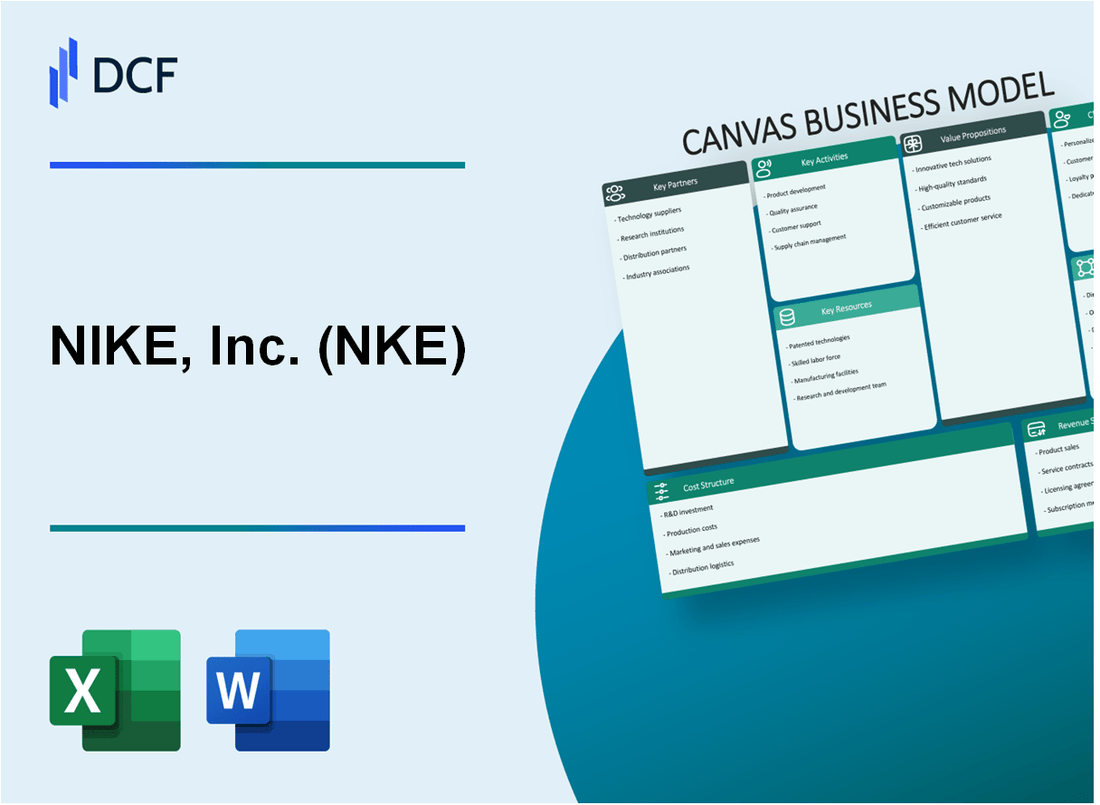
NIKE, Inc. (NKE): Lienzo del Modelo de Negocio [Actualizado en Ene-2025] |
Completamente Editable: Adáptelo A Sus Necesidades En Excel O Sheets
Diseño Profesional: Plantillas Confiables Y Estándares De La Industria
Predeterminadas Para Un Uso Rápido Y Eficiente
Compatible con MAC / PC, completamente desbloqueado
No Se Necesita Experiencia; Fáciles De Seguir
NIKE, Inc. (NKE) Bundle
El modelo de negocio de Nike es una obra maestra de innovación estratégica, que se transforma de una empresa de zapatos simple a una potencia de estilo de vida deportivo global que trasciende las fronteras tradicionales. Al integrar a la perfección la tecnología de vanguardia, las poderosas asociaciones de atletas y un enfoque digital primero, Nike ha revolucionado cómo los consumidores experimentan prendas deportivas y de rendimiento. Su lienzo de modelo de negocio revela un complejo ecosistema de asociaciones, plataformas digitales y estrategias centradas en el cliente que han impulsado a la marca a convertirse en un $ 51 mil millones Imperio atlético global, reinventando constantemente la intersección del deporte, la tecnología y la inspiración personal.
Nike, Inc. (NKE) - Modelo de negocios: asociaciones clave
Atletas profesionales y endosos de equipos deportivos
La cartera de respaldo de Nike incluye:
| Atleta/equipo | Valor de contrato | Duración |
|---|---|---|
| LeBron James | $ 1 mil millones | Vida |
| Cristiano Ronaldo | $ 160 millones | 5 años |
| Marca Michael Jordan | $ 4.7 mil millones de ingresos anuales | En curso |
Socios de fabricación en Asia
Distribución de fabricación de Nike en 2023:
| País | Fábricas de fabricación | Porcentaje de producción |
|---|---|---|
| Vietnam | 71 | 51% |
| Porcelana | 45 | 21% |
| Indonesia | 38 | 19% |
Socios minoristas
- Locker de pies: 1.100 tiendas que transportan productos Nike
- Dick's Sporting Goods: Ventas de productos Nike de $ 2.1 mil millones en 2023
- Amazon: canal exclusivo de ventas directas de Nike desde 2017
Asociaciones tecnológicas
| Socio tecnológico | Enfoque de colaboración | Inversión |
|---|---|---|
| Manzana | Nike+ Ejecutar la aplicación | $ 220 millones |
| Doblar | Innovación de fabricación digital | $ 150 millones |
Colaboradores de sostenibilidad
- Bluesign Technologies: producción textil sostenible
- Iniciativa mejor algodón: abastecimiento de algodón responsable
- Coalición de ropa sostenible: estándares ambientales
Nike, Inc. (NKE) - Modelo de negocio: actividades clave
Diseño e innovación de productos en calzado y ropa deportiva
Nike invirtió $ 2.7 mil millones en investigación y desarrollo en el año fiscal 2023. Las actividades de diseño e innovación abarcan múltiples categorías de productos:
| Categoría de productos | Inversión de innovación anual | Equipos de diseño |
|---|---|---|
| Calzado de rendimiento | $ 892 millones | 387 diseñadores |
| Ropa de rendimiento | $ 624 millones | 276 diseñadores |
| Accesorios de rendimiento | $ 413 millones | 189 diseñadores |
Marketing global y promoción de la marca
El gasto de marketing global de Nike alcanzó los $ 3.9 mil millones en el año fiscal 2023.
- Presupuesto de marketing digital: $ 1.6 mil millones
- Publicidad de medios tradicional: $ 1.2 mil millones
- Patrocinio de atletas y endosos: $ 1.1 mil millones
Desarrollo de plataforma digital
| Plataforma digital | Usuarios activos mensuales | Inversión de desarrollo anual |
|---|---|---|
| Aplicación Nike | 48.2 millones | $ 412 millones |
| Nike snkrs | 29.7 millones | $ 276 millones |
Gestión de la cadena de suministro y logística
La gestión de la cadena de suministro de Nike implica:
- 184 instalaciones de fabricación contratadas
- 42 países con presencia manufacturera
- Inversión de logística y distribución: $ 1.3 mil millones anualmente
Investigación y desarrollo de tecnologías de desempeño
| Área tecnológica | Inversión de I + D | Solicitudes de patentes |
|---|---|---|
| Innovación material | $ 624 millones | 87 patentes |
| Seguimiento de rendimiento | $ 413 millones | 52 patentes |
| Tecnologías sostenibles | $ 512 millones | 63 patentes |
Nike, Inc. (NKE) - Modelo de negocio: recursos clave
Fuerte reputación y reconocimiento de la marca global
Valor de la marca a partir de 2023: $ 47.4 mil millones, clasificando la 16ª marca global más valiosa según Interbrand. Capitalización de mercado de $ 165.99 mil millones a partir de enero de 2024. Reconocimiento de marca global en 190 países.
| Métrico de marca | Valor |
|---|---|
| Valor de marca global | $ 47.4 mil millones |
| Capitalización de mercado | $ 165.99 mil millones |
| Países de operación | 190 |
Extensas propiedad intelectual y patentes de diseño
Total de patentes registradas: 8,250 a partir de 2023. Inversión anual de I + D de $ 2.7 mil millones.
- Patentes de tecnología de Nike Air Technology
- Tecnología de fabricación de FlyKnit
- Innovaciones de tela DRI-FIT
Centros de investigación e innovación avanzados
Nike opera 3 centros principales de innovación global:
| Ubicación | Área de enfoque |
|---|---|
| Beaverton, Oregon (sede) | Innovación de calzado deportivo |
| Manchester, Reino Unido | Tecnología de fútbol/fútbol |
| Shanghai, China | Investigación de ropa de rendimiento |
Infraestructura digital robusta y plataformas de comercio electrónico
Ingresos digitales: $ 8.9 mil millones en el año fiscal 2023. Plataforma de comercio electrónico que atiende a 29.4 millones de usuarios activos de la aplicación Nike a nivel mundial.
Equipos de diseño y marketing talentosos
Total de empleados: 79,100 a mayo de 2023. Composición del equipo de diseño: 1.200 diseñadores profesionales en ubicaciones globales.
| Métrico de empleado | Valor |
|---|---|
| Total de empleados | 79,100 |
| Diseñadores profesionales | 1,200 |
| Centros de diseño globales | 6 |
Nike, Inc. (NKE) - Modelo de negocio: propuestas de valor
Productos deportivos y de estilo de vida de alto rendimiento
Nike genera $ 51.2 mil millones en ingresos anuales (año fiscal 2023). Desglose de categorías de productos:
| Categoría de productos | Ingresos ($ B) | Cuota de mercado |
|---|---|---|
| Calzado atlético | 22.7 | 27.4% |
| Ropa atlética | 16.5 | 23.8% |
| Equipo atlético | 12.0 | 15.6% |
Innovaciones tecnológicas de vanguardia en ropa deportiva
Nike invierte $ 3.2 mil millones anuales en I + D, con innovaciones tecnológicas clave:
- Tecnología Nike Flyknit
- Tecnología Nike Air Zoom
- Nike Dri-Fit Management Management
Experiencias personalizadas de los clientes a través de plataformas digitales
Métricas del ecosistema digital Nike:
| Plataforma digital | Usuarios activos | Crecimiento anual |
|---|---|---|
| Aplicación Nike | 28.5 millones | 18.3% |
| Aplicación SNKRS | 12.7 millones | 22.6% |
Mensajería de marca inspiradora y narración de historias de atletas
Nike Endorsement Portfolio:
- 300+ patrocinios de atletas profesionales
- Gasto total de respaldo de atletas: $ 1.8 mil millones anuales
- Los mejores atletas: LeBron James, Cristiano Ronaldo, Serena Williams
Compromisos de sostenibilidad y responsabilidad social
Inversiones de sostenibilidad de Nike:
| Iniciativa de sostenibilidad | Inversión ($ m) | Año objetivo |
|---|---|---|
| Uso de materiales reciclados | 475 | 2025 |
| Programa de reducción de carbono | 290 | 2030 |
Nike, Inc. (NKE) - Modelo de negocios: relaciones con los clientes
Compromiso digital personalizado a través de la aplicación Nike
Descargas de la aplicación Nike: 421 millones de usuarios activos a partir del cuarto trimestre 2023. Ingresos de comercio digital: $ 8.2 mil millones en el año fiscal 2023. Las características de la aplicación incluyen recomendaciones de productos personalizadas, acceso exclusivo a productos de edición limitada y seguimiento en tiempo real de actividades de acondicionamiento físico.
| Módulo de la aplicación Nike | Valor |
|---|---|
| Usuarios activos totales | 421 millones |
| Ingresos de comercio digital | $ 8.2 mil millones |
Edificio comunitario a través de Nike Training Club y Nike Run Club
Aplicación Nike Training Club: más de 26 millones de usuarios activos. Aplicación Nike Run Club: 50 millones de corredores registrados a nivel mundial. Las plataformas totales de participación comunitaria alcanzan 76 millones de usuarios a partir de 2023.
- Nike Training Club: contenido de entrenamiento gratuito
- Nike Run Club: seguimiento del GPS y monitoreo de rendimiento
- Desafíos de la comunidad y competiciones virtuales
Programas de fidelización y beneficios de membresía
Programa de membresía de Nike: 182 millones de miembros en todo el mundo. Gasto promedio de miembros: 3.4x más alto que los no miembros. Los beneficios de la membresía incluyen:
| Beneficio de membresía | Detalles |
|---|---|
| Envío gratis | Ilimitado para miembros |
| Acceso temprano al producto | Lanzamientos exclusivos |
| Recomendaciones personalizadas | Sugerencias impulsadas por IA |
Interacciones directas del consumidor a través de las redes sociales
A continuación de Nike Social Media: Instagram 157 millones, Twitter 8.2 millones, Facebook 36.4 millones. Tasa de participación: 4.2% en todas las plataformas. Gasto de marketing en redes sociales: $ 3.6 mil millones en 2023.
Opciones de personalización para productos
Nike by You (anteriormente Nikeid) Plataforma: genera el 15% de los ingresos digitales totales. Opciones de personalización disponibles para el 60% del catálogo de productos. Precio promedio de calzado personalizado: $ 180.
| Métrica de personalización | Valor |
|---|---|
| Ingresos digitales de la personalización | 15% |
| Catálogo de productos con personalización | 60% |
| Precio promedio de calzado personalizado | $180 |
Nike, Inc. (NKE) - Modelo de negocio: canales
Plataforma de comercio electrónico de Nike.com
Nike.com generó $ 9.7 mil millones en ingresos digitales en el año fiscal 2023, lo que representa el 26% de los ingresos totales de la marca Nike. La plataforma de comercio electrónico ofrece ventas directas a consumidores en 51 países.
| Métrico de canal digital | Valor |
|---|---|
| Ingresos digitales anuales | $ 9.7 mil millones |
| Porcentaje de ingresos digitales | 26% |
| Países atendidos | 51 |
Tiendas minoristas de Nike en todo el mundo
Nike opera 1,032 tiendas minoristas propiedad a nivel mundial a partir de junio de 2023.
- 565 tiendas propiedad de Nike en América del Norte
- 287 tiendas propiedad de Nike en la región de EMEA
- 180 tiendas propiedad de Nike en las regiones del Gran China y Asia Pacífico
Atléticos y grandes almacenes de terceros
Nike distribuye productos a través de aproximadamente 20,000 socios minoristas en todo el mundo, incluidos los principales minoristas como Foot Locker, Dick's Sporting Goods y Department Store.
| Categoría de socios minoristas | Número de minoristas |
|---|---|
| Minoristas totales de terceros | 20,000+ |
| Minoristas de artículos deportivos | 5,500 |
| Grandes almacenes | 3,200 |
Aplicaciones móviles de Nike
Nike tiene 4 aplicaciones móviles principales con más de 100 millones de usuarios activos en todo el mundo:
- Aplicación Nike: 52 millones de usuarios activos
- Nike Training Club: 27 millones de usuarios activos
- Nike SNKRS: 21 millones de usuarios activos
- Nike Run Club: 14 millones de usuarios activos
Canales de comercialización de redes sociales
El alcance de las redes sociales de Nike a partir de enero de 2024:
| Plataforma | Seguidores/suscriptores |
|---|---|
| 157 millones de seguidores | |
| 35 millones de seguidores | |
| Gorjeo | 8.4 millones de seguidores |
| YouTube | 2.3 millones de suscriptores |
Nike, Inc. (NKE) - Modelo de negocio: segmentos de clientes
Atletas profesionales
Nike sirve a 422 atletas profesionales bajo contratos de aprobación a partir de 2023. Ingresos generados por segmentos de atletas profesionales estimados en $ 3.2 mil millones anuales.
| Categoría deportiva | Número de atletas patrocinados | Valor de aprobación estimado |
|---|---|---|
| Baloncesto | 87 | $ 1.1 mil millones |
| Fútbol americano | 129 | $ 850 millones |
| Fútbol | 156 | $ 750 millones |
Entusiastas del fitness
Nike apunta a 78.5 millones de consumidores activos de fitness a nivel mundial. El segmento de fitness genera aproximadamente $ 4.7 mil millones en ingresos anuales.
- Aplicación Nike Training Club: 39.2 millones de usuarios activos
- Cuota de mercado de engranajes de rendimiento: 42.3%
- Gasto promedio del consumidor: $ 267 por año
Consumidores de ropa deportiva casual
El segmento de ropa casual representa el 53% de los ingresos totales de Nike, aproximadamente $ 24.6 mil millones en 2023.
| Grupo de edad | Penetración del mercado | Frecuencia de compra promedio |
|---|---|---|
| 25-40 años | 47% | 3.2 veces al año |
| 18-24 años | 36% | 4.1 veces al año |
Jóvenes y adultos jóvenes
Nike captura el 62% del mercado de ropa deportiva juvenil, con $ 8.3 mil millones en ingresos de los consumidores de 13 a 25 años.
- Compromiso de las redes sociales: 127 millones de seguidores de Instagram
- Seguidores de Tiktok: 3.2 millones
- Ingresos de la línea de productos juveniles: $ 5.6 mil millones
Atletas recreativos impulsados por el rendimiento
El segmento de atletas recreativos genera $ 6.9 mil millones en ingresos anuales con 45.7 millones de consumidores activos.
| Tipo de actividad | Recuento de consumidores | Ingreso del producto |
|---|---|---|
| Correr | 18.3 millones | $ 2.7 mil millones |
| Gimnasio/entrenamiento | 15.4 millones | $ 2.2 mil millones |
| Deportes al aire libre | 12 millones | $ 2 mil millones |
Nike, Inc. (NKE) - Modelo de negocio: Estructura de costos
Gastos de diseño y desarrollo de productos
Los gastos de diseño y desarrollo de productos de Nike para el año fiscal 2023 totalizaron $ 3.4 mil millones, lo que representa el 4.5% de los ingresos totales.
| Categoría de gastos | Cantidad (USD) | Porcentaje de ingresos |
|---|---|---|
| Diseño de calzado | $ 1.2 mil millones | 1.6% |
| Diseño de ropa | $ 850 millones | 1.1% |
| Diseño de equipos | $ 450 millones | 0.6% |
Inversiones globales de marketing y publicidad
El gasto de marketing y publicidad de Nike en el año fiscal 2023 alcanzó los $ 4.9 mil millones, lo que representa el 6.5% de los ingresos totales.
- Marketing digital: $ 2.1 mil millones
- Publicidad de medios tradicional: $ 1.3 mil millones
- Patrocinios de atletas: $ 1.5 mil millones
Operaciones de fabricación y cadena de suministro
Los costos de fabricación y cadena de suministro de Nike en el año fiscal 2023 fueron de aproximadamente $ 14.6 mil millones.
| Componente de la cadena de suministro | Costo (USD) |
|---|---|
| Adquisición de materia prima | $ 6.2 mil millones |
| Sobrecarga de fabricación | $ 5.4 mil millones |
| Logística y transporte | $ 3.0 mil millones |
Tecnología y mantenimiento de la plataforma digital
Nike invirtió $ 1.2 mil millones en infraestructura tecnológica y plataformas digitales en el año fiscal 2023.
- Desarrollo de la aplicación Nike: $ 450 millones
- Plataforma de comercio electrónico: $ 350 millones
- Infraestructura en la nube: $ 250 millones
- Ciberseguridad: $ 150 millones
Inversiones de investigación e innovación
Nike asignó $ 2.7 mil millones a iniciativas de investigación e innovación en el año fiscal 2023.
| Área de innovación | Inversión (USD) |
|---|---|
| Investigación de Ciencias de Materiales | $ 1.1 mil millones |
| Diseño sostenible | $ 850 millones |
| Tecnología de rendimiento | $ 750 millones |
Nike, Inc. (NKE) - Modelo de negocios: flujos de ingresos
Ventas de calzado deportivo
Los ingresos del calzado deportivo de Nike para el año fiscal 2023 fueron de $ 21.2 mil millones. Desglose por categoría:
| Categoría | Ingresos (miles de millones) |
|---|---|
| Zapatillas | $7.6 |
| Zapatillas de baloncesto | $4.9 |
| Zapatos de entrenamiento | $3.7 |
| Otro calzado atlético | $4.9 |
Ventas de ropa atlética
Los ingresos de la ropa atlética de Nike para el año fiscal 2023 fueron de $ 16.5 mil millones. Segmentación:
| Categoría | Ingresos (miles de millones) |
|---|---|
| Ropa para hombres | $8.3 |
| Ropa de mujer | $5.7 |
| Ropa juvenil | $2.5 |
Accesorios y equipos
Los accesorios y los ingresos por equipos de Nike para el año fiscal 2023 fueron de $ 3.8 mil millones.
- Equipo deportivo: $ 1.5 mil millones
- Bolsas y mochilas: $ 0.9 mil millones
- Calcetines y otros accesorios: $ 1.4 mil millones
Plataforma digital y ingresos de membresía
Los ingresos por comercio digital de Nike para el año fiscal 2023 fueron de $ 9.7 mil millones.
| Canal digital | Ingresos (miles de millones) |
|---|---|
| Nike.com | $6.2 |
| Aplicación Nike | $2.5 |
| Programa de membresía de Nike | $1.0 |
Contratos de licencia y aprobación
Los ingresos por licencias de Nike para el año fiscal 2023 fueron de $ 1.2 mil millones.
- Endosos de atletas: $ 0.7 mil millones
- Licencias de marca: $ 0.5 mil millones
NIKE, Inc. (NKE) - Canvas Business Model: Value Propositions
Performance innovation for elite and everyday athletes
NIKE, Inc. is unifying its Innovation, Design, and Product teams across NIKE, Jordan Brand, and Converse into a single operation to streamline athlete-first development.
Demand creation expense for the fourth quarter of fiscal 2025 was $4.7 billion, representing a 9 percent increase. Analysts projected a record $4.9 billion marketing spend.
Cultural relevance and aspirational lifestyle brand identity
The company is prioritizing cultural and category relevance, evidenced by increased Demand creation spend even as revenues fell. The full-year revenue for NIKE, Inc. in fiscal 2025 was $46.3 billion.
Exclusive access to limited-edition products via digital apps
The company is repositioning Nike Digital as a full-price channel. NIKE Digital sales declined 26 percent in the fourth quarter of fiscal 2025. In the first quarter of fiscal 2026, NIKE Digital sales declined 12 percent year over year.
The NIKE Brand Digital segment saw a 20 percent decrease in full-year fiscal 2025 NIKE Direct revenues.
Superior product quality and premium pricing strategy
CEO Elliott Hill opted for price hikes across various items of clothing and footwear as part of a turnaround strategy. The gross profit margin for the full fiscal year 2025 narrowed to 42.73 percent. New tariffs are expected to cause a gross margin contraction of around 1.75 points in the subsequent quarter.
| Metric | Fiscal Year 2025 Amount | Change vs. Prior Year |
| Total NIKE, Inc. Revenue | $46.3 billion | Down 10 percent (reported basis) |
| NIKE Direct Revenue (Full Year) | $18.8 billion | Down 13 percent |
| Gross Profit Margin (Full Year) | 42.73 percent | Narrowed from 44.56 percent |
| Net Income (Full Year) | $3.22 billion | Down -43.53 percent |
Personalized shopping experiences through digital membership
The company previously aimed for its digital business to represent 40 percent of total business by 2025. In 2019, the digital share was 10 percent.
The company returned approximately $5.3 billion to shareholders in fiscal 2025.
- Share repurchases totaled $3.0 billion, retiring 37.6 million shares.
- Dividends paid totaled $2.3 billion, up 6 percent from the prior year.
NIKE, Inc. (NKE) - Canvas Business Model: Customer Relationships
You're looking at how NIKE, Inc. connects with its consumers directly, which is the engine for its Direct-to-Consumer (DTC) strategy. This relationship block is heavily digitized, but the numbers show a recent, sharp pullback in that digital engagement, which is a key near-term risk you need to watch.
Digital membership programs (NikePlus) for personalized offers are central to the strategy, powered by the data collected across their ecosystem of apps. While the exact active member count for late 2025 isn't public, the scale of their application footprint is massive; as of mid-2023, the four core apps (SNKRS, NIKE Mobile App, NTC, and NRC) attracted 500 million users in total. The focus is on leveraging this membership base for tailored experiences, though the recent financial reports show the digital channel is under pressure.
Automated self-service via e-commerce and mobile apps saw a significant contraction in Fiscal Year 2025. NIKE Direct revenues for the full fiscal year 2025 were $\$18.8$ billion, down $13$ percent reported year-over-year, with NIKE Brand Digital sales specifically falling $20$ percent. This trend continued into the start of fiscal 2026, where Q1 Nike Digital sales declined $12$ percent year-over-year, even as total revenue saw a slight increase. Management is actively repositioning Nike Digital to a full-price model, which involved reducing promotional days by over 50 in North America in early 2025 compared to the prior year.
For the premium segment, dedicated in-store staff for premium, immersive retail experiences remains a focus, though the digital sales slump suggests a channel shift or traffic issue. In Q3 Fiscal 2025, NIKE-owned store sales saw a $2$ percent dip, contrasting with the steeper $15$ percent drop in Nike Digital sales for that quarter. For the full fiscal year 2025, NIKE-owned stores were flat, which, given the overall DTC revenue decline, suggests they are holding ground better than the pure digital channel.
Community building through running clubs and fitness apps is supported by significant corporate investment, signaling a long-term commitment to brand affinity over immediate sales. In Fiscal Year 2024, NIKE, Inc. invested $\$133$ million in community impact, which represented $2.2\%$ of the prior year's Pre-Tax Income (PTI), meeting their stated goal of investing at least $2\%$ of prior-year PTI annually.
The SNKRS app is the ultimate direct-to-consumer relationship tool for the most coveted products, but it faces significant user satisfaction challenges. Internal data from late 2024/early 2025 showed that the global number of active SNKRS app users had grown $57$ percent over the prior year. However, the total demand within the app reached $\$1.69$ billion, of which NIKE only met $7$ percent. This scarcity created a major relationship risk, with internal metrics showing the perceived fairness among users was only in the mid-20s, far below the target of the $80$s.
Here's a quick look at the key relationship metrics we can quantify:
| Relationship Metric Category | Specific Data Point | Value/Amount | Timeframe/Context |
| Digital Reach (Apps) | Total App Users (All Four Core Apps) | 500 million | As of mid-2023 |
| Digital Channel Performance | NIKE Direct Revenue | $\$18.8$ billion | Fiscal Year 2025 Full Year |
| Digital Channel Performance | NIKE Brand Digital Revenue Change | (20%) decline | Fiscal Year 2025 Full Year |
| Exclusive Product Channel Health | SNKRS App Active User Growth | 57% increase | Year-over-year, late 2024/early 2025 |
| Exclusive Product Channel Health | SNKRS Total Demand | $\$1.69$ billion | Late 2024/early 2025 |
| Exclusive Product Channel Health | SNKRS Demand Fulfillment Rate | 7% met | Late 2024/early 2025 |
| Community Investment | Annual Community Investment Target | At least 2% of prior-year PTI | Ongoing Goal |
| Community Investment | FY24 Community Investment Amount | $\$133$ million | Fiscal Year 2024 |
The company is clearly prioritizing the long-term relationship value over short-term digital volume, evidenced by the push for a full-price digital model, which resulted in a $15$ percent digital sales drop in Q3 FY2025. Still, the expected tariff-related costs of $\$1$ billion in fiscal 2026 add another layer of complexity to maintaining consumer value perception.
You should track the success of the new CEO's efforts to restore fairness in the SNKRS app, as that perceived fairness metric is a direct measure of the health of their most engaged consumer relationship. The goal is 80 percent perceived fairness, a massive jump from the mid-20s reported recently.
- Digital sales declined 15% in Q3 FY2025.
- NIKE-owned stores were flat in FY2025, while Digital sales fell 20%.
- The company expects e-commerce traffic to decline by double digits in fiscal 2026.
- In EMEA, Nike Digital revenue fell 36% in Q4 FY2025.
- In Greater China, Nike Digital revenue fell 31% in Q4 FY2025.
Finance: draft the Q2 FY2026 cash flow projection incorporating the expected $\$1$ billion in tariff headwinds by next week.
NIKE, Inc. (NKE) - Canvas Business Model: Channels
You're looking at how NIKE, Inc. gets its product into the hands of the consumer as of late 2025. The channel strategy is clearly in a state of recalibration, moving away from the aggressive Direct-to-Consumer (DTC) focus of prior years toward a more balanced, or perhaps pragmatic, approach.
NIKE Brand Digital (Nike.com, Nike App, SNKRS) is a core part of the NIKE Direct segment, but it saw significant headwinds in fiscal 2025. For the full fiscal year ended May 31, 2025, NIKE Direct revenues-which bundle digital and owned stores-totaled $18.8 billion, a reported decrease of 13 percent year-over-year. The digital component, NIKE Brand Digital, was the primary drag, falling 20 percent for the full fiscal year 2025. This trend continued into the first quarter of fiscal 2026 (ending August 31, 2025), where NIKE Brand Digital sales were down 12 percent year-over-year, though this decline was less severe than the 15 percent drop seen in the third quarter of fiscal 2025. It seems the push to make digital a full-price channel is impacting volume, for now.
NIKE-owned retail stores showed resilience, or at least stability, within the NIKE Direct portfolio during the full fiscal year 2025, as those revenues were reported as flat compared to the prior year. However, looking at the quarterly data, even owned stores faced pressure; in Q3 fiscal 2025, NIKE-owned stores saw a 2 percent decrease, and in Q1 fiscal 2026, they were down 1 percent. As of November 18, 2025, there were 292 NIKE stores operating in the United States alone.
The Strategic wholesale partners segment remains the largest revenue driver for NIKE, Inc. Wholesale revenues for the full fiscal year 2025 were $25.9 billion, representing approximately 56.0 percent of the total $46.3 billion in revenue. While wholesale revenue declined by 7 percent for the full year, the first quarter of fiscal 2026 showed a strong rebound, with wholesale revenues growing 7 percent year-over-year to $6.8 billion. This suggests a deliberate shift to re-energize relationships with key retailers as part of the 'Win Now' strategy under the new CEO.
You should note the significant strategic move regarding Resumed direct sales on major e-commerce platforms like Amazon. NIKE ended its six-year hiatus by resuming direct sales on Amazon in the US starting in May 2025. This decision was made to ensure products are available wherever consumers choose to shop, a clear pivot from the previous DTC-first mandate.
The physical footprint and supporting infrastructure rely on a network of providers. While specific 2025 figures for Global third-party logistics and shipping providers aren't broken out in the earnings reports, the overall channel mix shift has direct implications. The gross margin for the full fiscal year 2025 decreased to 42.7 percent, partially attributed to changes in channel mix, which often involves logistics costs and inventory positioning across these varied channels.
Here's the quick math on the NIKE Brand revenue split for the full fiscal year 2025:
| Channel Category | FY 2025 Revenue (Reported) | % of Total NIKE, Inc. Revenue | Year-over-Year Change (Reported) |
| Wholesale | $25.9 billion | ~56.0% | Down 7 percent |
| NIKE Direct (Digital + Owned Stores) | $18.8 billion | ~40.6% | Down 13 percent |
The performance across the digital and physical DTC components shows volatility:
- NIKE Brand Digital sales fell 20 percent in FY 2025.
- NIKE-owned stores revenue was flat for FY 2025.
- In Q1 FY2026, NIKE Direct revenue was $4.5 billion, down 4 percent.
- In Q3 FY2025, NIKE Digital sales dropped 15 percent.
What this estimate hides is the specific contribution of the SNKRS app versus Nike.com, but the overall NIKE Brand Digital decline of 20 percent in FY 2025 is the key takeaway for that part of the channel strategy. Finance: draft 13-week cash view by Friday.
NIKE, Inc. (NKE) - Canvas Business Model: Customer Segments
You're looking at how NIKE, Inc. carves up its massive global market to drive sales, which is key to understanding its financial performance, especially after the reported 10% revenue decline in Fiscal Year 2025, landing at $46.3 billion total revenue. NIKE, Inc. doesn't treat all buyers the same; it segments them based on their activity level, fashion alignment, and digital engagement.
The core of the business still rests on selling performance gear, but the focus has broadened significantly. The company targets a wide demographic, primarily individuals aged 15 to 45, ensuring it captures both current spending power and future brand loyalty. This broad appeal is reflected in the product revenue split for Fiscal Year 2025:
| Product Segment | FY 2025 Revenue (Billions USD) | Percentage of Total Revenue |
| Footwear | $30.97 B | 66.87% |
| Apparel | $15.27 B | 32.97% |
| Product and Service, Other | $74.00 M | 0.16% |
Performance Athletes (professional, serious amateur)
This segment remains the brand's heritage and innovation proving ground. While specific revenue attributed only to professional athletes isn't broken out, their influence drives the premium product lines. The focus here is on high-performance technology, which trickles down to the serious amateur market. The brand's commitment to this group is evident in its continued investment in sport offense, ensuring products resonate with athletes.
Sneaker Enthusiasts and Streetwear/Fashion Consumers
This group drives significant margin and cultural relevance, often overlapping with the youth demographic. They are highly engaged with the direct-to-consumer (DTC) channel, which includes the Nike app and website. However, NIKE, Inc. is actively repositioning this channel as a full-price experience. This strategic shift led to a notable contraction in this segment's direct spending power, with NIKE Brand Digital sales falling 20% in Q1 FY2025 and 15% in Q3 FY2025. Still, the brand maintains its premium image, which supports higher average selling prices when promotions are pulled back.
General Lifestyle and Fitness Consumers (global mass market)
This segment represents the largest volume of casual wearers and general fitness participants globally. They are served through both NIKE Direct and Wholesale channels. In FY2025, Wholesale revenue was $25.9 billion, down 7%, indicating that this mass market relies heavily on the broader retail network. These consumers seek the brand for its lifestyle appeal and association with health-conscious living.
Youth and Gen Z seeking cultural and digital connection
Millennials (ages 24-39) and Generation Z (ages 9-24) are crucial for future growth. They are the primary target for sneaker purchases and are heavily influenced by digital trends and cultural moments. The company's strategy involves creating emotional connections, but the recent digital sales slump shows a near-term challenge in fully capturing this digitally native group at full price. The brand actively targets teens, noted as a favorite footwear and apparel brand for them in 2024 in the US, according to analysts at Piper Sandler.
Women's segment, a key focus for future growth
NIKE, Inc. views the women's segment as a structural growth lever, with analysts forecasting an 8% Compound Annual Growth Rate (CAGR) for women's sportswear through 2030. This focus is paying off in specific areas; for instance, in Q4 2025, the women's segment grew high single digits in apparel, outperforming broader revenue declines. In the US market specifically, female clothing and footwear contributed approximately 30-35% of North America revenues in FY2025. Furthermore, women represented 40% of NIKE Membership as of 2023, signaling a deep and growing base of loyal customers.
- The women's segment is a key driver, with Jefferies forecasting 8% CAGR for women's sportswear through 2030.
- In Q4 2025, women's apparel growth was high single digits, outpacing overall declines.
- Historically, men accounted for 67.4% of end-users in 2022, showing the gap the women's push is closing.
- Product allocation reflects this focus: 38.1% of footwear products targeted women in 2023.
Finance: review Q2 FY2026 inventory levels against the Q1 FY2026 wholesale growth of 11% in North America.
NIKE, Inc. (NKE) - Canvas Business Model: Cost Structure
You're looking at the expense side of the NIKE, Inc. ledger, which is where the rubber meets the road for profitability. The cost structure is heavily weighted toward getting product made and then convincing the world to buy it. Here's the quick math on the major drains on the top line, using the latest reported quarterly figures from Q3 Fiscal Year 2025.
Cost of Sales (COS), the largest expense, including inventory and production
Cost of Sales is your biggest single cost, directly tied to the manufacturing and acquisition of goods. For the third quarter of Fiscal Year 2025, which ended February 28, 2025, NIKE, Inc. reported a Cost of Sales of $6,594 million on revenues of $11.3 billion. This resulted in a Gross Margin of 41.5% for the quarter, a drop of 330 basis points year-over-year, driven by higher discounts, inventory obsolescence reserves, and increased product costs. Keeping inventory levels in check is critical to protecting this margin; at the end of that same quarter, total inventories stood at $7.5 billion.
The full-year picture for Fiscal 2025 showed total revenues of $46.3 billion, illustrating the scale of the underlying cost base.
Demand creation expense (marketing/advertising), a major investment
Marketing spend is a non-negotiable investment to maintain brand heat. In Q3 FY2025, NIKE, Inc. spent $1.1 billion on Demand Creation expense, which was an increase of 8% compared to the prior year, primarily due to higher brand marketing expense. This investment is designed to support product launches and major sport moments.
Research and development (R&D) for product innovation
Innovation costs are essential for future revenue, though they are often embedded within other expense lines. While Operating Overhead includes R&D costs, the reported Capitalized research and development expenditures for the most recent period (likely FY2025) were $923 million. For context, the prior period's figure was $878 million.
Operating overhead (wages, rent, logistics) of $2.8 billion in Q3 FY2025
This category covers the fixed and semi-fixed costs of running the global enterprise. For the third quarter of FY2025, Operating overhead expense was reported at $2.8 billion. This represented a decrease of 13% year-over-year, largely attributed to the prior year including restructuring charges of $340 million and lower wage-related expenses. Selling and administrative expense overall for the quarter was $3.9 billion, down 8%.
The key components of operating overhead, which also include R&D costs, bad debt expense, rent, depreciation, and technology investments, are managed closely as part of the turnaround plan.
Tariff and supply chain costs, a current headwind
Geopolitical factors are imposing a direct, measurable cost burden. NIKE, Inc. CFO Matthew Friend has flagged that increased costs from U.S. tariffs could cost the company roughly $1 billion in Fiscal Year 2025, with projections indicating this impact could rise to approximately $1.5 billion in Fiscal Year 2026. The company pays an average U.S. customs tax rate in the mid-teens for imported footwear. To combat this, NIKE is actively shifting its sourcing mix; China, which accounted for around 16% of all footwear imports into the U.S., is targeted to drop to the high single digits by the end of Fiscal Year 2026. The company is executing a four-pronged approach to mitigate these headwinds over time.
Here's a snapshot of the key quarterly expenses from Q3 FY2025:
| Expense Category | Q3 FY2025 Amount (in millions) | Year-over-Year Change (Q3 FY2025 vs Q3 FY2024) |
| Cost of Sales (COS) | $6,594 | -4% |
| Demand Creation Expense | $1,100 | +8% |
| Operating Overhead Expense | $2,800 | -13% |
| Selling and Administrative Expense (Total SG&A) | $3,900 | -8% |
The company's strategy involves managing these costs through specific actions:
- Reducing reliance on high-tariff sourcing regions like China.
- Implementing surgical price increases starting in the fall of 2025.
- Negotiating with retail partners and suppliers to absorb structural cost increases.
- Evaluating corporate cost reductions.
Finance: draft 13-week cash view by Friday.
NIKE, Inc. (NKE) - Canvas Business Model: Revenue Streams
You're looking at how NIKE, Inc. actually brings in the money, which is always the most critical part of any business model review. For fiscal year 2025 (FY2025), the total revenue for NIKE, Inc. landed at approximately \$46.3 billion. This revenue is split primarily between two major channels: Wholesale and NIKE Direct (DTC, or direct-to-consumer).
The Wholesale revenue stream accounted for \$25.9 billion in FY2025. That's the money coming from selling products to authorized retailers and partners. To be fair, this channel saw a reported decrease of 7 percent compared to the prior year. The other major channel, NIKE Direct revenue (DTC), totaled \$18.8 billion in FY2025. This segment, which includes sales through NIKE-owned stores and digital platforms, experienced a reported decrease of 13 percent year-over-year.
When you break down the revenue by product type, Footwear sales remain the engine, as they always have. Here's the quick math on the product segments for FY2025:
| Product Category | FY2025 Revenue (Billions USD) | Percentage of Total Segment Revenue (Approximate) |
| Footwear sales | \$30.97 | 66.87% |
| Apparel sales | \$15.27 | 32.97% |
| Product and Service, Other | \$0.074 | 0.16% |
As you can see, Footwear is definitely the largest product category, bringing in over two-thirds of the segment revenue. The Apparel and Equipment sales are grouped here, with Apparel alone at \$15.27 billion. Equipment revenue isn't explicitly broken out from Apparel or the 'Other' category in this specific segmentation, so we use the Apparel figure as the primary component alongside Footwear.
Finally, we look at Licensing and franchise fees, which includes revenue from brands like Converse. While a specific total for licensing fees isn't immediately available for the full year, we know the subsidiary Converse generated revenues of \$357 million in the fourth quarter of FY2025 alone. Global Brand Divisions revenues also include NIKE Brand licensing and other miscellaneous revenues that aren't part of the main geographic segments. This stream provides a steady, albeit smaller, component to the overall top line.
You'll want to track the channel mix shift closely; the DTC channel is shrinking faster than Wholesale in the reported period, which is a key dynamic to watch. Finance: draft 13-week cash view by Friday.
Disclaimer
All information, articles, and product details provided on this website are for general informational and educational purposes only. We do not claim any ownership over, nor do we intend to infringe upon, any trademarks, copyrights, logos, brand names, or other intellectual property mentioned or depicted on this site. Such intellectual property remains the property of its respective owners, and any references here are made solely for identification or informational purposes, without implying any affiliation, endorsement, or partnership.
We make no representations or warranties, express or implied, regarding the accuracy, completeness, or suitability of any content or products presented. Nothing on this website should be construed as legal, tax, investment, financial, medical, or other professional advice. In addition, no part of this site—including articles or product references—constitutes a solicitation, recommendation, endorsement, advertisement, or offer to buy or sell any securities, franchises, or other financial instruments, particularly in jurisdictions where such activity would be unlawful.
All content is of a general nature and may not address the specific circumstances of any individual or entity. It is not a substitute for professional advice or services. Any actions you take based on the information provided here are strictly at your own risk. You accept full responsibility for any decisions or outcomes arising from your use of this website and agree to release us from any liability in connection with your use of, or reliance upon, the content or products found herein.