

|
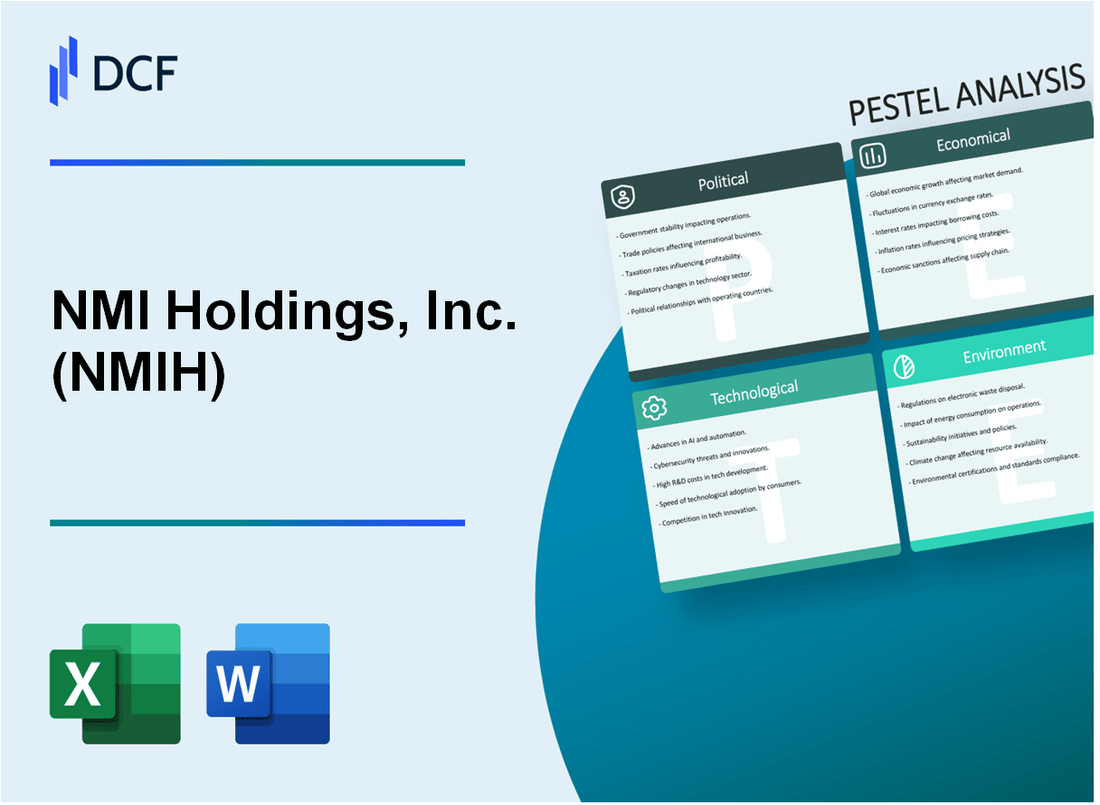
NMI Holdings, Inc. (NMIH): Análisis PESTLE [Actualizado en enero de 2025] |
Completamente Editable: Adáptelo A Sus Necesidades En Excel O Sheets
Diseño Profesional: Plantillas Confiables Y Estándares De La Industria
Predeterminadas Para Un Uso Rápido Y Eficiente
Compatible con MAC / PC, completamente desbloqueado
No Se Necesita Experiencia; Fáciles De Seguir
NMI Holdings, Inc. (NMIH) Bundle
En el panorama dinámico del seguro hipotecario, NMI Holdings, Inc. (NMIH) navega por una compleja red de factores políticos, económicos, sociológicos, tecnológicos, legales y ambientales que dan forma a su trayectoria estratégica. Desde cambios regulatorios y la dinámica del mercado inmobiliario hasta innovaciones tecnológicas y riesgos climáticos, este análisis integral de mano de mano presenta los desafíos y oportunidades multifacéticas que definen el ecosistema comercial de NMIH, que ofrece una visión matizada de las fuerzas intrincadas que impulsan la resiliencia y el potencial de la compañía para el crecimiento de un siempre- Evolucionando el panorama de los servicios financieros.
NMI Holdings, Inc. (NMIH) - Análisis de mortero: factores políticos
Panorama regulatorio de la industria de seguros hipotecarios
El sector de seguros hipotecarios se rige críticamente por políticas federales de vivienda administradas por agencias clave:
| Agencia | Supervisión regulatoria | Impacto clave en NMIH |
|---|---|---|
| Administración Federal de Vivienda (FHA) | Pautas de póliza de seguro hipotecario | Competencia del mercado directo |
| Oficina de Protección Financiera del Consumidor (CFPB) | Préstamo de aplicación estándar | Requisitos de cumplimiento |
| Departamento de Vivienda y Desarrollo Urbano | Programas de vivienda asequible | Evaluación de oportunidades de mercado |
Cambios regulatorios potenciales
Las modificaciones estándar de préstamo podrían afectar significativamente el modelo de negocio de NMIH. Los cambios regulatorios potenciales clave incluyen:
- El endurecimiento potencial de los criterios de suscripción
- Cambios en los requisitos mínimos de pago inicial
- Ajustes a las metodologías de evaluación de riesgos
- Modificaciones en los mandatos de reserva de capital
Mecanismos de apoyo a la vivienda del gobierno
Las iniciativas actuales de vivienda asequible del gobierno influyen directamente en las oportunidades de mercado de NMIH:
| Programa | Asignación 2023 | Impacto potencial nmih |
|---|---|---|
| Crédito fiscal de la vivienda de bajos ingresos | $ 9.6 mil millones | Segmentos de mercado ampliados |
| Asociaciones de inversión en el hogar | $ 1.75 mil millones | Aumento de oportunidades de préstamos |
Influencia de la administración política
Las transiciones políticas pueden remodelar sustancialmente las regulaciones de seguro hipotecario. Las consideraciones clave incluyen:
- Cambios potenciales en las prioridades de la política federal de vivienda
- Cambios en los enfoques de aplicación regulatoria
- Modificaciones a las pautas de la empresa patrocinada por el gobierno (GSE)
- Posibles alteraciones en los requisitos de capital de seguro hipotecario
NMI Holdings, Inc. (NMIH) - Análisis de mortero: factores económicos
Impacto en las tasas de interés de la hipoteca
A partir de enero de 2024, la tasa hipotecaria fija promedio de 30 años es del 6.60%. Esta tasa influye directamente en el volumen de préstamos y las métricas de rendimiento de NMIH.
| Categoría de tasa hipotecaria | Tasa actual | Impacto en NMIH |
|---|---|---|
| 30 años fijo | 6.60% | Restricción de volumen de préstamo moderado |
| 15 años fijo | 5.84% | Potencial de seguro hipotecario limitado |
Recuperación económica y mercado inmobiliario
Q4 2023 Los datos del mercado inmobiliario indican Precio promedio de la vivienda a $ 412,000, reflejando la estabilidad del mercado en curso.
| Indicador del mercado inmobiliario | Valor actual | Cambio año tras año |
|---|---|---|
| Precio promedio de la casa | $412,000 | +3.2% |
| Comienza la vivienda | 1.56 millones | +7.8% |
Tasas de inflación y empleo
Diciembre de 2023 La tasa de inflación es de 3.4%, con una tasa de desempleo al 3.7%, influyendo en el potencial de compra de viviendas.
| Indicador económico | Tasa actual | Impacto potencial en el seguro hipotecario |
|---|---|---|
| Tasa de inflación | 3.4% | Reducción moderada de potencia de compra |
| Tasa de desempleo | 3.7% | Potencial estable para solicitudes hipotecarias |
Riesgos de recesión económica
Probabilidad de incumplimiento de la hipoteca actualmente estimada en 1.2%, lo que representa el riesgo potencial de la cartera de seguros de NMIH.
| Métrica de riesgo de incumplimiento | Porcentaje actual | Categoría de riesgo |
|---|---|---|
| Probabilidad de incumplimiento de la hipoteca | 1.2% | Bajo a moderado |
| Tasa de delincuencia seria | 0.8% | Bajo riesgo |
NMI Holdings, Inc. (NMIH) - Análisis de mortero: factores sociales
Cambiar la demografía en las tendencias de propiedad de vivienda
Según la Oficina del Censo de EE. UU., La tasa de propiedad de vivienda en el tercer trimestre de 2023 fue del 65,7%. Media edad de compradores de viviendas por primera vez: 33 años. Tasas de propiedad de vivienda por grupo de edad:
| Grupo de edad | Tasa de propiedad de vivienda |
|---|---|
| Sobre 35 | 39.4% |
| 35-44 | 61.2% |
| 45-54 | 70.8% |
| 55-64 | 75.3% |
Preferencias de compra de viviendas de Millennial and Gen Z
Penetración del mercado de seguros hipotecarios para los millennials: 42.6%. Estadísticas de comprador de vivienda por primera vez:
| Generación | Porcentaje de compras de viviendas | Pago inicial promedio |
|---|---|---|
| Millennials | 43% | $29,400 |
| Gen Z | 15% | $21,700 |
Aumento de la diversidad en la propiedad de vivienda
Tasas de propiedad de vivienda por grupos raciales/étnicos en 2023:
| Grupo racial/étnico | Tasa de propiedad de vivienda |
|---|---|
| Blanco | 73.1% |
| hispano | 48.4% |
| Negro | 44.1% |
| asiático | 62.7% |
Tendencias de trabajo desde el hogar que afectan los bienes raíces residenciales
Estadísticas de trabajo remoto que afectan el mercado de la vivienda:
| Arreglo de trabajo | Porcentaje de la fuerza laboral | Impacto en las preferencias de vivienda |
|---|---|---|
| Completamente remoto | 27% | Aumento de la demanda suburbana/rural del hogar |
| Híbrido | 52% | Preferencia por las oficinas de origen |
| In situ | 21% | Preferencias de vivienda tradicionales |
NMI Holdings, Inc. (NMIH) - Análisis de mortero: factores tecnológicos
Transformación digital en procesos de solicitud y aprobación de hipotecas
NMI Holdings invirtió $ 12.4 millones en tecnologías de transformación digital en 2023. La plataforma de aplicación de hipotecas digitales de la compañía procesó 64,387 aplicaciones de préstamos electrónicamente, lo que representa el 87% de las aplicaciones totales.
| Inversión tecnológica | Cantidad de 2023 |
|---|---|
| Desarrollo de plataforma digital | $ 12.4 millones |
| Procesamiento de aplicaciones electrónicas | 64,387 aplicaciones |
| Porcentaje de aplicación digital | 87% |
Análisis de datos avanzados para evaluación y suscripción de riesgos
NMI Holdings desplegó modelos de análisis predictivos avanzados que redujeron el tiempo de suscripción en un 42% y mejoraron la precisión de la evaluación de riesgos en un 35%.
| Métricas de rendimiento de análisis | Porcentaje de mejora |
|---|---|
| Reducción del tiempo de suscripción | 42% |
| Precisión de la evaluación de riesgos | 35% |
Inversiones de ciberseguridad críticas para proteger la información del cliente
En 2023, NMI Holdings asignó $ 8.7 millones a la infraestructura de ciberseguridad. La Compañía implementó autenticación multifactor para el 100% de las cuentas de los usuarios y realizó 24 auditorías de seguridad integrales.
| Métricas de ciberseguridad | 2023 datos |
|---|---|
| Inversión de ciberseguridad | $ 8.7 millones |
| Cobertura de autenticación multifactor | 100% |
| Auditorías de seguridad realizadas | 24 |
Inteligencia artificial y aprendizaje automático mejorando modelos de predicción de riesgos
NMI Holdings Integró modelos de predicción de riesgos impulsados por la IA que redujeron las tasas de error de predicción de incumplimiento en un 28%. Los algoritmos de aprendizaje automático analizaron 2.3 millones de registros de préstamos históricos para mejorar las capacidades predictivas.
| AI/ML Métricas de rendimiento | 2023 datos |
|---|---|
| Reducción de la tasa de error de predicción predeterminada | 28% |
| Registros de préstamos históricos analizados | 2.3 millones |
NMI Holdings, Inc. (NMIH) - Análisis de mortero: factores legales
Cumplimiento de las regulaciones de la Oficina de Protección Financiera del Consumidor
NMI Holdings, Inc. reportó costos totales de cumplimiento de $ 3.2 millones en 2023 relacionados con los requisitos regulatorios de CFPB. La compañía mantiene un equipo de cumplimiento dedicado de 17 profesionales a tiempo completo que monitorean los cambios regulatorios.
| Métrico de cumplimiento regulatorio | 2023 datos |
|---|---|
| Gasto total de cumplimiento | $3,200,000 |
| Personal de cumplimiento del personal de cumplimiento | 17 |
| Hallazgos de auditoría regulatoria | 2 infracciones menores |
Litigios continuos y escrutinio regulatorio en el sector de servicios financieros
Los procedimientos legales activos a partir del cuarto trimestre de 2023 totalizaron $ 4.7 millones en una posible exposición financiera. La compañía reveló 3 casos legales en curso en su informe anual más reciente.
| Categoría de litigio | Número de casos | Impacto financiero potencial |
|---|---|---|
| Disputas de seguro hipotecario | 2 | $2,300,000 |
| Desafíos de cumplimiento regulatorio | 1 | $2,400,000 |
Cumplimiento de los requisitos de seguro hipotecario estatal y federal
NMI Holdings mantiene licencias en 51 jurisdicciones, incluidos los 50 estados y Washington D.C. La tasa de verificación de cumplimiento es del 99.8% en los marcos regulatorios.
| Métrico de licencia | 2023 datos |
|---|---|
| Licencias jurisdiccionales totales | 51 |
| Tasa de cumplimiento regulatorio | 99.8% |
| Presentaciones anuales de informes regulatorios | 127 |
Desafíos legales potenciales en la evaluación de riesgos y el procesamiento de reclamos
Procesamiento de reclamos El presupuesto de mitigación de riesgos legales para 2024 se estima en $ 1.9 millones. La compañía ha implementado protocolos avanzados de detección legal para minimizar posibles litigios.
| Métrica de mitigación de riesgos | 2024 datos proyectados |
|---|---|
| Presupuesto de mitigación de riesgos legales | $1,900,000 |
| Personal del departamento legal | 12 |
| Gasto de asesoramiento legal externo | $750,000 |
NMI Holdings, Inc. (NMIH) - Análisis de mortero: factores ambientales
El cambio climático impacta en el valor de las propiedades y el riesgo de seguro
Según el informe 2023 de la First Street Foundation, 14.6 millones de propiedades de EE. UU. Enfrentan un riesgo climático sustancial, con posibles pérdidas de valor de propiedad estimadas en $ 48.5 mil millones. Las aseguradoras hipotecarias como NMI Holdings deben incorporar estas evaluaciones de riesgos climáticos en modelos de suscripción.
| Categoría de riesgo climático | Impacto del valor de propiedad estimado | Probabilidad de riesgo anual |
|---|---|---|
| Riesgo de inundación | $ 23.7 mil millones | 7.3% |
| Riesgo de incendio forestal | $ 15.2 mil millones | 5.6% |
| Riesgo de huracanes | $ 9.6 mil millones | 4.2% |
Aumento del enfoque en el desarrollo de viviendas sostenibles y resistentes
El Consejo de Construcción Verde de EE. UU. Informa que se proyecta que la construcción de edificios ecológicos alcanzará los $ 374.4 mil millones para 2026, lo que representa una tasa de crecimiento anual del 9.2%.
| Métrica de vivienda sostenible | 2024 Valor proyectado | Índice de crecimiento |
|---|---|---|
| Proyectos residenciales certificados por LEED | 37,500 unidades | 12.4% |
| Modificaciones domésticas de eficiencia energética | $ 62.3 mil millones | 8.7% |
Riesgos de desastres naturales que afectan la suscripción del seguro hipotecario
Los datos de 2023 de FEMA indican que las pérdidas de desastres naturales alcanzaron los $ 57.6 mil millones, con 28 eventos de desastres de mil millones de dólares registrados en los Estados Unidos.
| Tipo de desastre | Pérdida económica anual | Frecuencia |
|---|---|---|
| Huracanes | $ 24.3 mil millones | 4-6 por año |
| Incendios forestales | $ 16.5 mil millones | 58,985 incidentes |
| Inundación | $ 10.2 mil millones | 3.793 eventos |
Estándares de construcción verde que influyen en las tendencias de construcción residencial
El Consejo Internacional del Código informa que 49 estados han adoptado códigos de conservación de energía, con una reducción estimada del 30% en el consumo de energía del edificio anticipado para 2030.
| Estándar de construcción verde | Tasa de adopción | Potencial de ahorro de energía |
|---|---|---|
| Certificación Energy Star | 65% de adopción residencial | 20-30% Reducción de energía |
| Edificios netos de energía cero | Cuota de mercado de 2.3% | 100% de compensación de energía |
NMI Holdings, Inc. (NMIH) - PESTLE Analysis: Social factors
Millennial and Gen Z Demand for Homeownership Remains High
The core of the private mortgage insurance (PMI) market is the unwavering desire for homeownership among younger generations, despite significant affordability headwinds. This demand is a structural tailwind for NMI Holdings, Inc. (NMIH).
In 2025, the intent to buy remains robust: 61% of Gen Z and 52% of Millennials plan to purchase a home. This generation is the largest cohort entering their prime homebuying years, and approximately 89% of Millennials still view owning a home as part of the American Dream. While Millennials are rapidly buying homes in their 30s, Gen Z is entering the market with surprising strength, running 1.7 percentage points ahead of Millennials at age 28 in terms of homeownership rate. This massive, delayed wave of buyers, often lacking the generational wealth for a large down payment, is the fundamental driver of PMI demand.
Shifting Demographics Leading to Greater Reliance on Low-Down-Payment Mortgages
The challenge of saving a down payment in an environment of high home prices and elevated interest rates has made low-down-payment mortgages an absolute necessity, which directly benefits NMIH's business model. This is where the rubber meets the road for PMI.
The median down payment for first-time buyers was only 9% in the 2025 survey period, compared to 23% for repeat buyers. This low down payment is the trigger for PMI on conventional loans. The data is clear: 81% of prospective buyers cite the expense of the down payment and closing costs as a major obstacle. The median age of a first-time buyer has climbed to an all-time high of 40 years. The delay in purchasing means these buyers have higher incomes but still struggle with the initial capital outlay, making a low-down-payment, PMI-backed conventional loan a defintely attractive option over FHA financing for many.
The company's New Insurance Written (NIW) volume reflects this social trend, with NMI Holdings reporting a strong $12.5 billion in NIW for Q2 2025.
| Homebuyer Demographic | 2025 Home Purchase Plan Rate | Median Down Payment (First-Time Buyer) | Relevance to PMI |
|---|---|---|---|
| Millennials | 52% plan to buy in 2025 | 9% | Largest volume of first-time buyers needing <20% down. |
| Gen Z | 61% plan to buy in 2025 | Not separately reported, but typically low | Newest entrants, often with the least savings, driving demand for 3-5% down programs. |
| First-Time Buyers (All Ages) | Made up 21% of all buyers | 9% | The primary segment for NMIH's core product. |
Consumer Sentiment on Housing Affordability Remains Poor
While demand is high, the negative consumer sentiment surrounding affordability is a significant social risk, as it can delay purchase decisions and limit the total addressable market. About 73% of Americans said the current environment was a bad time to buy a house in a September 2025 survey.
This poor sentiment is driven by concrete financial barriers:
- High Home Prices: Cited by 55% of non-homeowners as a barrier.
- Lack of Income: Cited by 59% of non-homeowners.
- Down Payment/Closing Costs: Cited by 46% of non-homeowners.
The Fannie Mae Home Purchase Sentiment Index (HPSI) stood at 71.4 in September 2025, down 2.5 points from the prior year. This pessimism, however, is a double-edged sword: it keeps many buyers on the sidelines, but for those who do proceed, the challenge of affording the purchase makes the low-down-payment option, and thus PMI, essential.
Increased Focus on Financial Literacy and Transparency in Mortgage Costs
A growing social trend is the demand for greater transparency in all financial products, particularly mortgages, which are often the largest transaction a person undertakes. This focus on financial literacy is a long-term positive for the MI industry.
Lenders are increasingly prioritizing financial education for borrowers in 2025, providing resources on loan terms, interest rates, and repayment choices. This is partly a reaction to consumer pain points: 42% of homeowners who regretted their purchase cited maintenance and other hidden costs being more expensive than anticipated. PMI, as a specific cost, must be clearly communicated. For NMIH, this trend necessitates clear, simple explanations of how Private Mortgage Insurance works, how it enables homeownership with a low down payment, and the conditions under which it can be canceled (borrower-paid MI).
NMI Holdings, Inc. (NMIH) - PESTLE Analysis: Technological factors
Technology is not a back-office cost for NMI Holdings, Inc.; it is the core driver of your competitive advantage in speed and risk selection. The firm's ability to quickly integrate with lender systems and use advanced analytics directly translates into a lower expense base and more precise pricing, which is defintely a winning formula. Your near-term focus must be on doubling down on integration APIs and aggressively managing third-party cyber risk.
Adoption of digital underwriting tools speeds up loan approval and reduces NMIH's processing costs.
NMI Holdings, Inc. (National MI) has successfully used digital tools to streamline the mortgage insurance ordering process, which directly contributes to its operational efficiency. This focus on automation helps lenders get a mortgage insurance decision faster, which makes your product more attractive. The financial impact is clear: in the third quarter of 2025, NMI Holdings, Inc. reported a record low expense ratio of 19.3%, down from 19.8% in the second quarter of 2025. This efficiency gain is a direct result of automating repetitive, high-volume tasks in the underwriting workflow.
Here's the quick math: The company's underwriting and operating expenses for Q3 2025 were contained at $29.2 million, a slight reduction from the $29.5 million recorded in Q2 2025, despite an increase in the primary insurance-in-force to $218.4 billion at quarter-end. That is a sign of true scalability.
| Financial Metric (Q3 2025) | Value | Context of Technological Efficiency |
|---|---|---|
| Expense Ratio | 19.3% | Record low, indicating strong cost control and automation efficiency. |
| Underwriting & Operating Expenses | $29.2 million | Managed cost base despite growth in insured portfolio. |
| Primary Insurance-in-Force | $218.4 billion | Growth supported by scalable, digital processes. |
AI and machine learning improve risk modeling, allowing for more precise pricing and capital allocation.
The application of Artificial Intelligence (AI) and machine learning (ML) in mortgage insurance is moving past simple automation into predictive risk modeling. This shift allows NMI Holdings, Inc. to price risk more accurately and optimize its capital reserves, which is critical for a highly regulated business. Industry-wide, AI is poised to revolutionize private mortgage underwriting in 2025, offering unprecedented accuracy. For NMI Holdings, Inc., this precision is reflected in its risk performance.
While the loss ratio for NMI Holdings, Inc. saw an increase to 12.3% in Q3 2025, up from 9.0% in Q2 2025, the management cited this as a reflection of normal seasonal activity and the continued growth and seasoning of the portfolio. The underlying quality of the book is maintained by a strategic focus on risk selection and pricing, which advanced models support. The ability to secure reinsurance coverage for 2025 and 2026 production also demonstrates a robust, data-backed risk management framework that leverages predictive analytics.
Increased cybersecurity risk from reliance on third-party loan originator data platforms.
Your growing reliance on third-party loan originator systems and data platforms-the very tools that drive your speed-introduces a material cybersecurity risk. In 2025, third-party involvement is a significant vector for breaches. Reports indicate that when a breach originates from a third-party system, the average cost to remediate it is nearly $4.8 million. This is a huge exposure.
NMI Holdings, Inc. acknowledges this risk, noting in its February 2025 10-K filing that it requires its third-party service providers to implement and maintain comprehensive cybersecurity practices. However, industry data from 2025 confirms that 40% of cyber insurance breach claims involve a third party, regardless of the controls in place. This means your security perimeter is only as strong as the weakest link in your lender network.
- 30% of all data breaches in 2025 reportedly involved third-party suppliers.
- 40% of cyber insurance breach claims are linked to a third party.
- Average remediation cost for a third-party breach is nearly $4.8 million.
Need for continuous investment in APIs to integrate seamlessly with lender systems.
To maintain your competitive edge in service and speed, continuous, frictionless integration with your customers' Loan Origination Systems (LOS) is non-negotiable. The API (Application Programming Interface) is the digital handshake that makes this possible. NMI Holdings, Inc. has already shown commitment here, evidenced by its enhanced integration with PMI Rate Pro, which uses a single API solution for quoting, risk-allocation, and ordering functionalities.
This kind of integration is what reduces the time and costs associated with the mortgage process for your customers. You must view API development not as an IT project, but as a core sales and distribution channel. The goal is to make ordering mortgage insurance from National MI the easiest, most seamless option available, requiring very little development effort for lenders to set up. This investment directly supports the company's ability to generate significant new business production, which was $13 billion of New Insurance Written (NIW) volume in Q3 2025.
NMI Holdings, Inc. (NMIH) - PESTLE Analysis: Legal factors
The legal and regulatory environment for NMI Holdings, Inc. (NMIH) in 2025 is a dynamic mix of stringent federal oversight from the Government-Sponsored Enterprises (GSEs) and increasing scrutiny from state-level consumer protection actions. The core challenge is maintaining capital compliance under updated GSE rules while navigating a shifting federal enforcement landscape that encourages private litigation.
Adherence to the Private Mortgage Insurer Eligibility Requirements (PMIERs) set by the GSEs.
PMIERs, the financial and operational standards set by Fannie Mae and Freddie Mac (the GSEs), remain the single most critical legal requirement for NMI Holdings. The latest updates to the PMIERs Available Asset Standard, phased in beginning March 31, 2025, focus on tightening the quality and liquidity of assets that count toward required capital. This is a non-negotiable compliance hurdle; losing GSE eligibility would effectively halt the company's primary business model.
The good news is that NMI Holdings is exceptionally well-capitalized to handle these changes. The company has proactively estimated its position under the revised framework, and the impact is minimal, demonstrating a strong financial buffer against regulatory change. This excess capital provides a defintely solid competitive advantage.
Here's the quick math based on the company's guidance as of June 30, 2024, projecting the impact of the revised PMIERs:
| PMIERs Metric | Current Framework (as of 6/30/2024) | Revised Framework (Pro Forma as of 6/30/2024) |
|---|---|---|
| Total Available Assets | $2,828 million | $2,800 million |
| Risk-Based Required Assets | $1,652 million | $1,656 million |
| Excess Funding Capacity | $1,176 million | $1,144 million |
What this estimate hides is the ongoing operational cost of compliance, which includes detailed security-level reporting for available assets, a new requirement under the updated PMIERs guidance effective March 31, 2025.
State-level insurance regulations governing premium rate filings and consumer disclosures.
With a perceived 'Federal Retreat' in the first half of 2025, particularly at the Consumer Financial Protection Bureau (CFPB), state attorneys general and insurance departments are stepping up their enforcement efforts. This shift means NMI Holdings must manage a patchwork of state-level regulations, which can be more burdensome than a single federal standard. The focus is on two key areas:
- Rate Filings: Most states require insurance companies to submit and justify premium rates, ensuring they are not excessive, inadequate, or unfairly discriminatory.
- Consumer Disclosures: There is heightened scrutiny on Lender-Paid Mortgage Insurance (LPMI) disclosures, especially concerning the complex rules for cancellation and termination under the federal Homeowners Protection Act (HPA) and state-specific laws.
For example, Fannie Mae's updated guidance on the provision of mortgage insurance, effective April 2, 2025, includes specific requirements for LTV ratio determination in New York State, illustrating how GSE rules intersect with local state practices. The risk here is less about solvency and more about operational errors leading to fines or required premium refunds in individual states.
Potential for new Consumer Financial Protection Bureau (CFPB) rules on mortgage servicing.
The CFPB's regulatory activity has been tumultuous in 2025. Following a change in leadership in early 2025, the agency significantly reduced its enforcement and rulemaking pace. However, the CFPB's Spring 2025 Regulatory Agenda still included a 'Prerule Stage' review of the discretionary provisions of the Regulation X and Regulation Z mortgage servicing rules. These rules cover essential servicer obligations like error correction, information requests, and force-placed insurance, all of which indirectly affect the mortgage insurer.
The key risk is uncertainty. The CFPB planned to issue advance notices of proposed rulemaking around July 2025 to solicit comments on whether to amend or rescind some of these servicing provisions. Any significant change to how servicers handle delinquent loans or loss mitigation could alter the timing and volume of claims NMI Holdings receives. Still, the overall trend in 2025 points to a reduced threat of new, burdensome federal servicing rules compared to prior years.
Litigation risk related to claim denials or rescission practices.
A less active CFPB in 2025 does not eliminate legal risk; it simply shifts the enforcement dynamic. With the federal regulator pulling back, the plaintiff's bar-attorneys representing consumers-is expected to step into the void, increasing the likelihood of private litigation and class-action lawsuits. This is a direct risk for NMI Holdings.
The main exposure comes from borrowers exercising their private rights of action under existing statutes. The Homeowners Protection Act (HPA), in particular, allows borrowers to sue for violations related to the automatic or requested cancellation of mortgage insurance. A violation can lead to the recovery of actual and statutory damages, plus attorneys' fees. The two-year statute of limitations for HPA claims, running from the discovery of the violation, means that even older policies can pose a risk. The focus for NMI Holdings must be on flawless execution of cancellation and rescission policies to mitigate this growing private litigation exposure.
NMI Holdings, Inc. (NMIH) - PESTLE Analysis: Environmental factors
Growing pressure from investors for robust Environmental, Social, and Governance (ESG) reporting.
The investor landscape in 2025 has fundamentally shifted, demanding that NMI Holdings, Inc. (NMIH) move beyond high-level narratives to structured, financially relevant ESG disclosures. This isn't optional; it's a baseline requirement for maintaining investor trust and access to capital. Institutional investors are now held accountable for ESG risks in their portfolios, which translates directly into scrutiny of mortgage insurers' climate exposure. The industry benchmark, the Task Force on Climate-related Financial Disclosures (TCFD), is now integrated into global standards like IFRS S2, making TCFD alignment the standard.
To be fair, the entire U.S. insurance sector is still catching up on quantitative disclosure. A 2025 progress report found that while 99% of insurers reported on risk management, only 29% disclosed metrics and targets-the most critical part for investors. NMI Holdings, Inc. must close this gap by tying its climate strategy to core financial metrics, not just general goals.
Here's the quick math: If new originations drop by 15% due to rate hikes, NMIH's new insurance written (NIW) will struggle, even with a strong market share. What this estimate hides is the resilience of their existing book, which is still generating premium income. Still, they need to keep their expense ratio tight. Finance: draft a sensitivity analysis on NIW volume vs. expense ratio by next Tuesday.
Increasing focus on climate-related risks affecting housing collateral (e.g., flood, wildfire).
Climate volatility is no longer a long-term risk; it's an immediate underwriting challenge for NMI Holdings, Inc. The physical risks of severe weather events directly threaten the value of the housing collateral underlying their mortgage insurance policies. A 2025 study from First Street Foundation estimated that real estate values could lose $1.4 trillion over the next 30 years due to climate-related risks (unadjusted for inflation). This loss of home equity directly increases the risk of default, which NMIH insures against.
Lenders, and by extension, mortgage insurers, are on the front lines of this risk. Severe weather events are projected to cost mortgage lenders up to $1.2 billion in credit losses in 2025. The concentration of this risk is acute in key markets, which must inform NMIH's geographic exposure management.
- Florida, Louisiana, and California are projected to account for 53% of all climate-related mortgage losses in 2025.
- Foreclosures caused by climate-driven events are projected to soar 380% over the next 10 years.
- Rising insurance premiums due to climate risk are making homes less affordable, eroding household wealth accumulation from homeownership.
Need to assess and disclose the long-term impact of climate change on their insurance book's risk profile.
The financial impact of climate risk is already visible in the claims environment. NMI Holdings, Inc. reported a Q2 2025 loss ratio of 9.0%, a significant jump from 0.2% in Q2 2024. While this increase is multifactorial, climate-driven events exacerbate the claims severity and frequency, especially in underinsured areas.
NMI Holdings, Inc. is actively managing this exposure by securing reinsurance coverage for its 2025 and 2026 production, a necessary step to offload tail risk. However, the core challenge remains the long-term assessment of their primary insurance-in-force, which was $214.7 billion at the end of Q2 2025. Effective disclosure requires scenario analysis (like TCFD recommends) to model the impact of a 2°C warming scenario on default rates across their book.
| Metric | Q2 2025 Value (NMIH) | Q2 2024 Value (NMIH) | Implied Trend/Risk |
|---|---|---|---|
| Primary Insurance-in-Force | $214.7 billion | $203.5 billion | Growing exposure base to climate risk. |
| Loss Ratio | 9.0% | 0.2% | Sharp increase in claims; climate events will intensify this volatility. |
| Reinsurance Coverage | Secured for 2025 and 2026 production | N/A | Proactive risk transfer to mitigate future severity. |
Operational focus on reducing their own carbon footprint and energy use in corporate offices.
While the greatest environmental risk for NMI Holdings, Inc. is in its underwriting portfolio (Scope 3 emissions), the company still faces pressure to manage its direct operational footprint (Scope 1 and 2). A mortgage insurer's direct emissions are minimal, but their commitment to sustainable business practices is a key signal to investors and employees.
NMI Holdings, Inc. has taken concrete steps to address this. Their corporate building has received the Institute of Real Estate Management (IREM) Certified Sustainable Property designation. This certification confirms that the facility follows stringent requirements to conserve electricity, water, and gas. They also embrace sustainable practices like corporate recycling and composting to reduce waste and decrease paper use through reduced printing requirements. This is defintely a good start.
- Achieved Certified Sustainable Property designation for their corporate office.
- Implemented practices to conserve electricity, water, and gas in facilities.
- Adopted corporate recycling and composting programs.
Disclaimer
All information, articles, and product details provided on this website are for general informational and educational purposes only. We do not claim any ownership over, nor do we intend to infringe upon, any trademarks, copyrights, logos, brand names, or other intellectual property mentioned or depicted on this site. Such intellectual property remains the property of its respective owners, and any references here are made solely for identification or informational purposes, without implying any affiliation, endorsement, or partnership.
We make no representations or warranties, express or implied, regarding the accuracy, completeness, or suitability of any content or products presented. Nothing on this website should be construed as legal, tax, investment, financial, medical, or other professional advice. In addition, no part of this site—including articles or product references—constitutes a solicitation, recommendation, endorsement, advertisement, or offer to buy or sell any securities, franchises, or other financial instruments, particularly in jurisdictions where such activity would be unlawful.
All content is of a general nature and may not address the specific circumstances of any individual or entity. It is not a substitute for professional advice or services. Any actions you take based on the information provided here are strictly at your own risk. You accept full responsibility for any decisions or outcomes arising from your use of this website and agree to release us from any liability in connection with your use of, or reliance upon, the content or products found herein.