

|
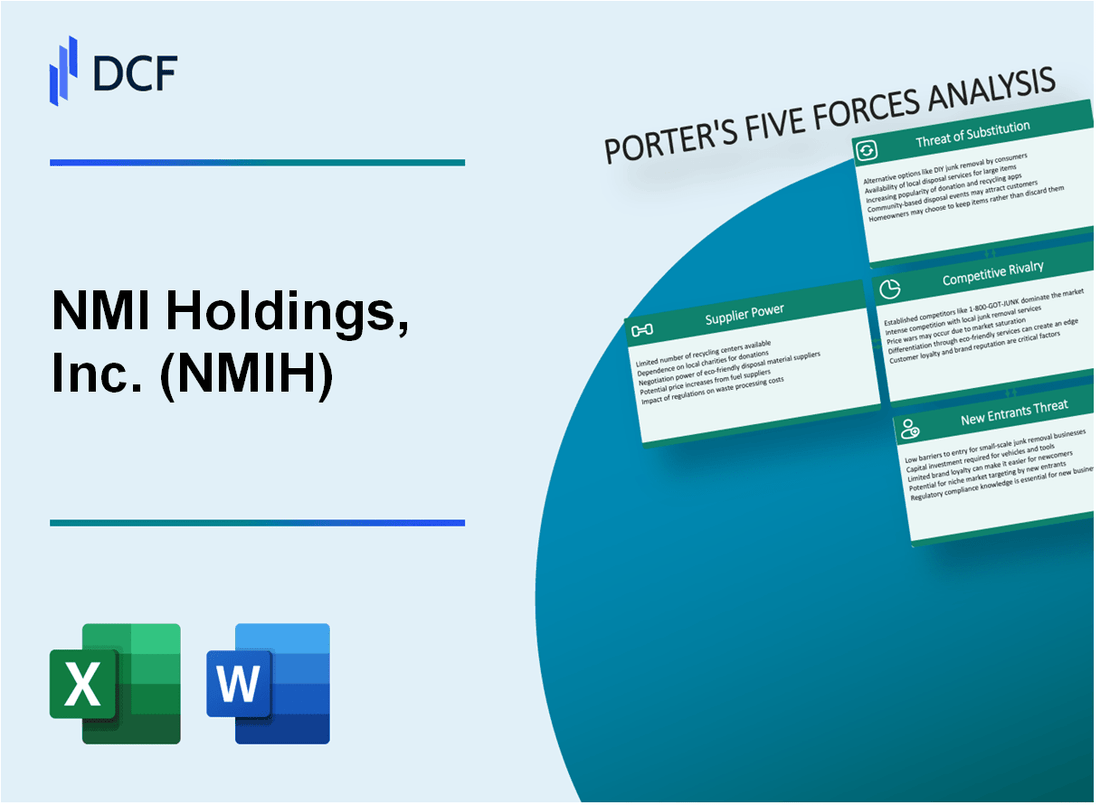
Análisis de 5 Fuerzas de NMI Holdings, Inc. (NMIH) [Actualizado en enero de 2025] |
Completamente Editable: Adáptelo A Sus Necesidades En Excel O Sheets
Diseño Profesional: Plantillas Confiables Y Estándares De La Industria
Predeterminadas Para Un Uso Rápido Y Eficiente
Compatible con MAC / PC, completamente desbloqueado
No Se Necesita Experiencia; Fáciles De Seguir
NMI Holdings, Inc. (NMIH) Bundle
En el intrincado panorama del seguro hipotecario, NMI Holdings, Inc. (NMIH) navega por un complejo ecosistema de desafíos estratégicos y dinámica competitiva. El marco de las cinco fuerzas de Michael Porter presenta un análisis matizado del posicionamiento del mercado de la compañía, revelando ideas críticas sobre el poder de los proveedores, las relaciones con los clientes, la intensidad competitiva, los riesgos sustitutos y las posibles barreras de entrada al mercado. A medida que el seguro hipotecario continúa evolucionando en 2024, comprender estas fuerzas estratégicas se vuelve primordial para los inversores, analistas de la industria y profesionales financieros que buscan comprender la estrategia competitiva y la resistencia al mercado de NMI Holdings.
NMI Holdings, Inc. (NMIH) - Las cinco fuerzas de Porter: poder de negociación de los proveedores
Número limitado de seguros hipotecarios y proveedores de reaseguros
A partir de 2024, el mercado de seguros hipotecarios tiene solo 6 proveedores principales de seguro hipotecario privado en los Estados Unidos, que incluyen:
| Proveedor | Cuota de mercado |
|---|---|
| NMI Holdings | 12.4% |
| Seguro hipotecario de genworth | 23.6% |
| Arch Mi | 18.9% |
| Mgic | 35.2% |
| Radián | 9.9% |
Tecnología especializada y herramientas de evaluación de riesgos
El mercado de tecnología de seguro hipotecario requiere una inversión significativa:
- Costos promedio de desarrollo de tecnología: $ 15.7 millones anuales
- Desarrollo de software de evaluación de riesgos: $ 8.3 millones por plataforma
- Aprendizaje automático e integración de IA: $ 6.2 millones por implementación
El cumplimiento regulatorio aumenta los costos de cambio de proveedor
Gastos de cumplimiento regulatorio para proveedores de seguro hipotecario:
| Área de cumplimiento | Costo anual |
|---|---|
| Informes regulatorios | $ 2.1 millones |
| Cumplimiento legal | $ 3.4 millones |
| Sistemas de gestión de riesgos | $ 4.6 millones |
Concentración de tecnología clave y proveedores de datos
Tecnología clave y métricas de concentración de proveedores de datos:
- Los 3 principales proveedores de datos controlan el 78.5% del mercado de datos de seguro hipotecario
- Valor promedio del contrato del proveedor de datos: $ 5.9 millones anuales
- Costos de cambio para proveedores de datos: $ 3.2 millones por transición
NMI Holdings, Inc. (NMIH) - Las cinco fuerzas de Porter: poder de negociación de los clientes
Opciones de seguro de los prestamistas de hipotecas
A partir del cuarto trimestre de 2023, NMI Holdings enfrenta la competencia de 3 proveedores de seguros hipotecarios primarios: Arch Capital Group, MGIC Investment Corporation y Essent Group. Muestra de distribución de participación de mercado:
| Proveedor | Cuota de mercado (%) |
|---|---|
| Mgic | 32.1% |
| Genworth | 24.5% |
| Capital de arco | 20.3% |
| NMI Holdings | 15.7% |
Sensibilidad al precio en el mercado de seguros hipotecarios competitivos
Tasas de primas promedio de seguro hipotecario en 2024:
- 0.5% - 1.5% del monto del préstamo para los prestatarios con puntajes de crédito 620-700
- 0.3% - 0.8% para prestatarios con puntajes de crédito por encima de 740
Capacidades de negociación de volumen de préstamos
Umbrales de negociación para los prestamistas:
| Volumen de préstamo anual | Potencial descuento (%) |
|---|---|
| $ 50-100 millones | 0.5-1.0% |
| $ 100-500 millones | 1.0-2.5% |
| $ 500+ millones | 2.5-4.0% |
Evaluación de riesgos y flexibilidad de precios
Factores de precios basados en el riesgo en 2024:
- Puntuación de crédito: 35% de impacto en la prima
- Pago inicial: 25% de impacto
- Relación de deuda / ingreso: impacto del 20%
- Tipo de préstamo: 15% de impacto
- Tipo de propiedad: 5% de impacto
NMI Holdings, Inc. (NMIH) - Las cinco fuerzas de Porter: rivalidad competitiva
Panorama competitivo del mercado
A partir del cuarto trimestre de 2023, la intensidad competitiva del mercado de seguros hipotecarios revela los siguientes competidores clave para NMI Holdings:
| Competidor | Cuota de mercado (%) | Ingresos anuales ($ M) |
|---|---|---|
| Seguro hipotecario de genworth | 23.4% | 1,275 |
| Corporación de Inversión MGIC | 26.7% | 1,452 |
| NMI Holdings (NMIH) | 15.2% | 687 |
Análisis de capacidades competitivas
NMI Holdings demuestra capacidades competitivas a través de:
- Tasa de precisión de evaluación de riesgos del 94.6%
- Inversión de tecnología de gestión de riesgos de $ 42.3 millones en 2023
- Algoritmos de modelado predictivo avanzado
Comparación de estrategia de precios
| Competidor | Tasa de prima promedio (%) | Rango de cobertura de riesgos |
|---|---|---|
| NMI Holdings | 2.75% | 60-80% |
| Genworth | 3.12% | 55-75% |
| Mgic | 2.89% | 65-85% |
Métricas de inversión tecnológica
Gasto tecnológico para la gestión de riesgos en 2023:
- NMI Holdings: $ 42.3 millones
- Genworth: $ 38.7 millones
- MGIC: $ 41.2 millones
NMI Holdings, Inc. (NMIH) - Las cinco fuerzas de Porter: amenaza de sustitutos
Estrategias alternativas de mitigación de riesgos
A partir del cuarto trimestre de 2023, las alternativas de préstamos respaldadas por el gobierno presentan una presión competitiva significativa:
| Tipo de préstamo | Cuota de mercado | Volumen anual |
|---|---|---|
| Préstamos de la FHA | 16.2% | $ 330 mil millones |
| Préstamos de VA | 8.7% | $ 186 mil millones |
| Préstamos del USDA | 2.3% | $ 45 mil millones |
Competencia de seguro hipotecario privado
Panorama competitivo de aseguradoras de hipotecas privadas:
- Arch Capital Group: cuota de mercado del 22.4%
- Radian Group: 19.7% de participación de mercado
- MGIC Investment Corporation: 17.3% de participación de mercado
- NMI Holdings: 15.6% de participación de mercado
Opciones de autoeingumento
Capacidades de autoseguro de las grandes instituciones financieras:
| Institución | Capacidad de autosuantía | Retención de riesgos |
|---|---|---|
| JPMorgan Chase | $ 250 mil millones | 85% |
| Wells Fargo | $ 180 mil millones | 75% |
| Banco de América | $ 210 mil millones | 80% |
Plataformas emergentes de tecnología financiera
Métricas del mercado de la tecnología de gestión de riesgos:
- Tamaño del mercado global de Insurtech: $ 5.48 mil millones en 2023
- CAGR proyectada: 10.2% de 2024-2030
- Inversiones de plataforma de gestión de riesgos digitales: $ 1.2 mil millones
NMI Holdings, Inc. (NMIH) - Las cinco fuerzas de Porter: amenaza de nuevos participantes
Barreras regulatorias en el mercado de seguros hipotecarios
A partir de 2024, las aseguradoras de hipotecas enfrentan requisitos regulatorios estrictos de:
- Administración Federal de Vivienda (FHA)
- Empresas patrocinadas por el gobierno (Fannie Mae y Freddie Mac)
- Comisionados de Seguros del Estado
Requisitos de capital
| Requisito de capital regulatorio | Cantidad mínima |
|---|---|
| Capital mínimo basado en el riesgo | $ 500 millones |
| Requisito de capital legal | $ 350 millones |
Barreras de infraestructura tecnológica
Requisitos de inversión tecnológica:
- Sistemas de modelado de riesgos avanzados: $ 25-50 millones
- Infraestructura de ciberseguridad: $ 10-15 millones anuales
- Plataformas de evaluación de riesgos de aprendizaje automático: $ 15-30 millones
Criterios de calificaciones financieras
| Agencia de calificación | Calificación mínima de fortaleza financiera |
|---|---|
| SOY. Mejor | A- (excelente) |
| Estándar & Pobre | A- (fuerte) |
Complejidad de la evaluación de riesgos
Requisitos de experiencia de suscripción:
- Se necesitan profesionales actuariales: Mínimo 10-15 especialistas
- Salario anual promedio para analistas de riesgos senior: $ 150,000- $ 250,000
- Costo de desarrollo del modelo de aprendizaje automático: $ 5-10 millones
NMI Holdings, Inc. (NMIH) - Porter's Five Forces: Competitive rivalry
The private mortgage insurance sector where NMI Holdings, Inc. operates is characterized by a high degree of rivalry. You see this structure clearly when you look at the key players.
Industry is a tight oligopoly of six main insurers, including NMI Holdings, Inc.
The competitive set is small, which often leads to strategic moves that are highly visible to rivals. Milliman's first quarter 2025 update tracks performance across these six key providers:
- Arch
- Enact
- Essent
- MGIC
- NMI Holdings, Inc.
- Radian
The Federal Housing Finance Agency Office of Inspector General confirmed in March 2025 that there continue to be only six active mortgage insurers approved to provide coverage for Enterprise mortgages. This concentration means any significant pricing action by one player is immediately felt by the others.
Competition is intense, often driving down premium rates for new insurance written.
Executives within the industry have noted that the market has become 'a homogeneous market.' To gain new business volume, the pressure to lower prices is significant. Here's the quick math on what that means for market share pursuit:
| Metric | Value/Context | Source Year/Period |
| NMI Holdings, Inc. Primary Insurance-in-Force | $218.4 billion | Q3 2025 |
| Industry New Insurance Written (NIW) Estimate (All Six) | Roughly $285 billion (Expected) | 2024 (Expected similar for 2025) |
| Individual Insurer Share (Enterprise Coverage) | Between 14 and 18 percent each | Year-end 2024 |
| Total Enterprise Coverage Volume | Approximately $377 billion | Year-end 2024 |
The direct consequence of this structure is that executives feel compelled to cut prices to move from one market share percentage to the next. If one insurer attempts to grow new insurance written (NIW) by moving from, say, a 16% share to 18%, the market reaction is to 'just push prices down.'
NMI Holdings, Inc. has a strong in-force book of $218.4 billion as of Q3 2025.
This large, established book provides a crucial base against the competitive pricing pressures on new business. The in-force book represents a stream of earned premiums that is less immediately subject to today's spot rates. For NMI Holdings, Inc., the primary insurance-in-force reached a record $218.4 billion at the end of the third quarter of 2025. This portfolio generated record net premiums earned of $151.3 million in Q3 2025. The company's ability to maintain a high persistency rate, reported at 83.9% in Q3 2025, helps stabilize this revenue base.
High fixed costs and low marginal costs incentivize aggressive market share pursuit.
While specific cost breakdowns aren't public, the operating leverage in the business is evident from the expense structure. Once the platform and personnel are in place-the fixed costs-the cost to insure one additional loan (marginal cost) is relatively low. This dynamic naturally pushes companies to write more business to spread those fixed costs over a larger premium base. NMI Holdings, Inc. demonstrated strong cost management in Q3 2025, achieving a record low expense ratio of 19.3%. This efficiency is key; lower operating costs mean a lower breakeven point, allowing the company to aggressively price new business to gain share while still remaining profitable, something smaller or less efficient competitors might struggle to match.
Consider the Q3 2025 results that show this operating leverage in action:
- GAAP Net Income: $96 million
- Total Revenue: $178.7 million
- Return on Equity (ROE): 15.6%
- Expense Ratio: 19.3% (Record Low)
You need to watch the NIW production figures against these profitability metrics; that's where you see the trade-off between growth and rate discipline.
NMI Holdings, Inc. (NMIH) - Porter's Five Forces: Threat of substitutes
You're looking at the competitive landscape for NMI Holdings, Inc. (NMIH), and the threat of substitutes is definitely a big one, especially when government programs offer a way around private mortgage insurance (MI) altogether. These government-backed options aren't going anywhere; they're baked into the housing system.
Government-backed FHA and VA loans are major, non-cancelable alternatives. For instance, VA loans, which require no mortgage insurance, saw their share of mortgaged homebuyers rise to 7.3% nationwide in August 2025, up from 6.5% the prior year. At the halfway point of fiscal year 2025, VA purchase lending was up nearly 10% compared to the same period in FY 2024, showing strong momentum for this substitute product. FHA loans, popular with first-time buyers, typically require only a 3.5% down payment. These government options represent a structural alternative to the conventional loan market where NMI Holdings, Inc. (NMIH) primarily operates.
Lender-Paid Mortgage Insurance (LPMI) directly replaces borrower-paid MI. This is a substitution within the MI product itself, where the lender effectively pays the premium by charging a slightly higher interest rate, which can feel less immediate to the borrower. The overall Lenders Mortgage Insurance market size is projected to grow from $9.23 billion in 2024 to $9.85 billion in 2025, showing this segment is still expanding despite substitution pressures. However, one form of this, the Lender Paid Single Premium MI, is non-refundable, and the Homeowners Protection Act of 1998 doesn't apply to it, meaning borrowers lose the built-in exit strategy present in borrower-paid MI.
Borrowers can cancel private MI when LTV reaches 80%, a built-in exit. This statutory right under the Homeowners Protection Act (HPA) provides a clear path out of the expense for borrowers with Borrower-Paid MI. Lenders must automatically cancel when the balance hits 78% of the original value, but borrowers can request removal once they hit 80% equity. The Private Mortgage Insurance market, which includes these borrower-paid products, is expected to grow from $6.24 billion in 2024 to $6.84 billion in 2025, a CAGR of 9.5%. Still, this built-in exit is a key difference compared to the government alternatives or non-refundable LPMI options.
High interest rates push more borrowers toward lower-cost government options. As of late November 2025, the average 30-year fixed mortgage rate was hovering around 6.23% to 6.40%. While this is down from recent peaks, it's still significantly higher than the historical average of 7.71% between April 1971 and November 2025. When rates are elevated, the lower upfront costs or no MI requirement of FHA/VA loans become much more attractive to budget-conscious buyers, increasing the pull toward these substitutes. It's a tough environment for conventional loans.
Here's a quick look at how the MI segments are trending:
| Market Segment | 2024 Size (USD) | 2025 Projected Size (USD) | CAGR (2024-2025) |
| Lenders Mortgage Insurance (LPMI included) | $9.23 billion | $9.85 billion | 6.7% |
| Private Mortgage Insurance (PMI) | $6.24 billion | $6.84 billion | 9.5% |
The appeal of government options is further cemented by their inherent cost structure:
- VA loans: Zero mortgage insurance premium.
- FHA loans: Mortgage Insurance Premium (MIP) is often required for the life of the loan.
- Conventional PMI: Cancellable at 80% LTV upon request.
- LPMI: Non-refundable single premium option exists.
If onboarding takes 14+ days, churn risk rises, but here the risk is borrowers choosing a different loan type entirely.
NMI Holdings, Inc. (NMIH) - Porter's Five Forces: Threat of new entrants
The threat of new entrants into the private mortgage insurance (MI) sector, which is critical for NMI Holdings, Inc. to manage, is significantly constrained by regulatory hurdles and the immense capital base required to compete effectively.
Private Mortgage Insurer Eligibility Requirements (PMIERs) demand substantial capital.
To even qualify to insure loans acquired by Fannie Mae and Freddie Mac (the GSEs), a new entrant must meet the stringent Private Mortgage Insurer Eligibility Requirements (PMIERs). These requirements mandate holding significant, highly liquid assets to cover potential claims under stress scenarios. As of June 30, 2024, the existing private mortgage insurers collectively held more than \$26.8 billion in PMIERs available assets. For context on the capital required for an incumbent like NMI Holdings, Inc., as of June 30, 2024, the company reported PMIERs total available assets of \$2,828 million against risk-based required assets of \$1,652 million, resulting in an excess funding capacity of \$1,176 million under the existing framework. The barrier isn't just meeting the minimum; it's matching the sheer volume of capital already deployed.
New entrants must secure critical approval from the GSEs (Fannie Mae/Freddie Mac).
Eligibility is not automatic; it is granted by the GSEs under the oversight of the Federal Housing Finance Agency (FHFA). The PMIERs themselves are the core financial and operational standards for this approval. The FHFA announced updates to the PMIERs in August 2024, with a phased implementation beginning March 31, 2025, and fully effective by September 30, 2026. Any new entrant must navigate this evolving, complex regulatory standard, which dictates everything from asset quality to operational controls. Furthermore, the GSEs have a transparent, objective process for approving new products and activities, which a new MI would need to successfully pass to ensure its insured loans can be purchased by the Enterprises.
Achieving scale and building relationships with lenders is a high barrier.
The incumbent market players have established deep, long-standing relationships across the mortgage origination ecosystem. NMI Holdings, Inc. itself serves a diverse customer base including national and regional mortgage banks, money center banks, and credit unions. The scale of business is massive; in 2024, the entire private MI industry supported nearly \$300 billion in mortgage originations. To be a viable competitor, a new firm must quickly build the infrastructure and trust to secure a significant share of this volume, which is a relationship-driven business. For NMI Holdings, Inc. alone, its primary insurance-in-force stood at \$211.3 billion at the end of the first quarter of 2025. A new entrant faces the challenge of displacing entrenched providers who already have established workflows with thousands of lenders.
Incumbents collectively hold \$11 billion in excess PMIERs capital, deterring entry.
The collective financial strength of the existing MI companies acts as a powerful deterrent. While the exact figure for excess capital as of late 2025 is not published, the aggregate capital buffer is substantial. As of June 30, 2024, the industry held over \$26.8 billion in PMIERs available assets. This level of capital, which exceeds the minimum required assets, signals to potential new entrants that the established players are heavily capitalized to withstand economic stress and absorb losses, making the investment required to compete on a similar footing extremely high. The market size itself is projected to grow from \$6.24 billion in 2024 to \$6.84 billion in 2025, suggesting that the existing players are positioned to capture the majority of this growth without needing to cede significant market share to a startup.
Here's a quick look at the capital positioning:
| Metric | Value (as of mid-2024 or latest available) | Source Context |
|---|---|---|
| Collective Industry PMIERs Available Assets | \$26.8 billion | June 30, 2024 |
| NMI Holdings, Inc. Excess Funding Capacity (Pro Forma Revised PMIERs) | \$1,144 million | Estimated as of June 30, 2024 |
| NMI Holdings, Inc. Primary Insurance-in-Force | \$211.3 billion | End of Q1 2025 |
| Industry Mortgage Originations Supported | Nearly \$300 billion | 2024 |
The regulatory and capital requirements mean that starting a private mortgage insurance company today is not a matter of securing a few bank lines; it requires billions in committed, liquid capital and a multi-year plan to satisfy the GSEs.
- PMIERs compliance requires holding the most liquid investments.
- GSE approval is mandatory for insuring Enterprise-acquired loans.
- The industry supported \$300 billion in 2024 originations.
- NMI Holdings' Q3 2025 net income was \$96 million.
- The market size is projected to reach \$6.84 billion in 2025.
Disclaimer
All information, articles, and product details provided on this website are for general informational and educational purposes only. We do not claim any ownership over, nor do we intend to infringe upon, any trademarks, copyrights, logos, brand names, or other intellectual property mentioned or depicted on this site. Such intellectual property remains the property of its respective owners, and any references here are made solely for identification or informational purposes, without implying any affiliation, endorsement, or partnership.
We make no representations or warranties, express or implied, regarding the accuracy, completeness, or suitability of any content or products presented. Nothing on this website should be construed as legal, tax, investment, financial, medical, or other professional advice. In addition, no part of this site—including articles or product references—constitutes a solicitation, recommendation, endorsement, advertisement, or offer to buy or sell any securities, franchises, or other financial instruments, particularly in jurisdictions where such activity would be unlawful.
All content is of a general nature and may not address the specific circumstances of any individual or entity. It is not a substitute for professional advice or services. Any actions you take based on the information provided here are strictly at your own risk. You accept full responsibility for any decisions or outcomes arising from your use of this website and agree to release us from any liability in connection with your use of, or reliance upon, the content or products found herein.