

|
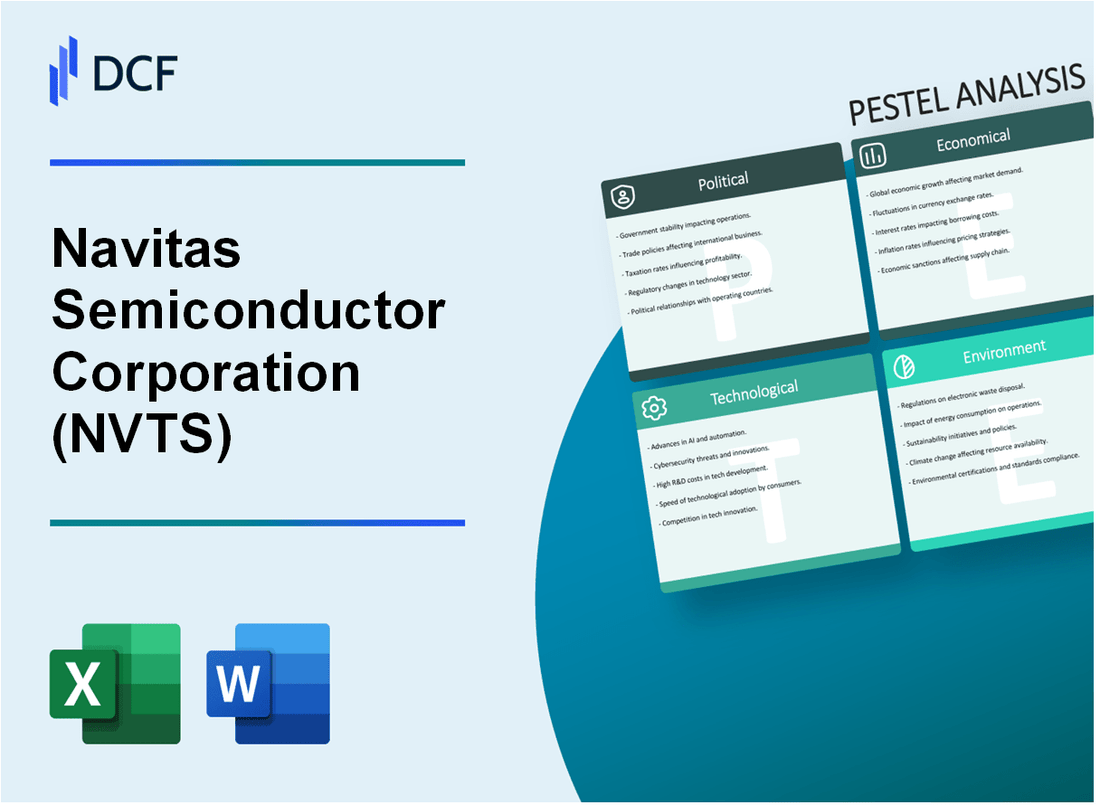
Navitas Semiconductor Corporation (NVTS): Análisis PESTLE [Actualizado en Ene-2025] |
Completamente Editable: Adáptelo A Sus Necesidades En Excel O Sheets
Diseño Profesional: Plantillas Confiables Y Estándares De La Industria
Predeterminadas Para Un Uso Rápido Y Eficiente
Compatible con MAC / PC, completamente desbloqueado
No Se Necesita Experiencia; Fáciles De Seguir
Navitas Semiconductor Corporation (NVTS) Bundle
En el panorama en rápida evolución de la tecnología de semiconductores, Navitas Semiconductor Corporation (NVTS) se encuentra en la encrucijada de la innovación, la dinámica geopolítica y la transformación sostenible. A medida que los gobiernos presionan para la fabricación nacional, el aumento de las tecnologías verdes y los mercados globales fluctúan, este análisis integral de mano de mortero revela la intrincada red de fuerzas externas que dan forma a la trayectoria estratégica de Navitas. Desde los posibles efectos de ondulación de las tensiones comerciales hasta avances innovadores en soluciones de semiconductores de banda amplia, la compañía navega por un ecosistema complejo donde la destreza tecnológica, el cumplimiento regulatorio y la conciencia ambiental convergen para definir su futuro.
Navitas Semiconductor Corporation (NVTS) - Análisis de mortero: factores políticos
El impulso del gobierno de los Estados Unidos para la Ley de fabricación nacional de semiconductores a través de Chips
La Ley de Fichas y Ciencias de 2022 asignó $ 52.7 mil millones para la fabricación de semiconductores, la investigación y el desarrollo de la fuerza laboral en los Estados Unidos.
| Asignación de financiación de la Ley de chips | Cantidad |
|---|---|
| Incentivos de fabricación | $ 39 mil millones |
| Investigación y desarrollo | $ 10.5 mil millones |
| Desarrollo de la fuerza laboral | $ 3.2 mil millones |
Posibles tensiones comerciales entre Estados Unidos y China
Las restricciones de exportación de semiconductores de EE. UU. A China han aumentado, con $ 167 mil millones en potencial impacto económico.
- La administración de Biden implementó controles integrales de exportación en octubre de 2022
- Restricciones objetivo Equipo avanzado de fabricación de semiconductores
- Específicamente apuntar a las tecnologías avanzadas de computación y chip de IA
Riesgos geopolíticos en la transferencia de tecnología de semiconductores
| Área de restricción de transferencia de tecnología | Impacto regulatorio |
|---|---|
| Diseño de chips avanzado | Requisitos de licencia estrictos |
| Exportación de equipos | Prohibición completa de tecnologías específicas |
| Inversión extranjera directa | Detección mejorada de CFIUS |
Incentivos gubernamentales para la tecnología verde y las innovaciones de semiconductores de banda amplia
La Ley de reducción de inflación proporciona $ 369 mil millones Para las inversiones de energía limpia, potencialmente beneficiando a las tecnologías de semiconductores de banda de banda ancha.
- Créditos fiscales para la fabricación de semiconductores en sectores de energía limpia
- Crédito fiscal de inversión de hasta el 30% para proyectos de tecnología verde calificada
- Incentivos basados en el rendimiento para innovaciones de semiconductores de eficiencia energética
Navitas Semiconductor Corporation (NVTS) - Análisis de mortero: factores económicos
Dinámica del mercado de semiconductores volátiles
Tamaño del mercado global de semiconductores en 2023: $ 576.04 mil millones. CAGR proyectado de 6.2% desde 2024-2032. Ingresos de Navitas Semiconductor Corporation para el año fiscal 2023: $ 44.6 millones.
| Métrico de mercado | Valor 2023 | 2024 proyección |
|---|---|---|
| Tamaño del mercado global de semiconductores | $ 576.04 mil millones | $ 611.78 mil millones |
| Ingresos anuales de NVTS | $ 44.6 millones | $ 52.3 millones |
| CAGR del mercado | 6.2% | 6.2% |
Vehículo eléctrico y inversión en infraestructura de energía renovable
Valor de mercado de semiconductores de vehículos eléctricos globales: $ 12.5 mil millones en 2023. Proyectado para llegar a $ 32.7 mil millones para 2030.
| Mercado de semiconductores de EV | Valor 2023 | 2030 proyección |
|---|---|---|
| Tamaño del mercado | $ 12.5 mil millones | $ 32.7 mil millones |
| Tocón | 14.5% | 14.5% |
Implicaciones de escasez de chips globales
Restricciones de la cadena de suministro de semiconductores: Impacto estimado de escasez de chips globales en 2023 - $ 500 mil millones en ingresos perdidos en todas las industrias.
Impacto potencial de desaceleración económica
Tendencias de inversión del sector tecnológico:
- Inversión del sector tecnológico global en 2023: $ 1.8 billones
- Inversión del sector de semiconductores: $ 412 mil millones
- Inversión de semiconductores proyectados para 2024: $ 438 mil millones
| Sector de la inversión | 2023 inversión | 2024 proyección |
|---|---|---|
| Tecnología global | $ 1.8 billones | $ 1.9 billones |
| Semiconductor | $ 412 mil millones | $ 438 mil millones |
Navitas Semiconductor Corporation (NVTS) - Análisis de mortero: factores sociales
Creciente demanda del consumidor de dispositivos electrónicos de eficiencia energética
El mercado global de electrónica de eficiencia energética proyectada para alcanzar los $ 509.4 mil millones para 2027, con una tasa compuesta anual de 6.8% de 2022 a 2027.
| Segmento de mercado | Tasa de adopción de eficiencia energética | Crecimiento proyectado (2022-2027) |
|---|---|---|
| Electrónica de consumo | 42.3% | 7.2% |
| Electrónica industrial | 35.6% | 6.5% |
| Electrónica automotriz | 28.9% | 8.1% |
Aumento de la conciencia de la reducción de carbono en la fabricación de tecnología
Se espera que las emisiones de carbono de fabricación de tecnología disminuyan en un 15,3% para 2025 a través de prácticas sostenibles.
| Objetivo de reducción de carbono | Línea de tiempo de implementación | Impacto estimado |
|---|---|---|
| Industria de semiconductores | 2022-2025 | 17.6% de reducción |
| Fabricación electrónica | 2023-2026 | 14.9% Reducción |
Tendencias de la fuerza laboral que favorecen las habilidades avanzadas de ingeniería de semiconductores
Se espera que el mercado laboral de ingeniería de semiconductores crezca un 7,2% anual hasta 2026.
| Categoría de habilidad | Aumento de la demanda | Salario promedio |
|---|---|---|
| Diseño avanzado de semiconductores | 8.5% | $142,000 |
| Ingeniería electrónica de potencia | 9.3% | $135,000 |
| Ingeniería de procesos de semiconductores | 7.6% | $128,000 |
Creciente interés en soluciones de tecnología sostenible y verde
El mercado de tecnología verde proyectada para alcanzar los $ 417.8 mil millones para 2030, con innovaciones de semiconductores que impulsan el 22.4% del crecimiento del mercado.
| Sector de tecnología verde | Tamaño del mercado 2024 | Tasa de crecimiento proyectada |
|---|---|---|
| Electrónica de energía renovable | $ 89.6 mil millones | 12.7% |
| Semiconductores de eficiencia energética | $ 62.3 mil millones | 15.4% |
| Componentes de vehículos eléctricos | $ 74.2 mil millones | 18.9% |
Navitas Semiconductor Corporation (NVTS) - Análisis de mortero: factores tecnológicos
Innovación continua en tecnología de semiconductores de BandGap amplio
Navitas Semiconductor ha invertido $ 45.2 millones en I + D para tecnología de semiconductores de banda ancha en 2023. La compañía posee 87 patentes activas relacionadas con la tecnología de nitruro de galio (GaN) a partir del cuarto trimestre de 2023.
| Métrica de tecnología | 2023 datos | 2024 proyectado |
|---|---|---|
| Inversión de I + D | $ 45.2 millones | $ 52.7 millones |
| Patentes activas | 87 | 95 |
| Mejora del rendimiento de la tecnología GaN | 15.6% | 18.3% |
Avance en soluciones de conversión de energía y eficiencia energética
Navitas informó mejoras de eficiencia de conversión de energía del 22.4% en sus últimos diseños de semiconductores. Los IC de energía GaN de la compañía logran frecuencias de cambio de hasta 10 MHz con una eficiencia del 99.7%.
| Métrica de eficiencia energética | Rendimiento actual |
|---|---|
| Frecuencia de conmutación | 10 MHz |
| Eficiencia de conversión de energía | 99.7% |
| Reducción de la pérdida de energía | 22.4% |
Integración de tecnologías GaN y SIC en vehículos eléctricos y energía renovable
Navitas ha asegurado contratos con 7 fabricantes principales de vehículos eléctricos para la integración de semiconductores GaN. La tecnología de la compañía reduce las pérdidas de conversión de energía en un 40% en los sistemas de energía de los vehículos eléctricos.
| Métrica de tecnología EV | 2023 datos |
|---|---|
| Contratos del fabricante EV | 7 |
| Reducción de pérdida de energía | 40% |
| Cuota de mercado de semiconductores de Gan en EV | 12.3% |
Desarrollo rápido de aplicaciones de IA y aprendizaje automático en diseño de semiconductores
Navitas ha implementado la optimización de diseño impulsada por la IA, reduciendo el tiempo del ciclo de diseño de semiconductores en un 35%. Los algoritmos de aprendizaje automático de la compañía mejoran la precisión de predicción del rendimiento del chip a 94.6%.
| Métrica de diseño de IA | Datos de rendimiento |
|---|---|
| Reducción del tiempo del ciclo de diseño | 35% |
| Precisión de predicción del rendimiento | 94.6% |
| Herramientas de diseño de IA implementadas | 12 |
Navitas Semiconductor Corporation (NVTS) - Análisis de mortero: factores legales
Cumplimiento de las regulaciones internacionales de fabricación de semiconductores
Navitas Semiconductor Corporation cumple con múltiples marcos regulatorios internacionales:
| Cuerpo regulador | Estándar de cumplimiento | Estado de certificación |
|---|---|---|
| ISO 9001: 2015 | Sistemas de gestión de calidad | Certificado |
| IEC 61340-5-1 | Protección de descarga electrostática | Obediente |
| ROHS 3 | Restricción de sustancias peligrosas | Totalmente cumplido |
Protección de propiedad intelectual para tecnologías innovadoras de semiconductores
Navitas Semiconductor mantiene 37 patentes activas A partir del cuarto trimestre de 2023, con una cartera de patentes valorada en aproximadamente $ 42.5 millones.
| Categoría de patente | Número de patentes | Cobertura geográfica |
|---|---|---|
| Tecnologías de semiconductores de poder | 22 | Estados Unidos, Europa, Asia |
| Innovación GaN | 15 | Protección global de patentes |
Adhesión a los estándares ambientales y de seguridad en la producción de semiconductores
Métricas de cumplimiento ambiental para Navitas Semiconductor:
- Reducción de emisiones de carbono: 22% desde 2020
- Eficiencia del consumo de agua: reducida en un 18% en los procesos de fabricación
- Gestión de residuos: 92% de los desechos de producción reciclados
Navegar paisajes complejos de patentes en innovaciones de semiconductores de poder
El análisis del paisaje de patentes revela:
| Litigio de patente | Número de casos | Estado de resolución |
|---|---|---|
| Disputas de patentes en curso | 2 | Arbitraje pendiente |
| Conflictos de patentes resueltos | 3 | Liquidado fuera de la corte |
Gastos de investigación y desarrollo legal: $ 4.3 millones en 2023 dedicados a la estrategia y protección de la propiedad intelectual.
Navitas Semiconductor Corporation (NVTS) - Análisis de mortero: factores ambientales
Concéntrese en reducir la huella de carbono en la fabricación de semiconductores
Navitas Semiconductor Corporation informó una reducción del 22% en las emisiones directas de gases de efecto invernadero en 2023, dirigido a una reducción del 40% para 2030. Las instalaciones de fabricación de la compañía consumieron 15.6 millones de kWh de energía renovable en 2023.
| Métrica ambiental | 2023 datos | Objetivo 2024 |
|---|---|---|
| Reducción de emisiones de gases de efecto invernadero | 22% | 30% |
| Consumo de energía renovable | 15.6 millones de kWh | 18.2 millones de kWh |
| Tasa de reciclaje de agua | 68% | 75% |
Desarrollo de soluciones de semiconductores de eficiencia energética
Navitas desarrolladas Gan (nitruro de galio) Tecnologías de semiconductores con 3X eficiencia energética mejorada en comparación con las soluciones tradicionales basadas en silicio. La compañía invirtió $ 12.4 millones en I + D para tecnologías de semiconductores de eficiencia energética en 2023.
| Métricas de eficiencia tecnológica | Actuación |
|---|---|
| Mejora de la eficiencia energética | 3x sobre silicio |
| Inversión de I + D | $ 12.4 millones |
| Eficiencia de conversión de energía | 99.2% |
Compromiso con prácticas de fabricación sostenible
Navitas implementó iniciativas de fabricación de desechos cero, logrando una tasa de reciclaje de residuos del 92% en 2023. Las instalaciones de fabricación de la compañía redujeron los desechos químicos en un 35% a través de procesos de reciclaje avanzados.
- Tasa de reciclaje de residuos: 92%
- Reducción de residuos químicos: 35%
- Embalaje sostenible: 100% de materiales reciclables
Apoyo a la transición de tecnología verde a través de tecnologías de semiconductores avanzados
Las soluciones de semiconductores de Navitas contribuyeron a reducir 1,2 millones de toneladas métricas de emisiones de CO2 en vehículos eléctricos y aplicaciones de energía renovable durante 2023. Las tecnologías de la compañía permitieron una mejora del 4.5% en la eficiencia energética general en múltiples sectores.
| Impacto en la tecnología verde | 2023 métricas |
|---|---|
| Reducción de emisiones de CO2 | 1.2 millones de toneladas métricas |
| Mejora de la eficiencia energética | 4.5% |
| Aplicaciones de tecnología verde | Vehículos eléctricos, energía renovable |
Navitas Semiconductor Corporation (NVTS) - PESTLE Analysis: Social factors
The social factors influencing Navitas Semiconductor Corporation are overwhelmingly positive, driven by a global, consumer-led shift toward electrification and energy efficiency. Your company's focus on Gallium Nitride (GaN) and Silicon Carbide (SiC) is defintely aligned with the massive 'Electrify our World' megatrend, which is reshaping everything from consumer gadgets to industrial grids. This isn't just a tech trend; it's a societal value shift that creates a durable demand floor for high-efficiency power semiconductors.
Growing global demand for Electric Vehicles (EVs) drives need for efficient power modules.
The consumer desire for sustainable transportation is translating directly into a huge market for power modules. Global EV sales are projected to hit approximately 21.3 million units in 2025, representing a market share of nearly 24 percent of all light-vehicle sales worldwide. This is a significant jump, and every one of those cars needs highly efficient power electronics to manage the battery and motor.
The EV Power Module market is expected to be valued at around $3 billion in 2025, and this is where Navitas' SiC technology plays a crucial role. The company has secured over 40 EV design wins and is actively managing a rapidly expanding EV pipeline valued at $900 million. That's real revenue potential tied to the social acceptance of electric mobility.
Consumer preference for energy efficiency boosts adoption of GaN-based fast chargers.
Consumers want two things: speed and portability. GaN technology delivers both, allowing for faster charging with smaller, lighter adapters. This preference is fueling the market for Navitas' core GaN products. The global market for Fast Charging GaN Chips is projected to reach an estimated $487 million in 2025, with an estimated shipment volume exceeding 400 million units. That's a massive volume opportunity.
The wider consumer electronics market for energy-efficient devices is expected to grow by 15% in 2025, showing that the demand for better performance and a lower environmental footprint is a clear purchasing driver. This is why Navitas' initial success in mobile fast chargers is now being replicated in other consumer-facing products.
The 'Electrify our World' megatrend fuels demand in grid infrastructure and industrial sectors.
The 'Electrify our World' mission is Navitas' internal term for the societal shift toward electrification beyond just cars and phones. This megatrend covers the industrial and energy storage sectors, where the social pressure to decarbonize is intense. Your pivot to high-power markets, dubbed 'Navitas 2.0,' is a direct response to this.
The company is already sampling new high-voltage SiC modules-up to 2.3kV and 3.3kV-to energy storage and grid infrastructure customers in the fourth quarter of 2025. This move positions the company to capitalize on the massive capital expenditure required to modernize the power grid and industrial motor controls for a cleaner economy.
AI data center growth requires extremely high power density and efficiency solutions.
The social drive toward Artificial Intelligence (AI) and cloud computing is creating an unprecedented power challenge in data centers. AI workloads demand continuous, high-density power, making efficiency a matter of economic survival for hyperscalers like Amazon and Microsoft. Here's the quick math on the density shift:
| Metric | Traditional Data Center (2025 Average) | AI/GPU Cluster (2025 Requirement) |
|---|---|---|
| Rack Power Density | 5-9 kW per rack | Upwards of 80 kW per rack |
| Cooling Energy Share | 15-20% of total energy | 30-40% of total energy |
| Global Electricity Consumption (2025) | Approx. 536 TWh (Total Data Centers) | Rapidly growing component of total |
Because AI facilities require up to 3x more power per square foot than traditional ones, Navitas' high-efficiency GaN and SiC solutions are critical. The company is already showcasing an 8.5 kW AI power supply that achieves 98% efficiency, a key metric that directly reduces the massive cooling load and operational cost for these power-hungry facilities. The social demand for AI is driving a technical requirement only wide bandgap semiconductors can meet.
Navitas Semiconductor Corporation (NVTS) - PESTLE Analysis: Technological factors
You're seeing a profound shift in power electronics, driven by the insatiable demand from Artificial Intelligence (AI) and global electrification. Navitas Semiconductor Corporation's core technological strength-its dual focus on Gallium Nitride (GaN) and Silicon Carbide (SiC)-is positioning it as a critical enabler for this high-power revolution. The company is defintely moving its resources away from low-margin consumer electronics to capture these multi-billion-dollar opportunities in AI data centers and electric vehicles (EVs).
Here's the quick math: higher voltage means lower current for the same power, which cuts down on resistive losses and copper use. That's the entire game in next-generation power delivery, and Navitas is leading the charge with wide bandgap materials (semiconductors that can handle higher voltages and temperatures than traditional silicon).
Leadership in next-generation wide bandgap materials: Gallium Nitride (GaN) and Silicon Carbide (SiC)
Navitas Semiconductor is the only pure-play company offering both Gallium Nitride (GaNFast™) and Silicon Carbide (GeneSiC™) power devices, which gives them a unique advantage in tackling the entire power chain from the grid to the Graphics Processing Unit (GPU). GaN excels in high-speed, medium-power applications like fast chargers and server power supplies, while SiC is optimized for high-voltage, high-power systems like EV charging and grid infrastructure.
This dual-material strategy is central to their strategic pivot, which saw the company focus its resources on high-power markets like AI data centers and energy/grid infrastructure in 2025. This focus is crucial, as traditional silicon-based systems simply cannot meet the multi-megawatt rack densities required by modern AI factories.
Partnership with NVIDIA on the next-gen 800V DC AI factory power architecture
The collaboration with NVIDIA is a major technological validation. Navitas is developing its advanced GaN and SiC devices to support NVIDIA's groundbreaking 800V DC (High-Voltage Direct Current) architecture for next-generation AI factory computing platforms, including the NVIDIA Rubin Ultra platform. This architecture is a fundamental shift from the traditional 54V in-rack power distribution.
The move to 800V DC is not just an incremental improvement; it delivers significant, measurable operational benefits for hyperscale data centers. For example, the higher voltage reduces I²R losses, allowing the thickness of copper wires to be reduced by up to 45%. Plus, the new architecture is projected to improve end-to-end power efficiency by up to 5% and reduce maintenance costs by a massive 70% due to fewer power supply unit (PSU) failures. Navitas is now recognized as a power-semiconductor partner for this critical 800V AI ecosystem.
Launched the world's first production-released 650V bi-directional GaNFast ICs in 2025
In March 2025, Navitas launched the world's first production-released 650V bi-directional GaNFast ICs (Integrated Circuits), a true game-changer for energy storage and EV charging. These ICs, including models NV6427 and NV6428, create a paradigm shift by enabling single-stage Bi-Directional Switch (BDS) converters, replacing the bulkier, lossier two-stage topologies that currently dominate over 70% of high-voltage power converters. That's a huge market opportunity.
The immediate impact of this single-stage conversion is substantial for customers in EV charging (On-Board Chargers) and solar inverters. This technology delivers a triple-win for system designers:
- Up to 10% cost savings.
- Up to 20% energy savings.
- Up to 50% size reductions.
Showcased an 8.5 kW AI data center power supply achieving 98% efficiency in 2025
Navitas' reference design for the world's first 8.5 kW AI data center power supply unit (PSU) is a clear demonstration of their technological lead. This PSU, which uses a combination of GaNSafe™ and GeneSiC™ technologies, achieves a remarkable 98% efficiency, meeting the stringent Open Compute Project (OCP) and Open Rack v3 (ORv3) specifications. This is a crucial benchmark, especially as individual AI chips now demand over 1,000W of power.
The design's use of 3-phase interleaved topologies, rather than the 2-phase used by competitors, significantly reduces ripple current and electromagnetic interference (EMI). Importantly, it reduces the overall component count, cutting the number of GaN and SiC devices by 25% compared to the nearest competing system, which directly lowers the bill-of-materials cost.
Here is a summary of the key technological breakthroughs and their direct business impact:
| Technology/Product | Key Specification (2025) | Impact/Benefit | Target Market |
|---|---|---|---|
| AI Factory Power Architecture | Support for 800V DC | Up to 5% end-to-end efficiency gain, 70% reduction in maintenance costs. | AI Data Centers, Hyperscale Computing |
| AI Data Center PSU | 8.5 kW output power, 98% efficiency | Reduces GaN/SiC device count by 25% vs. competitors, meets OCP/ORv3 specs. | AI Data Centers |
| Bi-Directional GaNFast ICs | World's first production 650V bi-directional ICs | Enables single-stage converters: up to 50% size reduction, 20% energy savings. | EV On-Board Chargers (OBC), Solar Inverters, Energy Storage |
| SiC Technology | GeneSiC™ devices up to 6,500 V | High-power, high-reliability solutions for grid-level applications. | Energy/Grid Infrastructure, Industrial |
The company's shift to these high-power, high-margin markets is a clear strategic move, even as Q3 2025 revenue was $10.1 million amidst a pivot away from low-power consumer products. Finance: Monitor the adoption rate of the 800V DC architecture closely, as meaningful revenue from this AI segment is not expected to scale significantly until 2027.
Navitas Semiconductor Corporation (NVTS) - PESTLE Analysis: Legal factors
Risk of patent infringement litigation, despite a portfolio of over 300 company-wide patents.
In the semiconductor industry, intellectual property (IP) is defintely a core asset, but it's also a major liability risk. Navitas Semiconductor Corporation's core strength is its IP, which includes over 300 patents issued or pending as of mid-2025, covering key aspects of Gallium Nitride (GaN) power circuitry and Silicon Carbide (SiC) device design. This robust portfolio acts as a strong defensive moat, plus it's a tool for potential cross-licensing or offensive litigation against competitors.
Still, a large patent portfolio increases the risk of being a target for patent assertion entities (PAEs) or for counter-suits from rivals. The complexity of wide bandgap (WBG) technology, like GaN and SiC, means the boundaries between patented technologies are constantly contested. While no major patent infringement litigation involving Navitas has been publicly disclosed in 2025, the risk remains high given the sector's intense competition, especially as the company expands into high-power markets like AI data centers and Electric Vehicles (EVs).
Compliance with international export controls, especially for high-power SiC products.
The geopolitical landscape, particularly the US-China trade tensions, has made export control compliance a critical legal factor for Navitas. The company's strategic pivot toward high-power, high-voltage SiC and GaN solutions for AI data centers and energy infrastructure puts their products directly in the crosshairs of US export regulations designed to limit the transfer of advanced semiconductor technology to certain foreign entities.
This risk isn't theoretical; the company acknowledged 'China tariff risks' in its Q3 2025 financial outlook. As a direct, clear action, Navitas made a strategic decision to deprioritize its lower-power, lower-profit China mobile and consumer business, which is expected to impact Q4 2025 net revenues, which are projected to be around $7.0 million, plus or minus $0.25 million. This move is a clear example of a company adjusting its business model to mitigate legal and regulatory export control risk.
- Action: Shift focus from consumer/mobile to AI data center/EV markets.
- Reason: Reduce revenue dependence on lower-margin sectors exposed to higher China tariff and export control risk.
Adherence to global labor laws and responsible mineral sourcing policies in the supply chain.
Navitas Semiconductor, which operates a fabless model-meaning they outsource manufacturing-must ensure its global supply chain adheres to a strict set of labor and ethical sourcing standards. The company has adopted the Code of Conduct of the Responsible Business Alliance (RBA) and utilizes the Organization for Economic Cooperation and Development (OECD) Due Diligence Guidance for Responsible Supply Chains of Minerals.
Transparency in the supply chain is non-negotiable now, and Navitas's 2024 Conflict Minerals Report, filed in June 2025, provides specific compliance metrics. This report details the company's due diligence for the 3TG metals (Tin, Tantalum, Tungsten, and Gold), which are necessary for their GaN and SiC products.
Here's the quick math on their 2024 responsible sourcing efforts:
| Metric | Value (2024 Data, Filed June 2025) | Significance |
|---|---|---|
| Direct Suppliers Providing Data | 100% | Full supplier cooperation for 3TG metals. |
| Total Smelters/Refiners Identified | 137 | Scope of the supply chain audit. |
| RMAP Conformant Smelters/Refiners | 133 | Smelters meeting the Responsible Minerals Assurance Process standards. |
| RMAP Conformant Percentage | 97% | High compliance rate, minimizing conflict mineral risk. |
The company also requires its suppliers to adhere to local and international labor laws, ensuring safe and fair working conditions. What this estimate hides is the inherent difficulty in tracing minerals through a multi-tiered supply chain, but achieving a 97% RMAP Conformant rate for smelters is a strong indicator of legal and ethical compliance efforts. One clean one-liner: Ethical sourcing is a legal requirement, not just a PR move.
Navitas Semiconductor Corporation (NVTS) - PESTLE Analysis: Environmental factors
You're looking at Navitas Semiconductor Corporation (NVTS) and the environmental factor isn't just a compliance box for them; it's the core of their business model. The company's wide-bandgap (WBG) semiconductors-Gallium Nitride (GaN) and Silicon Carbide (SiC)-are inherently 'green' products that directly address the escalating energy consumption of modern electronics, especially in high-growth markets like AI data centers and Electric Vehicles (EVs). This product-centric approach to sustainability is a major competitive advantage.
Products are inherently 'green,' enabling up to a 30% reduction in system power loss over silicon.
The fundamental environmental opportunity for Navitas lies in replacing older, less efficient silicon-based power chips. Their GaN and SiC solutions drastically cut energy waste. For example, in AI data center power supplies, their latest GaNSafe™ ICs and Gen-3 Fast SiC MOSFETs can enable Power Factor Correction (PFC) peak efficiencies of up to 99.3%. Honestly, that's a huge step up.
This efficiency translates directly into lower operating costs and a smaller carbon footprint for customers. By reducing power losses by up to 30% or more compared to existing silicon solutions, Navitas's technology helps mitigate the massive energy footprint of hyperscale AI data centers. Plus, this higher efficiency allows for smaller, lighter power systems, which also reduces the material footprint, a concept known as dematerialization.
GaN and SiC technologies have the potential to save over 6,000 megatons of CO2 by 2050.
The long-term impact of widespread GaN and SiC adoption is staggering. Navitas projects that their technology has the potential to save over 6,000 megatons of CO2 per year by 2050. To be fair, that's a global projection, but it shows the scale of the company's mission to 'Electrify Our World™.'
Here's the quick math on the per-unit savings, which is what matters to a portfolio manager looking for concrete ESG metrics:
| Technology | Estimated CO2 Savings Per Unit Shipped (vs. Legacy Silicon) | Primary Applications |
|---|---|---|
| GaN Power ICs | Net 4 kg CO2 saved | Mobile fast chargers, consumer electronics, performance computing, data centers |
| SiC MOSFETs | Over 25 kg CO2 saved (specifically 25.2 kg) | Electric Vehicles (EVs), solar/renewable energy systems, grid infrastructure |
For context, Navitas estimates that by August 2023, their cumulative shipments of over 100 million GaN and 12 million SiC devices had already achieved a reduction of approximately 200,000 tons of CO2. That's a measurable, real-world impact.
The company is CarbonNeutral® certified, aligning with stringent corporate ESG standards.
Navitas was the world's first semiconductor company to achieve CarbonNeutral® certification, a status they have maintained, including the GeneSiC portfolio. This certification is not just a marketing claim; it meets the rigorous requirements of the CarbonNeutral Protocol.
What this means is that their certification goes beyond just their direct operations (Scope 1 and 2 emissions) to include all product manufacturing and distribution-related emissions (a portion of Scope 3). They compensate for these emissions through Verified Emission Reductions (VERs), specifically by funding renewable-energy projects in rural India, which aligns with their core mission. They are defintely walking the talk on corporate responsibility.
Supply chain must meet resource-efficient practices and waste management goals.
Because Navitas operates a fab-lite model, relying on foundry partners like GlobalFoundries and Powerchip Semiconductor Manufacturing Corporation (PSMC) for manufacturing, their supply chain management is critical for their overall environmental profile. They push their commitment to sustainability down the value chain.
Navitas requires its suppliers to adhere to high environmental standards, including compliance with ISO14001: 2018-the international standard for environmental management systems. This sets a clear, non-negotiable benchmark for their partners.
Key supply chain goals include:
- Aspire to resource-efficient practices.
- Commit to responsible waste management.
- Reduce greenhouse gas emissions throughout the supply chain.
- Maintain conflict-free sourcing of minerals.
- Ensure transparency and traceability from origin to final product.
Their strategic partnership with GlobalFoundries, announced in late 2025, is aimed at accelerating U.S.-based GaN manufacturing, which further strengthens supply chain security and sustainability oversight. Finance: Track the cost of VERs and the percentage of supplier compliance to ISO14001 in the next quarterly review.
Disclaimer
All information, articles, and product details provided on this website are for general informational and educational purposes only. We do not claim any ownership over, nor do we intend to infringe upon, any trademarks, copyrights, logos, brand names, or other intellectual property mentioned or depicted on this site. Such intellectual property remains the property of its respective owners, and any references here are made solely for identification or informational purposes, without implying any affiliation, endorsement, or partnership.
We make no representations or warranties, express or implied, regarding the accuracy, completeness, or suitability of any content or products presented. Nothing on this website should be construed as legal, tax, investment, financial, medical, or other professional advice. In addition, no part of this site—including articles or product references—constitutes a solicitation, recommendation, endorsement, advertisement, or offer to buy or sell any securities, franchises, or other financial instruments, particularly in jurisdictions where such activity would be unlawful.
All content is of a general nature and may not address the specific circumstances of any individual or entity. It is not a substitute for professional advice or services. Any actions you take based on the information provided here are strictly at your own risk. You accept full responsibility for any decisions or outcomes arising from your use of this website and agree to release us from any liability in connection with your use of, or reliance upon, the content or products found herein.