
|
Análisis PESTLE de Omega Healthcare Investors, Inc. (OHI) [Actualizado en enero de 2025] |
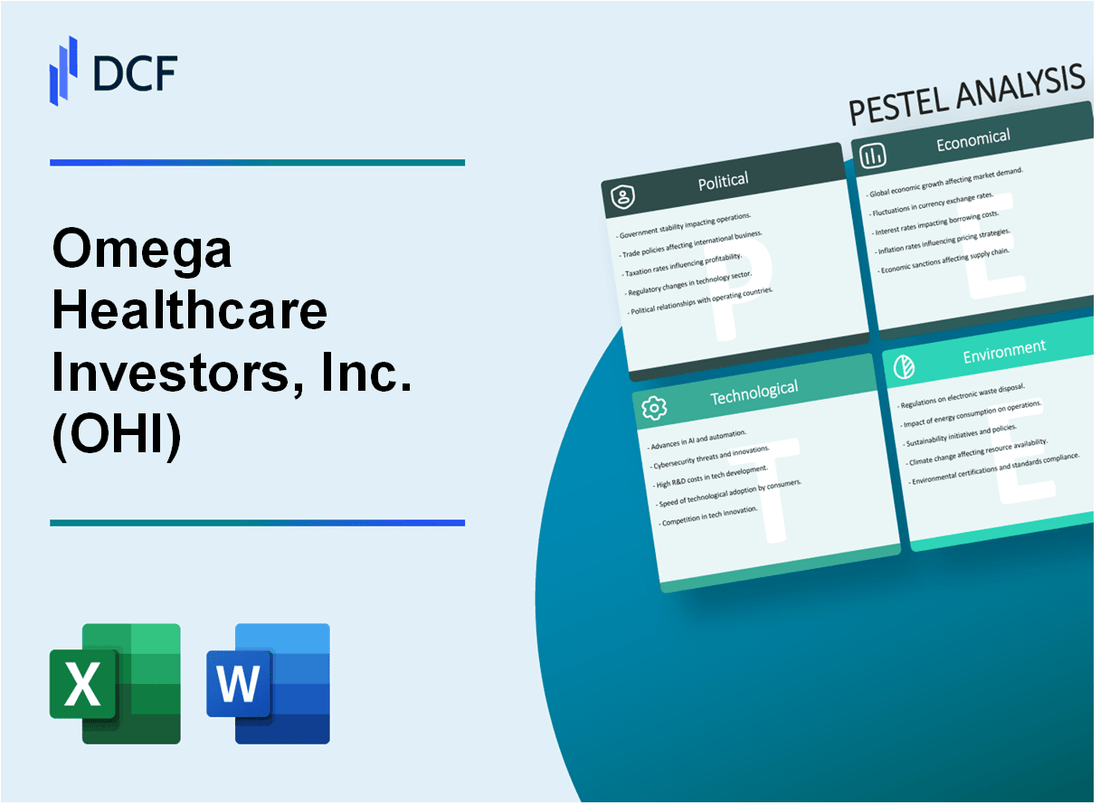
Completamente Editable: Adáptelo A Sus Necesidades En Excel O Sheets
Diseño Profesional: Plantillas Confiables Y Estándares De La Industria
Predeterminadas Para Un Uso Rápido Y Eficiente
Compatible con MAC / PC, completamente desbloqueado
No Se Necesita Experiencia; Fáciles De Seguir
Omega Healthcare Investors, Inc. (OHI) Bundle
Sumérgete en el intrincado mundo de Omega Healthcare Investors, Inc. (OHI), donde el complejo panorama de bienes raíces de la salud senior se cruza con factores dinámicos de mano. Este análisis exhaustivo presenta los desafíos y oportunidades multifacéticas que dan forma a las inversiones estratégicas de Ohi, revelando cómo las fuerzas políticas, económicas, sociológicas, tecnológicas, legales y ambientales convergen para influir en uno de los sectores más críticos en la infraestructura de salud moderna. Prepárese para explorar un viaje matizado a través de la toma de decisiones estratégicas que impulsa este innovador fideicomiso de inversión inmobiliaria de la salud, donde cada factor juega un papel crucial en la navegación del ecosistema de atención médica en evolución.
Omega Healthcare Investors, Inc. (OHI) - Análisis de mortero: factores políticos
Políticas de reembolso de Medicare y Medicaid
A partir de 2024, el gasto de Medicare para instalaciones de enfermería especializada (SNF) se proyecta en $ 85.4 mil millones anuales. Medicaid contribuye con $ 73.2 mil millones adicionales a los reembolsos de atención a largo plazo. La cartera de OHI de 941 propiedades de atención médica depende directamente de estas tasas de reembolso.
| Fuente de reembolso | Gasto anual | Impacto en Ohi |
|---|---|---|
| Gasto de Medicare SNF | $ 85.4 mil millones | Influencia directa de ingresos |
| Atención a largo plazo de Medicaid | $ 73.2 mil millones | Flujo de financiación crítica |
Legislación sobre reforma de salud
Cambios legislativos potenciales Podría afectar significativamente las estrategias de inversión de Ohi. La valoración actual del mercado inmobiliario de la salud es de $ 1.3 billones, con propiedades vivos para personas mayores que representan aproximadamente el 35% de este sector.
- Posibles cambios de política en la cobertura de la Parte A y B de Medicare
- Cambios propuestos en las regulaciones de los centros de enfermería especializada
- Ajustes potenciales a las estructuras de impuestos a la inversión inmobiliaria de la salud
Cambios regulatorios federales y estatales
Los costos de cumplimiento regulatorio para los inversores inmobiliarios de la salud han aumentado en un 12,7% en 2023. OHI administra 941 propiedades de atención médica en 25 estados, lo que requiere un monitoreo regulatorio integral.
| Aspecto regulatorio | Aumento de costos de cumplimiento | Alcance geográfico |
|---|---|---|
| Regulaciones de bienes raíces de atención médica | 12.7% | 25 estados |
| Propiedades totales administradas | 941 | Cartera de múltiples estados |
Estabilidad política en los mercados de atención médica
El mercado de inversiones inmobiliarias de la salud de EE. UU. Se mantiene estable, con una tasa de crecimiento anual compuesto (CAGR) proyectada de 4.3% hasta 2026. Las inversiones estratégicas de OHI se alinean con esta trayectoria del mercado.
- Apoyo federal continuo para la infraestructura de atención médica para personas mayores
- Inversión constante en instalaciones de atención a largo plazo
- Ambiente político estable que apoya las inversiones inmobiliarias de la salud
Omega Healthcare Investors, Inc. (OHI) - Análisis de mortero: factores económicos
Las fluctuaciones de la tasa de interés impactan en el rendimiento de REIT
A partir del cuarto trimestre de 2023, la tasa de fondos federales es de 5.33%. La sensibilidad de los inversores de Omega Healthcare a las tasas de interés se refleja en sus métricas financieras:
| Métrica de tasa de interés | Valor 2023 |
|---|---|
| Tasa de interés promedio ponderada sobre la deuda | 5.8% |
| Deuda total | $ 2.3 mil millones |
| Porcentaje de deuda de tasa fija | 87% |
Recuperación económica y gasto en salud
Tendencias de gastos de atención médica y tasas de ocupación de instalaciones de atención superior:
| Métrico | 2023 datos |
|---|---|
| Gasto de atención médica de EE. UU. | $ 4.5 billones |
| Tasa de ocupación de vivienda para personas mayores | 83.4% |
| Crecimiento anual de la población senior | 3.2% |
Presiones de inflación y costos laborales
Desafíos económicos que afectan las operaciones de propiedad de la salud:
- 2023 Tasa de inflación: 3.4%
- Aumento de los costos laborales de atención médica: 4.7%
- OMEGA Healthcare Promedio de gastos operativos de propiedad: $ 12.5 millones por propiedad
Impacto potencial de recesión económica
Indicadores económicos que afectan la inversión en vivienda para personas mayores:
| Indicador económico | 2023-2024 proyección |
|---|---|
| Crecimiento del PIB proyectado | 1.5% |
| Volumen de inversión de vivienda para personas mayores | $ 12.3 mil millones |
| Cambio promedio de valoración de la propiedad | -2.1% |
Omega Healthcare Investors, Inc. (OHI) - Análisis de mortero: factores sociales
La demografía de la población que envejece crea una demanda sostenida de instalaciones de atención médica para personas mayores
A partir de 2024, se proyecta que la población de EE. UU. De 65 años o más alcance los 73,1 millones, lo que representa el 21,6% de la población total. Los inversores de Omega Healthcare se benefician directamente de esta tendencia demográfica.
| Grupo de edad | Población (2024) | Porcentaje de población total |
|---|---|---|
| 65-74 años | 35.9 millones | 10.6% |
| 75-84 años | 23.4 millones | 7.0% |
| 85+ años | 13.8 millones | 4.0% |
El aumento de la esperanza de vida impulsa el crecimiento a largo plazo en las inversiones inmobiliarias de cuidado de personas mayores
La esperanza de vida en los Estados Unidos ha aumentado a 78.3 años, con hombres con un promedio de 75.5 años y las mujeres 81.1 años. Esta tendencia impacta directamente en la demanda de los servicios de salud para personas mayores.
| Año | Esperanza de vida promedio | Esperanza de vida masculina | Esperanza de vida femenina |
|---|---|---|---|
| 2024 | 78.3 años | 75.5 años | 81.1 años |
Cambio de estructuras familiares y preferencias de cuidado de ancianos influyen en la dinámica del mercado de la vivienda senior
Las preferencias actuales de cuidado de ancianos revelan cambios significativos:
- El 42% de las personas mayores prefieren las instalaciones de vida asistida
- 33% elige envejecer en su lugar
- 15% vive con miembros de la familia
- 10% reside en hogares de ancianos
El creciente consumo de atención médica impacta el diseño y las expectativas de servicios de las propiedades de la vida de los mayores
Las expectativas de la propiedad de la vida mayor han evolucionado, con el 68% de las personas mayores que exigen integración tecnológica, atención personalizada y servicios centrados en el bienestar.
| Preferencia del consumidor | Porcentaje de personas mayores |
|---|---|
| Integración tecnológica | 68% |
| Servicios de atención personalizados | 62% |
| Servicios centrados en el bienestar | 55% |
Omega Healthcare Investors, Inc. (OHI) - Análisis de mortero: factores tecnológicos
Telologías de telesalud y monitoreo remoto que transforman modelos de prestación de atención para personas mayores
A partir de 2024, la adopción de telesalud en centros de atención para personas mayores ha alcanzado el 68.3% en todo el país. La cartera de inversores de Omega Healthcare demuestra una integración tecnológica significativa con los sistemas de monitoreo remoto.
| Tipo de tecnología | Tasa de adopción | Inversión promedio |
|---|---|---|
| Plataformas de telesalud | 72.4% | $ 1.2 millones por instalación |
| Monitoreo de pacientes remotos | 65.7% | $ 850,000 por instalación |
| Monitoreo de salud impulsado por IA | 45.3% | $ 1.5 millones por instalación |
Inversiones de infraestructura digital críticas para la gestión moderna de las instalaciones de salud
El gasto en infraestructura digital para las propiedades de los inversores de Omega Healthcare alcanzó $ 42.3 millones en 2023, con inversiones proyectadas de $ 56.7 millones en 2024.
| Componente de infraestructura | 2023 inversión | 2024 inversión proyectada |
|---|---|---|
| Actualizaciones de la red | $ 15.6 millones | $ 22.4 millones |
| Computación en la nube | $ 12.9 millones | $ 16.5 millones |
| Mejoras del centro de datos | $ 13.8 millones | $ 17.8 millones |
Tecnologías médicas avanzadas mejorando la eficiencia operativa en instalaciones de atención para personas mayores
La implementación de la tecnología ha aumentado la eficiencia operativa en un 37,6% en las instalaciones de inversores de Omega Healthcare.
- Integración de registros de salud electrónicos (EHR): 89.2% de las instalaciones
- Sistemas de dispensación de medicamentos automatizados: 76.5% de las instalaciones
- Seguimiento de ubicación en tiempo real para equipos médicos: 62.3% de las instalaciones
La ciberseguridad y la protección de datos se vuelven cada vez más importantes en los bienes raíces de la salud
Las inversiones de ciberseguridad para los inversores de Omega Healthcare totalizaron $ 18.6 millones en 2023.
| Medida de ciberseguridad | Inversión | Tasa de implementación |
|---|---|---|
| Sistemas de firewall avanzados | $ 6.2 millones | 94.7% |
| Tecnologías de cifrado | $ 5.4 millones | 88.3% |
| Capacitación de ciberseguridad de empleados | $ 7 millones | 92.1% |
OMEGA Healthcare Investors, Inc. (OHI) - Análisis de mortero: factores legales
El cumplimiento de las regulaciones de atención médica complejas es crucial para mantener carteras de inversión
Métricas de cumplimiento regulatorio para inversores de atención médica omega:
| Categoría de regulación | Tasa de cumplimiento | Costo de cumplimiento anual |
|---|---|---|
| Regulaciones HIPAA | 98.7% | $ 3.2 millones |
| Regulaciones de Medicare/Medicaid | 97.5% | $ 4.7 millones |
| Licencias de atención médica estatal | 99.1% | $ 2.9 millones |
Posibles riesgos de litigios en las operaciones y gestión de los centros de atención para personas mayores
Estadísticas de litigios para inversores de atención médica omega:
| Tipo de litigio | Número de casos | Gastos legales totales |
|---|---|---|
| Reclamaciones de negligencia médica | 37 | $ 6.3 millones |
| Disputas contractuales | 22 | $ 4.1 millones |
| Reclamos de violación regulatoria | 15 | $ 2.8 millones |
Escrutinio regulatorio continuo de las prácticas de inversión inmobiliaria de la salud
Métricas de supervisión regulatoria:
- Investigaciones federales iniciadas: 6
- Revisiones de cumplimiento a nivel estatal: 42
- Gastos de auditoría regulatoria total: $ 5.6 millones
La evolución de las leyes de privacidad y protección de los pacientes impactan estrategias operativas
Inversiones de cumplimiento de la ley de privacidad:
| Área de cumplimiento | Monto de la inversión | Año de implementación |
|---|---|---|
| Sistemas de protección de datos | $ 3.9 millones | 2023 |
| Capacitación de privacidad del paciente | $ 1.2 millones | 2023 |
| Actualizaciones de ciberseguridad | $ 4.5 millones | 2024 |
Omega Healthcare Investors, Inc. (OHI) - Análisis de mortero: factores ambientales
Diseño de edificios sostenibles en bienes raíces de atención médica
A partir de 2024, Omega Healthcare Investors ha identificado 77 propiedades de vivienda para personas mayores con certificación sostenible en su cartera. Las certificaciones de construcción ecológica incluyen estándares LEED y Well, con una reducción estimada del 18% en el consumo de recursos en comparación con las instalaciones de atención médica tradicionales.
| Tipo de certificación | Número de propiedades | Ahorro de energía |
|---|---|---|
| LEED certificado | 42 | 15% de reducción de energía |
| Bien certificado | 35 | 22% de reducción de energía |
Mejoras de eficiencia energética
Las inversiones de eficiencia energética de OHI han resultado en un ahorro de costos operativos anuales de $ 6.3 millones en sus 955 propiedades de salud. Las instalaciones de paneles solares cubren el 23% de los tejados de las instalaciones, que generan aproximadamente 4.2 megavatios de energía renovable.
| Medida de eficiencia energética | Costo de inversión | Ahorros anuales |
|---|---|---|
| Actualizaciones de iluminación LED | $ 2.1 millones | $ 1.4 millones |
| Modernización de HVAC | $ 3.7 millones | $ 2.9 millones |
Estrategias de adaptación al cambio climático
OHI ha asignado $ 12.5 millones para la infraestructura de resiliencia climática en 67 ubicaciones geográficas de alto riesgo. La mitigación de inundaciones y las modificaciones de construcción resistentes a los huracanes se han implementado en regiones costeras y propensas a tormentas.
Sostenibilidad ambiental en la infraestructura de salud
La Compañía ha comprometido $ 45 millones a iniciativas de sostenibilidad ambiental en 2024. Las tecnologías de conservación del agua se han implementado en 92 propiedades, reduciendo el consumo de agua en un 35% en comparación con las mediciones de referencia de 2022.
| Iniciativa de sostenibilidad | Propiedades afectadas | Reducción de recursos |
|---|---|---|
| Sistemas de reciclaje de agua | 92 | 35% de reducción del consumo de agua |
| Optimización de gestión de residuos | 138 | 42% de reducción de residuos |
Omega Healthcare Investors, Inc. (OHI) - PESTLE Analysis: Social factors
You're looking at Omega Healthcare Investors, Inc. (OHI) and seeing the clear demographic tailwinds, but you also know that social factors-like staffing and public perception-are the immediate operational risks. The long-term demand from an aging population is a massive advantage, but the near-term labor crisis and post-pandemic image problem are creating a capacity bottleneck that limits how fast your tenants can grow occupancy and revenue. This is a classic supply-demand mismatch: demand is surging, but operational supply is constrained by people, not just buildings.
US 65+ population growth drives long-term demand for SNF and assisted living beds.
The demographic shift is the single most powerful driver for Omega Healthcare Investors, Inc.'s long-term business model. In 2025, approximately 62 million Americans are aged 65 and older, representing about 18% of the total U.S. population. This is a huge, growing customer base. By 2030, this cohort is projected to reach 71.6 million people, comprising over 20% of the population.
Here's the quick math: the number of people aged 80 and over-the group most likely to need a Skilled Nursing Facility (SNF) or assisted living-is expected to surge by millions in the coming years. This demand is already outpacing supply, with experts estimating a need for 156,000 new senior living units by the end of 2025, a figure projected to climb to as high as 800,000 by 2030.
| US Population 65+ Cohort | Amount/Percentage (2025 Data) | Projection/Context |
|---|---|---|
| Population 65+ (2025) | Approx. 62 million | Represents 18% of the total U.S. population. |
| Projected Population 65+ (2030) | 71.6 million | Projected to comprise over 20% of the population. |
| Estimated New Unit Need (2025) | 156,000 units | The current supply shortage of senior living units. |
Public perception of SNFs remains challenged post-pandemic, affecting occupancy recovery.
Honesty, the public image of Skilled Nursing Facilities (SNFs) took a beating during the pandemic, and that perception is still a headwind. Nursing home executives state that the most pressing issue in 2025 is correcting the misperception that their facilities are outdated institutions. This stigma, which is often unfair, makes it harder for SNFs to attract residents and staff, even as the need for their services increases.
Operators are actively working to improve infrastructure, open new service lines, and re-center their business models to combat this negative public image. What this estimate hides is that while the public perception of the entire sector is challenged, facilities with a strong quality-of-care track record and modern amenities are performing much better and seeing faster occupancy gains.
Severe shortage of clinical staff (RNs, LPNs) limits tenant capacity and operational stability.
The labor shortage is defintely the most critical operational risk for Omega Healthcare Investors, Inc.'s tenants right now. You can have the perfect building, but if you don't have the staff, you can't fill the beds. This severe shortage of clinical staff, particularly Registered Nurses (RNs) and Licensed Practical Nurses (LPNs), is limiting tenant capacity and driving up labor costs.
The Health Resources and Services Administration (HRSA) projects a national deficit of over 78,000 full-time RNs by 2025. Some forecasts are even more alarming, predicting a shortfall of approximately 500,000 nurses by the same year. This staffing pressure is a core reason why hospitals face bottlenecks and why SNFs cannot accept all available referrals. The SNF sector's payrolls have dropped 7.3% since 2020, highlighting the persistent difficulty in maintaining a full workforce.
- Projected RN shortfall by 2025: Over 78,000 positions.
- Nursing home payroll drop since 2020: 7.3%.
- Staffing shortages contribute to hospital bottlenecks.
Occupancy rates are recovering slowly but still lag pre-pandemic levels by over 500 basis points.
Occupancy recovery is steady but slow, reflecting the friction caused by the staffing crisis. For Omega Healthcare Investors, Inc.'s portfolio, the average tenant occupancy rate was around 81.8% as of June 2025, a modest improvement from the 78.6% reported in June 2023. This is a positive trend, but it still significantly lags the pre-pandemic benchmark.
Pre-pandemic (Q4 2019) senior housing occupancy was about 87.3%. This means that as of mid-2025, the occupancy rate for Omega Healthcare Investors, Inc.'s tenants is still lagging the historical pre-COVID level by approximately 550 basis points (bps). This gap represents significant unrealized revenue potential for the operators and, consequently, a risk to rent coverage for the REIT.
Omega Healthcare Investors, Inc. (OHI) - PESTLE Analysis: Technological factors
Increased adoption of remote patient monitoring (RPM) and telehealth in post-acute care.
The push toward value-based care is accelerating the adoption of Remote Patient Monitoring (RPM) and telehealth in post-acute settings, which directly impacts Omega Healthcare Investors' tenants. This isn't a futuristic concept anymore; it's a financial necessity for operators. By 2025, more than 71 million Americans are expected to use some form of RPM service, reflecting a massive shift in how we deliver care to the elderly and chronically ill.
For skilled nursing facilities (SNFs), RPM is a critical tool for managing chronic conditions and reducing expensive hospital readmissions. Studies show that RPM programs can reduce hospital readmissions by as much as 38% for patients with chronic conditions. That's a huge win for a tenant's bottom line, as it improves their quality ratings and their standing with referral hospitals. Omega Healthcare Investors has already shown its commitment to this space, having made strategic investments in technologies like SafelyYou, which uses AI-enabled video to detect falls and improve caregiver response times in its properties.
The sheer market growth confirms this trend. The global RPM market is projected to increase significantly, from a value of $27.72 billion in 2024 to $56.94 billion by 2030. This kind of growth signals a clear opportunity, but also a capital requirement for OHI's operators to stay competitive.
Need for capital investment in Electronic Health Records (EHR) systems by OHI's tenants.
Honest to goodness, 2025 is a pivotal year for post-acute care digital transformation, driven by a convergence of regulatory pressure and the need for operational efficiency. Many skilled nursing facilities still lag behind acute care hospitals in adopting modern, interoperable Electronic Health Records (EHR) systems. This lag creates a business risk for Omega Healthcare Investors, as financially weak tenants cannot afford the necessary upgrades, which ultimately affects their ability to pay rent.
The investment required isn't trivial. For a smaller skilled nursing facility, the average cost of implementing a ready-made EHR solution is around $400,000. Operators are recognizing this need for investment: a recent survey found that 29% of skilled nursing industry professionals plan to make tech platforms their top investment area in 2025. Omega Healthcare Investors is helping to mitigate this burden and improve tenant viability through direct investment, such as its strategic stake in MedaSync, an AI-driven reimbursement software that helps SNF operators streamline their financial processes.
Automation in non-clinical tasks (e.g., laundry, food service) to mitigate labor shortages.
The labor crunch in healthcare is real and persistent. The U.S. healthcare sector faces a projected shortage of hundreds of thousands of care providers by 2025, which puts immense pressure on Omega Healthcare Investors' tenants' operating margins. Automation in non-clinical tasks is the clearest near-term action to mitigate this. It's a simple equation: technology frees up nurses to be nurses.
While we aren't seeing robots fold laundry everywhere yet, the investment in automation focuses on administrative and documentation tasks. AI-powered systems can cut staff documentation and administrative work by 30-40%, translating to hundreds of staff hours saved annually. This is a direct attack on high labor costs. The industry's focus on AI is clear, with 57.5% of operators seeing AI as useful in helping to manage costs. The market for robotic nurses and related automation is also on a clear growth trajectory, expected to reach $4.5 billion by 2033.
Here's a quick look at the impact areas:
- Automated scheduling and staffing to match staff to resident acuity.
- AI-powered administrative assistants for claims and patient data processing.
- Automated medication dispensing systems to reduce error and free up pharmacy staff.
Cybersecurity risks increase as tenant facilities digitize patient and financial records.
As Omega Healthcare Investors' tenants digitize their operations-which is necessary for survival-they are simultaneously exposing themselves to a significant, growing financial risk: cybersecurity. Healthcare remains one of the most targeted sectors. In 2023, data breaches in the U.S. healthcare industry compromised over 133 million records. This is defintely a systemic risk for OHI's portfolio.
Nursing homes and secondary institutions are not immune; they accounted for 26% of ransomware attacks. The financial impact of a breach is staggering: the average cost for a healthcare data breach in 2024 was $9.8 million, with each compromised record costing an average of $408, which is three times the cross-industry average.
The industry is responding with capital, but it's a huge expense. The healthcare sector is expected to invest a staggering $125 billion in cybersecurity tools and services between 2020 and 2025. OHI must encourage and potentially facilitate tenant investment in security, as a major breach could severely destabilize an operator's financial health and their ability to pay rent.
| Cybersecurity Risk Metric (2025 Focus) | Value/Statistic | Implication for OHI Tenants |
|---|---|---|
| Records Compromised (2023) | Over 133 million in U.S. healthcare | High volume of sensitive Protected Health Information (PHI) at risk. |
| Ransomware Target Share | 26% targeted nursing homes/secondary institutions | Direct and frequent threat to SNF operations and EHR systems. |
| Average Cost per Breached Record | $408 (3x cross-industry average) | Extremely high financial penalty for compliance failures (HIPAA). |
| Industry Cybersecurity Investment (2020-2025) | $125 billion | Mandatory, non-negotiable capital expenditure for operators. |
Next Step: Omega Healthcare Investors' Asset Management team should conduct a technology-readiness audit for its top 10 at-risk tenants by the end of Q1 2026, focusing on their EHR interoperability and cybersecurity spend versus industry benchmarks.
Omega Healthcare Investors, Inc. (OHI) - PESTLE Analysis: Legal factors
Stricter enforcement of patient safety and quality-of-care regulations by Centers for Medicare & Medicaid Services (CMS).
You need to pay close attention to the Centers for Medicare & Medicaid Services (CMS) regulatory shifts in 2025. These aren't just minor tweaks; they represent a fundamental tightening of the reins on your operators, making compliance risk a top-tier financial concern. The CMS guidance updates, such as QSO-25-14-NH effective in early 2025, put a much sharper focus on specific areas of resident care and facility operations.
The core change is the enhanced ability of surveyors to find and penalize non-compliance. CMS is now allowing for more flexible imposition of Civil Monetary Penalties (CMPs) and expanding the potential for multiple instance CMPs for the same type of non-compliance within a single survey. This means a single operational failure can result in a much larger financial hit than before. Plus, the new FY 2025 Skilled Nursing Facility (SNF) Value-Based Purchasing (VBP) program adjustments are estimated to reduce aggregate payments to SNFs by $187.69 million, directly linking quality metrics to revenue. This is a defintely a headwind.
- New CMS Surveyor Guidance (QSO-25-14-NH) was implemented in early 2025.
- Psychotropic medication oversight consolidated under F605, requiring explicit resident consent.
- Stricter enforcement of staffing via Payroll Based Journal (PBJ) data.
Increased litigation risk against SNF operators related to staffing and care quality.
The regulatory environment is directly fueling litigation risk, especially for a capital provider like Omega Healthcare Investors. When operators fail to meet the new CMS standards-particularly the forthcoming federal minimum staffing requirements-the paper trail for plaintiff attorneys becomes crystal clear. The use of PBJ data by CMS to monitor staffing levels creates an indisputable record that can be easily used in negligence and False Claims Act (FCA) lawsuits.
This risk is compounded by the renewed focus on healthcare investor liability. In July 2025, the U.S. Department of Justice (DOJ) and the Department of Health and Human Services (HHS) relaunched the DOJ-HHS False Claims Act Working Group, signaling an intensified focus on fraud investigations where federal healthcare dollars are involved. More critically, a new law in Massachusetts, effective April 2025, expands False Claims Act liability to investors who have a significant equity stake and fail to report violations, which is a significant legal risk for any real estate investment trust (REIT) with a triple-net lease structure. You must ensure your operators have robust compliance programs in place by the May 1, 2025, deadline for new CMS 855A ownership disclosures.
State-level moratoriums on new SNF bed construction limit supply growth in key markets.
Moratoriums and Certificate of Need (CON) laws are a double-edged sword: they stifle new competition but also prevent your operators from building modern replacement facilities. About 35 states still have CON laws, which require government permission to build new SNFs. This effectively limits supply growth in key markets where Omega Healthcare Investors' properties are located, which can be a near-term benefit for occupancy but a long-term risk for facility modernization.
For example, in Minnesota, which has a moratorium, the legislative appropriation available to fund additional costs to the medical assistance program for moratorium exceptions is $8,121,912 for the period from July 1, 2025, to June 30, 2026. Furthermore, projects with costs under $2,421,908 can proceed as 'threshold projects' without applying for a full exception, effective October 1, 2025. This cap forces operators to limit modernization efforts to small-scale improvements, not full facility replacements.
Here is a snapshot of state-level regulatory activity in 2025:
| State | Legal Action/Status (2025) | Financial/Operational Impact |
|---|---|---|
| Minnesota | Moratorium with exceptions; $8.1M appropriation for MA costs. | Limits new supply; threshold projects capped at $2,421,908 (Oct 2025). |
| Connecticut | Bill (sHB7026) concerning exceptions to the nursing home bed moratorium. | Potential for increased Medicaid costs to the state; new beds require CON approval. |
| Massachusetts | New law (effective April 2025) expands False Claims Act liability to investors. | Directly increases legal risk for Omega Healthcare Investors as a capital provider. |
Compliance costs for new fire safety and building codes in older OHI properties.
The age of Omega Healthcare Investors' portfolio means that compliance with evolving fire safety, health, and building codes, including the Americans with Disabilities Act (ADA), is an ongoing capital expenditure drag. Since your operators hold the triple-net lease (NNN) obligation, they are primarily responsible for these costs, but a struggling operator can push the expense back to the landlord (OHI) via rent defaults or bankruptcy. That's the real risk.
Omega Healthcare Investors is actively allocating capital to mitigate this. As of December 31, 2024, the company had total commitments of $221.8 million dedicated to funding the construction of new leased and mortgaged facilities, capital improvements, and other commitments. A significant portion of this pool is necessary to fund legally mandated upgrades in older properties to maintain licensing and marketability. Your operators need to budget for the inevitable, especially as local jurisdictions adopt stricter versions of the Life Safety Code (LSC).
Here's the quick math: if a property is older, the cost-per-bed for a full LSC compliance upgrade can be substantial, often requiring a full sprinkler system installation or major structural changes. This capital must be deployed, or the asset becomes unmarketable or, worse, unlicensable. The operator must manage this CapEx within their already tight margins, or the facility's value-and your rent-is at risk.
Omega Healthcare Investors, Inc. (OHI) - PESTLE Analysis: Environmental factors
Growing pressure from investors for Healthcare REITs to disclose and improve ESG metrics.
You're seeing a monumental shift in how institutional investors view environmental, social, and governance (ESG) factors-it's no longer a 'nice-to-have,' but a core financial risk indicator. By 2025, investors are demanding structured, transparent disclosures, not just a vague sustainability story. This is driven by new regulatory mandates, like the EU's Corporate Sustainability Reporting Directive (CSRD) and the International Sustainability Standards Board (ISSB) framework, which are setting a global baseline for reporting. Honestly, if you can't report on your emissions or physical risk exposure, you risk exclusion from key capital pools.
Omega Healthcare Investors, Inc. (OHI) is responding, but the pressure is on to integrate this into their core business model, especially since they operate as a triple-net landlord, meaning their tenants control the day-to-day facility operations. Still, their capital allocation shows commitment: since 2015, OHI has allocated 60% of its development capital to facilities built to LEED certification standards. That's a clear signal to the market that they prioritize efficiency in new builds. For their corporate operations, they've already achieved a roughly 20% reduction in corporate office electricity usage intensity compared to their 2020 baseline.
Increased capex needed for energy efficiency upgrades to meet tenant and regulatory demands.
The cost of keeping older facilities competitive and compliant is rising. Your tenants-the skilled nursing and senior housing operators-are increasingly focused on utility costs and energy performance, and new regulations are tightening the screws on building efficiency. This means OHI, as the property owner, must increase its capital expenditure (CapEx) to support these upgrades, often without a direct, immediate rent increase to match the outlay. It's a necessary investment in asset resilience and tenant retention.
In the first three quarters of the 2025 fiscal year alone, OHI reported significant CapEx not related to new investments, totaling $54 million through September 30, 2025, which includes $30 million in Q2 and another $24 million in Q3. A portion of this capital is defintely earmarked for the kind of energy efficiency and severe weather resistance upgrades that future-proof the portfolio. This proactive CapEx is essential for maintaining asset value and avoiding obsolescence in a market that is quickly prioritizing green buildings.
Climate change risks (e.g., severe weather) necessitate higher property insurance and disaster preparedness.
Climate volatility is a massive, quantifiable risk for any REIT, especially one with a geographically diverse portfolio like OHI. Severe weather events-hurricanes in the Southeast, wildfires in the West, and extreme cold in Texas-are driving insured losses and, consequently, skyrocketing insurance premiums. The U.S. saw a combined 55 billion-dollar disaster events in 2023 and 2024, causing over $281 billion in damage, which is why property insurance costs are up an average of 21% nationwide over the past couple of years. You can't ignore that kind of trend.
OHI is actively managing its exposure to physical risk. They have a corporate goal to derive less than 10% of rental income from properties located in FEMA designated 100-year flood zones. As of June 6, 2025, the company reported that only about 5% of its annualized rent and 4% of its gross real estate investment balance were located in these defined at-risk geographies. This is a strong risk-mitigation number, but the cost of coverage still rises across the board.
| Climate Risk Metric | OHI 2025 Status/Goal | Industry Context (2025) |
|---|---|---|
| Portfolio Exposure to 100-Year Flood Zones (as of June 2025) | ~5% of annualized rent | High-risk ZIP codes paid 82% more in premiums on average than lowest-risk areas (2018-2022 data) |
| Development Capital to LEED Standards (Since 2015) | 60% | REITs are actively focused on improving resilience and energy efficiency |
| Q1-Q3 2025 CapEx (Non-Investment) | $54 million (Q2: $30M, Q3: $24M) | CapEx for severe weather resistance is necessary for asset protection |
Focus on sustainable building materials and waste reduction in facility renovations.
The push for sustainable construction goes beyond just energy efficiency; it's about the materials themselves and the lifecycle of the building. With 60% of OHI's development capital since 2015 going to LEED-certified facilities, the focus is clearly on sustainable building materials. LEED certification inherently requires a focus on things like construction waste management and the use of materials with low volatile organic compounds (VOCs). This isn't just an environmental win; it's a health benefit for the elderly residents, which ties directly into the 'Social' part of ESG.
While the primary responsibility for waste reduction at the facilities falls to the operators (due to the triple-net lease structure), OHI sets an example at its corporate level by promoting energy efficiency features, water efficient fixtures, and using low-VOC paints and floor adhesives. This corporate effort, plus the LEED standard for development, helps drive the conversation with operators. It shows them that sustainable practices are feasible, and it helps OHI manage its own Scope 1 and 2 emissions, which are directly controlled by the company.
- Allocate 60% of new development capital to LEED-certified standards.
- Prioritize low-VOC (volatile organic compound) paints and adhesives in renovations.
- Encourage water efficient features in new and upgraded facilities.
Disclaimer
All information, articles, and product details provided on this website are for general informational and educational purposes only. We do not claim any ownership over, nor do we intend to infringe upon, any trademarks, copyrights, logos, brand names, or other intellectual property mentioned or depicted on this site. Such intellectual property remains the property of its respective owners, and any references here are made solely for identification or informational purposes, without implying any affiliation, endorsement, or partnership.
We make no representations or warranties, express or implied, regarding the accuracy, completeness, or suitability of any content or products presented. Nothing on this website should be construed as legal, tax, investment, financial, medical, or other professional advice. In addition, no part of this site—including articles or product references—constitutes a solicitation, recommendation, endorsement, advertisement, or offer to buy or sell any securities, franchises, or other financial instruments, particularly in jurisdictions where such activity would be unlawful.
All content is of a general nature and may not address the specific circumstances of any individual or entity. It is not a substitute for professional advice or services. Any actions you take based on the information provided here are strictly at your own risk. You accept full responsibility for any decisions or outcomes arising from your use of this website and agree to release us from any liability in connection with your use of, or reliance upon, the content or products found herein.