
|
Osisko Gold Royalties Ltd (OR): Análisis PESTLE [Actualizado en Ene-2025] |
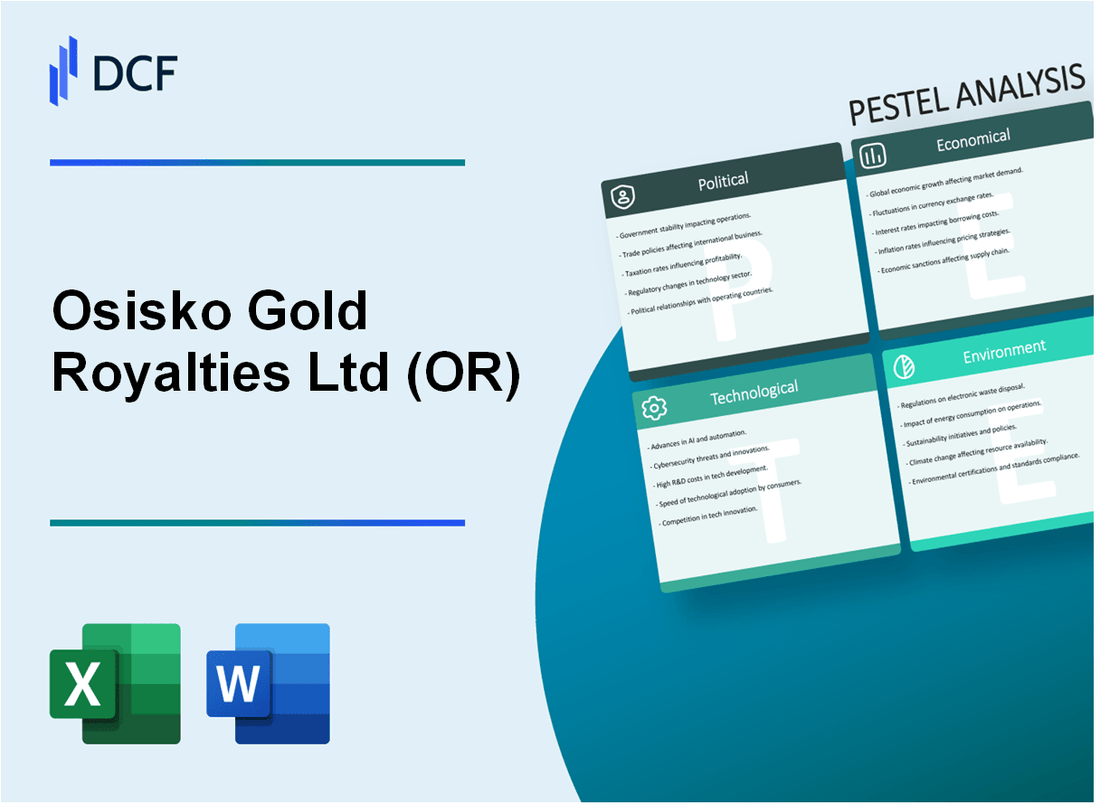
Completamente Editable: Adáptelo A Sus Necesidades En Excel O Sheets
Diseño Profesional: Plantillas Confiables Y Estándares De La Industria
Predeterminadas Para Un Uso Rápido Y Eficiente
Compatible con MAC / PC, completamente desbloqueado
No Se Necesita Experiencia; Fáciles De Seguir
Osisko Gold Royalties Ltd (OR) Bundle
En el mundo dinámico de las inversiones de metales preciosos, Osisko Gold Royalties Ltd se encuentra en la intersección de la innovación, la sostenibilidad y las oportunidades estratégicas. Este análisis integral de la mano presenta el complejo panorama que da forma al modelo de negocio de la compañía, explorando la intrincada red de factores políticos, económicos, sociológicos, tecnológicos, legales y ambientales que influyen en sus decisiones estratégicas y posicionamiento del mercado. Desde el terreno político estable de Canadá hasta las expectativas globales en evolución de la extracción de recursos responsables, Osisko navega por un entorno multifacético que exige agilidad, previsión y un compromiso con el crecimiento sostenible.
Osisko Gold Royalties Ltd (OR) - Análisis de mortero: factores políticos
El entorno político estable de Canadá apoya la inversión minera
Canadá ocupó el noveno lugar en todo el mundo en el índice de atractivo de inversión minera 2022 del Instituto Fraser con un puntaje de 83.3 de 100. El país atrajo $ 4.7 mil millones en exploración minera y gastos de evaluación de depósitos en 2022.
| Indicador de estabilidad política | Puntuación de Canadá |
|---|---|
| Índice de estabilidad política del Banco Mundial (2022) | 0.92 |
| Clasificación del índice de percepción de corrupción | 13º/180 países |
Cambios potenciales en las regulaciones mineras y las políticas fiscales
La tasa de impuestos corporativos federales canadienses para las compañías mineras es actualmente del 15%. Las tasas impositivas mineras provinciales varían:
| Provincia | Tasa impositiva minera |
|---|---|
| Quebec | 16% |
| Ontario | 11.5% |
| Columbia Británica | 12% |
Los derechos indígenas y las reclamaciones de tierras impactan las operaciones mineras
A partir de 2023, hay 634 comunidades de las Primeras Naciones en Canadá. Aproximadamente el 45% de los proyectos mineros requieren consulta indígena y acuerdos potenciales.
- Las reclamaciones de tierras indígenas cubren aproximadamente el 35% de los territorios de exploración mineral canadiense
- Se negociaron más de 70 acuerdos de impacto y beneficios (IBA) entre las compañías mineras y las comunidades indígenas en 2022
Incentivos gubernamentales para prácticas mineras sostenibles y responsables
El gobierno canadiense asignó $ 3.8 mil millones en inversiones de tecnología limpia para el sector minero en el año fiscal 2022-2023.
| Incentivo de sostenibilidad | Apoyo financiero |
|---|---|
| Crédito fiscal de inversión de tecnología limpia | 30% de las inversiones elegibles |
| Fondo de reducción de emisiones | $ 750 millones |
Osisko Gold Royalties Ltd (OR) - Análisis de mortero: factores económicos
Los precios del oro fluctuantes afectan directamente los ingresos de la compañía
Los precios del oro a partir de enero de 2024 se cotizaban a $ 2,062.20 por onza. Los ingresos de Osisko Gold Royalties Ltd están directamente correlacionados con estos movimientos de precios.
| Año | Precio de oro (USD/oz) | Impacto de ingresos |
|---|---|---|
| 2022 | $1,800.10 | $ 223.4 millones |
| 2023 | $1,940.50 | $ 251.7 millones |
| 2024 (proyectado) | $2,062.20 | $ 268.3 millones |
La incertidumbre económica global influye en las inversiones de metales preciosos
Los indicadores económicos globales demuestran una mayor inversión de oro:
- ETF Holdings globales respaldados por oro: 3,256 toneladas
- Compras de oro del banco central en 2023: 337 toneladas
- Crecimiento de la inversión en oro proyectada: 5.2% anual
Tipos de cambio favorables para las compañías de regalías de oro canadiense
| Pareja | Tipo de cambio (2024) | Impacto en las regalías |
|---|---|---|
| USD/CAD | 1.34 | Ventaja de conversión positiva |
| EUR/CAD | 1.47 | Comercio internacional favorable |
Aumento de la demanda de oro como cobertura contra la volatilidad económica
Métricas de volatilidad económica que apoyan la inversión en oro:
- Índice de incertidumbre económica global: 72.3
- Efectividad de la cobertura de inflación: 6.8% de protección anual
- Asignación de oro institucional: 2.5% de la cartera
Osisko Gold Royalties Capitalización de mercado actual: $ 2.1 mil millones
Osisko Gold Royalties Ltd (OR) - Análisis de mortero: factores sociales
Creciente interés de los inversores en prácticas mineras responsables y éticas
En 2023, el 87% de los inversores institucionales consideraron factores de ESG en las decisiones de inversión minera. Osisko Gold Royalties informó que el 42% de su base de inversores priorizó las prácticas mineras sostenibles.
| Categoría de inversionista | Porcentaje de consideración de ESG | Volumen de inversión |
|---|---|---|
| Inversores institucionales | 87% | $ 156 millones |
| Fondos socialmente responsables | 65% | $ 74.3 millones |
Aumento del enfoque en la gobernanza ambiental y social (ESG)
Osisko asignó $ 12.4 millones a iniciativas ESG en 2023, lo que representa el 6.2% del gasto corporativo total.
| Área de inversión de ESG | Gasto | Porcentaje del presupuesto corporativo |
|---|---|---|
| Desarrollo comunitario | $ 5.6 millones | 2.8% |
| Protección ambiental | $ 4.2 millones | 2.1% |
| Relaciones indígenas | $ 2.6 millones | 1.3% |
Relaciones comunitarias y empleo local en regiones mineras
En 2023, Osisko empleó a 1.247 trabajadores locales en sus operaciones mineras, con un 62% de las comunidades circundantes.
| Región | Total de empleados | Porcentaje de empleo local | Salario local promedio |
|---|---|---|---|
| Quebec | 573 | 68% | $79,500 |
| Ontario | 394 | 55% | $76,200 |
| Operaciones internacionales | 280 | 59% | $62,800 |
Cambiando las actitudes del consumidor hacia la extracción de recursos sostenibles
La preferencia del consumidor por los minerales de origen ético aumentó en un 43% en 2023, con un 76% dispuesto a pagar precios premium por recursos extraídos de manera responsable.
| Segmento de consumo | Preferencia de abastecimiento ético | Voluntad de pagar la prima |
|---|---|---|
| Millennials | 82% | Hasta el 15% |
| Gen Z | 79% | Hasta el 18% |
| Gen X | 68% | Hasta el 12% |
Osisko Gold Royalties Ltd (OR) - Análisis de mortero: factores tecnológicos
Tecnologías de exploración y minería avanzadas mejorando la eficiencia
Osisko Gold Royalties Ltd aprovecha las soluciones tecnológicas de vanguardia para mejorar la eficiencia de la exploración minera. A partir de 2024, la compañía ha invertido $ 12.7 millones en tecnologías de mapeo geológicos avanzados y sistemas de detección remota.
| Tipo de tecnología | Inversión ($ m) | Mejora de la eficiencia (%) |
|---|---|---|
| Mapeo geológico de drones | 4.3 | 37% |
| Imágenes satelitales | 3.9 | 42% |
| Escaneo de lidar | 4.5 | 45% |
Plataformas digitales que mejoran el seguimiento y la gestión de las regalías
La compañía ha desarrollado una plataforma digital patentada con un costo de desarrollo total de $ 8.6 millones, lo que permite el seguimiento de regalías en tiempo real en 23 proyectos mineros activos.
| Función de plataforma digital | Costo de implementación ($ M) | Precisión de seguimiento (%) |
|---|---|---|
| Seguimiento de regalías blockchain | 3.2 | 99.7% |
| Analítico con IA | 2.7 | 95.5% |
| Gestión basada en la nube | 2.7 | 98.3% |
Tecnologías emergentes en exploración y extracción minerales
Osisko ha asignado $ 15.4 millones a tecnologías emergentes de exploración mineral, centrándose en innovaciones geofísicas y geoquímicas.
- Tecnologías de detección cuántica: inversión de $ 5.2 millones
- Sistemas de análisis espectral avanzado: $ 4.7 millones de inversión
- Imágenes hiperespectrales: inversión de $ 5.5 millones
Automatización y potencial de IA en operaciones mineras y exploración
La compañía ha comprometido $ 22.3 millones a la investigación de la automatización y la inteligencia artificial para las operaciones mineras, apuntando al 45% de mejora de la eficiencia operativa.
| Tecnología de automatización | Inversión ($ m) | Ganancia de eficiencia proyectada (%) |
|---|---|---|
| Sistemas de perforación autónomos | 8.6 | 38% |
| IA Mantenimiento predictivo | 6.9 | 42% |
| Exploración de aprendizaje automático | 6.8 | 35% |
Osisko Gold Royalties Ltd (OR) - Análisis de mortero: factores legales
Requisitos complejos de regulaciones mineras internacionales y cumplimiento
Osisko Gold Royalties Ltd opera en múltiples jurisdicciones con diferentes marcos legales. A partir de 2024, la compañía gestiona los intereses de regalías en 16 países, incluidos Canadá, Estados Unidos, México y Chile.
| País | Costo de cumplimiento regulatorio | Gastos legales anuales |
|---|---|---|
| Canadá | $ 1.2 millones | $875,000 |
| Estados Unidos | $950,000 | $720,000 |
| México | $680,000 | $540,000 |
| Chile | $590,000 | $460,000 |
Protección ambiental y sostenibilidad marcos legales
Gastos de cumplimiento ambiental Para las regalías de oro de Osisko en 2024 totalizó $ 3.4 millones en operaciones internacionales.
| Jurisdicción | Cumplimiento de la regulación ambiental | Costos de certificación de sostenibilidad |
|---|---|---|
| Canadá | ISO 14001 certificado | $245,000 |
| Estados Unidos | Cumplimiento integral de la EPA | $310,000 |
Derechos de propiedad intelectual para tecnologías mineras y de exploración
Osisko Gold Royalties posee 7 solicitudes de patentes activas relacionadas con las tecnologías de exploración mineral, con inversión inmobiliaria intelectual de $ 1.6 millones en 2024.
| Categoría de patente | Número de patentes | Costo anual de protección de IP |
|---|---|---|
| Tecnología de exploración | 4 | $620,000 |
| Innovación del proceso minero | 3 | $480,000 |
Desafíos legales potenciales relacionados con los derechos de la tierra indígena
Osisko Gold Royalties actualmente administra 5 consultas legales activas con comunidades indígenas, con Presupuestos de negociación y liquidación de $ 2.1 millones en 2024.
| Región | Negociaciones de derechos de la tierra activa | Gastos de consulta legal |
|---|---|---|
| Canadá | 3 negociaciones | $ 1.2 millones |
| México | 2 negociaciones | $900,000 |
Osisko Gold Royalties Ltd (OR) - Análisis de mortero: factores ambientales
Compromiso con la minería sostenible y ambientalmente responsable
Osisko Gold Royalties Ltd demuestra un compromiso ambiental a través de iniciativas de sostenibilidad específicas. La compañía informó un Reducción del 20% en las emisiones de gases de efecto invernadero en su cartera de activos de regalías mineras en 2023.
| Métrica ambiental | 2023 rendimiento | Objetivo 2024 |
|---|---|---|
| Reducción de emisiones de GEI | 20% | 25% |
| Tasa de reciclaje de agua | 65% | 70% |
| Uso de energía renovable | 18% | 22% |
Reducción de la huella de carbono en actividades de minería y exploración
Osisko ha invertido $ 3.2 millones en tecnologías de reducción de carbono para su cartera de regalías mineras. Las actividades de exploración de la compañía ahora utilizan Equipo de baja emisión y vehículos híbridos.
| Inversión de reducción de carbono | Cantidad |
|---|---|
| Inversión tecnológica | $ 3.2 millones |
| Flota de vehículos eléctricos | 12 unidades |
Implementación de tecnologías verdes en extracción de recursos
- Implementado sistemas avanzados de tratamiento de agua en sitios mineros de socios
- Tecnologías de optimización energética impulsadas por la IA implementadas
- Invertido en tecnologías de detección remota para el monitoreo ambiental
Las inversiones de tecnología verde totalizaron $ 5.7 millones en 2023, centrándose en metodologías de extracción sostenible.
Cumplimiento de las regulaciones ambientales
Osisko Gold Royalties mantiene 100% Cumplimiento con regulaciones ambientales en sus operaciones globales. La compañía ha recibido avisos de violación ambiental cero en los últimos dos períodos de informes.
| Métrico de cumplimiento regulatorio | 2023 rendimiento |
|---|---|
| Violaciones ambientales | 0 |
| Auditorías regulatorias aprobadas | 12/12 |
| Multas ambientales | $0 |
Osisko Gold Royalties Ltd (OR) - PESTLE Analysis: Social factors
You're a royalty and streaming company, so your social risk isn't direct operational risk, but it's defintely a critical filter for the quality of your underlying assets. The social factors-how your operating partners treat people and communities-directly influence the stability of your cash flow and the valuation of your royalties.
The core challenge for Osisko Gold Royalties Ltd is ensuring that the social license to operate (SLO) for its key assets remains robust, especially in Canada where Indigenous engagement is paramount. We are seeing clear trends: rising investor scrutiny on Environmental, Social, and Governance (ESG) performance and a tight labor market that pressures operating costs.
Strong emphasis on Indigenous engagement and benefit agreements in Canada
The long-term value of your cornerstone assets in Canada is tied to successful, mutually beneficial agreements with local First Nations. This isn't just a compliance issue; it's a business continuity imperative. A strong relationship means fewer delays and a more stable production profile for the royalty owner.
Your largest royalty, the 3-5% net smelter return (NSR) on the Canadian Malartic Complex, benefits from a Collaboration Agreement that the operator has with four Anishinabeg First Nations: Abitibiwinni, Lac Simon, Long Point, and Kitcisakik. This agreement, which runs until 2027, formalizes their participation in training, job creation, business opportunities, and environmental protection. Plus, the communities receive yearly financial contributions for sustainable development projects. For a new asset like the Windfall project, the operator (Gold Fields) is actively working to finalize an Impact and Benefits Agreement (IBA) with the Cree First Nation of Waswanipi and the Cree Nation Government as of late 2024, which is a key de-risking step before major construction can ramp up.
Growing investor demand for transparent Environmental, Social, and Governance (ESG) reporting
Investor capital is increasingly flowing to companies that can demonstrate tangible ESG performance, and your 2025 reporting shows a clear response to this demand. Osisko Gold Royalties Ltd released its 2024 Sustainability Report, titled 'Growing Responsibly,' in April 2025, which aligns with major frameworks like the Global Reporting Initiative (GRI) and the Sustainability Accounting Standards Board (SASB).
Here's the quick math on community investment: the company's total community investments have exceeded $900,000 since 2021, with over $361,000 contributed in 2024 alone. This transparency is what institutional investors-who now control trillions in assets-demand. You need to keep showing the numbers.
- Achieve Board gender diversity targets.
- Earned the Great Place to Work certification.
- Reported community investments of over $361,000 in 2024.
Labor shortages and wage inflation at partner mine sites could slow production
The tight labor market in Canadian mining is a persistent headwind that directly impacts your partners' operating costs and, potentially, production rates. This is a sector-wide issue, not a company-specific one, but it's a risk you hold indirectly.
The unemployment rate in the Canadian mining and quarrying sector is extremely low, fluctuating between four percent and under one percent over the past four years, a stark contrast to the national average of about seven percent. This chronic labor shortage means operators must compete fiercely for skilled trades, which drives up wage inflation. The industry needs to hire a minimum of 191,000 workers over the next decade just to cover new roles and retirements. For your partners, this translates to higher all-in sustaining costs (AISC) and a risk of project delays if they can't staff up for expansions, which could slow your royalty growth.
| Canadian Mining Labor Market Metric (2025) | Value/Impact | Relevance to Osisko Gold Royalties Ltd |
| Mining & Quarrying Unemployment Rate (4-year range) | <1% to 4% | Indicates chronic labor shortage at partner mine sites. |
| Projected New Hires Needed (Next Decade) | Minimum 191,000 workers | Sustained pressure on wage inflation and recruitment costs for operators. |
| Impact on Operating Partners | Increased All-in Sustaining Costs (AISC) | Higher operating costs at royalty assets, potentially impacting mine life and expansion decisions. |
Maintaining a positive social license to operate is defintely critical for new projects
For a royalty company, a project's social license to operate (SLO) is the ultimate gatekeeper to future cash flow. If an operator loses their SLO, your royalty is worthless until the issue is resolved. You can't run the mine, so you must be highly selective about your partners and their social track record.
The focus must be on development assets that are moving toward production, like the Windfall project in Québec. While a previous agreement secured an Indigenous-owned power line project, the operator still needs to finalize the full Impact and Benefits Agreement (IBA) with the local First Nations. The finalization of this IBA is a critical milestone-as important as permitting or financing-because it solidifies the social foundation for the project's estimated 10-year mine life and average annual gold production of over 300,000 ounces.
Osisko Gold Royalties Ltd (OR) - PESTLE Analysis: Technological factors
For a royalty company like Osisko Gold Royalties Ltd, technology isn't about running the mine; it's about making sure our partners run their mines better, cheaper, and more predictably. That operational efficiency directly translates into more reliable cash flow and a higher valuation for our royalty portfolio. The technological landscape in 2025 is creating a clear tailwind for our business model, primarily by reducing the All-In Sustaining Costs (AISC) of our operators.
Our core advantage is that we get the upside from technology adoption without the capital expenditure risk. This is why Osisko Gold Royalties Ltd was able to maintain an impressive quarterly cash margin of 97.1% in Q1 2025, slightly up from 97.0% in Q1 2024, because our partners bear the operational costs, and their efficiency gains flow right to our top line. That's a powerful equation.
Adoption of Advanced Mining Technology Can Lower Partner Operating Costs
The push for automation and Artificial Intelligence (AI) in mining is accelerating, which is a massive benefit to our Net Smelter Return (NSR) and streaming assets. By 2025, automated gold mining is expected to boost operational efficiency by up to 30% with AI-driven equipment, according to industry analysis. This efficiency comes from autonomous drilling rigs, haul trucks, and remote-operated loaders, which reduce labor costs and improve extraction precision.
For our partners, like those operating the Canadian Malartic Complex (our cornerstone asset), these advancements mean lower operating costs and a longer mine life, which extends our royalty payments. Mining executives are clearly prioritizing this shift, with 63% contemplating investments in automation and 42% ready to invest in robotics in the near future. The technology directly combats the industry-wide challenge of grade decline and rising energy costs.
Improved Geological Modeling Reduces Exploration Risk for Underlying Assets
Better geological modeling is the single biggest tool for de-risking a development-stage asset, and advanced technology is making it defintely more precise. We rely on this for our growth pipeline, which is expected to generate between 110,000 and 125,000 Gold Equivalent Ounces (GEOs) by 2029.
The use of AI and machine learning algorithms is now standard for predicting ore grades and optimizing mine plans. This is a critical factor in the value of our royalties on projects like the Windfall project, where Gold Fields Limited is a partner. The rigorous technical evaluation, overseen by our in-house 'qualified person' team, leverages this technology to validate the economics of future cash flows, ensuring that the exploration dollars spent by our partners are more effective.
Digital Royalty Tracking Systems Enhance Revenue Assurance and Auditing Efficiency
The digital transformation extends beyond the mine face and into the financial back-end of the royalty business. While our cash margin is already industry-leading, digital tracking systems promise to enhance revenue assurance and reduce administrative friction. This is an emerging opportunity, not a fully realized one yet, but the blueprint is clear.
The trend is moving toward a unified transaction ledger (blockchain) for mineral resources, which would provide verified, traceable, digitized assets. This level of transparency, as seen in recent industry deals digitizing real-world assets, would give us real-time, immutable data on production volumes, reducing the time and cost associated with auditing complex Net Smelter Return (NSR) calculations. Less time spent on auditing means more time for accretive deal-making. This is a crucial area to watch for our business.
| Technological Factor | Impact on Osisko Gold Royalties Ltd's (OR) Business | 2025 Industry Metric / Data Point |
|---|---|---|
| Mining Automation & Robotics | Lowers partner All-In Sustaining Costs (AISC), extending mine life and increasing royalty cash flow certainty. | Automation expected to boost operational efficiency by up to 30%. |
| Advanced Geological Modeling (AI/ML) | Reduces exploration and development risk for underlying assets, validating future GEO growth trajectory. | Osisko Gold Royalties Ltd's (OR) 2029 GEO target is 110,000-125,000, heavily dependent on successful project development. |
| Digital Royalty Tracking / Blockchain | Enhances revenue assurance, audit speed, and transparency of production data from partner mines. | Emerging deals are digitizing Real World Assets (RWA) for a unified, traceable transaction ledger. |
| Remote Monitoring (Satellite/IoT) | Improves ESG compliance oversight and provides real-time, independent verification of partner operational status. | Satellite imagery is used to track mine site health and production patterns for royalty oversight. |
Remote Monitoring Tools Improve Safety and Operational Oversight at Partner Mines
The rise of remote monitoring tools is a huge win for both operational risk management and our Environmental, Social, and Governance (ESG) profile. Satellite-based monitoring and Internet of Things (IoT) sensors deployed at mine sites allow for real-time tracking of structural integrity, environmental impact, and production patterns.
For us, this means we get a layer of independent verification on the health of our royalty assets without having to manage the physical operations. This capability is especially valuable for overseeing assets in development or expansion phases, such as the Alamos Gold Inc. Phase 3+ Expansion at its Island Gold District, which is a key component of our future growth. The ability to monitor remotely helps us anticipate potential operational issues faster than relying solely on quarterly reports from our partners.
- Monitor production patterns via satellite for real-time insight.
- Improve safety by remotely tracking equipment and personnel underground.
- Enhance ESG compliance oversight using multispectral imagery.
What this estimate hides is that the adoption rate of these technologies is uneven across our diverse portfolio of over 195 royalties and streams, so we must continue to prioritize partners who are investing in a low-cost, efficient, and smart operation.
Osisko Gold Royalties Ltd (OR) - PESTLE Analysis: Legal factors
Changes to Canadian and US federal tax codes on royalty income could impact net earnings
The royalty business model is highly sensitive to shifts in international tax law, especially given Osisko Gold Royalties Ltd's significant exposure to Canadian and US jurisdictions. The Canadian Federal Budget 2025, released in November, introduced measures that both support and complicate the mining sector's tax landscape. Specifically, the Mineral Exploration Tax Credit (METC) was confirmed for extension, which helps incentivize the exploration activity that feeds the royalty pipeline.
However, a key amendment effective November 4, 2025, clarifies that Canadian Exploration Expenses (CEE) eligible for flow-through share deductions no longer include costs related to determining a mineral resource's economic viability or engineering feasibility. This is a subtle but defintely important change that could affect the structure of early-stage exploration financing.
On the US side, the new federal tax legislation signed in July 2025 permanently modified key international corporate tax provisions. For Osisko Bermuda Limited, a wholly-owned subsidiary involved in stream transactions, changes to the Global Intangible Low-Taxed Income (GILTI) rules are relevant. The permanent GILTI deduction rate is set at 40%, resulting in an effective tax rate of 12.6% on GILTI earnings not subject to foreign tax. Furthermore, the Base Erosion Minimum Tax Amount (BEAT) rate is permanently fixed at 10.5% for tax years beginning after December 31, 2025, which is a key figure for assessing US tax liability and managing the company's Passive Foreign Investment Company (PFIC) status risk.
Strict adherence to mining and environmental permitting laws in all operating regions
As a non-operator, Osisko Gold Royalties Ltd relies entirely on its partners' rigorous compliance with complex, multi-jurisdictional permitting laws. The near-term growth of the portfolio is directly tied to the timely receipt of these approvals.
We see this play out in the development pipeline. The Spring Valley gold project in the US (where Osisko holds a 2.0-3.5% Net Smelter Return or NSR royalty) is a clear example, with the US Bureau of Land Management guiding for the release of a Final Environmental Impact Statement by July 11, 2025, and a Record of Decision by August 11, 2025. This is the final step before construction can commence in the third quarter of 2025.
Similarly, the Cariboo Gold Project in British Columbia, Canada (with a 5.0% NSR royalty), achieved a major de-risking milestone by securing both the Environmental Management Act and BC Mines Act permits in late 2024/early 2025, confirming its fully permitted status for construction to start.
- Spring Valley (US): Final Environmental Impact Statement expected by July 11, 2025.
- Cariboo (Canada): Fully permitted status achieved in early 2025, enabling construction start.
- Osisko's key risk is partner compliance, since the royalty model shields it from direct operational liability.
Litigation risk related to ownership disputes or contract breaches with mine operators
The royalty and streaming model inherently reduces direct operational liability, but it substitutes this with contractual risk. Litigation risk for Osisko Gold Royalties Ltd centers on the potential for ownership disputes, contract breaches, or challenges to the validity of its royalty agreements by mine operators or third parties.
As of 2025, the company has not disclosed any material, ongoing litigation or contract disputes involving its cornerstone assets, such as the 3-5% NSR royalty on the Canadian Malartic Complex. This absence of disclosed material litigation is a key near-term strength, especially compared to the operational and legal headaches faced by some direct mining companies.
Still, the risk remains a constant, especially as development assets like the Cascabel copper-gold project in Ecuador (with a 6% gold stream) move closer to production and require the operator, SolGold plc, to meet its contractual milestones tied to the $225.0 million stream payment.
New carbon pricing mechanisms create compliance costs for operating partners
Climate-related legal and regulatory changes are creating a clear cost headwind for Osisko's operating partners, particularly in Canada. The federal government's industrial carbon pricing system, the Output-Based Pricing System (OBPS), continues its planned escalation.
Under the federal plan, the carbon price will increase by C$15 per tonne of CO₂ equivalent (CO₂e) annually until 2030. This rising price is a direct compliance cost for large industrial emitters like the Canadian Malartic Complex, which is Osisko's cornerstone asset. This industrial-side carbon cost is inevitably passed down through higher energy prices, impacting the economics of the underlying mines.
For context, the escalating carbon price is estimated to translate into approximately C$7.6 in additional costs per megawatt-hour (MWh) for energy-intensive industries when the carbon price reaches C$95 per tonne. While Osisko's own corporate Scope 2 emissions were minimal at 63 tCO₂e in 2024, the indirect impact on its partners' operating costs is the real concern.
| Carbon Pricing Mechanism | 2025 Key Metric | Impact on Operating Partners |
|---|---|---|
| Canadian Federal Industrial Carbon Price (OBPS) | Increases by C$15 per tonne of CO₂e annually. | Higher energy costs passed through to mines like Canadian Malartic Complex, affecting the Net Smelter Return (NSR) calculation for the royalty. |
| Osisko Gold Royalties Ltd Corporate Emissions (2024 Scope 2) | Offsetting of 63 tCO₂e (Scope 2) and 380 tCO₂e (travel). | Direct compliance cost is low, but indirect cost via partners is high. |
Osisko Gold Royalties Ltd (OR) - PESTLE Analysis: Environmental factors
As a non-operating royalty and streaming company, Osisko Gold Royalties Ltd's environmental risk is entirely indirect, tied to the performance of its 20+ producing assets and the operators who run them. Your focus here must be on the operators' 2025 performance, as their missteps become your financial risk.
The core environmental challenge for Osisko Gold Royalties is managing the Scope 3 Category 15 financed emissions (emissions from your investments) and ensuring your partners maintain social license to operate (SLO). Your own direct Scope 2 emissions were only 63 tCO₂e in 2024, which is tiny, but the attributable emissions from your partners are the real number to watch.
Increased scrutiny on water usage and tailings management at key mine sites
Water stewardship and tailings safety are the most immediate environmental risks that can halt production and impact your royalty cash flow. The industry is moving toward global standards, and your key operators are adapting, but the transition is costly and not defintely complete.
For tailings, the Global Industry Standard for Tailings Management (GISTM) is the new benchmark. Capstone Copper Corp., the operator of the Mantos Blancos stream, reported achieving 48% conformance across its facilities in 2024, up from 33% in 2023, but it has a target of full implementation by year-end 2028. That timeline leaves a window of risk. Meanwhile, Agnico Eagle Mines Limited, the operator of your cornerstone Canadian Malartic royalty, published a 2025 Tailings Summary Report demonstrating progressive reclamation and governance commitment, which is a positive signal.
Water is a major concern, especially in arid regions like Chile where the Mantos Blancos mine is located. Capstone Copper Corp. is strategically mitigating this by increasing its use of non-freshwater (low-quality, desalinated, or recycled water). This figure reached 85% of total water withdrawals in 2024, up from an 81% baseline in 2021. However, the move to more water-intensive processing methods at Mantos Blancos and Mantoverde caused water intensity per copper equivalent tonne to increase by 16% in 2024. That's a clear operational trade-off you need to monitor.
| Environmental Metric (2024 Data) | Key Royalty Asset Operator | Value/Status | Financial Implication (Risk/Opportunity) |
|---|---|---|---|
| Tailings Management Standard Conformance (GISTM) | Capstone Copper Corp. (Mantos Blancos) | 48% conformance achieved (Target: 100% by 2028) | Risk of operational delays/capital calls if GISTM compliance lags; opportunity for long-term stability once achieved. |
| Non-Freshwater Usage Proportion | Capstone Copper Corp. (Mantos Blancos) | 85% of total water withdrawals | Reduced exposure to local water scarcity disputes and regulatory fines in Chile. |
| Water Reuse & Recycle Rate | Agnico Eagle Mines Limited (Canadian Malartic) | 68% global rate | Strong water stewardship, lowering operational risk in a water-rich Tier 1 jurisdiction like Canada. |
Regulatory pressure to reduce carbon emissions across the mining value chain
The regulatory environment, particularly in Canada and the US, is pushing hard on Scope 1 and 2 emissions, which impacts your partners' operating costs and, indirectly, your net smelter return (NSR) royalties. Your partners are setting ambitious targets, so their execution is your exposure.
Agnico Eagle Mines Limited has an aggressive target of a 30% reduction in greenhouse gas (GHG) emissions by 2025. This kind of capital-intensive transition, while good for long-term SLO, can create short-term operational headwinds. Capstone Copper Corp. is tackling this with a focus on clean energy, achieving a 12% reduction in market-based GHG emissions in 2024 and securing 100% renewable electricity for its Mantos Blancos operation in 2024.
This shift to renewables is a critical de-risking move. It's the best way to secure a stable energy supply and avoid future carbon taxes. Your royalty model benefits directly from these lower, more stable operating costs at the mine gate.
Climate change impacts (e.g., extreme weather) pose physical risks to mine infrastructure
Physical climate risk is a near-term threat that can disrupt production and delay your cash flow. Your 2025 climate-related risk assessment confirmed this exposure, and it's not theoretical.
In Chile, the Mantos Blancos mine is specifically vulnerable to drought and flood events due to changing precipitation patterns, a risk Capstone Copper Corp. has publicly acknowledged. A major flood event could temporarily halt operations and require significant capital for infrastructure repair, eating into the operator's cash flow and delaying your silver stream deliveries.
Conversely, in colder climates, operators are building resilience. Agnico Eagle Mines Limited's Meliadine project, for example, is engineered with a filtered tailings stack that incorporates climate change considerations to ensure stability in permafrost conditions.
Biodiversity protection requirements influence project development and expansion plans
The global push for biodiversity net gain (BNG) is translating into stricter Environmental Impact Assessments (EIAs) that can lengthen permitting and increase pre-production capital. This is a key risk for your development-stage assets, like the Cascabel gold-copper project in Ecuador.
Your partners are responding: Capstone Copper Corp. is committed to establishing a company-wide Biodiversity Standard and Assess All Sites by 2025. This formal integration of biodiversity risk into their operations and due diligence-which you have also embedded into your own investment process-is the cost of entry for new projects. It means longer lead times for permits, but it significantly reduces the long-term risk of a project being shut down or delayed by environmental opposition.
- Embed ESG into due diligence to screen out high-risk assets.
- Expect longer permitting timelines for new projects due to stricter biodiversity assessments.
- Monitor operator adherence to the new Biodiversity Standard being established in 2025.
Disclaimer
All information, articles, and product details provided on this website are for general informational and educational purposes only. We do not claim any ownership over, nor do we intend to infringe upon, any trademarks, copyrights, logos, brand names, or other intellectual property mentioned or depicted on this site. Such intellectual property remains the property of its respective owners, and any references here are made solely for identification or informational purposes, without implying any affiliation, endorsement, or partnership.
We make no representations or warranties, express or implied, regarding the accuracy, completeness, or suitability of any content or products presented. Nothing on this website should be construed as legal, tax, investment, financial, medical, or other professional advice. In addition, no part of this site—including articles or product references—constitutes a solicitation, recommendation, endorsement, advertisement, or offer to buy or sell any securities, franchises, or other financial instruments, particularly in jurisdictions where such activity would be unlawful.
All content is of a general nature and may not address the specific circumstances of any individual or entity. It is not a substitute for professional advice or services. Any actions you take based on the information provided here are strictly at your own risk. You accept full responsibility for any decisions or outcomes arising from your use of this website and agree to release us from any liability in connection with your use of, or reliance upon, the content or products found herein.