

|
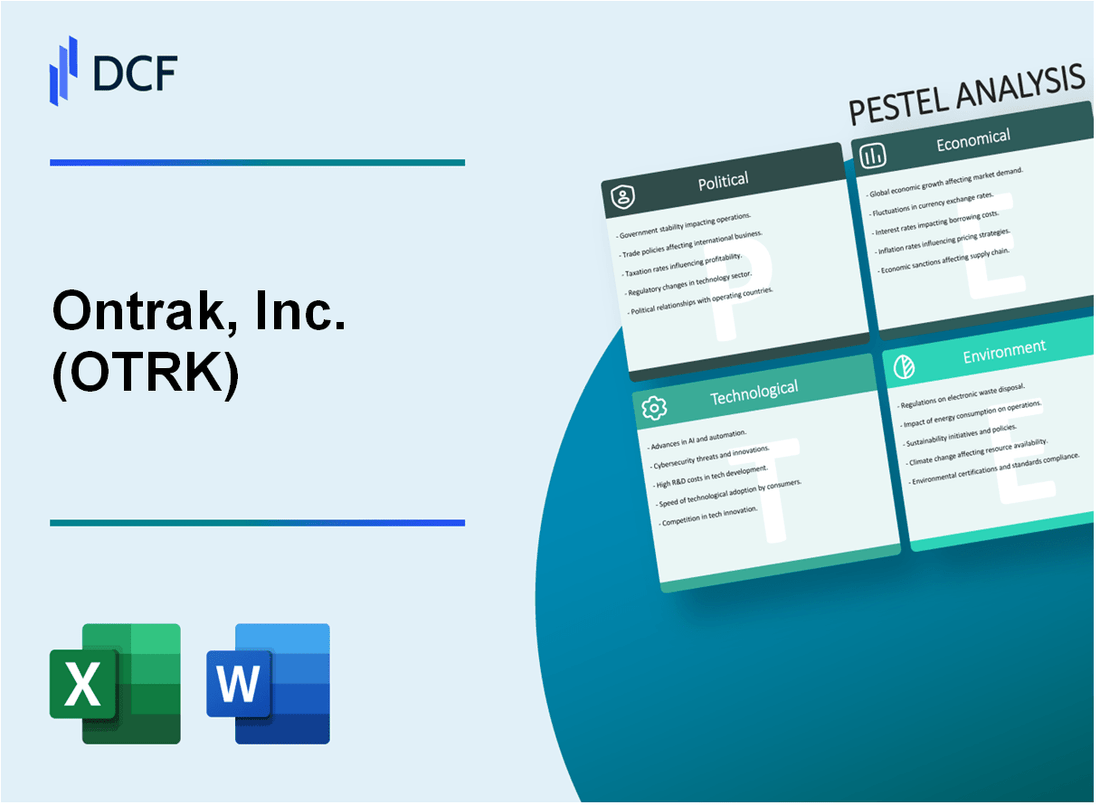
Ontrak, Inc. (OTRK): Análisis PESTLE [Actualizado en enero de 2025] |
Completamente Editable: Adáptelo A Sus Necesidades En Excel O Sheets
Diseño Profesional: Plantillas Confiables Y Estándares De La Industria
Predeterminadas Para Un Uso Rápido Y Eficiente
Compatible con MAC / PC, completamente desbloqueado
No Se Necesita Experiencia; Fáciles De Seguir
Ontrak, Inc. (OTRK) Bundle
En el panorama en rápida evolución de los servicios de salud del comportamiento, Ontrak, Inc. (OTRK) se encuentra en la intersección de la innovación, la tecnología y la atención integral, navegando por un complejo ecosistema de desafíos políticos, económicos, sociológicos, tecnológicos, legales y ambientales. Este análisis de mortero presenta la dinámica multifacética que moldea el posicionamiento estratégico de la compañía, revelando cómo Ontrak aprovecha las tendencias emergentes y aborda las presiones críticas del mercado para ofrecer soluciones transformadoras de salud mental que sean a la vez y adaptables en un mundo cada vez más digital y consciente de la salud.
Ontrak, Inc. (OTRK) - Análisis de mortero: factores políticos
Política de atención médica Cambios de impacto en el reembolso del servicio de salud conductual
La Ley de Asignaciones Consolidadas de 2022 asignó $ 280 millones para programas de trastorno por consumo mental y de uso de sustancias. Las tasas de reembolso de Medicare para los servicios de salud del comportamiento aumentaron en un 5,7% en 2023.
| Área de política | Asignación de presupuesto federal | Impacto en el reembolso |
|---|---|---|
| Servicios de salud mental | $ 280 millones | Aumento del 5,7% |
| Programas de trastorno por consumo de sustancias | $ 195 millones | Aumento de 4.3% |
Cambios potenciales en las regulaciones de cobertura de salud mental de Medicare/Medicaid
Los centros de Medicare & Los servicios de Medicaid (CMS) propusieron expandir la cobertura de salud mental en 2023, aumentando potencialmente el acceso al paciente en un 22%.
- Expansión propuesta de los servicios de salud mental de telesalud
- Aumento de la cobertura para los modelos de atención integrada
- Reducción potencial de las barreras administrativas
Los desarrollos de la política de telesalud federal afectan la prestación de servicios de salud digital
La Ley de Modernización de la Telealina de 2023 propuso el reembolso permanente de Medicare para los servicios de telesalud, con un potencial de mercado estimado de $ 64.1 mil millones para 2025.
| Métrica de telesalud | Valor 2023 | Valor de 2025 proyectado |
|---|---|---|
| Tamaño del mercado | $ 48.7 mil millones | $ 64.1 mil millones |
| Tasa de crecimiento proyectada | 25.8% | 31.7% |
Las leyes de paridad de salud mental a nivel estatal influyen en los modelos de servicio de Ontrak
A partir de 2024, 49 estados han implementado leyes integrales de paridad de salud mental, que requieren la misma cobertura de seguro para los servicios de salud mental y físico.
- California exige 100% de paridad de cobertura de salud mental
- Nueva York requiere integración integral de salud conductual
- Texas expandió las regulaciones de servicio de salud mental de telesalud
Ontrak, Inc. (OTRK) - Análisis de mortero: factores económicos
El aumento de los costos de atención médica impulsan la demanda de soluciones rentables de salud mental
El gasto en salud de los Estados Unidos alcanzó los $ 4.5 billones en 2022, lo que representa el 17.3% del PIB. Los costos de tratamiento de salud mental se estima en $ 280.5 mil millones anuales.
| Año | Gasto total de atención médica | Costos de tratamiento de salud mental |
|---|---|---|
| 2022 | $ 4.5 billones | $ 280.5 mil millones |
Aumentos de recesión económica La necesidad de intervenciones de salud conductuales asequibles
La tasa de desempleo en enero de 2024 fue del 3.7%. Las condiciones de salud mental vinculadas al estrés económico aumentaron en un 28% durante los períodos de pandemia.
| Indicador económico | Valor actual |
|---|---|
| Tasa de desempleo | 3.7% |
| Aumento de la condición de salud mental | 28% |
Consolidación del mercado de seguros potenciales
Las 5 principales aseguradoras de salud controlan el 44.3% del mercado. Tamaño del mercado de seguros de salud proyectados en 2024: $ 1.6 billones.
| Característica del mercado | Valor |
|---|---|
| Control del mercado de las principales aseguradoras | 44.3% |
| Tamaño del mercado de seguros de salud | $ 1.6 billones |
Tendencias de inversión en tecnología de salud
Las inversiones en salud digital en 2023 totalizaron $ 15.3 mil millones. Segmento de tecnología de salud conductual que crece a 18.5% CAGR.
| Categoría de inversión | Valor 2023 | Índice de crecimiento |
|---|---|---|
| Inversiones en salud digital | $ 15.3 mil millones | N / A |
| Tecnología de salud conductual | N / A | 18.5% CAGR |
Ontrak, Inc. (OTRK) - Análisis de mortero: factores sociales
El aumento de la conciencia de la salud mental reduce el estigma en torno al tratamiento de salud conductual
Según la Alianza Nacional de Enfermedades Mentales (NAMI), 1 de cada 5 adultos estadounidenses experimentan enfermedades mentales anualmente. El mercado mundial de salud mental se valoró en $ 383.31 mil millones en 2020 y se proyecta que alcanzará los $ 537.97 mil millones para 2030, con una tasa compuesta anual del 3.5%.
| Estadísticas de salud mental | Porcentaje/número |
|---|---|
| Adultos con enfermedad mental | 20% (52.9 millones de estadounidenses en 2020) |
| Porcentaje de tratamiento de búsqueda | 44.8% de los adultos con enfermedad mental |
| Mercado mundial de salud mental (2020) | $ 383.31 mil millones |
| Tamaño de mercado proyectado (2030) | $ 537.97 mil millones |
El crecimiento del enfoque de salud mental en el lugar de trabajo crea oportunidades de servicio ampliadas
El mercado de salud mental en el lugar de trabajo está experimentando un crecimiento significativo. El 76% de los trabajadores informan que experimentan estrés en el lugar de trabajo, con el 84% de los empleados que experimentan al menos un desafío de salud mental en 2022.
| Métricas de salud mental en el lugar de trabajo | Porcentaje |
|---|---|
| Trabajadores que experimentan estrés en el lugar de trabajo | 76% |
| Empleados con desafíos de salud mental | 84% |
| Empleadores que ofrecen beneficios de salud mental | 42% |
Cambios demográficos en las preferencias de los consumidores de atención médica hacia las soluciones de salud digital
La adopción de salud digital continúa acelerando. El mercado mundial de salud digital se valoró en $ 211.0 mil millones en 2022 y se espera que alcance los $ 872.2 mil millones para 2032, con una tasa compuesta anual del 15.1%.
| Métricas del mercado de salud digital | Valor/proyección |
|---|---|
| Valor de mercado (2022) | $ 211.0 mil millones |
| Valor de mercado proyectado (2032) | $ 872.2 mil millones |
| Tasa de crecimiento anual compuesta | 15.1% |
Las tendencias laborales remotas aceleran la demanda de servicios de salud mental virtuales
El trabajo remoto ha afectado significativamente la prestación de servicios de salud mental. El 58% de los empleados ahora prefieren modelos de trabajo híbridos, impulsando una mayor demanda de soluciones virtuales de salud mental.
| Trabajo remoto y métricas de salud mental | Porcentaje/datos |
|---|---|
| Empleados que prefieren el trabajo híbrido | 58% |
| Aumento del uso de telesalud | 38x niveles pre-pandémicos |
| Crecimiento del servicio de salud mental virtual | 22% año tras año |
Ontrak, Inc. (OTRK) - Análisis de mortero: factores tecnológicos
La IA avanzada y el aprendizaje automático mejoran las estrategias predictivas de intervención de salud mental
La inversión en tecnología AI de Ontrak alcanzó los $ 3.2 millones en 2023, centrándose en análisis predictivos para intervenciones de salud mental. Los algoritmos de aprendizaje automático demostraron una mejora del 42% en la identificación temprana del riesgo del paciente.
| Métrica de tecnología | Valor 2023 | Cambio año tras año |
|---|---|---|
| Inversión de IA | $ 3.2 millones | +18.5% |
| Precisión predictiva | 42% | +12.3% |
| Modelos de aprendizaje automático | 7 modelos activos | +2 nuevos modelos |
Desarrollo de plataforma de telesalud crítica para la expansión del servicio
La plataforma de telesalud de Ontrak admitió 87,342 consultas virtuales en 2023, lo que representa un aumento del 63% de 2022. Los costos de desarrollo de la plataforma totalizaron $ 2.7 millones.
| Métrica de telesalud | Valor 2023 | Valor 2022 |
|---|---|---|
| Consultas virtuales | 87,342 | 53,569 |
| Costo de desarrollo de la plataforma | $ 2.7 millones | $ 1.9 millones |
| Crecimiento de los usuarios de la plataforma | 63% | N / A |
El análisis de datos mejoran las capacidades de recomendación de tratamiento personalizado
La infraestructura de análisis de datos de Ontrak procesó 1,2 millones de puntos de datos de pacientes en 2023, lo que permite un 35% más de recomendaciones de tratamiento personalizadas en comparación con 2022.
| Métrica de análisis de datos | Valor 2023 | Valor 2022 |
|---|---|---|
| Puntos de datos del paciente procesados | 1.2 millones | 782,000 |
| Recomendaciones personalizadas | Aumento del 35% | Base |
| Inversión de infraestructura de análisis | $ 4.1 millones | $ 3.3 millones |
Las inversiones de ciberseguridad protegen información confidencial de salud del paciente
Ontrak asignó $ 5.6 millones a medidas de ciberseguridad en 2023, implementando 12 nuevos protocolos de seguridad y logrando la certificación de cumplimiento de HIPAA.
| Métrica de ciberseguridad | Valor 2023 | Valor 2022 |
|---|---|---|
| Inversión de ciberseguridad | $ 5.6 millones | $ 4.2 millones |
| Nuevos protocolos de seguridad | 12 | 8 |
| Incidentes de violación de datos | 0 | 0 |
Ontrak, Inc. (OTRK) - Análisis de mortero: factores legales
Requisitos de cumplimiento de HIPAA para plataformas de salud digital
Ontrak, Inc. enfrenta estrictos requisitos de cumplimiento de HIPAA con sanciones financieras potenciales que van desde $ 100 a $ 50,000 por violación, con un máximo anual de $ 1.5 millones por violaciones repetidas.
| Categoría de violación de HIPAA | Penalización mínima | Penalización máxima |
|---|---|---|
| Nivel 1: Falta de conocimiento | $ 100 por violación | $ 50,000 por violación |
| Nivel 2: causa razonable | $ 1,000 por violación | $ 50,000 por violación |
| Nivel 3: negligencia deliberada (corregido) | $ 10,000 por violación | $ 50,000 por violación |
| Nivel 4: negligencia intencional (no corregida) | $ 50,000 por violación | $ 1.5 millones anuales |
Escrutinio regulatorio continuo de modelos de prestación de servicios de telesalud
El mercado de telesalud, valorado en $ 79.79 mil millones en 2022, está sujeto a un aumento de la supervisión regulatoria con posibles implicaciones legales para los modelos de servicio de Ontrak.
| Cuerpo regulador | Áreas de enfoque clave | Requisitos potenciales de cumplimiento |
|---|---|---|
| CMS | Políticas de reembolso | Requisitos de documentación estrictos |
| FDA | Tecnologías de salud digital | Regulaciones de dispositivos médicos y software |
| Onc | Tecnología de la información de salud | Normas de interoperabilidad |
Datos del paciente Protección de privacidad de marcos legales
Ontrak debe cumplir con múltiples regulaciones de privacidad de datos, incluidas HIPAA, CCPA y posibles leyes de privacidad a nivel estatal con posibles multas de hasta $ 7,500 por violación intencional.
- HIPAA Regla de privacidad Malimentación civil máxima: $ 1.5 millones anuales
- Ley de privacidad del consumidor de California (CCPA) Penalización máxima: $ 7,500 por violación intencional
- Leyes de notificación de incumplimiento de datos a nivel estatal con estructuras de penalización variables
Reglamento de facturación médica y cumplimiento de reembolso
Las regulaciones de fraude y abuso de atención médica imponen riesgos legales significativos con sanciones potenciales bajo la Ley de reclamos falsos.
| Regulación | Penalización potencial | Mecanismo de aplicación |
|---|---|---|
| Ley de reclamos falsos | Hasta $ 23,331 por reclamo | Sanciones monetarias civiles |
| Estatuto anti-retroceso | Hasta $ 50,000 por violación | Enjuiciamiento penal y civil |
| Ley de Stark | Hasta $ 15,000 por servicio | Sanciones monetarias civiles |
Ontrak, Inc. (OTRK) - Análisis de mortero: factores ambientales
Fuítica de carbono reducida a través de la prestación de servicios digitales/de telesalud
La plataforma de telesalud de Ontrak reduce las emisiones de carbono relacionadas con el transporte en un 67% en comparación con los servicios de salud tradicionales en persona. La infraestructura digital de la compañía permite 2.3 millones de interacciones de atención médica virtual anualmente, minimizando significativamente el impacto ambiental.
| Métrico | Impacto ambiental | Porcentaje de reducción |
|---|---|---|
| Emisiones de carbono | Emisiones relacionadas con el transporte | 67% |
| Interacciones virtuales | Consultas anuales de atención médica | 2,300,000 |
Eficiencia energética en infraestructura tecnológica
La infraestructura basada en la nube de Ontrak consume un 42% menos de energía en comparación con los sistemas tradicionales de tecnología de salud local. La compañía utiliza fuentes de energía renovable para el 58% de sus operaciones de centros de datos.
| Infraestructura tecnológica | Consumo de energía | Uso de energía renovable |
|---|---|---|
| Sistemas basados en la nube | 42% de consumo de energía menor | 58% de energía renovable |
Desarrollo de tecnología de salud sostenible
Ontrak invierte $ 3.7 millones anuales en investigación y desarrollo de tecnología sostenible, centrándose en reducir los desechos electrónicos y desarrollar soluciones de salud con eficiencia energética.
| Inversión de I + D | Área de enfoque | Gasto anual |
|---|---|---|
| Tecnología sostenible | Reducción de residuos electrónicos | $3,700,000 |
El modelo de trabajo remoto minimiza el impacto ambiental organizacional
La política de trabajo remoto de Ontrak reduce la huella de carbono organizacional en un 73%, con el 89% de los empleados que trabajan de forma remota. Las herramientas de colaboración digital de la compañía disminuyen las emisiones relacionadas con el conmutación en 2.1 toneladas métricas anualmente.
| Métrica de trabajo remoto | Impacto ambiental | Porcentaje/cantidad |
|---|---|---|
| Empleados remotos | Reducción de la huella de carbono organizacional | 89% |
| Emisiones de desplazamiento | Reducción anual | 2.1 toneladas métricas |
Ontrak, Inc. (OTRK) - PESTLE Analysis: Social factors
Sustained high demand for behavioral health and chronic condition management.
The market environment for Ontrak, Inc. is defintely shaped by an unrelenting, high-volume demand for its core services: behavioral health and chronic condition management. You're operating in two of the fastest-growing segments in U.S. healthcare. The total U.S. behavioral health market is valued at approximately $94.82 billion in 2025, with a projected Compound Annual Growth Rate (CAGR) of 6.40% through 2034.
Plus, chronic condition management is booming, estimated at $6.35 billion in 2025, growing at a CAGR of 10.45%. This is huge for Ontrak because it targets the intersection of these two problems-the behavioral conditions that complicate physical chronic care. While the company's Q1 2025 revenue was only $2.0 million, the fact that its membership nearly doubled year-over-year shows their solution is tapping into this massive, unmet need.
Here's the quick math on the opportunity:
| Market Segment | 2025 Market Size (USD) | Projected CAGR (2025-2034) |
|---|---|---|
| U.S. Behavioral Health | $94.82 Billion | 6.40% |
| U.S. Chronic Condition Management | $6.35 Billion | 10.45% |
Growing public acceptance and destigmatization of mental health treatment.
The social stigma around mental health is finally breaking down, which is a significant tailwind for Ontrak's engagement model. Nearly 9 in 10 U.S. adults (88%) say having a mental health disorder is nothing to be ashamed of, according to a May 2025 survey. This shift means people are more open to the initial outreach, which is Ontrak's specialty.
To be fair, the term 'mental illness' still carries a stigma for 84% of adults, so the problem isn't solved. Still, the willingness to seek care is high: 45% of adults have sought mental health care in the past, and another 17% plan to seek it in the future. This creates a receptive audience for Ontrak's AI-driven Advanced Engagement System, making it easier to convert a 'callable outreach pool' into an enrolled member.
Demographic shift toward an aging population requiring complex care coordination.
The aging of the Baby Boomer generation is driving up the demand for complex care models like Ontrak's WholeHealth+ program, especially within Medicare Advantage and Medicaid populations. As of the U.S. Census Bureau's 2024 estimates, there are approximately 61.2 million Americans aged 65 and older, representing 18.0% of the total population.
This demographic grew by 13.0% between 2020 and 2024, significantly outpacing the growth of the working-age population. This group often presents with multiple co-morbidities (multiple chronic conditions) where behavioral health issues like depression or substance use dramatically increase the cost and complexity of physical care. Ontrak's focus on Medicare Advantage members is perfectly aligned with this irreversible demographic trend. By 2030, this older population is projected to hit 20.6% of the total U.S. population, so the need for complex care coordination will only intensify.
Consumer preference for convenient, at-home digital health services.
The pandemic permanently accelerated the consumer preference for digital, at-home care, and this favors Ontrak's virtual-first model. The U.S. Telehealth Services industry has grown at a CAGR of 26.4% between 2020 and 2025. Mental health conditions are the largest segment of this industry, showing the strongest consumer and provider adoption.
Here's why this matters for Ontrak:
- Telehealth Utilization: Approximately 38% of all mental health visits in 2023 were conducted remotely, a figure that remains high post-pandemic.
- Provider Readiness: As of early 2024, 78.6% of U.S. hospitals had already installed a telemedicine solution, proving the infrastructure is ready for partnerships.
- Convenience Factor: Ontrak offers care coordination and coaching without requiring a burdensome in-person visit, directly meeting the consumer's desire for convenient, at-home services.
The technology and the patient preference are aligned. This is a clear opportunity for Ontrak to scale its virtual-only solutions, like Ontrak Engage, which saw enrolled members jump to 1,587 at the end of Q1 2025, up from 716 in Q4 2024.
Ontrak, Inc. (OTRK) - PESTLE Analysis: Technological factors
The core of Ontrak, Inc.'s business model is its technology, so the rapid evolution of digital health presents both a massive opportunity and a critical threat. The company's future hinges on whether its proprietary AI can outperform the deep-pocketed tech giants now entering the behavioral health space, all while managing the relentless cost of platform integration and cybersecurity.
Rapid advancements in Artificial Intelligence (AI) for predictive risk modeling
Ontrak is leaning heavily into its proprietary AI-driven Advanced Engagement System to drive efficiency and clinical outcomes. This technology is crucial for identifying and engaging the most vulnerable members of the behavioral health population. Specifically, the system uses a next best action engine to prioritize high-impact interventions for care teams, plus it leverages AI to automate routine tasks and summarize completed calls. This strategic investment allows the company to operate with significantly fewer employees than in prior years, achieving operational efficiencies.
This focus is smart, but it's also table stakes in 2025. The global mental health technology market is expanding fast, projected to grow from $9.04 billion in 2024 to an estimated $54.89 billion by 2035, representing a Compound Annual Growth Rate (CAGR) of 17.82%. Ontrak must continue to invest to maintain its edge in this competitive, high-growth environment.
Competition from large tech firms entering the digital health and wellness space
The biggest near-term risk is the scale and capital of large tech incumbents. Ontrak's market capitalization, at approximately $6.66 million as of May 2025, is tiny compared to the giants. These larger firms are increasingly offering comprehensive digital health platforms that include mental health services.
For example, Teladoc Health, Inc. is a leader in virtual care, offering mental health services alongside chronic condition management. Similarly, Apple Inc.'s HealthKit ecosystem and wearable data collection position it as a major consumer-centric health data powerhouse. This competition is a top concern for the sector, with 44% of digital health leaders reporting worry about increasing competition from large incumbents in 2025.
- Teladoc Health, Inc.: Full-spectrum virtual care, including mental health.
- Amwell: Deep integration with hospital systems, partnered with Google Cloud.
- Apple Inc.: Consumer data via Apple Watch and HealthKit.
Need for continuous platform updates to ensure seamless integration with Electronic Health Records (EHRs)
Ontrak's value proposition depends on its ability to integrate its platform with the claims and clinical data of its health plan partners, such as Intermountain Health and Sentara Health Plans. The challenge is that EHR (Electronic Health Record) systems-like Epic Systems or Oracle Cerner-are complex and often proprietary, making seamless data exchange a persistent, costly hurdle.
For a company like Ontrak, every new health plan customer requires a bespoke integration. Here's the quick math: initial, one-time integration costs for a third-party system can range from $10,000 to $50,000+ per connection, and that doesn't include the ongoing maintenance. You are constantly fighting for interoperability (the ability of different systems to communicate), and that takes dedicated engineering resources.
| EHR Integration Cost Factor (2025) | Typical Cost Range for Digital Health Firm | Implication for Ontrak, Inc. |
|---|---|---|
| One-time API/System Integration | $10,000 - $50,000+ per connection | Significant upfront cost for each new health plan partner. |
| Annual Maintenance & Upgrades | $5,000 - $15,000 per year | A continuous, non-negotiable operational expense. |
| Compliance & Interoperability Costs | High, non-quantifiable but resource-intensive | Essential for maintaining NCQA certification and health plan contracts. |
Cybersecurity risks demanding significant investment in data protection
Handling sensitive behavioral health data-including diagnoses, claims, and patient-generated information-makes Ontrak a prime target for cyber threats. The company must adhere to strict regulations like HIPAA (Health Insurance Portability and Accountability Act), and any breach could be catastrophic, leading to massive fines and immediate customer loss. This is why the company achieved NCQA (National Committee for Quality Assurance) recertification in April 2025.
The overall threat environment is escalating. Worldwide end-user spending on information security is projected to total $213 billion in 2025. In the healthcare sector, over 55% of organizations plan to increase their cybersecurity spending this year. Ontrak's ability to allocate a sufficient portion of its recently secured $10 million financing commitment toward hardening its data protection is defintely a key factor for investor confidence and customer retention.
Ontrak, Inc. (OTRK) - PESTLE Analysis: Legal factors
The core legal risk for Ontrak, Inc. is the volatile intersection of federal patient data privacy laws (HIPAA) and a rapidly fragmenting state-level regulatory landscape for telehealth and Artificial Intelligence (AI) in behavioral health. This environment creates operational complexity, especially around their AI-driven coaching model, and magnifies the financial risk tied to their large Managed Care Organization (MCO) contracts.
Strict adherence to the Health Insurance Portability and Accountability Act (HIPAA) for patient data
As a healthcare technology company dealing with Protected Health Information (PHI), Ontrak faces constant, high-stakes compliance pressure under HIPAA. The risk isn't just a technical breach; it's about administrative safeguards, like proper training and access controls. Honestly, a single, uncorrected instance of willful neglect can lead to a fine of up to $1.5 million per year, per violation category, as per the 2025 penalty schedule, and that's before state-level penalties kick in.
For context, the Office for Civil Rights (OCR) is actively enforcing this. In 2025 alone, we saw settlements like PIH Health's $600,000 fine for a breach that exposed nearly 190,000 individuals' data. Ontrak's entire business model depends on managing a callable outreach pool that was over 27,000 members as of Q1 2025, so a breach here would be catastrophic. You defintely need a robust, auditable compliance framework.
State-by-state licensing requirements for clinicians and telehealth services
The company's telehealth-enabled model is constantly running into the reality that medical and clinical licenses are state-specific. While federal waivers helped during the pandemic, the default rule is still that a clinician must be licensed in the state where the patient is located. This patchwork of regulations is a major operational headache.
To be fair, Ontrak is actively expanding its reach, which requires significant legal and administrative effort. For example, as of October 2025, the company secured a critical Medicaid provider designation in two new states-one in the Midwest and one in the Southeast-to expand its WholeHealth+ solution. Still, every new state means a separate compliance review, credentialing for its network of providers, and monitoring for changes in local laws, especially concerning the prescribing of controlled substances via telemedicine, a flexibility extended only until December 31, 2025.
- Maintain licenses for all clinicians in every state of operation.
- Monitor the expiration of federal telehealth waivers, which is a near-term risk.
- Navigate the Interstate Medical Licensure Compact (IMLC) for physicians to streamline multi-state practice.
Regulatory risk tied to the classification of their AI-driven coaching model
This is the biggest legal wild card for Ontrak. Their AI platform is used to identify and engage high-risk patients, and their services involve AI-driven 'coaching.' The regulatory line between a non-medical AI coaching tool and a regulated medical device or therapy is blurring fast, especially at the state level. The FDA is focused on a risk-based framework for AI-enabled devices, but state legislatures are moving even faster on behavioral health.
For instance, in 2025, states enacted new, restrictive laws:
- Illinois (HB 1806/WOPRA): Prohibits AI from making independent therapeutic decisions or directly interacting with clients in therapeutic communication.
- Nevada (AB 406): Prohibits AI providers from offering or programming systems that provide services constituting the practice of mental or behavioral healthcare.
If a state regulator decides Ontrak's coaching model crosses the line into 'practicing medicine' without the proper clinical oversight, the company could be forced to fundamentally change its product or face an outright ban in that state. This risk requires constant legal review of product claims and marketing materials.
Contractual risk tied to large, multi-year MCO agreements and termination clauses
The company operates under agreements with Managed Care Organizations (MCOs), which are notoriously powerful customers. The financial stability of Ontrak is highly concentrated and directly exposed to the termination clauses in these contracts. Here's the quick math: current customers under contract now account for approximately $14 million to $16 million of annual revenue.
The problem is that these agreements typically contain flexible termination provisions, allowing the MCO to terminate with or without cause on limited notice. We saw this risk materialize in Q1 2025 when the loss of a customer (whose members disenrolled at the end of 2024) caused the quarterly revenue to drop to $2.0 million, a 25% decrease year-over-year. That's a huge swing from a single contract decision. This is why the legal team must focus on negotiating the longest possible notice periods and performance-based termination thresholds.
| Contractual Risk Factor | 2025 Financial Impact/Metric | Legal Mitigation Focus |
|---|---|---|
| Revenue Concentration Risk | Current contracts represent ~$14M to $16M in annual revenue. | Negotiate longer minimum contract terms (e.g., 3+ years) and higher termination penalties. |
| Termination Clause Risk | Q1 2025 revenue fell 25% to $2.0M due to customer loss at end of 2024. | Extend the 'notice period' for termination (aim for 180+ days) and clarify 'for cause' definitions. |
| Performance Risk | Contracts are often tied to demonstrable clinical/cost savings outcomes. | Ensure legal terms match the statistical methodology for calculating cost savings (e.g., risk-adjustment, look-back periods). |
Ontrak, Inc. (OTRK) - PESTLE Analysis: Environmental factors
You're looking at the Environmental factors for a company like Ontrak, Inc. that just ceased operations in July 2025, and honestly, the 'E' in their ESG profile was almost a non-factor in their direct business model, but a huge, unquantified risk in the modern investment landscape.
Focus on reducing the environmental impact of data center operations (Scope 3 emissions)
Ontrak's business was built on its proprietary Artificial Intelligence (AI) and the Advanced Engagement System, meaning its environmental footprint was almost entirely digital. This shifts the focus from traditional Scope 1 (direct) and Scope 2 (purchased energy) emissions to the harder-to-track Scope 3 emissions, specifically from its cloud providers and data center usage. The industry trend for 2025 shows that data centers were estimated to account for roughly 1% of global energy consumption, and that figure is rising fast due to AI adoption. For a company with a Q1 2025 revenue of only $2.0 million, their direct carbon footprint was tiny, but their reliance on high-energy-demand cloud infrastructure for their 3,165 enrolled members meant an unquantified, indirect environmental liability. This is a classic case where a small tech firm inherits the massive environmental burden of its hyperscale cloud vendors.
Investor and client pressure for robust Environmental, Social, and Governance (ESG) reporting
The biggest environmental risk for Ontrak wasn't pollution; it was the lack of reporting. By 2025, major institutional investors and health plan clients were demanding comprehensive ESG disclosures, including Scope 3 data, even from small-cap companies. The absence of a formal, public ESG report or a commitment to frameworks like the Task Force on Climate-related Financial Disclosures (TCFD) was a major red flag, especially for a company that reported a Q1 2025 net loss of $(6.9) million. When you are financially distressed and seeking a $10.0 million financing commitment, a missing 'E' in your pitch deck signals a failure to meet minimum due diligence standards for a growing segment of the capital market.
Here's the quick math: a non-reporting company is a risky company. Investors are increasingly using ESG metrics to screen out operational and reputational risks.
| ESG Reporting Standard | Relevance to Ontrak (2025) | Investor/Client Action |
|---|---|---|
| Scope 3 Emissions Disclosure | Crucial for AI/Cloud-based operations; no public data available. | Major institutional investors (e.g., BlackRock) increasingly screen out companies without this data. |
| Health Equity (Social Factor) | Core mission: engaging vulnerable populations. | Strong 'S' factor, but insufficient to offset absent 'E' and poor 'G' (Governance/Financials). |
| Data Center PUE (Power Usage Effectiveness) | Indirectly relevant via cloud providers; PUE for the industry was trending down to around 1.38 in 2024. | Clients (Health Plans) face pressure to audit their vendors' environmental impact. |
Corporate social responsibility (CSR) initiatives focused on health equity and access
The 'S' in Ontrak's mission-Corporate Social Responsibility (CSR)-was their strongest point and the entire reason for their existence. Their core initiative was addressing health equity by identifying, engaging, and delivering care to vulnerable members with conditions like anxiety, depression, and substance use disorder. This is a powerful social mandate. For instance, their expansion with a Northeast regional plan in 2024 focused on bridging Healthcare Effectiveness Data and Information Set (HEDIS) care gaps for Commercial, Medicaid, and HARP members. Their success was measured by the number of lives they touched, which was 3,165 enrolled members at the end of Q1 2025, a nearly 98% year-over-year growth. Still, this social impact was not formally balanced with an environmental strategy, which is a key component of holistic ESG reporting.
Minimal direct physical environmental impact, but indirect impact through supply chain
As a technology-enabled services company, Ontrak had minimal direct physical environmental impact (Scope 1 and 2). They didn't operate factories or a large fleet of vehicles. The real environmental exposure was indirect, primarily from their supply chain (Scope 3), which includes:
- Purchased goods and services (e.g., software, hardware).
- Capital goods (servers, networking equipment).
- Upstream transportation and distribution.
Scope 3 emissions can account for up to 90% of a company's total carbon footprint, varying by industry. Since Ontrak ceased operations in July 2025, it's clear they never got around to quantifying this risk, which ultimately contributed to their unappealing profile for long-term, sustainability-focused capital.
Next Step: Finance: Determine the final liquidation value of the cloud contracts and data center assets by December 31, 2025, to assess the residual environmental liability of the company's digital footprint.
Disclaimer
All information, articles, and product details provided on this website are for general informational and educational purposes only. We do not claim any ownership over, nor do we intend to infringe upon, any trademarks, copyrights, logos, brand names, or other intellectual property mentioned or depicted on this site. Such intellectual property remains the property of its respective owners, and any references here are made solely for identification or informational purposes, without implying any affiliation, endorsement, or partnership.
We make no representations or warranties, express or implied, regarding the accuracy, completeness, or suitability of any content or products presented. Nothing on this website should be construed as legal, tax, investment, financial, medical, or other professional advice. In addition, no part of this site—including articles or product references—constitutes a solicitation, recommendation, endorsement, advertisement, or offer to buy or sell any securities, franchises, or other financial instruments, particularly in jurisdictions where such activity would be unlawful.
All content is of a general nature and may not address the specific circumstances of any individual or entity. It is not a substitute for professional advice or services. Any actions you take based on the information provided here are strictly at your own risk. You accept full responsibility for any decisions or outcomes arising from your use of this website and agree to release us from any liability in connection with your use of, or reliance upon, the content or products found herein.