

|
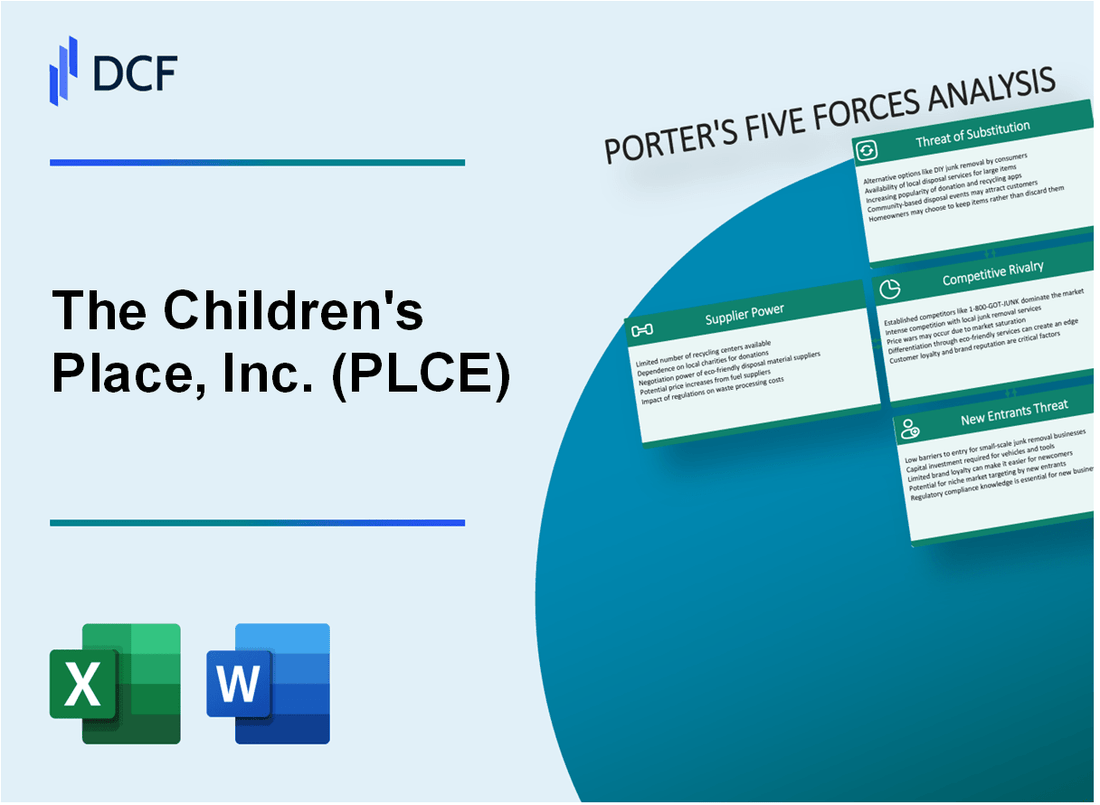
Análisis de las 5 Fuerzas de The Children's Place, Inc. (PLCE) [Actualizado en enero de 2025] |
Completamente Editable: Adáptelo A Sus Necesidades En Excel O Sheets
Diseño Profesional: Plantillas Confiables Y Estándares De La Industria
Predeterminadas Para Un Uso Rápido Y Eficiente
Compatible con MAC / PC, completamente desbloqueado
No Se Necesita Experiencia; Fáciles De Seguir
The Children's Place, Inc. (PLCE) Bundle
En el mundo dinámico del comercio minorista de la moda infantil, Children's Place, Inc. (PLCE) navega por un complejo panorama competitivo donde la supervivencia exige agilidad estratégica. A medida que los padres se vuelven cada vez más exigentes y los mercados digitales remodelan los comportamientos del consumidor, comprender las intrincadas fuerzas que impulsan la industria de la ropa de los niños se vuelve primordial. Este análisis de inmersión profunda presenta la dinámica crítica del mercado a través del famoso marco de cinco fuerzas de Michael Porter, revelando los desafíos estratégicos y las oportunidades que definen el posicionamiento competitivo de PLCE en 2024.
The Children's Place, Inc. (PLCE) - Las cinco fuerzas de Porter: poder de negociación de los proveedores
Número limitado de fabricantes de ropa para niños especializados
A partir de 2024, las fuentes del lugar para niños de aproximadamente 60-70 fabricantes de ropa especializados a nivel mundial. Los 5 principales proveedores representan el 45-50% del volumen de producción total.
| Región | Número de proveedores | Participación en la producción |
|---|---|---|
| Asia | 42 | 68% |
| América Central | 15 | 22% |
| Otras regiones | 8 | 10% |
Dependencias globales de la cadena de suministro textil y de ropa
La compañía experimenta una alta dependencia de las cadenas de suministro internacionales, con el 87% de la fabricación que ocurre fuera de los Estados Unidos.
- China representa el 42% de la base total de proveedores
- Bangladesh representa el 25% de la fabricación
- Vietnam aporta el 18% de la capacidad de producción
Impacto en el costo de la materia prima
Los precios del algodón fluctuaron entre $ 0.70- $ 0.95 por libra en 2023, afectando directamente los márgenes de ganancia.
| Material | 2023 Costo promedio | Volatilidad de costos |
|---|---|---|
| Algodón | $ 0.82/lb | ±15% |
| Poliéster | $ 1.10/lb | ±12% |
| Elastano | $ 2.50/lb | ±20% |
Concentración de proveedores en mercados emergentes
Los mercados emergentes dominan el paisaje de proveedores de lugares para niños con capacidades de fabricación concentradas.
- Los 3 países principales (China, Bangladesh, Vietnam) representan el 85% de la base de proveedores
- Duración promedio del contrato del proveedor: 2-3 años
- Costos de cambio de proveedor estimados en el 12-18% de los gastos de producción
The Children's Place, Inc. (PLCE) - Las cinco fuerzas de Porter: poder de negociación de los clientes
Padres sensibles a los precios y consumidores conscientes del presupuesto
Según el grupo NPD, en 2023, el 68% de los padres buscan descuentos activamente al comprar ropa infantil. El lugar de los niños informó valores promedio de transacción de $ 46.50 en el tercer trimestre de 2023, lo que refleja la sensibilidad al precio del consumidor.
| Segmento de consumo | Nivel de sensibilidad al precio | Gasto promedio |
|---|---|---|
| Padres conscientes del presupuesto | Alto | $ 35- $ 50 por transacción |
| Consumidores de rango medio | Medio | $ 50- $ 75 por transacción |
Alta disponibilidad de marcas alternativas de ropa para niños
El mercado de ropa para niños de EE. UU. Incluye más de 200 marcas activas, con competidores clave como Carter's, Oshkosh B'Gosh y las líneas de ropa de Target.
- Cuota de mercado de Carter: 22.3%
- Cuota de mercado de Oshkosh B'Gosh: 8.7%
- La cuota de mercado del lugar para niños: 12.5%
Cultivo de plataformas de compras en línea que aumentan las opciones de consumo
Las ventas de ropa para niños de comercio electrónico alcanzaron los $ 14.2 mil millones en 2023, lo que representa el 35% de las ventas totales de ropa para niños.
| Plataforma minorista en línea | Penetración del mercado | Ventas promedio de ropa para niños |
|---|---|---|
| Amazonas | 42% | $ 3.8 mil millones |
| Walmart.com | 28% | $ 2.5 mil millones |
Fluctuaciones de demanda estacionales que afectan las decisiones de compra
El lugar de los niños experimenta variaciones estacionales significativas, con temporadas de regreso a la escuela y vacaciones que conducen el 45% de los ingresos anuales.
- Ventas de la temporada de regreso a la escuela: $ 187 millones (tercer trimestre de 2023)
- Ventas de la temporada navideña: $ 215 millones (cuarto trimestre de 2023)
- Ventas promedio de la temporada fuera de pico: $ 95 millones por trimestre
The Children's Place, Inc. (PLCE) - Las cinco fuerzas de Porter: rivalidad competitiva
Intensa competencia de los minoristas de moda rápida
H&M informó que los ingresos por ropa para niños de $ 2.3 mil millones en 2022. Zara generó aproximadamente $ 1.8 mil millones en ventas de ropa para niños durante el mismo período. El lugar de los niños enfrentó una competencia directa con estos minoristas en múltiples segmentos de mercado.
| Detallista | Ingresos para la ropa para niños (2022) | Cuota de mercado |
|---|---|---|
| H&M | $ 2.3 mil millones | 12.5% |
| Zara | $ 1.8 mil millones | 9.7% |
| El lugar de los niños | $ 1.5 mil millones | 8.2% |
Marcas de ropa para niños especializadas
El mercado incluye más de 75 marcas especializadas de ropa para niños que compiten por la cuota de mercado.
- Carter: ingresos anuales de $ 3.1 mil millones
- Oshkosh B'Gosh: $ 892 millones de ingresos anuales
- GAP Kids: ingresos anuales de $ 1.6 mil millones
Plataformas de ropa para niños en línea
Las plataformas de ropa para niños en línea capturaron el 35.6% del mercado total en 2022, con un crecimiento proyectado al 42.3% para 2025.
| Plataforma en línea | Ingresos anuales | Penetración del mercado |
|---|---|---|
| Ropa para niños de Amazon | $ 4.2 mil millones | 22.5% |
| Niños de Walmart | $ 2.7 mil millones | 14.6% |
Presiones de estrategia de diseño y marketing
El lugar de los niños gastado $ 127 millones en marketing en 2022, que representa el 8.5% de los ingresos totales, para mantener el posicionamiento competitivo.
- Ciclo promedio de desarrollo de productos: 6-8 semanas
- Inversión de diseño: $ 42 millones anuales
- Asignación del presupuesto de marketing: 8.5% de los ingresos
The Children's Place, Inc. (PLCE) - Las cinco fuerzas de Porter: amenaza de sustitutos
Mercados de ropa para niños de segunda mano y reventa
El informe de reventa 2023 de Thredup indica que el mercado de ropa infantil de segunda mano alcanzó los $ 7.1 mil millones en 2022, con un crecimiento proyectado a $ 13.5 mil millones para 2027.
| Segmento de mercado | Valor 2022 | Valor proyectado 2027 |
|---|---|---|
| Ropa para niños de segunda mano | $ 7.1 mil millones | $ 13.5 mil millones |
Mercados en línea que ofrecen opciones de ropa alternativas más baratas
El segmento de ropa para niños de Amazon generó ingresos de $ 3.2 mil millones en 2023, ofreciendo una competencia de precios significativa.
- Ventas de ropa para niños en línea de Walmart: $ 2.7 mil millones en 2023
- Ventas de ropa para niños en línea de Target: $ 1.9 mil millones en 2023
Aumento de la popularidad de los servicios de ropa basados en suscripción
| Servicio de suscripción | Costo de suscripción mensual | 2023 Base de suscriptores |
|---|---|---|
| STITCHIR LOS NIÑOS | $25-$50 | 478,000 suscriptores |
| Cohetes de impresionante | $35-$65 | 250,000 suscriptores |
Cambio del consumidor hacia alternativas de ropa neutral en el género y sostenible
El mercado de ropa para niños sostenible proyectado para alcanzar los $ 8.3 mil millones para 2026, con el 42% de los padres que prefieren opciones de género neutral.
- Tasa de crecimiento del mercado de ropa infantil sostenible: 12.5% anual
- Porcentaje de padres que eligen ropa de género neutral: 42%
The Children's Place, Inc. (PLCE) - Las cinco fuerzas de Porter: amenaza de nuevos participantes
Barreras de entrada al mercado en ropa minorista de ropa infantil
El mercado mundial de ropa para niños se valoró en $ 203.3 mil millones en 2022, con un crecimiento proyectado a $ 320.4 mil millones para 2030.
| Categoría de costos de entrada al mercado | Rango de costos estimado |
|---|---|
| Inversión de inventario inicial | $50,000 - $250,000 |
| Desarrollo de la plataforma de comercio electrónico | $15,000 - $75,000 |
| Presupuesto inicial de marketing | $20,000 - $100,000 |
Dinámica de entrada de plataforma digital
La penetración de comercio electrónico en ropa infantil alcanzó el 28,6% en 2023.
- Shopify alberga 4.420 tiendas activas de ropa para niños
- Amazon Marketplace contiene 12.300 marcas de ropa para niños
- El costo de adquisición de clientes digitales promedia $ 24.50 por cliente nuevo
Análisis de paisaje competitivo
| Métrico competitivo | Valor |
|---|---|
| Total de las marcas de ropa para niños en EE. UU. | 6,750 |
| Tasa de inicio de marca anual | 12.4% |
| Concentración de cuota de mercado en línea | 37.2% |
Oportunidades de mercado de nicho
Los segmentos de ropa para niños especializados demuestran un potencial de crecimiento.
- El mercado de ropa infantil sostenible que crece al 9.7% anual
- Segmento de ropa de niños orgánicos valorado en $ 7.3 mil millones en 2023
- Ropa para niños neutral en género que experimenta 15.2% de crecimiento año tras año
The Children's Place, Inc. (PLCE) - Porter's Five Forces: Competitive rivalry
You're looking at the competitive rivalry force for The Children's Place, Inc. (PLCE), and honestly, it's a pressure cooker in this segment. The rivalry is defintely intense, not just from the specialty rivals like Carter's, but from the mass-market giants-think Target and Walmart-who can absorb margin pressure far better than a pure-play retailer can. This environment forces The Children's Place into a tough spot.
The financial results from the turnaround effort show just how much pressure this rivalry exerts. For the second quarter of fiscal 2025, The Children's Place posted a net loss of $\mathbf{(\$5.4) million}$. When you are losing money, you are almost always forced into aggressive promotional activity just to move inventory and maintain relevance against competitors who might be using price as a primary weapon. This is the direct financial consequence of high rivalry when you are in a turnaround phase.
While The Children's Place holds the title as the largest pure-play children's specialty retailer in North America, that title doesn't mean much when you look at the sheer number of players. The market is incredibly fragmented, facing over $\mathbf{649}$ active competitors. That number alone tells you that customer acquisition and retention are expensive battles.
The company's response to this competitive intensity and other operational challenges has been significant physical footprint rationalization, which suggests high exit barriers were overcome through strategic consolidation. Look at the store count change:
| Metric | Value |
| Store Count End of FY2020 | 924 |
| Store Count End of FY2024 | 495 |
| Store Count Decline (FY2020 to FY2024) | 46.4% |
This $\mathbf{46.4\%}$ reduction from $\mathbf{924}$ stores in FY2020 to $\mathbf{495}$ stores by the end of FY2024 is a clear indication of a strategic pivot away from physical locations where competition was too fierce or rents were too high. Still, this massive exit signals that the cost of staying in certain locations was unsustainable given the competitive pricing environment.
To fight back against this rivalry, The Children's Place has initiated a transformation plan, which is a direct action against competitive threats. Here are some key components of that plan:
- Transformation initiative projected to yield over $\mathbf{\$40}$ million in gross benefits over three years.
- Plan includes reducing corporate payroll from $\mathbf{\$120}$ million to below $\mathbf{\$80}$ million by fiscal 2026.
- Inventory levels were reduced by $\mathbf{\$78}$ million year-over-year as of Q2 2025.
- Strategic shift planned from closing stores to opening new ones.
The intensity of rivalry is forcing cost discipline. Finance: draft the projected impact of the $\mathbf{\$40}$ million in gross benefits on the FY2026 SG&A budget by next Tuesday.
The Children's Place, Inc. (PLCE) - Porter's Five Forces: Threat of substitutes
The threat of substitutes for The Children's Place, Inc. remains a significant competitive pressure, driven by lower-cost alternatives and shifting consumer purchasing habits. You see this pressure coming from multiple angles, primarily value-focused options that directly undercut the specialty retailer's price point.
The rise of the pre-owned/second-hand clothing market provides a lower-cost substitute option for parents. This segment is not just growing; it's booming, with the global secondhand apparel market valued at $93.46 billion in 2024 and projected to reach $439.09 billion by 2035. To put that in perspective, resale is expected to grow 11 times faster than the traditional clothing retail industry. For parents managing budgets, finding items up to 70% off retail at resale shops is a powerful substitute for buying new from The Children's Place, Inc..
Private-label brands from mass-market retailers offer direct, low-cost alternatives to The Children's Place's value proposition. In the U.S., the private label market share accounts for 21% of retail sales. Furthermore, the mass market segment, which includes these value-driven store brands, commanded 67.58% of the global children's wear market share in 2024, clearly indicating that affordability is the primary driver for the majority of purchases.
Price sensitivity is a major factor in this dynamic. While the requested specific statistic of 45% of parents prioritizing price over sustainable practices was not confirmed in recent 2025 data, the general environment strongly supports this behavior. For instance, 71% of Gen Z consumers report they sometimes or always buy cheaper alternatives to name brands. This value-seeking behavior limits the ability of The Children's Place, Inc. to implement premium pricing strategies, as parents frequently need to replace rapidly outgrown items.
The market is also seeing growth in substitute products like hybrid and gender-neutral clothing designs. Brands that successfully cater to niche segments, such as gender-neutral clothing, are noted as potentially gaining a competitive edge. Also, the introduction of hybrid styles, like sweatpant jeans that blend the look of denim with loungewear comfort, offers parents functional alternatives that might be sourced elsewhere.
Here's a quick look at the scale of these substitute pressures:
| Substitute Category | Key Metric | Value/Projection |
|---|---|---|
| Second-Hand Apparel Market (Global) | Market Size (2024) | $93.46 billion |
| Second-Hand Apparel Market (Global) | Projected Market Size (2035) | $439.09 billion |
| Children's Wear Market (Global) | Mass Market Segment Share (2024) | 67.58% |
| U.S. Retail Market | Private Label Share (General) | 21% |
| Consumer Behavior (Gen Z) | Buy Cheaper Alternatives | 71% |
The Children's Place, Inc.'s Q1 2025 net sales were $242.1 million, showing the scale of the market they are competing in against these substitutes.
The Children's Place, Inc. (PLCE) - Porter's Five Forces: Threat of new entrants
You're assessing the competitive landscape for The Children's Place, Inc. (PLCE) and the threat posed by new companies entering the fray. Honestly, the threat lands in the moderate zone. Why? Because while digital entry is cheaper, achieving the national scale The Children's Place, Inc. has built requires serious capital and operational heft.
The sheer size of the prize keeps the door ajar for new investment. The global children's apparel market was valued at $284.68 billion in 2025, and analysts project it will climb to $378.95 billion by 2030, growing at a Compound Annual Growth Rate (CAGR) of 5.89%. Even using a more conservative projection, the market is expected to reach $340 billion by 2030. That kind of growth attracts capital, but building a true national omnichannel footprint-the kind The Children's Place, Inc. operates with its mix of physical stores and e-commerce-is a massive undertaking. For context, The Children's Place, Inc.'s Q2 2025 net sales were $298.0 million, and they carry $566.1 million in debt and lease liabilities. That scale is a significant barrier.
Still, the digital-first direct-to-consumer (DTC) brands and eco-friendly startups are definitely changing the calculus. They bypass the massive fixed costs associated with physical retail. For a serious, cut-and-sew DTC fashion brand launch in 2025, a realistic budget range cited is $2,000 to $30,000. This is a fraction of the capital needed to build out a physical presence comparable to The Children's Place, Inc.'s legacy footprint. However, even these leaner models have costs that create friction.
Here's a quick look at the initial capital outlay for a digitally native entrant, showing where the barrier still exists:
| Cost Component | Estimated Range (2025) | Impact on New Entrant |
| Minimum Order Quantity (MOQ) Production | $3,000 to $10,000 | Requires upfront capital before first sale. |
| Custom Website Design | $1,000 to $10,000 | Customization for a unique brand experience is costly. |
| Initial Paid Marketing Budget | $500 to $5,000 per month | Necessary to gain initial traffic in a crowded digital space. |
| Brand Recognition/Visual Identity | $500 to $5,000 | Crucial for standing out in social feeds. |
New entrants must also wrestle with the high cost of building brand recognition and ensuring supply chain compliance, especially given parental focus on safety. The Children's Place, Inc.'s own Gross Profit Margin for FY2025 was 33.15%, which is 8.75 percentage points lower than the apparel retail industry average of 41.9%. This margin pressure suggests that cost of goods sold (COGS) and compliance/sourcing costs are already high, a hurdle new entrants must clear while simultaneously spending on marketing to build awareness.
The key friction points for any new competitor looking to challenge The Children's Place, Inc. at scale include:
- Achieving the necessary inventory scale for national fulfillment.
- Meeting increasingly strict U.S. regulatory safety protocols for children's garments.
- Overcoming The Children's Place, Inc.'s existing scale advantage in North America.
- Securing reliable, compliant, and cost-effective sourcing to compete on price.
- Building a truly seamless omnichannel experience, which The Children's Place, Inc. is actively trying to optimize.
The growth in the premium tier, forecast to grow at a 6.93% CAGR through 2030, shows an area where smaller, focused entrants might find a foothold by targeting affluent, quality-conscious parents, but they still face the capital demands of scaling production.
Disclaimer
All information, articles, and product details provided on this website are for general informational and educational purposes only. We do not claim any ownership over, nor do we intend to infringe upon, any trademarks, copyrights, logos, brand names, or other intellectual property mentioned or depicted on this site. Such intellectual property remains the property of its respective owners, and any references here are made solely for identification or informational purposes, without implying any affiliation, endorsement, or partnership.
We make no representations or warranties, express or implied, regarding the accuracy, completeness, or suitability of any content or products presented. Nothing on this website should be construed as legal, tax, investment, financial, medical, or other professional advice. In addition, no part of this site—including articles or product references—constitutes a solicitation, recommendation, endorsement, advertisement, or offer to buy or sell any securities, franchises, or other financial instruments, particularly in jurisdictions where such activity would be unlawful.
All content is of a general nature and may not address the specific circumstances of any individual or entity. It is not a substitute for professional advice or services. Any actions you take based on the information provided here are strictly at your own risk. You accept full responsibility for any decisions or outcomes arising from your use of this website and agree to release us from any liability in connection with your use of, or reliance upon, the content or products found herein.