
|
Thermon Group Holdings, Inc. (THR): Análisis PESTLE [Actualizado en Ene-2025] |
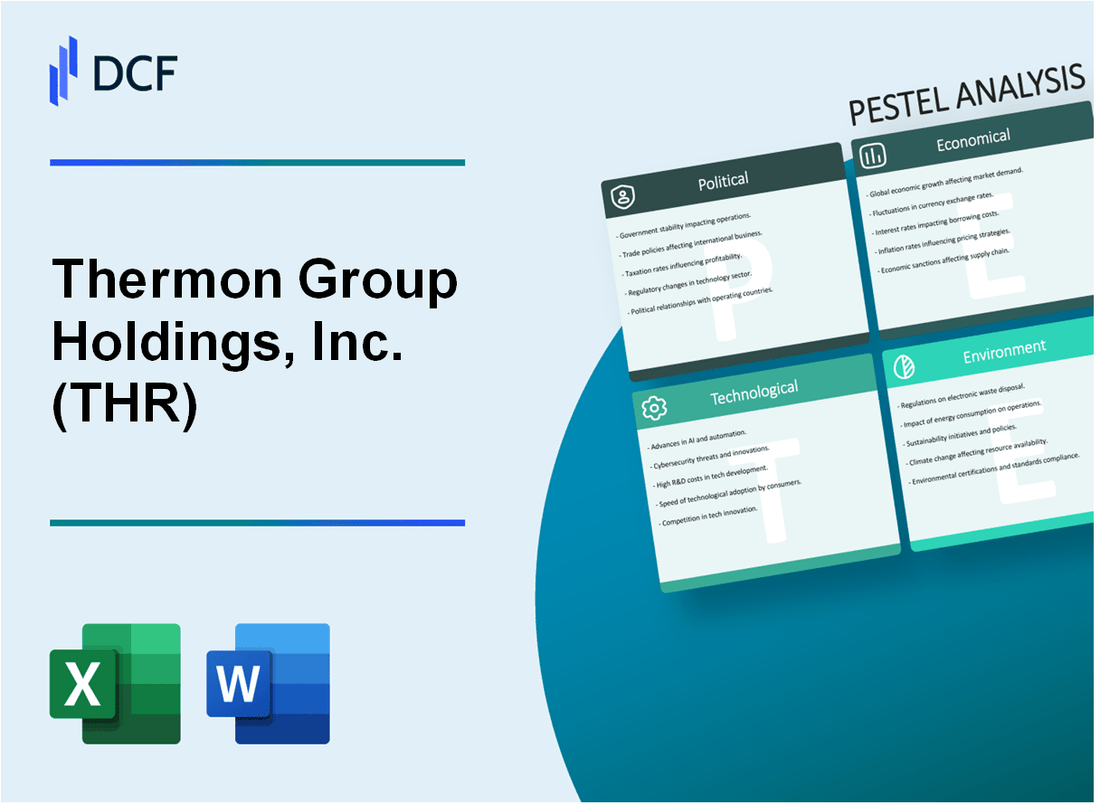
Completamente Editable: Adáptelo A Sus Necesidades En Excel O Sheets
Diseño Profesional: Plantillas Confiables Y Estándares De La Industria
Predeterminadas Para Un Uso Rápido Y Eficiente
Compatible con MAC / PC, completamente desbloqueado
No Se Necesita Experiencia; Fáciles De Seguir
Thermon Group Holdings, Inc. (THR) Bundle
En el panorama dinámico de las soluciones de calefacción industrial, Thermon Group Holdings, Inc. (THR) se encuentra en la encrucijada de innovación, desafíos regulatorios y tecnologías transformadoras. Este análisis integral de la maja revela la intrincada red de factores políticos, económicos, sociológicos, tecnológicos, legales y ambientales que dan forma al posicionamiento estratégico de THR en el mercado mundial de equipos industriales. Desde inversiones en infraestructura gubernamental hasta tecnologías de gestión térmica de vanguardia, la compañía navega por un complejo ecosistema de oportunidades y desafíos que definirán su trayectoria futura.
Thermon Group Holdings, Inc. (THR) - Análisis de mortero: factores políticos
Políticas de inversión en infraestructura del gobierno de los Estados Unidos
La Ley de Inversión y Empleos de Infraestructura (IJA) asignó $ 1.2 billones para el desarrollo de infraestructura, con $ 550 mil millones en un nuevo gasto federal que apoya directamente los sectores industriales.
| Categoría de financiación de infraestructura | Presupuesto asignado |
|---|---|
| Infraestructura de fabricación industrial | $ 110 mil millones |
| Modernización de la red energética | $ 73 mil millones |
| Incentivos de producción de fabricación | $ 52 mil millones |
Impacto en las regulaciones comerciales
Políticas comerciales actuales que afectan la fabricación global de Thermon:
- Sección 301 Los aranceles sobre las importaciones chinas van desde 7.5% a 25%
- Acuerdo de US-MexicO-Canadá (USMCA) establece barreras comerciales reducidas
- Las regulaciones de control de exportación restringen las transferencias de tecnología en sectores industriales específicos
Cambios de política del sector energético
| Área de política | Impacto regulatorio |
|---|---|
| Incentivos de energía renovable | Crédito fiscal de inversión hasta el 30% |
| Reducción de emisiones de carbono | La EPA exige la reducción de las emisiones industriales en un 17.5% para 2030 |
Tensiones geopolíticas
Desafíos actuales de operación comercial internacional:
- Las tensiones comerciales de US-China resultan en $ 360 mil millones en tarifas mutuas
- Rusia-ucraína conflicto que interrumpe las cadenas de suministro industrial global
- Inestabilidad geopolítica de Medio Oriente que impacta los mercados de equipos de energía
Thermon Group Holdings, Inc. (THR) - Análisis de mortero: factores económicos
Fluctuando la demanda del mercado global de equipos industriales
El tamaño del mercado mundial de equipos industriales se valoró en $ 4.56 billones en 2023, con una tasa compuesta anual proyectada de 5.8% de 2024-2030. El segmento de mercado de Thermon Group muestra específicamente un crecimiento potencial en las tecnologías de calefacción industrial.
| Segmento de mercado | Valor 2023 | 2024 crecimiento proyectado |
|---|---|---|
| Equipo industrial global | $ 4.56 billones | 5.8% CAGR |
| Tecnologías de calefacción industrial | $ 687 mil millones | 6.2% CAGR |
Recuperación económica continua que impacta las inversiones de equipos de capital
Las inversiones en equipos de capital en 2023 alcanzaron los $ 2.3 billones a nivel mundial, y las inversiones del sector manufacturero representan el 42% del gasto total.
| Categoría de inversión | Valor de inversión 2023 | Porcentaje de total |
|---|---|---|
| Inversiones totales de equipos de capital | $ 2.3 billones | 100% |
| Inversiones del sector manufacturero | $ 966 mil millones | 42% |
Volatilidad del costo del sector energético que afecta la adopción de tecnología de calefacción industrial
La volatilidad del sector energético demostró un impacto significativo en las inversiones de tecnología de calefacción industrial. Los precios del petróleo crudo de Brent promediaron $ 82.44 por barril en 2023, creando una dinámica de inversión compleja.
| Métrico de energía | Valor 2023 | Impacto en la adopción de la tecnología |
|---|---|---|
| Precio de petróleo crudo de Brent | $ 82.44/barril | Incertidumbre de inversión moderada |
| Precio del gas natural | $ 3.65/mmbtu | Entorno de inversión tecnológica estable |
La recesión potencial corre el riesgo de influir en las estrategias de gasto corporativo
Las proyecciones del FMI indican una desaceleración económica global potencial, y se espera que el gasto corporativo se contraiga en un 3,2% en los sectores de alto riesgo durante 2024.
| Indicador económico | 2024 proyección | Impacto potencial |
|---|---|---|
| Crecimiento global del PIB | 2.9% | Expansión moderada |
| Contracción de gasto corporativo | 3.2% | Reducción del sector de alto riesgo |
Thermon Group Holdings, Inc. (THR) - Análisis de mortero: factores sociales
Creciente énfasis en la fuerza laboral en las tecnologías de seguridad industrial
Según el Consejo Nacional de Seguridad, las lesiones en el lugar de trabajo le costaron a los empleadores estadounidenses $ 171 mil millones en 2019. El mercado de tecnología de seguridad industrial proyectada para alcanzar los $ 12.3 mil millones para 2026, con una tasa compuesta anual del 6.8%.
| Segmento de tecnología de seguridad | Valor de mercado 2024 | Tasa de crecimiento proyectada |
|---|---|---|
| Equipo de protección personal | $ 59.5 mil millones | 5.2% |
| Sistemas de gestión de seguridad | $ 4.2 mil millones | 7.1% |
| Sensores de seguridad industrial | $ 3.8 mil millones | 8.3% |
Aumento de la demanda de soluciones industriales sostenibles y de eficiencia energética
Se espera que el mercado global de eficiencia energética industrial alcance los $ 66.2 mil millones para 2026, con un 5,9% de CAGR. Las inversiones de energía renovable alcanzaron los $ 366 mil millones en 2023.
| Sector de eficiencia energética | Inversión global 2024 | Crecimiento anual |
|---|---|---|
| Gestión de la energía industrial | $ 24.5 mil millones | 6.4% |
| Tecnologías de fabricación verde | $ 18.3 mil millones | 7.2% |
Escasez de mano de obra calificada en sectores de fabricación técnica
La brecha de habilidades de fabricación en EE. UU. Podría dar lugar a 2.1 millones de empleos sin cubrir para 2030, lo que podría causar un impacto económico de $ 1 billón. Escasez actual de habilidades de la fuerza laboral de fabricación al 77%.
| Categoría de habilidades de fabricación | Porcentaje de escasez actual | Impacto proyectado |
|---|---|---|
| Habilidades de ingeniería técnica | 62% | Pérdida potencial de $ 450 mil millones |
| Habilidades de fabricación avanzadas | 54% | Pérdida potencial de $ 320 mil millones |
Cambiar las regulaciones de seguridad en el lugar de trabajo y los requisitos de cumplimiento
Se espera que las inversiones de cumplimiento regulatorio de OSHA alcancen $ 9.7 mil millones en 2024. El gasto promedio de cumplimiento corporativo aumentó un 45% desde 2020.
| Área de cumplimiento | Inversión anual | Impacto regulatorio |
|---|---|---|
| Programas de capacitación en seguridad | $ 3.2 mil millones | Capacitación anual obligatoria de 8 horas |
| Certificaciones de seguridad para equipos | $ 2.5 mil millones | Requisitos de inspección trimestrales |
Thermon Group Holdings, Inc. (THR) - Análisis de mortero: factores tecnológicos
Gestión térmica avanzada e innovaciones de calefacción industrial
Thermon Group Holdings invirtió $ 12.3 millones en I + D para tecnologías de gestión térmica en el año fiscal 2023. La compañía posee 17 patentes activas relacionadas con soluciones de calefacción industrial a partir del cuarto trimestre de 2023.
| Categoría de tecnología | Conteo de patentes | Inversión de I + D |
|---|---|---|
| Sistemas de calefacción eléctrica | 7 | $ 5.6 millones |
| Tecnologías de calentamiento de fluidos | 6 | $ 4.2 millones |
| Detección térmica avanzada | 4 | $ 2.5 millones |
Transformación digital en sistemas de monitoreo de equipos industriales
Thermon implementó soluciones de monitoreo digital en el 62% de sus líneas de productos para fines de 2023. Las inversiones de transformación digital alcanzaron $ 8.7 millones en el mismo período fiscal.
| Capacidad de monitoreo digital | Porcentaje de implementación | Inversión tecnológica |
|---|---|---|
| Seguimiento de equipos en tiempo real | 58% | $ 3.2 millones |
| Análisis de rendimiento | 45% | $ 2.9 millones |
| Diagnóstico remoto | 38% | $ 2.6 millones |
Integración de IoT y tecnologías de mantenimiento predictivo
La integración de IoT en el ecosistema de productos de Thermon alcanzó la cobertura del 47% en el cuarto trimestre de 2023. Las inversiones de tecnología de mantenimiento predictivo totalizaron $ 6.5 millones en el mismo año.
- Implementación del sensor IoT: 3.200 unidades en las líneas de productos industriales
- Desarrollo del algoritmo de mantenimiento predictivo: 12 nuevos modelos de aprendizaje automático
- Capacidad de procesamiento de datos: 1.2 petabytes por mes
Automatización emergente y capacidades de monitoreo remoto
Las tecnologías de automatización representaban el 35% de la cartera de desarrollo tecnológico de Thermon en 2023. Los ingresos del sistema de monitoreo remoto alcanzaron los $ 22.4 millones.
| Tecnología de automatización | Inversión de desarrollo | Penetración del mercado |
|---|---|---|
| Automatización de procesos robóticos | $ 2.1 millones | 28% |
| Monitoreo mejorado con AI | $ 3.6 millones | 22% |
| Sistemas de control avanzados | $ 4.8 millones | 42% |
Thermon Group Holdings, Inc. (THR) - Análisis de mortero: factores legales
Cumplimiento de los estándares internacionales de seguridad de equipos industriales
Estado de certificación ISO 9001: 2015: Thermon Group Holdings mantiene la certificación activa, que cubre los sistemas de gestión de calidad en las instalaciones de fabricación.
| Estándar de seguridad | Nivel de cumplimiento | Jurisdicción regulatoria |
|---|---|---|
| Regulaciones de seguridad industrial de OSHA | 100% cumplido | Estados Unidos |
| Directiva de maquinaria CE | Cumplimiento total | unión Europea |
| IEC 60079 Estándar de atmósferas explosivas | Certificado | Comisión Electrotécnica Internacional |
Impactos de la regulación ambiental en los procesos de fabricación
Gasto de cumplimiento ambiental: $ 2.7 millones asignados para la adherencia regulatoria en el año fiscal 2023.
| Regulación | Costo de cumplimiento | Estrategia de mitigación |
|---|---|---|
| Regulaciones de desechos peligrosos de la EPA | $890,000 | Programa de reducción de residuos |
| Modificaciones de acto de aire limpio | $1,250,000 | Tecnologías de control de emisiones |
Protección de propiedad intelectual para innovaciones tecnológicas
Cartera de patentes: 37 patentes activas a partir del cuarto trimestre de 2023, protegiendo las innovaciones de tecnología de calefacción de núcleo.
| Categoría de patente | Número de patentes | Cobertura geográfica |
|---|---|---|
| Diseño de elementos de calefacción | 15 | EE. UU., EU, China |
| Sistemas de control de temperatura | 12 | América del Norte, Europa |
| Técnicas de aplicación industrial | 10 | Global |
Consideraciones potenciales de responsabilidad en soluciones de calefacción industrial
Presupuesto de gestión de riesgos legales: $ 3.4 millones asignados para protección de responsabilidad en 2023.
| Categoría de responsabilidad | Cobertura de seguro | Prima anual |
|---|---|---|
| Responsabilidad del producto | $ 50 millones | $1,200,000 |
| Indemnización profesional | $ 25 millones | $750,000 |
| Responsabilidad de la seguridad en el lugar de trabajo | $ 15 millones | $480,000 |
Thermon Group Holdings, Inc. (THR) - Análisis de mortero: factores ambientales
Creciente énfasis en tecnologías de calefacción industrial sostenible
El mercado global de tecnologías de calefacción industrial proyectada para alcanzar los $ 25.3 mil millones para 2027, con una tasa compuesta anual del 5.8%. Las soluciones de calefacción sostenibles de Thermon se dirigieron a la reducción del impacto ambiental en aplicaciones industriales.
| Segmento de mercado | Inversión en tecnología sostenible | Crecimiento proyectado (2024-2027) |
|---|---|---|
| Calefacción industrial verde | $ 3.7 mil millones | 7.2% |
| Soluciones térmicas de eficiencia energética | $ 2.5 mil millones | 6.5% |
Estrategias de reducción de emisiones de carbono en la fabricación
Objetivos de reducción de carbono de Thermon: reducción de emisiones del 35% para 2030, alineada con los objetivos globales de descarbonización industrial.
| Categoría de reducción de emisiones | Porcentaje objetivo | Inversión |
|---|---|---|
| Emisiones de fabricación directa | 25% | $ 1.2 millones |
| Emisiones de la cadena de suministro | 10% | $850,000 |
Requisitos de eficiencia energética en diseño de equipos industriales
Los estándares de eficiencia energética mandato 40% mejoran el rendimiento térmico en los equipos de calefacción industrial para 2025.
| Métrica de eficiencia | Rendimiento actual | Objetivo 2025 |
|---|---|---|
| Eficiencia térmica | 65% | 91% |
| Reducción del consumo de energía | 22% | 40% |
Principios de economía circular que influyen en el desarrollo de productos
Las inversiones de la economía circular en la gestión del ciclo de vida del producto se estimaron en $ 4.5 millones para Thermon en 2024.
| Iniciativa de economía circular | Inversión | Impacto esperado |
|---|---|---|
| Diseño de productos reciclable | $ 1.8 millones | 60% de reciclabilidad de material |
| Extensión del ciclo de vida del producto | $ 2.7 millones | 45% de vida útil del producto |
Thermon Group Holdings, Inc. (THR) - PESTLE Analysis: Social factors
You might think of industrial heating as a purely technical, engineering problem, but honestly, the biggest shifts for Thermon Group Holdings, Inc. right now are driven by social pressure-specifically, what society demands from its industrial base. This includes everything from a mandate for less energy waste to a non-negotiable expectation of worker safety. These social forces are creating a massive, multi-billion-dollar opportunity for Thermon, but they also bring a defintely real risk from the skilled labor crunch.
Growing industrial demand for energy efficiency and sustainability
The global push for sustainability (ESG) is no longer a niche concern; it's a core operational and social mandate for Thermon's client base. Industry accounts for nearly 40% of total final energy consumption, so the pressure to cut waste is immense. This social demand translates directly into a booming market for Thermon's core products, which are designed to prevent heat loss and optimize thermal processes.
The market for industrial energy efficiency services is a clear indicator of this trend, expected to expand from $11.03 billion in 2024 to $11.72 billion in 2025, reflecting a compound annual growth rate (CAGR) of 6.3%. This growth is driven by customers actively seeking solutions to reduce their carbon footprint and save on escalating energy costs. Thermon's focus on electrification and decarbonization, which the company explicitly cites as a long-term secular growth driver, positions it perfectly to capture this spending.
Skilled labor shortage for specialized installation and maintenance
Here's the quick math: you can sell the most advanced heat tracing system in the world, but if you can't find a qualified electrician or pipefitter to install it correctly, the project stalls. The skilled labor shortage is a crucial social headwind. For the broader industrial and construction sector, 91% of construction firms struggled to fill skilled positions in 2024, and this shortage is expected to continue impacting budgets in 2025. It's a huge bottleneck.
This challenge is particularly acute in the energy efficiency sector itself, where 72% of employers reported a shortage of workers in 2024. For Thermon, this means longer project lead times, higher installation costs, and increased competition for technical staff. This is why the push for digitalization is so important-it helps systems become easier to install and maintain, effectively using technology to help mitigate the labor deficit.
Increased focus on industrial safety mandates reliable temperature control
Industrial safety is a social factor that is rapidly moving from a best practice to a strict, federally enforced rule, and this creates a non-discretionary spending driver for Thermon. The Occupational Safety and Health Administration (OSHA) is finalizing its first-ever national Heat Injury and Illness Prevention Standard in 2025, with informal hearings scheduled through July 2025.
This proposed rule is a game-changer for industrial environments, including factories and processing plants, which are often covered if temperatures regularly exceed 80°F indoors. The mandates require employers to have a plan to evaluate and control heat hazards, which often involves engineering controls like ventilation and, critically, precise temperature control of hot processes. Thermon's core business of reliable temperature management and heat tracing is a direct solution to these new, stringent safety requirements, making its products an essential compliance cost for many clients.
Client pressure for digitalization and remote monitoring capabilities
Clients are demanding more than just hardware; they want data and control. The social expectation for real-time information, driven by consumer technology, has fully migrated to the industrial sector. This trend, which Thermon calls 'digitization,' is one of its key strategic pillars.
The shift is clear in the market data. The remote monitoring solutions market for related systems like HVAC is projected to reach $10.06 billion by 2033, with an 8.2% CAGR from 2024. This client pressure means Thermon must continually invest in its Industrial Internet of Things (IIoT) capabilities to offer real-time monitoring, predictive maintenance, and remote diagnostics for its heating systems. This is a clear opportunity to increase higher-margin service revenue.
The table below summarizes the core social drivers impacting Thermon Group Holdings, Inc. and the corresponding financial and market context from the 2025 fiscal year data.
| Social Factor | 2025 Market/Financial Context | Impact on Thermon's Business |
|---|---|---|
| Growing Industrial Demand for Energy Efficiency | Industrial Energy Efficiency Services market expected to reach $11.72 billion in 2025 (6.3% CAGR). | Strong tailwind for sales of efficient heat tracing and process heating solutions; aligns with the company's decarbonization strategy. |
| Skilled Labor Shortage for Specialized Installation | 72% of energy efficiency employers report a worker shortage. 91% of construction firms struggled to fill skilled roles in 2024. | Increases installation costs and project timelines; necessitates a focus on product design for easier, faster deployment and digital tools for remote support. |
| Increased Focus on Industrial Safety Mandates | OSHA's proposed Heat Standard sets an Initial Heat Trigger at a heat index of 80°F for indoor/outdoor work. | Creates non-discretionary, compliance-driven demand for reliable temperature control and process heating equipment to mitigate workplace hazards. |
| Client Pressure for Digitalization and Remote Monitoring | Remote Monitoring Solutions for HVAC market projected at $10.06 billion by 2033 (8.2% CAGR). | Drives investment in IIoT (Industrial Internet of Things) product features and higher-margin digital service offerings; critical for maintaining competitive advantage. |
The company's full-year 2025 Revenue of $498.2 million and Net Income of $53.5 million show a business that is successfully navigating these social currents, but the long-term winners will be those who can best solve the labor shortage by scaling their digital offerings.
Thermon Group Holdings, Inc. (THR) - PESTLE Analysis: Technological factors
Accelerated shift to electric heat tracing over legacy steam systems.
You need to recognize that the industrial landscape is quickly moving away from steam tracing systems, and this is a major tailwind for Thermon Group Holdings, Inc. The global Electric Heat Tracing (EHT) market is valued at approximately $3.0 billion in 2025, and it's projected to grow at a Compound Annual Growth Rate (CAGR) of 7.8% through 2030. This growth is a direct result of the sustained conversion from legacy steam to electric solutions, which offer superior energy efficiency and lower maintenance costs.
Thermon is well-positioned as one of the largest participants in this market, capitalizing on the broader industry push toward electrification and decarbonization. [cite: 6 in step 1] Their core product, self-regulating cables, is a key technology driving this shift, having commanded 43.2% of the electric heat tracing market share in 2024. This trend is not just about efficiency; it's about meeting new regulatory pressure and operational goals, especially in the emerging hydrogen economy and LNG facilities.
Industrial IoT integration for predictive maintenance and asset monitoring.
The digitization of industrial assets is a non-negotiable trend, and Thermon's integration of Industrial Internet of Things (IIoT) technology is crucial for their long-term value proposition. The broader Industrial Internet of Things market stood at an estimated $154.14 billion in 2025 and is forecast to grow at a staggering 24.96% CAGR through 2030. This growth is driven by the shift from reactive maintenance to a predictive model.
Thermon's smart, connected control and monitoring systems, like their Genesis™ and TraceNet™ products, are built on this IIoT foundation. [cite: 6 in step 1, 12 in step 1] These advanced control systems integrate with a plant's central data management, enabling lower operating costs and reduced emissions for the end-user. [cite: 6 in step 1] For instance, their systems have the capacity to manage over 30,000 heat trace circuits within a single facility, offering a massive data stream for predictive analytics. [cite: 12 in step 1]
R&D focus on advanced materials for extreme operating environments.
The push for electrification in high-demand sectors like data centers and nuclear energy means the technology must perform under extreme conditions. Thermon understands this, and their R&D focus is a clear indicator of their strategic direction. They are defintely investing in the future by doubling their R&D lab's footprint and adding 'revolutionary testing capabilities' to their Canadian facilities. [cite: 11 in step 1]
This R&D is specifically aimed at safely introducing new technologies that can push the operational limits of temperature, voltage, and wattage, which is essential for serving customers pursuing decarbonization goals. [cite: 11 in step 1] While a specific R&D expense figure for the full fiscal year 2025 is not publicly isolated from general operating expenses, the physical expansion of the lab shows a capital commitment to:
- Develop high-temperature insulation materials. [cite: 5 in step 2]
- Engineer next-wave polymer insulation for enhanced thermal performance. [cite: 5 in step 2]
- Innovate on conductive materials for durability in extreme environments. [cite: 5 in step 2]
Cybersecurity risk for connected control and monitoring systems.
The trade-off for digitization is increased cybersecurity risk. As Thermon's smart systems become integrated with critical infrastructure, they become potential targets for cyber-attacks. The Cybersecurity and Infrastructure Security Agency (CISA) has been consistently releasing Industrial Control Systems (ICS) Advisories, with multiple alerts being issued as recently as November 2025, highlighting the immediate and ongoing threat to industrial systems. [cite: 13 in step 1, 14 in step 1]
Thermon mitigates this by maintaining a comprehensive risk management system based on the National Institutes of Standards and Technology (NIST) Cybersecurity Framework. [cite: 7 in step 1] They employ 24/7 monitoring and regular testing to protect the confidentiality, integrity, and availability of their information assets and, more importantly, their customers' operational technology (OT) systems. [cite: 7 in step 1] What this estimate hides is the potential cost of a major breach, which could severely damage their reputation for reliability in mission-critical applications.
| Technological Factor | 2025 Market/Company Metric | Strategic Implication for Thermon |
|---|---|---|
| Electric Heat Tracing Market Size | $3.0 billion (Global Market Value) | Major growth vector; reinforces strategic focus on decarbonization and electrification. |
| Projected EHT Market CAGR (2025-2030) | 7.8% (Compound Annual Growth Rate) | Indicates a stable, high-growth environment for core products over the near-term. |
| Industrial IoT Market Size | $154.14 billion (Global Market Value) | High-growth opportunity to sell high-margin software and services for predictive maintenance. |
| Max Circuits Managed (Product Capacity) | Over 30,000 heat trace circuits (per large facility system) [cite: 12 in step 1] | Demonstrates scale and complexity of IIoT offering; a competitive advantage in large-scale projects. |
| R&D Investment Action | Doubling R&D lab footprint (in Ontario, Canada) [cite: 11 in step 1] | Concrete action to develop advanced materials for extreme temperature/voltage applications. |
Thermon Group Holdings, Inc. (THR) - PESTLE Analysis: Legal factors
Stricter global compliance for explosion-proof equipment (ATEX, IECEx)
Thermon Group Holdings, Inc. operates in highly regulated industrial and hazardous locations, so compliance with global safety standards is not a choice, it's the cost of entry. The core of this is the certification for explosion-proof equipment, primarily governed by the European Union's ATEX Directive (mandatory for the EU market) and the International Electrotechnical Commission System for Certification (IECEx), which acts as a globally respected standard for international market access.
You can't sell process heating solutions to the oil and gas, chemical, or mining sectors-which account for over 70% of the explosion-proof equipment market-without these stamps of approval. The technical requirements of ATEX and IECEx are harmonized, meaning a smart manufacturer like Thermon can use an IECEx Test Report to streamline the mandatory ATEX certification process.
This strict regulatory environment is defintely a strategic advantage for established players, as it creates a high barrier to entry for new competitors. The cost of non-compliance is severe, with global non-compliance fines in the broader hazardous area equipment space reaching an estimated $14 billion in 2024. For a global company like Thermon, which generated $498.2 million in revenue in Fiscal 2025, maintaining a flawless compliance record is mission-critical.
Evolving environmental regulations on industrial energy consumption
While Thermon's primary legal risk isn't environmental fines, evolving regulations on industrial energy consumption are a significant commercial driver and a compliance point. New laws and incentives are pushing industrial customers toward the electrification of process heating to reduce greenhouse gas emissions and comply with local environmental rules.
Thermon's own operations, however, show a challenge in their internal environmental footprint. The company's total energy consumption increased in the most recent fiscal year, and it relies entirely on grid electricity. This is a clear near-term risk as global and national environmental, social, and governance (ESG) reporting requirements tighten.
Here's the quick math on Thermon's recent energy consumption:
| Metric | Unit of Measure | Fiscal Year 2025 Result | Change from FY2024 |
|---|---|---|---|
| Total Energy Consumed | Gigajoules (GJ) | 68,024 GJ | +6% increase |
| Percentage Grid Electricity | Percentage (%) | 100% | No change |
| Hazardous Waste from Manufacturing | Metric Tons (t) | 2t | -95.6% decrease |
The good news is the dramatic reduction in hazardous waste to just 2t in Fiscal 2025 (down from 45t in Fiscal 2024), but the 100% reliance on grid electricity means compliance costs or capital expenditures for renewable energy sourcing could become a material factor in future fiscal years, even if they weren't in Fiscal 2025. You need a plan to address that 100% grid dependency.
Increased legal scrutiny on supply chain and conflict mineral sourcing
The legal scrutiny on industrial supply chains, particularly regarding conflict minerals, continues to intensify, driven by regulations like the Dodd-Frank Act in the U.S. Thermon, like all manufacturers of electric components, must conduct due diligence on the sourcing of tin, tungsten, tantalum, and gold (3TG).
Thermon has a formal screening mechanism for conflict materials as part of its supplier management process, following the framework established by the Organisation for Economic Co-operation and Development (OECD). However, the complexity of the global supply chain is a persistent risk. The company has previously noted that due to being several levels removed from the source, they were unable to determine the country of origin for all necessary conflict minerals, resulting in a 'DRC Conflict Undeterminable' status for their core product lines.
The key risk here isn't necessarily a massive fine, but the potential for reputational damage or loss of business from major customers who require a fully transparent, conflict-free supply chain. The company mitigates this by:
- Employing a screening mechanism for conflict materials.
- Sourcing critical raw materials like copper and stainless steel from multiple suppliers.
- Maintaining a process to collect and report conflict minerals use to meet customer requirements.
Intellectual property protection for specialized heat transfer technology
Intellectual property (IP) protection is a critical legal lever for Thermon, whose competitive edge rests on highly engineered solutions. The company holds patents on some of its products and processes, notably the patented heat-spreading technology acquired through the Powerblanket acquisition.
The legal framework here is defensive: protecting their existing IP, and offensive: registering new patents to maintain a technological lead. The risk is twofold: a failure to successfully enforce existing IP rights against infringers, or costly, time-consuming litigation. Any significant IP dispute would reduce operating income, though management believes current litigation expenses are not expected to have a significant adverse effect on financial position.
The value of this IP is directly tied to the company's ability to drive innovation and maintain its gross margin, which stood at a healthy 44.7% for Fiscal 2025. Protecting that margin means aggressively defending their patents, especially in their core markets of electric heat tracing cables and smart control systems.
Thermon Group Holdings, Inc. (THR) - PESTLE Analysis: Environmental factors
Decarbonization mandates push clients to electrify process heating.
You need to see the industrial decarbonization trend not as a threat to traditional heating, but as a massive market shift toward your core competency: electric process heating. Global mandates and incentives are driving clients to replace fossil-fueled systems, and this is a clear opportunity for Thermon Group Holdings, Inc. (THR). The industrial electrification market is accelerating, projected to reach $130.67 billion by 2034, growing at an 8.52% Compound Annual Growth Rate (CAGR) from 2025. That's a huge tailwind.
The company is already capitalizing on this, having been awarded two large, multi-year projects related to decarbonization in the second quarter of Fiscal 2025 alone. This shift is structural, not cyclical. Right now, existing technologies can electrify about 60% of industrial heat demand, and your electric heat tracing and control systems are perfectly positioned for that transition. We are seeing the US push for electrification and the EU mandate for hydrogen-ready systems, which means your clients need modular, flexible heating solutions now.
- Electrification addresses 60% of current industrial heat demand.
- Decarbonization is a stated strategic pillar for Thermon.
- The Industrial Electrification Market is forecast to grow at an 8.52% CAGR (2025-2034).
Regulations on industrial emissions create new market for monitoring.
Stricter global regulations, like the U.S. EPA's expanded reporting and the EU's Industrial Emissions Directive, are forcing industrial plants to invest in sophisticated monitoring. This regulatory pressure directly creates a new, high-margin market for your control and software solutions. The Continuous Emission Monitoring System (CEMS) market, which is critical for compliance, is estimated to be valued at $2,970.31 million in 2025.
Compliance monitoring is expected to account for approximately 47% of the total CEMS market share this year. Thermon's Genesis and TraceNet control products, which can manage over 30,000 heat trace circuits and integrate with a plant's central data management system, are essential tools for clients needing real-time emissions data. You are selling compliance assurance, not just hardware. The overall Emission Monitoring System (EMS) market is valued at $3.47 billion in 2025, which shows the sheer size of this regulatory-driven opportunity.
Extreme weather events necessitate more resilient heating infrastructure.
The increasing frequency of extreme weather-from deep freezes to record heatwaves-has turned infrastructure resilience into a critical capital expenditure driver for your clients. Chronic hazards like extreme heat and heavy rainfall account for 86% of projected losses, which is a significant factor for industrial operators. By 2035, extreme heat alone is projected to cause $448 billion in annual fixed-asset losses for publicly listed companies.
Your heat tracing and temperature management systems are a direct solution to this physical risk. They protect pipelines and equipment from freezing during cold snaps and prevent overheating or process failure in high-temperature environments. This is a non-negotiable insurance policy for clients in the oil & gas, chemical, and power generation sectors, who are now moving away from designs based on historical climate records. This risk is pushing companies to invest in modernizing grids and strengthening logistics, which means more demand for resilient, high-performance electric systems.
Focus on reducing waste in manufacturing and installation processes.
While external environmental pressures drive product demand, internal operational metrics show where you must improve. Thermon's commitment to reducing its own environmental impact is a key part of its sustainability profile. However, the Fiscal Year 2025 data reveals a mixed picture that needs immediate attention from an operational excellence standpoint.
The good news is that hazardous waste from manufacturing dropped drastically to 2 metric tons in FY25, down from 45 metric tons in FY24. That's a huge reduction. But, the percentage of that hazardous waste recycled fell from 77% in FY24 to 0% in FY25. This drop in recycling is a major red flag that undermines the waste reduction effort. Furthermore, total energy consumed in FY25 increased by 6% to 68,024 Gigajoules (GJ), with 100% still sourced from grid electricity, meaning no renewable energy use in operations. Operational Excellence initiatives, like the Denver facility consolidation, did drive incremental savings of $0.8 million in Fiscal 2025, but the sustainability metrics need to catch up.
| Environmental Metric | Fiscal Year 2025 Value | FY25 vs. FY24 Change | Strategic Implication |
|---|---|---|---|
| Total Energy Consumed | 68,024 GJ | +6% increase | Risk: Rising operational costs, poor ESG optics without renewable sourcing. |
| Renewable Energy Sourcing | 0% of total energy | No change (100% grid electricity) | Action: Missed opportunity for internal decarbonization; lags client focus. |
| Hazardous Waste from Manufacturing | 2 metric tons (t) | Significant drop from 45t in FY24 | Opportunity: Manufacturing efficiency is improving; a major positive. |
| Hazardous Waste Recycled | 0% | Sharp decrease from 77% in FY24 | Risk: Immediate operational failure to address; damages sustainability claims. |
Next Step: Operations must immediately identify the breakdown in the hazardous waste recycling process and restore the rate above 77% by the end of Q1 Fiscal 2026.
Disclaimer
All information, articles, and product details provided on this website are for general informational and educational purposes only. We do not claim any ownership over, nor do we intend to infringe upon, any trademarks, copyrights, logos, brand names, or other intellectual property mentioned or depicted on this site. Such intellectual property remains the property of its respective owners, and any references here are made solely for identification or informational purposes, without implying any affiliation, endorsement, or partnership.
We make no representations or warranties, express or implied, regarding the accuracy, completeness, or suitability of any content or products presented. Nothing on this website should be construed as legal, tax, investment, financial, medical, or other professional advice. In addition, no part of this site—including articles or product references—constitutes a solicitation, recommendation, endorsement, advertisement, or offer to buy or sell any securities, franchises, or other financial instruments, particularly in jurisdictions where such activity would be unlawful.
All content is of a general nature and may not address the specific circumstances of any individual or entity. It is not a substitute for professional advice or services. Any actions you take based on the information provided here are strictly at your own risk. You accept full responsibility for any decisions or outcomes arising from your use of this website and agree to release us from any liability in connection with your use of, or reliance upon, the content or products found herein.