
|
Thermon Group Holdings, Inc. (THR): Analyse du pilon [Jan-2025 MISE À JOUR] |
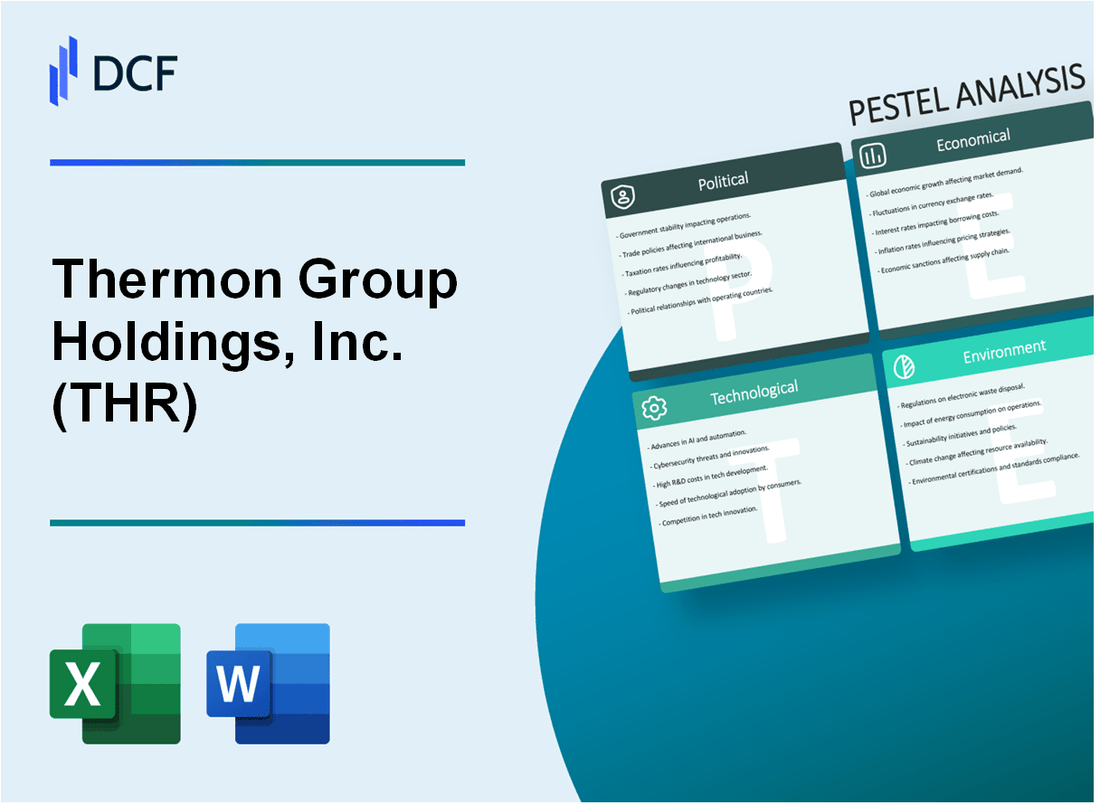
Entièrement Modifiable: Adapté À Vos Besoins Dans Excel Ou Sheets
Conception Professionnelle: Modèles Fiables Et Conformes Aux Normes Du Secteur
Pré-Construits Pour Une Utilisation Rapide Et Efficace
Compatible MAC/PC, entièrement débloqué
Aucune Expertise N'Est Requise; Facile À Suivre
Thermon Group Holdings, Inc. (THR) Bundle
Dans le paysage dynamique des solutions de chauffage industriel, Thermon Group Holdings, Inc. (THR) se dresse au carrefour de l'innovation, des défis réglementaires et des technologies transformatrices. Cette analyse complète du pilon dévoile le réseau complexe de facteurs politiques, économiques, sociologiques, technologiques, juridiques et environnementaux qui façonnent le positionnement stratégique de THR sur le marché mondial des équipements industriels. Des investissements gouvernementaux sur les infrastructures aux technologies de gestion thermique de pointe, la société navigue dans un écosystème complexe d'opportunités et de défis qui définiront sa trajectoire future.
Thermon Group Holdings, Inc. (THR) - Analyse du pilon: facteurs politiques
Politiques d'investissement des infrastructures du gouvernement américain
La loi sur les investissements et les emplois de l'infrastructure (IIJA) 1,2 billion de dollars pour le développement des infrastructures, avec 550 milliards de dollars dans les nouvelles dépenses fédérales soutenant directement les secteurs industriels.
| Catégorie de financement des infrastructures | Budget alloué |
|---|---|
| Infrastructure de fabrication industrielle | 110 milliards de dollars |
| Modernisation du réseau énergétique | 73 milliards de dollars |
| Incitations à la production de fabrication | 52 milliards de dollars |
Impact des réglementations commerciales
Politiques commerciales actuelles affectant la fabrication mondiale de Thermon:
- Les tarifs de la section 301 sur les importations chinoises vont de 7,5% à 25%
- L'accord US-Mexico-Canada (USMCA) prévoit Réduction des barrières commerciales
- Les réglementations de contrôle des exportations restreignent les transferts technologiques dans des secteurs industriels spécifiques
Changements de politique du secteur de l'énergie
| Domaine politique | Impact réglementaire |
|---|---|
| Incitations aux énergies renouvelables | Crédit d'impôt d'investissement jusqu'à 30% |
| Réduction des émissions de carbone | L'EPA oblige la réduction des émissions industrielles de 17,5% d'ici 2030 |
Tensions géopolitiques
Défis actuels de l'opération internationale:
- Les tensions commerciales américaines-chinoises résultant en 360 milliards de dollars dans les tarifs mutuels
- Conflit de la Russie-Ukraine perturbant les chaînes d'approvisionnement industrielles mondiales
- L'instabilité géopolitique du Moyen-Orient impactant les marchés d'équipement énergétique
Thermon Group Holdings, Inc. (THR) - Analyse du pilon: facteurs économiques
Fluctuant de la demande du marché mondial des équipements industriels
La taille du marché mondial des équipements industriels était évaluée à 4,56 billions de dollars en 2023, avec un TCAC projeté de 5,8% de 2024 à 2030. Le segment de marché du groupe Thermon montre spécifiquement une croissance potentielle des technologies de chauffage industriel.
| Segment de marché | Valeur 2023 | 2024 Croissance projetée |
|---|---|---|
| Équipement industriel mondial | 4,56 billions de dollars | 5,8% CAGR |
| Technologies de chauffage industriel | 687 milliards de dollars | 6,2% CAGR |
La reprise économique continue a un impact sur les investissements en équipement
Les investissements en équipement en 2023 ont atteint 2,3 billions de dollars dans le monde, les investissements du secteur manufacturier représentant 42% des dépenses totales.
| Catégorie d'investissement | 2023 Valeur d'investissement | Pourcentage du total |
|---|---|---|
| Investissements totaux d'équipement à l'équipement | 2,3 billions de dollars | 100% |
| Investissements du secteur manufacturier | 966 milliards de dollars | 42% |
Volatilité des coûts du secteur de l'énergie affectant l'adoption de la technologie de chauffage industriel
La volatilité du secteur de l'énergie a démontré un impact significatif sur les investissements en technologie de chauffage industriel. Les prix du pétrole brut de Brent étaient en moyenne de 82,44 $ le baril en 2023, créant une dynamique d'investissement complexe.
| Métrique énergétique | Valeur 2023 | Impact sur l'adoption de la technologie |
|---|---|---|
| Prix du pétrole brut Brent | 82,44 $ / baril | Incertitude d'investissement modérée |
| Prix du gaz naturel | 3,65 $ / MMBTU | Environnement d'investissement technologique stable |
Les risques de récession potentiels influencent les stratégies de dépenses des entreprises
Les projections du FMI indiquent un ralentissement économique mondial potentiel, les dépenses des entreprises devraient se contracter de 3,2% dans les secteurs à haut risque en 2024.
| Indicateur économique | 2024 projection | Impact potentiel |
|---|---|---|
| Croissance mondiale du PIB | 2.9% | Expansion modérée |
| Contraction des dépenses des entreprises | 3.2% | Réduction du secteur à haut risque |
Thermon Group Holdings, Inc. (THR) - Analyse du pilon: facteurs sociaux
L'accent mis sur la main-d'œuvre sur les technologies de sécurité industrielle
Selon le National Safety Council, les blessures en milieu de travail ont coûté aux employeurs américains 171 milliards de dollars en 2019. Le marché des technologies de sécurité industrielle prévoyait de atteindre 12,3 milliards de dollars d'ici 2026, avec un TCAC de 6,8%.
| Segment de la technologie de sécurité | Valeur marchande 2024 | Taux de croissance projeté |
|---|---|---|
| Équipement de protection personnelle | 59,5 milliards de dollars | 5.2% |
| Systèmes de gestion de la sécurité | 4,2 milliards de dollars | 7.1% |
| Capteurs de sécurité industrielle | 3,8 milliards de dollars | 8.3% |
Demande croissante de solutions industrielles durables et éconergétiques
Le marché mondial de l'efficacité énergétique industrielle devrait atteindre 66,2 milliards de dollars d'ici 2026, avec un TCAC de 5,9%. Les investissements en énergie renouvelable ont atteint 366 milliards de dollars en 2023.
| Secteur de l'efficacité énergétique | Investissement mondial 2024 | Croissance annuelle |
|---|---|---|
| Gestion de l'énergie industrielle | 24,5 milliards de dollars | 6.4% |
| Technologies de fabrication verte | 18,3 milliards de dollars | 7.2% |
Pénuries de main-d'œuvre qualifiées dans les secteurs de la fabrication technique
Les compétences manufacturières aux États-Unis pourraient entraîner 2,1 millions d'emplois non remplis d'ici 2030, ce qui a potentiellement provoqué un impact économique de 1 billion de dollars. La pénurie actuelle des compétences de main-d'œuvre de fabrication à 77%.
| Catégorie de compétences de fabrication | Pourcentage de pénurie actuel | Impact projeté |
|---|---|---|
| Compétences en génie technique | 62% | 450 milliards de dollars de perte potentielle |
| Compétences de fabrication avancées | 54% | Perte potentielle de 320 milliards de dollars |
Modification des réglementations de sécurité au travail et des exigences de conformité
L'OSHA Regulatory Compliance Investments devrait atteindre 9,7 milliards de dollars en 2024. Les dépenses moyennes de la conformité des entreprises ont augmenté de 45% depuis 2020.
| Zone de conformité | Investissement annuel | Impact réglementaire |
|---|---|---|
| Programmes de formation à la sécurité | 3,2 milliards de dollars | Formation annuelle obligatoire de 8 heures |
| Certifications de sécurité de l'équipement | 2,5 milliards de dollars | Exigences d'inspection trimestrielles |
Thermon Group Holdings, Inc. (THR) - Analyse du pilon: facteurs technologiques
Innovations avancées de gestion thermique et de chauffage industriel
Thermon Group Holdings a investi 12,3 millions de dollars dans la R&D pour les technologies de gestion thermique au cours de l'exercice 2023. La société détient 17 brevets actifs liés aux solutions de chauffage industriel au quatrième trimestre 2023.
| Catégorie de technologie | Dénombrement des brevets | Investissement en R&D |
|---|---|---|
| Systèmes de chauffage électrique | 7 | 5,6 millions de dollars |
| Technologies de chauffage fluide | 6 | 4,2 millions de dollars |
| Détection thermique avancée | 4 | 2,5 millions de dollars |
Transformation numérique dans les systèmes de surveillance des équipements industriels
Thermon a mis en œuvre des solutions de surveillance numérique sur 62% de ses gammes de produits d'ici la fin de 2023. Les investissements en transformation numérique ont atteint 8,7 millions de dollars au cours de la même période fiscale.
| Capacité de surveillance numérique | Pourcentage de mise en œuvre | Investissement technologique |
|---|---|---|
| Suivi d'équipement en temps réel | 58% | 3,2 millions de dollars |
| Analyse des performances | 45% | 2,9 millions de dollars |
| Diagnostics à distance | 38% | 2,6 millions de dollars |
Intégration des technologies de maintenance IoT et prédictive
L'intégration de l'IoT dans l'écosystème des produits de Thermon a atteint une couverture de 47% d'ici le quatrième trimestre 2023. Les investissements en technologie de maintenance prédictive ont totalisé 6,5 millions de dollars la même année.
- Déploiement du capteur IoT: 3 200 unités sur les gammes de produits industriels
- Développement de l'algorithme de maintenance prédictive: 12 nouveaux modèles d'apprentissage automatique
- Capacité de traitement des données: 1,2 pétaoctets par mois
Automatisation émergente et capacités de surveillance à distance
Les technologies d'automatisation représentaient 35% du portefeuille de développement technologique de Thermon en 2023. Les revenus du système de surveillance à distance ont atteint 22,4 millions de dollars.
| Technologie d'automatisation | Investissement en développement | Pénétration du marché |
|---|---|---|
| Automatisation de processus robotique | 2,1 millions de dollars | 28% |
| Surveillance améliorée AI | 3,6 millions de dollars | 22% |
| Systèmes de contrôle avancés | 4,8 millions de dollars | 42% |
Thermon Group Holdings, Inc. (THR) - Analyse du pilon: facteurs juridiques
Conformité aux normes internationales de sécurité des équipements industriels
ISO 9001: Statut de certification 2015: Thermon Group Holdings maintient une certification active, couvrant les systèmes de gestion de la qualité dans les installations de fabrication.
| Norme de sécurité | Niveau de conformité | Juridiction réglementaire |
|---|---|---|
| Règlement sur la sécurité industrielle de l'OSHA | 100% conforme | États-Unis |
| Directive de machines CE | Compliance complète | Union européenne |
| IEC 60079 Standard des atmosphères explosives | Agréé | Commission électrotechnique internationale |
La réglementation environnementale a un impact sur les processus de fabrication
Dépenses de conformité environnementale: 2,7 millions de dollars alloués à l'adhésion réglementaire au cours de l'exercice 2023.
| Règlement | Coût de conformité | Stratégie d'atténuation |
|---|---|---|
| Règlement sur les déchets dangereux de l'EPA | $890,000 | Programme de réduction des déchets |
| Modifications de la Clean Air Act | $1,250,000 | Technologies de contrôle des émissions |
Protection de la propriété intellectuelle pour les innovations technologiques
Portefeuille de brevets: 37 Brevets actifs auprès du quatrième trimestre 2023, protégeant les innovations de la technologie de chauffage de base.
| Catégorie de brevet | Nombre de brevets | Couverture géographique |
|---|---|---|
| Conception d'élément chauffant | 15 | États-Unis, UE, Chine |
| Systèmes de contrôle de la température | 12 | Amérique du Nord, Europe |
| Techniques d'application industrielle | 10 | Mondial |
Considérations de responsabilité potentielle dans les solutions de chauffage industrielles
Budget de gestion des risques juridiques: 3,4 millions de dollars alloués à la protection de la responsabilité en 2023.
| Catégorie de responsabilité | Couverture d'assurance | Prime annuelle |
|---|---|---|
| Responsabilité du produit | 50 millions de dollars | $1,200,000 |
| Indemnité professionnelle | 25 millions de dollars | $750,000 |
| Responsabilité de la sécurité au travail | 15 millions de dollars | $480,000 |
Thermon Group Holdings, Inc. (THR) - Analyse du pilon: facteurs environnementaux
Accent croissant sur les technologies de chauffage industriel durable
Le marché mondial des technologies de chauffage industriel prévoit de atteindre 25,3 milliards de dollars d'ici 2027, avec un TCAC de 5,8%. Les solutions de chauffage durable de Thermon visaient à réduire l'impact environnemental dans les applications industrielles.
| Segment de marché | Investissement en technologie durable | Croissance projetée (2024-2027) |
|---|---|---|
| Chauffage industriel vert | 3,7 milliards de dollars | 7.2% |
| Solutions thermiques économes en énergie | 2,5 milliards de dollars | 6.5% |
Stratégies de réduction des émissions de carbone dans la fabrication
Les objectifs de réduction du carbone de Thermon: réduction des émissions de 35% d'ici 2030, alignés sur les objectifs mondiaux de décarbonisation industrielle.
| Catégorie de réduction des émissions | Pourcentage cible | Investissement |
|---|---|---|
| Émissions de fabrication directes | 25% | 1,2 million de dollars |
| Émissions de la chaîne d'approvisionnement | 10% | $850,000 |
Exigences d'efficacité énergétique dans la conception des équipements industriels
Les normes d'efficacité énergétique obligent 40% des performances thermiques améliorées dans l'équipement de chauffage industriel d'ici 2025.
| Métrique d'efficacité | Performance actuelle | Cible 2025 |
|---|---|---|
| Efficacité thermique | 65% | 91% |
| Réduction de la consommation d'énergie | 22% | 40% |
Principes d'économie circulaire influençant le développement de produits
Les investissements en économie circulaire dans la gestion du cycle de vie des produits estimé à 4,5 millions de dollars pour Thermon en 2024.
| Initiative de l'économie circulaire | Investissement | Impact attendu |
|---|---|---|
| Conception de produits recyclables | 1,8 million de dollars | 60% de recyclabilité des matériaux |
| Extension du cycle de vie du produit | 2,7 millions de dollars | Durée de vie des produits 45% plus longue |
Thermon Group Holdings, Inc. (THR) - PESTLE Analysis: Social factors
You might think of industrial heating as a purely technical, engineering problem, but honestly, the biggest shifts for Thermon Group Holdings, Inc. right now are driven by social pressure-specifically, what society demands from its industrial base. This includes everything from a mandate for less energy waste to a non-negotiable expectation of worker safety. These social forces are creating a massive, multi-billion-dollar opportunity for Thermon, but they also bring a defintely real risk from the skilled labor crunch.
Growing industrial demand for energy efficiency and sustainability
The global push for sustainability (ESG) is no longer a niche concern; it's a core operational and social mandate for Thermon's client base. Industry accounts for nearly 40% of total final energy consumption, so the pressure to cut waste is immense. This social demand translates directly into a booming market for Thermon's core products, which are designed to prevent heat loss and optimize thermal processes.
The market for industrial energy efficiency services is a clear indicator of this trend, expected to expand from $11.03 billion in 2024 to $11.72 billion in 2025, reflecting a compound annual growth rate (CAGR) of 6.3%. This growth is driven by customers actively seeking solutions to reduce their carbon footprint and save on escalating energy costs. Thermon's focus on electrification and decarbonization, which the company explicitly cites as a long-term secular growth driver, positions it perfectly to capture this spending.
Skilled labor shortage for specialized installation and maintenance
Here's the quick math: you can sell the most advanced heat tracing system in the world, but if you can't find a qualified electrician or pipefitter to install it correctly, the project stalls. The skilled labor shortage is a crucial social headwind. For the broader industrial and construction sector, 91% of construction firms struggled to fill skilled positions in 2024, and this shortage is expected to continue impacting budgets in 2025. It's a huge bottleneck.
This challenge is particularly acute in the energy efficiency sector itself, where 72% of employers reported a shortage of workers in 2024. For Thermon, this means longer project lead times, higher installation costs, and increased competition for technical staff. This is why the push for digitalization is so important-it helps systems become easier to install and maintain, effectively using technology to help mitigate the labor deficit.
Increased focus on industrial safety mandates reliable temperature control
Industrial safety is a social factor that is rapidly moving from a best practice to a strict, federally enforced rule, and this creates a non-discretionary spending driver for Thermon. The Occupational Safety and Health Administration (OSHA) is finalizing its first-ever national Heat Injury and Illness Prevention Standard in 2025, with informal hearings scheduled through July 2025.
This proposed rule is a game-changer for industrial environments, including factories and processing plants, which are often covered if temperatures regularly exceed 80°F indoors. The mandates require employers to have a plan to evaluate and control heat hazards, which often involves engineering controls like ventilation and, critically, precise temperature control of hot processes. Thermon's core business of reliable temperature management and heat tracing is a direct solution to these new, stringent safety requirements, making its products an essential compliance cost for many clients.
Client pressure for digitalization and remote monitoring capabilities
Clients are demanding more than just hardware; they want data and control. The social expectation for real-time information, driven by consumer technology, has fully migrated to the industrial sector. This trend, which Thermon calls 'digitization,' is one of its key strategic pillars.
The shift is clear in the market data. The remote monitoring solutions market for related systems like HVAC is projected to reach $10.06 billion by 2033, with an 8.2% CAGR from 2024. This client pressure means Thermon must continually invest in its Industrial Internet of Things (IIoT) capabilities to offer real-time monitoring, predictive maintenance, and remote diagnostics for its heating systems. This is a clear opportunity to increase higher-margin service revenue.
The table below summarizes the core social drivers impacting Thermon Group Holdings, Inc. and the corresponding financial and market context from the 2025 fiscal year data.
| Social Factor | 2025 Market/Financial Context | Impact on Thermon's Business |
|---|---|---|
| Growing Industrial Demand for Energy Efficiency | Industrial Energy Efficiency Services market expected to reach $11.72 billion in 2025 (6.3% CAGR). | Strong tailwind for sales of efficient heat tracing and process heating solutions; aligns with the company's decarbonization strategy. |
| Skilled Labor Shortage for Specialized Installation | 72% of energy efficiency employers report a worker shortage. 91% of construction firms struggled to fill skilled roles in 2024. | Increases installation costs and project timelines; necessitates a focus on product design for easier, faster deployment and digital tools for remote support. |
| Increased Focus on Industrial Safety Mandates | OSHA's proposed Heat Standard sets an Initial Heat Trigger at a heat index of 80°F for indoor/outdoor work. | Creates non-discretionary, compliance-driven demand for reliable temperature control and process heating equipment to mitigate workplace hazards. |
| Client Pressure for Digitalization and Remote Monitoring | Remote Monitoring Solutions for HVAC market projected at $10.06 billion by 2033 (8.2% CAGR). | Drives investment in IIoT (Industrial Internet of Things) product features and higher-margin digital service offerings; critical for maintaining competitive advantage. |
The company's full-year 2025 Revenue of $498.2 million and Net Income of $53.5 million show a business that is successfully navigating these social currents, but the long-term winners will be those who can best solve the labor shortage by scaling their digital offerings.
Thermon Group Holdings, Inc. (THR) - PESTLE Analysis: Technological factors
Accelerated shift to electric heat tracing over legacy steam systems.
You need to recognize that the industrial landscape is quickly moving away from steam tracing systems, and this is a major tailwind for Thermon Group Holdings, Inc. The global Electric Heat Tracing (EHT) market is valued at approximately $3.0 billion in 2025, and it's projected to grow at a Compound Annual Growth Rate (CAGR) of 7.8% through 2030. This growth is a direct result of the sustained conversion from legacy steam to electric solutions, which offer superior energy efficiency and lower maintenance costs.
Thermon is well-positioned as one of the largest participants in this market, capitalizing on the broader industry push toward electrification and decarbonization. [cite: 6 in step 1] Their core product, self-regulating cables, is a key technology driving this shift, having commanded 43.2% of the electric heat tracing market share in 2024. This trend is not just about efficiency; it's about meeting new regulatory pressure and operational goals, especially in the emerging hydrogen economy and LNG facilities.
Industrial IoT integration for predictive maintenance and asset monitoring.
The digitization of industrial assets is a non-negotiable trend, and Thermon's integration of Industrial Internet of Things (IIoT) technology is crucial for their long-term value proposition. The broader Industrial Internet of Things market stood at an estimated $154.14 billion in 2025 and is forecast to grow at a staggering 24.96% CAGR through 2030. This growth is driven by the shift from reactive maintenance to a predictive model.
Thermon's smart, connected control and monitoring systems, like their Genesis™ and TraceNet™ products, are built on this IIoT foundation. [cite: 6 in step 1, 12 in step 1] These advanced control systems integrate with a plant's central data management, enabling lower operating costs and reduced emissions for the end-user. [cite: 6 in step 1] For instance, their systems have the capacity to manage over 30,000 heat trace circuits within a single facility, offering a massive data stream for predictive analytics. [cite: 12 in step 1]
R&D focus on advanced materials for extreme operating environments.
The push for electrification in high-demand sectors like data centers and nuclear energy means the technology must perform under extreme conditions. Thermon understands this, and their R&D focus is a clear indicator of their strategic direction. They are defintely investing in the future by doubling their R&D lab's footprint and adding 'revolutionary testing capabilities' to their Canadian facilities. [cite: 11 in step 1]
This R&D is specifically aimed at safely introducing new technologies that can push the operational limits of temperature, voltage, and wattage, which is essential for serving customers pursuing decarbonization goals. [cite: 11 in step 1] While a specific R&D expense figure for the full fiscal year 2025 is not publicly isolated from general operating expenses, the physical expansion of the lab shows a capital commitment to:
- Develop high-temperature insulation materials. [cite: 5 in step 2]
- Engineer next-wave polymer insulation for enhanced thermal performance. [cite: 5 in step 2]
- Innovate on conductive materials for durability in extreme environments. [cite: 5 in step 2]
Cybersecurity risk for connected control and monitoring systems.
The trade-off for digitization is increased cybersecurity risk. As Thermon's smart systems become integrated with critical infrastructure, they become potential targets for cyber-attacks. The Cybersecurity and Infrastructure Security Agency (CISA) has been consistently releasing Industrial Control Systems (ICS) Advisories, with multiple alerts being issued as recently as November 2025, highlighting the immediate and ongoing threat to industrial systems. [cite: 13 in step 1, 14 in step 1]
Thermon mitigates this by maintaining a comprehensive risk management system based on the National Institutes of Standards and Technology (NIST) Cybersecurity Framework. [cite: 7 in step 1] They employ 24/7 monitoring and regular testing to protect the confidentiality, integrity, and availability of their information assets and, more importantly, their customers' operational technology (OT) systems. [cite: 7 in step 1] What this estimate hides is the potential cost of a major breach, which could severely damage their reputation for reliability in mission-critical applications.
| Technological Factor | 2025 Market/Company Metric | Strategic Implication for Thermon |
|---|---|---|
| Electric Heat Tracing Market Size | $3.0 billion (Global Market Value) | Major growth vector; reinforces strategic focus on decarbonization and electrification. |
| Projected EHT Market CAGR (2025-2030) | 7.8% (Compound Annual Growth Rate) | Indicates a stable, high-growth environment for core products over the near-term. |
| Industrial IoT Market Size | $154.14 billion (Global Market Value) | High-growth opportunity to sell high-margin software and services for predictive maintenance. |
| Max Circuits Managed (Product Capacity) | Over 30,000 heat trace circuits (per large facility system) [cite: 12 in step 1] | Demonstrates scale and complexity of IIoT offering; a competitive advantage in large-scale projects. |
| R&D Investment Action | Doubling R&D lab footprint (in Ontario, Canada) [cite: 11 in step 1] | Concrete action to develop advanced materials for extreme temperature/voltage applications. |
Thermon Group Holdings, Inc. (THR) - PESTLE Analysis: Legal factors
Stricter global compliance for explosion-proof equipment (ATEX, IECEx)
Thermon Group Holdings, Inc. operates in highly regulated industrial and hazardous locations, so compliance with global safety standards is not a choice, it's the cost of entry. The core of this is the certification for explosion-proof equipment, primarily governed by the European Union's ATEX Directive (mandatory for the EU market) and the International Electrotechnical Commission System for Certification (IECEx), which acts as a globally respected standard for international market access.
You can't sell process heating solutions to the oil and gas, chemical, or mining sectors-which account for over 70% of the explosion-proof equipment market-without these stamps of approval. The technical requirements of ATEX and IECEx are harmonized, meaning a smart manufacturer like Thermon can use an IECEx Test Report to streamline the mandatory ATEX certification process.
This strict regulatory environment is defintely a strategic advantage for established players, as it creates a high barrier to entry for new competitors. The cost of non-compliance is severe, with global non-compliance fines in the broader hazardous area equipment space reaching an estimated $14 billion in 2024. For a global company like Thermon, which generated $498.2 million in revenue in Fiscal 2025, maintaining a flawless compliance record is mission-critical.
Evolving environmental regulations on industrial energy consumption
While Thermon's primary legal risk isn't environmental fines, evolving regulations on industrial energy consumption are a significant commercial driver and a compliance point. New laws and incentives are pushing industrial customers toward the electrification of process heating to reduce greenhouse gas emissions and comply with local environmental rules.
Thermon's own operations, however, show a challenge in their internal environmental footprint. The company's total energy consumption increased in the most recent fiscal year, and it relies entirely on grid electricity. This is a clear near-term risk as global and national environmental, social, and governance (ESG) reporting requirements tighten.
Here's the quick math on Thermon's recent energy consumption:
| Metric | Unit of Measure | Fiscal Year 2025 Result | Change from FY2024 |
|---|---|---|---|
| Total Energy Consumed | Gigajoules (GJ) | 68,024 GJ | +6% increase |
| Percentage Grid Electricity | Percentage (%) | 100% | No change |
| Hazardous Waste from Manufacturing | Metric Tons (t) | 2t | -95.6% decrease |
The good news is the dramatic reduction in hazardous waste to just 2t in Fiscal 2025 (down from 45t in Fiscal 2024), but the 100% reliance on grid electricity means compliance costs or capital expenditures for renewable energy sourcing could become a material factor in future fiscal years, even if they weren't in Fiscal 2025. You need a plan to address that 100% grid dependency.
Increased legal scrutiny on supply chain and conflict mineral sourcing
The legal scrutiny on industrial supply chains, particularly regarding conflict minerals, continues to intensify, driven by regulations like the Dodd-Frank Act in the U.S. Thermon, like all manufacturers of electric components, must conduct due diligence on the sourcing of tin, tungsten, tantalum, and gold (3TG).
Thermon has a formal screening mechanism for conflict materials as part of its supplier management process, following the framework established by the Organisation for Economic Co-operation and Development (OECD). However, the complexity of the global supply chain is a persistent risk. The company has previously noted that due to being several levels removed from the source, they were unable to determine the country of origin for all necessary conflict minerals, resulting in a 'DRC Conflict Undeterminable' status for their core product lines.
The key risk here isn't necessarily a massive fine, but the potential for reputational damage or loss of business from major customers who require a fully transparent, conflict-free supply chain. The company mitigates this by:
- Employing a screening mechanism for conflict materials.
- Sourcing critical raw materials like copper and stainless steel from multiple suppliers.
- Maintaining a process to collect and report conflict minerals use to meet customer requirements.
Intellectual property protection for specialized heat transfer technology
Intellectual property (IP) protection is a critical legal lever for Thermon, whose competitive edge rests on highly engineered solutions. The company holds patents on some of its products and processes, notably the patented heat-spreading technology acquired through the Powerblanket acquisition.
The legal framework here is defensive: protecting their existing IP, and offensive: registering new patents to maintain a technological lead. The risk is twofold: a failure to successfully enforce existing IP rights against infringers, or costly, time-consuming litigation. Any significant IP dispute would reduce operating income, though management believes current litigation expenses are not expected to have a significant adverse effect on financial position.
The value of this IP is directly tied to the company's ability to drive innovation and maintain its gross margin, which stood at a healthy 44.7% for Fiscal 2025. Protecting that margin means aggressively defending their patents, especially in their core markets of electric heat tracing cables and smart control systems.
Thermon Group Holdings, Inc. (THR) - PESTLE Analysis: Environmental factors
Decarbonization mandates push clients to electrify process heating.
You need to see the industrial decarbonization trend not as a threat to traditional heating, but as a massive market shift toward your core competency: electric process heating. Global mandates and incentives are driving clients to replace fossil-fueled systems, and this is a clear opportunity for Thermon Group Holdings, Inc. (THR). The industrial electrification market is accelerating, projected to reach $130.67 billion by 2034, growing at an 8.52% Compound Annual Growth Rate (CAGR) from 2025. That's a huge tailwind.
The company is already capitalizing on this, having been awarded two large, multi-year projects related to decarbonization in the second quarter of Fiscal 2025 alone. This shift is structural, not cyclical. Right now, existing technologies can electrify about 60% of industrial heat demand, and your electric heat tracing and control systems are perfectly positioned for that transition. We are seeing the US push for electrification and the EU mandate for hydrogen-ready systems, which means your clients need modular, flexible heating solutions now.
- Electrification addresses 60% of current industrial heat demand.
- Decarbonization is a stated strategic pillar for Thermon.
- The Industrial Electrification Market is forecast to grow at an 8.52% CAGR (2025-2034).
Regulations on industrial emissions create new market for monitoring.
Stricter global regulations, like the U.S. EPA's expanded reporting and the EU's Industrial Emissions Directive, are forcing industrial plants to invest in sophisticated monitoring. This regulatory pressure directly creates a new, high-margin market for your control and software solutions. The Continuous Emission Monitoring System (CEMS) market, which is critical for compliance, is estimated to be valued at $2,970.31 million in 2025.
Compliance monitoring is expected to account for approximately 47% of the total CEMS market share this year. Thermon's Genesis and TraceNet control products, which can manage over 30,000 heat trace circuits and integrate with a plant's central data management system, are essential tools for clients needing real-time emissions data. You are selling compliance assurance, not just hardware. The overall Emission Monitoring System (EMS) market is valued at $3.47 billion in 2025, which shows the sheer size of this regulatory-driven opportunity.
Extreme weather events necessitate more resilient heating infrastructure.
The increasing frequency of extreme weather-from deep freezes to record heatwaves-has turned infrastructure resilience into a critical capital expenditure driver for your clients. Chronic hazards like extreme heat and heavy rainfall account for 86% of projected losses, which is a significant factor for industrial operators. By 2035, extreme heat alone is projected to cause $448 billion in annual fixed-asset losses for publicly listed companies.
Your heat tracing and temperature management systems are a direct solution to this physical risk. They protect pipelines and equipment from freezing during cold snaps and prevent overheating or process failure in high-temperature environments. This is a non-negotiable insurance policy for clients in the oil & gas, chemical, and power generation sectors, who are now moving away from designs based on historical climate records. This risk is pushing companies to invest in modernizing grids and strengthening logistics, which means more demand for resilient, high-performance electric systems.
Focus on reducing waste in manufacturing and installation processes.
While external environmental pressures drive product demand, internal operational metrics show where you must improve. Thermon's commitment to reducing its own environmental impact is a key part of its sustainability profile. However, the Fiscal Year 2025 data reveals a mixed picture that needs immediate attention from an operational excellence standpoint.
The good news is that hazardous waste from manufacturing dropped drastically to 2 metric tons in FY25, down from 45 metric tons in FY24. That's a huge reduction. But, the percentage of that hazardous waste recycled fell from 77% in FY24 to 0% in FY25. This drop in recycling is a major red flag that undermines the waste reduction effort. Furthermore, total energy consumed in FY25 increased by 6% to 68,024 Gigajoules (GJ), with 100% still sourced from grid electricity, meaning no renewable energy use in operations. Operational Excellence initiatives, like the Denver facility consolidation, did drive incremental savings of $0.8 million in Fiscal 2025, but the sustainability metrics need to catch up.
| Environmental Metric | Fiscal Year 2025 Value | FY25 vs. FY24 Change | Strategic Implication |
|---|---|---|---|
| Total Energy Consumed | 68,024 GJ | +6% increase | Risk: Rising operational costs, poor ESG optics without renewable sourcing. |
| Renewable Energy Sourcing | 0% of total energy | No change (100% grid electricity) | Action: Missed opportunity for internal decarbonization; lags client focus. |
| Hazardous Waste from Manufacturing | 2 metric tons (t) | Significant drop from 45t in FY24 | Opportunity: Manufacturing efficiency is improving; a major positive. |
| Hazardous Waste Recycled | 0% | Sharp decrease from 77% in FY24 | Risk: Immediate operational failure to address; damages sustainability claims. |
Next Step: Operations must immediately identify the breakdown in the hazardous waste recycling process and restore the rate above 77% by the end of Q1 Fiscal 2026.
Disclaimer
All information, articles, and product details provided on this website are for general informational and educational purposes only. We do not claim any ownership over, nor do we intend to infringe upon, any trademarks, copyrights, logos, brand names, or other intellectual property mentioned or depicted on this site. Such intellectual property remains the property of its respective owners, and any references here are made solely for identification or informational purposes, without implying any affiliation, endorsement, or partnership.
We make no representations or warranties, express or implied, regarding the accuracy, completeness, or suitability of any content or products presented. Nothing on this website should be construed as legal, tax, investment, financial, medical, or other professional advice. In addition, no part of this site—including articles or product references—constitutes a solicitation, recommendation, endorsement, advertisement, or offer to buy or sell any securities, franchises, or other financial instruments, particularly in jurisdictions where such activity would be unlawful.
All content is of a general nature and may not address the specific circumstances of any individual or entity. It is not a substitute for professional advice or services. Any actions you take based on the information provided here are strictly at your own risk. You accept full responsibility for any decisions or outcomes arising from your use of this website and agree to release us from any liability in connection with your use of, or reliance upon, the content or products found herein.