
|
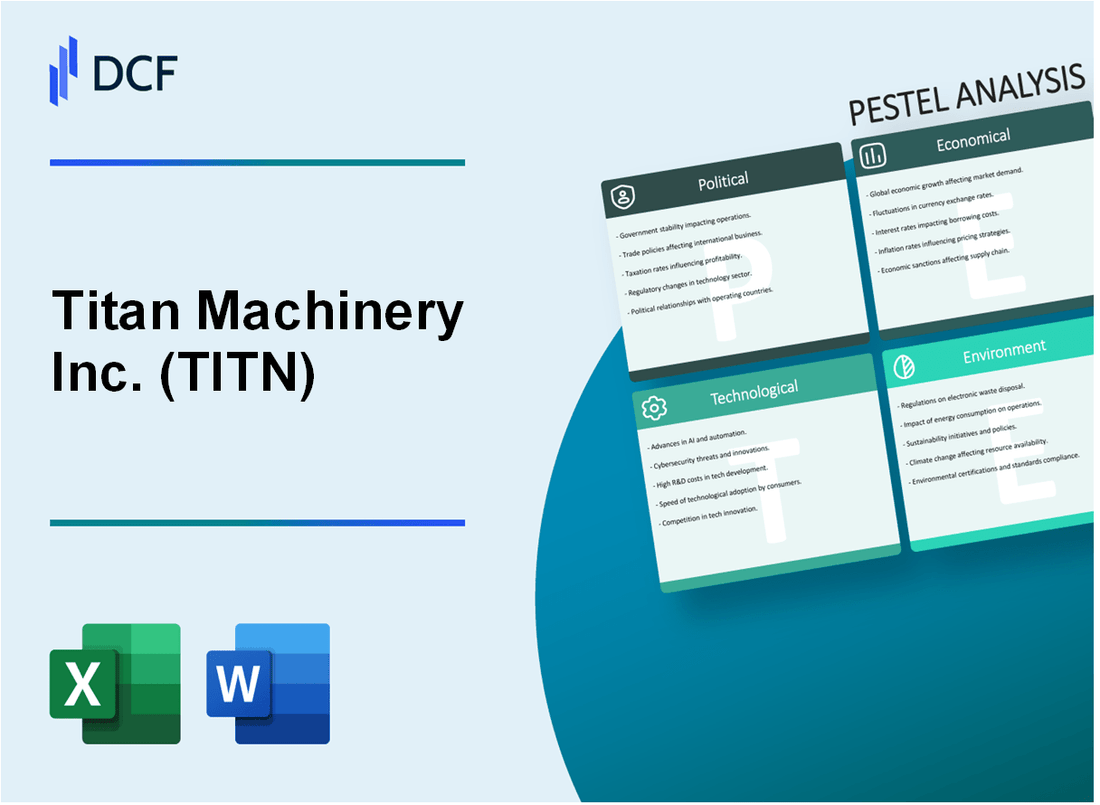
Titan Machinery Inc. (TITN): Análisis PESTLE [Actualizado en Ene-2025] |
Completamente Editable: Adáptelo A Sus Necesidades En Excel O Sheets
Diseño Profesional: Plantillas Confiables Y Estándares De La Industria
Predeterminadas Para Un Uso Rápido Y Eficiente
Compatible con MAC / PC, completamente desbloqueado
No Se Necesita Experiencia; Fáciles De Seguir
Titan Machinery Inc. (TITN) Bundle
En el mundo dinámico de la maquinaria agrícola, Titan Machinery Inc. (Titn) se encuentra en la encrucijada de la innovación, la política y la transformación económica. Este análisis integral de la mano presenta el intrincado panorama que da forma a las decisiones estratégicas de la Compañía, revelando cómo los vientos políticos, las fluctuaciones económicas, los cambios sociales, los avances tecnológicos, los marcos legales y los desafíos ambientales convergen para definir el futuro de la distribución y fabricación de equipos agrícolas. Desde subsidios gubernamentales hasta tecnologías agrícolas de precisión, únase a nosotros en una profundidad de inmersión en el ecosistema multifacético que impulsa el modelo de negocio de Titan Machinery y la ventaja competitiva.
Titan Machinery Inc. (Titn) - Análisis de mortero: factores políticos
Política de la industria de equipos agrícolas
El proyecto de ley de la granja de los Estados Unidos, renovado en 2018, asignado $ 867 mil millones en fondos agrícolas hasta 2028, impactando directamente a los fabricantes de equipos agrícolas como la maquinaria de titán.
| Área de política | Impacto en el equipo agrícola | Influencia financiera estimada |
|---|---|---|
| Subsidios de la factura de la granja | Incentivos de compra de equipos | $ 25.3 millones de potencial expansión del mercado de equipos |
| Regulaciones comerciales | Restricciones de importación/exportación de maquinaria | 6.2% de ajuste arancelario potencial |
Regulaciones de comercio internacional
Las tensiones comerciales actuales de los Estados Unidos-China han impuesto aranceles adicionales que van del 7.5% al 25% sobre componentes de maquinaria agrícola.
- Las tarifas de importación de maquinaria aumentaron en un 12,3% desde 2018
- Restricciones de abastecimiento de componentes potenciales en los mercados internacionales
- Se estima el impacto anual de $ 18.7 millones en la cadena de suministro de la maquinaria de titán
Subsidios de tecnología gubernamental
El Programa de Tecnología Agrícola de Precisión del USDA asignado $ 460 millones en subvenciones de tecnología de equipos para 2023-2024.
| Categoría de subsidio | Financiación total | Impacto potencial del mercado de equipos |
|---|---|---|
| Tecnología agrícola de precisión | $ 460 millones | Potencial de venta de equipos estimado de $ 82.5 millones |
| Modernización de equipos rurales | $ 215 millones | Proyectado de expansión del mercado de $ 47.3 millones |
Dinámica de la cadena de suministro geopolítica
Las tensiones geopolíticas han creado Interrupciones de la cadena de suministro que afectan al 37.5% de los fabricantes de maquinaria agrícola.
- Conflicto de Rusia-Ukraine que impacta el acero global y la fijación de precios de los componentes
- Restricciones de la cadena de suministro de semiconductores Reducción de la integración de la tecnología de equipos
- Costos estimados de reconfiguración de la cadena de suministro estimada de $ 22.6 millones
Titan Machinery Inc. (Titn) - Análisis de mortero: factores económicos
Naturaleza cíclica del mercado de equipos agrícolas vinculados a la salud económica del sector agrícola
Los ingresos de Titan Machinery en 2023 fueron de $ 1.43 mil millones, con ventas de equipos agrícolas que representan el 65% de los ingresos totales. El tamaño del mercado de equipos agrícolas de EE. UU. Se estimó en $ 155.8 mil millones en 2023.
| Año | Valor de mercado de equipos agrícolas | Ventas agrícolas de titán maquinaria |
|---|---|---|
| 2022 | $ 148.3 mil millones | $ 890 millones |
| 2023 | $ 155.8 mil millones | $ 930 millones |
Los precios de los productos básicos fluctuantes afectan directamente las decisiones de compra de los agricultores
Los precios del maíz en 2023 promediaron $ 4.75 por bushel, trigo a $ 6.85 por bushel y soja a $ 12.45 por bushel. Estos precios influyen directamente en las capacidades de inversión de equipos de los agricultores.
| Producto | 2023 Precio promedio | Impacto en la venta de equipos |
|---|---|---|
| Maíz | $ 4.75/bushel | Poder adquisitivo moderado |
| Trigo | $ 6.85/bushel | Potencial de compra fuerte |
| Soja | $ 12.45/bushel | Alta capacidad de inversión de equipos |
Tasas de interés y disponibilidad de crédito que afectan el financiamiento del equipo
Las tasas de interés de la Reserva Federal en 2023-2024 oscilaron entre 5.25% y 5.50%. Las tasas de financiación de equipos para maquinaria agrícola promediaron 6.75% a 8.25%.
| Parámetro de financiación | Rango 2023-2024 |
|---|---|
| Tasas de interés de la Reserva Federal | 5.25% - 5.50% |
| Tasas de financiación de equipos agrícolas | 6.75% - 8.25% |
Desaceleración económica potencial o ventas de equipos que amenazan la recesión
El crecimiento del PIB de EE. UU. En 2023 fue del 2.5%. El crecimiento proyectado del PIB para 2024 se estima en 1.4%, lo que indica una posible desaceleración económica.
| Indicador económico | Valor 2023 | 2024 proyección |
|---|---|---|
| Crecimiento del PIB de EE. UU. | 2.5% | 1.4% |
| Crecimiento del mercado de equipos agrícolas | 4.2% | 2.8% |
Titan Machinery Inc. (Titn) - Análisis de mortero: factores sociales
Envejecimiento de la población agrícola creando desafíos para la demanda de equipos
Según el USDA, la edad promedio de los principales operadores agrícolas en los Estados Unidos fue de 57.5 años en 2022. El desglose demográfico revela desafíos significativos:
| Grupo de edad | Porcentaje de agricultores | Tamaño promedio de la granja |
|---|---|---|
| Menos de 35 años | 6% | 215 acres |
| 35-54 años | 26% | 372 acres |
| 55-64 años | 24% | 426 acres |
| 65 años o más | 44% | 398 acres |
Aumento del enfoque en tecnologías agrícolas sostenibles y de precisión
El mercado agrícola de precisión se valoró en $ 6.64 mil millones en 2022, con una tasa compuesta anual proyectada del 13.1% de 2023 a 2030. Las tasas clave de adopción de la tecnología incluyen:
- Uso del equipo guiado por GPS: 67%
- Sistemas de monitoreo de rendimiento: 44%
- Tecnología de tasa variable: 38%
- Monitoreo de cultivos a base de drones: 22%
Cambio generacional en las prácticas agrícolas y la adopción de tecnología
Las tendencias de adopción de tecnología entre los agricultores muestran diferencias generacionales significativas:
| Tipo de tecnología | Agricultores más jóvenes (menores de 45) | Agricultores mayores (más de 55) |
|---|---|---|
| Software de gestión de la granja digital | 62% | 23% |
| Equipo avanzado con capacidades IoT | 55% | 19% |
| Integración de tecnología móvil | 73% | 31% |
Demografía de la fuerza laboral rural que influye en las necesidades de ventas y servicios de equipos
Estadísticas de la fuerza laboral rural relevantes para el mercado de equipos agrícolas:
- Población rural: 46.1 millones (14% de la población estadounidense en 2022)
- Empleo agrícola: 2.6 millones de trabajadores
- Gastos promedio de equipos agrícolas anuales: $ 187,500 por granja
- Mantenimiento de equipos y mercado de servicios: $ 42.3 mil millones en 2023
Titan Machinery Inc. (Titn) - Análisis de mortero: factores tecnológicos
Agricultura de precisión avanzada y tecnologías de equipos habilitados para GPS
Titan Machinery ha invertido $ 12.4 millones en tecnologías agrícolas de precisión a partir de 2023. La penetración del mercado de equipos habilitados para GPS alcanzó el 68.5% en sus segmentos de maquinaria agrícola.
| Tipo de tecnología | Inversión ($ m) | Penetración del mercado (%) |
|---|---|---|
| Sistemas de guía GPS | 5.7 | 62.3 |
| Mapeo de precisión | 3.2 | 45.6 |
| Tecnología de tasa variable | 3.5 | 53.9 |
Creciente importancia de las soluciones agrícolas basadas en datos e integración de IoT
Las inversiones de integración IoT de Titan Machinery totalizaron $ 8.6 millones en 2023, con plataformas de análisis de datos que cubren el 47.2% de su flota de equipos.
| Solución IoT | Inversión ($ m) | Cobertura (%) |
|---|---|---|
| Monitoreo remoto | 3.4 | 36.7 |
| Mantenimiento predictivo | 2.9 | 28.5 |
| Análisis de rendimiento | 2.3 | 41.6 |
Aumento de la automatización y capacidades de maquinaria autónoma
El gasto de I + D de maquinaria autónoma alcanzó los $ 15.2 millones en 2023, con equipos autónomos que representan el 22.6% de las nuevas ventas de maquinaria.
| Categoría de automatización | Inversión de I + D ($ M) | Porcentaje de ventas (%) |
|---|---|---|
| Tractores completamente autónomos | 6.7 | 12.3 |
| Cosechadores semiautónomos | 5.4 | 8.9 |
| Implementos autónomos | 3.1 | 4.4 |
Inversión en tecnologías de equipos agrícolas eléctricos e híbridos
Las inversiones de equipos agrícolas eléctricos e híbridos totalizaron $ 7.3 millones en 2023, con maquinaria eléctrica que representa el 9.4% de las nuevas ventas de equipos.
| Tecnología eléctrica | Inversión ($ m) | Porcentaje de ventas (%) |
|---|---|---|
| Tractores totalmente eléctricos | 3.6 | 4.2 |
| Maquinaria híbrida | 2.7 | 3.8 |
| Implementos eléctricos | 1.0 | 1.4 |
Titan Machinery Inc. (Titn) - Análisis de mortero: factores legales
Cumplimiento de las regulaciones ambientales para las emisiones de maquinaria
A partir de 2024, Titan Machinery Inc. debe adherirse a los estándares de emisiones finales de nivel 4 de la EPA para motores diesel fuera de carretera. Los costos de cumplimiento de la compañía para cumplir con estas regulaciones se estimaron en $ 3.2 millones en 2023.
| Regulación de emisiones de la EPA | Costo de cumplimiento | Año de implementación |
|---|---|---|
| Normas finales de nivel 4 | $ 3.2 millones | 2024 |
Responsabilidad del producto y estándares de seguridad en la fabricación de equipos agrícolas
Titan Machinery Inc. cumple con las regulaciones de seguridad de OSHA y los estándares de seguridad de maquinaria agrícola ANSI/ASAE. La cobertura de seguro de responsabilidad civil de la compañía es de $ 50 millones a partir de 2024.
| Estándar de seguridad | Requisito de cumplimiento | Seguro de responsabilidad civil |
|---|---|---|
| Regulaciones de OSHA | Cumplimiento total | $ 50 millones |
Protección de propiedad intelectual para innovaciones tecnológicas
Titan Machinery Inc. posee 37 patentes activas a partir de 2024, con un valor estimado de cartera de propiedades intelectuales de $ 12.5 millones.
| Categoría de patente | Número de patentes activas | Valor de la cartera de IP |
|---|---|---|
| Tecnología de equipos agrícolas | 37 | $ 12.5 millones |
Requisitos reglamentarios para la venta y servicio de equipos en diferentes estados
La compañía opera en 11 estados y debe cumplir con las diferentes regulaciones de ventas y servicios de equipos a nivel estatal. Los costos anuales de cumplimiento legal para las operaciones de varios estados fueron de $ 1.7 millones en 2023.
| Estados operativos | Costos de cumplimiento legal | Complejidad regulatoria |
|---|---|---|
| 11 estados | $ 1.7 millones | Alto |
Titan Machinery Inc. (Titn) - Análisis de mortero: factores ambientales
Creciente énfasis en el diseño de equipos sostenible y ecológico
La inversión ambiental de Titan Machinery en 2023: $ 4.2 millones dedicada al desarrollo de equipos sostenibles. Objetivo de reducción de emisiones de carbono: 22% para 2026.
| Métrica de sostenibilidad | 2023 datos | 2024 objetivo proyectado |
|---|---|---|
| Componentes del equipo reciclable | 67% | 75% |
| Inversiones de diseño de eficiencia energética | $ 3.7 millones | $ 5.1 millones |
| Procesos de fabricación verde | 52% | 65% |
Reducción de la huella de carbono en las operaciones de fabricación y equipos
Emisiones totales de carbono en 2023: 42,500 toneladas métricas. Reducción planificada: 8,500 toneladas métricas para 2025.
| Estrategia de reducción de carbono | Implementación actual | Impacto esperado |
|---|---|---|
| Uso de energía renovable | 36% de la energía total | 55% para 2026 |
| Flota de equipos eléctricos | 17 modelos eléctricos | 28 modelos para 2025 |
La adaptación a los impactos del cambio climático en los requisitos de maquinaria agrícola
Inversión de resiliencia climática de maquinaria agrícola: $ 6.3 millones en 2023. Presupuesto de desarrollo de equipos resistentes a la sequía: $ 2.1 millones.
| Característica de adaptación climática | Capacidad de corriente | Meta de desarrollo 2024-2026 |
|---|---|---|
| Maquinaria eficiente | 43% de equipos agrícolas | 68% de cobertura |
| Componentes resistentes al calor | 29% de la línea de maquinaria | 52% de cobertura |
Desarrollo de tecnologías de equipos de eficiencia energética y de baja emisión
Gasto de I + D de tecnología de baja emisión: $ 5.8 millones en 2023. Inversión proyectada: $ 7.2 millones para 2024.
| Métrica de eficiencia energética | 2023 rendimiento | Objetivo 2024-2026 |
|---|---|---|
| Mejora de la eficiencia del combustible | Reducción del 22% | 35% de reducción |
| Modelos de equipos de baja emisión | 12 modelos | 24 modelos |
Titan Machinery Inc. (TITN) - PESTLE Analysis: Social factors
You're looking at the social dynamics that drive equipment demand, and honestly, the biggest takeaway is that the aging farmer population is creating a massive, two-sided market shift for Titan Machinery Inc.: larger equipment sales are up, but the service business is constrained by a lack of skilled hands. It's a classic supply-demand problem, but for people.
Aging farmer population accelerates farm consolidation, favoring larger, more efficient equipment
The U.S. agricultural landscape is consolidating fast, driven by the retirement of an older generation. The average age of a U.S. farmer is now 58.1 years, a long-term trend that means a huge amount of farmland is set to change hands. Farmers aged 65 and over own roughly 40% of all U.S. farmland. As these operations are sold, they are typically absorbed by larger, more financially robust farms. This is why the number of U.S. farms dropped by 6.9% between 2017 and 2022.
This consolidation is a clear tailwind for Titan Machinery Inc.'s new equipment sales mix. Bigger farms need bigger, more technologically advanced machinery to maximize efficiency and cover more acres with less labor. They are the primary buyers of the high-horsepower tractors and combines that drive higher average selling prices. This trend is defintely pushing the market toward precision agriculture (PA) equipment, where the initial investment is higher but the long-term efficiency gains are substantial.
Acute shortage of skilled technicians for complex, modern machinery
The increasing complexity of modern, high-tech farm equipment-which is essentially a rolling data center-has created a severe labor crisis for dealerships. The industry may need to fill as many as 73,500 heavy equipment technician positions by the end of 2025. This isn't a future problem; it's a current bottleneck.
This shortage directly limits Titan Machinery Inc.'s ability to maximize its high-margin service revenue. For the third quarter of fiscal 2026 (ended October 31, 2025), the company's Service revenue was $48.9 million, and Parts revenue was $122.3 million, totaling $171.2 million in aftermarket revenue. That's a critical, stable revenue stream, but if a lack of technicians means a $500,000 combine sits idle for 14 days, the customer is losing money, and the dealership is missing a service opportunity. A preliminary 2026 survey found that 63.3% of dealers are 'most concerned' about technician availability. This is a major operational risk.
Increased public and consumer demand for sustainable farming practices
Consumer preferences are shifting hard toward food that is perceived as more sustainable, driving demand for the precision technology that enables it. The global sustainable agriculture market is projected to grow from $15.07 billion in 2024 to $16.75 billion in 2025, representing an 11.2% compound annual growth rate (CAGR).
This demand translates directly into a need for equipment that supports practices like reduced tillage, variable rate application, and advanced telematics. It's a massive opportunity for Titan Machinery Inc. to sell higher-margin, technology-loaded equipment and subscription services. The market is expected to nearly double to $28.36 billion by 2030.
- Sustainable agriculture market is growing at an 11.2% CAGR into 2025.
- Over 60% of small-to-medium enterprises (SMEs) plan to adopt eco-friendly farming practices by 2025.
- Precision farming tools are essential for meeting sustainability goals.
Rural economic health directly correlates with dealership service revenue
While new equipment sales are cyclical and sensitive to commodity prices and interest rates, the aftermarket business-parts and service-provides a crucial buffer, directly tied to the underlying health of rural communities. Titan Machinery Inc. management confirmed this in their Q3 2026 results, stating that the parts and service businesses continue to provide critical stability during a challenging agriculture industry environment.
When farm income is down, farmers delay buying a new tractor, but they absolutely must keep their existing fleet running. This drives demand for service and parts. Nearly 95% of dealers forecast their service revenue will be as good or better in 2025 than in the prior year, with many expecting growth. This stability is a key differentiator for the dealership model, smoothing out the volatility of wholegoods sales.
Here's the quick math on the stability of the aftermarket business for Titan Machinery Inc. in a challenging environment:
| Revenue Segment (Q3 Fiscal 2026) | Amount (Ended Oct 31, 2025) | YoY Change (Approx.) |
|---|---|---|
| Equipment Revenue | $459.9 million | Down 7.1% (from $495.1M) |
| Parts Revenue | $122.3 million | Up 1.0% (from $121.1M) |
| Service Revenue | $48.9 million | Down 4.3% (from $51.1M) |
| Total Aftermarket (Parts & Service) | $171.2 million | Down 0.5% (from $172.2M) |
The aftermarket revenue held essentially flat, down only 0.5%, while Equipment revenue dropped 7.1% in the same period. That's how the service business provides stability.
Titan Machinery Inc. (TITN) - PESTLE Analysis: Technological factors
The technological landscape for Titan Machinery Inc. is a double-edged sword: it's the primary driver of equipment replacement cycles and service revenue growth, but it also introduces significant capital investment needs and regulatory risk.
The shift to highly sophisticated, data-driven machinery is fundamentally changing the dealer's role from a simple sales point to a critical technology and service partner. This requires substantial foresight and capital allocation to stay ahead of the curve, especially as margins on new equipment sales remain under pressure due to a softer demand environment.
Rapid adoption of precision agriculture (Guidance, Telematics) drives replacement cycles
Precision agriculture (PA) technologies like advanced guidance systems, telematics, and variable-rate application are now essential, not optional, for farmers aiming to maximize profitability. This is a clear opportunity for Titan Machinery, as the proven return on investment (ROI) forces farmers to upgrade or replace older, less-capable machinery. For instance, the AI-powered precision systems the company presented in mid-2025 can deliver up to a 70-80% reduction in crop protection product usage for customers, a compelling economic argument for a new purchase.
This technological push provides a critical buffer in a down equipment cycle. When new equipment sales slow down, the high-margin parts and service revenue tied to maintaining and optimizing this complex PA technology provides stability. The company's full-year fiscal 2025 service revenue increased by an impressive 14.5% year-over-year, or 7.1% on a same-store basis, demonstrating the strength of this high-tech service model.
Autonomous equipment development requires significant dealer investment in training and tools
The move toward fully autonomous equipment-like tractors that can operate without a driver-is the next major hurdle. For Titan Machinery, this requires a massive, proactive investment in specialized diagnostic tools, facility upgrades, and, most importantly, technician training. You can't fix a self-driving tractor with a wrench and a manual; it takes software engineers and data analysts.
The capital expenditure (CapEx) budget reflects this need. In fiscal 2025, Titan Machinery used $51.8 million in cash for property and equipment purchases, and they anticipate cash expenditures of approximately $40.0 million in fiscal 2026. Here's the quick math: a significant portion of that CapEx must be earmarked for the infrastructure and training required to service and support the next generation of autonomous equipment, ensuring the dealer network can handle the complexity. If technicians aren't trained fast enough, equipment uptime-the core value proposition of the technology-will suffer.
'Right to Repair' legislation threatens proprietary diagnostic tool and service revenue
The 'Right to Repair' (RTR) movement is a significant near-term legislative risk that directly targets the dealer's high-margin service model. Historically, manufacturers and authorized dealers like Titan Machinery have maintained a lucrative monopoly on proprietary diagnostic tools and software, which is necessary for complex repairs. However, with the passage of laws like Colorado's in 2024 and the introduction of the federal Freedom for Agricultural Repair and Maintenance (FARM) Act in November 2025, this is changing.
The goal of RTR is to mandate that manufacturers provide owners and independent shops with the same tools, software, and documentation available to authorized dealers. This will likely have a negative impact on the high-margin service, preventative maintenance, and warranty revenue streams. Dealers typically draw only about 10% of their sales value from services and labor, but this segment is disproportionately profitable. The silver lining is that parts revenue, which makes up about 20% of sales, may see a positive impact as customers buy parts from the dealer to perform their own repairs.
Data analytics and remote monitoring improve equipment uptime and dealer service efficiency
The extensive telematics data collected from connected equipment is an asset that Titan Machinery is using to improve its own operational efficiency and customer service. Remote monitoring allows the dealer to anticipate equipment failures and schedule preventative maintenance before a breakdown occurs, which is critical for a farmer during a tight planting or harvesting window. This is defintely a competitive advantage.
This proactive, data-driven approach is a key reason the Parts and Service segment remains a stable revenue generator, providing a consistent stream of income even when equipment sales are down. The table below illustrates the segment's recent performance, highlighting its role as a financial stabilizer.
| Revenue Segment | Q1 Fiscal 2026 (Ended April 30, 2025) | Q2 Fiscal 2026 (Ended July 31, 2025) | Q3 Fiscal 2026 (Ended October 31, 2025) |
|---|---|---|---|
| Equipment Revenue | $436.8 million | $376.3 million | $459.9 million |
| Parts Revenue | $105.6 million | $109.2 million | $122.3 million |
| Service Revenue | $44.0 million | $48.8 million | $48.9 million |
The consistent quarterly service revenue, which hit $48.9 million in Q3 Fiscal 2026, shows the resilience of the service business, which is heavily reliant on the advanced diagnostic and remote monitoring tools that keep modern, high-tech machinery running efficiently. This is the core of the customer care strategy that keeps the company closely engaged with its customers.
Next Step: Service Operations: Develop a new pricing model for parts and service labor by Q1 2026 that accounts for potential revenue erosion from the new federal FARM Act.
Titan Machinery Inc. (TITN) - PESTLE Analysis: Legal factors
Stricter Tier 4 Final/Stage V emissions standards require higher-cost equipment
The regulatory environment around engine emissions continues to be a major cost driver, directly impacting the price and complexity of the new equipment Titan Machinery Inc. sells. The European Union's Stage V standards, which are the world's most stringent, mandate the widespread use of Diesel Particulate Filters (DPFs) and other after-treatment systems across a broader range of engine power ratings than the US Tier 4 Final standards.
This compliance isn't free. While the technology is necessary for environmental goals, it creates a cost burden that dealers like Titan Machinery must manage. For the customer, this is a mandated cost that offers minimal operational value over the previous generation. Here's the quick math: general tractor prices increased by a significant 20% between 2021 and 2023, a much steeper climb than the previous nine years, largely driven by this kind of mandated technology and general inflation.
This puts pressure on equipment margins, which Titan Machinery noted in its Fiscal Year 2025 guidance update, anticipating margins may approach historical lows seen in Fiscal Years 2016 and 2017 due to softer demand and the difficulty of passing on these higher equipment costs.
Varying 'Right to Repair' laws across US states and EU complicate service operations
The growing 'Right to Repair' movement presents a legal and operational challenge to the traditional dealer service model, which is a crucial profit center for Titan Machinery. The core issue is access to diagnostic tools, repair manuals, and embedded software (firmware) that manufacturers like Case IH and New Holland have historically controlled.
In the US, the Federal Trade Commission (FTC) is actively involved, having filed a lawsuit against a major agricultural OEM in 2025, alleging antitrust violations for controlling repairs and parts access. This litigation signals a rising federal scrutiny that could force manufacturers to open up their repair ecosystems. Farmers argue that these restrictions drive up costs and cause operational delays, with one study suggesting US farmers could save as much as $1.2 billion a year if manufacturers stopped imposing repair restrictions. That's a massive potential shift in the after-market service revenue pool.
In Europe, the legal framework is more unified but equally challenging. EU legislation is cementing the right to non-discriminatory access to repair and maintenance information for tractors under Regulation (EU) No 167/2013, with new functionalities for independent repair workshops rolling out in 2025 and new regulations taking effect in 2026. Titan Machinery must adapt its service operations across its US and European stores (Bulgaria, Germany, Romania, Ukraine) to comply with this patchwork of state-level and bloc-wide regulations, which complicates training, parts inventory, and software licensing.
International trade and customs regulations impact cross-border equipment movement
Given Titan Machinery's operations span the US, Europe, and Australia, the volatility of international trade and customs regulations poses a constant legal risk. The company's ability to transfer equipment efficiently between its US, German, and Romanian locations is directly affected by trade policy.
The US-Mexico-Canada Agreement (USMCA) is a current point of uncertainty, as potential updates to its regulations were announced in February 2025, which could significantly impact the duty-free eligibility of certain equipment. Any change to USMCA rules would require immediate and costly adjustments to the supply chain for North American operations.
Furthermore, the general global trade environment is fragmenting. For example, the US has recently imposed additional sanctions of 25% on certain goods from countries like India (due to Russian oil imports), highlighting the risk of sudden, high tariffs that can disrupt cross-border sales and inventory management. Even for used equipment, non-tariff barriers like the US Department of Agriculture (USDA) regulations on soil contamination require thorough cleaning and inspection before importation, adding time and cost to every used machine moved across a border.
Labor laws and wage pressures, particularly for specialized technicians
The legal and market dynamics of labor are driving up the cost of retaining the specialized technicians crucial for servicing complex, modern equipment. The demand for skilled agricultural technicians is high, with a projected job growth rate of 6% from 2018-2028. This scarcity gives technicians significant leverage on wages.
Over the last five years, US agricultural technician salaries have already increased by 13%. This wage pressure is a global issue for Titan Machinery, requiring competitive compensation across its international footprint. The cost of labor is defintely rising faster than general inflation in this specialized field.
Here is a comparison of average technician compensation in two of Titan Machinery's key markets as of 2025:
| Region | Specialized Role | Average Annual Salary (2025) | Hourly Rate (Approx.) |
|---|---|---|---|
| United States | Agricultural Equipment Technician | $50,082 | $24 |
| Germany (EU) | Agricultural Engineering Technician | €63,023 | €30 |
The higher compensation in the German market (€63,023) compared to the US ($50,082) reflects differences in labor laws, collective bargaining agreements, and the high demand for engineering-level technical expertise in the EU. This disparity necessitates a localized and competitive labor strategy for Titan Machinery to maintain service absorption rates in its European segment.
Titan Machinery Inc. (TITN) - PESTLE Analysis: Environmental factors
Extreme weather and climate variability create unpredictable planting/harvest cycles, affecting equipment usage
You know that agricultural equipment sales are a cyclical business, but climate variability is making those cycles feel like a rollercoaster. Extreme weather events-from prolonged droughts to severe flooding-are directly impacting the timing and duration of planting and harvesting seasons, which in turn throws off the replacement cycle for high-dollar machinery.
The near-term impact is clear in the market data for 2025. US farm tractor sales, year-to-date through October 2025, are down 9.2% overall. For the high-horsepower, high-margin machines that Titan Machinery Inc. (TITN) specializes in, the drop is even more severe: sales of 4WD articulated tractors plunged 38.5% through June 2025. This volatility forces farmers to delay major capital expenditure, prioritizing maintenance and repairs, which is why the company's parts and service segments provide critical stability during this trough in the equipment cycle.
Here's the quick math on the market pressure:
- Total US Farm Tractor Sales (YTD Oct 2025): Down 9.2%
- 4WD Articulated Tractor Sales (YTD Jun 2025): Down 38.5%
- North American Large Ag Equipment Volume (FY2026 Projection): Decline of approximately 30%
This is defintely a headwind, but it also creates an opportunity for the company's rental fleet, as farmers prefer to rent specialized equipment for shorter, unpredictable windows rather than commit to a multi-million-dollar purchase.
Increased focus on soil health management drives demand for specific tillage and planting tools
The push for regenerative agriculture and improved soil health is a structural tailwind for the equipment industry, shifting demand toward specialized tools. Farmers are moving away from traditional, deep-tillage methods to practices that sequester carbon and improve water retention, like no-till and minimum-tillage farming.
This trend translates into a tangible market opportunity for Titan Machinery Inc. The global soil management market is valued at $26.36 billion in 2025 and is forecasted to grow at a Compound Annual Growth Rate (CAGR) of 5.00% through 2034. North America is a dominant region in this space, with the U.S. soil health management industry expected to see a substantial CAGR of 7.3% from 2025 to 2033. This means a higher demand for equipment like specialized drills, planters, and vertical tillage tools, which are less disruptive to soil structure.
The shift is not just about new equipment sales; it's about precision. Farmers are increasingly relying on advanced sensors and data analytics to optimize resource use, a key component of soil health. This means more revenue potential in the precision agriculture technology embedded in the equipment CNH Industrial (Case IH, New Holland) supplies.
Pressure for low-carbon fuels and electric equipment in the long-term fleet transition
The long-term transition to low-carbon and electric fleets is no longer a distant concept; it's a 2025 reality that impacts the dealer model. Electric and hybrid tractors offer zero tailpipe emissions and lower operational costs, and manufacturers are integrating them into their product lines.
By the end of 2025, over 40% of commercial farms are expected to integrate some form of electric or hybrid power into their machinery fleets. This is a massive product cycle shift. Plus, the global autonomous tractor market, which often overlaps with electrification, is projected to reach $4.6 billion by 2025. Titan Machinery Inc. must adapt its service infrastructure to handle battery technology, high-voltage systems, and complex software updates for these machines, which is a significant investment in technician training and shop tooling.
This transition is already influencing the product mix: the company's core suppliers, like CNH Industrial, are key players in developing these next-generation, eco-friendly machines. The dealer network must be ready to service and support this new technology, or risk losing market share to those who are.
Dealer operations must manage the disposal of large, regulated waste materials (oil, tires)
As a dealer network with a large service footprint, managing hazardous waste is a critical, and increasingly regulated, operational factor. The company's operations, including the retail and wholesale of agricultural and construction equipment, are specifically cited as a source of negative environmental impact due to GHG emissions and Non-GHG emissions (which includes waste).
The regulatory environment is tightening, especially in the US. The Resource Conservation and Recovery Act (RCRA) compliance is seeing changes in 2025. Specifically, the new electronic manifest (e-Manifest) rule takes effect on December 1, 2025, requiring both small and large hazardous waste generators to register and use electronic manifests for off-site waste transport. This is a direct compliance cost and administrative burden for all dealership service centers, which generate regulated wastes like:
- Used oil and oil filters
- Spent solvents and degreasers
- Lead-acid and lithium-ion batteries
- Used tires and scrap metal
The EPA also introduced new Management Method Codes for use on the e-Manifest and Biennial Report starting January 1, 2025, to improve data precision on how waste is managed after storage and transfer. Compliance is non-negotiable because of the cradle-to-grave liability under RCRA, meaning the generator-Titan Machinery Inc.-is responsible for the waste until its proper final disposal.
Disclaimer
All information, articles, and product details provided on this website are for general informational and educational purposes only. We do not claim any ownership over, nor do we intend to infringe upon, any trademarks, copyrights, logos, brand names, or other intellectual property mentioned or depicted on this site. Such intellectual property remains the property of its respective owners, and any references here are made solely for identification or informational purposes, without implying any affiliation, endorsement, or partnership.
We make no representations or warranties, express or implied, regarding the accuracy, completeness, or suitability of any content or products presented. Nothing on this website should be construed as legal, tax, investment, financial, medical, or other professional advice. In addition, no part of this site—including articles or product references—constitutes a solicitation, recommendation, endorsement, advertisement, or offer to buy or sell any securities, franchises, or other financial instruments, particularly in jurisdictions where such activity would be unlawful.
All content is of a general nature and may not address the specific circumstances of any individual or entity. It is not a substitute for professional advice or services. Any actions you take based on the information provided here are strictly at your own risk. You accept full responsibility for any decisions or outcomes arising from your use of this website and agree to release us from any liability in connection with your use of, or reliance upon, the content or products found herein.