
|
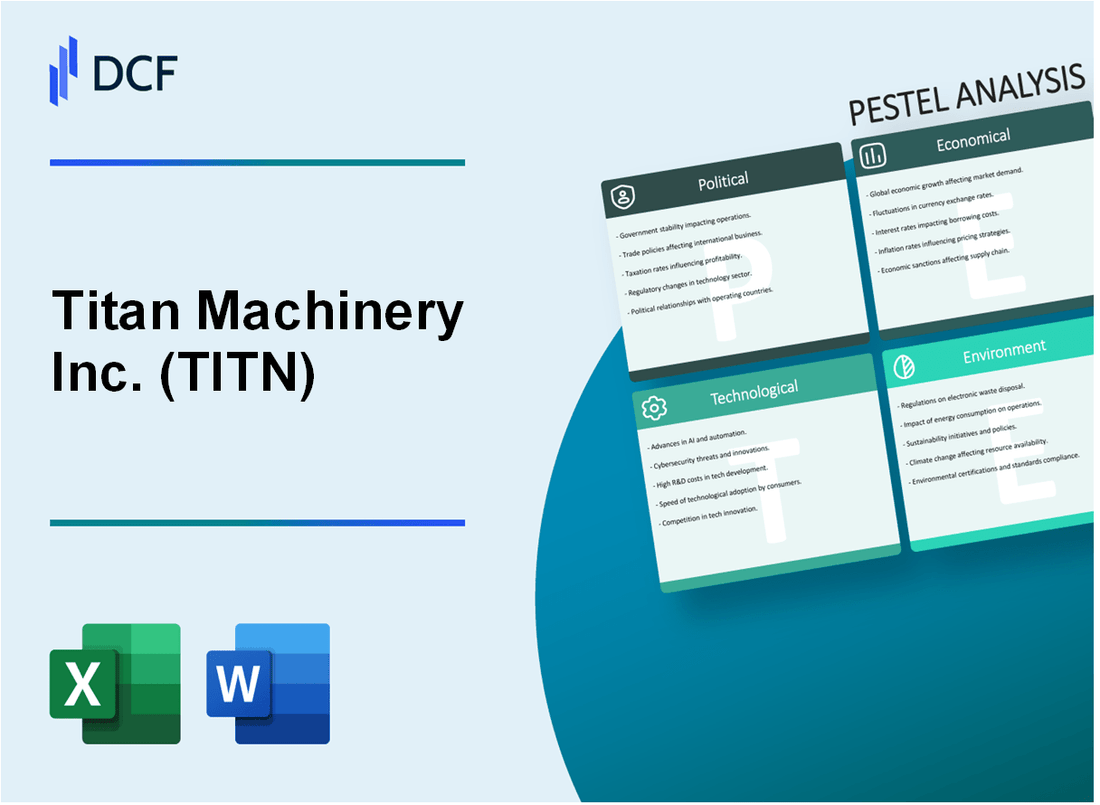
Titan Machinery Inc. (TITN): PESTLE Analysis [Nov-2025 Updated] |
Fully Editable: Tailor To Your Needs In Excel Or Sheets
Professional Design: Trusted, Industry-Standard Templates
Investor-Approved Valuation Models
MAC/PC Compatible, Fully Unlocked
No Expertise Is Needed; Easy To Follow
Titan Machinery Inc. (TITN) Bundle
You're looking for a clear, actionable breakdown of the external forces shaping Titan Machinery Inc. (TITN) right now, and honestly, the landscape is complex. We're seeing a definite shift from the post-pandemic boom, so understanding these PESTLE factors is defintely the right move for your investment thesis. Here's the quick math: while the equipment market is cooling slightly, Titan Machinery's strategic acquisitions in Europe and its focus on parts and service are cushioning the blow, so we are estimating the company's Fiscal Year 2025 revenue to land near $2.75 billion, a solid figure considering the headwinds in commodity prices. This figure maps directly to how the company navigates everything from US Farm Bill uncertainty to the 'Right to Repair' legislation, and the full analysis below shows exactly where the risks and opportunities lie.
Titan Machinery Inc. (TITN) - PESTLE Analysis: Political factors
US Farm Bill uncertainty delays large capital purchases
You are seeing firsthand how political gridlock in Washington translates directly to farmer hesitation on the ground, which is defintely impacting Titan Machinery's core domestic agriculture sales. The new Farm Bill, which typically sets the course for commodity support and conservation programs for five years, remains in limbo. The 2018 Farm Bill was only extended for one year through September 30, 2025, by the American Relief Act, 2025. This stopgap measure continues a cycle of policy uncertainty that makes farmers nervous about committing to large capital expenditures.
The numbers show the direct consequence of this uncertainty and other market factors. Through June 2025, US agricultural tractor sales were down 10.9% year-to-date, with combine sales dipping a massive 43.4%. Farmers simply hold off on buying new equipment when they can't model their future revenue with certainty.
Here's the quick math on the positive side: The 'One Big Beautiful Bill Act,' a reconciliation bill signed in July 2025, did provide a critical, near-term tax boost. It permanently restored full bonus depreciation for capital investments made in 2025 and raised the Section 179 small business expensing limit to $2.5 million, up from the prior limit of about $1.29 million. This tax certainty is a clear incentive to buy before year-end, which could partially offset the demand slump for Titan Machinery.
Government infrastructure spending boosts demand for construction equipment
While the agriculture side faces headwinds, the massive influx of federal cash from the Infrastructure Investment and Jobs Act (IIJA) is a strong, multi-year tailwind for Titan Machinery's construction segment. The IIJA provides $550 billion in new federal funding through 2026.
This spending is translating into concrete demand for the heavy machinery Titan Machinery sells. Road, bridge, and utility projects are driving the need for excavators, loaders, and articulated trucks. As of April 2025, total construction spending in the United States hit a seasonally adjusted annual rate of $2.07 trillion, with highway and street construction alone reaching $136.9 billion annualized.
What this estimate hides is that Titan Machinery's Construction Segment is still expected to see a decline of 5% to 10% in its fiscal year 2026 revenue. This suggests that while the macro-political factor is positive, regional or company-specific inventory management and local market saturation are currently negating the federal tailwind. The US construction equipment market is projected to reach $65.1 billion by 2025, so the opportunity is clearly there for them to capture.
Trade tariffs and geopolitical tensions affect global supply chain stability
The ongoing US-China trade tensions and broader geopolitical instability are creating significant cost and complexity for the entire heavy equipment supply chain. This is a direct political risk that impacts Titan Machinery's cost of goods sold and, consequently, its equipment margins.
The current tariff package is substantial:
- A general tariff of 10% on all Chinese imports, which was increased to 20% by March 4, 2025.
- Specific tariffs of 25% on key components like hydraulic cylinders, transmission systems, and steel-intensive elements sourced from China.
- This has driven up unit costs for some mid-sized equipment manufacturers by 15-22%.
For Titan Machinery, this means higher input costs from their Original Equipment Manufacturers (OEMs) like Case IH and Case Construction, who have global supply chains. The company is already focused on reducing total inventory, with a target raised to $150 million for the full fiscal year. Navigating these tariffs requires strategic sourcing shifts, with many companies now diversifying their supplier networks to countries like India, Turkey, and Latin America to mitigate the cost shock.
European Union (EU) Common Agricultural Policy (CAP) subsidies influence farmer spending
The political decisions made in Brussels have been a massive driver of Titan Machinery's recent growth. The European Union's Common Agricultural Policy (CAP) provides substantial financial support to farmers, with the current 2021-2027 budget totaling €386.6 billion.
This direct financial link is clear in the company's performance: Titan Machinery's Europe Segment is the strongest performer, with expected revenue growth of 35% to 40% for fiscal year 2026. This surge was largely due to customers in Romania capitalizing on EU subvention funds before a September deadline.
However, the political landscape is shifting, and this growth is expected to moderate following the expiration of that specific Romanian stimulus. The EU is also actively simplifying the CAP, with proposals in 2025 to increase the annual lump-sum payment for small farmers from €1,250 to €2,500 and introduce a new funding option of up to €50,000 for farm competitiveness. These changes aim to reduce bureaucracy and could provide a more stable, long-term incentive for smaller farmers to upgrade equipment.
| Political Factor | 2025 Impact on Titan Machinery | Quantifiable Data / Action |
|---|---|---|
| US Farm Bill Status | Delays large Ag equipment purchases due to policy uncertainty. | US Combine Sales down 43.4% YTD through June 2025. |
| US Tax Policy (OBBB Act) | Creates a near-term incentive for capital investment. | Section 179 expensing limit raised to $2.5 million for 2025. |
| US Infrastructure Spending (IIJA) | Strong, multi-year demand driver for Construction Segment. | US Construction Spending reached $2.07 trillion SAAR in April 2025. |
| Trade Tariffs (US-China) | Increases cost of goods sold and supply chain volatility. | Tariffs of 25% on key Chinese components driving up unit costs by 15-22% for some OEMs. |
| EU CAP Subsidies | Fueled near-term European revenue growth but faces moderation. | Europe Segment expected revenue growth of 35% to 40% in FY2026. |
Titan Machinery Inc. (TITN) - PESTLE Analysis: Economic factors
High interest rates increase the cost of financing for equipment buyers
The Federal Reserve's sustained high interest rate environment is defintely the primary headwind for Titan Machinery Inc.'s domestic equipment sales. Higher rates directly increase the cost of capital for both the company and its customers, which are often farmers or construction firms needing to finance large-ticket purchases. For the broader U.S. farm sector, total debt is forecast to climb to an estimated $591.8 billion in 2025, with interest expenses projected to rise by another $1.6 billion, tightening farmer operating margins significantly.
For Titan Machinery Inc. itself, the cost of carrying inventory on its credit lines (floorplan financing) has spiked. The company's floorplan and other interest expense was $13.1 million in the fourth quarter of fiscal 2025, marking a steep 40.9% increase year-over-year. While the company is aggressively reducing inventory-with outstanding floorplan payables down to $739.6 million as of October 31, 2025-the high interest rate environment still pressures profitability and forces more aggressive pricing to move machines.
Volatility in commodity prices (corn, soybeans) impacts farmer income and equipment demand
The core economic challenge for Titan Machinery Inc.'s largest segment, Agriculture, is the volatility and general decline in key crop prices. Lower commodity prices for corn and soybeans are the primary driver of softening equipment demand. Total crop cash receipts across the U.S. farm sector are projected to fall by $6.1 billion, a 2.5% decrease, to $236.6 billion in 2025. This revenue slump makes farmers hesitant to commit to multi-million-dollar equipment upgrades.
Here's the quick math: lower receipts mean less cash flow for new equipment. The only reason U.S. Net Farm Income is forecast to rise to $179.8 billion in 2025 is due to a massive injection of government support, with direct government payments forecast at $40.5 billion, a jump of about 300% from 2024 levels. This government aid provides a crucial cash-flow buffer for farmers, but it's not a sustainable driver for capital expenditure on equipment.
Used equipment values provide good trade-in capital for new sales
The notion of 'strong' used equipment values is no longer accurate in this cycle; the market has softened considerably, which complicates trade-in cycles for new sales. The industry has seen used equipment prices slip, with resale values down 7.27% year-over-year in August 2025, and auction values down 17.13%. This decline means less trade-in capital for the buyer and higher risk of inventory writedowns for the dealer.
Titan Machinery Inc. is actively managing this risk, focusing on reducing excess and aged inventory. The company cut aged equipment inventory by $94 million over five months leading up to Q3 fiscal 2026. This aggressive inventory optimization is necessary to normalize equipment margins, which were under pressure from the need for aggressive pricing to clear the lots.
| Metric (Fiscal 2026) | Value (as of Oct 31, 2025) | Economic Implication |
|---|---|---|
| YTD Inventory Reduction Target (Raised) | $150 million | Aggressive cash flow focus, reducing floorplan interest burden. |
| Aged Equipment Inventory Reduction (5 months) | $94 million | Mitigating risk from falling used equipment values and potential writedowns. |
| Q3 Equipment Gross Margin (Domestic Ag) | ~5.9% | Margin compression due to aggressive pricing to move inventory. |
Inflationary pressure on operating costs, parts, and labor remains a concern
While equipment demand is soft, the cost to run the dealership network and service the existing fleet continues to climb due to persistent inflation. The U.S. annual Consumer Price Index (CPI) reached 2.7% in June 2025, indicating that general price pressure is still a factor.
This impacts Titan Machinery Inc. in two key ways:
- Labor Costs: Farm sector labor expenses are forecast to be a record high in 2025, climbing 3.6% from the previous year to $53.5 billion. This translates directly to higher technician wages and overhead for Titan Machinery Inc.'s service department.
- Operating Costs: The company's operating expenses increased 1.7% to $100.5 million in Q3 Fiscal 2026, outpacing the decline in revenue. This deleveraging is a major challenge.
To be fair, the stability of the parts and service business, which generates over 50% of the company's gross profit, acts as a crucial counter-cyclical buffer against equipment sales declines.
Titan Machinery Inc. (TITN) - PESTLE Analysis: Social factors
You're looking at the social dynamics that drive equipment demand, and honestly, the biggest takeaway is that the aging farmer population is creating a massive, two-sided market shift for Titan Machinery Inc.: larger equipment sales are up, but the service business is constrained by a lack of skilled hands. It's a classic supply-demand problem, but for people.
Aging farmer population accelerates farm consolidation, favoring larger, more efficient equipment
The U.S. agricultural landscape is consolidating fast, driven by the retirement of an older generation. The average age of a U.S. farmer is now 58.1 years, a long-term trend that means a huge amount of farmland is set to change hands. Farmers aged 65 and over own roughly 40% of all U.S. farmland. As these operations are sold, they are typically absorbed by larger, more financially robust farms. This is why the number of U.S. farms dropped by 6.9% between 2017 and 2022.
This consolidation is a clear tailwind for Titan Machinery Inc.'s new equipment sales mix. Bigger farms need bigger, more technologically advanced machinery to maximize efficiency and cover more acres with less labor. They are the primary buyers of the high-horsepower tractors and combines that drive higher average selling prices. This trend is defintely pushing the market toward precision agriculture (PA) equipment, where the initial investment is higher but the long-term efficiency gains are substantial.
Acute shortage of skilled technicians for complex, modern machinery
The increasing complexity of modern, high-tech farm equipment-which is essentially a rolling data center-has created a severe labor crisis for dealerships. The industry may need to fill as many as 73,500 heavy equipment technician positions by the end of 2025. This isn't a future problem; it's a current bottleneck.
This shortage directly limits Titan Machinery Inc.'s ability to maximize its high-margin service revenue. For the third quarter of fiscal 2026 (ended October 31, 2025), the company's Service revenue was $48.9 million, and Parts revenue was $122.3 million, totaling $171.2 million in aftermarket revenue. That's a critical, stable revenue stream, but if a lack of technicians means a $500,000 combine sits idle for 14 days, the customer is losing money, and the dealership is missing a service opportunity. A preliminary 2026 survey found that 63.3% of dealers are 'most concerned' about technician availability. This is a major operational risk.
Increased public and consumer demand for sustainable farming practices
Consumer preferences are shifting hard toward food that is perceived as more sustainable, driving demand for the precision technology that enables it. The global sustainable agriculture market is projected to grow from $15.07 billion in 2024 to $16.75 billion in 2025, representing an 11.2% compound annual growth rate (CAGR).
This demand translates directly into a need for equipment that supports practices like reduced tillage, variable rate application, and advanced telematics. It's a massive opportunity for Titan Machinery Inc. to sell higher-margin, technology-loaded equipment and subscription services. The market is expected to nearly double to $28.36 billion by 2030.
- Sustainable agriculture market is growing at an 11.2% CAGR into 2025.
- Over 60% of small-to-medium enterprises (SMEs) plan to adopt eco-friendly farming practices by 2025.
- Precision farming tools are essential for meeting sustainability goals.
Rural economic health directly correlates with dealership service revenue
While new equipment sales are cyclical and sensitive to commodity prices and interest rates, the aftermarket business-parts and service-provides a crucial buffer, directly tied to the underlying health of rural communities. Titan Machinery Inc. management confirmed this in their Q3 2026 results, stating that the parts and service businesses continue to provide critical stability during a challenging agriculture industry environment.
When farm income is down, farmers delay buying a new tractor, but they absolutely must keep their existing fleet running. This drives demand for service and parts. Nearly 95% of dealers forecast their service revenue will be as good or better in 2025 than in the prior year, with many expecting growth. This stability is a key differentiator for the dealership model, smoothing out the volatility of wholegoods sales.
Here's the quick math on the stability of the aftermarket business for Titan Machinery Inc. in a challenging environment:
| Revenue Segment (Q3 Fiscal 2026) | Amount (Ended Oct 31, 2025) | YoY Change (Approx.) |
|---|---|---|
| Equipment Revenue | $459.9 million | Down 7.1% (from $495.1M) |
| Parts Revenue | $122.3 million | Up 1.0% (from $121.1M) |
| Service Revenue | $48.9 million | Down 4.3% (from $51.1M) |
| Total Aftermarket (Parts & Service) | $171.2 million | Down 0.5% (from $172.2M) |
The aftermarket revenue held essentially flat, down only 0.5%, while Equipment revenue dropped 7.1% in the same period. That's how the service business provides stability.
Titan Machinery Inc. (TITN) - PESTLE Analysis: Technological factors
The technological landscape for Titan Machinery Inc. is a double-edged sword: it's the primary driver of equipment replacement cycles and service revenue growth, but it also introduces significant capital investment needs and regulatory risk.
The shift to highly sophisticated, data-driven machinery is fundamentally changing the dealer's role from a simple sales point to a critical technology and service partner. This requires substantial foresight and capital allocation to stay ahead of the curve, especially as margins on new equipment sales remain under pressure due to a softer demand environment.
Rapid adoption of precision agriculture (Guidance, Telematics) drives replacement cycles
Precision agriculture (PA) technologies like advanced guidance systems, telematics, and variable-rate application are now essential, not optional, for farmers aiming to maximize profitability. This is a clear opportunity for Titan Machinery, as the proven return on investment (ROI) forces farmers to upgrade or replace older, less-capable machinery. For instance, the AI-powered precision systems the company presented in mid-2025 can deliver up to a 70-80% reduction in crop protection product usage for customers, a compelling economic argument for a new purchase.
This technological push provides a critical buffer in a down equipment cycle. When new equipment sales slow down, the high-margin parts and service revenue tied to maintaining and optimizing this complex PA technology provides stability. The company's full-year fiscal 2025 service revenue increased by an impressive 14.5% year-over-year, or 7.1% on a same-store basis, demonstrating the strength of this high-tech service model.
Autonomous equipment development requires significant dealer investment in training and tools
The move toward fully autonomous equipment-like tractors that can operate without a driver-is the next major hurdle. For Titan Machinery, this requires a massive, proactive investment in specialized diagnostic tools, facility upgrades, and, most importantly, technician training. You can't fix a self-driving tractor with a wrench and a manual; it takes software engineers and data analysts.
The capital expenditure (CapEx) budget reflects this need. In fiscal 2025, Titan Machinery used $51.8 million in cash for property and equipment purchases, and they anticipate cash expenditures of approximately $40.0 million in fiscal 2026. Here's the quick math: a significant portion of that CapEx must be earmarked for the infrastructure and training required to service and support the next generation of autonomous equipment, ensuring the dealer network can handle the complexity. If technicians aren't trained fast enough, equipment uptime-the core value proposition of the technology-will suffer.
'Right to Repair' legislation threatens proprietary diagnostic tool and service revenue
The 'Right to Repair' (RTR) movement is a significant near-term legislative risk that directly targets the dealer's high-margin service model. Historically, manufacturers and authorized dealers like Titan Machinery have maintained a lucrative monopoly on proprietary diagnostic tools and software, which is necessary for complex repairs. However, with the passage of laws like Colorado's in 2024 and the introduction of the federal Freedom for Agricultural Repair and Maintenance (FARM) Act in November 2025, this is changing.
The goal of RTR is to mandate that manufacturers provide owners and independent shops with the same tools, software, and documentation available to authorized dealers. This will likely have a negative impact on the high-margin service, preventative maintenance, and warranty revenue streams. Dealers typically draw only about 10% of their sales value from services and labor, but this segment is disproportionately profitable. The silver lining is that parts revenue, which makes up about 20% of sales, may see a positive impact as customers buy parts from the dealer to perform their own repairs.
Data analytics and remote monitoring improve equipment uptime and dealer service efficiency
The extensive telematics data collected from connected equipment is an asset that Titan Machinery is using to improve its own operational efficiency and customer service. Remote monitoring allows the dealer to anticipate equipment failures and schedule preventative maintenance before a breakdown occurs, which is critical for a farmer during a tight planting or harvesting window. This is defintely a competitive advantage.
This proactive, data-driven approach is a key reason the Parts and Service segment remains a stable revenue generator, providing a consistent stream of income even when equipment sales are down. The table below illustrates the segment's recent performance, highlighting its role as a financial stabilizer.
| Revenue Segment | Q1 Fiscal 2026 (Ended April 30, 2025) | Q2 Fiscal 2026 (Ended July 31, 2025) | Q3 Fiscal 2026 (Ended October 31, 2025) |
|---|---|---|---|
| Equipment Revenue | $436.8 million | $376.3 million | $459.9 million |
| Parts Revenue | $105.6 million | $109.2 million | $122.3 million |
| Service Revenue | $44.0 million | $48.8 million | $48.9 million |
The consistent quarterly service revenue, which hit $48.9 million in Q3 Fiscal 2026, shows the resilience of the service business, which is heavily reliant on the advanced diagnostic and remote monitoring tools that keep modern, high-tech machinery running efficiently. This is the core of the customer care strategy that keeps the company closely engaged with its customers.
Next Step: Service Operations: Develop a new pricing model for parts and service labor by Q1 2026 that accounts for potential revenue erosion from the new federal FARM Act.
Titan Machinery Inc. (TITN) - PESTLE Analysis: Legal factors
Stricter Tier 4 Final/Stage V emissions standards require higher-cost equipment
The regulatory environment around engine emissions continues to be a major cost driver, directly impacting the price and complexity of the new equipment Titan Machinery Inc. sells. The European Union's Stage V standards, which are the world's most stringent, mandate the widespread use of Diesel Particulate Filters (DPFs) and other after-treatment systems across a broader range of engine power ratings than the US Tier 4 Final standards.
This compliance isn't free. While the technology is necessary for environmental goals, it creates a cost burden that dealers like Titan Machinery must manage. For the customer, this is a mandated cost that offers minimal operational value over the previous generation. Here's the quick math: general tractor prices increased by a significant 20% between 2021 and 2023, a much steeper climb than the previous nine years, largely driven by this kind of mandated technology and general inflation.
This puts pressure on equipment margins, which Titan Machinery noted in its Fiscal Year 2025 guidance update, anticipating margins may approach historical lows seen in Fiscal Years 2016 and 2017 due to softer demand and the difficulty of passing on these higher equipment costs.
Varying 'Right to Repair' laws across US states and EU complicate service operations
The growing 'Right to Repair' movement presents a legal and operational challenge to the traditional dealer service model, which is a crucial profit center for Titan Machinery. The core issue is access to diagnostic tools, repair manuals, and embedded software (firmware) that manufacturers like Case IH and New Holland have historically controlled.
In the US, the Federal Trade Commission (FTC) is actively involved, having filed a lawsuit against a major agricultural OEM in 2025, alleging antitrust violations for controlling repairs and parts access. This litigation signals a rising federal scrutiny that could force manufacturers to open up their repair ecosystems. Farmers argue that these restrictions drive up costs and cause operational delays, with one study suggesting US farmers could save as much as $1.2 billion a year if manufacturers stopped imposing repair restrictions. That's a massive potential shift in the after-market service revenue pool.
In Europe, the legal framework is more unified but equally challenging. EU legislation is cementing the right to non-discriminatory access to repair and maintenance information for tractors under Regulation (EU) No 167/2013, with new functionalities for independent repair workshops rolling out in 2025 and new regulations taking effect in 2026. Titan Machinery must adapt its service operations across its US and European stores (Bulgaria, Germany, Romania, Ukraine) to comply with this patchwork of state-level and bloc-wide regulations, which complicates training, parts inventory, and software licensing.
International trade and customs regulations impact cross-border equipment movement
Given Titan Machinery's operations span the US, Europe, and Australia, the volatility of international trade and customs regulations poses a constant legal risk. The company's ability to transfer equipment efficiently between its US, German, and Romanian locations is directly affected by trade policy.
The US-Mexico-Canada Agreement (USMCA) is a current point of uncertainty, as potential updates to its regulations were announced in February 2025, which could significantly impact the duty-free eligibility of certain equipment. Any change to USMCA rules would require immediate and costly adjustments to the supply chain for North American operations.
Furthermore, the general global trade environment is fragmenting. For example, the US has recently imposed additional sanctions of 25% on certain goods from countries like India (due to Russian oil imports), highlighting the risk of sudden, high tariffs that can disrupt cross-border sales and inventory management. Even for used equipment, non-tariff barriers like the US Department of Agriculture (USDA) regulations on soil contamination require thorough cleaning and inspection before importation, adding time and cost to every used machine moved across a border.
Labor laws and wage pressures, particularly for specialized technicians
The legal and market dynamics of labor are driving up the cost of retaining the specialized technicians crucial for servicing complex, modern equipment. The demand for skilled agricultural technicians is high, with a projected job growth rate of 6% from 2018-2028. This scarcity gives technicians significant leverage on wages.
Over the last five years, US agricultural technician salaries have already increased by 13%. This wage pressure is a global issue for Titan Machinery, requiring competitive compensation across its international footprint. The cost of labor is defintely rising faster than general inflation in this specialized field.
Here is a comparison of average technician compensation in two of Titan Machinery's key markets as of 2025:
| Region | Specialized Role | Average Annual Salary (2025) | Hourly Rate (Approx.) |
|---|---|---|---|
| United States | Agricultural Equipment Technician | $50,082 | $24 |
| Germany (EU) | Agricultural Engineering Technician | €63,023 | €30 |
The higher compensation in the German market (€63,023) compared to the US ($50,082) reflects differences in labor laws, collective bargaining agreements, and the high demand for engineering-level technical expertise in the EU. This disparity necessitates a localized and competitive labor strategy for Titan Machinery to maintain service absorption rates in its European segment.
Titan Machinery Inc. (TITN) - PESTLE Analysis: Environmental factors
Extreme weather and climate variability create unpredictable planting/harvest cycles, affecting equipment usage
You know that agricultural equipment sales are a cyclical business, but climate variability is making those cycles feel like a rollercoaster. Extreme weather events-from prolonged droughts to severe flooding-are directly impacting the timing and duration of planting and harvesting seasons, which in turn throws off the replacement cycle for high-dollar machinery.
The near-term impact is clear in the market data for 2025. US farm tractor sales, year-to-date through October 2025, are down 9.2% overall. For the high-horsepower, high-margin machines that Titan Machinery Inc. (TITN) specializes in, the drop is even more severe: sales of 4WD articulated tractors plunged 38.5% through June 2025. This volatility forces farmers to delay major capital expenditure, prioritizing maintenance and repairs, which is why the company's parts and service segments provide critical stability during this trough in the equipment cycle.
Here's the quick math on the market pressure:
- Total US Farm Tractor Sales (YTD Oct 2025): Down 9.2%
- 4WD Articulated Tractor Sales (YTD Jun 2025): Down 38.5%
- North American Large Ag Equipment Volume (FY2026 Projection): Decline of approximately 30%
This is defintely a headwind, but it also creates an opportunity for the company's rental fleet, as farmers prefer to rent specialized equipment for shorter, unpredictable windows rather than commit to a multi-million-dollar purchase.
Increased focus on soil health management drives demand for specific tillage and planting tools
The push for regenerative agriculture and improved soil health is a structural tailwind for the equipment industry, shifting demand toward specialized tools. Farmers are moving away from traditional, deep-tillage methods to practices that sequester carbon and improve water retention, like no-till and minimum-tillage farming.
This trend translates into a tangible market opportunity for Titan Machinery Inc. The global soil management market is valued at $26.36 billion in 2025 and is forecasted to grow at a Compound Annual Growth Rate (CAGR) of 5.00% through 2034. North America is a dominant region in this space, with the U.S. soil health management industry expected to see a substantial CAGR of 7.3% from 2025 to 2033. This means a higher demand for equipment like specialized drills, planters, and vertical tillage tools, which are less disruptive to soil structure.
The shift is not just about new equipment sales; it's about precision. Farmers are increasingly relying on advanced sensors and data analytics to optimize resource use, a key component of soil health. This means more revenue potential in the precision agriculture technology embedded in the equipment CNH Industrial (Case IH, New Holland) supplies.
Pressure for low-carbon fuels and electric equipment in the long-term fleet transition
The long-term transition to low-carbon and electric fleets is no longer a distant concept; it's a 2025 reality that impacts the dealer model. Electric and hybrid tractors offer zero tailpipe emissions and lower operational costs, and manufacturers are integrating them into their product lines.
By the end of 2025, over 40% of commercial farms are expected to integrate some form of electric or hybrid power into their machinery fleets. This is a massive product cycle shift. Plus, the global autonomous tractor market, which often overlaps with electrification, is projected to reach $4.6 billion by 2025. Titan Machinery Inc. must adapt its service infrastructure to handle battery technology, high-voltage systems, and complex software updates for these machines, which is a significant investment in technician training and shop tooling.
This transition is already influencing the product mix: the company's core suppliers, like CNH Industrial, are key players in developing these next-generation, eco-friendly machines. The dealer network must be ready to service and support this new technology, or risk losing market share to those who are.
Dealer operations must manage the disposal of large, regulated waste materials (oil, tires)
As a dealer network with a large service footprint, managing hazardous waste is a critical, and increasingly regulated, operational factor. The company's operations, including the retail and wholesale of agricultural and construction equipment, are specifically cited as a source of negative environmental impact due to GHG emissions and Non-GHG emissions (which includes waste).
The regulatory environment is tightening, especially in the US. The Resource Conservation and Recovery Act (RCRA) compliance is seeing changes in 2025. Specifically, the new electronic manifest (e-Manifest) rule takes effect on December 1, 2025, requiring both small and large hazardous waste generators to register and use electronic manifests for off-site waste transport. This is a direct compliance cost and administrative burden for all dealership service centers, which generate regulated wastes like:
- Used oil and oil filters
- Spent solvents and degreasers
- Lead-acid and lithium-ion batteries
- Used tires and scrap metal
The EPA also introduced new Management Method Codes for use on the e-Manifest and Biennial Report starting January 1, 2025, to improve data precision on how waste is managed after storage and transfer. Compliance is non-negotiable because of the cradle-to-grave liability under RCRA, meaning the generator-Titan Machinery Inc.-is responsible for the waste until its proper final disposal.
Disclaimer
All information, articles, and product details provided on this website are for general informational and educational purposes only. We do not claim any ownership over, nor do we intend to infringe upon, any trademarks, copyrights, logos, brand names, or other intellectual property mentioned or depicted on this site. Such intellectual property remains the property of its respective owners, and any references here are made solely for identification or informational purposes, without implying any affiliation, endorsement, or partnership.
We make no representations or warranties, express or implied, regarding the accuracy, completeness, or suitability of any content or products presented. Nothing on this website should be construed as legal, tax, investment, financial, medical, or other professional advice. In addition, no part of this site—including articles or product references—constitutes a solicitation, recommendation, endorsement, advertisement, or offer to buy or sell any securities, franchises, or other financial instruments, particularly in jurisdictions where such activity would be unlawful.
All content is of a general nature and may not address the specific circumstances of any individual or entity. It is not a substitute for professional advice or services. Any actions you take based on the information provided here are strictly at your own risk. You accept full responsibility for any decisions or outcomes arising from your use of this website and agree to release us from any liability in connection with your use of, or reliance upon, the content or products found herein.