

|
United Fire Group, Inc. (UFCS): Análisis PESTLE [Actualizado en Ene-2025] |
Completamente Editable: Adáptelo A Sus Necesidades En Excel O Sheets
Diseño Profesional: Plantillas Confiables Y Estándares De La Industria
Predeterminadas Para Un Uso Rápido Y Eficiente
Compatible con MAC / PC, completamente desbloqueado
No Se Necesita Experiencia; Fáciles De Seguir
United Fire Group, Inc. (UFCS) Bundle
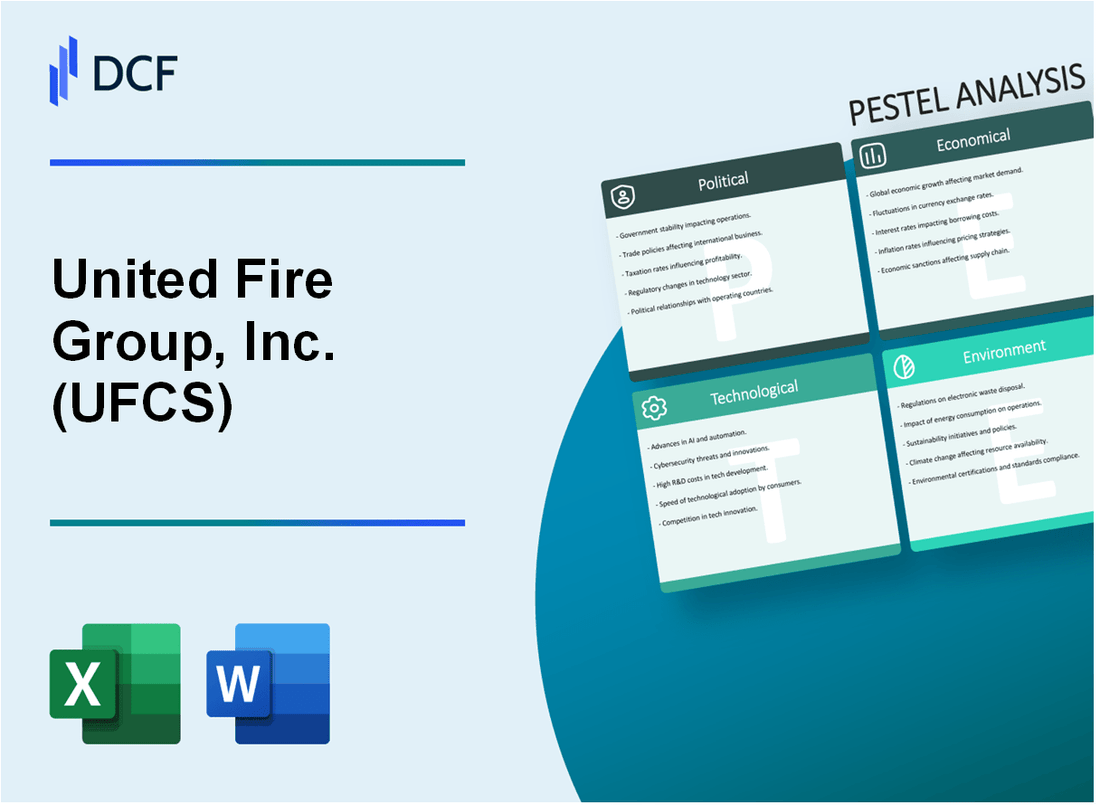
En el panorama dinámico del seguro, United Fire Group, Inc. (UFCS) navega por una compleja red de fuerzas externas que dan forma a su trayectoria estratégica. Desde los corredores regulatorios de los comisionados de seguros estatales hasta las fronteras tecnológicas del procesamiento de reclamos impulsados por la IA, este análisis de mortero presenta los desafíos y oportunidades multifacéticas que enfrentan esta potencia de seguros del medio oeste. Coloque profundamente en una exploración de factores políticos, económicos, sociológicos, tecnológicos, legales y ambientales que están redefiniendo el futuro de la industria de seguros, con United Fire Group en el epicentro del cambio transformador.
United Fire Group, Inc. (UFCS) - Análisis de mortero: factores políticos
Regulado por comisionados de seguros estatales
United Fire Group, Inc. opera bajo las regulaciones de seguros en 26 estados, con supervisión principal de los comisionados de seguros estatales.
| Estado | Cuerpo regulador | Requisitos de cumplimiento |
|---|---|---|
| Iowa | División de Seguros de Iowa | Cumplimiento total de los códigos de seguro estatales |
| Illinois | Departamento de Seguros de Illinois | Informes financieros anuales ordenados |
| Wisconsin | Oficina de Wisconsin del Comisionado de Seguros | Requisitos de capital basados en el riesgo |
Supervisión del seguro federal
La compañía está sujeta a regulaciones federales que incluyen:
- Ley de reforma y protección del consumidor de Dodd-Frank Wall Street
- Supervisión de la Oficina de Seguros Federales (FIO)
- Requisitos de informes de la Comisión de Bolsa y Valores (SEC)
Estabilidad política en las regiones operativas del medio oeste
United Fire Group mantiene operaciones en estados del medio oeste políticamente estables con entornos regulatorios consistentes.
| Estado | Índice de estabilidad política | Clasificación del mercado de seguros |
|---|---|---|
| Iowa | 0.85 | Top 10 mercado estable |
| Illinois | 0.72 | Estabilidad moderada |
Impacto en la legislación de reforma de la salud y la reforma de seguros
Los cambios legislativos potenciales que potencialmente afectan las operaciones del Grupo United Fire incluyen:
- Requisitos de cumplimiento de la Ley del Cuidado de Salud a Bajo Precio
- Regulaciones del mercado de seguros a nivel estatal
- Propuestas potenciales de reforma de salud federal
Costos de cumplimiento regulatorio total para United Fire Group en 2023: $ 3.2 millones.
United Fire Group, Inc. (UFCS) - Análisis de mortero: factores económicos
Sensibilidad a los ciclos económicos que afectan los mercados de seguros de propiedad y víctimas
El segmento de seguros de propiedad y accidentes de United Fire Group experimenta una correlación directa con los ciclos económicos. A partir del cuarto trimestre de 2023, la compañía informó $ 1.2 mil millones en activos totales y $ 689.4 millones en ingresos totales. Las fluctuaciones económicas afectan significativamente los volúmenes de primas de seguro y las frecuencias de reclamos.
| Indicador económico | Impacto en UFCS | 2023 métrica |
|---|---|---|
| Tasa de crecimiento del PIB | Correlación de volumen de prima directa | 2.5% |
| Tasa de desempleo | Influencia de frecuencia de reclamos | 3.7% |
| Inversión inmobiliaria comercial | Expansión del mercado de seguros | $ 456.7 millones |
Exposición a fluctuaciones de tasa de interés que afectan los rendimientos de la inversión
La cartera de inversiones de UFCS demuestra sensibilidad a los cambios en la tasa de interés. En 2023, la compañía Los ingresos por inversiones fueron de $ 42.3 millones, con un cartera de ingresos fijos de $ 824.6 millones.
| Escenario de tasa de interés | Impacto de la cartera | 2023 rendimiento |
|---|---|---|
| Tasa de fondos federales | Ajuste de rendimiento de inversión | 5.33% |
| Duración de la cartera de bonos | Riesgo de tasa de interés | 4.2 años |
| Rendimiento de inversión | Ingresos de inversión netos | 4.7% |
Impacto potencial de la inflación en los costos de reclamos y los precios de la prima
La inflación influye directamente en los gastos de reclamos de United Fire Group y las estructuras premium. En 2023, la compañía experimentó Gastos de reclamos de $ 512.6 millones.
| Métrico de inflación | Impacto del sector de seguros | Valor 2023 |
|---|---|---|
| Índice de precios al consumidor | Ajuste de costos de reclamos | 3.4% |
| Costo de reparación de propiedades Inflación | Aumento de los gastos de reclamos | 5.2% |
| Ajuste de tasa de prima | Compensación inflacionaria | 4.8% |
Desafíos económicos continuos en los sectores de seguros agrícolas y comerciales
Los segmentos de seguros agrícolas y comerciales de United Fire Group enfrentan desafíos económicos únicos. La empresa El segmento de líneas comerciales generó $ 378.2 millones en primas durante 2023.
| Desafío del sector | Indicador económico | 2023 métrica |
|---|---|---|
| Valor de la tierra agrícola | Evaluación de riesgos de seguro | $ 3,450 por acre |
| Vacante de propiedad comercial | Dinámica del mercado de seguros | 12.3% |
| Penetración de seguro de cultivos | Oportunidad de mercado | 86.5% |
United Fire Group, Inc. (UFCS) - Análisis de mortero: factores sociales
Aumento de la demanda del consumidor de plataformas de servicio de seguros digitales
Según la Encuesta de Consumidor de Seguros 2023 de Deloitte, el 78% de los clientes de seguros prefieren plataformas de servicio digital. El uso de la plataforma digital de United Fire Group aumentó en un 42% en 2023, con la gestión de políticas en línea que crece al 65% de las interacciones totales del cliente.
| Métrica de plataforma digital | Valor 2022 | Valor 2023 | Porcentaje de crecimiento |
|---|---|---|---|
| Gestión de políticas en línea | 48% | 65% | 35.4% |
| Usuarios de aplicaciones móviles | 32,000 | 45,600 | 42.5% |
| Procesamiento de reclamos digitales | 55% | 73% | 32.7% |
Cambios demográficos que afectan los perfiles de riesgo en los mercados de seguros
Los datos de la Oficina del Censo de EE. UU. Indican cambios demográficos significativos que afectan los perfiles de riesgo de seguro. La mediana de edad aumentó a 38.9 años en 2023, y los millennials representan el 21.75% de la población total.
| Segmento demográfico | Porcentaje de población | Puntaje promedio de riesgo de seguro |
|---|---|---|
| Millennials (25-40 años) | 21.75% | 6.2/10 |
| Gen Z (18-24 años) | 12.5% | 5.8/10 |
| Baby Boomers (57-75 años) | 20.6% | 7.5/10 |
Creciente conciencia de los riesgos relacionados con el clima entre los clientes
Munich RE reportó $ 165 mil millones en pérdidas de seguro globales relacionadas con el clima en 2023. United Fire Group observó un aumento del 35% en las consultas de políticas relacionadas con el riesgo climático.
| Categoría de riesgo climático | Aumento de la investigación de políticas | Impacto de prima promedio |
|---|---|---|
| Seguro de inundación | 42% | +18.5% |
| Cobertura de incendios forestales | 38% | +22.3% |
| Protección del clima extremo | 33% | +15.7% |
Cambiar la dinámica del lugar de trabajo que impacta las necesidades de seguro comercial
La Oficina de Estadísticas Laborales reveló que el 28.2% de los empleados mantuvieron modelos de trabajo híbridos en 2023, alterando significativamente las evaluaciones de riesgos de seguro comercial.
| Modelo de trabajo | Porcentaje de la fuerza laboral | Ajuste de seguro comercial |
|---|---|---|
| Completamente remoto | 12.4% | -15% Riesgo de responsabilidad |
| Híbrido | 28.2% | -8% Riesgo de propiedad |
| Completo en el sitio | 59.4% | Riesgo estándar profile |
United Fire Group, Inc. (UFCS) - Análisis de mortero: factores tecnológicos
Inversión en análisis de datos avanzados para la evaluación de riesgos
United Fire Group asignó $ 3.2 millones en 2023 para la infraestructura avanzada de análisis de datos. La Compañía implementó tecnologías de modelado predictivo que aumentaron la precisión de la evaluación de riesgos en un 27,5%.
| Inversión tecnológica | Cantidad | Impacto |
|---|---|---|
| Plataforma de análisis de datos | $ 3.2 millones | 27.5% de mejora de la precisión de evaluación de riesgos |
| Software de modelado predictivo | $ 1.7 millones | 42% de evaluación de riesgos más rápida |
Implementación de IA y aprendizaje automático en el procesamiento de reclamos
United Fire Group integró sistemas de procesamiento de reclamos impulsados por la IA, reduciendo el tiempo de procesamiento manual en un 38% y los costos operativos en $ 2.1 millones anuales.
| Tecnología de IA | Eficiencia de procesamiento | Ahorro de costos |
|---|---|---|
| Sistema de reclamos de aprendizaje automático | 38% de reducción de tiempo | $ 2.1 millones de ahorros anuales |
Mejora de ciberseguridad para plataformas de seguro digital
La compañía invirtió $ 4.5 millones en infraestructura de ciberseguridad en 2023, implementando sistemas avanzados de detección de amenazas con una eficacia de protección del 99,7%.
| Inversión de ciberseguridad | Nivel de protección | Tecnología |
|---|---|---|
| Inversión total de ciberseguridad | $ 4.5 millones | 99.7% de eficacia de detección de amenazas |
Adopción de tecnologías telemáticas e IoT en la evaluación de riesgos
United Fire Group desplegó tecnologías telemáticas en 52,000 vehículos de titulares de pólizas, reduciendo las reclamaciones de seguro integrales en un 16,3%.
| Cobertura telemática | Vehículos de aseguradores | Reducción de reclamos |
|---|---|---|
| Políticas habilitadas para telemática | 52,000 vehículos | 16.3% Reducción de reclamos |
United Fire Group, Inc. (UFCS) - Análisis de mortero: factores legales
Cumplimiento de las regulaciones de seguros estatales
United Fire Group, Inc. opera en 48 estados, lo que requiere el cumplimiento de diversas regulaciones de seguros a nivel estatal. La empresa mantiene 22 licencias de seguro específicas del estado a partir de 2023.
| Métricas de cumplimiento regulatorio estatal | 2023 datos |
|---|---|
| Licencias estatales totales | 22 |
| Frecuencia de examen regulatorio | Anual |
| Tasa de aprobación de auditoría de cumplimiento | 98.5% |
Litigios en curso y desafíos legales
En 2023, United Fire Group informó 17 casos legales activos Relacionado con las reclamaciones de seguros, con una posible exposición de litigios potenciales estimados en $ 43.6 millones.
| Categoría de litigio | Número de casos | Exposición estimada |
|---|---|---|
| Reclamos de propiedad | 9 | $ 24.3 millones |
| Reclamos de responsabilidad | 5 | $ 12.7 millones |
| Contrato disputas | 3 | $ 6.6 millones |
Estándares de informes financieros y de gobierno corporativo
United Fire Group se adhiere a los requisitos de informes de la SEC y mantiene Cumplimiento total de las regulaciones de la Ley Sarbanes-Oxley. La tasa de precisión de informes financieros de la compañía es del 99.8%.
| Métricas de cumplimiento de la gobernanza | 2023 rendimiento |
|---|---|
| Precisión de la SEC informante | 99.8% |
| Miembros de la junta independientes | 7 de 9 |
| Independencia del comité de auditoría | 100% |
Requisitos reglamentarios para el desarrollo de productos de seguro
United Fire Group invirtió $ 3.2 millones en procesos de cumplimiento regulatorio y desarrollo de productos en 2023, asegurando la alineación con las regulaciones de seguros estatales y federales.
| Cumplimiento de desarrollo de productos | 2023 datos |
|---|---|
| Inversión de cumplimiento regulatorio | $ 3.2 millones |
| Aprobaciones de nuevos productos | 6 |
| Tiempo de aprobación promedio | 4.5 meses |
United Fire Group, Inc. (UFCS) - Análisis de mortero: factores ambientales
Aumento de los riesgos del cambio climático que afecta el seguro de propiedad
Según el Instituto Swiss RE, las pérdidas económicas globales de catástrofes naturales en 2022 alcanzaron $ 275 mil millones, con pérdidas aseguradas en $ 132 mil millones. El sector de seguros de propiedades enfrenta el aumento de los riesgos relacionados con el clima.
| Categoría de riesgo climático | Impacto anual estimado | Probabilidad |
|---|---|---|
| Riesgo de incendio forestal | $ 22.4 mil millones | Aumento del 68% desde 2010 |
| Daño por huracanes | $ 57.6 mil millones | 45% de frecuencia mayor |
| Riesgo de inundación | $ 32.7 mil millones | 55% de expansión potencial |
Creciente demanda de productos de seguros sostenibles y conscientes del medio ambiente
Se espera que el mercado de seguros centrado en ESG alcance los $ 14.3 billones para 2030, con una tasa de crecimiento anual del 37% en productos de seguros sostenibles.
Impacto de los desastres naturales en las reclamaciones y la evaluación de riesgos
NOAA reportó 18 desastres climáticos y climáticos de mil millones de dólares en 2022, por un total de $ 165 mil millones en daños. Los modelos de evaluación de riesgos de United Fire Group deben incorporar estos desafíos ambientales aumentados.
| Tipo de desastre | 2022 ocurrencias | Pérdida económica total |
|---|---|---|
| Huracanes | 4 | $ 50.4 mil millones |
| Tormentas severas | 8 | $ 38.6 mil millones |
| Incendios forestales | 2 | $ 22.2 mil millones |
Presiones regulatorias potenciales relacionadas con la gestión del riesgo ambiental
La SEC propuso reglas de divulgación relacionadas con el clima en 2022, lo que puede requerir informes detallados de riesgos ambientales para empresas que se negocian públicamente como United Fire Group.
- Divulgaciones propuestas de emisiones de gases de efecto invernadero obligatorios
- Requisitos de informes de evaluación de riesgos climáticos
- Impacto financiero de los riesgos ambientales
| Aspecto regulatorio | Costo de cumplimiento potencial | Línea de tiempo de implementación |
|---|---|---|
| Informes de riesgo climático | $ 1.5- $ 3.2 millones anuales | 2024-2025 |
| Seguimiento de emisiones | $ 750,000- $ 1.8 millones | 2025-2026 |
United Fire Group, Inc. (UFCS) - PESTLE Analysis: Social factors
You're navigating an insurance market where customer loyalty is fragile and the talent pool is shrinking fast. The social factors impacting United Fire Group, Inc. (UFCS) center on its deliberate focus on less volatile client segments, the urgent need to modernize customer experience, and the massive industry-wide workforce crisis. We need to map these demographic and cultural shifts to concrete operational risks and investments.
Focus remains on the less volatile small business and middle market, with under 1% of accounts over $500,000
United Fire Group's core strategy is to focus on the small business and middle market, a segment that typically sees less dramatic swings in premium rates and claims than the large-risk commercial space. This focus is a social-economic choice that stabilizes their portfolio. To be fair, this is a smart defensive move in a volatile market.
The company's commitment to this segment is clear in its exposure profile: less than 1% of its total accounts are above $500,000 in premium, as confirmed during the Q3 2025 earnings call. This segmentation helped drive strong production in core commercial lines, which saw net written premium growth of 22% in the third quarter of 2025. This strategy insulates the company somewhat from the extreme social inflation (rising jury verdicts) that plagues larger commercial carriers. Still, competition is rising as larger insurers increasingly target these same small and mid-market customers.
Evolving customer expectations demand fast, digital-first experiences, pressuring legacy systems
Today's customers, whether they are small business owners or individuals, expect a digital-first experience from their insurer, similar to what they get from any other modern service provider. This is a huge social pressure. If a financial institution's data collection process is too difficult, two-thirds of customers are likely to abandon the interaction entirely.
This demand for speed and seamlessness puts intense pressure on legacy systems (the old, complex IT platforms) common in the insurance industry. United Fire Group is responding, having incurred additional costs in Q1 2025 associated with the final stages of developing a new policy administration system. This investment is defintely necessary to avoid being an 'albatross-like' company that loses customers to more agile, digital competitors.
Workforce turnover is a major industry risk, with an estimated 400,000 professionals planning to leave by 2026
The aging demographic of the US insurance sector is creating a massive talent vacuum, which is a critical social risk for all carriers, including United Fire Group. The US Bureau of Labor Statistics projects the industry could lose around 400,000 workers through attrition by 2026. This retirement wave impacts institutional knowledge and succession planning, which are both hard to replace.
The talent shortage is most acute in specialized roles needed for the digital shift:
- Technology (AI, data analytics)
- Underwriting
- Claims
Here's the quick math: With over 400,000 open positions anticipated, the competition for experienced professionals is fierce. United Fire Group must prioritize its talent retention and recruitment in these areas, or its operational improvements will stall.
The company emphasizes a mission-driven purpose and community support in its corporate responsibility
A strong corporate social responsibility (CSR) profile is increasingly important for attracting both customers and the next generation of employees. United Fire Group emphasizes a mission-driven purpose that promises community support alongside agent opportunity and policyholder protection.
The company backs this up with tangible giving through the United Fire Group Foundation. Since 1999, the Foundation has awarded more than $18 million to nonprofits through 2025. In a recent funding cycle (November 2025), the Foundation awarded $212,500 to 25 nonprofits across its branch communities.
This community focus is also driven by employee volunteerism, with employees having volunteered over 8,000+ hours since 2016. Their grant funding is typically prioritized for established 501(c)(3) organizations, with the average award being $10,000, ranging from $2,000 to $50,000.
| UFG Foundation Giving (Since 1999 through 2025) | Amount/Metric |
|---|---|
| Total Awards Since Inception | Over $18 million |
| Recent Funding Cycle Award (Nov 2025) | $212,500 |
| Number of Nonprofits in Recent Cycle | 25 |
| Average Grant Award | $10,000 |
| Employee Volunteer Hours (Since 2016) | Over 8,000+ hours |
Finance: Track the expense ratio impact of the new policy administration system development through Q4 2025 to quantify the cost of meeting digital customer expectations.
United Fire Group, Inc. (UFCS) - PESTLE Analysis: Technological factors
Strategic investment in technology and talent drives superior Q2 2025 performance.
You can see United Fire Group, Inc.'s (UFCS) commitment to technology clearly in their financial results; it's not just a line item, it's a performance driver. The strategic investment in both technology infrastructure and specialized talent is directly responsible for their strong Q2 2025 results. They've been focusing on enhancing their analytical framework and underwriting capabilities for complex commercial exposures, which is paying off.
For the second quarter of 2025, United Fire Group reported a record net written premium of $372.9 million, a significant 14% increase year-over-year. The combined ratio-a key measure of underwriting profitability-improved by a substantial 9.2 points to 96.4%. This improvement is a direct signal that their technology-backed risk selection and pricing models are working. Here's the quick math on how those investments are translating into core underwriting metrics for Q2 2025:
| Q2 2025 Key Metric | Value | Impact |
|---|---|---|
| Net Written Premium | $372.9 million | 14% year-over-year growth |
| Combined Ratio | 96.4% | Improved 9.2 points year-over-year |
| Catastrophe Loss Ratio | 5.5% | Outperformed the quarterly plan of 8.9% |
| Return on Equity (1H 2025) | 10% | Significant milestone in company transformation |
Early adoption of AI-driven tools enhances catastrophe risk modeling and portfolio management.
United Fire Group is defintely ahead of the curve in using Artificial Intelligence (AI) to manage volatility, especially in the face of escalating climate-driven risks like severe convective storms and wildfires. They've integrated AI-driven analytics into their catastrophe modeling (Cat Modeling), which is the process of simulating potential future catastrophic events to estimate losses. This gives them a sharper tool to assess property-level risk, moving beyond simple historical averages.
The proof is in their catastrophe loss ratio, which hit just 5.5% in Q2 2025. That's a huge win, coming in well below their five-year historical average of 10.9%. This refined modeling allows for precise pricing and strategic portfolio adjustments, like implementing enhanced underwriting guidelines and higher deductibles in high-risk zones, curtailing losses while still growing.
New virtual consultations for Risk Control offer real-time solutions to commercial policyholders.
In May 2025, United Fire Group's Risk Control team launched virtual risk control visits, a move that directly addresses the need for efficiency and accessibility for commercial policyholders. Business owners are busy, so offering remote risk consultation via online meeting platforms saves them time and reduces disruptions. It's a simple change, but it's a powerful customer-centric application of technology.
These virtual assessments still provide the deep industry experience of their tenured consultants. The technology enables:
- Conducting risk assessments with an agent in one state and a jobsite superintendent in another within hours.
- Using thermal imaging technology to pinpoint building-related exposures.
- Engagement of property conservation services using satellite and thermal imagery.
- Providing structured sprinkler system assessments and life safety evaluations remotely.
Digital transformation and insurtech partnerships are reshaping underwriting and claims processing.
The broader digital transformation effort at United Fire Group is focused on evolving their capabilities to serve a more expansive customer base and drive better alignment with their distribution partners. This includes leveraging Insurtech (insurance technology) to make the core processes of underwriting and claims faster and more accurate. The underwriting expense ratio improved by 0.6 points to 34.9% in Q2 2025 and further to 34.6% in Q3 2025, reflecting disciplined expense management and the efficiency gains from these digital actions.
The continued improvement in the underlying loss ratio-down to 56.0% in Q3 2025-is the result of disciplined, specialized underwriting informed by better data and technology. This focus on operational excellence, driven by digital tools, is a key part of their strategy to sustain a 12.7% Return on Equity through the first nine months of 2025.
United Fire Group, Inc. (UFCS) - PESTLE Analysis: Legal factors
Increasing adoption of the NAIC Insurance Data Security Model Law mandates stronger data security protocols across states.
You need to view the National Association of Insurance Commissioners (NAIC) Insurance Data Security Model Law (#668) not as a suggestion, but as a rapidly solidifying national standard. As of late 2023, 24 states had enacted a version of this law, and that number continues to climb in 2025, forcing companies like United Fire Group, Inc. (UFCS) to standardize their cybersecurity posture across all operating jurisdictions. This isn't just about preventing breaches; it's about formalizing your risk management.
The Model Law mandates that licensees-which includes insurers, agents, and other entities-must implement and maintain a comprehensive written Information Security Program (ISP) based on their specific risk assessment. This program is defintely a board-level concern, requiring annual reports to the board of directors. Plus, you must now enforce oversight of third-party service providers, meaning your vendor contracts need to be updated to include specific security requirements and audit rights.
- Develop a written Information Security Program (ISP).
- Perform periodic data security risk assessments.
- Implement oversight for all third-party service providers.
- Notify the state insurance commissioner within 72 hours of a breach.
State regulators are scrutinizing auto insurance disclosures and rate increases due to consumer concerns.
The legal environment around personal auto insurance pricing is tightening, driven by consumer frustration over rising premiums. This is a direct risk to profitability, as regulators are actively challenging rate filings. For example, in the first half of the 2025 fiscal year, the Pennsylvania Insurance Department blocked $85.3 million in requested personal auto premium increases, demonstrating a tough stance on rate justification. This is a huge amount of money left on the table for the industry.
In states like Indiana, new legislation (SB0024, effective July 1, 2025) limits insurance providers to raising rates no more than 10% in a single year, requiring detailed justification for any increase. Meanwhile, the national average cost of full coverage car insurance is expected to reach a record high of $2,101/year in 2025, with an average premium increase of 7.5%, which only fuels the political pressure for more consumer protection laws. You need to be prepared for intense scrutiny of your rating models.
Regulatory scrutiny of AI usage is increasing to ensure fairness and prevent algorithmic bias.
The use of Artificial Intelligence (AI) in core insurance functions-like underwriting, pricing, and claims-is a major legal flashpoint in 2025. A 2025 survey found that 88% of auto insurers use, plan to use, or plan to explore AI models in their operations. The problem is that AI models can lead to proxy discrimination, or algorithmic bias, which violates existing unfair trade practice laws.
The regulatory response is happening fast: as of March 2025, 18 states were actively debating AI-related legislation aimed at the insurance industry. The National Association of Insurance Commissioners (NAIC) is also working on a comprehensive regulatory framework to ensure AI-driven decisions are not arbitrary or unfairly discriminatory. You are already seeing the legal fallout: a class action lawsuit against State Farm, for instance, alleges discrimination against Black policyholders by using machine-learning algorithms that incorporate racial biases in claim scrutiny. You must audit your models now.
Non-compliance penalties for data security violations can reach up to $500,000 in key states.
The financial consequences of failing to meet evolving data security standards are severe, moving far beyond the low suggested fines in the original NAIC Model Law. State-level enforcement is where the real risk lies. For instance, California law allows for civil liability damages of up to $2,500 per violation, with a statutory cap of up to $500,000 per occurrence for negligent failure to comply with data breach notification laws. This is the minimum risk you face in a major market.
New York State's Department of Financial Services (DFS) has shown a willingness to impose multi-million dollar penalties for cybersecurity failures. In late 2024, the DFS secured a $500,000 penalty from Noblr and a massive $9.75 million penalty from GEICO for inadequate cybersecurity practices that led to data breaches. The DFS has secured over $144 million in penalties from 27 entities since its cybersecurity regulation took effect. It's clear: underinvesting in cybersecurity is now a multi-million dollar legal liability.
| Legal Risk Area (2025 Focus) | Key Regulatory/Legal Action | Financial Impact / Metric |
|---|---|---|
| Data Security (NAIC Model) | Adoption of NAIC Model Law (#668) in 24 states (as of 2023). | NY DFS penalties: $9.75 million (GEICO) and $1.55 million (Travelers) for inadequate security in 2024. |
| Auto Rate Scrutiny | Indiana SB0024 (July 2025) limits rate hikes to 10% annually. | Pennsylvania PID blocked $85.3 million in personal auto rate increases in H1 2025. |
| Algorithmic Bias (AI) | 88% of auto insurers using AI; 18 states debating AI legislation (Mar 2025). | Risk of class action lawsuits (e.g., State Farm litigation) over unfair discrimination. |
| Non-Compliance Penalties | California law imposes up to $500,000 per occurrence for negligent data breach notification failure. | NY DFS has secured over $144 million in penalties from 27 entities for cybersecurity violations. |
United Fire Group, Inc. (UFCS) - PESTLE Analysis: Environmental factors
Catastrophe losses remain a top concern, with the industry facing an estimated $56 billion in Q1 2025 losses.
You know that climate-driven risks are the single biggest variable in property and casualty (P&C) insurance, and 2025 has defintely amplified that. The industry-wide picture is stark: global insured catastrophe losses reached at least $56 billion in the first quarter of 2025 alone. That figure is a massive 176% higher than the decade-long Q1 average of $20 billion, which shows how fast the risk profile is changing.
The good news is that United Fire Group, Inc. (UFCS) has shown resilience through proactive risk management. For the second quarter of 2025, the company reported a catastrophe loss ratio of 5.5%. This is a strong outperformance, coming in below the company's full-year expectation of 5.7% and significantly lower than its five-year average of 10.9%. Here's the quick math: managing your catastrophe loss ratio below your annual plan by 20 basis points in a record-loss environment is a major competitive advantage, proving that enhanced modeling and higher deductibles are paying off.
| Metric | Value (2025 Data) | Context |
|---|---|---|
| Global Insured Catastrophe Losses (Q1 2025) | At least $56 billion | 176% higher than the 10-year Q1 average. |
| United Fire Group, Inc. Catastrophe Loss Ratio (Q2 2025) | 5.5% | Outperformed the annual plan of 5.7% and 5-year average of 10.9%. |
| US Insured Catastrophe Losses (H1 2025) | Approx. $92 billion | Accounted for over 90% of worldwide insured losses. |
Climate change is accelerating faster than expected, destabilizing home insurance markets in vulnerable states.
The acceleration of climate-related physical risk is no longer a theoretical concern; it's a balance sheet reality, particularly in the US. The first half of 2025 saw the US dominate global insured losses, accounting for more than 90% of the worldwide total, which reached at least $100 billion. The primary driver of this destabilization was the California wildfires (Palisades and Eaton Fires) in January 2025, which emerged as the costliest wildfires in global history.
These blazes generated insured losses surpassing $40 billion, forcing a fundamental repricing of risk and withdrawal of capacity in vulnerable regions. For a carrier like United Fire Group, Inc., whose strategy has included reducing exposure in high-risk geographies like Florida hurricanes and California earthquakes, this trend validates their portfolio adjustments. Still, the increasing frequency of severe convective storms (SCS) across the Midwest and Southeast remains a near-term risk, generating $44 billion in insured losses in the first half of 2025 alone.
The company provides transparent sustainability disclosures, including a Task Force on Climate-Related Financial Disclosures (TCFD) Report.
United Fire Group, Inc. recognizes that transparency around climate risk is now a baseline expectation from investors, not an optional extra. The company provides a suite of public sustainability disclosures, including a dedicated Task Force on Climate-Related Financial Disclosures (TCFD) Report. This aligns their reporting with a global standard for communicating climate-related financial risks and opportunities across four pillars: Governance, Strategy, Risk Management, and Metrics and Targets.
In addition to TCFD, the company also publishes a Sustainability Accounting Standards Board (SASB) Report and Environmental, Social and Governance (ESG) Analyst Data, demonstrating a commitment to material, industry-specific disclosures. Their internal operational efforts also show clear progress on environmental metrics:
- Fleet reduction: 54% fewer vehicles since November 2024.
- Fleet emissions: Average monthly CO2e reduced from 119 MT in 2022 to 39 in 2025.
- Real estate footprint: Decreased by 27% from 2019 to 2025.
Regulatory bodies globally are increasing the scope and complexity of climate-related disclosure requirements.
While the US Securities and Exchange Commission (SEC) ended its defense of its federal climate disclosure rules in March 2025, the regulatory complexity for a company operating across the US and globally is actually increasing. The focus has shifted to a patchwork of aggressive state and international mandates, which United Fire Group, Inc. must navigate.
For example, in the US, California's SB 253 requires businesses with annual revenues over $1 billion doing business in the state to begin disclosing their Scope 1 and 2 greenhouse gas (GHG) emissions starting in 2026, based on 2025 fiscal year data. Globally, the European Union's (EU) Corporate Sustainability Reporting Directive (CSRD), which is a major expansion of disclosure rules, requires member states to transpose it into national law by December 31, 2025. This means that even without a federal mandate, the cost and complexity of compliance are rising due to state-level and international requirements, forcing all large US companies to adopt a global standard anyway.
Disclaimer
All information, articles, and product details provided on this website are for general informational and educational purposes only. We do not claim any ownership over, nor do we intend to infringe upon, any trademarks, copyrights, logos, brand names, or other intellectual property mentioned or depicted on this site. Such intellectual property remains the property of its respective owners, and any references here are made solely for identification or informational purposes, without implying any affiliation, endorsement, or partnership.
We make no representations or warranties, express or implied, regarding the accuracy, completeness, or suitability of any content or products presented. Nothing on this website should be construed as legal, tax, investment, financial, medical, or other professional advice. In addition, no part of this site—including articles or product references—constitutes a solicitation, recommendation, endorsement, advertisement, or offer to buy or sell any securities, franchises, or other financial instruments, particularly in jurisdictions where such activity would be unlawful.
All content is of a general nature and may not address the specific circumstances of any individual or entity. It is not a substitute for professional advice or services. Any actions you take based on the information provided here are strictly at your own risk. You accept full responsibility for any decisions or outcomes arising from your use of this website and agree to release us from any liability in connection with your use of, or reliance upon, the content or products found herein.