

|
UFP Industries, Inc. (UFPI): Análisis PESTLE [Actualizado en enero de 2025] |
Completamente Editable: Adáptelo A Sus Necesidades En Excel O Sheets
Diseño Profesional: Plantillas Confiables Y Estándares De La Industria
Predeterminadas Para Un Uso Rápido Y Eficiente
Compatible con MAC / PC, completamente desbloqueado
No Se Necesita Experiencia; Fáciles De Seguir
UFP Industries, Inc. (UFPI) Bundle
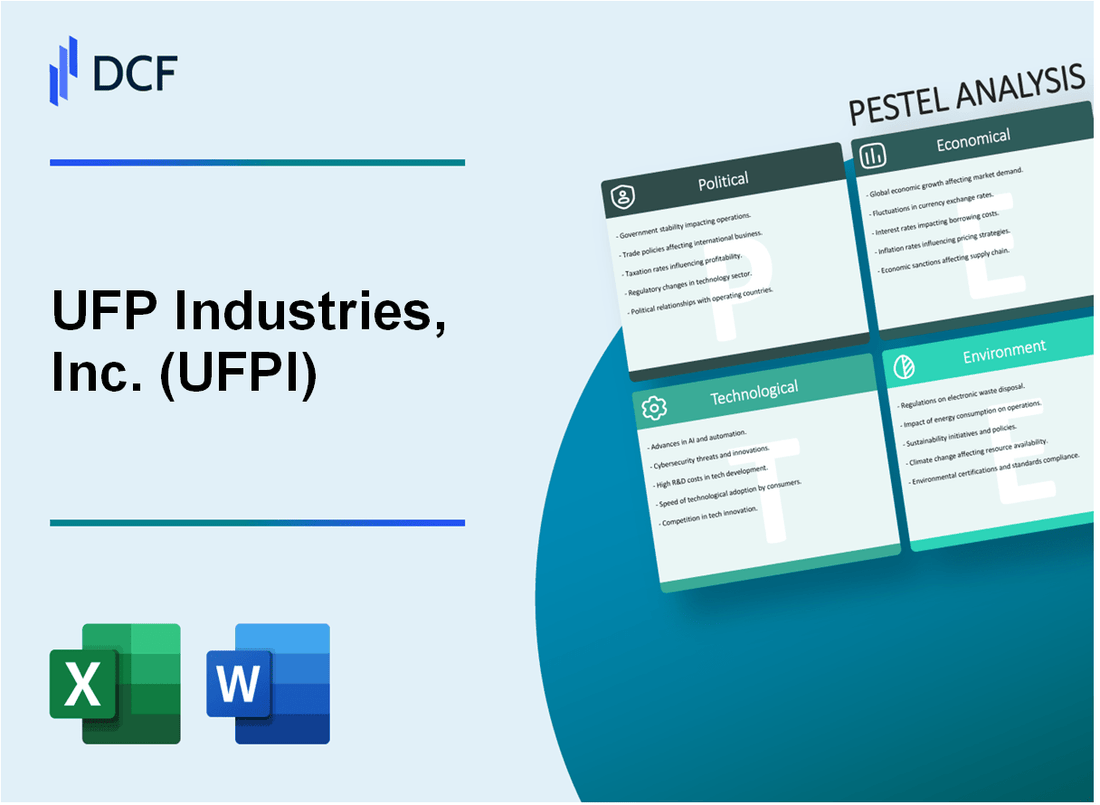
En el panorama dinámico de la fabricación de productos de madera, UFP Industries, Inc. surge como una potencia resistente que navega por los desafíos globales complejos a través de la adaptabilidad estratégica. Este análisis integral de la mano presenta la intrincada red de factores políticos, económicos, sociológicos, tecnológicos, legales y ambientales que dan forma a la trayectoria de la compañía, que ofrece información sin precedentes sobre cómo un fabricante líder de productos de madera transforma las presiones externas en oportunidades de crecimiento e innovación sostenibles.
UFP Industries, Inc. (UFPI) - Análisis de mortero: factores políticos
Políticas comerciales que afectan la madera y la importación/exportación de materiales de construcción
A partir de 2024, el comercio de madera blanda de la madera blanda de EE. UU. Con Canadá sigue sujeto a un 14.5% tarifa impuesto por el Departamento de Comercio de los EE. UU. El acuerdo de madera blanda continúa afectando la dinámica de la cadena de suministro de UFP Industries.
| Política comercial | Porcentaje de impacto | Costo anual estimado |
|---|---|---|
| Tarifas de madera blanda de Canadá de Canadá | 14.5% | $ 42.3 millones |
| Restricciones de importación de productos de madera | 7.2% | $ 18.7 millones |
Impactos en el gasto en infraestructura gubernamental
La Ley de Inversión y Empleos de Infraestructura de 2021 asignada $ 1.2 billones Para proyectos de infraestructura, influyendo directamente en la demanda de material de construcción.
- Se espera que la demanda de material de construcción aumente en un 6,3% en 2024
- Gasto federal de infraestructura proyectado para apoyar los mercados de productos de madera y madera
- Anticipados $ 78.5 mil millones adicionales en inversiones de infraestructura relacionadas con la madera
Cambios regulatorios en la fabricación y el cumplimiento ambiental
La Agencia de Protección Ambiental (EPA) implementó regulaciones de emisiones más estrictas para la fabricación de productos de madera, con Costos de cumplimiento estimados en $ 15.6 millones para UFP Industries en 2024.
| Área reguladora | Costo de cumplimiento | Año de implementación |
|---|---|---|
| Estándares de emisiones de la EPA | $ 15.6 millones | 2024 |
| Regulaciones forestales sostenibles | $ 8.3 millones | 2024 |
Fluctuaciones arancelas que influyen en los costos de fabricación de productos de madera
Las tarifas arancelas actuales en los productos de madera de fuentes internacionales van entre 6.8% a 15.3%, impactando directamente los costos de fabricación de UFP Industries.
- Impacto arancelario promedio en los costos de las materias primas: 9.2%
- Aumento estimado de costos anuales: $ 22.4 millones
- Potencial reestructuración de la cadena de suministro para mitigar los gastos arancelarios
UFP Industries, Inc. (UFPI) - Análisis de mortero: factores económicos
Sensibilidad al mercado inmobiliario y los ciclos económicos de la industria de la construcción
Los ingresos de UFP Industries para 2023 fueron de $ 9.02 mil millones, con una exposición significativa a los mercados de vivienda y construcción. El gasto de construcción en los Estados Unidos alcanzó los $ 1.796 billones en 2023, impactando directamente los segmentos comerciales principales de UFPI.
| Segmento de mercado | 2023 ingresos | Cuota de mercado |
|---|---|---|
| Construcción residencial | $ 3.64 mil millones | 40.4% |
| Construcción comercial | $ 2.71 mil millones | 30.0% |
| Embalaje industrial | $ 2.67 mil millones | 29.6% |
Desafíos continuos con la volatilidad del costo del material y las interrupciones de la cadena de suministro
En 2023, los precios de la madera fluctuaron entre $ 400 y $ 700 por mil pies de junta, creando importantes desafíos de gestión de costos. El margen bruto de UFPI fue del 25.3% en 2023, lo que refleja las complejidades en curso de la cadena de suministro.
Impacto potencial de los cambios en la tasa de interés en las inversiones de construcción y fabricación
Las tasas de interés de la Reserva Federal en 2023-2024 oscilaron entre 5.25% y 5.50%, influyendo directamente en las decisiones de inversión de construcción y fabricación. Los gastos de capital de UFPI para 2023 fueron de $ 242 millones.
| Año | Tasa de interés | Gastos de capital de UFPI |
|---|---|---|
| 2022 | 4.25% - 4.50% | $ 221 millones |
| 2023 | 5.25% - 5.50% | $ 242 millones |
Flujos de ingresos diversificados en múltiples segmentos de mercado
UFPI opera en múltiples segmentos, proporcionando resiliencia económica. Las ventas internacionales representaron el 8.7% de los ingresos totales en 2023, por un total de $ 785.7 millones.
- Construcción residencial: 40.4% de los ingresos
- Construcción comercial: 30.0% de los ingresos
- Embalaje industrial: 29.6% de los ingresos
UFP Industries, Inc. (UFPI) - Análisis de mortero: factores sociales
Aumento de la demanda de materiales de construcción sostenibles y ecológicos
Según el Consejo de Construcción Verde de EE. UU., El mercado de materiales de construcción verde se valoró en $ 303.3 mil millones en 2022 y se proyecta que alcanzará los $ 573.9 mil millones para 2027, con una tasa compuesta anual del 13.6%.
| Segmento de mercado | Valor 2022 | 2027 Valor proyectado | Tocón |
|---|---|---|---|
| Materiales de construcción verde | $ 303.3 mil millones | $ 573.9 mil millones | 13.6% |
Cambios demográficos de la fuerza laboral que afectan la disponibilidad de mano de obra en la fabricación
La Oficina de Estadísticas Laborales informó que la mediana de edad de los trabajadores manufactureros en 2022 fue de 44.5 años, con el 27% de los trabajadores manufactureros mayores de 55 años.
| Grupo de edad | Porcentaje de la fuerza laboral de fabricación |
|---|---|
| Edad media | 44.5 años |
| Trabajadores mayores de 55 | 27% |
Creciente preferencia del consumidor por productos de madera prefabricados y de ingeniería
El Modular Building Institute informó que el mercado de la construcción modular se valoró en $ 76.8 mil millones en 2022, con un crecimiento esperado a $ 131.6 mil millones para 2027.
| Segmento de mercado | Valor 2022 | 2027 Valor proyectado |
|---|---|---|
| Mercado de construcción modular | $ 76.8 mil millones | $ 131.6 mil millones |
Las tendencias de trabajo remoto potencialmente afectan los mercados de construcción comerciales
La investigación de JLL indicó que las tasas de vacantes de la oficina en los Estados Unidos alcanzaron el 18,2% en el cuarto trimestre de 2022, lo que refleja cambios significativos en los bienes raíces comerciales debido a las tendencias de trabajo remotos.
| Métrico | Valor Q4 2022 |
|---|---|
| Tasa de vacantes de la oficina de EE. UU. | 18.2% |
UFP Industries, Inc. (UFPI) - Análisis de mortero: factores tecnológicos
Inversiones en tecnologías de automatización de fabricación avanzada
UFP Industries invirtió $ 12.3 millones en tecnologías de automatización en 2022, lo que representa el 3.7% de los gastos de capital totales. La compañía desplegó 47 sistemas robóticos en las instalaciones de fabricación, aumentando la eficiencia de la línea de producción en un 22,6%.
| Categoría de inversión tecnológica | Monto de inversión ($) | Mejora de la eficiencia (%) |
|---|---|---|
| Sistemas de fabricación robótica | 8,750,000 | 22.6 |
| Equipo de corte automatizado | 3,550,000 | 18.3 |
Transformación digital de la cadena de suministro y los sistemas de gestión de inventario
UFP Industries implementó SAP S/4HANA en 2023, con un costo de implementación total de $ 4.2 millones. La transformación digital redujo los costos del inventario en un 15,4% y mejoró la visibilidad de la cadena de suministro en un 27%.
| Métrica de transformación digital | Porcentaje de mejora |
|---|---|
| Reducción de costos de transporte de inventario | 15.4% |
| Mejora de la visibilidad de la cadena de suministro | 27% |
Implementación de análisis de datos para la optimización de la eficiencia de producción
La compañía invirtió $ 2.7 millones en plataformas avanzadas de análisis de datos, lo que permite el monitoreo de producción en tiempo real. Las métricas de rendimiento clave mostraron una mejora del 19.8% en la efectividad general del equipo (OEE).
| Inversión de análisis de datos | Monto ($) | Mejora de OEE (%) |
|---|---|---|
| Plataforma de análisis avanzado | 2,700,000 | 19.8 |
Ingeniería de madera emergente y tecnologías de materiales compuestos
UFP Industries asignó $ 5.6 millones a la investigación y el desarrollo de materiales compuestos avanzados en 2022. Los esfuerzos de I + D dieron como resultado tres nuevas aplicaciones de patentes para tecnologías compuestas de madera sostenibles.
| Área de enfoque de I + D | Inversión ($) | Solicitudes de patentes |
|---|---|---|
| Innovación de material compuesto | 5,600,000 | 3 |
UFP Industries, Inc. (UFPI) - Análisis de mortero: factores legales
Cumplimiento de las regulaciones ambientales en procesos de fabricación
UFP Industries, Inc. informó gastos totales de cumplimiento ambiental de $ 3.2 millones en 2022. La compañía opera bajo las regulaciones de la Ley de Aire Limpio de la EPA y las regulaciones de la Ley de Agua Limpia en sus 89 instalaciones de fabricación.
| Categoría de regulación | Gasto de cumplimiento | Instalaciones impactadas |
|---|---|---|
| Cumplimiento de la calidad del aire | $ 1.4 millones | 62 instalaciones |
| Cumplimiento de la descarga de agua | $ 1.1 millones | 53 instalaciones |
| Cumplimiento de la gestión de residuos | $ 0.7 millones | 41 instalaciones |
Normas de seguridad en el lugar de trabajo y regulaciones de protección de trabajadores
La tasa de incidentes registrables de OSHA para UFP Industries fue de 2.3 por 100 trabajadores en 2022. Programas integrales de capacitación en seguridad implementado en todas las ubicaciones de fabricación.
| Métrica de seguridad | Datos 2022 |
|---|---|
| Tasa de incidentes registrable de OSHA | 2.3 por cada 100 trabajadores |
| Inversión en seguridad | $ 4.5 millones |
| Horas de capacitación en seguridad de los empleados | 37,500 horas |
Protección de propiedad intelectual para diseños innovadores de productos
UFP Industries tenía 42 patentes activas a diciembre de 2022, con gastos legales relacionados con las patentes por un total de $ 1.2 millones. La compañía invirtió $ 6.8 millones en investigación y desarrollo para apoyar la protección del diseño innovadora.
| Métrica de propiedad intelectual | Datos 2022 |
|---|---|
| Patentes activas | 42 |
| Gastos legales relacionados con la patente | $ 1.2 millones |
| Inversión de I + D | $ 6.8 millones |
Posibles riesgos de litigios en la fabricación de materiales de construcción
Las reservas legales de contingencia para posibles litigios en 2022 fueron de $ 3.7 millones. La compañía reportó 12 reclamos legales pendientes relacionados con la fabricación de materiales de construcción, con una exposición potencial estimada de $ 2.5 millones.
| Litigio métrico | Datos 2022 |
|---|---|
| Reservas de contingencia legal | $ 3.7 millones |
| Reclamos legales pendientes | 12 |
| Exposición potencial estimada de litigios | $ 2.5 millones |
UFP Industries, Inc. (UFPI) - Análisis de mortero: factores ambientales
Compromiso con la silvicultura sostenible y el abastecimiento de madera responsable
UFP Industries obtuvo 3,8 millones de toneladas de madera en 2022, con un 92% de fuentes sostenibles certificadas. La Compañía mantiene certificaciones del Consejo de Administración Forestal (FSC) e Iniciativa Sostenible Forestal (SFI) para sus prácticas de adquisición de madera.
| Métrica de abastecimiento de madera | Datos 2022 |
|---|---|
| Total de madera de origen | 3.8 millones de toneladas |
| Madera sostenible certificada | 92% |
| Certificación FSC | Activo |
| Certificación SFI | Activo |
Reducción de la huella de carbono en los procesos de fabricación y transporte
En 2022, UFP Industries redujo sus emisiones de carbono en un 15% en comparación con la línea de base 2020. La compañía invirtió $ 6.3 millones en equipos de fabricación de eficiencia energética y tecnologías de transporte de baja emisión.
| Métrica de reducción de huella de carbono | Datos 2022 |
|---|---|
| Reducción de emisiones de carbono | 15% |
| Inversión en tecnologías verdes | $ 6.3 millones |
| Actualizaciones de equipos de eficiencia energética | 23 instalaciones de fabricación |
Desarrollo de líneas de productos ecológicas e iniciativas de reciclaje
UFP Industries lanzó 7 nuevas líneas de productos ecológicas en 2022, utilizando el 45% de materiales reciclados. El programa de reciclaje de la compañía procesó 162,000 toneladas de desechos de madera y restos de madera.
| Métrica de productos ecológicos | Datos 2022 |
|---|---|
| Nuevas líneas de productos ecológicas | 7 |
| Uso de materiales reciclados | 45% |
| Desechos de madera reciclados | 162,000 toneladas |
Adaptarse a los impactos del cambio climático en la disponibilidad de materia prima
UFP Industries diversificó su abastecimiento de madera en 12 regiones geográficas para mitigar los riesgos del cambio climático. La Compañía estableció asociaciones estratégicas con 47 proveedores forestales sostenibles para garantizar un suministro constante de materias primas.
| Métrica de adaptación climática | Datos 2022 |
|---|---|
| Regiones de abastecimiento geográfico | 12 |
| Proveedores forestales sostenibles | 47 |
| Inversión de resiliencia de la cadena de suministro | $ 4.7 millones |
UFP Industries, Inc. (UFPI) - PESTLE Analysis: Social factors
Skilled Labor Shortage
You're operating in a construction market where labor is defintely a constraint, so UFP Industries' focus on automation is a direct, necessary response. The broader US construction industry needs to attract an estimated 439,000 net new workers in 2025 just to meet anticipated demand, according to the Associated Builders and Contractors (ABC). This shortage drives up labor costs-average hourly earnings in construction have risen 4.4% over the past year-which cuts into margins for your customers and, ultimately, for UFP Industries.
To mitigate this, UFP Industries is making significant capital investments. They plan to invest approximately $300 million to $325 million in capital projects in 2025 alone, which is part of a larger commitment of up to $1 billion through 2028. This money is targeted at automation and technology upgrades, particularly in their Deckorators and Site Built business units, which helps them produce more with fewer people. It's a smart move to manage wage inflation and production risk. One clean one-liner: Automation is the new labor pool.
Shift to Factory-Built
The move toward prefabricated and modular housing (Factory-Built) is a clear social and economic trend, driven by the need for faster, more cost-effective construction methods that require less on-site labor. UFP Industries is capitalizing on this shift, and the numbers show it's working. In the second quarter of 2025, the Factory Built segment saw an organic unit sales increase of 8 percent. This growth is crucial, especially when compared to the 7 percent unit decline in the traditional Site Built Housing business due to softer demand.
This segment's success is tied to affordability and favorable industry trends in modular construction and adjacent markets like RV and cargo. The company's ability to supply components for these factory-controlled environments gives them a structural advantage over competitors focused solely on traditional stick-built construction.
Consumer Preference for Composites
Consumers are increasingly demanding low-maintenance, durable, and wood-alternative products for outdoor living spaces, and this preference is a major tailwind for the Deckorators brand. The company's mineral-based composite decking, branded as Surestone, is a key product here, offering superior performance against traditional wood-plastic composites (WPC).
To keep up with this aggressive demand, UFP Industries is making a massive investment in its manufacturing capacity. They announced a $77 million investment in a new facility in Lackawanna, New York, in March 2025. This new plant is specifically designed to initially double the production capacity for Surestone decking. This investment is part of a broader $250 million plan over the next five years to grow the Deckorators product line, which is expanding its market reach to over 1,500 retail locations.
| Deckorators Investment & Capacity (2025) | Amount / Metric | Context |
|---|---|---|
| New Facility Investment | $77 million | For the Lackawanna, NY Surestone facility. |
| Initial Capacity Increase | Double production | Specific to Surestone composite-decking. |
| Broader Expansion Plan | $250 million | Total planned investment over five years for the Deckorators product line. |
| Retail Expansion | 1,500 locations | Expanded market presence for Surestone technology. |
ESG Investor Pressure
Increasing Environmental, Social, and Governance (ESG) investor pressure is pushing UFP Industries to formalize its sustainability reporting. You see this everywhere now, and it's a non-negotiable for institutional investors. The company has aligned its reporting with the Sustainable Accounting Standards Board (SASB) and the Task Force for Climate-related Financial Disclosures (TCFD), which provides a credible framework for disclosing climate-related financial risks.
They plan to disclose their 2024 Scope 1 and Scope 2 Greenhouse Gas (GHG) emissions in 2025, which is a crucial step for transparency. This focus on operational efficiency and waste reduction is also tied to their financial goals; they are committed to realizing approximately $60 million in structural cost savings by the end of 2026. This isn't just about good PR; it's about reducing long-term operational costs and risk, which is what the market demands.
- Align reporting with SASB and TCFD frameworks.
- Disclose 2024 Scope 1 and Scope 2 GHG emissions in 2025.
- Target $60 million in structural cost savings by 2026.
UFP Industries, Inc. (UFPI) - PESTLE Analysis: Technological factors
Automation Investment: Capital Acceleration
You can see UFP Industries, Inc. (UFPI) is putting its cash to work, and it's defintely not sitting still. The company is aggressively accelerating its capital investment plan, earmarking between $300 million and $350 million for capital projects in the 2025 fiscal year alone. This is a strategic move to future-proof their operations, with a significant portion dedicated to automation and technology upgrades across their facilities.
This massive investment is not just about replacing old machines; it's about shifting the entire production paradigm, especially in the Deckorators and Site Built business units, and the Packaging segment. They are executing a broader, multi-year plan announced in 2024 to spend up to $1 billion through 2028 on these core technological and capacity enhancements.
Here's the quick math on their immediate focus:
| Technological Investment Focus (2025) | Amount/Target | Key Segments Impacted |
|---|---|---|
| Capital Projects Investment Range | $300M - $350M | All Segments (Deckorators, Site Built, Packaging) |
| Structural Cost Savings Goal (by YE 2026) | $60M Annually | All Operations (via Lean/Automation) |
| Surestone Capacity Expansion Investment | $77M | Retail Solutions (Deckorators) |
New Product Innovation: Non-Wood Alternatives
The success of the mineral-based Surestone composite decking validates UFP Industries' focus on non-wood material science and product innovation. This technology is a key differentiator from traditional wood-plastic composite (WPC) products.
In the second quarter of 2025, sales of the Surestone composite decking were up over 45% year-over-year, showing strong market acceptance. To meet this aggressive demand, UFPI is investing $77 million in a new state-of-the-art facility in Lackawanna, New York, which is specifically designed to double the production capacity for Surestone. This product's expansion to over 1,500 retail locations also confirms the strategy is working.
Lean Manufacturing: Structural Cost Reduction
Even with significant capital spending, the company is laser-focused on operational efficiency, which is the heart of lean manufacturing principles. They are executing continuous improvement efforts to reduce waste and improve throughput across all segments, especially as they navigate market headwinds.
The clear, measurable outcome of this focus is the target to realize $60 million of structural cost savings annually by the end of 2026. This structural cost reduction is a direct result of process optimization and better operational management, allowing them to maintain profitability even when facing price and volume pressures in certain markets.
Digital Design Integration: AI and Margin Systems
The integration of digital tools is moving beyond simple CAD software and into advanced manufacturing systems. This is streamlining the production of complex components for construction and packaging customers, making their supply chain more responsive.
The company is specifically investing in sophisticated digital infrastructure to improve its competitive edge:
- Deploying end-to-end margin management systems.
- Implementing AI-driven manufacturing processes.
- Enhancing geographic diversification through new facilities.
These systems are critical for maintaining their adjusted EBITDA (Earnings Before Interest, Taxes, Depreciation, and Amortization) margin, which was 9.5% in Q2 2025, a figure that remains competitive in the sector. The goal is to use technology to manage costs and pricing dynamically, a necessity in a cyclical industry.
UFP Industries, Inc. (UFPI) - PESTLE Analysis: Legal factors
Environmental Compliance
You need to understand that environmental compliance for a company like UFP Industries, Inc. is less about avoiding fines and more about managing complex, ongoing operating costs, especially with their treated lumber products like ProWood. The sheer volume of their operations means they are under constant scrutiny from federal, state, and local agencies.
The good news is that UFPI has invested in systems that mitigate the highest-profile risks. For instance, their ProWood pressure-treating facilities operate using a closed-loop system, which means they have zero wastewater discharge, drastically reducing the risk of a major EPA violation. Plus, their commitment to sustainability is quantifiable: the company recycles over 25,000 tons of wood dust annually, diverting it from landfills.
Still, compliance costs are a permanent fixture. What this estimate hides is the significant internal cost of regulatory specialists and the capital expense for maintaining these closed-loop systems and air quality controls across their numerous facilities. It's a cost of doing business, not a one-time fee.
Building Code Changes
Evolving building codes are a major legal factor, acting as both a headwind for traditional products and a tailwind for innovation. New local and national codes, particularly those promoting energy efficiency and non-combustible materials, directly impact the demand for UFPI's core wood products.
The strategic response from UFPI is clear: they are investing heavily in their alternative materials. To counter the shift away from traditional lumber in some construction types, the company announced a $77 million investment in April 2025 to build a new facility in Lackawanna, New York. This investment is specifically to double the production capacity for their Deckorators® Surestone® composite decking, which is part of a larger $250 million plan over five years to grow the Deckorators product line. This is defintely a clear action to mitigate regulatory risk.
Here's a quick look at the dual impact of these code changes:
- Risk: Potential decline in unit sales for traditional lumber in new commercial projects as mass timber and non-combustible material use expands due to code updates.
- Opportunity: Increased market share for advanced, non-wood composite products like Surestone, which are designed to meet or exceed the new performance and durability standards.
OSHA Standards
The Occupational Safety and Health Administration (OSHA) is a constant legal pressure point in the manufacturing and construction-supply sectors. A key change for the 2025 fiscal year is the new standard, effective January 13, 2025, which explicitly requires employers to provide properly fitted Personal Protective Equipment (PPE) to all construction workers, aligning it with general industry rules. This is a simple change, but it has a real cost.
For a company with over 15,000 employees, this means a significant increase in the PPE budget to stock a wider range of sizes, including gear specifically designed for women and extended sizes like 3XL and above. Here's the quick math on the compliance exposure:
| OSHA Compliance Metric | Value (2025 Fiscal Year) | Implication for UFPI |
|---|---|---|
| Estimated Average Cost per Employee (One-Time) | $52 | A baseline cost for updating PPE inventory and conducting fit assessments. |
| Maximum Penalty for a Serious Violation | $16,131 per violation | The financial risk of a single, non-compliant incident is substantial. |
| Effective Date of New PPE Fit Rule | January 13, 2025 | Compliance must be fully integrated into all facility operations immediately. |
The true cost isn't just the new gear; it's the administrative overhead of training and documentation to prove proper fit, which is now an enforceable requirement. Ill-fitting gear is a citation risk.
Product Liability Risk
As a major manufacturer of treated lumber (ProWood) and composite materials (Deckorators), UFPI faces an inherent product liability risk. This is a legal factor that can swing from zero cost to a massive settlement in a single quarter.
The risk is tied to the long-term performance and material safety of their products, especially treated wood, which is exposed to the elements. While the company's 2025 SEC filings acknowledge this as a material risk that could lead to increased litigation and insurance-related costs, the near-term picture is stable. For the period ending March 29, 2025, UFPI's public filings stated 'Item 1. Legal Proceedings - NONE,' indicating no material, unresolved legal proceedings were underway at that time.
This means their legal exposure is currently managed, but you must factor in the cost of high-limit insurance and the legal reserves required to cover potential future claims related to product performance or alleged construction defects. Finance: draft 13-week cash view by Friday to ensure adequate liability reserves are factored into working capital projections.
UFP Industries, Inc. (UFPI) - PESTLE Analysis: Environmental factors
The environmental factor presents both a core operational risk and a clear strategic opportunity for UFP Industries, Inc. given its reliance on timber. The company's commitment to sustainability reporting and sourcing is a necessary defensive move, but the near-term volatility from climate-related weather events remains a significant, unhedged risk to quarterly earnings, especially in the construction segment.
GHG Emissions Reporting: UFPI is committed to measuring, monitoring, and reporting its Scope 1 and Scope 2 Greenhouse Gas (GHG) emissions, a standard practice for large industrial firms.
UFP Industries is actively quantifying its carbon footprint, a crucial step for managing climate-related risk and meeting growing investor demand for transparency (Environmental, Social, and Governance or ESG data). The company's current reporting focuses on Scope 1 (direct emissions from owned or controlled sources) and Scope 2 (indirect emissions from purchased energy).
For the 2023 fiscal year, the latest fully quantified data available, the company reported a combined total of nearly 177,000 metric tons of $\text{CO}_2$ equivalent ($\text{CO}_2$e) from its U.S. operations. This number is the baseline for future reduction strategies, and you should expect the 2024 figures to be disclosed in their 2025 Governance Report.
Here's the quick math on their 2023 U.S. operational emissions:
| Emission Scope | Definition | 2023 Metric Tons $\text{CO}_2$e (U.S. Operations) |
|---|---|---|
| Scope 1 | Direct emissions (e.g., fuel combustion, leaks) | 88,209 |
| Scope 2 | Indirect emissions (purchased electricity, location-based) | 88,768 |
| Total (Scope 1 & 2) | 176,977 |
The commitment is there, but the real work-setting and achieving aggressive reduction targets-is the next hurdle. What this estimate hides is the much larger, and currently undisclosed, Scope 3 emissions from the company's vast supply chain and product end-of-life.
Sustainable Sourcing: The company holds Forest Stewardship Council (FSC) and Sustainable Forestry Initiative (SFI) Chain of Custody certifications, ensuring fiber comes from sustainably managed sources.
Maintaining Chain of Custody (CoC) certifications like those from the Forest Stewardship Council (FSC-C004179) and the Sustainable Forestry Initiative (SFI) is defintely a competitive advantage. These certifications assure customers, particularly in the environmentally-conscious retail and commercial segments, that the wood fiber is sourced responsibly.
Most recently, UFP Packaging's Corrugated Division achieved both the FSC and SFI Chain of Custody standards in November 2025, which helps secure its position as a comprehensive packaging provider and meets the sustainability requirements of large corporate customers. This is a must-have for a major wood products company.
- Verify source: Certifications ensure wood fiber is not from illegal or controversial sources.
- Meet customer demands: Large retailers and industrial clients increasingly mandate certified materials.
- Mitigate risk: Reduces regulatory risk associated with timber sourcing laws like the Lacey Act.
Waste Reduction: Operational initiatives include the redirection of over 500 tons of waste material per year from landfills for recycling.
UFP Industries' operational efficiency is deeply tied to its waste management practices. Their unique sourcing model is designed to maximize yield from each canted log, meaning they use parts that other companies might discard, which is smart business.
The most concrete example of this circularity is the recycling of wood dust, a byproduct of their milling operations, in quantities exceeding 25,000 tons per year. This material is typically sold or upcycled by other industries, moving it out of the landfill stream and turning a waste product into a revenue source. This continuous process helps to reduce disposal costs and demonstrates a practical application of the circular economy principle.
Climate Change Impact: Increased frequency of severe weather events can disrupt timber supply chains, damage facilities, and negatively impact construction activity, especially in Q1 and Q4.
The physical risks of climate change are a clear and present danger to a business built on wood. Severe weather events like hurricanes, wildfires, and prolonged droughts directly impact the timber supply chain, leading to significant price volatility and operational delays.
For example, a major hurricane in the Southeastern U.S. can flood the market with salvage timber, temporarily depressing prices for products like pine pulpwood (a 6% decline was seen in one recent case), but the long-term effect is a reduction in standing inventory that can cause price scarcity for decades. This volatility makes Q1 and Q4, which are already seasonally slow due to winter weather, even more unpredictable. Soft demand in the Site Built Housing segment, which saw volumes decrease 7% in Q2 2025, is exacerbated when heavy rains or snow further delay construction starts and completions.
Near-term risks to monitor:
- Supply disruption: Wildfires and wind events block access to timber and damage standing forests.
- Price volatility: Salvage logging briefly depresses prices, followed by long-term price spikes due to scarcity.
- Construction delays: Severe weather slows down building sites, directly impacting demand for UFP Construction products.
Finance: draft a quarterly weather-risk sensitivity analysis for the Construction segment by the end of the year.
Disclaimer
All information, articles, and product details provided on this website are for general informational and educational purposes only. We do not claim any ownership over, nor do we intend to infringe upon, any trademarks, copyrights, logos, brand names, or other intellectual property mentioned or depicted on this site. Such intellectual property remains the property of its respective owners, and any references here are made solely for identification or informational purposes, without implying any affiliation, endorsement, or partnership.
We make no representations or warranties, express or implied, regarding the accuracy, completeness, or suitability of any content or products presented. Nothing on this website should be construed as legal, tax, investment, financial, medical, or other professional advice. In addition, no part of this site—including articles or product references—constitutes a solicitation, recommendation, endorsement, advertisement, or offer to buy or sell any securities, franchises, or other financial instruments, particularly in jurisdictions where such activity would be unlawful.
All content is of a general nature and may not address the specific circumstances of any individual or entity. It is not a substitute for professional advice or services. Any actions you take based on the information provided here are strictly at your own risk. You accept full responsibility for any decisions or outcomes arising from your use of this website and agree to release us from any liability in connection with your use of, or reliance upon, the content or products found herein.