

|
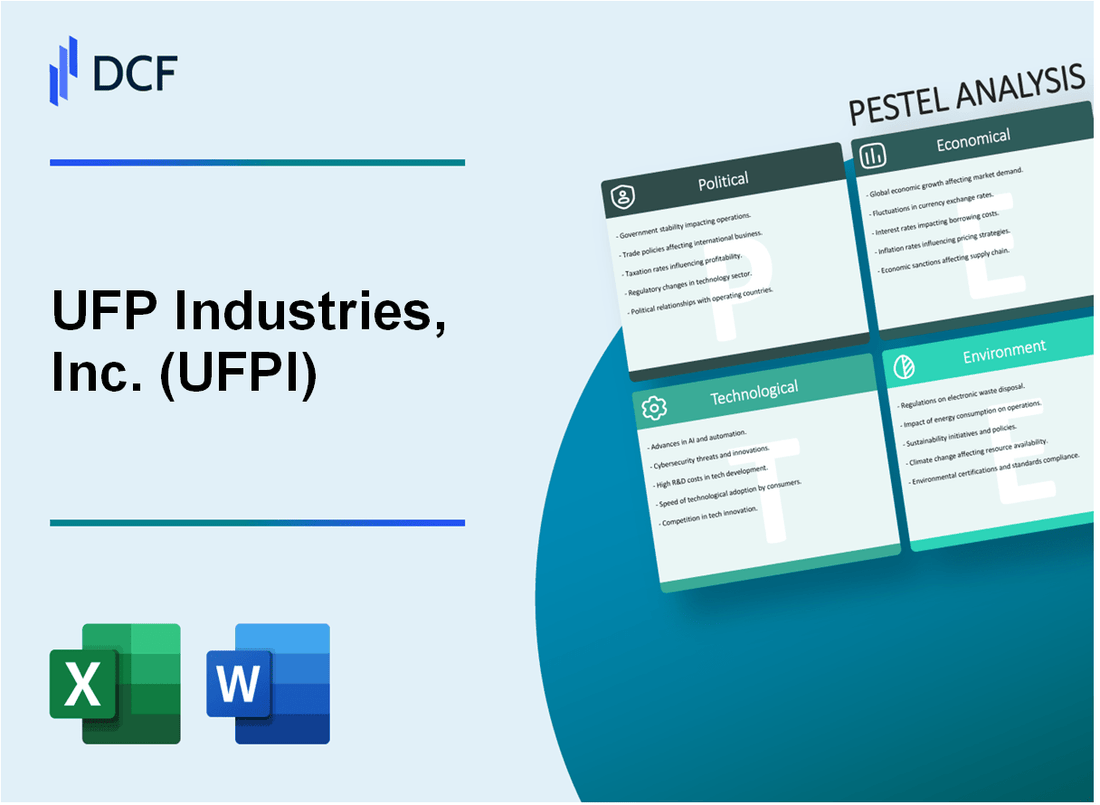
UFP Industries, Inc. (UFPI): Analyse du pilon [Jan-2025 MISE À JOUR] |
Entièrement Modifiable: Adapté À Vos Besoins Dans Excel Ou Sheets
Conception Professionnelle: Modèles Fiables Et Conformes Aux Normes Du Secteur
Pré-Construits Pour Une Utilisation Rapide Et Efficace
Compatible MAC/PC, entièrement débloqué
Aucune Expertise N'Est Requise; Facile À Suivre
UFP Industries, Inc. (UFPI) Bundle
Dans le paysage dynamique de la fabrication de produits en bois, UFP Industries, Inc. apparaît comme une puissance résiliente naviguant des défis mondiaux complexes grâce à l'adaptabilité stratégique. Cette analyse complète du pilon dévoile le réseau complexe de facteurs politiques, économiques, sociologiques, technologiques, juridiques et environnementaux qui façonnent la trajectoire de l'entreprise, offrant des informations sans précédent sur la façon dont un fabricant de produits en bois de premier plan transforme les pressions externes en possibilités de croissance et d'innovation durables.
UFP Industries, Inc. (UFPI) - Analyse du pilon: facteurs politiques
Politiques commerciales affectant le bois d'oeuvre et les matériaux de construction Importation / Exportation
Depuis 2024, le commerce américain de bois d'oeuvre avec le Canada reste soumis à un Tarif de 14,5% imposé par le département américain du commerce. L'accord de bois de bois souple continue d'avoir un impact sur la dynamique de la chaîne d'approvisionnement de l'UFP Industries.
| Politique commerciale | Pourcentage d'impact | Coût annuel estimé |
|---|---|---|
| Tarifs du bois de bois souple de Canada U.S.-Canada | 14.5% | 42,3 millions de dollars |
| Restrictions d'importation de produits en bois | 7.2% | 18,7 millions de dollars |
Les dépenses d'infrastructure du gouvernement ont des effets
La loi sur l'investissement et les emplois de l'infrastructure 2021 alloués 1,2 billion de dollars Pour les projets d'infrastructure, influençant directement la demande de matériaux de construction.
- La demande de matériaux de construction devrait augmenter de 6,3% en 2024
- Les dépenses fédérales sur les infrastructures prévues pour soutenir les marchés du bois et du bois
- Anticipé 78,5 milliards de dollars supplémentaires d'investissements d'infrastructure liés au bois
Changements réglementaires dans la fabrication et la conformité environnementale
L'Agence de protection de l'environnement (EPA) a mis en œuvre des réglementations plus strictes sur les émissions pour la fabrication de produits en bois, avec frais de conformité estimés à 15,6 millions de dollars pour les industries de l'UFP en 2024.
| Zone de réglementation | Coût de conformité | Année de mise en œuvre |
|---|---|---|
| Normes d'émissions de l'EPA | 15,6 millions de dollars | 2024 |
| Règlements sur la foresterie durable | 8,3 millions de dollars | 2024 |
Tarif Fluctuations influençant les coûts de fabrication de produits en bois
Les taux tarifaires actuels sur les produits en bois provenant de sources internationales varient entre 6,8% à 15,3%, impactant directement les coûts de fabrication des industries de l'UFP.
- Impact du tarif moyen sur les coûts des matières premières: 9,2%
- Augmentation des coûts annuels estimés: 22,4 millions de dollars
- Restructuration potentielle de la chaîne d'approvisionnement pour atténuer les dépenses tarifaires
UFP Industries, Inc. (UFPI) - Analyse du pilon: facteurs économiques
Sensibilité au marché du logement et aux cycles économiques de l'industrie de la construction
Les revenus de l'UFP Industries pour 2023 étaient de 9,02 milliards de dollars, avec une exposition importante aux marchés du logement et de la construction. Aux États-Unis, les dépenses de construction ont atteint 1,796 billion de dollars en 2023, ce qui concerne directement les segments commerciaux de base d'UFPI.
| Segment de marché | Revenus de 2023 | Part de marché |
|---|---|---|
| Construction résidentielle | 3,64 milliards de dollars | 40.4% |
| Construction commerciale | 2,71 milliards de dollars | 30.0% |
| Emballage industriel | 2,67 milliards de dollars | 29.6% |
Défis continus avec la volatilité des coûts matériels et les perturbations de la chaîne d'approvisionnement
En 2023, les prix du bois ont fluctué entre 400 $ et 700 $ par mille pieds de planche, créant des défis importants de gestion des coûts. La marge brute de l'UFPI était de 25,3% en 2023, reflétant les complexités continues de la chaîne d'approvisionnement.
Impact potentiel des changements de taux d'intérêt sur les investissements de construction et de fabrication
Les taux d'intérêt de la Réserve fédérale en 2023-2024 variaient de 5,25% à 5,50%, influençant directement les décisions d'investissement de construction et de fabrication. Les dépenses en capital de l'UFPI pour 2023 étaient de 242 millions de dollars.
| Année | Taux d'intérêt | Dépenses en capital UFPI |
|---|---|---|
| 2022 | 4.25% - 4.50% | 221 millions de dollars |
| 2023 | 5.25% - 5.50% | 242 millions de dollars |
Diversifiez les sources de revenus sur plusieurs segments de marché
L'UFPI opère sur plusieurs segments, fournissant une résilience économique. Les ventes internationales ont représenté 8,7% des revenus totaux en 2023, totalisant 785,7 millions de dollars.
- Construction résidentielle: 40,4% des revenus
- Construction commerciale: 30,0% des revenus
- Emballage industriel: 29,6% des revenus
UFP Industries, Inc. (UFPI) - Analyse du pilon: facteurs sociaux
Demande croissante de matériaux de construction durables et respectueux de l'environnement
Selon l'US Green Building Council, le marché des matériaux de construction verte était évalué à 303,3 milliards de dollars en 2022 et devrait atteindre 573,9 milliards de dollars d'ici 2027, avec un TCAC de 13,6%.
| Segment de marché | Valeur 2022 | 2027 Valeur projetée | TCAC |
|---|---|---|---|
| Matériaux de construction verts | 303,3 milliards de dollars | 573,9 milliards de dollars | 13.6% |
Travaux de travail des changements démographiques affectant la disponibilité de la main-d'œuvre dans la fabrication
Le Bureau of Labor Statistics a indiqué que l'âge médian des travailleurs de la fabrication en 2022 était de 44,5 ans, avec 27% des travailleurs de la fabrication de plus de 55 ans.
| Groupe d'âge | Pourcentage de la main-d'œuvre de fabrication |
|---|---|
| Âge médian | 44,5 ans |
| Travailleurs de plus de 55 ans | 27% |
Préférence croissante des consommateurs pour les produits en bois préfabriqué et conçu
Le Modular Building Institute a indiqué que le marché de la construction modulaire était évalué à 76,8 milliards de dollars en 2022, avec une croissance attendue à 131,6 milliards de dollars d'ici 2027.
| Segment de marché | Valeur 2022 | 2027 Valeur projetée |
|---|---|---|
| Marché de la construction modulaire | 76,8 milliards de dollars | 131,6 milliards de dollars |
Les tendances de travail à distance ont un impact sur les marchés de la construction commerciale
JLL Research a indiqué que les taux de vacance des bureaux aux États-Unis ont atteint 18,2% au T4 2022, reflétant des changements importants dans l'immobilier commercial en raison des tendances du travail à distance.
| Métrique | Valeur du trimestre 2022 |
|---|---|
| Taux de vacance des bureaux américains | 18.2% |
UFP Industries, Inc. (UFPI) - Analyse du pilon: facteurs technologiques
Investissements dans les technologies avancées de l'automatisation de la fabrication
UFP Industries a investi 12,3 millions de dollars dans les technologies d'automatisation en 2022, ce qui représente 3,7% du total des dépenses en capital. La société a déployé 47 systèmes robotiques dans les installations de fabrication, augmentant l'efficacité des lignes de production de 22,6%.
| Catégorie d'investissement technologique | Montant d'investissement ($) | Amélioration de l'efficacité (%) |
|---|---|---|
| Systèmes de fabrication robotique | 8,750,000 | 22.6 |
| Équipement de coupe automatisé | 3,550,000 | 18.3 |
Transformation numérique des systèmes de gestion de la chaîne d'approvisionnement et des stocks
UFP Industries a mis en place SAP S / 4HANA en 2023, avec un coût de mise en œuvre total de 4,2 millions de dollars. La transformation numérique a réduit les coûts de transport des stocks de 15,4% et amélioré la visibilité de la chaîne d'approvisionnement de 27%.
| Métrique de transformation numérique | Pourcentage d'amélioration |
|---|---|
| Inventaire de réduction des coûts de transport | 15.4% |
| Amélioration de la visibilité de la chaîne d'approvisionnement | 27% |
Mise en œuvre de l'analyse des données pour l'optimisation de l'efficacité de la production
La société a investi 2,7 millions de dollars dans des plateformes avancées d'analyse de données, permettant la surveillance de la production en temps réel. Les mesures de performance clés ont montré une amélioration de 19,8% de l'efficacité globale de l'équipement (OEE).
| Investissement d'analyse des données | Montant ($) | OEE Amélioration (%) |
|---|---|---|
| Plateforme d'analyse avancée | 2,700,000 | 19.8 |
Emerging Wood Engineering et Composite Material Technologies
Les industries de l'UFP ont alloué 5,6 millions de dollars à la recherche et au développement de matériaux composites avancés en 2022. Les efforts de R&D ont entraîné trois nouvelles applications de brevet pour les technologies composites à base de bois durables.
| Zone de focus R&D | Investissement ($) | Demandes de brevet |
|---|---|---|
| Innovation du matériau composite | 5,600,000 | 3 |
UFP Industries, Inc. (UFPI) - Analyse du pilon: facteurs juridiques
Conformité aux réglementations environnementales dans les processus de fabrication
UFP Industries, Inc. a déclaré des dépenses totales de conformité environnementale de 3,2 millions de dollars en 2022. La société opère en vertu de l'EPA Clean Air Act et des réglementations sur la loi sur les eaux propres dans ses 89 installations de fabrication.
| Catégorie de réglementation | Dépenses de conformité | Les installations touchées |
|---|---|---|
| Conformité de la qualité de l'air | 1,4 million de dollars | 62 installations |
| Conformité à la décharge d'eau | 1,1 million de dollars | 53 installations |
| Compliance de la gestion des déchets | 0,7 million de dollars | 41 installations |
Normes de sécurité au travail et réglementation de protection des travailleurs
Le taux d'incident recordable de l'OSHA pour les industries de l'UFP était de 2,3 pour 100 travailleurs en 2022. Total des investissements en matière de sécurité des travailleurs ont atteint 4,5 millions de dollars, avec Programmes de formation complète en matière de sécurité mis en œuvre dans tous les emplacements de fabrication.
| Métrique de sécurité | 2022 données |
|---|---|
| Taux d'incident enregistrable de l'OSHA | 2,3 pour 100 travailleurs |
| Investissement en sécurité | 4,5 millions de dollars |
| Heures de formation des employés | 37 500 heures |
Protection de la propriété intellectuelle pour les conceptions de produits innovants
UFP Industries détenait 42 brevets actifs en décembre 2022, avec des dépenses juridiques liées aux brevets totalisant 1,2 million de dollars. L'entreprise a investi 6,8 millions de dollars de recherche et développement pour soutenir une protection innovante de conception.
| Métrique de la propriété intellectuelle | 2022 données |
|---|---|
| Brevets actifs | 42 |
| Frais juridiques liés aux brevets | 1,2 million de dollars |
| Investissement en R&D | 6,8 millions de dollars |
Risques potentiels en matière de litige dans la fabrication de matériaux de construction
Les réserves juridiques d'urgence pour les litiges potentiels en 2022 étaient de 3,7 millions de dollars. La société a déclaré 12 réclamations juridiques en attente liées à la fabrication de matériaux de construction, avec une exposition potentielle estimée à 2,5 millions de dollars.
| Métrique du litige | 2022 données |
|---|---|
| Réserves juridiques | 3,7 millions de dollars |
| Réclamations juridiques en attente | 12 |
| Exposition aux litiges potentiels estimés | 2,5 millions de dollars |
UFP Industries, Inc. (UFPI) - Analyse du pilon: facteurs environnementaux
Engagement envers la foresterie durable et l'approvisionnement responsable du bois
L'UFP Industries a obtenu 3,8 millions de tonnes de bois en 2022, avec 92% de sources certifiées durables. La société maintient Forest Stewardship Council (FSC) et les certifications de l'initiative forestière durable (SFI) pour ses pratiques d'approvisionnement en bois.
| Métrique d'approvisionnement en bois | 2022 données |
|---|---|
| Total du bois d'origine | 3,8 millions de tonnes |
| Bois durable certifié | 92% |
| Certification FSC | Actif |
| Certification SFI | Actif |
Réduire l'empreinte carbone dans les processus de fabrication et de transport
En 2022, l'UFP Industries a réduit ses émissions de carbone de 15% par rapport à la ligne de base de 2020. La société a investi 6,3 millions de dollars dans des équipements de fabrication économes en énergie et des technologies de transport à faible émission.
| Métrique de réduction de l'empreinte carbone | 2022 données |
|---|---|
| Réduction des émissions de carbone | 15% |
| Investissement dans les technologies vertes | 6,3 millions de dollars |
| Mises à niveau d'équipement économe en énergie | 23 installations de fabrication |
Développer des gammes de produits écologiques et des initiatives de recyclage
UFP Industries a lancé 7 nouvelles gammes de produits écologiques en 2022, en utilisant 45% de matériaux recyclés. Le programme de recyclage de l'entreprise a traité 162 000 tonnes de déchets de bois et de restes de bois.
| Métrique du produit respectueux de l'environnement | 2022 données |
|---|---|
| Nouvelles gammes de produits respectueux de l'environnement | 7 |
| Utilisation des matériaux recyclés | 45% |
| Déchets de bois recyclés | 162 000 tonnes |
L'adaptation aux impacts du changement climatique sur la disponibilité des matières premières
Les industries de l'UFP ont diversifié son approvisionnement en bois dans 12 régions géographiques pour atténuer les risques de changement climatique. La société a établi des partenariats stratégiques avec 47 fournisseurs forestiers durables pour assurer une offre cohérente de matières premières.
| Métrique d'adaptation climatique | 2022 données |
|---|---|
| Régions d'approvisionnement géographique | 12 |
| Fournisseurs forestiers durables | 47 |
| Investissement de résilience de la chaîne d'approvisionnement | 4,7 millions de dollars |
UFP Industries, Inc. (UFPI) - PESTLE Analysis: Social factors
Skilled Labor Shortage
You're operating in a construction market where labor is defintely a constraint, so UFP Industries' focus on automation is a direct, necessary response. The broader US construction industry needs to attract an estimated 439,000 net new workers in 2025 just to meet anticipated demand, according to the Associated Builders and Contractors (ABC). This shortage drives up labor costs-average hourly earnings in construction have risen 4.4% over the past year-which cuts into margins for your customers and, ultimately, for UFP Industries.
To mitigate this, UFP Industries is making significant capital investments. They plan to invest approximately $300 million to $325 million in capital projects in 2025 alone, which is part of a larger commitment of up to $1 billion through 2028. This money is targeted at automation and technology upgrades, particularly in their Deckorators and Site Built business units, which helps them produce more with fewer people. It's a smart move to manage wage inflation and production risk. One clean one-liner: Automation is the new labor pool.
Shift to Factory-Built
The move toward prefabricated and modular housing (Factory-Built) is a clear social and economic trend, driven by the need for faster, more cost-effective construction methods that require less on-site labor. UFP Industries is capitalizing on this shift, and the numbers show it's working. In the second quarter of 2025, the Factory Built segment saw an organic unit sales increase of 8 percent. This growth is crucial, especially when compared to the 7 percent unit decline in the traditional Site Built Housing business due to softer demand.
This segment's success is tied to affordability and favorable industry trends in modular construction and adjacent markets like RV and cargo. The company's ability to supply components for these factory-controlled environments gives them a structural advantage over competitors focused solely on traditional stick-built construction.
Consumer Preference for Composites
Consumers are increasingly demanding low-maintenance, durable, and wood-alternative products for outdoor living spaces, and this preference is a major tailwind for the Deckorators brand. The company's mineral-based composite decking, branded as Surestone, is a key product here, offering superior performance against traditional wood-plastic composites (WPC).
To keep up with this aggressive demand, UFP Industries is making a massive investment in its manufacturing capacity. They announced a $77 million investment in a new facility in Lackawanna, New York, in March 2025. This new plant is specifically designed to initially double the production capacity for Surestone decking. This investment is part of a broader $250 million plan over the next five years to grow the Deckorators product line, which is expanding its market reach to over 1,500 retail locations.
| Deckorators Investment & Capacity (2025) | Amount / Metric | Context |
|---|---|---|
| New Facility Investment | $77 million | For the Lackawanna, NY Surestone facility. |
| Initial Capacity Increase | Double production | Specific to Surestone composite-decking. |
| Broader Expansion Plan | $250 million | Total planned investment over five years for the Deckorators product line. |
| Retail Expansion | 1,500 locations | Expanded market presence for Surestone technology. |
ESG Investor Pressure
Increasing Environmental, Social, and Governance (ESG) investor pressure is pushing UFP Industries to formalize its sustainability reporting. You see this everywhere now, and it's a non-negotiable for institutional investors. The company has aligned its reporting with the Sustainable Accounting Standards Board (SASB) and the Task Force for Climate-related Financial Disclosures (TCFD), which provides a credible framework for disclosing climate-related financial risks.
They plan to disclose their 2024 Scope 1 and Scope 2 Greenhouse Gas (GHG) emissions in 2025, which is a crucial step for transparency. This focus on operational efficiency and waste reduction is also tied to their financial goals; they are committed to realizing approximately $60 million in structural cost savings by the end of 2026. This isn't just about good PR; it's about reducing long-term operational costs and risk, which is what the market demands.
- Align reporting with SASB and TCFD frameworks.
- Disclose 2024 Scope 1 and Scope 2 GHG emissions in 2025.
- Target $60 million in structural cost savings by 2026.
UFP Industries, Inc. (UFPI) - PESTLE Analysis: Technological factors
Automation Investment: Capital Acceleration
You can see UFP Industries, Inc. (UFPI) is putting its cash to work, and it's defintely not sitting still. The company is aggressively accelerating its capital investment plan, earmarking between $300 million and $350 million for capital projects in the 2025 fiscal year alone. This is a strategic move to future-proof their operations, with a significant portion dedicated to automation and technology upgrades across their facilities.
This massive investment is not just about replacing old machines; it's about shifting the entire production paradigm, especially in the Deckorators and Site Built business units, and the Packaging segment. They are executing a broader, multi-year plan announced in 2024 to spend up to $1 billion through 2028 on these core technological and capacity enhancements.
Here's the quick math on their immediate focus:
| Technological Investment Focus (2025) | Amount/Target | Key Segments Impacted |
|---|---|---|
| Capital Projects Investment Range | $300M - $350M | All Segments (Deckorators, Site Built, Packaging) |
| Structural Cost Savings Goal (by YE 2026) | $60M Annually | All Operations (via Lean/Automation) |
| Surestone Capacity Expansion Investment | $77M | Retail Solutions (Deckorators) |
New Product Innovation: Non-Wood Alternatives
The success of the mineral-based Surestone composite decking validates UFP Industries' focus on non-wood material science and product innovation. This technology is a key differentiator from traditional wood-plastic composite (WPC) products.
In the second quarter of 2025, sales of the Surestone composite decking were up over 45% year-over-year, showing strong market acceptance. To meet this aggressive demand, UFPI is investing $77 million in a new state-of-the-art facility in Lackawanna, New York, which is specifically designed to double the production capacity for Surestone. This product's expansion to over 1,500 retail locations also confirms the strategy is working.
Lean Manufacturing: Structural Cost Reduction
Even with significant capital spending, the company is laser-focused on operational efficiency, which is the heart of lean manufacturing principles. They are executing continuous improvement efforts to reduce waste and improve throughput across all segments, especially as they navigate market headwinds.
The clear, measurable outcome of this focus is the target to realize $60 million of structural cost savings annually by the end of 2026. This structural cost reduction is a direct result of process optimization and better operational management, allowing them to maintain profitability even when facing price and volume pressures in certain markets.
Digital Design Integration: AI and Margin Systems
The integration of digital tools is moving beyond simple CAD software and into advanced manufacturing systems. This is streamlining the production of complex components for construction and packaging customers, making their supply chain more responsive.
The company is specifically investing in sophisticated digital infrastructure to improve its competitive edge:
- Deploying end-to-end margin management systems.
- Implementing AI-driven manufacturing processes.
- Enhancing geographic diversification through new facilities.
These systems are critical for maintaining their adjusted EBITDA (Earnings Before Interest, Taxes, Depreciation, and Amortization) margin, which was 9.5% in Q2 2025, a figure that remains competitive in the sector. The goal is to use technology to manage costs and pricing dynamically, a necessity in a cyclical industry.
UFP Industries, Inc. (UFPI) - PESTLE Analysis: Legal factors
Environmental Compliance
You need to understand that environmental compliance for a company like UFP Industries, Inc. is less about avoiding fines and more about managing complex, ongoing operating costs, especially with their treated lumber products like ProWood. The sheer volume of their operations means they are under constant scrutiny from federal, state, and local agencies.
The good news is that UFPI has invested in systems that mitigate the highest-profile risks. For instance, their ProWood pressure-treating facilities operate using a closed-loop system, which means they have zero wastewater discharge, drastically reducing the risk of a major EPA violation. Plus, their commitment to sustainability is quantifiable: the company recycles over 25,000 tons of wood dust annually, diverting it from landfills.
Still, compliance costs are a permanent fixture. What this estimate hides is the significant internal cost of regulatory specialists and the capital expense for maintaining these closed-loop systems and air quality controls across their numerous facilities. It's a cost of doing business, not a one-time fee.
Building Code Changes
Evolving building codes are a major legal factor, acting as both a headwind for traditional products and a tailwind for innovation. New local and national codes, particularly those promoting energy efficiency and non-combustible materials, directly impact the demand for UFPI's core wood products.
The strategic response from UFPI is clear: they are investing heavily in their alternative materials. To counter the shift away from traditional lumber in some construction types, the company announced a $77 million investment in April 2025 to build a new facility in Lackawanna, New York. This investment is specifically to double the production capacity for their Deckorators® Surestone® composite decking, which is part of a larger $250 million plan over five years to grow the Deckorators product line. This is defintely a clear action to mitigate regulatory risk.
Here's a quick look at the dual impact of these code changes:
- Risk: Potential decline in unit sales for traditional lumber in new commercial projects as mass timber and non-combustible material use expands due to code updates.
- Opportunity: Increased market share for advanced, non-wood composite products like Surestone, which are designed to meet or exceed the new performance and durability standards.
OSHA Standards
The Occupational Safety and Health Administration (OSHA) is a constant legal pressure point in the manufacturing and construction-supply sectors. A key change for the 2025 fiscal year is the new standard, effective January 13, 2025, which explicitly requires employers to provide properly fitted Personal Protective Equipment (PPE) to all construction workers, aligning it with general industry rules. This is a simple change, but it has a real cost.
For a company with over 15,000 employees, this means a significant increase in the PPE budget to stock a wider range of sizes, including gear specifically designed for women and extended sizes like 3XL and above. Here's the quick math on the compliance exposure:
| OSHA Compliance Metric | Value (2025 Fiscal Year) | Implication for UFPI |
|---|---|---|
| Estimated Average Cost per Employee (One-Time) | $52 | A baseline cost for updating PPE inventory and conducting fit assessments. |
| Maximum Penalty for a Serious Violation | $16,131 per violation | The financial risk of a single, non-compliant incident is substantial. |
| Effective Date of New PPE Fit Rule | January 13, 2025 | Compliance must be fully integrated into all facility operations immediately. |
The true cost isn't just the new gear; it's the administrative overhead of training and documentation to prove proper fit, which is now an enforceable requirement. Ill-fitting gear is a citation risk.
Product Liability Risk
As a major manufacturer of treated lumber (ProWood) and composite materials (Deckorators), UFPI faces an inherent product liability risk. This is a legal factor that can swing from zero cost to a massive settlement in a single quarter.
The risk is tied to the long-term performance and material safety of their products, especially treated wood, which is exposed to the elements. While the company's 2025 SEC filings acknowledge this as a material risk that could lead to increased litigation and insurance-related costs, the near-term picture is stable. For the period ending March 29, 2025, UFPI's public filings stated 'Item 1. Legal Proceedings - NONE,' indicating no material, unresolved legal proceedings were underway at that time.
This means their legal exposure is currently managed, but you must factor in the cost of high-limit insurance and the legal reserves required to cover potential future claims related to product performance or alleged construction defects. Finance: draft 13-week cash view by Friday to ensure adequate liability reserves are factored into working capital projections.
UFP Industries, Inc. (UFPI) - PESTLE Analysis: Environmental factors
The environmental factor presents both a core operational risk and a clear strategic opportunity for UFP Industries, Inc. given its reliance on timber. The company's commitment to sustainability reporting and sourcing is a necessary defensive move, but the near-term volatility from climate-related weather events remains a significant, unhedged risk to quarterly earnings, especially in the construction segment.
GHG Emissions Reporting: UFPI is committed to measuring, monitoring, and reporting its Scope 1 and Scope 2 Greenhouse Gas (GHG) emissions, a standard practice for large industrial firms.
UFP Industries is actively quantifying its carbon footprint, a crucial step for managing climate-related risk and meeting growing investor demand for transparency (Environmental, Social, and Governance or ESG data). The company's current reporting focuses on Scope 1 (direct emissions from owned or controlled sources) and Scope 2 (indirect emissions from purchased energy).
For the 2023 fiscal year, the latest fully quantified data available, the company reported a combined total of nearly 177,000 metric tons of $\text{CO}_2$ equivalent ($\text{CO}_2$e) from its U.S. operations. This number is the baseline for future reduction strategies, and you should expect the 2024 figures to be disclosed in their 2025 Governance Report.
Here's the quick math on their 2023 U.S. operational emissions:
| Emission Scope | Definition | 2023 Metric Tons $\text{CO}_2$e (U.S. Operations) |
|---|---|---|
| Scope 1 | Direct emissions (e.g., fuel combustion, leaks) | 88,209 |
| Scope 2 | Indirect emissions (purchased electricity, location-based) | 88,768 |
| Total (Scope 1 & 2) | 176,977 |
The commitment is there, but the real work-setting and achieving aggressive reduction targets-is the next hurdle. What this estimate hides is the much larger, and currently undisclosed, Scope 3 emissions from the company's vast supply chain and product end-of-life.
Sustainable Sourcing: The company holds Forest Stewardship Council (FSC) and Sustainable Forestry Initiative (SFI) Chain of Custody certifications, ensuring fiber comes from sustainably managed sources.
Maintaining Chain of Custody (CoC) certifications like those from the Forest Stewardship Council (FSC-C004179) and the Sustainable Forestry Initiative (SFI) is defintely a competitive advantage. These certifications assure customers, particularly in the environmentally-conscious retail and commercial segments, that the wood fiber is sourced responsibly.
Most recently, UFP Packaging's Corrugated Division achieved both the FSC and SFI Chain of Custody standards in November 2025, which helps secure its position as a comprehensive packaging provider and meets the sustainability requirements of large corporate customers. This is a must-have for a major wood products company.
- Verify source: Certifications ensure wood fiber is not from illegal or controversial sources.
- Meet customer demands: Large retailers and industrial clients increasingly mandate certified materials.
- Mitigate risk: Reduces regulatory risk associated with timber sourcing laws like the Lacey Act.
Waste Reduction: Operational initiatives include the redirection of over 500 tons of waste material per year from landfills for recycling.
UFP Industries' operational efficiency is deeply tied to its waste management practices. Their unique sourcing model is designed to maximize yield from each canted log, meaning they use parts that other companies might discard, which is smart business.
The most concrete example of this circularity is the recycling of wood dust, a byproduct of their milling operations, in quantities exceeding 25,000 tons per year. This material is typically sold or upcycled by other industries, moving it out of the landfill stream and turning a waste product into a revenue source. This continuous process helps to reduce disposal costs and demonstrates a practical application of the circular economy principle.
Climate Change Impact: Increased frequency of severe weather events can disrupt timber supply chains, damage facilities, and negatively impact construction activity, especially in Q1 and Q4.
The physical risks of climate change are a clear and present danger to a business built on wood. Severe weather events like hurricanes, wildfires, and prolonged droughts directly impact the timber supply chain, leading to significant price volatility and operational delays.
For example, a major hurricane in the Southeastern U.S. can flood the market with salvage timber, temporarily depressing prices for products like pine pulpwood (a 6% decline was seen in one recent case), but the long-term effect is a reduction in standing inventory that can cause price scarcity for decades. This volatility makes Q1 and Q4, which are already seasonally slow due to winter weather, even more unpredictable. Soft demand in the Site Built Housing segment, which saw volumes decrease 7% in Q2 2025, is exacerbated when heavy rains or snow further delay construction starts and completions.
Near-term risks to monitor:
- Supply disruption: Wildfires and wind events block access to timber and damage standing forests.
- Price volatility: Salvage logging briefly depresses prices, followed by long-term price spikes due to scarcity.
- Construction delays: Severe weather slows down building sites, directly impacting demand for UFP Construction products.
Finance: draft a quarterly weather-risk sensitivity analysis for the Construction segment by the end of the year.
Disclaimer
All information, articles, and product details provided on this website are for general informational and educational purposes only. We do not claim any ownership over, nor do we intend to infringe upon, any trademarks, copyrights, logos, brand names, or other intellectual property mentioned or depicted on this site. Such intellectual property remains the property of its respective owners, and any references here are made solely for identification or informational purposes, without implying any affiliation, endorsement, or partnership.
We make no representations or warranties, express or implied, regarding the accuracy, completeness, or suitability of any content or products presented. Nothing on this website should be construed as legal, tax, investment, financial, medical, or other professional advice. In addition, no part of this site—including articles or product references—constitutes a solicitation, recommendation, endorsement, advertisement, or offer to buy or sell any securities, franchises, or other financial instruments, particularly in jurisdictions where such activity would be unlawful.
All content is of a general nature and may not address the specific circumstances of any individual or entity. It is not a substitute for professional advice or services. Any actions you take based on the information provided here are strictly at your own risk. You accept full responsibility for any decisions or outcomes arising from your use of this website and agree to release us from any liability in connection with your use of, or reliance upon, the content or products found herein.