

|
Instituto Técnico Universal, Inc. (UTI): Análisis FODA [Actualizado en Ene-2025] |
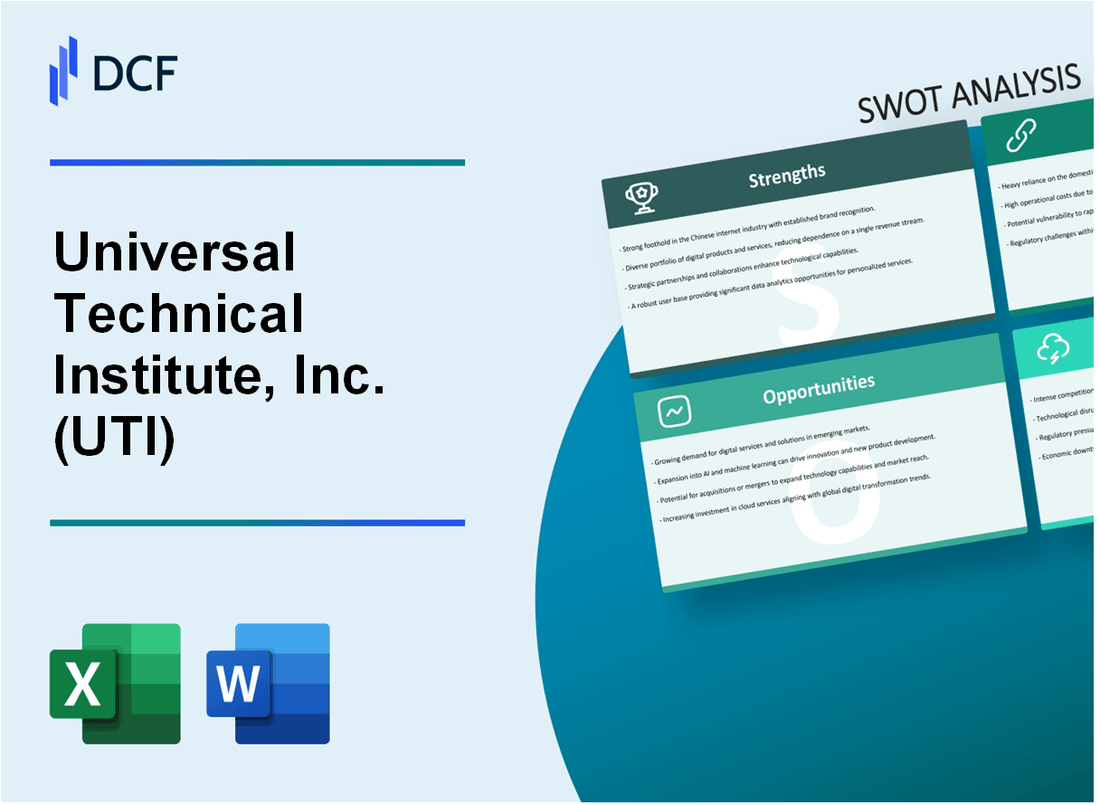
Completamente Editable: Adáptelo A Sus Necesidades En Excel O Sheets
Diseño Profesional: Plantillas Confiables Y Estándares De La Industria
Predeterminadas Para Un Uso Rápido Y Eficiente
Compatible con MAC / PC, completamente desbloqueado
No Se Necesita Experiencia; Fáciles De Seguir
Universal Technical Institute, Inc. (UTI) Bundle
En el panorama de educación técnica de rápido evolución, el Instituto Técnico Universal (UTI) se encuentra en una encrucijada crítica, navegando por desafíos complejos y oportunidades prometedoras dentro del sector automotriz y de capacitación en transporte. A medida que las industrias se transforman con las tecnologías emergentes y las demandas de la fuerza laboral, el posicionamiento estratégico de UTI se vuelve cada vez más crucial para los estudiantes que buscan carreras técnicas especializadas. Este análisis FODA completo revela el panorama competitivo del instituto, explorando sus fortalezas, vulnerabilidades potenciales, perspectivas de crecimiento y desafíos externos en el mercado dinámico de capacitación educativa y automotriz.
Universal Technical Institute, Inc. (UTI) - Análisis FODA: Fortalezas
Educación técnica y vocacional especializada
Universal Technical Institute ofrece capacitación especializada en 5 Disciplinas técnicas principales:
- Tecnología automotriz
- Tecnología diesel
- Tecnología marina
- Tecnología de motocicletas
- Tecnología de reparación de colisiones
| Programa | Longitud promedio del programa | Costo de matrícula promedio |
|---|---|---|
| Tecnología automotriz | 54 semanas | $38,500 |
| Tecnología diesel | 47 semanas | $42,000 |
| Reparación de colisiones | 36 semanas | $35,200 |
Asociaciones de la industria sólidas
UTI mantiene asociaciones con 17 principales fabricantes y empleadores automotrices, incluido:
- Ford Motor Company
- General Motors
- Toyota
- BMW
- Oruga
Ubicación del campus
Opera UTI 12 ubicaciones del campus En todo Estados Unidos, proporcionando accesibilidad integral de educación técnica.
| Región | Número de campus |
|---|---|
| Costa oeste | 3 |
| Suroeste | 2 |
| Sudeste | 3 |
| Nordeste | 2 |
| Medio oeste | 2 |
Instalaciones y equipos de capacitación
Invierte UTI $ 12.5 millones anuales En actualizaciones de equipos e instalaciones para mantener entornos de capacitación de vanguardia.
| Recurso de capacitación | Cantidad |
|---|---|
| Bahías de entrenamiento | 450 |
| Computadoras de diagnóstico | 1,200 |
| Vehículos de entrenamiento | 350 |
Universal Technical Institute, Inc. (UTI) - Análisis FODA: debilidades
Costos de matrícula más altos en comparación con los programas técnicos de la universidad comunitaria
Los costos de matrícula de UTI superan significativamente los de los programas técnicos de la universidad comunitaria. A partir de 2024, el costo promedio del programa de UTI varía desde $ 33,000 a $ 45,000, en comparación con los programas técnicos de la universidad comunitaria promedio $ 10,000 a $ 15,000.
| Tipo de institución | Costo promedio del programa | Duración del programa |
|---|---|---|
| Ésimo | $33,000 - $45,000 | 12-24 meses |
| Colegio comunitario | $10,000 - $15,000 | 12-24 meses |
Diversidad de programas limitados en comparación con universidades integrales
UTI ofrece una gama más estrecha de programas técnicos en comparación con universidades integrales. Las ofertas actuales del programa incluyen:
- Tecnología automotriz
- Tecnología diesel
- Mecánica de motocicletas
- Mecánica marina
- Técnico de NASCAR
En contraste, ofrecen universidades integrales 50-100 programas técnicos y vocacionales diferentes.
Desafíos de percepción potencial con respecto al modelo educativo con fines de lucro
La infección urinaria enfrenta desafíos continuos con su modelo educativo con fines de lucro. A partir de 2024:
- 67% de los estudiantes potenciales expresan escepticismo sobre las instituciones con fines de lucro
- El escrutinio de acreditación permanece alto
- Los costos de cumplimiento regulatorio continúan aumentando
| Métrica de percepción | Porcentaje |
|---|---|
| Escepticismo de los estudiantes | 67% |
| Preocupaciones de cumplimiento regulatorio | 54% |
Dependencia de las tendencias de empleo del sector automotriz y de transporte
El modelo de negocio de UTI depende en gran medida del empleo automotriz y del sector del transporte. Las métricas de dependencia clave incluyen:
- El sector automotriz representa 72% de las inscripciones de programas totales de UTI
- Crecimiento del empleo del técnico automotriz proyectado: 2% anual
- Riesgo de desplazamiento potencial de tecnologías de vehículos eléctricos
| Sector | Porcentaje de inscripción de programas | Proyección de crecimiento del empleo |
|---|---|---|
| Automotor | 72% | 2% anual |
| Diesel | 15% | 4% anual |
| Otros sectores | 13% | Varía |
Universal Technical Institute, Inc. (UTI) - Análisis FODA: oportunidades
Creciente demanda de profesionales técnicos calificados en los sectores automotrices y de transporte
Según la Oficina de Estadísticas Laborales de EE. UU., Se proyecta que los técnicos y la mecánica de servicio automotriz tendrán un crecimiento del 2% del empleo de 2021 a 2031, con aproximadamente 4.500 aperturas de trabajo esperadas anualmente.
| Sector | Crecimiento del empleo proyectado | Aperturas de trabajo anuales |
|---|---|---|
| Técnicos de servicio automotriz | 2% | 4,500 |
| Mecánica diesel | 4% | 3,200 |
Expandir programas de capacitación en tecnologías emergentes
El mercado de vehículos eléctricos (EV) está experimentando un rápido crecimiento, y las ventas globales de EV alcanzan 10.5 millones de unidades en 2022, lo que representa un aumento del 55% de 2021.
- Los programas de capacitación de técnicos de EV han aumentado en un 35% en los últimos dos años
- Las habilidades de mantenimiento de vehículos híbridos se están volviendo cada vez más valiosas
- Salario promedio para técnicos de EV: $ 65,000 - $ 85,000 anualmente
Expansión potencial del mercado internacional
| Región | Tamaño del mercado de la educación técnica | Potencial de crecimiento |
|---|---|---|
| Asia-Pacífico | $ 68.5 mil millones | 7.2% CAGR |
| América Latina | $ 22.3 mil millones | 5.9% CAGR |
Desarrollo de formatos de aprendizaje en línea e híbridos
Se proyecta que el mercado de educación técnica en línea alcanzará los $ 74.5 mil millones para 2027, con una tasa de crecimiento anual compuesta del 12.3%.
- El 62% de los estudiantes técnicos prefieren modelos de aprendizaje híbrido
- Los programas de certificación técnica en línea han visto un aumento del 40% en la matrícula desde 2020
- Ahorro promedio de costos de los programas en línea: 30-45% en comparación con la capacitación tradicional en persona
Universal Technical Institute, Inc. (UTI) - Análisis FODA: amenazas
Aumento de la competencia de colegios comunitarios y plataformas de capacitación técnica en línea
A partir de 2024, el mercado de educación técnica muestra presiones competitivas significativas:
| Tipo de competencia | Impacto de la cuota de mercado | Diferencia de matrícula promedio |
|---|---|---|
| Colegios comunitarios | 27.3% de penetración del mercado | $ 6,500 costo anual más bajo |
| Plataformas técnicas en línea | 18.7% de crecimiento del mercado | $ 4,200 costo del programa más bajo |
Posibles recesiones económicas que afectan las industrias automotrices y de transporte
Indicadores de vulnerabilidad de la industria automotriz:
- Contracción del mercado laboral del sector automotriz proyectado: 4.2%
- Declace del empleo de fabricación: 3.7%
- Reducción de ingresos de la industria potencial: $ 12.3 mil millones
Cambio de paisajes tecnológicos que requieren actualizaciones curriculares continuas
Desafíos de adaptación tecnológica:
| Área tecnológica | Inversión requerida | Actualización de frecuencia |
|---|---|---|
| Tecnología de vehículos eléctricos | $ 2.1 millones | Cada 18 meses |
| Sistemas de diagnóstico avanzados | $ 1.7 millones | Cada 24 meses |
Escrutinio regulatorio de instituciones educativas con fines de lucro
Métricas de cumplimiento regulatorio:
- Costo de investigación federal: $ 3.4 millones
- Rango de multa de cumplimiento potencial: $ 500,000 - $ 2.3 millones
- Frecuencia de revisión de acreditación: anualmente
Los factores de riesgo de cumplimiento incluyen Tasas de incumplimiento del préstamo estudiantil, Verificación de empleo de posgrado, y Requisitos de transparencia institucional.
Universal Technical Institute, Inc. (UTI) - SWOT Analysis: Opportunities
The opportunities for Universal Technical Institute, Inc. are not just theoretical; they are grounded in a massive, structural shift in the US labor market. You have a clear runway for growth because the demand for skilled workers-both in the trades and in healthcare-is far outstripping the supply. UTI's strategic plan is simply a direct, aggressive response to this market reality, and it's backed by the fiscal strength of a company that delivered $835.6 million in revenue for fiscal year 2025.
Accelerate campus expansion, planning to open at least two and up to five new locations annually
The core of UTI's next growth phase is physical expansion, which is a significant capital investment but a necessary one to capture market share. The company has committed to opening a minimum of two and up to five new campuses annually between fiscal years 2026 and 2029. This is a defintely aggressive target, but it's what the market dictates.
To support this, CapEx is surging. While fiscal year 2025 cash capital expenditures were $42.0 million, primarily for program expansions, the fiscal year 2026 guidance assumes approximately $100 million in cash capital expenditures to fund these new campus launches and program additions. This is a massive investment, but it's a smart one: you have to spend money to make money, especially when building out physical infrastructure to serve a growing student body.
The new locations are strategically placed in high-growth markets, focusing on both the UTI (skilled trades) and Concorde (healthcare) divisions.
- UTI-Salt Lake City: Nearly 113,000 square feet, serving over 3,000 students at scale.
- Concorde-Houston: 45,000 square feet, serving up to 700 students at scale.
- Concorde-Atlanta: Over 47,000 square feet, serving up to 700 students at scale.
Capitalize on the massive supply-demand imbalance in skilled trades and healthcare
This is the biggest tailwind for UTI. The US labor market is fundamentally broken in these two sectors, creating a persistent, high-margin opportunity for a scaled education provider. The data is stark: employers are desperate for qualified workers, and traditional four-year colleges aren't filling the gap.
In the skilled trades, the shortage is critical. As of Q1 2025, the manufacturing sector alone had 622,000 unfilled roles, and the total number of unfilled trade jobs is over one million. In healthcare, the demand for support roles is growing fastest, with an expected workforce gap of about 446,300 workers for home health aides by 2025. This is a structural problem that UTI's model is perfectly positioned to solve.
| Sector | US Labor Shortage Metric (2025) | UTI Division Addressing Gap |
|---|---|---|
| Skilled Trades (Manufacturing) | 622,000 unfilled roles (Q1 2025) | Universal Technical Institute (UTI) |
| Healthcare (Home Health Aides) | Expected workforce gap of 446,300 workers by 2025 | Concorde Career Colleges |
| Skilled Trades (Total) | Over 1,000,000 unfilled trade jobs | Universal Technical Institute (UTI) |
Launch approximately 20 new programs annually, including in high-demand areas like EV technology and nursing
It's not just about more campuses; it's about having the right curriculum. UTI is accelerating its program diversification, planning to launch approximately 20 new programs annually across both the UTI and Concorde divisions. This is how you stay relevant in a rapidly changing technical landscape.
The focus on high-demand, emerging fields is smart. For the UTI division, this means a heavy push into electrical and EV technology. For the Concorde division, it's about expanding high-demand healthcare programs like nursing, dental, and diagnostic services.
- EV Technology: New Battery Hybrid Electric Vehicle (BHEV) and EV courses are now integrated into core automotive programs at multiple campuses.
- Electrical Trades: UTI launched four new electrical-centric programs in July 2025, including Electrical, Robotics, and Automation Technology (ERAT) and Electrical & Wind Turbine Technology (EWTT).
- Nursing and Allied Health: The new Concorde campuses in Houston and Atlanta will offer a range of nursing, dental, diagnostic, patient care, and allied health programs, directly addressing the critical labor risk in healthcare support occupations.
Expand B2B partnerships with employers and the military for structured training programs
The company's B2B strategy is a crucial differentiator, moving beyond just placing graduates to becoming a true workforce solution partner. This creates a direct pipeline for students and a predictable revenue stream from employers. UTI is strengthening partnerships with over 13,000 employment partners to enhance student job opportunities.
A great example of this is the first-of-its-kind collaboration with Heartland Dental Services in Fort Myers, Florida, for a new campus dedicated solely to dental hygiene and assistant programs. This tight integration with a major industry player ensures curriculum is perfectly aligned with employer needs, which in turn leads to stronger student outcomes and a better return on investment for the company.
Also, the ongoing Manufacturer-Specific Advanced Training (MSAT) programs with Original Equipment Manufacturers (OEMs) like Ford and BMW are being updated to include new EV curriculum, solidifying UTI's role as the go-to training ecosystem for the automotive industry's electrification pivot.
Next step: Operations and Finance should model the expected revenue ramp for the three new 2027 campuses (Salt Lake City, Houston, Atlanta) based on the stated student capacity and average tuition rates by the end of the quarter.
Universal Technical Institute, Inc. (UTI) - SWOT Analysis: Threats
Extensive regulatory risk from potential changes in Department of Education Title IV Program funding.
The biggest near-term threat to Universal Technical Institute, Inc. (UTI) is the regulatory environment, specifically the new Department of Education (ED) rules governing federal financial aid (Title IV). As a for-profit institution, the new Gainful Employment (GE) rule and Financial Value Transparency (FVT) Framework apply to nearly all your programs, which is a much wider net than for public or non-profit schools. This is a serious risk because Title IV funding is the lifeblood of the sector.
The ED is set to publish the first program-specific financial outcome rates in early 2025. Programs that fail the metrics for two out of three consecutive years will lose their eligibility for Title IV funding starting in 2026. Honestly, this is a clear, existential threat to any program that can't demonstrate a strong return on investment (ROI).
The GE rule's financial metrics are tough to meet. A program fails if its graduates' estimated annual loan payments exceed 8% of their annual earnings or 20% of their discretionary income. Plus, less than 50% of graduates must earn more than a typical high school graduate in their state's labor force. You need to be defintely sure your programs are on the right side of these numbers, because only 42% of for-profit institutions have fewer than 10% of graduates in programs that would fail GE, compared to 97% of public/non-profit schools.
Increased competition from community colleges expanding their own skilled trades programs.
While demand for skilled trades is booming, your competition from public community colleges is intensifying, and they have a massive cost advantage. They are aggressively expanding their vocational and trade programs, often with significant state and local funding. Enrollment at vocational-focused public two-year institutions grew by almost 20% from Spring 2020 to 871,000 students in Spring 2025, which shows their scale and momentum.
The core threat is the tuition differential. For example, a public two-year institution like Spokane Community College offers a Skilled Trades Preparation program with tuition of only $25, plus alternative funding assistance. This is a nearly insurmountable price point for a private, for-profit school to compete with, even with UTI's strong industry partnerships. You're competing on value-add, not price.
- Community colleges are expanding in key areas: HVAC, Electrical, Plumbing, and Welding.
- Many offer US Department of Labor Registered Apprenticeship Programs, allowing students to earn while they learn.
- Their low-cost model directly pressures UTI's enrollment funnel, especially in markets where you don't have a long-standing reputation.
Economic downturns could affect student enrollment and their ability to finance tuition.
The good news is that vocational school enrollment tends to be counter-cyclical, meaning it rises when the job market is weak. But that's not the whole story for a tuition-dependent, for-profit model like UTI. Your full-year FY2025 average full-time active students increased 10.5% to 24,618, and new student starts grew 10.8% to 29,793, which is great, but a severe downturn is a different beast.
Historically, the for-profit education sector is volatile. Sector-wide enrollment dropped 16% between 2007 and 2014, for example. A sudden, deep recession could make students wary of taking on any debt, even for a high-ROI career. What this estimate hides is the student's ability to secure financing.
The new Title IV reforms, such as those in the 'One Big Beautiful Bill Act,' are placing limits on the loans students and their parents can incur. If the federal cap is hit, students must seek private market loans or simply be unable to access sufficient affordable capital to pay your tuition. A sluggish economy increases the risk of students defaulting, which then impacts your own regulatory metrics.
Execution risk in successfully launching and scaling multiple new campuses by 2027.
Your North Star strategy is aggressive, aiming to open multiple campuses annually between 2026 and 2029. This is a high-stakes, high-reward plan, but the execution risk is substantial. You're investing heavily ahead of demonstrated demand, which analysts have already flagged as a key near-term concern.
The financial commitment is significant. UTI is projecting approximately $100 million in total Capital Expenditure (CapEx) invested annually in new campuses and program expansions to execute this growth. For context, your total cash CapEx for FY2025 was $42.0 million. This jump in spending creates pressure on near-term margins and cash flow.
The first three new campuses planned for FY2027-UTI-Salt Lake City, Concorde-Houston, and Concorde-Atlanta-represent a major capacity expansion. UTI-Salt Lake City alone is planned for a capacity of over 3,000 students. Missing enrollment targets at just one of these large, new sites could significantly impact your projected revenue growth and profitability.
| FY2027 New Campus | Division | Approximate Capacity (Students) | Execution Risk Factor |
|---|---|---|---|
| UTI-Salt Lake City | Universal Technical Institute | Over 3,000 | Large-scale, greenfield site requiring high initial enrollment ramp. |
| Concorde-Houston | Concorde Career Colleges | Up to 700 | Regulatory approval for new healthcare programs in a competitive metro. |
| Concorde-Atlanta | Concorde Career Colleges | Up to 700 | Timely build-out and staffing in a new geographic market. |
All new campus openings are explicitly subject to appropriate regulatory approvals, which adds a layer of uncertainty and potential for delay to the entire rollout schedule.
Disclaimer
All information, articles, and product details provided on this website are for general informational and educational purposes only. We do not claim any ownership over, nor do we intend to infringe upon, any trademarks, copyrights, logos, brand names, or other intellectual property mentioned or depicted on this site. Such intellectual property remains the property of its respective owners, and any references here are made solely for identification or informational purposes, without implying any affiliation, endorsement, or partnership.
We make no representations or warranties, express or implied, regarding the accuracy, completeness, or suitability of any content or products presented. Nothing on this website should be construed as legal, tax, investment, financial, medical, or other professional advice. In addition, no part of this site—including articles or product references—constitutes a solicitation, recommendation, endorsement, advertisement, or offer to buy or sell any securities, franchises, or other financial instruments, particularly in jurisdictions where such activity would be unlawful.
All content is of a general nature and may not address the specific circumstances of any individual or entity. It is not a substitute for professional advice or services. Any actions you take based on the information provided here are strictly at your own risk. You accept full responsibility for any decisions or outcomes arising from your use of this website and agree to release us from any liability in connection with your use of, or reliance upon, the content or products found herein.