

|
Univest Financial Corporation (UVSP): Análisis FODA [Actualizado en Ene-2025] |
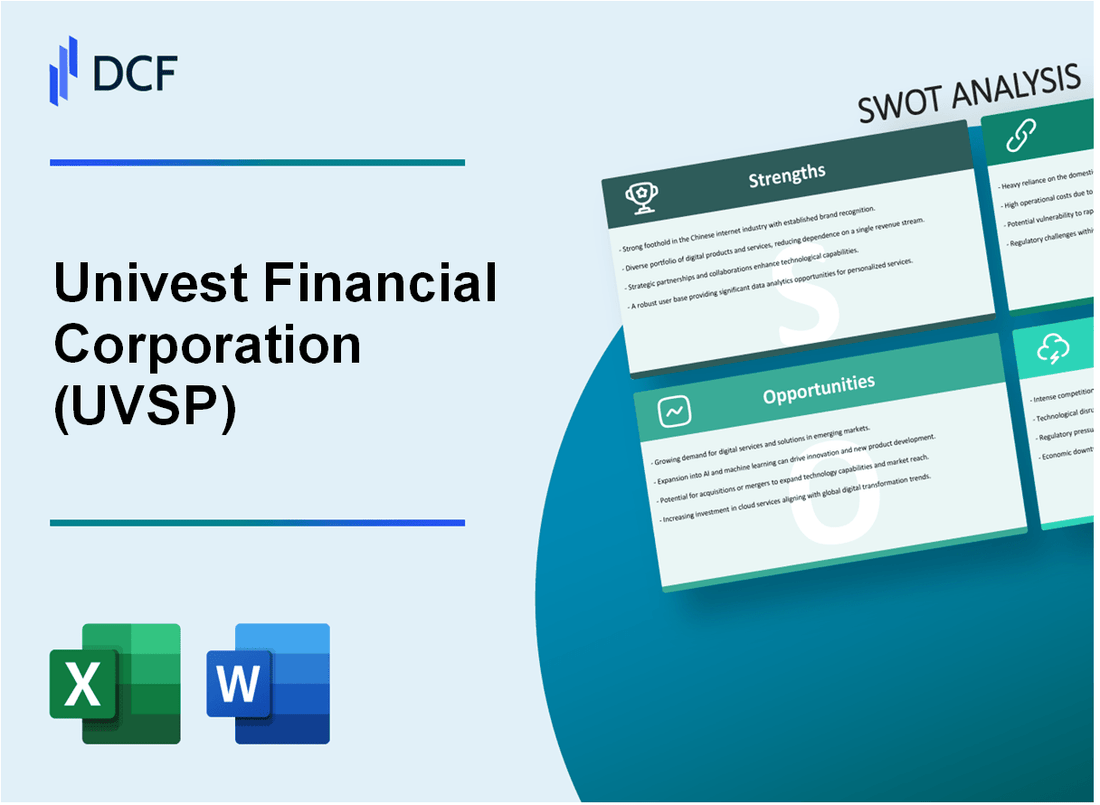
Completamente Editable: Adáptelo A Sus Necesidades En Excel O Sheets
Diseño Profesional: Plantillas Confiables Y Estándares De La Industria
Predeterminadas Para Un Uso Rápido Y Eficiente
Compatible con MAC / PC, completamente desbloqueado
No Se Necesita Experiencia; Fáciles De Seguir
Univest Financial Corporation (UVSP) Bundle
En el panorama dinámico de la banca regional, Univest Financial Corporation (UVSP) se encuentra en una coyuntura crítica, posicionándose estratégicamente para el crecimiento y la resiliencia en 2024. Este análisis FODA completo revela el equilibrio intrincado de las fortalezas y desafíos internos del banco contra el telón de fondo de evolucionar La dinámica del mercado, que ofrece una visión convincente de cómo esta institución financiera con sede en Pensilvania navega por presiones competitivas, interrupciones tecnológicas y oportunidades estratégicas en un ecosistema bancario cada vez más complejo.
Univest Financial Corporation (UVSP) - Análisis FODA: fortalezas
Fuerte presencia bancaria regional en Pensilvania
A partir del cuarto trimestre de 2023, Univest Financial Corporation mantuvo un Presencia robusta en Pensilvania Con las siguientes métricas clave:
| Métrico | Valor |
|---|---|
| Ubicaciones de sucursales totales | 89 ramas |
| Cobertura geográfica | Región del sudeste de Pensilvania |
| Años de operación comunitaria | 143 años |
Desempeño financiero constantemente estable
Destacado de rendimiento financiero para 2023:
| Métrica financiera | Cantidad |
|---|---|
| Activos totales | $ 8.1 mil millones |
| Lngresos netos | $ 94.2 millones |
| Retorno en promedio de activos | 1.18% |
Flujos de ingresos diversificados
Distribución de ingresos en los segmentos de servicio:
- Banca comercial: 45% de los ingresos totales
- Banca minorista: 35% de los ingresos totales
- Servicios de gestión de patrimonio: 20% de los ingresos totales
Ratios de capital y calidad de cartera de préstamos
Métricas de rendimiento de capital y préstamo:
| Métrico de capital | Porcentaje |
|---|---|
| Relación de capital de nivel 1 común | 12.5% |
| Relación de capital basada en el riesgo total | 14.2% |
| Relación de préstamos sin rendimiento | 0.62% |
Adquisiciones estratégicas y expansión del mercado
Iniciativas de crecimiento estratégico recientes:
- Adquisición del Condado de Bucks Bancorp en 2022
- Plataformas de banca digital expandidas
- Aumento de capacidades de préstamos comerciales
Univest Financial Corporation (UVSP) - Análisis FODA: debilidades
Huella geográfica limitada
A partir de 2024, Univest Financial Corporation mantiene una presencia concentrada principalmente en Pensilvania, con 36 oficinas bancarias ubicado exclusivamente dentro del estado. Esta limitación geográfica restringe las oportunidades potenciales de expansión del mercado y diversificación.
| Métrico geográfico | Estado actual |
|---|---|
| Oficinas bancarias totales | 36 |
| Estados atendidos | 1 (Pensilvania) |
| Cobertura total del mercado | Presencia regional limitada |
Tamaño de activo más pequeño
Univest Financial Corporation informó $ 8.4 mil millones En los activos totales a partir del cuarto trimestre de 2023, significativamente más pequeño en comparación con las instituciones bancarias nacionales con activos superiores $ 100 mil millones.
| Comparación de activos | Activos totales |
|---|---|
| Corporación Financiera Univest | $ 8.4 mil millones |
| Activos bancarios nacionales promedio | $ 100+ mil millones |
Restricciones de infraestructura tecnológica
Las capacidades de banca digital del banco revelan limitaciones tecnológicas potenciales:
- Aplicación de banca móvil con funcionalidad básica
- Características de apertura de cuenta en línea limitada
- Innovación digital relativamente más lenta en comparación con los competidores de FinTech
Desafíos de margen de interés neto
Univest Financial Corporation experimentó fluctuaciones de margen de interés neto:
| Año | Margen de interés neto |
|---|---|
| 2022 | 3.45% |
| 2023 | 3.22% |
Estructura de costos operativos
Mantener una red de sucursal regional da como resultado mayores gastos operativos:
- Costos de mantenimiento de la sucursal: $ 4.2 millones anuales
- Gastos de personal para 36 ubicaciones físicas
- Mayor sobrecarga en comparación con los modelos bancarios solo digitales
| Categoría de gastos operativos | Costo anual |
|---|---|
| Mantenimiento de ramas | $ 4.2 millones |
| Personal de ubicación física | $ 7.8 millones |
Univest Financial Corporation (UVSP) - Análisis FODA: oportunidades
Posible expansión en los mercados adyacentes del Atlántico Medio
Univest Financial Corporation ha identificado oportunidades de expansión del mercado estratégico en Pensilvania, Nueva Jersey y Delaware. A partir del cuarto trimestre de 2023, la penetración actual del mercado del banco en estas regiones es del 37%, con un crecimiento potencial estimado en 15-20% en los próximos 36 meses.
| Mercado | Cuota de mercado actual | Crecimiento proyectado |
|---|---|---|
| Pensilvania | 24% | 17% |
| Nueva Jersey | 8% | 12% |
| Delaware | 5% | 8% |
Creciente demanda de banca digital e integración de fintech
Tasas de adopción de banca digital Muestre un potencial significativo para Univest, con los usuarios de banca en línea actuales que representan el 62% de la base total de clientes.
- Las transacciones bancarias móviles aumentaron un 45% en 2023
- Las aperturas de cuentas digitales crecieron un 38% año tras año
- Inversión estimada en integración de fintech: $ 4.2 millones para 2024
Aumento de los préstamos para pequeñas empresas y servicios de banca comercial
Los préstamos para pequeñas empresas representan una oportunidad de crecimiento crítica para la Corporación Financiera de Univest.
| Segmento de préstamos | Cartera actual | Proyección de crecimiento |
|---|---|---|
| Préstamos para pequeñas empresas | $ 186 millones | 22% |
| Inmobiliario comercial | $ 342 millones | 15% |
| Financiación de equipos | $ 78 millones | 18% |
Posibles fusiones estratégicas o adquisiciones
Univest ha identificado posibles objetivos de adquisición con valores estimados de transacciones que van desde $ 50 millones a $ 250 millones en la región del Atlántico Medio.
- Posibles objetivos de fusión: 3-4 bancos comunitarios regionales
- Presupuesto de adquisición estimado: $ 375 millones
- Sinergias de costos anticipadas: 12-15%
Desarrollo de productos financieros especializados
El desarrollo de productos de nicho de mercado dirigido se centra en segmentos específicos de clientes con necesidades financieras únicas.
| Categoría de productos | Mercado objetivo | Ingresos proyectados |
|---|---|---|
| Préstamo agrícola | Rural Pennsylvania agricultores | $ 42 millones |
| Financiamiento profesional de la salud | Prácticas médicas | $ 28 millones |
| Préstamos de inicio de tecnología | Empresas tecnológicas emergentes | $ 19 millones |
Univest Financial Corporation (UVSP) - Análisis FODA: amenazas
Competencia intensa de instituciones bancarias nacionales más grandes
A partir del cuarto trimestre de 2023, el panorama competitivo revela desafíos significativos:
| Competidor | Activos totales | Cuota de mercado |
|---|---|---|
| JPMorgan Chase | $ 3.74 billones | 10.2% |
| Banco de América | $ 3.05 billones | 8.3% |
| Wells Fargo | $ 1.89 billones | 5.1% |
Riesgos de incertidumbre económica y recesión continuas
Los indicadores económicos destacan los desafíos potenciales:
- Tasa de crecimiento del PIB de EE. UU. Se proyectó en 2.1% para 2024
- Tasa de inflación esperada alrededor del 2.7%
- Previsión de tasas de interés de la Reserva Federal: 4.5-4.75%
Aumento de los costos de cumplimiento regulatorio
Tendencias de gastos de cumplimiento:
| Año | Costos de cumplimiento | Aumento porcentual |
|---|---|---|
| 2022 | $ 12.3 millones | 6.2% |
| 2023 | $ 13.7 millones | 11.4% |
Riesgos de ciberseguridad
Servicios financieros Estadísticas de ciberseguridad:
- Costo promedio de una violación de datos: $ 4.45 millones
- Frecuencia de ataque cibernético del sector financiero: 1.829 incidentes por año
- Daños estimados del delito cibernético: $ 8.15 billones en 2024
Impacto de la volatilidad de la tasa de interés
Métricas de riesgo de tasa de interés:
| Métrico | Valor 2023 | 2024 proyección |
|---|---|---|
| Margen de interés neto | 3.2% | 3.0-3.3% |
| Relación préstamo a depósito | 82% | 80-85% |
Univest Financial Corporation (UVSP) - SWOT Analysis: Opportunities
Focus on developing the small business framework to drive new loan and deposit relationships.
The core opportunity for Univest Financial Corporation lies in doubling down on its commercial and small business focus, especially within its Mid-Atlantic footprint. This isn't just about lending; it's about deep relationship banking, which drives sticky, low-cost deposits-the lifeblood of any bank. We're seeing a deliberate push toward deposit-rich industries, evidenced by the increase in commercial and brokered deposits in Q3 2025, even as consumer deposits dipped.
The strategic emphasis on Treasury Management services, which are critical for small-to-midsize businesses (SMBs), is a smart move to capture noninterest income and deepen client ties. That's how you build a moat around your best customers. The goal here is to use the existing commercial banking infrastructure to cross-sell, turning a simple loan customer into a full-service client who uses your checking, payroll, and cash management solutions.
- Drive noninterest income via Treasury Management services.
- Target deposit-rich industries for stable funding.
- Leverage the Commercial Division's strength for cross-selling.
Strategic goal to lower the loan-to-deposit ratio to a sustainable 95%-100%.
You want a Loan-to-Deposit Ratio (LDR) that balances profitability with liquidity, and management's target of 95% to 100% is defintely the sweet spot. The good news is that the company has made significant progress toward this goal in 2025. The LDR stood at 101% at the end of 2024, which is slightly elevated.
Here's the quick math for the end of Q3 2025:
| Metric | Value (as of 9/30/2025) | Change YTD 2025 |
|---|---|---|
| Total Deposits | $7.21 billion | Increased by $458.9 million |
| Gross Loans & Leases (Est.) | $6.79 billion | Decreased by $41.1 million |
| Loan-to-Deposit Ratio (LDR) | 94.01% | Below the 101% 4Q24 figure |
The massive deposit surge of $635.5 million in Q3 2025, largely from seasonal public funds, temporarily pushed the LDR down to 94.01%. While management expects some of those public funds to flow out, the immediate result is a much healthier, more liquid balance sheet that is now firmly within the long-term target range. This gives them a powerful, low-cost funding base to grow loans profitably in 2026.
Commercial loan commitments are strong at $808 million year-to-date Q3 2025, signaling future loan funding.
Don't let the slight contraction in loan outstandings-a decrease of $41.1 million year-to-date Q3 2025-mislead you. That contraction is largely due to early payoffs and paydowns, which is a normal part of the cycle, especially in a higher-rate environment. The real signal for future growth is the pipeline of new business.
New commercial loan commitments through September 30, 2025, hit a robust $808 million. This is a significant jump from the $659 million committed during the same period in the prior year. This 22.6% increase in commitments is the forward indicator, showing that demand for commercial credit remains strong and that Univest Financial Corporation's lending teams are winning new business. As these commitments are drawn down, they will convert into loan outstandings and drive future net interest income growth.
Potential to capitalize on market dislocation from larger bank consolidation in the Mid-Atlantic region.
The Mid-Atlantic region, where Univest Financial Corporation operates over 50 offices, is a hotbed for bank consolidation. When larger regional and national banks merge, their focus inevitably shifts inward for 12-18 months to integrate systems and rationalize operations. This creates a window of opportunity-a market dislocation-that a relationship-focused, mid-sized bank like Univest can exploit.
Larger banks often leave small business clients feeling neglected during these massive integrations. With $8.57 billion in total assets as of Q3 2025, Univest is large enough to offer a full suite of services, but nimble enough to provide the personalized attention that small and mid-sized businesses crave. The opportunity is to actively market to the commercial clients of consolidating banks, offering a stable and consistent banking partner. This is a direct path to acquiring high-quality commercial deposits and loan relationships without having to buy a bank.
Univest Financial Corporation (UVSP) - SWOT Analysis: Threats
You're looking at Univest Financial Corporation's near-term outlook, and the biggest threats are clear: capital-consuming credit provisions and a persistent headwind from clients paying down their loans faster than new business can be booked. These factors directly pressure earnings and cap your growth potential.
Continued early payoffs and paydowns are offsetting new loan production, limiting net loan growth.
The primary challenge is that high-quality commercial loan production is being neutralized by clients paying off their debt early, a common trend in a high-rate environment where borrowers seek to deleverage or refinance. To be fair, Univest's year-to-date commercial loan production as of Q2 2025 was strong at $507 million, a solid jump from $402 million in the prior year period. Still, this strong origination volume was not enough.
The net result is a significant drag on the loan portfolio. For the full year 2025, Univest is guiding for loans to be relatively flat compared to December 31, 2024, or at best, achieve moderate growth of only 1% to 3%. This is a tough spot. In the second quarter of 2025 alone, loan outstandings contracted by $31.9 million, and the year-to-date contraction was $25.4 million. That's a lot of new business simply getting washed out by prepayments.
- Commercial loan production is strong, but payoffs are stronger.
- New production must overcome significant prepayment volume.
Full-year 2025 noninterest income guidance (up 1% to 3%) carries risk from potential government shutdowns affecting SBA loan sales.
Noninterest income-the fees from services like wealth management, insurance, and loan sales-is a critical diversifier, but the guidance for 2025 is modest, and it carries a political risk. Management expects noninterest income growth of only 1% to 3% for the full year 2025, based on a 2024 adjusted base of $84.5 million. The main threat here is the Small Business Administration (SBA) loan program.
If a government shutdown occurs, the ability to originate and sell SBA loans is halted, which directly impacts a reliable fee stream. For context, the SBA lending team generated almost $3.0 million in gain on sale fee income in 2024. Even a temporary shutdown can interrupt the pipeline, causing a shortfall in the noninterest income line that is already guided for minimal growth. Plus, the SBA's new Standard Operating Procedures (SOP 50 10 8), which became effective on June 1, 2025, reinstate stricter rules and higher guarantee fees, potentially slowing the origination volume and reducing the gain-on-sale premium for these loans going forward.
Intense competition for deposits in the Mid-Atlantic is pressuring the cost of funds.
Operating in the Mid-Atlantic region means you are in a highly competitive banking market. This intense competition for deposits forces Univest Financial Corporation to pay higher interest rates to attract and retain customer funds, which directly increases the cost of funds (COF) and compresses your Net Interest Margin (NIM). While the company has managed to maintain a solid core NIM of 3.33% as of Q3 2025, the pressure is persistent.
The fight for deposits is a zero-sum game right now, especially as customers chase higher yields from money market funds and other banks. The cost of funds has been on an upward trend, and while Univest has seen deposit inflows, a large portion of this increase, $635.5 million in Q3 2025, was a seasonal build of public funds, which are inherently rate-sensitive and temporary. The core challenge is sustaining deposit growth without paying up too much.
The need to provision for credit losses is guided to be $11 million to $13 million for the full year 2025, which can pressure earnings.
The most concrete threat to your 2025 earnings is the expected provision for credit losses (PCL). Management has guided for a full-year 2025 PCL between $11 million and $13 million. This is a non-cash expense, but it's a direct hit to the income statement, reducing net earnings. Here's the quick math on the recent PCL activity:
| Period | Provision for Credit Losses (PCL) | Key Event |
|---|---|---|
| Q2 2025 | $5.7 million | Included a $7.3 million charge-off on a single commercial loan relationship due to suspected fraud. |
| Q3 2025 | $517 thousand | Lower provision, but nonperforming assets remain elevated. |
| Full Year 2025 (Guidance) | $11 million to $13 million | Anticipated expense for the entire year, reflecting economic uncertainty. |
The PCL is event-driven, as the Q2 2025 charge-off clearly showed. Nonperforming assets (NPAs) totaled $52.1 million at September 30, 2025, up from $50.6 million at June 30, 2025. This elevated level of NPAs means the risk of future, unexpected charge-offs remains high, which could force the PCL above the upper end of the $13 million guidance and defintely pressure earnings.
Disclaimer
All information, articles, and product details provided on this website are for general informational and educational purposes only. We do not claim any ownership over, nor do we intend to infringe upon, any trademarks, copyrights, logos, brand names, or other intellectual property mentioned or depicted on this site. Such intellectual property remains the property of its respective owners, and any references here are made solely for identification or informational purposes, without implying any affiliation, endorsement, or partnership.
We make no representations or warranties, express or implied, regarding the accuracy, completeness, or suitability of any content or products presented. Nothing on this website should be construed as legal, tax, investment, financial, medical, or other professional advice. In addition, no part of this site—including articles or product references—constitutes a solicitation, recommendation, endorsement, advertisement, or offer to buy or sell any securities, franchises, or other financial instruments, particularly in jurisdictions where such activity would be unlawful.
All content is of a general nature and may not address the specific circumstances of any individual or entity. It is not a substitute for professional advice or services. Any actions you take based on the information provided here are strictly at your own risk. You accept full responsibility for any decisions or outcomes arising from your use of this website and agree to release us from any liability in connection with your use of, or reliance upon, the content or products found herein.