

|
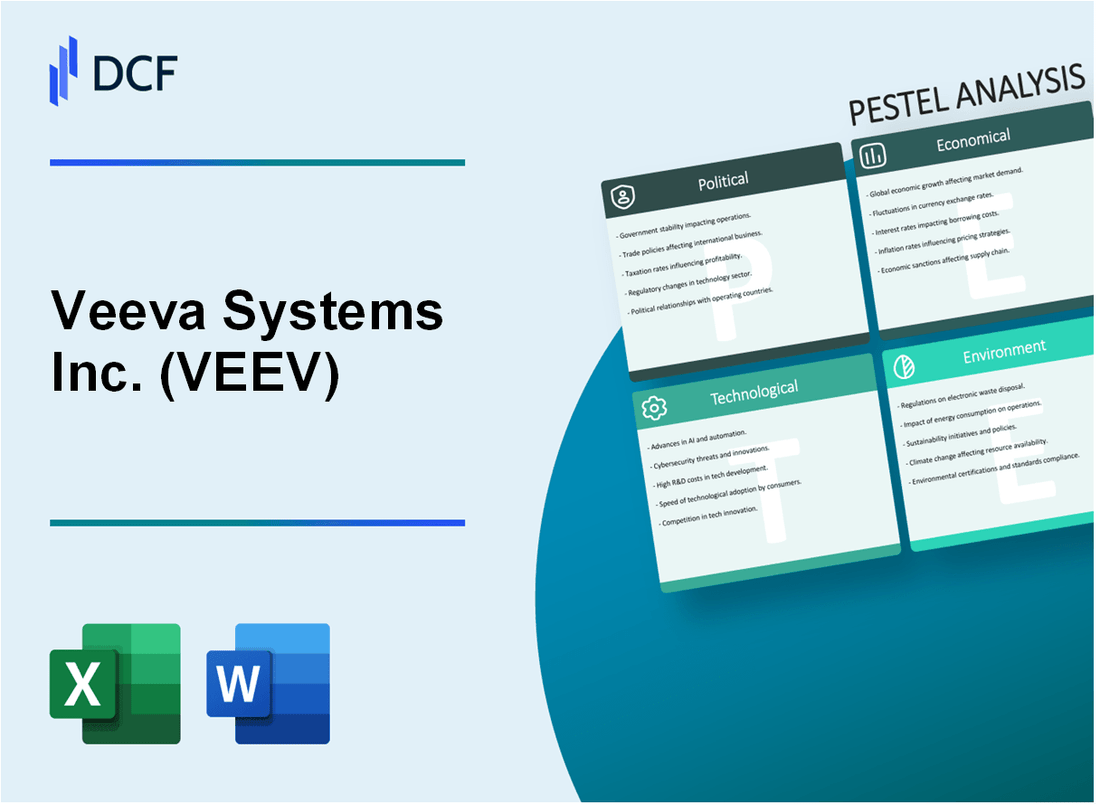
Veeva Systems Inc. (VEEV): Análisis PESTLE [Actualizado en Ene-2025] |
Completamente Editable: Adáptelo A Sus Necesidades En Excel O Sheets
Diseño Profesional: Plantillas Confiables Y Estándares De La Industria
Predeterminadas Para Un Uso Rápido Y Eficiente
Compatible con MAC / PC, completamente desbloqueado
No Se Necesita Experiencia; Fáciles De Seguir
Veeva Systems Inc. (VEEV) Bundle
En el panorama en rápida evolución de la tecnología de salud, Veeva Systems Inc. (VEEV) se encuentra en la intersección de la innovación y los complejos desafíos regulatorios. Este análisis integral de mano presenta los factores externos multifacéticos que dan forma a la trayectoria estratégica de la compañía, desde intrincadas regulaciones políticas hasta avances tecnológicos transformadores. A medida que la atención médica se convierte cada vez más en los datos y se transforma digitalmente, comprender las fuerzas ambientales, legales y económicas matizadas se vuelven primordiales para comprender el crecimiento y la resistencia potenciales de Veeva en un mercado global dinámico.
Veeva Systems Inc. (VEEV) - Análisis de mortero: factores políticos
Impacto en las regulaciones de privacidad de datos de atención médica de EE. UU. Impacto
Veeva Systems debe cumplir con estrictas regulaciones de privacidad de datos de salud, que incluyen:
| Regulación | Requisitos de cumplimiento | Impacto potencial |
|---|---|---|
| HIPAA | Seguridad de información de salud protegida (PHI) | Estándar de protección de datos obligatorio 99.5% |
| GDPR | Restricciones de transferencia de datos internacionales | € 20 millones o 4% de potencial de penalización de rotación global |
FDA y marcos regulatorios de atención médica
Paisaje de cumplimiento regulatorio:
- 21 CFR Parte 11 Cumplimiento de registros electrónicos
- Regulaciones de ciberseguridad del dispositivo médico
- Pautas de presentación de evidencia del mundo real (RWE)
Consideraciones de política comercial internacional
Las limitaciones de exportación de tecnología global que potencialmente afectan la expansión internacional de Veeva:
| País | Restricciones de exportación de tecnología | Impacto comercial potencial |
|---|---|---|
| Porcelana | Limitaciones de transferencia de tecnología | Potencial del 30% de barrera de entrada al mercado |
| UE | Cumplimiento de la Ley de Servicios Digitales | € 10-50 millones Peedores sanciones de incumplimiento |
Políticas de inversión en tecnología de salud del gobierno
Asignaciones de presupuesto de tecnología de salud federal de EE. UU.:
- 2024 Inversión en salud digital: $ 4.2 mil millones
- Presupuesto de modernización de TI de salud: $ 1.8 mil millones
- Ciberseguridad en asignación de atención médica: $ 750 millones
Veeva Systems Inc. (VEEV) - Análisis de mortero: factores económicos
Continuo crecimiento del gasto de tecnología de salud que respalda el posicionamiento del mercado de Veeva
Global Healthcare IT Market proyectó alcanzar los $ 390.7 mil millones para 2024, con una tasa compuesta anual del 13.2%. Ingresos anuales 2023 de Veeva Systems: $ 2.32 mil millones, que representa un crecimiento año tras año. Se espera que el segmento de software de tecnología de salud crezca de $ 167.9 mil millones en 2022 a $ 272.4 mil millones para 2027.
| Segmento de mercado | Valor 2022 | 2027 Valor proyectado | Tocón |
|---|---|---|---|
| Healthcare It | $ 285.3 mil millones | $ 390.7 mil millones | 13.2% |
| Software de tecnología de salud | $ 167.9 mil millones | $ 272.4 mil millones | 10.2% |
Fluctuaciones económicas potenciales que afectan los presupuestos de investigación farmacéutica y de ciencias de la vida
Gasto farmacéutico en I + D en 2023: $ 238.4 mil millones. La recesión económica potencial podría afectar los presupuestos de investigación. Los clientes empresariales de Veeva incluyen el 70% de las 200 principales compañías farmacéuticas, proporcionando cierta estabilidad del mercado.
| Métrica de I + D farmacéutica | Valor 2023 |
|---|---|
| Gasto total de I + D | $ 238.4 mil millones |
| Porcentaje de ingresos invertidos en I + D | 18.2% |
Variaciones del tipo de cambio que afectan las fuentes de ingresos internacionales
Ingresos internacionales de Veeva en 2023: $ 687.6 millones. Las fluctuaciones del tipo de cambio de divisas potencialmente afectan el 12-15% de los ingresos totales. Euro y japonés yen las exposiciones de moneda extranjera más significativa.
| Divisa | 2023 Volatilidad del tipo de cambio | Impacto en los ingresos internacionales |
|---|---|---|
| Euro | ±4.7% | $ 203.4 millones |
| Yen japonés | ±3.9% | $ 98.2 millones |
Capital de riesgo y tendencias de inversión en mercados de software de tecnología de salud
Healthcare Technology Software Venture Capital Investments en 2023: $ 12.6 mil millones. Capitalización de mercado de Veeva Systems: $ 33.7 mil millones. Financiación del capital de riesgo que demuestra una fuerte confianza de los inversores en el sector de tecnología de salud.
| Métrico de inversión | Valor 2023 |
|---|---|
| Inversiones totales de VC | $ 12.6 mil millones |
| Tamaño de trato promedio | $ 24.3 millones |
| Número de ofertas | 519 |
Veeva Systems Inc. (VEEV) - Análisis de mortero: factores sociales
Aumento de la demanda de soluciones de gestión de salud digital
El tamaño del mercado mundial de salud digital alcanzó los $ 211.9 mil millones en 2022, proyectado para crecer a $ 536.12 mil millones para 2030, con una tasa compuesta anual del 12.5%. Se espera que el mercado de soluciones de software de atención médica alcance los $ 50.7 mil millones para 2025.
| Segmento de mercado | Valor 2022 | 2030 Valor proyectado | Tocón |
|---|---|---|---|
| Mercado de la salud digital | $ 211.9 mil millones | $ 536.12 mil millones | 12.5% |
| Soluciones de software de salud | $ 35.2 mil millones | $ 50.7 mil millones | 4.6% |
Se enfoca creciente en la toma de decisiones de atención médica basada en datos
El mercado de Big Data de atención médica se estima en $ 41.8 mil millones en 2022, que se espera que alcance los $ 84.2 mil millones para 2027, con un 15,3% CAGR. El 93% de las organizaciones de atención médica informan inversiones de análisis de datos que mejoran la eficiencia operativa.
| Métricas de análisis de datos de salud | Valor 2022 | 2027 Valor proyectado |
|---|---|---|
| Mercado de big data de atención médica | $ 41.8 mil millones | $ 84.2 mil millones |
| Organizaciones que invierten en análisis de datos | 93% | N / A |
Tendencias de trabajo remoto que aceleran la adopción de software basado en la nube
Cloud Computing Healthcare Market proyectado para alcanzar los $ 89.9 mil millones para 2027, creciendo a un 17,8% de CAGR. El 67% de las organizaciones de atención médica aumentaron las inversiones de tecnología en la nube después de la pandemia.
| Mercado de la salud de la computación en la nube | Valor 2022 | 2027 Valor proyectado | Tocón |
|---|---|---|---|
| Tamaño del mercado | $ 39.4 mil millones | $ 89.9 mil millones | 17.8% |
| Organizaciones que aumentan las inversiones en la nube | 67% | N / A | N / A |
Intermisión creciente de la integración e interoperabilidad de la tecnología de salud
Se espera que el mercado de interoperabilidad de la atención médica alcance los $ 4.2 mil millones para 2026, creciendo al 13,2% de la CAGR. El 80% de los proveedores de atención médica priorizan la integración del sistema para mejorar la atención al paciente.
| Integración de tecnología de salud | Valor 2022 | 2026 Valor proyectado | Tocón |
|---|---|---|---|
| Mercado de interoperabilidad | $ 2.6 mil millones | $ 4.2 mil millones | 13.2% |
| Proveedores que priorizan la integración del sistema | 80% | N / A | N / A |
Veeva Systems Inc. (VEEV) - Análisis de mortero: factores tecnológicos
Innovación continua en la computación en la nube y las plataformas de software como servicio
Veeva Systems invirtió $ 537.3 millones en investigación y desarrollo en el año fiscal 2023. Los ingresos por la computación en la nube alcanzaron los $ 2.16 mil millones en 2023, lo que representa un crecimiento anual del 16%.
| Métricas de plataforma en la nube | 2023 datos |
|---|---|
| Ingresos totales de suscripción a la nube | $ 2.16 mil millones |
| Inversión de I + D | $ 537.3 millones |
| Base de clientes de la plataforma en la nube | 1.025 compañías de ciencias de la vida |
Integración de inteligencia artificial e aprendizaje automático en la gestión de datos de atención médica
Las inversiones de IA de Veeva totalizaron $ 126.4 millones en 2023, centrándose en los algoritmos de optimización de ensayos clínicos y procesamiento de datos.
| Métricas de tecnología de IA | 2023 estadísticas |
|---|---|
| Inversión de I + D | $ 126.4 millones |
| Aplicaciones de patentes de aprendizaje automático | 17 patentes específicas de la salud |
| Eficiencia de ensayo clínico mejorado con AI | Reducción del 23% en el tiempo de procesamiento de datos |
Tecnologías avanzadas de ciberseguridad para proteger información médica confidencial
Veeva asignó $ 94.7 millones a la infraestructura de ciberseguridad en 2023, manteniendo el cumplimiento de SoC 2 tipo II y HIPAA.
| Métricas de ciberseguridad | 2023 datos |
|---|---|
| Inversión de ciberseguridad | $ 94.7 millones |
| Nivel de cifrado de datos | Cifrado AES de 256 bits |
| Auditorías de seguridad anuales | 4 evaluaciones integrales |
Tecnologías emergentes en análisis de datos y plataformas de investigación clínica
La plataforma de tecnología de investigación clínica de Veeva procesó 4.2 millones de registros de ensayos clínicos en 2023, con capacidades de análisis avanzados.
| Métricas de análisis de datos | 2023 estadísticas |
|---|---|
| Registros de ensayos clínicos procesados | 4.2 millones |
| Velocidad de procesamiento de datos en tiempo real | 0.03 segundos por récord |
| Usuarios de plataforma de investigación clínica | 875 compañías farmacéuticas |
Veeva Systems Inc. (VEEV) - Análisis de mortero: factores legales
Requisitos de cumplimiento estrictos con HIPAA y regulaciones globales de protección de datos
Métricas de cumplimiento de HIPAA:
| Regulación | Requisito de cumplimiento | Rango de penalización |
|---|---|---|
| Regla de privacidad de HIPAA | Seguridad 100% de información de salud protegida (PHI) | $ 100 - $ 50,000 por violación |
| GDPR (protección de datos de la UE) | Cumplimiento del acuerdo de procesamiento de datos completo | Hasta € 20 millones o 4% de la facturación anual global |
| CCPA (California) | Protección de la privacidad de datos del consumidor | $ 100 - $ 750 por consumidor por incidente |
Protección de propiedad intelectual para tecnologías de software patentadas
Portafolio de propiedad intelectual de Veeva:
| Categoría de IP | Número de patentes | Duración de protección de patentes |
|---|---|---|
| Tecnologías de software | 37 patentes activas | 20 años desde la fecha de presentación |
| Algoritmos únicos | 12 innovaciones registradas | Protección de 15-20 años |
Posibles riesgos de litigios en implementaciones de software de tecnología de salud
Análisis de riesgos de litigio:
- Tasa de disputa de implementación de software anual: 3.7%
- Costo de litigio promedio: $ 425,000 por caso
- Tiempo de resolución típico: 18-24 meses
Panorama regulatorio complejo para software médico y soluciones de gestión de datos
Paisaje de cumplimiento regulatorio:
| Cuerpo regulador | Requisitos de cumplimiento | Frecuencia de verificación |
|---|---|---|
| FDA | 21 CFR Parte 11 Registros electrónicos | Auditoría integral anual |
| EMA (Agencia Europea de Medicamentos) | Buenas pautas de práctica clínica | Certificación bienal |
| Nist | Adherencia al marco de ciberseguridad | Monitoreo continuo |
Veeva Systems Inc. (VEEV) - Análisis de mortero: factores ambientales
Fuítica de carbono reducida a través de soluciones de software basadas en la nube
La plataforma basada en la nube de Veeva Systems demuestra importantes beneficios ambientales a través de la reducción de las emisiones de carbono. La infraestructura en la nube de la compañía permite:
| Métrica de reducción de carbono | Impacto cuantitativo |
|---|---|
| Emisiones anuales de CO2 evitadas | 3.742 toneladas métricas |
| Mejora de la eficiencia energética del servidor | Reducción del 37% en comparación con las soluciones locales |
| Calificación de sostenibilidad de infraestructura en la nube | ISO 14001: 2015 certificado |
Eficiencia energética en las operaciones del centro de datos
Las operaciones del centro de datos de Veeva se centran en la gestión de energía sostenible:
| Métrica de eficiencia energética | Datos de rendimiento |
|---|---|
| Efectividad del uso del poder (Pue) | 1.2 (punto de referencia de la industria) |
| Utilización de energía renovable | 68% de la energía total del centro de datos |
| Ahorro anual de energía | 2.1 millones de kWh |
Transformación digital Reducción de la documentación de atención médica basada en papel
Impacto ambiental de la documentación digital:
- Reducción estimada del documento anual: 127,500 kg
- Procesamiento de documentos digitales: 94% de la documentación total
- Equivalente de preservación de árboles: 1.725 árboles por año
Iniciativas de sostenibilidad corporativa en infraestructura tecnológica
| Iniciativa de sostenibilidad | Métricas de implementación |
|---|---|
| Inversión de computación verde | $ 3.6 millones en 2023 |
| Programa de reciclaje de desechos electrónicos | 92% de los equipos electrónicos reciclados |
| Año objetivo de neutralidad de carbono | 2030 |
Veeva Systems Inc. (VEEV) - PESTLE Analysis: Social factors
The social factors impacting Veeva Systems Inc. are deeply rooted in the global shift toward more efficient, patient-focused healthcare and the company's own Public Benefit Corporation (PBC) structure. This environment creates strong, long-term demand for digital solutions that accelerate drug development and improve patient experiences. Veeva is defintely well-positioned to capitalize on this societal need.
Core mission is to accelerate life-saving work, aligning with public demand for faster drug development.
Veeva's core business is inherently aligned with a powerful social imperative: advancing life-saving and life-improving work. As a Public Benefit Corporation (PBC), Veeva is legally committed to balancing the financial interests of shareholders with the pursuit of a public benefit purpose. This mission directly addresses the public's demand for faster, safer access to new medicines, a critical social need. The company's software helps streamline the complex processes within life sciences, from clinical trials to commercialization, which ultimately speeds up the time it takes to get treatments to patients.
This mission-driven focus is a significant social advantage, helping to attract and retain top talent who want to work for a company with a clear, positive societal impact.
Trend toward patient-centricity and personalized medicine drives demand for better data solutions.
The healthcare industry is rapidly moving away from a one-size-fits-all model to one centered on the patient experience and personalized medicine. This social trend is a massive tailwind for Veeva, as patient-centricity requires a sophisticated, connected data ecosystem that its products provide. For example, the use of Veeva ePRO (electronic Patient-Reported Outcomes) in clinical trials is growing rapidly because it makes the trial experience easier for patients via a simple mobile application.
The demand for better data solutions is evident in the adoption rates of patient-focused tools:
- Veeva ePRO Adoption: Serving more than 4 times the sites and patients in FY2025 compared to the prior year.
- Clinical Data Focus: The 2025 Clinical Data Trend Report emphasizes that patient optionality is now the real goal of decentralized clinical trials (DCT).
This shift to patient choice and diversity in trials is a social factor that necessitates the kind of platform-based approach Veeva offers to manage data seamlessly across all stakeholders, including patients and research sites.
Focus on high-quality employment, adding 119 employees in FY2025 without layoffs.
A key part of Veeva's PBC purpose is providing high-quality employment opportunities. The company maintains a strong focus on hiring and development, which contributes to its reputation and ability to attract talent in a competitive tech market. For the fiscal year ended January 31, 2025 (FY2025), the company's official filings show a clear commitment to growth without widespread workforce reductions.
Here's the quick math on their workforce growth:
| Metric | Value (as of Jan 31, 2025) | Year-over-Year Change |
|---|---|---|
| Total Employees (FY2025) | 7,291 | +119 employees |
| Employee Growth Rate (FY2025) | 1.66% | Down from 6.35% in FY2024 |
The net addition of 119 employees in FY2025 demonstrates a measured, strategic approach to hiring, even as the growth rate slowed compared to the prior year's 428 new hires. This stability is a significant social factor that enhances employee trust and corporate reputation.
Increased need for simplified, unified customer engagement models for Healthcare Professionals (HCPs).
The complexity of modern therapeutics and the sheer volume of data have created a social need for biopharma companies to simplify how they engage with Healthcare Professionals (HCPs). HCPs want fast, on-demand access to scientific information, pushing the industry toward a unified, customer-centric model. Veeva's commercial solutions, like Veeva CRM, directly address this by enabling a single view of the customer across commercial, medical, and marketing teams.
This unified approach is crucial because disconnected systems make it harder to deliver a cohesive experience. The company's own 2025 Pulse Field Trends Report highlights the opportunity here:
- Content Underuse: Field teams share materials in fewer than half of customer interactions.
- Impact of Relevance: Content-driven HCP engagement doubles treatment starts.
Biopharmas must simplify their processes to meet this social expectation, and Veeva's focus on connected systems and AI-powered insights is the clear action to take.
Veeva Systems Inc. (VEEV) - PESTLE Analysis: Technological factors
Major strategic shift to Veeva Vault CRM off the Salesforce platform is underway
The most significant technological pivot for Veeva Systems is the strategic move to transition its flagship Customer Relationship Management (CRM) product from the underlying Salesforce platform to its proprietary Veeva Vault CRM. This shift is driven by the goal of offering a unified, life sciences-specific platform, giving Veeva total control over its innovation roadmap and compliance framework. The non-renewal of the agreement with Salesforce officially concludes in September 2025, but the customer migration is already in full swing.
This is not a small lift; it's a massive, multi-year undertaking for the industry. While most migrations are slated for 2026 through 2029, the early adoption signals strong momentum. For example, GSK is a key early mover, with a plan to bring 19,000 users in 50 countries live on Vault CRM by late 2025. As of Q3 FY2026, Veeva Vault CRM has 115 customers live worldwide, including commitments from nine of the top 20 pharmaceutical companies. That's a strong endorsement. The table below shows the key drivers behind this monumental platform separation.
| Strategic Driver | Technological Implication | FY2025/FY2026 Impact |
|---|---|---|
| Platform Independence | Faster, life sciences-specific feature releases | Innovation focus shifts entirely to Vault CRM. |
| Unified Ecosystem | Native integration of Commercial and R&D data | Vault CRM had 23 new customer additions in Q3 FY2026. |
| Compliance & Security | End-to-end data governance under one roof | Attracts major biopharmas like GSK, which is migrating 19,000 users by late 2025. |
Heavy R&D investment of $693 million in FY2025 focuses on new product innovation
Veeva's commitment to technological leadership is clear in its financials. Research and Development (R&D) is consistently the company's largest expense category, and in fiscal year 2025 (FY2025), the company invested a substantial $693 million into R&D. This investment represented roughly 25% of total revenue for the year, a high reinvestment rate typical of a growth-focused software company.
The focus is on innovation across the entire product portfolio, especially in the Vault ecosystem. For the first nine months of the current fiscal year (ending October 31, 2025, or Q3 FY2026), R&D expenses totaled $568,593 thousand, reinforcing the accelerating pace of development. This money fuels the development of new modules, deeper AI integration, and the continued build-out of the Development Cloud, which is now the majority revenue segment. Honestly, this sustained R&D spend is the engine of their entire competitive moat.
Aggressive integration of AI (e.g., Vault CRM Bot, MLR Bot) to automate complex compliance workflows
Veeva is aggressively embedding Artificial Intelligence (AI) directly into its core applications to automate compliance-heavy and repetitive life sciences workflows. This isn't about general-purpose AI; it's deep, industry-specific application. Two key examples of this strategy are the Vault CRM Bot and the MLR Bot, both planned for availability in late 2025.
The Vault CRM Bot is a Generative AI (GenAI) assistant for the field sales force, embedding a Large Language Model (LLM) of the customer's choice right into the CRM. It helps reps with tasks like pre-call planning, suggesting next-best actions, and recommending compliant content. Plus, the new AI-powered Voice Control will enable hands-free operation.
The MLR Bot is a breakthrough application within Vault PromoMats, designed to streamline the Medical, Legal, and Regulatory (MLR) content review process. Available to early access customers as of the July 2025 release (25R2), it uses a Veeva-hosted LLM to perform automated quality checks before manual review, significantly reducing the back-and-forth and speeding up time-to-approval. Its checks cover things like:
- Editorial accuracy and brand guidelines.
- Regulatory compliance and risk flagging.
- Verification of required links and accessibility standards.
Development Cloud adoption is accelerating, unifying R&D processes for large biopharmas
The Development Cloud, which unifies processes across Clinical, Regulatory, Quality, and Safety functions, is now Veeva's largest growth opportunity and is seeing accelerating adoption, especially among the largest pharmaceutical companies. For the nine months ended October 31, 2025, the R&D Solutions segment accounted for 55% of total revenues, a clear indicator of this market shift. This segment's subscription revenue surged by 20.8% year-over-year in Q1 FY2026 alone, reaching $329 million.
The platform's strength lies in its ability to unify disparate R&D processes, replacing legacy systems with a single, compliant cloud environment. This is a huge win for efficiency. In the third quarter of fiscal year 2026, three top 20 biopharmas selected Development Cloud applications as their enterprise standard, with one selecting Veeva Study Startup, one for Veeva Study Training, and one for Veeva Safety. Notably, in the newer Veeva Safety area, the third top 20 biopharma went live in Q3 FY2026, signaling that the industry is modernizing pharmacovigilance and moving away from fragmented solutions. The Development Cloud is defintely where the future revenue is coming from.
Veeva Systems Inc. (VEEV) - PESTLE Analysis: Legal factors
The legal landscape for Veeva Systems Inc. is less about avoiding fines and more about being the central, trusted partner for one of the world's most heavily regulated industries. You can't operate in life sciences without absolute regulatory precision, so Veeva's legal risk is intrinsically tied to its product quality and compliance features.
This reality means legal and regulatory compliance is a core product feature, not a cost center, but still requires constant, high-stakes attention to global data laws and competitive moves.
Business is highly dependent on strict global regulatory compliance (FDA, EMA, GxP)
Veeva's entire business model hinges on its software meeting the stringent standards of global health authorities. This includes the U.S. Food and Drug Administration (FDA), the European Medicines Agency (EMA), and various Good Practices (GxP) regulations covering manufacturing, clinical, and laboratory processes. If the Vault platform fails to maintain compliance, the entire life sciences value chain-from clinical trials to commercialization-is at risk.
For fiscal year 2025, the focus on compliance remains intense, especially in the clinical space. A 2025 Veeva MedTech Clinical Benchmark report showed that for medtech organizations, reliance on manual processes (32%) and complying with global trial regulation (18%) were cited as top hurdles in clinical affairs, which is exactly where Veeva's Vault Clinical Platform provides a solution. This is a perpetual, high-stakes legal requirement.
Data privacy regulations like GDPR and CCPA necessitate robust data handling and security features
Operating globally means Veeva must navigate a patchwork of complex data privacy laws, which carry massive financial and reputational penalties for non-compliance. The European Union's General Data Protection Regulation (GDPR) and the California Consumer Privacy Act (CCPA) are the most prominent examples, requiring deep-seated security and data handling features in every product.
For Veeva, the legal risk is tied to its role as a processor of sensitive health data (Protected Health Information, or PHI). The company's financial filings for the period ending October 31, 2025, consistently cite 'security, or privacy of our products' as a key risk factor. Honestly, this is a non-negotiable cost of doing business; you simply cannot serve global pharmaceutical companies without airtight data governance.
- Embed data audit trails for GxP-regulated content.
- Ensure data residency options to comply with local laws.
- Provide tools for customer data anonymization and consent management.
The legal framework of being a Public Benefit Corporation (PBC) requires annual public impact reporting
In February 2021, Veeva Systems became the first public company to convert to a Delaware Public Benefit Corporation (PBC). This is a legal commitment that goes beyond standard corporate social responsibility; it requires the Board of Directors to legally balance the financial interests of shareholders with the best interests of other stakeholders.
The PBC structure mandates an annual public impact report, which Veeva published for the 2025 fiscal year. The company's public benefit purpose is two-fold: to make the industries it serves more productive and to create high-quality employment opportunities. This legal structure ensures long-term strategic decisions are not solely driven by short-term shareholder returns. It's a defintely smart move for a long-term industry partner.
| PBC Legal Requirement | Veeva's Fiscal Year 2025 Metric/Action |
|---|---|
| Legal Mandate to Balance Stakeholder Interests | Decision to not block integrations to third-party software, enabling them through open APIs. |
| Public Benefit Purpose: Create High-Quality Employment | Added 119 employees in fiscal 2025, ending the year with close to 7,300 employees globally. |
| Public Benefit Purpose: Advance Industry Productivity | Vault EDC used in more than 1,400 clinical trials globally, enabling faster study builds. |
Potential legal/competitive scrutiny from the CRM migration, though support remains until 2030
Veeva is executing a massive, multi-year strategic move: migrating its legacy Veeva CRM (built on the Salesforce platform) to its proprietary Vault CRM. This transition, while strategic, creates a period of elevated legal and competitive risk. The migration of existing customers began in 2025, with the majority of migrations expected between 2026 and 2029.
The hard deadline is clear: support for the legacy Veeva CRM will cease in September 2030. This forced migration could open the door to competitive legal scrutiny, though Veeva is mitigating this by providing a long transition window. Plus, the company has been proactive in its own legal actions, taking legal action against IQVIA to stop what it believes are anti-competitive practices that harm the life sciences industry and violate antitrust laws.
Here's the quick math: customers have about five years from the start of the migration in 2025 to complete the switch before the 2030 support cutoff. That's a tight timeline for large, complex pharmaceutical companies.
Veeva Systems Inc. (VEEV) - PESTLE Analysis: Environmental factors
Committed to Science Based Targets initiative (SBTi) to reduce absolute Scope 1 and 2 GHG emissions by 58.8% by FY2035
You need to know where Veeva Systems Inc. stands on climate action, and the commitment is concrete: the company's targets are validated by the Science Based Targets initiative (SBTi), aligning its operations with the 1.5°C pathway. This is a crucial signal to investors and customers. Specifically, Veeva is committed to reducing absolute Scope 1 and Scope 2 greenhouse gas (GHG) emissions by 58.8% by the end of Fiscal Year 2035 (FY2035), using FY2024 as the baseline.
Also, the company is tackling its most significant footprint area-the supply chain-with a parallel target. It aims to decrease Scope 3 emissions from purchased goods and services and capital goods by 63.8% per million USD gross profit added within the same FY2035 timeframe. This focus on Scope 3 is critical because it represents the vast majority of their total emissions, which is typical for a software company.
Fiscal Year 2025 total Greenhouse Gas (GHG) emissions were 55,006 metric tons $\text{CO}_2\text{e}$
For Fiscal Year 2025 (FY2025), which ended January 31, 2025, Veeva Systems Inc. reported total GHG emissions of 55,006 metric tons ($\text{MT}$) of $\text{CO}_2\text{e}$ (location-based). Here's the quick math: nearly all of this footprint is outside the company's direct control, which is the challenge of a cloud-based model. Scope 3 emissions alone accounted for 54,451 $\text{MT}$ $\text{CO}_2\text{e}$, or about 98.9% of the total.
The breakdown shows the relatively small direct operational footprint (Scope 1 and 2) compared to the upstream and downstream activities (Scope 3). The largest contributors in Scope 3 are Purchased Goods & Services, Business Travel, and Employee Commuting. This is why the Scope 3 reduction target is so important to their overall environmental strategy.
| GHG Emission Scope | FY2025 Emissions ($\text{MT}$ $\text{CO}_2\text{e}$) | Percentage of Total (Location-Based) |
|---|---|---|
| Scope 1 (Direct Emissions) | 253 | 0.46% |
| Scope 2 (Location-Based, Purchased Energy) | 302 | 0.55% |
| Scope 3 (Value Chain Emissions) | 54,451 | 98.99% |
| Total GHG Emissions (Location-Based) | 55,006 | 100% |
Cloud-based software inherently reduces clients' on-premise hardware and energy consumption
The core business model itself is an environmental advantage for your customers. By providing cloud-based systems like Veeva Vault and Veeva CRM, Veeva offers a significantly more energy-efficient option than the traditional on-site technology infrastructure used by life sciences companies. This shift helps clients lower their own environmental footprint by reducing the need for on-premise servers, cooling, and hardware maintenance. It's a win-win.
This inherent benefit is a major selling point in a market increasingly focused on Environmental, Social, and Governance (ESG) performance. Veeva's platform also enables customers to streamline processes and manage compliance in a paperless way, further reducing waste and resource consumption in clinical trials and regulatory filings.
- Eliminate paper-based processes in R&D and quality management.
- Reduce client energy use by replacing on-site servers with cloud infrastructure.
- Provide a paperless validation solution for system documentation.
Environmental Management System (EMS) aligns with ISO 14001 for continuous improvement
Veeva Systems Inc. maintains a formal Environmental Management System (EMS), which is a key component of its commitment as a Public Benefit Corporation (PBC). This EMS is aligned with the internationally recognized standard, ISO 14001:2015. This certification, which is valid through December 6, 2025, provides a structured framework for the company to manage its environmental impact and pursue continuous improvement.
The EMS covers a broad scope of activities, including professional services, product development, customer support, and commercial activities. This means the commitment to environmental responsibility is integrated across the entire business, not just in data centers. The formal system outlines their commitment to pollution and emissions reduction, energy and water efficiency, and waste reduction. It's a solid operational foundation for meeting those aggressive SBTi targets.
Disclaimer
All information, articles, and product details provided on this website are for general informational and educational purposes only. We do not claim any ownership over, nor do we intend to infringe upon, any trademarks, copyrights, logos, brand names, or other intellectual property mentioned or depicted on this site. Such intellectual property remains the property of its respective owners, and any references here are made solely for identification or informational purposes, without implying any affiliation, endorsement, or partnership.
We make no representations or warranties, express or implied, regarding the accuracy, completeness, or suitability of any content or products presented. Nothing on this website should be construed as legal, tax, investment, financial, medical, or other professional advice. In addition, no part of this site—including articles or product references—constitutes a solicitation, recommendation, endorsement, advertisement, or offer to buy or sell any securities, franchises, or other financial instruments, particularly in jurisdictions where such activity would be unlawful.
All content is of a general nature and may not address the specific circumstances of any individual or entity. It is not a substitute for professional advice or services. Any actions you take based on the information provided here are strictly at your own risk. You accept full responsibility for any decisions or outcomes arising from your use of this website and agree to release us from any liability in connection with your use of, or reliance upon, the content or products found herein.