

|
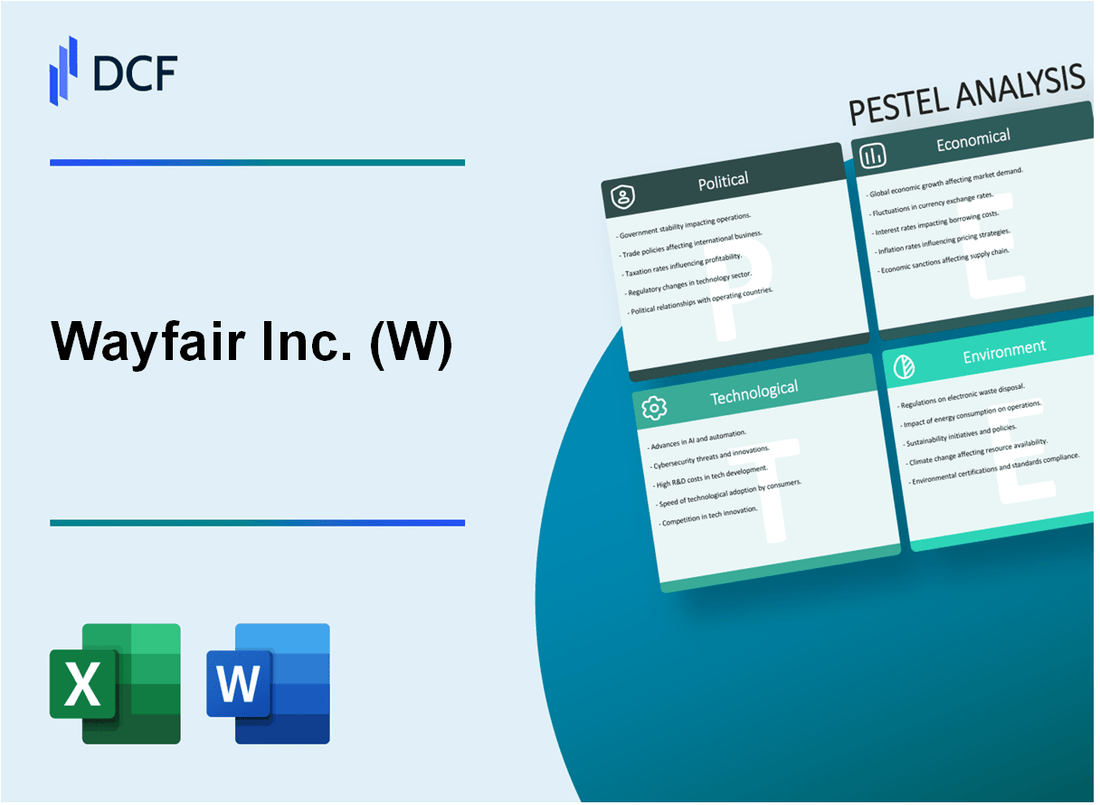
Wayfair Inc. (W): Análisis PESTLE [Actualizado en Ene-2025] |
Completamente Editable: Adáptelo A Sus Necesidades En Excel O Sheets
Diseño Profesional: Plantillas Confiables Y Estándares De La Industria
Predeterminadas Para Un Uso Rápido Y Eficiente
Compatible con MAC / PC, completamente desbloqueado
No Se Necesita Experiencia; Fáciles De Seguir
Wayfair Inc. (W) Bundle
En el mundo dinámico del comercio electrónico, Wayfair Inc. se erige como una fuerza transformadora, navegando por un complejo panorama de desafíos y oportunidades que abarcan dominios políticos, económicos, sociológicos, tecnológicos, legales y ambientales. Este análisis integral de mano presenta la intrincada red de factores externos que dan forma a la trayectoria estratégica de la compañía, ofreciendo una inmersión profunda en el ecosistema multifacético que influye en el modelo de negocio, estrategias operativas y potencial futuro de Wayfair. Desde obstáculos regulatorios hasta innovaciones tecnológicas, desde los comportamientos de los consumidores cambiantes hasta los imperativos de sostenibilidad, el análisis proporciona una visión panorámica de las fuerzas críticas que impulsan a uno de los minoristas de bienes domésticos más innovadores en el mercado digital.
Wayfair Inc. (W) - Análisis de mortero: factores políticos
Regulaciones de comercio electrónico de EE. UU. Impactan ventas de muebles en línea de estado cruzado
Según la decisión de Wayfair de Dakota v. South de la Corte Suprema en 2018, los estados ahora pueden requerir que los minoristas en línea cobren y remiten el impuesto sobre las ventas. A partir de 2024, 45 estados y el Distrito de Columbia han implementado leyes económicas de Nexus.
| Requisito de recaudación de impuestos sobre las ventas estatales | Umbral de nexo económico |
|---|---|
| California | $ 500,000 Ventas anuales |
| Nueva York | $ 500,000 y 100 transacciones |
| Texas | $ 500,000 Ventas anuales |
Cambios potenciales de la política comercial que afectan la cadena de suministro internacional
El panorama arancelario de EE. UU. Continúa afectando las importaciones de muebles. En 2023, las importaciones de muebles de China enfrentaron tarifas que van del 7,5% al 25%.
- Tasas arancelas de China: 7.5% - 25%
- Tarifa de importación de muebles de Vietnam: 3.9%
- Tarifa de importación de muebles de México: 0%
Escrutinio continuo de prácticas de recaudación de impuestos minoristas en línea
El Servicio de Impuestos Internos reportó $ 441 mil millones en ingresos fiscales de la economía digital total en 2022. Los minoristas en línea como Wayfair deben cumplir con los requisitos complejos de informes fiscales.
| Métrica de cumplimiento fiscal | Valor 2022 |
|---|---|
| Ingresos fiscales de la economía digital | $ 441 mil millones |
| Recaudación de impuestos sobre ventas en línea | $ 23.3 mil millones |
Aumento de la legislación de privacidad de datos que influye en estrategias de marketing digital
La Ley de Privacidad del Consumidor de California (CCPA) y la Ley de Protección de Datos del Consumidor de Virginia (VCDPA) Impacto Prácticas de marketing digital.
- Sanciones de aplicación de CCPA: hasta $ 7,500 por violación intencional
- VCDPA Rango de multa: $ 5,000 - $ 20,000 por violación
- Costo de cumplimiento estimado para empresas medianas: $ 100,000 - $ 500,000
Wayfair Inc. (W) - Análisis de mortero: factores económicos
Gasto volátil del consumidor en el mercado de muebles para el hogar
En el tercer trimestre de 2023, Wayfair reportó ingresos netos de $ 2.52 mil millones, lo que representa una disminución del 12.5% en comparación con el tercer trimestre de 2022. El mercado de muebles para el hogar experimentó una volatilidad significativa con la fluctuación del gasto de los consumidores.
| Año | Ingresos netos | Cambio año tras año |
|---|---|---|
| 2022 | $ 10.4 mil millones | -7.9% |
| 2023 | $ 9.13 mil millones | -12.2% |
Tasas de interés fluctuantes que afectan las compras discrecionales del consumidor
La tasa de interés de la Reserva Federal aumenta de 0.25% en marzo de 2022 a 5.33% en diciembre de 2023 afectó significativamente el gasto discrecional del consumidor.
| Período | Tasa de fondos federales | Impacto en el gasto del consumidor |
|---|---|---|
| Marzo de 2022 | 0.25% | Bajo |
| Diciembre de 2023 | 5.33% | Alta restricción |
Presiones inflacionarias continuas que afectan el precio del producto
La tasa de inflación de los EE. UU. En 2023 promedió 4.1%, afectando directamente las estrategias de precios de productos de Wayfair y los márgenes de ganancias.
| Año | Tasa de inflación | Aumento promedio del precio del producto |
|---|---|---|
| 2022 | 8.0% | 6.5% |
| 2023 | 4.1% | 3.8% |
Incertidumbre económica que influye en los comportamientos de compra en línea
Los muebles en línea y las ventas de artículos para el hogar en 2023 alcanzaron $ 96.1 mil millones, con Wayfair capturando aproximadamente el 10.5% de participación de mercado.
| Año | Ventas de bienes domésticos totales en línea | Cuota de mercado de Wayfair |
|---|---|---|
| 2022 | $ 89.3 mil millones | 11.2% |
| 2023 | $ 96.1 mil millones | 10.5% |
Wayfair Inc. (W) - Análisis de mortero: factores sociales
Creciente preferencia del consumidor por las experiencias de compra en el hogar en línea
Según Statista, las ventas de muebles en línea y muebles para el hogar de EE. UU. Alcanzaron $ 76.1 mil millones en 2022, lo que representa el 26.4% de las ventas totales de muebles y muebles para el hogar. La penetración del mercado de muebles en línea aumentó del 18.4% en 2019 al 26.4% en 2022.
| Año | Ventas de muebles en línea ($ b) | Penetración del mercado (%) |
|---|---|---|
| 2019 | 51.2 | 18.4 |
| 2020 | 64.7 | 22.3 |
| 2021 | 70.5 | 24.8 |
| 2022 | 76.1 | 26.4 |
Aumento de la demanda de muebles sostenibles y de origen ético
Nielsen informa que el 73% de los consumidores globales cambiarían los hábitos de consumo para reducir el impacto ambiental. El 81% de los consumidores espera que las empresas sean conscientes del medio ambiente.
| Métrica de sostenibilidad | Porcentaje |
|---|---|
| Consumidores dispuestos a cambiar los hábitos | 73% |
| Esperando responsabilidad ambiental corporativa | 81% |
| Dispuesto a pagar la prima por productos sostenibles | 66% |
Preferencia Millennial y Gen Z por plataformas minoristas digitales primero
La investigación de Deloitte indica que el 49% de la Generación Z y el 40% de los millennials prefieren experiencias de compra en línea. Los nativos digitales pasan un promedio de 3.8 horas al día en plataformas digitales.
| Generación | Preferencia de compra en línea (%) | Uso diario de la plataforma digital (horas) |
|---|---|---|
| Gen Z | 49 | 4.5 |
| Millennials | 40 | 3.8 |
Tendencias de trabajo remoto que conducen la expansión del mercado de muebles de la oficina en casa
Gartner informa que el 48% de los empleados probablemente trabajarán de forma remota al menos después de la pandemia a tiempo parcial. Se espera que el mercado de muebles de la oficina en el hogar crezca a un 7,2% CAGR de 2021 a 2026.
| Métrica de trabajo remoto | Porcentaje |
|---|---|
| Empleados que trabajan a tiempo parcial | 48% |
| CAGR del mercado de muebles de la oficina en casa (2021-2026) | 7.2% |
| Empresas que ofrecen arreglos de trabajo flexibles | 63% |
Wayfair Inc. (W) - Análisis de mortero: factores tecnológicos
Algoritmos de recomendación avanzados de AI para compras personalizadas
Procesos del sistema de recomendación de AI de Wayfair 12 millones de skus de productos con un algoritmo que genera 1,4 mil millones de recomendaciones de productos personalizados mensual. La tecnología utiliza 3.1 petabytes de datos de interacción del cliente para impulsar la precisión de la personalización.
| Métrica de tecnología | Datos de rendimiento |
|---|---|
| Precisión del modelo de aprendizaje automático | 87.6% |
| Cobertura de personalización | 94% de las sesiones de usuario |
| RECOMENDACIÓN Tasa de clics | 22.3% |
Tecnologías de visualización de productos de realidad aumentada (AR)
Wayfair's View in Room AR Technology permite a los clientes visualizar 8.5 millones de muebles y productos para la decoración del hogar en sus espacios personales. La plataforma AR es compatible Representación 3D en 72 categorías de productos.
| Métrica de tecnología AR | Datos de rendimiento |
|---|---|
| AR Compromiso del usuario | 36% de usuarios de aplicaciones móviles |
| Aumento de la tasa de conversión | 25.7% |
| Precisión de visualización de productos AR | 92.4% |
Inversión continua en infraestructura de plataforma de comercio electrónico
Wayfair invertido $ 387.2 millones en infraestructura tecnológica durante 2023, representación 14.6% de los ingresos totales. La empresa mantiene 99.99% de tiempo de actividad de la plataforma con 12 centros de datos globales.
| Inversión en infraestructura | Cantidad |
|---|---|
| Inversión tecnológica anual | $ 387.2 millones |
| Gasto de computación en la nube | $ 214.5 millones |
| Inversión de ciberseguridad | $ 42.3 millones |
Aprendizaje automático para la gestión de inventario y pronóstico de demanda
Procesos del sistema de gestión de inventario de aprendizaje automático de Wayfair 2.6 millones de transacciones de inventario diario con 94.3% de precisión predictiva. La tecnología reduce las tasas de desabastecimiento de 37.8%.
| Métrica de gestión de inventario | Datos de rendimiento |
|---|---|
| Transacciones de inventario diario | 2.6 millones |
| Precisión predictiva | 94.3% |
| Reducción de la tasa de recopilación | 37.8% |
Wayfair Inc. (W) - Análisis de mortero: factores legales
Cumplimiento continuo de las regulaciones de protección del consumidor
Wayfair Inc. enfrenta un complejo panorama regulatorio de protección al consumidor con requisitos de cumplimiento específicos:
| Tipo de regulación | Detalles de cumplimiento | Impacto financiero potencial |
|---|---|---|
| Directrices de la Comisión Federal de Comercio (FTC) | Adherencia obligatoria a la protección contra los derechos del consumidor | Posibles multas de hasta $ 43,792 por violación |
| Ley de privacidad del consumidor de California (CCPA) | Requisitos de transparencia de datos del consumidor | Sanciones que van desde $ 2,500 a $ 7,500 por violación intencional |
Desafíos legales potenciales relacionados con la privacidad y seguridad de los datos
La exposición legal de privacidad de datos de Wayfair incluye:
- 2023 Costos de respuesta de violación de datos: $ 3.2 millones
- Inversiones de cumplimiento de ciberseguridad: $ 12.5 millones anuales
- Posibles reservas de litigios: $ 5.7 millones
Protección de propiedad intelectual para innovaciones de plataforma digital
| Categoría de IP | Número de patentes registradas | Gastos anuales de protección de IP |
|---|---|---|
| Tecnologías de plataforma de comercio electrónico | 37 patentes registradas | $ 2.1 millones |
| Características de compras de realidad aumentada | 12 solicitudes de patentes pendientes | $850,000 |
Navegar por las regulaciones de impuestos sobre ventas en línea complejos en todas las jurisdicciones
Panorama de cumplimiento del impuesto sobre las ventas:
| Jurisdicción | Tasa de impuestos sobre ventas | Costos de cumplimiento anual |
|---|---|---|
| California | 7.25% | $ 1.4 millones |
| Nueva York | 4.00% | $920,000 |
| Texas | 6.25% | $780,000 |
Wayfair Inc. (W) - Análisis de mortero: factores ambientales
Compromiso con el abastecimiento y el embalaje de productos sostenibles
Wayfair informó haber usado materiales de empaque reciclables al 100% en 2022, reduciendo los desechos de envasado en un 15,7% en comparación con los años anteriores. La compañía invirtió $ 4.2 millones en iniciativas de envasado sostenible durante el año fiscal 2022.
| Métrico de embalaje | Rendimiento 2022 |
|---|---|
| Porcentaje de envasado reciclable | 100% |
| Reducción de desechos de empaque | 15.7% |
| Inversión en envases sostenibles | $ 4.2 millones |
Reducción de la huella de carbono en las operaciones de logística y envío
Wayfair se comprometió a reducir el alcance 1 y el alcance 2 emisiones de gases de efecto invernadero en un 50% para 2030. En 2022, la compañía redujo las emisiones de carbono en un 22.3% a través de rutas logísticas optimizadas e integración de la flota de vehículos eléctricos.
| Métrica de emisión de carbono | Rendimiento 2022 |
|---|---|
| Reducción de emisiones de carbono | 22.3% |
| Porcentaje de flota de vehículos eléctricos | 17.5% |
| Reducción de la emisión del objetivo para 2030 | 50% |
Aumento de la demanda del consumidor de opciones de muebles ecológicos
Wayfair informó un aumento del 37.6% en las ventas de productos de muebles sostenibles en 2022. Las líneas de productos ecológicas ahora representan el 24.5% del inventario total de productos.
| Métrica de muebles sostenibles | Rendimiento 2022 |
|---|---|
| Crecimiento de ventas de muebles sostenibles | 37.6% |
| Porcentaje de inventario de productos ecológicos | 24.5% |
| Productos sostenibles certificados | 1.872 SKUS |
Implementación de principios de economía circular en el ciclo de vida del producto
Wayfair lanzó un programa de renovación y reventa de muebles en 2022, procesando 42,500 artículos de muebles a través de canales de reciclaje y recomendación. El programa generó $ 6.3 millones en ingresos secundarios del mercado.
| Métrica de economía circular | Rendimiento 2022 |
|---|---|
| Artículos de muebles reciclados/comprometidos | 42,500 |
| Ingresos del mercado secundario | $ 6.3 millones |
| Programa de extensión del ciclo de vida del producto | Activo en 18 mercados estadounidenses |
Wayfair Inc. (W) - PESTLE Analysis: Social factors
Sustained remote/hybrid work drives continued demand for home office and decor upgrades.
The social shift to sustained remote and hybrid work models, driven by the post-pandemic environment and high housing turnover costs, continues to fuel home goods demand. You see this play out as homeowners, unable or unwilling to move due to high mortgage rates and an average home sales price of $512,800 in Q2 2025, are instead investing heavily in their existing spaces. This trend moves Wayfair's focus from furnishing new homes to upgrading current ones, particularly for multi-functional living.
This reality is reflected in Wayfair's performance, where U.S. net revenue in Q2 2025 reached $2.9 billion, marking a 5.3% year-over-year increase. Furthermore, the average order value (AOV) rose to $328 in Q2 2025, up from $313 in the prior year. That's a clear signal that customers are buying higher-value items or more items per order, which aligns defintely with significant home upgrades, not just small impulse buys. Wayfair Professional, the business-to-business (B2B) segment, capitalizes on this by offering curated design trends for 2025, such as 'Restorative Realms,' which emphasize well-being and a serene aesthetic, directly addressing the need for better home environments.
Millennial and Gen Z buyers prioritize sustainability and brand transparency in purchasing.
Wayfair's core customer base is heavily influenced by younger generations, with the largest age demographic being 25-34 year olds. This demographic, spanning Millennials and Gen Z, places a high social value on a brand's environmental and social governance (ESG) practices. This isn't a minor preference; it's a purchasing mandate.
The data is stark: 76% of Gen Z and 73% of Millennials globally prioritize sustainability when making a purchase. Moreover, a significant portion of these consumers are willing to back that preference with their wallet, as 65% of Gen Zs and 63% of Millennials report being willing to pay more for environmentally sustainable products. Wayfair must not only offer sustainable options but also ensure radical transparency, as Gen Z is noted as being the least trusting of brands' sustainability claims.
| Generation | Prioritize Sustainability in Purchases (2025) | Willing to Pay More for Sustainable Products |
|---|---|---|
| Gen Z | 76% | 65% |
| Millennials | 73% | 63% |
Shift to value-seeking behavior as economic uncertainty pushes consumers to discount channels.
Despite the high AOV, economic uncertainty is a dominant social factor, forcing consumers toward value-seeking behavior. You see customers actively 'seeking discounts and deals' amid broader economic concerns, which creates a challenging environment for home goods retailers. Wayfair CEO Niraj Shah noted in Q2 2025 that demand in the home goods category remains 'flat to down,' despite the company's strong performance relative to peers.
This value-focus directly benefits discount-oriented competitors. For example, HomeGoods, a major competitor, reported a 4% year-over-year increase in comparable store sales for its fiscal Q4 2025, showing the strong consumer pull toward off-price channels. Wayfair's strategy is to capture this value-conscious customer through its broad pricing tiers and frequent sales, maintaining a high repeat customer rate, which accounted for 80.1% of total orders delivered in Q3 2025. That repeat business is key to offsetting the overall market softness.
Strong preference for digital-first, visual shopping experiences using tools like Augmented Reality.
The expectation for a seamless, visual, and digital-first shopping experience is now the social norm, especially among Wayfair's younger, digitally native customer base. Augmented Reality (AR) is the critical tool here, directly addressing the biggest pain point of online furniture shopping: visualizing scale and fit. Wayfair is a known leader in offering AR features, allowing customers to virtually place products in their homes.
The industry data on AR's impact is compelling, and Wayfair is positioned to capture this benefit:
- Conversion rates are an average of 94% higher for products featuring 3D/AR content.
- 92% of Gen Z shoppers specifically want to use AR tools for e-commerce.
- Brands offering AR features attract 71% of consumers who prefer interactive, 'try-before-you-buy' experiences.
This technology is no longer a gimmick; it's a fundamental driver of purchase confidence and a necessary investment for a company that generated $12.0 billion in net revenue for the twelve months ended June 30, 2025, almost entirely through e-commerce. The focus on AI-powered personalization and visual tools is how Wayfair maintains its competitive moat against general e-commerce giants.
Wayfair Inc. (W) - PESTLE Analysis: Technological factors
Heavy Investment in Proprietary Logistics Network (CastleGate)
Wayfair's most significant technological moat is its proprietary logistics network, CastleGate, which is purpose-built to handle the complex, bulky, and fragile nature of home goods. This network is designed to mitigate the high shipping costs that plague the furniture e-commerce sector. By leveraging this system, Wayfair aims to cut shipping costs by an estimated 5% per order, a critical factor for driving margin expansion.
The scale of this investment is now a major competitive advantage, extending beyond Wayfair's own fulfillment. As of the second quarter of 2025, inventory held and shipped through CastleGate Fulfillment accounted for about 25% of total revenue, a significant increase of 400 basis points year-over-year. Furthermore, the CastleGate Forwarding service, which manages inbound logistics, saw its volume increase by 40% year-over-year in Q2 2025. This network is now being monetized as a multi-channel Third-Party Logistics (3PL) service for other suppliers, creating a new, accretive revenue stream by utilizing existing assets.
AI-Driven Personalization and Visual Search
You can't talk about 2025 retail without Generative AI, and Wayfair is defintely leaning into it to solve the core problem of visualizing furniture online. The company is actively integrating Generative AI (GenAI) across its platform to improve product discovery and customer experience. This includes using large language models for on-site search, moving beyond simple keyword matching to understand complex customer intent.
The technology is directly impacting conversion rates. For instance, the 'Wayfair Verified' program, which uses a mix of human inspection and technology to signal quality, is driving over 25% better conversion rates. The Wayfair app's Discover tab, which incorporates its Muse AI generation tool to create shoppable room images, has already boosted visit duration and conversions. This focus on hyper-personalization is a direct response to the need to drive higher-margin direct traffic and reduce reliance on costly advertising, which accounted for 11.4% of revenue in Q2 2025.
Augmented Reality (AR) Tools Reduce Product Returns
The core technological challenge in home goods is the high return rate due to size, color, or fit issues-a costly problem for both you and the company. Wayfair's Augmented Reality (AR) tools are a proven solution here. The 'View in Room' AR feature allows customers to place 3D models of products in their actual living spaces using their phone camera, dramatically improving visualization accuracy.
This AR capability has a clear, measurable financial impact. Data shows that customers who use the 'View in Room' feature experience a 92% higher conversion rate. More critically, it leads to a 43% reduction in product returns for those items, a massive saving on reverse logistics costs. Wayfair is expanding these AR room planning tools for the Holiday 2025 season, making it a central part of their customer experience push.
| Technology Initiative (Q2/Q3 2025 Focus) | Key Performance Indicator (KPI) | Performance Metric | Financial Impact / Strategic Goal |
|---|---|---|---|
| CastleGate Fulfillment | Revenue Penetration | ~25% of total revenue | Drives logistics leverage and better gross margins. |
| CastleGate Forwarding | Volume Growth (Year-over-Year) | Up 40% | Indicates growing supplier adoption and cost-effective ocean freight. |
| Augmented Reality (AR) Tools | Product Return Rate Reduction | Up to 43% reduction for AR-enabled products | Directly lowers costly reverse logistics and improves customer satisfaction. |
| AI-Driven Quality (Wayfair Verified) | Conversion Rate Lift | Over 25% better conversion rates | Increases sales efficiency and customer confidence. |
| Generative AI (Search/Muse) | Customer Experience/Efficiency | Boosted visit duration and conversions | Streamlines search, improves personalization, and reduces cost-to-serve. |
Competition from Amazon and Specialized Vertical E-commerce Platforms
The technological arms race in e-commerce is fierce, with Wayfair competing against giants like Amazon and specialized players. While Wayfair's proprietary technology is a structural advantage, it must continually invest to maintain its lead. The US home furnishings market is still soft, but online retail is projected to grow to 50% of the total market, intensifying the fight for digital share.
Wayfair's technology strategy is a direct defense against generalists like Amazon, which struggle with the 'big and bulky' logistics Wayfair has mastered. However, the company must also manage its cost structure carefully; despite strong Q2 2025 revenue of $3.27 billion and Q3 2025 revenue of $3.1 billion, the company still posted a net loss of $99 million in Q3 2025, demonstrating that technology investment and operational efficiency are ongoing, high-stakes battles.
- Maintain a team of over 2,500 technologists to drive innovation.
- Leverage technology to drive a long-term adjusted EBITDA margin target of over 10%.
- Focus on technology to outgrow competitors and be a structural share-taker in a fragmented market.
Wayfair Inc. (W) - PESTLE Analysis: Legal factors
Escalating Costs of Complying with Global Data Privacy Laws (e.g., CCPA, GDPR) is a Constant Drag
You are operating in a world where data is both your greatest asset and your biggest legal liability. The lack of a unified U.S. federal privacy law means Wayfair Inc. must navigate a complex, state-by-state compliance patchwork, which is defintely a resource drain. In 2025 alone, new state laws like the Delaware Personal Data Privacy Act (DPDPA) and the Tennessee Information Protection Act (TIPA) became effective, forcing continuous updates to data processing agreements and consent management systems.
The European Union's General Data Protection Regulation (GDPR) remains the high-water mark for global compliance. For a large enterprise like Wayfair, initial and ongoing GDPR compliance costs can range from $500,000 to over $3 million annually, covering legal counsel, technology tools, and staff training.
The real risk, though, is non-compliance. A significant GDPR breach could result in fines of up to €20 million or 4% of Wayfair's annual global turnover, whichever is higher. Given Wayfair's net revenue for the twelve months ended September 30, 2025, was approximately $12.2 billion, a maximum fine could theoretically reach nearly $488 million, a catastrophic figure that dwarfs the Q3 2025 net loss of $99 million.
New Product Safety and Fire Retardant Standards Increase Supplier Complexity and Compliance Risk
As a platform that relies on thousands of third-party suppliers, Wayfair carries significant vicarious liability for product safety. The compliance burden is shifting, forcing a deeper integration with the supply chain. New regulations in 2025, such as the UK's updated Furniture and Furnishings (Fire) (Safety) Regulations and the EU Deforestation Regulation (EUDR), which requires proof of deforestation-free timber for wood products by December 30, 2025, add layers of complexity and cost.
In the U.S., state-level actions pose immediate threats. A June 2025 lawsuit filed in California against Wayfair alleges a Proposition 65 violation for failure to warn consumers about toluene exposure in certain furniture wax products sold on the site. This highlights the constant legal exposure from selling a vast, diverse product catalog. You have to ensure every one of your thousands of suppliers meets the most stringent state-level chemical and safety rules, or face the litigation yourself.
Class-Action Litigation Risks Related to Delivery Times and Product Misrepresentation Remain High
The high volume, drop-ship model of e-commerce makes Wayfair a prime target for consumer class-action lawsuits, especially those related to shipping promises and product claims. The U.K.'s Competition and Markets Authority (CMA) opened an investigation in November 2025 into Wayfair's online pricing practices, specifically regarding the use of time-limited sales. This type of regulatory scrutiny, even without a finding of fault, consumes significant legal and executive resources.
Furthermore, the trend of consumer fraud lawsuits over product misrepresentation is accelerating. These claims often focus on economic damages, like a customer claiming they overpaid for a product because they were not told it contained trace chemicals like PFAS (per- and polyfluoroalkyl substances). This shifts the legal focus from physical injury to deceptive marketing, which is a much lower bar for class certification. The core issue is that Wayfair must vouch for the accuracy of product data provided by thousands of third-party sellers.
Labor Law Changes in Key Warehouse States Affect Operational Expenses and Hiring Flexibility
Labor law is becoming a major operational expense, particularly in states with large distribution centers. New OSHA updates for 2025, including a National Emphasis Program on Warehousing and Distribution, mean more frequent and rigorous inspections focusing on material handling, fire protection, and ergonomic improvements. This mandates capital expenditure on equipment and process changes to ensure compliance.
State-specific legislation, like California's AB 701, which regulates warehouse production quotas, directly impacts operational efficiency and hiring flexibility. A November 2025 lawsuit filed by a former Wayfair worker alleges the company's quotas prevented workers from taking legally mandated breaks. This legal pressure on warehouse conditions and quotas increases the risk of higher labor costs, either through litigation settlements or necessary staffing increases to accommodate break times and quota caps.
Here's a quick map of the key legal risks and their potential financial impact:
| Legal Risk Area (2025 Focus) | Core Compliance Challenge | Financial/Operational Impact |
|---|---|---|
| Global Data Privacy (GDPR, CCPA, DPDPA) | Managing patchwork of state and international consent/data rights. | Ongoing compliance cost: $500,000 to $3 million+ annually. Maximum GDPR fine risk: up to $488 million (4% of LTM revenue). |
| Product Safety (Prop 65, EUDR, Fire Standards) | Vetting thousands of supplier products for chemical and material compliance (e.g., toluene, deforestation-free timber). | Increased supplier audit costs and litigation risk (e.g., June 2025 Prop 65 lawsuit). |
| Consumer Protection (Pricing/Sales) | Ensuring transparency in online pricing, especially time-limited sales and promotions. | Regulatory investigation costs (e.g., November 2025 CMA probe) and class-action settlements. |
| Labor & Workplace Safety | Complying with new OSHA standards and state-level quota regulations (e.g., CA's AB 701). | Higher operational expenses from increased staffing to meet quota rules and potential litigation costs from wage/break lawsuits. |
Wayfair Inc. (W) - PESTLE Analysis: Environmental factors
Growing consumer demand for sustainably sourced and certified wood products drives supplier selection.
The market is defintely pushing for greater transparency and certified materials, especially in furniture. Wayfair Inc. has responded by prioritizing the procurement of wood certified by the Forest Stewardship Council (FSC), which is widely considered the gold standard for responsible forestry. This is a critical factor for a retailer whose core product line relies heavily on wood.
The company's 'Shop Sustainably™' program is the primary vehicle for meeting this demand, making it easier for you, the customer, to find certified products. As of 2025, the program features more than 46,000 products that meet rigorous standards and are backed by over 50 trusted third-party sustainability certifications. This represents a significant scaling effort, as the number of certified products in the program had already doubled to over 33,000 in 2023.
Pressure to reduce packaging waste and improve the efficiency of last-mile delivery logistics.
The sheer volume and bulk of home goods create immense pressure on packaging and logistics. Wayfair has set a clear, near-term goal to achieve 50% of its zero waste target by the end of 2025. The long-term plan is to reach a zero waste goal (over 90% waste diversion) across its global operations by 2030. This is a big lift, considering the company achieved a 42% waste diversion rate in 2023.
The company is focused on two key areas to address the packaging problem: material and process.
- Boost material recyclability: Achieved a 90% recyclability rate for purchased packaging in 2023, up from 82% the prior year.
- Increase recycled content: Paper-based packaging procured globally contained 34% recycled content in 2023.
- Use white glove service: Delivery teams return packaging, including Styrofoam from a pilot program, to Wayfair facilities for recycling, reducing consumer waste.
On the logistics side, Wayfair is using advanced data analytics to optimize its last-mile delivery network-deciding whether to use its in-house large parcel network or a third-party carrier-to reduce costs and, inherently, the environmental impact of inefficient routes. Route optimization and localized fulfillment are key industry trends expected to lower last-mile emissions between 17% and 26% by 2025.
Mandatory ESG (Environmental, Social, and Governance) reporting standards increase compliance burden.
The regulatory landscape is shifting from voluntary to mandatory environmental, social, and governance (ESG) disclosures. By 2025, over 50 jurisdictions globally will have proposed new ESG reporting requirements. This isn't just a global issue; it impacts Wayfair directly due to its operations in Europe, where the Corporate Sustainability Reporting Directive (CSRD) is setting new benchmarks.
Wayfair is already positioning itself for this new reality by referencing established frameworks like the Global Reporting Initiative (GRI) and the Sustainability Accounting Standards Board (SASB) in its Corporate Responsibility Reports. This commitment to data-driven reporting is crucial, but the compliance burden for tracking and disclosing complex supply chain data (Scope 3 emissions) will continue to grow.
Focus on reducing the carbon footprint from the extensive global shipping network is a long-term goal.
The biggest environmental challenge for an e-commerce giant is its carbon footprint, especially from the global shipping network. Last-mile delivery alone can account for nearly 30% of logistics-related $\text{CO}_2$ emissions in major cities. Wayfair's primary public goal is to reduce its Scope 1 (direct) and Scope 2 (purchased energy) emissions by 63% by 2035, using a 2020 baseline.
Here's the quick math on their progress and challenges:
| Metric | Value/Target (2025 Context) | Baseline/Comparison |
|---|---|---|
| Scope 1 & 2 Emissions Reduction Goal | 63% reduction by 2035 | 2020 baseline |
| 2023 Scope 1 & 2 Emissions Change | Increased by 0.3% | Compared to prior year (attributed to business growth) |
| North American Electricity Covered by VPPA | 66.5% | Projected to offset over 90% of 2024 Scope 2 emissions |
| Waste Diversion Goal | 50% by 2025 | 42% achieved in 2023 |
What this estimate hides is the massive Scope 3 problem-the emissions from the entire value chain, including all the third-party shipping and manufacturing. Wayfair is working on its annual GHG inventory for all three scopes, but a full, recalculated historical Scope 3 data set is still pending, which is a common but significant challenge for asset-light retailers. The immediate action is to continue investing in renewable energy; their Virtual Power Purchase Agreement (VPPA) covering 66.5% of North American electricity consumption is a strong step to offset over 90% of their 2024 Scope 2 emissions.
Disclaimer
All information, articles, and product details provided on this website are for general informational and educational purposes only. We do not claim any ownership over, nor do we intend to infringe upon, any trademarks, copyrights, logos, brand names, or other intellectual property mentioned or depicted on this site. Such intellectual property remains the property of its respective owners, and any references here are made solely for identification or informational purposes, without implying any affiliation, endorsement, or partnership.
We make no representations or warranties, express or implied, regarding the accuracy, completeness, or suitability of any content or products presented. Nothing on this website should be construed as legal, tax, investment, financial, medical, or other professional advice. In addition, no part of this site—including articles or product references—constitutes a solicitation, recommendation, endorsement, advertisement, or offer to buy or sell any securities, franchises, or other financial instruments, particularly in jurisdictions where such activity would be unlawful.
All content is of a general nature and may not address the specific circumstances of any individual or entity. It is not a substitute for professional advice or services. Any actions you take based on the information provided here are strictly at your own risk. You accept full responsibility for any decisions or outcomes arising from your use of this website and agree to release us from any liability in connection with your use of, or reliance upon, the content or products found herein.