

|
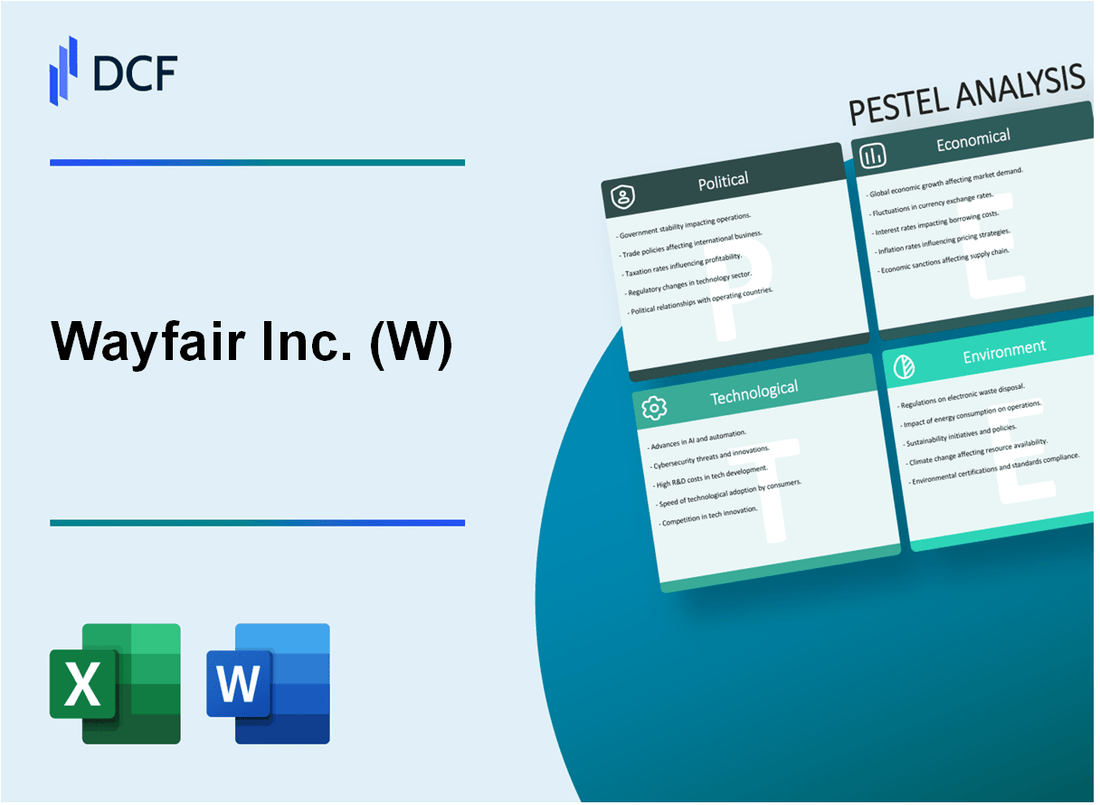
Wayfair Inc. (W): Analyse du Pestle [Jan-2025 Mise à jour] |
Entièrement Modifiable: Adapté À Vos Besoins Dans Excel Ou Sheets
Conception Professionnelle: Modèles Fiables Et Conformes Aux Normes Du Secteur
Pré-Construits Pour Une Utilisation Rapide Et Efficace
Compatible MAC/PC, entièrement débloqué
Aucune Expertise N'Est Requise; Facile À Suivre
Wayfair Inc. (W) Bundle
Dans le monde dynamique du commerce électronique, Wayfair Inc. est une force transformatrice, naviguant dans un paysage complexe de défis et d'opportunités qui s'étendent sur les domaines politiques, économiques, sociologiques, technologiques, juridiques et environnementaux. Cette analyse complète du pilon dévoile le réseau complexe de facteurs externes façonnant la trajectoire stratégique de l'entreprise, offrant une plongée profonde dans l'écosystème multiforme qui influence le modèle commercial de Wayfair, les stratégies opérationnelles et le potentiel futur. Des obstacles réglementaires aux innovations technologiques, du changement de comportement des consommateurs aux impératifs de durabilité, l'analyse offre une vue panoramique des forces critiques à l'origine de l'un des détaillants de produits de maison en ligne les plus innovants du marché numérique.
Wayfair Inc. (W) - Analyse du pilon: facteurs politiques
Règlement sur le commerce électronique américain Impact Cross-State en ligne Ventes de meubles en ligne
Selon la décision de la Cour suprême de la Cour suprême c. Wayfair en 2018, les États peuvent désormais exiger que les détaillants en ligne permettent et remettent la taxe de vente. En 2024, 45 États et le district de Columbia ont mis en œuvre les lois sur le lien économique.
| Exigence de recouvrement de taxe de vente de l'État | Seuil de lien économique |
|---|---|
| Californie | Ventes annuelles de 500 000 $ |
| New York | Transactions de 500 000 $ et 100 $ |
| Texas | Ventes annuelles de 500 000 $ |
Changements de politique commerciale potentielles affectant la chaîne d'approvisionnement internationale
Le paysage tarifaire américain continue d'avoir un impact sur les importations de meubles. En 2023, les importations de meubles en provenance de tarifs sont confrontés à des tarifs allant de 7,5% à 25%.
- Tarifs tarifaires en Chine: 7,5% - 25%
- Tarif d'importation de meubles Vietnam: 3,9%
- Tarif d'importation de meubles mexiciens: 0%
Examen continu des pratiques de recouvrement de taxes de détail en ligne
L'Internal Revenue Service a déclaré 441 milliards de dollars de recettes fiscales totales en économie numérique en 2022. Les détaillants en ligne comme Wayfair doivent se conformer aux exigences de rapports fiscaux complexes.
| Métrique de la conformité fiscale | Valeur 2022 |
|---|---|
| Revenus fiscaux de l'économie numérique | 441 milliards de dollars |
| Collection de taxe de vente en ligne | 23,3 milliards de dollars |
Augmentation de la législation sur la confidentialité des données influençant les stratégies de marketing numérique
La California Consumer Privacy Act (CCPA) et la Virginia Consumer Data Protection Act (VCDPA) ont un impact sur les pratiques de marketing numérique.
- Pennalités d'application de la loi de l'ACC: jusqu'à 7 500 $ par violation intentionnelle
- VCDPA Fine Range: 5 000 $ - 20 000 $ par violation
- Coût de conformité estimé pour les entreprises de taille moyenne: 100 000 $ - 500 000 $
Wayfair Inc. (W) - Analyse du pilon: facteurs économiques
Dépenses de consommation volatiles sur le marché de l'ameublement domestique
Au troisième trimestre 2023, Wayfair a déclaré un chiffre d'affaires net de 2,52 milliards de dollars, ce qui représente une baisse de 12,5% par rapport au troisième trimestre 2022. Le marché des meubles de la maison a connu une volatilité significative avec les dépenses de consommation fluctuantes.
| Année | Revenus nets | Changement d'une année à l'autre |
|---|---|---|
| 2022 | 10,4 milliards de dollars | -7.9% |
| 2023 | 9,13 milliards de dollars | -12.2% |
Fluctuation des taux d'intérêt affectant les achats discrétionnaires des consommateurs
Le taux d'intérêt de la Réserve fédérale augmente de 0,25% en mars 2022 à 5,33% en décembre 2023 a eu un impact significatif sur les dépenses discrétionnaires des consommateurs.
| Période | Taux de fonds fédéraux | Impact sur les dépenses de consommation |
|---|---|---|
| Mars 2022 | 0.25% | Faible |
| Décembre 2023 | 5.33% | Restriction élevée |
Des pressions inflationnistes en cours impactant la tarification des produits
Le taux d'inflation américain en 2023 était en moyenne de 4,1%, affectant directement les stratégies de tarification des produits de Wayfair et les marges bénéficiaires.
| Année | Taux d'inflation | Augmentation moyenne des prix du produit |
|---|---|---|
| 2022 | 8.0% | 6.5% |
| 2023 | 4.1% | 3.8% |
Incertitude économique influençant les comportements d'achat en ligne
Les meubles en ligne et les ventes de produits à domicile en 2023 ont atteint 96,1 milliards de dollars, avec Wayfair capturant environ 10,5% de part de marché.
| Année | Ventes de marchandises à domicile en ligne totale | Part de marché Wayfair |
|---|---|---|
| 2022 | 89,3 milliards de dollars | 11.2% |
| 2023 | 96,1 milliards de dollars | 10.5% |
Wayfair Inc. (W) - Analyse du pilon: facteurs sociaux
Préférence croissante des consommateurs pour les expériences d'achat à domicile en ligne
Selon Statista, les ventes de meubles en ligne et de mobilier en ligne américaines ont atteint 76,1 milliards de dollars en 2022, ce qui représente 26,4% du total des ventes de meubles et d'ameublement. La pénétration du marché des meubles en ligne est passée de 18,4% en 2019 à 26,4% en 2022.
| Année | Ventes de meubles en ligne ($ b) | Pénétration du marché (%) |
|---|---|---|
| 2019 | 51.2 | 18.4 |
| 2020 | 64.7 | 22.3 |
| 2021 | 70.5 | 24.8 |
| 2022 | 76.1 | 26.4 |
Demande croissante de meubles durables et d'origine éthique
Nielsen rapporte que 73% des consommateurs mondiaux modifieraient les habitudes de consommation pour réduire l'impact environnemental. 81% des consommateurs s'attendent à ce que les entreprises soient soucieuses de l'environnement.
| Métrique de la durabilité | Pourcentage |
|---|---|
| Les consommateurs sont prêts à changer les habitudes | 73% |
| Attendre la responsabilité environnementale des entreprises | 81% |
| Prêt à payer la prime pour les produits durables | 66% |
Millennial et Gen Z Préférence pour les plateformes de vente au détail numérique
Deloitte Research indique 49% de la génération Z et 40% des milléniaux préfèrent les expériences d'achat en ligne. Les indigènes numériques passent en moyenne 3,8 heures par jour sur les plateformes numériques.
| Génération | Préférence d'achat en ligne (%) | Utilisation quotidienne de la plate-forme numérique (heures) |
|---|---|---|
| Gen Z | 49 | 4.5 |
| Milléniaux | 40 | 3.8 |
Tendances de travail à distance entraînant une expansion du marché des meubles du bureau à domicile
Gartner rapporte que 48% des employés travailleront probablement à distance au moins à temps partiel post-pandémique. Le marché des meubles du bureau à domicile devrait augmenter à 7,2% de TCAC de 2021 à 2026.
| Métrique de travail à distance | Pourcentage |
|---|---|
| Les employés travaillant à distance à temps partiel | 48% |
| CAGR du marché des meubles du bureau à domicile (2021-2026) | 7.2% |
| Les entreprises offrant des dispositions de travail flexibles | 63% |
Wayfair Inc. (W) - Analyse du pilon: facteurs technologiques
Algorithmes de recommandation avancés à AI pour les achats personnalisés
Processus du système de recommandation de l'IA de Wayfair 12 millions de SKU de produits avec un algorithme qui génère 1,4 milliard de recommandations de produits personnalisés mensuel. La technologie utilise 3.1 Petaoctets de données d'interaction client pour stimuler la précision de la personnalisation.
| Métrique technologique | Données de performance |
|---|---|
| Précision du modèle d'apprentissage automatique | 87.6% |
| Couverture de personnalisation | 94% des séances utilisateur |
| Recommandation Taux de clics | 22.3% |
Réalité augmentée (AR) Technologies de visualisation des produits
La vue de Wayfair dans Room AR La technologie permet aux clients de visualiser 8,5 millions de meubles et de produits de décoration intérieure dans leurs espaces personnels. La plate-forme AR prend en charge Rendu 3D dans 72 catégories de produits.
| Métrique de la technologie AR | Données de performance |
|---|---|
| Engagement de l'utilisateur AR | 36% des utilisateurs d'applications mobiles |
| Augmentation du taux de conversion | 25.7% |
| Précision de visualisation du produit AR | 92.4% |
Investissement continu dans l'infrastructure de plate-forme de commerce électronique
Wayfair a investi 387,2 millions de dollars en infrastructure technologique en 2023, représentant 14,6% des revenus totaux. La société maintient 99,99% de disponibilité de la plate-forme avec 12 centres de données mondiaux.
| Investissement en infrastructure | Montant |
|---|---|
| Investissement technologique annuel | 387,2 millions de dollars |
| Dépenses de cloud computing | 214,5 millions de dollars |
| Investissement en cybersécurité | 42,3 millions de dollars |
Apprentissage automatique pour la gestion des stocks et les prévisions de la demande
Processus du système de gestion des stocks d'apprentissage automatique de Wayfair 2,6 millions de transactions d'inventaire quotidien avec 94,3% de précision prédictive. La technologie réduit les taux de stockage par 37.8%.
| Métrique de gestion des stocks | Données de performance |
|---|---|
| Transactions d'inventaire quotidien | 2,6 millions |
| Précision prédictive | 94.3% |
| Réduction du taux d'alimentation | 37.8% |
Wayfair Inc. (W) - Analyse du pilon: facteurs juridiques
Conformité continue aux réglementations de protection des consommateurs
Wayfair Inc. fait face à un paysage réglementaire complexe de protection des consommateurs avec des exigences de conformité spécifiques:
| Type de réglementation | Détails de la conformité | Impact financier potentiel |
|---|---|---|
| Lignes directrices de la Federal Trade Commission (FTC) | Adhésion obligatoire à la protection des droits des consommateurs | Amendes potentielles jusqu'à 43 792 $ par violation |
| California Consumer Privacy Act (CCPA) | Exigences de transparence des données des consommateurs | Des pénalités allant de 2 500 $ à 7 500 $ par violation intentionnelle |
Défis juridiques potentiels liés à la confidentialité et à la sécurité des données
L'exposition juridique de la confidentialité des données de Wayfair comprend:
- 2023 Coûts de réponse à la violation des données: 3,2 millions de dollars
- Investissements de conformité à la cybersécurité: 12,5 millions de dollars par an
- Réserves de litige potentiels: 5,7 millions de dollars
Protection de la propriété intellectuelle pour les innovations de plate-forme numérique
| Catégorie IP | Nombre de brevets enregistrés | Dépenses annuelles de protection IP |
|---|---|---|
| Technologies de plate-forme de commerce électronique | 37 brevets enregistrés | 2,1 millions de dollars |
| Caractéristiques d'achat de réalité augmentée | 12 demandes de brevet en instance | $850,000 |
Navigation de réglementation complexe des taxes de vente en ligne à travers les juridictions
Paysage de conformité de la taxe de vente:
| Juridiction | Taux de taxe de vente | Frais de conformité annuels |
|---|---|---|
| Californie | 7.25% | 1,4 million de dollars |
| New York | 4.00% | $920,000 |
| Texas | 6.25% | $780,000 |
Wayfair Inc. (W) - Analyse du pilon: facteurs environnementaux
Engagement envers l'approvisionnement et l'emballage des produits durables
Wayfair a déclaré utiliser des matériaux d'emballage 100% recyclables en 2022, réduisant les déchets d'emballage de 15,7% par rapport aux années précédentes. La société a investi 4,2 millions de dollars dans des initiatives d'emballage durables au cours de l'exercice 2022.
| Métrique d'emballage | 2022 Performance |
|---|---|
| Pourcentage d'emballage recyclable | 100% |
| Réduction des déchets d'emballage | 15.7% |
| Investissement dans un emballage durable | 4,2 millions de dollars |
Réduire l'empreinte carbone des opérations de logistique et d'expédition
Wayfair s'est engagé à réduire les émissions de gaz à effet de serre de la lunette 1 et de la portée
| Métrique d'émission de carbone | 2022 Performance |
|---|---|
| Réduction des émissions de carbone | 22.3% |
| Pourcentage de flotte de véhicules électriques | 17.5% |
| Réduction des émissions cibles d'ici 2030 | 50% |
Augmentation de la demande des consommateurs pour des options de meubles respectueuses de l'environnement
Wayfair a déclaré une augmentation de 37,6% des ventes de produits de meubles durables en 2022. Les gammes de produits écologiques représentent désormais 24,5% de l'inventaire total des produits.
| Métrique de meubles durables | 2022 Performance |
|---|---|
| Croissance des ventes de meubles durables | 37.6% |
| Pourcentage d'inventaire de produits respectueux de l'environnement | 24.5% |
| Produits certifiés durables | 1 872 SKUS |
Mise en œuvre des principes de l'économie circulaire dans le cycle de vie des produits
Wayfair a lancé un programme de rénovation et de revente de meubles en 2022, traitant 42 500 articles de meubles via des canaux de recyclage et de recommandation. Le programme a généré 6,3 millions de dollars de revenus du marché secondaire.
| Métrique de l'économie circulaire | 2022 Performance |
|---|---|
| Articles de meubles recyclés / recommandés | 42,500 |
| Revenus du marché secondaire | 6,3 millions de dollars |
| Programme d'extension du cycle de vie du produit | Actif sur 18 marchés américains |
Wayfair Inc. (W) - PESTLE Analysis: Social factors
Sustained remote/hybrid work drives continued demand for home office and decor upgrades.
The social shift to sustained remote and hybrid work models, driven by the post-pandemic environment and high housing turnover costs, continues to fuel home goods demand. You see this play out as homeowners, unable or unwilling to move due to high mortgage rates and an average home sales price of $512,800 in Q2 2025, are instead investing heavily in their existing spaces. This trend moves Wayfair's focus from furnishing new homes to upgrading current ones, particularly for multi-functional living.
This reality is reflected in Wayfair's performance, where U.S. net revenue in Q2 2025 reached $2.9 billion, marking a 5.3% year-over-year increase. Furthermore, the average order value (AOV) rose to $328 in Q2 2025, up from $313 in the prior year. That's a clear signal that customers are buying higher-value items or more items per order, which aligns defintely with significant home upgrades, not just small impulse buys. Wayfair Professional, the business-to-business (B2B) segment, capitalizes on this by offering curated design trends for 2025, such as 'Restorative Realms,' which emphasize well-being and a serene aesthetic, directly addressing the need for better home environments.
Millennial and Gen Z buyers prioritize sustainability and brand transparency in purchasing.
Wayfair's core customer base is heavily influenced by younger generations, with the largest age demographic being 25-34 year olds. This demographic, spanning Millennials and Gen Z, places a high social value on a brand's environmental and social governance (ESG) practices. This isn't a minor preference; it's a purchasing mandate.
The data is stark: 76% of Gen Z and 73% of Millennials globally prioritize sustainability when making a purchase. Moreover, a significant portion of these consumers are willing to back that preference with their wallet, as 65% of Gen Zs and 63% of Millennials report being willing to pay more for environmentally sustainable products. Wayfair must not only offer sustainable options but also ensure radical transparency, as Gen Z is noted as being the least trusting of brands' sustainability claims.
| Generation | Prioritize Sustainability in Purchases (2025) | Willing to Pay More for Sustainable Products |
|---|---|---|
| Gen Z | 76% | 65% |
| Millennials | 73% | 63% |
Shift to value-seeking behavior as economic uncertainty pushes consumers to discount channels.
Despite the high AOV, economic uncertainty is a dominant social factor, forcing consumers toward value-seeking behavior. You see customers actively 'seeking discounts and deals' amid broader economic concerns, which creates a challenging environment for home goods retailers. Wayfair CEO Niraj Shah noted in Q2 2025 that demand in the home goods category remains 'flat to down,' despite the company's strong performance relative to peers.
This value-focus directly benefits discount-oriented competitors. For example, HomeGoods, a major competitor, reported a 4% year-over-year increase in comparable store sales for its fiscal Q4 2025, showing the strong consumer pull toward off-price channels. Wayfair's strategy is to capture this value-conscious customer through its broad pricing tiers and frequent sales, maintaining a high repeat customer rate, which accounted for 80.1% of total orders delivered in Q3 2025. That repeat business is key to offsetting the overall market softness.
Strong preference for digital-first, visual shopping experiences using tools like Augmented Reality.
The expectation for a seamless, visual, and digital-first shopping experience is now the social norm, especially among Wayfair's younger, digitally native customer base. Augmented Reality (AR) is the critical tool here, directly addressing the biggest pain point of online furniture shopping: visualizing scale and fit. Wayfair is a known leader in offering AR features, allowing customers to virtually place products in their homes.
The industry data on AR's impact is compelling, and Wayfair is positioned to capture this benefit:
- Conversion rates are an average of 94% higher for products featuring 3D/AR content.
- 92% of Gen Z shoppers specifically want to use AR tools for e-commerce.
- Brands offering AR features attract 71% of consumers who prefer interactive, 'try-before-you-buy' experiences.
This technology is no longer a gimmick; it's a fundamental driver of purchase confidence and a necessary investment for a company that generated $12.0 billion in net revenue for the twelve months ended June 30, 2025, almost entirely through e-commerce. The focus on AI-powered personalization and visual tools is how Wayfair maintains its competitive moat against general e-commerce giants.
Wayfair Inc. (W) - PESTLE Analysis: Technological factors
Heavy Investment in Proprietary Logistics Network (CastleGate)
Wayfair's most significant technological moat is its proprietary logistics network, CastleGate, which is purpose-built to handle the complex, bulky, and fragile nature of home goods. This network is designed to mitigate the high shipping costs that plague the furniture e-commerce sector. By leveraging this system, Wayfair aims to cut shipping costs by an estimated 5% per order, a critical factor for driving margin expansion.
The scale of this investment is now a major competitive advantage, extending beyond Wayfair's own fulfillment. As of the second quarter of 2025, inventory held and shipped through CastleGate Fulfillment accounted for about 25% of total revenue, a significant increase of 400 basis points year-over-year. Furthermore, the CastleGate Forwarding service, which manages inbound logistics, saw its volume increase by 40% year-over-year in Q2 2025. This network is now being monetized as a multi-channel Third-Party Logistics (3PL) service for other suppliers, creating a new, accretive revenue stream by utilizing existing assets.
AI-Driven Personalization and Visual Search
You can't talk about 2025 retail without Generative AI, and Wayfair is defintely leaning into it to solve the core problem of visualizing furniture online. The company is actively integrating Generative AI (GenAI) across its platform to improve product discovery and customer experience. This includes using large language models for on-site search, moving beyond simple keyword matching to understand complex customer intent.
The technology is directly impacting conversion rates. For instance, the 'Wayfair Verified' program, which uses a mix of human inspection and technology to signal quality, is driving over 25% better conversion rates. The Wayfair app's Discover tab, which incorporates its Muse AI generation tool to create shoppable room images, has already boosted visit duration and conversions. This focus on hyper-personalization is a direct response to the need to drive higher-margin direct traffic and reduce reliance on costly advertising, which accounted for 11.4% of revenue in Q2 2025.
Augmented Reality (AR) Tools Reduce Product Returns
The core technological challenge in home goods is the high return rate due to size, color, or fit issues-a costly problem for both you and the company. Wayfair's Augmented Reality (AR) tools are a proven solution here. The 'View in Room' AR feature allows customers to place 3D models of products in their actual living spaces using their phone camera, dramatically improving visualization accuracy.
This AR capability has a clear, measurable financial impact. Data shows that customers who use the 'View in Room' feature experience a 92% higher conversion rate. More critically, it leads to a 43% reduction in product returns for those items, a massive saving on reverse logistics costs. Wayfair is expanding these AR room planning tools for the Holiday 2025 season, making it a central part of their customer experience push.
| Technology Initiative (Q2/Q3 2025 Focus) | Key Performance Indicator (KPI) | Performance Metric | Financial Impact / Strategic Goal |
|---|---|---|---|
| CastleGate Fulfillment | Revenue Penetration | ~25% of total revenue | Drives logistics leverage and better gross margins. |
| CastleGate Forwarding | Volume Growth (Year-over-Year) | Up 40% | Indicates growing supplier adoption and cost-effective ocean freight. |
| Augmented Reality (AR) Tools | Product Return Rate Reduction | Up to 43% reduction for AR-enabled products | Directly lowers costly reverse logistics and improves customer satisfaction. |
| AI-Driven Quality (Wayfair Verified) | Conversion Rate Lift | Over 25% better conversion rates | Increases sales efficiency and customer confidence. |
| Generative AI (Search/Muse) | Customer Experience/Efficiency | Boosted visit duration and conversions | Streamlines search, improves personalization, and reduces cost-to-serve. |
Competition from Amazon and Specialized Vertical E-commerce Platforms
The technological arms race in e-commerce is fierce, with Wayfair competing against giants like Amazon and specialized players. While Wayfair's proprietary technology is a structural advantage, it must continually invest to maintain its lead. The US home furnishings market is still soft, but online retail is projected to grow to 50% of the total market, intensifying the fight for digital share.
Wayfair's technology strategy is a direct defense against generalists like Amazon, which struggle with the 'big and bulky' logistics Wayfair has mastered. However, the company must also manage its cost structure carefully; despite strong Q2 2025 revenue of $3.27 billion and Q3 2025 revenue of $3.1 billion, the company still posted a net loss of $99 million in Q3 2025, demonstrating that technology investment and operational efficiency are ongoing, high-stakes battles.
- Maintain a team of over 2,500 technologists to drive innovation.
- Leverage technology to drive a long-term adjusted EBITDA margin target of over 10%.
- Focus on technology to outgrow competitors and be a structural share-taker in a fragmented market.
Wayfair Inc. (W) - PESTLE Analysis: Legal factors
Escalating Costs of Complying with Global Data Privacy Laws (e.g., CCPA, GDPR) is a Constant Drag
You are operating in a world where data is both your greatest asset and your biggest legal liability. The lack of a unified U.S. federal privacy law means Wayfair Inc. must navigate a complex, state-by-state compliance patchwork, which is defintely a resource drain. In 2025 alone, new state laws like the Delaware Personal Data Privacy Act (DPDPA) and the Tennessee Information Protection Act (TIPA) became effective, forcing continuous updates to data processing agreements and consent management systems.
The European Union's General Data Protection Regulation (GDPR) remains the high-water mark for global compliance. For a large enterprise like Wayfair, initial and ongoing GDPR compliance costs can range from $500,000 to over $3 million annually, covering legal counsel, technology tools, and staff training.
The real risk, though, is non-compliance. A significant GDPR breach could result in fines of up to €20 million or 4% of Wayfair's annual global turnover, whichever is higher. Given Wayfair's net revenue for the twelve months ended September 30, 2025, was approximately $12.2 billion, a maximum fine could theoretically reach nearly $488 million, a catastrophic figure that dwarfs the Q3 2025 net loss of $99 million.
New Product Safety and Fire Retardant Standards Increase Supplier Complexity and Compliance Risk
As a platform that relies on thousands of third-party suppliers, Wayfair carries significant vicarious liability for product safety. The compliance burden is shifting, forcing a deeper integration with the supply chain. New regulations in 2025, such as the UK's updated Furniture and Furnishings (Fire) (Safety) Regulations and the EU Deforestation Regulation (EUDR), which requires proof of deforestation-free timber for wood products by December 30, 2025, add layers of complexity and cost.
In the U.S., state-level actions pose immediate threats. A June 2025 lawsuit filed in California against Wayfair alleges a Proposition 65 violation for failure to warn consumers about toluene exposure in certain furniture wax products sold on the site. This highlights the constant legal exposure from selling a vast, diverse product catalog. You have to ensure every one of your thousands of suppliers meets the most stringent state-level chemical and safety rules, or face the litigation yourself.
Class-Action Litigation Risks Related to Delivery Times and Product Misrepresentation Remain High
The high volume, drop-ship model of e-commerce makes Wayfair a prime target for consumer class-action lawsuits, especially those related to shipping promises and product claims. The U.K.'s Competition and Markets Authority (CMA) opened an investigation in November 2025 into Wayfair's online pricing practices, specifically regarding the use of time-limited sales. This type of regulatory scrutiny, even without a finding of fault, consumes significant legal and executive resources.
Furthermore, the trend of consumer fraud lawsuits over product misrepresentation is accelerating. These claims often focus on economic damages, like a customer claiming they overpaid for a product because they were not told it contained trace chemicals like PFAS (per- and polyfluoroalkyl substances). This shifts the legal focus from physical injury to deceptive marketing, which is a much lower bar for class certification. The core issue is that Wayfair must vouch for the accuracy of product data provided by thousands of third-party sellers.
Labor Law Changes in Key Warehouse States Affect Operational Expenses and Hiring Flexibility
Labor law is becoming a major operational expense, particularly in states with large distribution centers. New OSHA updates for 2025, including a National Emphasis Program on Warehousing and Distribution, mean more frequent and rigorous inspections focusing on material handling, fire protection, and ergonomic improvements. This mandates capital expenditure on equipment and process changes to ensure compliance.
State-specific legislation, like California's AB 701, which regulates warehouse production quotas, directly impacts operational efficiency and hiring flexibility. A November 2025 lawsuit filed by a former Wayfair worker alleges the company's quotas prevented workers from taking legally mandated breaks. This legal pressure on warehouse conditions and quotas increases the risk of higher labor costs, either through litigation settlements or necessary staffing increases to accommodate break times and quota caps.
Here's a quick map of the key legal risks and their potential financial impact:
| Legal Risk Area (2025 Focus) | Core Compliance Challenge | Financial/Operational Impact |
|---|---|---|
| Global Data Privacy (GDPR, CCPA, DPDPA) | Managing patchwork of state and international consent/data rights. | Ongoing compliance cost: $500,000 to $3 million+ annually. Maximum GDPR fine risk: up to $488 million (4% of LTM revenue). |
| Product Safety (Prop 65, EUDR, Fire Standards) | Vetting thousands of supplier products for chemical and material compliance (e.g., toluene, deforestation-free timber). | Increased supplier audit costs and litigation risk (e.g., June 2025 Prop 65 lawsuit). |
| Consumer Protection (Pricing/Sales) | Ensuring transparency in online pricing, especially time-limited sales and promotions. | Regulatory investigation costs (e.g., November 2025 CMA probe) and class-action settlements. |
| Labor & Workplace Safety | Complying with new OSHA standards and state-level quota regulations (e.g., CA's AB 701). | Higher operational expenses from increased staffing to meet quota rules and potential litigation costs from wage/break lawsuits. |
Wayfair Inc. (W) - PESTLE Analysis: Environmental factors
Growing consumer demand for sustainably sourced and certified wood products drives supplier selection.
The market is defintely pushing for greater transparency and certified materials, especially in furniture. Wayfair Inc. has responded by prioritizing the procurement of wood certified by the Forest Stewardship Council (FSC), which is widely considered the gold standard for responsible forestry. This is a critical factor for a retailer whose core product line relies heavily on wood.
The company's 'Shop Sustainably™' program is the primary vehicle for meeting this demand, making it easier for you, the customer, to find certified products. As of 2025, the program features more than 46,000 products that meet rigorous standards and are backed by over 50 trusted third-party sustainability certifications. This represents a significant scaling effort, as the number of certified products in the program had already doubled to over 33,000 in 2023.
Pressure to reduce packaging waste and improve the efficiency of last-mile delivery logistics.
The sheer volume and bulk of home goods create immense pressure on packaging and logistics. Wayfair has set a clear, near-term goal to achieve 50% of its zero waste target by the end of 2025. The long-term plan is to reach a zero waste goal (over 90% waste diversion) across its global operations by 2030. This is a big lift, considering the company achieved a 42% waste diversion rate in 2023.
The company is focused on two key areas to address the packaging problem: material and process.
- Boost material recyclability: Achieved a 90% recyclability rate for purchased packaging in 2023, up from 82% the prior year.
- Increase recycled content: Paper-based packaging procured globally contained 34% recycled content in 2023.
- Use white glove service: Delivery teams return packaging, including Styrofoam from a pilot program, to Wayfair facilities for recycling, reducing consumer waste.
On the logistics side, Wayfair is using advanced data analytics to optimize its last-mile delivery network-deciding whether to use its in-house large parcel network or a third-party carrier-to reduce costs and, inherently, the environmental impact of inefficient routes. Route optimization and localized fulfillment are key industry trends expected to lower last-mile emissions between 17% and 26% by 2025.
Mandatory ESG (Environmental, Social, and Governance) reporting standards increase compliance burden.
The regulatory landscape is shifting from voluntary to mandatory environmental, social, and governance (ESG) disclosures. By 2025, over 50 jurisdictions globally will have proposed new ESG reporting requirements. This isn't just a global issue; it impacts Wayfair directly due to its operations in Europe, where the Corporate Sustainability Reporting Directive (CSRD) is setting new benchmarks.
Wayfair is already positioning itself for this new reality by referencing established frameworks like the Global Reporting Initiative (GRI) and the Sustainability Accounting Standards Board (SASB) in its Corporate Responsibility Reports. This commitment to data-driven reporting is crucial, but the compliance burden for tracking and disclosing complex supply chain data (Scope 3 emissions) will continue to grow.
Focus on reducing the carbon footprint from the extensive global shipping network is a long-term goal.
The biggest environmental challenge for an e-commerce giant is its carbon footprint, especially from the global shipping network. Last-mile delivery alone can account for nearly 30% of logistics-related $\text{CO}_2$ emissions in major cities. Wayfair's primary public goal is to reduce its Scope 1 (direct) and Scope 2 (purchased energy) emissions by 63% by 2035, using a 2020 baseline.
Here's the quick math on their progress and challenges:
| Metric | Value/Target (2025 Context) | Baseline/Comparison |
|---|---|---|
| Scope 1 & 2 Emissions Reduction Goal | 63% reduction by 2035 | 2020 baseline |
| 2023 Scope 1 & 2 Emissions Change | Increased by 0.3% | Compared to prior year (attributed to business growth) |
| North American Electricity Covered by VPPA | 66.5% | Projected to offset over 90% of 2024 Scope 2 emissions |
| Waste Diversion Goal | 50% by 2025 | 42% achieved in 2023 |
What this estimate hides is the massive Scope 3 problem-the emissions from the entire value chain, including all the third-party shipping and manufacturing. Wayfair is working on its annual GHG inventory for all three scopes, but a full, recalculated historical Scope 3 data set is still pending, which is a common but significant challenge for asset-light retailers. The immediate action is to continue investing in renewable energy; their Virtual Power Purchase Agreement (VPPA) covering 66.5% of North American electricity consumption is a strong step to offset over 90% of their 2024 Scope 2 emissions.
Disclaimer
All information, articles, and product details provided on this website are for general informational and educational purposes only. We do not claim any ownership over, nor do we intend to infringe upon, any trademarks, copyrights, logos, brand names, or other intellectual property mentioned or depicted on this site. Such intellectual property remains the property of its respective owners, and any references here are made solely for identification or informational purposes, without implying any affiliation, endorsement, or partnership.
We make no representations or warranties, express or implied, regarding the accuracy, completeness, or suitability of any content or products presented. Nothing on this website should be construed as legal, tax, investment, financial, medical, or other professional advice. In addition, no part of this site—including articles or product references—constitutes a solicitation, recommendation, endorsement, advertisement, or offer to buy or sell any securities, franchises, or other financial instruments, particularly in jurisdictions where such activity would be unlawful.
All content is of a general nature and may not address the specific circumstances of any individual or entity. It is not a substitute for professional advice or services. Any actions you take based on the information provided here are strictly at your own risk. You accept full responsibility for any decisions or outcomes arising from your use of this website and agree to release us from any liability in connection with your use of, or reliance upon, the content or products found herein.