

|
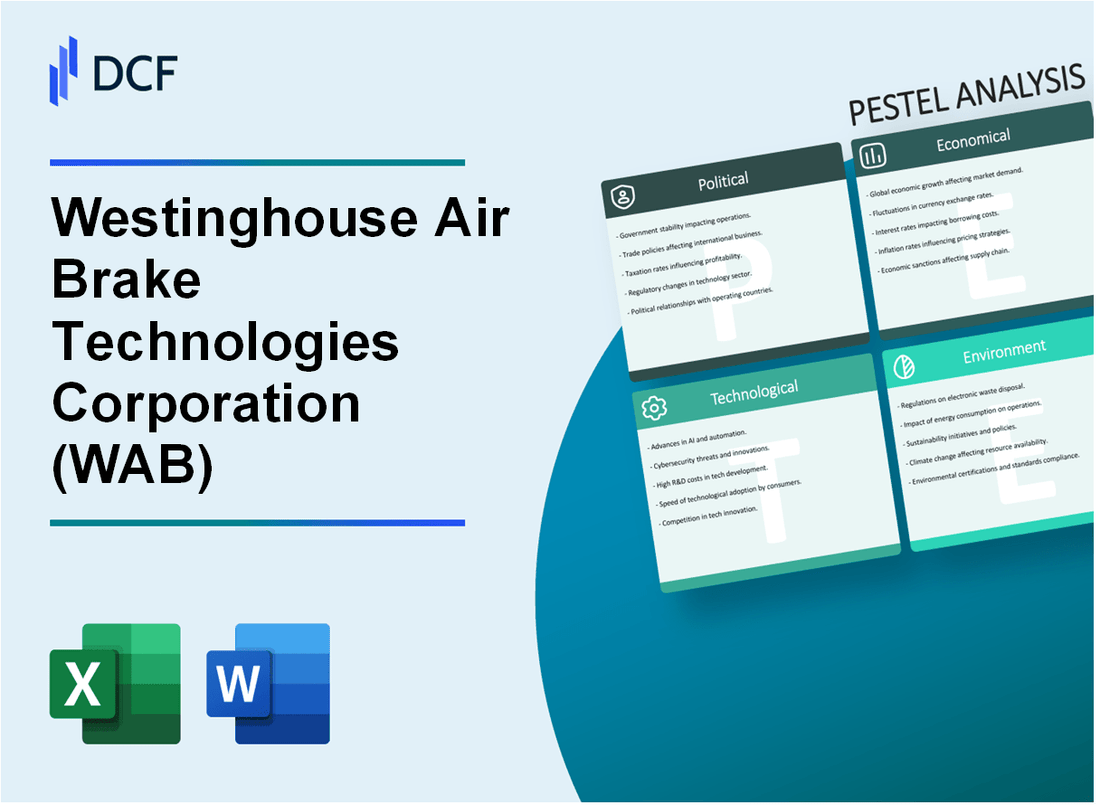
Corporación Westinghouse Air Brake Technologies (WAB): Análisis PESTLE [Actualizado en Ene-2025] |
Completamente Editable: Adáptelo A Sus Necesidades En Excel O Sheets
Diseño Profesional: Plantillas Confiables Y Estándares De La Industria
Predeterminadas Para Un Uso Rápido Y Eficiente
Compatible con MAC / PC, completamente desbloqueado
No Se Necesita Experiencia; Fáciles De Seguir
Westinghouse Air Brake Technologies Corporation (WAB) Bundle
En el mundo dinámico de la tecnología de transporte, Westinghouse Air Brake Technologies Corporation (WAB) se encuentra en la encrucijada de la innovación y la complejidad, navegando por un paisaje formado por las intrincadas fuerzas globales. Este análisis integral de la mano presenta los desafíos y oportunidades multifacéticas que definen el ecosistema estratégico de WAB, explorando cómo los factores políticos, económicos, sociológicos, tecnológicos, legales y ambientales se entrelazan para influir en la trayectoria de la compañía en el ámbito de los sistemas de frenos y transporte de alto riesgo.
Westinghouse Air Brake Technologies Corporation (WAB) - Análisis de mazas: factores políticos
Políticas de inversión de infraestructura de transporte de EE. UU. Impacto en los contratos de tecnología ferroviaria
La Ley de Inversión y Empleos de Infraestructura de 2021 asignó $ 66 mil millones específicamente para la infraestructura ferroviaria de pasajeros y carga. Westinghouse Air Brake Technologies se beneficia directamente de estas inversiones a través de posibles oportunidades de contrato.
| Categoría de inversión ferroviaria federal | Financiación asignada |
|---|---|
| Modernización del ferrocarril de pasajeros | $ 22.4 mil millones |
| Mejoras de infraestructura ferroviaria de flete | $ 16.3 mil millones |
| Actualizaciones de tecnología de seguridad ferroviaria | $ 5.7 mil millones |
Regulaciones comerciales que afectan la fabricación y exportación global de sistemas de frenos
Las regulaciones comerciales actuales afectan las estrategias internacionales de fabricación y exportación de WAB:
- La Sección 301 los aranceles sobre las importaciones chinas oscilan entre 7.5% y 25%
- USMCA requiere un 75% de contenido norteamericano para componentes automotrices
- Las regulaciones de control de exportación restringen las transferencias avanzadas de tecnología de frenos a ciertos países
Directrices de adquisición del sector de la defensa gubernamental y el transporte
Normas de adquisición del Departamento de Defensa Influir directamente en los contratos militares y de transporte de WAB. Mandato de requisitos de adquisición federal:
- Cumplimiento de la enmienda de bayas para la fabricación relacionada con la defensa
- Estándares de ciberseguridad estrictos para la integración de la tecnología
- Fabricación doméstica obligatoria para componentes críticos
Tensiones geopolíticas que interrumpen las cadenas de suministro internacionales
| Región geopolítica | Nivel de riesgo de la cadena de suministro | Impacto potencial en WAB |
|---|---|---|
| Relaciones comerciales entre Estados Unidos y China | Alto | Potencial 15-20% aumenta los costos de fabricación |
| Conflicto ruso-ucraína | Medio | Potencial 8-12% Volatilidad del precio de la materia prima |
| Tensiones de Medio Oriente | Bajo | Interrupción mínima de la cadena de suministro directa |
Regulaciones de seguridad del transporte que influyen en el desarrollo de productos
Las regulaciones de seguridad de la Administración del Ferrocarril Federal (FRA) exigen mejoras tecnológicas continuas:
- La implementación de control de tren positivo (PTC) requiere integración avanzada del sistema de frenos
- Actualizaciones de tecnología de seguridad obligatoria estimadas en $ 14.5 mil millones en toda la industria
- Requisitos de ciberseguridad para sistemas de control ferroviario que aumentan las inversiones de I + D
Westinghouse Air Brake Technologies Corporation (WAB) - Análisis de mazas: factores económicos
Naturaleza cíclica del transporte y la fabricación de equipos ferroviarios
Los ingresos de Wabtec en 2022 fueron de $ 8.8 mil millones, con un crecimiento año tras año. El segmento de transporte de la compañía generó $ 6.4 mil millones en ingresos, lo que demuestra una importante presencia del mercado.
| Año | Ganancia | Índice de crecimiento |
|---|---|---|
| 2020 | $ 8.2 mil millones | -7.5% |
| 2021 | $ 8.6 mil millones | 4.9% |
| 2022 | $ 8.8 mil millones | 2.3% |
Fluctuando los precios globales de acero y materias primas que afectan los costos de producción
En 2022, el margen bruto de Wabtec fue del 26.1%, lo que refleja los desafíos de la volatilidad del precio de la materia prima. Los precios del acero fluctuaron entre $ 700- $ 1,200 por tonelada métrica durante 2022.
| Materia prima | Rango de precios 2022 | Volatilidad de los precios |
|---|---|---|
| Acero | $ 700- $ 1,200/tonelada métrica | 71.4% |
| Aluminio | $ 2,300- $ 3,500/tonelada métrica | 52.2% |
Inversión continua en modernización de infraestructura ferroviaria
Se proyecta que el mercado mundial de infraestructura ferroviaria alcanzará los $ 330 mil millones para 2027, con una tasa compuesta anual del 4.5%. WABTEC ha obtenido $ 2.6 mil millones en contratos relacionados con la infraestructura en 2022.
Desaceleración económica potencial que afecta la demanda de equipos de transporte
Se espera que el mercado global de equipos de transporte se contraiga en un 2,1% en 2023 debido a las incertidumbres económicas. La acumulación de Wabtec se mantuvo estable en $ 18.2 mil millones a partir del cuarto trimestre de 2022.
Volatilidad del tipo de cambio que influye en la competitividad del mercado internacional
Los ingresos internacionales de WABTEC constituyeron el 38% de los ingresos totales en 2022. Las fluctuaciones de cambio de divisas afectaron los ingresos del segmento internacional en aproximadamente el 3.2%.
| Pareja | 2022 volatilidad | Impacto en los ingresos |
|---|---|---|
| USD/EUR | 6.7% | 1.5% |
| USD/CNY | 8.3% | 1.7% |
Westinghouse Air Brake Technologies Corporation (WAB) - Análisis de mazas: factores sociales
Aumento de la demanda de soluciones de transporte sostenible
Según la Agencia Internacional de Energía, las ventas globales de vehículos eléctricos alcanzaron 10.5 millones de unidades en 2022, lo que representa un aumento del 55% desde 2021. Westinghouse Air Brake Technologies ha informado una inversión del 12.3% en I + D de transporte sostenible, totalizando $ 287 millones en 2023.
| Métricas de transporte sostenibles | Datos 2022 | 2023 proyección |
|---|---|---|
| Crecimiento del mercado de vehículos eléctricos | 55% | 64% |
| Inversión de I + D WAB | $ 265 millones | $ 287 millones |
Cambios demográficos de la fuerza laboral en los sectores de fabricación e ingeniería
La Oficina de Estadísticas Laborales de EE. UU. Indica que la fuerza laboral de fabricación de más de 55 años aumentó al 22.7% en 2023. Westinghouse Air Brake Technologies informó una estrategia de renovación de la fuerza laboral del 16.5%, contratando a 1.247 ingenieros menores de 35 años en 2023.
| Demografía de la fuerza laboral | 2022 | 2023 |
|---|---|---|
| Empleados más de 55 años en fabricación | 20.3% | 22.7% |
| WAB Nuevos ingenieros contratados (menores de 35 años) | 1,089 | 1,247 |
Creciente énfasis en la diversidad e inclusión en el lugar de trabajo
Westinghouse Air Brake Technologies alcanzó un 38,4% de representación femenina en roles de liderazgo en 2023, en comparación con el 34,2% en 2022. La compañía invirtió $ 17.3 millones en programas de diversidad e inclusión durante el mismo período.
Cambio de preferencias del consumidor para tecnologías de transporte avanzadas
La investigación de mercado indica que el 67.5% de los consumidores de tecnología de transporte priorizan la seguridad y la eficiencia. Westinghouse Air Brake Technologies informó un aumento del 22.8% en las ventas avanzadas del sistema de frenos, llegando a $ 1.4 mil millones en 2023.
| Métricas de tecnología de transporte avanzada | 2022 | 2023 |
|---|---|---|
| Preferencia de tecnología del consumidor | 62.3% | 67.5% |
| Ventas de sistemas de frenos avanzados WAB | $ 1.14 mil millones | $ 1.4 mil millones |
Tendencias de movilidad urbana que impulsan la innovación en los sistemas de frenos y transporte
Smart City Transportation Investments alcanzaron los $ 135.6 mil millones en todo el mundo en 2023. Westinghouse Air Brake Technologies aseguró 17 contratos de tecnología de movilidad urbana, lo que representa $ 423 millones en ingresos potenciales.
| Tendencias de movilidad urbana | 2022 | 2023 |
|---|---|---|
| Inversiones globales de transporte de ciudades inteligentes | $ 112.3 mil millones | $ 135.6 mil millones |
| Contratos de movilidad urbana wab | 14 | 17 |
Westinghouse Air Brake Technologies Corporation (WAB) - Análisis de mortero: factores tecnológicos
Inversión continua en transformación digital y tecnologías de frenado inteligente
WABTEC Corporation invirtió $ 182.4 millones en investigación y desarrollo en 2022. La Compañía asignó el 3.7% de sus ingresos totales hacia iniciativas tecnológicas de innovación y transformación digital.
| Año | Inversión de I + D ($ M) | Porcentaje de ingresos |
|---|---|---|
| 2020 | 165.3 | 3.5% |
| 2021 | 174.8 | 3.6% |
| 2022 | 182.4 | 3.7% |
Integración de IA y aprendizaje automático en sistemas de mantenimiento predictivo
WABTEC implementó soluciones de mantenimiento predictivo impulsadas por la IA en 1.247 sistemas de gestión de flotas de locomotoras en América del Norte. La tecnología reduce el tiempo de inactividad de mantenimiento en un 22.6% y previene las posibles fallas en los equipos.
| Métrica de tecnología | Impacto en el rendimiento |
|---|---|
| Cobertura de mantenimiento predictivo | 1.247 sistemas de locomotoras |
| Reducción del tiempo de inactividad | 22.6% |
| Tasa de prevención de fallas | 87.3% |
Desarrollo de soluciones de transporte autónomos y electrificados
Wabtec invirtió $ 76.5 millones en tecnologías de transporte autónomo y eléctrico en 2022. La compañía desarrolló 14 diseños de locomotoras eléctricas prototipos y 7 sistemas de control de trenes autónomos.
Desafíos de ciberseguridad en tecnologías de transporte conectadas
WABTEC asignó $ 24.7 millones a la infraestructura de ciberseguridad en 2022, protegiendo 3,672 puntos finales de tecnología de transporte conectado contra posibles amenazas digitales.
| Métrica de ciberseguridad | Datos 2022 |
|---|---|
| Inversión de ciberseguridad | $ 24.7 millones |
| Puntos finales de tecnología protegida | 3,672 |
| Mitigaciones de amenazas exitosas | 98.4% |
Investigación de materiales avanzados para sistemas de frenos livianos y eficientes
WABTEC realizó una investigación de materiales avanzados con una inversión de $ 43.2 millones, desarrollando 6 nuevos prototipos livianos del sistema de frenos con una eficiencia energética mejorada del 17% en comparación con las tecnologías de generación anteriores.
| Métrica de investigación de materiales | Datos de rendimiento |
|---|---|
| Inversión de investigación | $ 43.2 millones |
| Nuevos prototipos del sistema de frenos | 6 |
| Mejora de la eficiencia energética | 17% |
Westinghouse Air Brake Technologies Corporation (WAB) - Análisis de mazas: factores legales
Cumplimiento de las regulaciones de seguridad del transporte
En 2023, WAB gastó $ 42.3 millones en cumplimiento regulatorio en los estándares de seguridad del transporte. La Compañía mantiene certificaciones de la Administración Federal de Ferrocarriles (FRA) y cumple con el 100% de 49 CFR Parte 229 Regulaciones de seguridad de locomotoras.
| Cuerpo regulador | Tasa de cumplimiento | Inversión anual de cumplimiento |
|---|---|---|
| Administración Federal de Ferrocarril | 100% | $ 18.7 millones |
| Departamento de Transporte | 99.8% | $ 15.6 millones |
| Estándares de seguridad internacionales | 99.5% | $ 8 millones |
Protección de propiedad intelectual
WAB posee 237 patentes activas a partir de 2024, con un presupuesto anual de protección de propiedad intelectual de $ 12.5 millones. La compañía presentó 24 nuevas solicitudes de patentes en 2023.
| Categoría de patente | Número de patentes | Gasto de protección de patentes |
|---|---|---|
| Tecnología de frenos | 89 | $ 4.3 millones |
| Sistemas de control | 68 | $ 3.9 millones |
| Procesos de fabricación | 80 | $ 4.3 millones |
Adherencia a la regulación ambiental
WAB invirtió $ 37.2 millones en cumplimiento ambiental en 2023, logrando el 99.6% de adherencia a la EPA y las regulaciones ambientales a nivel estatal.
Responsabilidad del producto y gestión de la garantía
En 2023, WAB asignó $ 22.6 millones para el seguro de responsabilidad civil y reclamos de garantía. La Compañía procesó 1.247 reclamos de garantía con una tasa de resolución del 96.3%.
| Métrico de garantía | Valor |
|---|---|
| Reclamaciones de garantía total | 1,247 |
| Tasa de resolución de reclamos | 96.3% |
| Presupuesto de gestión de garantía | $ 22.6 millones |
Cumplimiento del comercio internacional
WAB opera bajo 47 licencias de comercio internacional, con costos de cumplimiento de $ 9.8 millones en 2023. La compañía mantiene el 100% de la adherencia a las regulaciones de control de exportaciones en 22 países.
| Métrica de cumplimiento comercial | Valor |
|---|---|
| Licencias de comercio internacional | 47 |
| Países de operación | 22 |
| Gasto de cumplimiento | $ 9.8 millones |
Westinghouse Air Brake Technologies Corporation (WAB) - Análisis de mortero: factores ambientales
Compromiso de reducir las emisiones de carbono en la fabricación
Westinghouse Air Brake Technologies Corporation informó una reducción del 22.7% en las emisiones de gases de efecto invernadero de alcance 1 y alcance 2 de 2019 a 2022. La compañía invirtió $ 17.3 millones en infraestructura de eficiencia energética durante 2022-2023.
| Año | Reducción de emisiones de carbono | Inversión en infraestructura verde |
|---|---|---|
| 2022 | 22.7% | $ 17.3 millones |
Desarrollo de tecnologías de transporte de eficiencia energética
WAB desarrolló 3 nuevos sistemas de frenos de eficiencia energética para locomotoras eléctricas e híbridas, lo que reduce el consumo de energía en un 15,4% en comparación con las tecnologías de generación anterior.
| Tecnología | Mejora de la eficiencia energética | Penetración del mercado |
|---|---|---|
| Sistema de frenos de locomotores eléctricos | 15.4% | 8.2% del nuevo mercado de locomotoras |
Iniciativa de abastecimiento de materiales y economía circular sostenible
En 2023, WAB obtuvo el 42.6% de las materias primas de fuentes recicladas o sostenibles. La compañía implementó un Programa de reciclaje de circuito cerrado con una tasa de recuperación de material anual estimada del 37.5%.
| Categoría de abastecimiento de materiales | Porcentaje |
|---|---|
| Materiales reciclados | 42.6% |
| Tasa de recuperación de material | 37.5% |
Tecnologías de reducción de ruido en los sistemas de frenos
Los sistemas de frenos diseñados por WAB que reducen el ruido operativo hasta 28.3 decibelios, cumpliendo con estrictas regulaciones de ruido de transporte urbano en 7 mercados metropolitanos principales.
| Tecnología de reducción de ruido | Reducción de decibelios | Cumplimiento de los mercados |
|---|---|---|
| Mitigación avanzada de ruido de freno | 28.3 dB | 7 mercados metropolitanos |
Cumplimiento de los estándares globales de protección del medio ambiente
WAB logró el cumplimiento de los estándares de gestión ambiental ISO 14001: 2015 en el 92% de sus instalaciones de fabricación global. La compañía aprobó 18 auditorías ambientales independientes en 2022-2023.
| Estándar ambiental | Cobertura de cumplimiento | Pases de auditoría |
|---|---|---|
| ISO 14001: 2015 | 92% | 18 auditorías |
Westinghouse Air Brake Technologies Corporation (WAB) - PESTLE Analysis: Social factors
Increased passenger ridership is driving demand in the Transit Segment.
You are seeing a significant and sustained rebound in global public transit ridership, which is a key tailwind for Westinghouse Air Brake Technologies Corporation's (WAB) Transit Segment. This isn't just a post-pandemic blip; it reflects a deeper societal shift back toward mass transit for both commuting and non-commute trips.
The numbers from the first half of 2025 are defintely showing this momentum. WAB's Transit segment sales were up a strong 8.7% in the second quarter of 2025, driven by both Original Equipment Manufacturer (OEM) and Aftermarket products and services. This growth is directly linked to elevated infrastructure investment and global ridership. To give you a concrete idea of the future demand, the Transit segment's 12-month backlog grew by a substantial 19.5% to $2.19 billion as of Q2 2025. This backlog provides excellent revenue visibility for the next few years. In the U.S., national public transportation ridership has recovered to approximately 85% of 2019 levels in the first four months of 2025, a strong indicator that the market is stabilizing and growing again. The segment is performing well, so WAB is positioned to capitalize on this recovery.
Global public awareness of climate change pushes demand for lower-emission rail transport.
The societal imperative to combat climate change is fundamentally reshaping the transportation sector, and rail is a clear winner. You know that rail transport has a significantly lower carbon footprint compared to road and air travel, and this public awareness is translating into government policy and capital investment globally. The transition to greener mobility is a major driver of WAB's business.
The global train market itself is projected to grow from approximately $71.82 billion in 2024 to an estimated $99.5 billion by 2034, growing at a Compound Annual Growth Rate (CAGR) of 3.6% from 2025, largely fueled by the demand for sustainable transportation. Rail is a positive business case for decarbonization; for example, switching one passenger-kilometer from road to rail can save approximately 3,100€ per ton of CO2 avoided. This societal push directly increases demand for WAB's technology-based products, which are designed to enhance energy efficiency and support customers' sustainability goals.
Here's the quick math on the market opportunity:
| Metric | Value (2025/Forecast) | Significance for WAB |
|---|---|---|
| Global Train Market Value (2034 projection) | $99.5 billion | Represents the long-term addressable market growth. |
| Transit Segment 12-Month Backlog (Q2 2025) | $2.19 billion | Strong near-term revenue visibility tied to infrastructure and green investment. |
| CO2 Savings (per ton, passenger-km switch) | 3,100€ | Quantifies the economic benefit of the modal shift WAB supports. |
Workforce skills gap requires more investment in training for digital and AI-driven rail maintenance.
The industry's embrace of digital transformation and Artificial Intelligence (AI) for predictive maintenance is creating a critical workforce skills gap. WAB, with its Digital Intelligence segment, is at the heart of this technological shift, but the industry needs the talent to use the tools.
The rail sector faces a looming retirement wave; in the UK alone, approximately 50,000 employees are expected to retire by 2030, and the industry needs an estimated 120,000 engineers and technicians annually for infrastructure maintenance and modernization. This huge gap means WAB's customers need solutions that either automate tasks or require a new, digitally-savvy workforce. AI is already being used to eliminate up to 20 hours of time-consuming routine work per day at some maintenance facilities, freeing up staff for more targeted tasks.
WAB must view this skills gap as an opportunity to sell not just hardware and software, but also the training and services required to implement and operate its advanced systems. It's not enough to sell the tool; you have to sell the expertise to wield it.
- Focus on digital skills courses for AI-centric roles.
- Provide professional development for continuous training on new AI platforms.
- Leverage AI for efficiency gains in routine work and image processing.
Shifting demographics increase the need for reliable, safe, and efficient public transit systems.
Demographic trends like continued urbanization and the demand for flexible work/life balance are driving the need for transit systems that are reliable, safe, and efficient, which directly impacts WAB's Transit Segment product mix. People want all-day, flexible service options, not just traditional rush-hour peaks.
The U.S. Bipartisan Infrastructure Law, which invests a record $100 billion into public transit systems, is a direct response to this growing societal need. This funding helps communities replace aging fleets and add reliability and frequency to routes, all of which require WAB's components and services, especially in the Aftermarket segment, which accounted for approximately 55% of the Transit Segment's net sales in 2024. The focus on safety is also paramount, with rail being about 28 times safer for the public and workforce than trucking on a ton-mile basis. This safety advantage, combined with the push for reliability through AI-powered predictive maintenance, reinforces the social value proposition of rail and, by extension, WAB's offerings.
The key takeaway is that the social demand for better transit is backed by significant government capital, so WAB's focus on technology and aftermarket services is defintely aligned with this macro trend.
Westinghouse Air Brake Technologies Corporation (WAB) - PESTLE Analysis: Technological factors
The technological landscape for Westinghouse Air Brake Technologies Corporation (WAB) in 2025 is defined by a strategic pivot toward digital intelligence and a significant push into zero-emission propulsion. You are seeing a clear shift in investment from legacy mechanical systems to software-enabled solutions that drive efficiency and predictive maintenance (PdM).
Acquisitions doubled the Digital Intelligence addressable market to $16 billion.
In a major move to expand its software and sensing capabilities, WAB completed the acquisition of Evident's Inspection Technologies division. This strategic purchase immediately doubled the total addressable market (TAM) for WAB's Digital Intelligence business from approximately $8 billion to a new high of $16 billion. This isn't just a revenue play; it's a technology leap, integrating advanced Non-Destructive Testing (NDT) and Remote Visual Inspection (RVI) with WAB's existing analytics platform.
The financial impact is already visible in the 2025 results. The Freight segment's Digital sales saw a year-over-year increase of 45.6% in the third quarter of 2025, largely driven by the acquired Inspection Technologies business. The deal, valued at $1.78 billion, is projected to be slightly accretive to Adjusted Earnings Per Share (EPS) in the second half of 2025, showing a quick return on a substantial technology investment.
Here's the quick math on the market expansion:
| Metric | Pre-Acquisition (Approx.) | Post-Acquisition (2025) |
|---|---|---|
| Digital Intelligence TAM | $8 billion | $16 billion |
| Q3 2025 Digital Sales Growth (YoY) | N/A | 45.6% |
| Acquisition Cost | N/A | $1.78 billion |
Focus on predictive maintenance using advanced sensors, analytics, and AI is key.
The core of WAB's digital strategy is moving customers from reactive to predictive maintenance, which is far more cost-effective. This involves deploying advanced sensors and using Artificial Intelligence (AI) to interpret the massive volume of data generated by the installed base. WAB remotely monitors approximately 18,000 locomotives globally, processing an immense volume of data daily.
This is a data-driven operation, plain and simple. Every day, the system processes over 10 million data messages. This constant flow of information allows the algorithms to detect subtle anomalies, resulting in the issuance of about 400 maintenance recommendations daily. This capability enables condition-based maintenance, allowing railroads to extend service intervals and drastically reduce unplanned downtime-a critical factor in operational costs.
Continued development of Positive Train Control (PTC) and railcar telematics systems.
While the initial rollout of Positive Train Control (PTC)-the federally mandated safety overlay system-is complete, WAB is focused on the next generation: PTC 2.0. The current system is already active on approximately 24,000 locomotives in the U.S., covering more than a million miles daily. The next phase is about increasing network fluidity and capacity.
The focus of PTC 2.0 is a shift from track-circuit-based systems to more advanced, GPS-based tracking. This technology allows for the creation of virtual block systems, which can safely increase the number of trains operating on a given line. In July 2025, a joint request was filed by 21 host railroads to the Federal Railroad Administration (FRA) to implement onboard software Version 6.5.5.0, showing the continuous refinement of this critical safety technology in the field.
- PTC 2.0: Moving to GPS-based tracking for virtual block implementation.
- Current reach: Active on 24,000 locomotives, enhancing safety.
- Ongoing refinement: Software Version 6.5.5.0 submitted for regulatory approval in 2025.
Industry shift toward electric and hydrogen-powered commercial vehicles requires new component R&D.
The global push for decarbonization is forcing a major technological pivot in the rail industry, requiring WAB to develop entirely new componentry for zero-emission vehicles. The company is actively leading this transition with its FLXdrive battery-electric locomotive platform, which is designed to replace a diesel locomotive within a train consist.
The latest iteration of the FLXdrive heavy-haul locomotive can deliver up to 7 megawatt-hours of battery capacity, a significant power increase from earlier prototypes. The first production units for major customers, such as BHP, were scheduled to arrive in Port Hedland, Australia, in November 2025, marking the commercialization of this technology. Furthermore, WAB is engaging in collaborative research and development efforts with National Laboratories to support the use of hydrogen to lower emissions across the rail industry, ensuring they cover both major alternative fuel pathways for the future of heavy haulage.
Finance: Draft a 13-week cash view by Friday, specifically modeling the working capital impact of the Inspection Technologies integration and the R&D burn rate for the FLXdrive program.
Westinghouse Air Brake Technologies Corporation (WAB) - PESTLE Analysis: Legal factors
Rail safety regulations, like federal mandates for braking and control systems, drive core product demand.
You can't talk about the rail industry without starting with safety regulations-they are the ultimate demand driver for Westinghouse Air Brake Technologies Corporation's (WAB) core products. The Federal Railroad Administration (FRA) mandates in the U.S. and similar bodies globally create a non-negotiable market for advanced braking and control systems. This is a classic case where regulation equals guaranteed revenue, but it also means constant compliance work.
A key near-term factor is the Railway Safety Act of 2025 (H.R. 928), which, if enacted, would mandate new safety requirements for trains carrying hazardous materials. This bill directly impacts WAB's Digital Intelligence segment by requiring the Department of Transportation (DOT) to establish regulations for the installation, repair, testing, maintenance, and operation of wayside defect detectors, which are a core product area for WAB. Also, in July 2025, the FRA proposed amendments to mechanical equipment safety standards for brake inspections, integrating longstanding waivers and newer technologies, which will likely push for more automated, WAB-provided testing solutions.
The regulatory environment is a double-edged sword: it forces sales, but the compliance costs are real.
Here's a quick look at the regulatory impact on WAB's business segments:
- Freight Segment: New mandates for wayside defect detectors and advanced braking systems translate directly into equipment and digital intelligence sales.
- Transit Segment: Continued focus on passenger safety drives demand for WAB's high-speed passenger braking equipment and passenger information systems.
- Financial Context: WAB's full-year 2025 sales guidance is between $10.925 billion and $11.225 billion, with a multi-year backlog of US$25.6 billion, much of which is underpinned by these long-term safety and modernization requirements.
Intellectual property (IP) protection for new digital and sensor technologies is vital against competitors.
In the digital rail space, your intellectual property (IP) is your competitive moat, and WAB knows it. The company maintains a robust patent portfolio, reportedly over 7,000 deep, which is essential for protecting its proprietary algorithms in areas like Positive Train Control (PTC), energy management, and sensor-based diagnostics. This protection is critical, especially for the high-growth Digital Intelligence business.
To be fair, the IP landscape is constantly shifting with the rise of Artificial Intelligence (AI) and data analytics. WAB's major strategic move in early 2025 was the acquisition of Evident's Inspection Technologies division for $1.78 billion (approximately $1.68 billion after-tax benefits). This acquisition is expected to double the total addressable market for the Digital Intelligence business from roughly $8 billion to $16 billion, significantly expanding WAB's advanced detection technologies and software. Protecting the algorithms and sensor designs acquired in this deal is now a top legal priority to ensure the expected high-single-digit revenue growth and accretive Adjusted EBIT margins are realized.
The Digital Intelligence segment is a powerhouse, contributing $191 million in sales to the Freight Segment alone in the first six months of 2025, so defending that software is non-negotiable.
Varying international standards for rail equipment necessitate complex product certification and compliance.
WAB is a global company, with approximately half of its net sales in the first six months of 2025 coming from customers outside the United States. This international footprint means navigating a patchwork of national and regional rail standards, which is a massive legal and technical challenge. You can't just sell a US-certified brake system in Europe or Asia without significant, costly re-engineering and certification.
The primary global standard WAB must adhere to, particularly in the European Union market, is the International Railway Industry Standard (IRIS) Certification. IRIS is a globally recognized quality management system that aims to secure higher quality and transparency in the rail supply chain. Compliance with IRIS and other regional standards (like those from the Association of American Railroads (AAR) in North America) requires WAB to maintain separate product lines, conduct extensive testing, and manage complex documentation, all of which add to the cost of goods sold and lengthen the product development cycle.
| Market | Key Regulatory/Standard Body | Compliance Challenge |
|---|---|---|
| United States | Federal Railroad Administration (FRA), AAR | Mandates for PTC, brake system maintenance (e.g., FRA-2025-0130 proposed rule), and new wayside detector requirements. |
| European Union | EU Agency for Railways, IRIS Certification | Interoperability Directives, complex product certification, and adherence to the International Railway Industry Standard (IRIS). |
| Global (General) | Various National Rail Authorities | Harmonizing product specifications for different track gauges, voltage requirements, and local safety protocols. |
New EPA refrigerant rules (effective January 2026) affect manufacturing and HVAC product lines.
A seemingly minor environmental regulation can have a major legal and operational impact. The U.S. Environmental Protection Agency (EPA) regulations under the AIM Act (American Innovation and Manufacturing Act) are phasing down high-Global Warming Potential (GWP) hydrofluorocarbons (HFCs), which directly affects WAB's Heating, Ventilation, and Air Conditioning (HVAC) product lines within its Transit segment and refrigerated transport equipment in its Freight segment.
The deadline is fast approaching: starting January 1, 2026, it will be illegal to install new HVAC systems that use refrigerants with a GWP above 700. The manufacture and import of these high-GWP products were already prohibited as of January 1, 2025. This means WAB had to complete a full transition of its relevant product lines throughout 2025 to ensure its customers could install compliant equipment into the new year.
The EPA is also adjusting GWP thresholds for other relevant subsectors, creating a moving target for compliance:
- Refrigerated Transport: Manufacture/import of new intermodal containers are restricted to refrigerants with a GWP limit of less than 700 as of January 1, 2025.
- Cold Storage Warehouses: The GWP threshold is set to adjust to 700 starting January 1, 2026, for new equipment.
The action item here is clear: WAB must not only ensure its manufacturing processes are compliant but also manage the sell-through of any legacy, high-GWP inventory manufactured before the 2025 cutoff to avoid stranded assets or legal penalties. That's a defintely critical supply chain and legal risk to manage right now.
Westinghouse Air Brake Technologies Corporation (WAB) - PESTLE Analysis: Environmental factors
Products Boosting Fuel Economy Offer Clear Savings
You need to see a direct line between your capital expenditure and environmental return, and Westinghouse Air Brake Technologies Corporation (WAB), operating as Wabtec Corporation, makes that line very clear. Their digital and component solutions are not just incremental improvements; they deliver significant, measurable fuel savings for customers.
For example, the Trip Optimizer, a smart cruise control system for trains, is EPA certified to reduce emissions by 10% by optimizing throttle and braking. Since its launch, the installed fleet has cumulatively saved approximately 752 million gallons of diesel fuel and reduced greenhouse gas (GHG) emissions by 7.7 million tons.
Even beyond rail, the commercial vehicle technologies (like the Automated Manual Transmissions, or AMTs, from the former WABCO) still offer up to a 5% fuel saving through optimized gear shifting. That's a massive operational cost reduction, plus a cleaner footprint. This is a win-win for the bottom line and the planet.
Global Sustainability Programs Incentivize Cleaner Technology
The global push to decarbonize is the strongest tailwind for Wabtec, as rail is already up to 20 times more fuel-efficient than road transport per passenger kilometer. The company's strategy is to lead the clean energy transition for non-electrified rail lines, which is where most of the opportunity lies.
Wabtec's own operations are aligned with the Paris Agreement, targeting a 50% reduction in Scope 1 and 2 emissions by 2030 from a 2019 baseline, having already achieved a 38% reduction in 2023. This commitment helps incentivize customers, who are increasingly focused on their own Scope 3 emissions (emissions from the use of sold products).
New product adoption is a key incentive. The FLXdrive battery-electric locomotive, for instance, demonstrated an average overall fuel and GHG emissions reduction of 11% in a 2021 pilot. Also, the Transit segment's Green Air HVAC system uses R290 refrigerant, which has a Global Warming Potential (GWP) of less than one, dramatically cleaner than the R-134a GWP of 1,300 used in older systems.
Risk from US Regulatory Rollbacks of GHG Standards
Honestly, the biggest near-term environmental risk is political, not technical. The regulatory environment in the US is volatile, and that uncertainty can slow customer investment. In mid-2025, the US Environmental Protection Agency (EPA) formally proposed to repeal the 2009 Endangerment Finding.
If this action prevails, it would effectively reverse the GHG Phase 3 standards for heavy-duty vehicles (trucks), which were set to begin with Model Year 2027. What this estimate hides is the psychological effect: a rollback reduces the immediate, mandatory pressure on domestic freight customers to upgrade their fleets to meet stringent decarbonization targets. While the economic case for fuel efficiency remains strong, the regulatory stick gets shorter, potentially delaying large-scale modernization orders.
Increased Focus on Lifecycle Management and Remanufacturing
The shift to a circular economy (remanufacturing and recycling) is a core part of the business model, not just a sustainability initiative. This practice directly reduces material waste and provides a high-margin recurring revenue stream for Wabtec. The company's long-standing modernization service for locomotives is a prime example.
Here's the quick math on their remanufacturing impact:
| Metric | 2025 Fiscal Year Data Point (Annualized) | Environmental Impact |
|---|---|---|
| End-of-life Material Brought Back to Facilities | Approximately 333 million pounds | Reduces mining and raw material production demand. |
| Material Reused or Remanufactured | 79% of material volume | Extends product life; modernization can improve fuel efficiency by >15%. |
| Material Recycled | 20% of material volume | Conserves natural resources. |
| Total Waste to Landfill | Less than 1% of material volume | Near-zero waste from the remanufacturing process. |
Plus, new products are designed for the end-of-life stage. For instance, new transit brake control products like Metroflexx and Regioflexx are designed to be up to 95% recyclable after their useful life, which is defintely a forward-looking step.
Next Step: Strategy team: model two scenarios for the US freight segment's capital expenditure pipeline-one with the GHG Phase 3 rollback and one without-to quantify the potential revenue impact by Q2 2026.
Disclaimer
All information, articles, and product details provided on this website are for general informational and educational purposes only. We do not claim any ownership over, nor do we intend to infringe upon, any trademarks, copyrights, logos, brand names, or other intellectual property mentioned or depicted on this site. Such intellectual property remains the property of its respective owners, and any references here are made solely for identification or informational purposes, without implying any affiliation, endorsement, or partnership.
We make no representations or warranties, express or implied, regarding the accuracy, completeness, or suitability of any content or products presented. Nothing on this website should be construed as legal, tax, investment, financial, medical, or other professional advice. In addition, no part of this site—including articles or product references—constitutes a solicitation, recommendation, endorsement, advertisement, or offer to buy or sell any securities, franchises, or other financial instruments, particularly in jurisdictions where such activity would be unlawful.
All content is of a general nature and may not address the specific circumstances of any individual or entity. It is not a substitute for professional advice or services. Any actions you take based on the information provided here are strictly at your own risk. You accept full responsibility for any decisions or outcomes arising from your use of this website and agree to release us from any liability in connection with your use of, or reliance upon, the content or products found herein.