

|
Westinghouse Air Brake Technologies Corporation (WAB): Analyse de Pestle [Jan-2025 Mise à jour] |
Entièrement Modifiable: Adapté À Vos Besoins Dans Excel Ou Sheets
Conception Professionnelle: Modèles Fiables Et Conformes Aux Normes Du Secteur
Pré-Construits Pour Une Utilisation Rapide Et Efficace
Compatible MAC/PC, entièrement débloqué
Aucune Expertise N'Est Requise; Facile À Suivre
Westinghouse Air Brake Technologies Corporation (WAB) Bundle
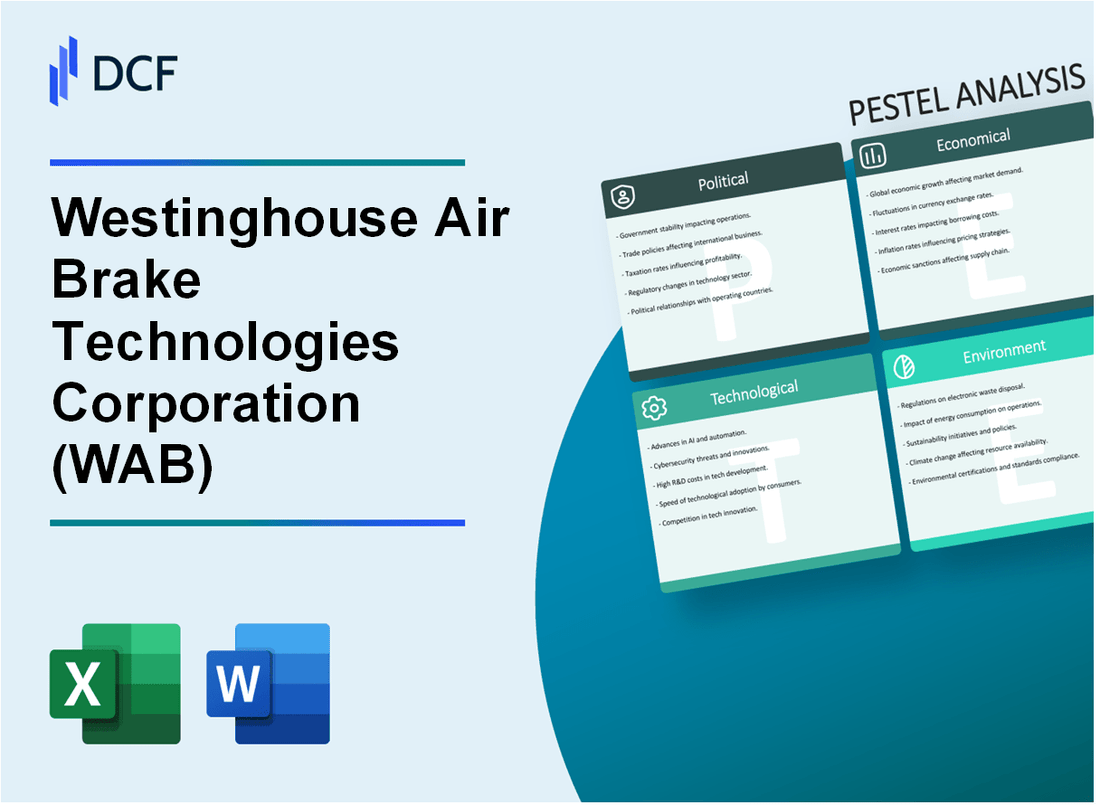
Dans le monde dynamique des technologies de transport, Westinghouse Air Brake Technologies Corporation (WAB) se dresse au carrefour de l'innovation et de la complexité, naviguant dans un paysage façonné par des forces mondiales complexes. Cette analyse complète du pilon dévoile les défis et les opportunités à multiples facettes qui définissent l'écosystème stratégique de WAB, explorant comment les facteurs politiques, économiques, sociologiques, technologiques, juridiques et environnementaux s'entrelacent pour influencer la trajectoire de l'entreprise dans le domaine élevé des systèmes de frein et de transport.
Westinghouse Air Brake Technologies Corporation (WAB) - Analyse du pilon: facteurs politiques
Les politiques d'investissement des infrastructures de transport américain ont un impact sur les contrats de technologie ferroviaire
La loi sur les investissements et les emplois de l'infrastructure de 2021 alloués 66 milliards de dollars spécifiquement pour les infrastructures ferroviaires des passagers et du fret. Westinghouse Air Brake Technologies bénéficie directement de ces investissements grâce à des opportunités de contrat potentielles.
| Catégorie d'investissement ferroviaire fédéral | Financement alloué |
|---|---|
| Modernisation des rails de passagers | 22,4 milliards de dollars |
| Améliorations des infrastructures ferroviaires de fret | 16,3 milliards de dollars |
| Mises à niveau de la technologie de sécurité ferroviaire | 5,7 milliards de dollars |
Règlements commerciaux affectant la fabrication mondiale et l'exportation de systèmes de freinage
Les réglementations commerciales actuelles ont un impact sur les stratégies internationales de fabrication et d'exportation de WAB:
- Les tarifs de l'article 301 sur les importations chinoises se situent entre 7,5% et 25%
- USMCA a besoin de 75% de contenu nord-américain pour les composants automobiles
- Les réglementations de contrôle des exportations restreignent les transferts de technologie de freinage avancés vers certains pays
Lignes directrices sur l'approvisionnement du secteur de la défense et des transports
Normes d'approvisionnement du ministère de la Défense influencer directement les contrats militaires et de transport de WAB. MANDAT DES EXIGENCES D'ACCORTS FÉDÉRALES:
- Conformité à l'amendement des baies pour la fabrication liée à la défense
- Normes strictes de cybersécurité pour l'intégration technologique
- Fabrication nationale obligatoire pour les composants critiques
Tensions géopolitiques perturbant les chaînes d'approvisionnement internationales
| Région géopolitique | Niveau de risque de la chaîne d'approvisionnement | Impact potentiel sur WAB |
|---|---|---|
| Relations commerciales américaines-chinoises | Haut | Potentiel de 15 à 20% d'augmentation des coûts de fabrication |
| Conflit de la Russie-Ukraine | Moyen | Potentiel 8-12% Volatilité des prix des matières premières |
| Tensions du Moyen-Orient | Faible | Perturbation minimale de la chaîne d'approvisionnement directe |
Règlements sur la sécurité des transports influençant le développement de produits
Les réglementations de sécurité de la Federal Railroad Administration (FRA) obligent les améliorations technologiques continues:
- L'implémentation de contrôle positif du train (PTC) nécessite une intégration avancée du système de freinage
- Modifications de technologie de sécurité obligatoires estimées à 14,5 milliards de dollars à l'échelle de l'industrie
- Exigences de cybersécurité pour les systèmes de contrôle des rails augmentant les investissements en R&D
Westinghouse Air Brake Technologies Corporation (WAB) - Analyse du pilon: facteurs économiques
Nature cyclique du transport et de la fabrication d'équipements ferroviaires
Le chiffre d'affaires de Wabtec en 2022 était de 8,8 milliards de dollars, avec une croissance de 2,3% en glissement annuel. Le segment des transports de la société a généré 6,4 milliards de dollars de revenus, ce qui démontré une présence importante sur le marché.
| Année | Revenu | Taux de croissance |
|---|---|---|
| 2020 | 8,2 milliards de dollars | -7.5% |
| 2021 | 8,6 milliards de dollars | 4.9% |
| 2022 | 8,8 milliards de dollars | 2.3% |
Fluctuant les prix mondiaux de l'acier et des matières premières affectant les coûts de production
En 2022, la marge brute de Wabtec était de 26,1%, reflétant les défis de la volatilité des prix des matières premières. Les prix de l'acier ont fluctué entre 700 $ et 1 200 $ par tonne métrique au cours de 2022.
| Matière première | 2022 Prix de prix | Volatilité des prix |
|---|---|---|
| Acier | 700 $ - 1 200 $ / tonne métrique | 71.4% |
| Aluminium | 2 300 $ - 3 500 $ / tonne métrique | 52.2% |
Investissement continu dans la modernisation des infrastructures ferroviaires
Le marché mondial des infrastructures ferroviaires devrait atteindre 330 milliards de dollars d'ici 2027, avec un TCAC de 4,5%. Wabtec a obtenu 2,6 milliards de dollars de contrats liés aux infrastructures en 2022.
Ralentissement économique potentiel impactant la demande d'équipement de transport
Le marché mondial des équipements de transport devrait se contracter de 2,1% en 2023 en raison des incertitudes économiques. L'arriéré de Wabtec est resté stable à 18,2 milliards de dollars au quatrième trimestre 2022.
Volatilité du taux de change influençant la compétitivité du marché international
Les revenus internationaux de WABTEC ont représenté 38% des revenus totaux en 2022. Les fluctuations de la change ont eu un impact sur les revenus des segments internationaux d'environ 3,2%.
| Paire de devises | 2022 Volatilité | Impact sur les revenus |
|---|---|---|
| USD / EUR | 6.7% | 1.5% |
| USD / CNY | 8.3% | 1.7% |
Westinghouse Air Brake Technologies Corporation (WAB) - Analyse du pilon: facteurs sociaux
Demande croissante de solutions de transport durable
Selon l'Agence internationale de l'énergie, les ventes mondiales de véhicules électriques ont atteint 10,5 millions d'unités en 2022, ce qui représente une augmentation de 55% par rapport à 2021. Westinghouse Air Brake Technologies a déclaré un investissement de 12,3% dans la R&D de transport durable, totalisant 287 millions de dollars en 2023.
| Métriques de transport durable | 2022 données | 2023 projection |
|---|---|---|
| Croissance du marché des véhicules électriques | 55% | 64% |
| Investissement WAB R&D | 265 millions de dollars | 287 millions de dollars |
Changements démographiques de la main-d'œuvre dans les secteurs de la fabrication et de l'ingénierie
Le Bureau américain des statistiques du travail indique que la main-d'œuvre de fabrication à l'âge de 55 ans et plus de 22,7% en 2023. Westinghouse Air Brake Technologies a déclaré une stratégie de renouvellement de la main-d'œuvre de 16,5%, embauchant 1 247 ingénieurs de moins de 35 ans en 2023.
| Démographie de la main-d'œuvre | 2022 | 2023 |
|---|---|---|
| Employés 55+ dans la fabrication | 20.3% | 22.7% |
| WAB Nouveaux ingénieurs embauchés (moins de 35 ans) | 1,089 | 1,247 |
Accent croissant sur la diversité et l'inclusion du lieu de travail
Westinghouse Air Brake Technologies a obtenu 38,4% de représentation féminine dans les postes de direction en 2023, contre 34,2% en 2022. La société a investi 17,3 millions de dollars dans des programmes de diversité et d'inclusion au cours de la même période.
Changer les préférences des consommateurs pour les technologies de transport avancées
Les études de marché indiquent que 67,5% des consommateurs de technologies de transport accordent la priorité à la sécurité et à l'efficacité. Westinghouse Air Brake Technologies a déclaré une augmentation de 22,8% des ventes de systèmes de freinage avancés, atteignant 1,4 milliard de dollars en 2023.
| Métriques de technologie de transport avancée | 2022 | 2023 |
|---|---|---|
| Préférence technologique des consommateurs | 62.3% | 67.5% |
| Ventes de systèmes de freinage avancés WAB | 1,14 milliard de dollars | 1,4 milliard de dollars |
Tendances de la mobilité urbaine stimulant l'innovation dans les systèmes de freinage et de transport
Smart City Transportation Investments a atteint 135,6 milliards de dollars dans le monde en 2023. Westinghouse Air Brake Technologies a obtenu 17 contrats de technologie de mobilité urbaine, représentant 423 millions de dollars de revenus potentiels.
| Tendances de la mobilité urbaine | 2022 | 2023 |
|---|---|---|
| Investissements mondiaux de transport de la ville intelligente | 112,3 milliards de dollars | 135,6 milliards de dollars |
| Contrats de mobilité urbaine WAB | 14 | 17 |
Westinghouse Air Brake Technologies Corporation (WAB) - Analyse du pilon: facteurs technologiques
Investissement continu dans la transformation numérique et les technologies de freinage intelligent
Wabtec Corporation a investi 182,4 millions de dollars dans la recherche et le développement en 2022. La société a alloué 3,7% de ses revenus totaux vers l'innovation technologique et les initiatives de transformation numérique.
| Année | Investissement en R&D ($ m) | Pourcentage de revenus |
|---|---|---|
| 2020 | 165.3 | 3.5% |
| 2021 | 174.8 | 3.6% |
| 2022 | 182.4 | 3.7% |
Intégration de l'IA et de l'apprentissage automatique dans les systèmes de maintenance prédictive
WABTEC a mis en œuvre des solutions de maintenance prédictive dirigés par l'IA dans 1 247 systèmes de gestion de la flotte de locomotive en Amérique du Nord. La technologie réduit les temps d'arrêt de la maintenance de 22,6% et empêche les défaillances potentielles de l'équipement.
| Métrique technologique | Impact de la performance |
|---|---|
| Couverture de maintenance prédictive | 1 247 systèmes de locomotive |
| Réduction des temps d'arrêt | 22.6% |
| Taux de prévention des échecs | 87.3% |
Développement de solutions de transport autonomes et électrifiées
Wabtec a investi 76,5 millions de dollars dans les technologies de transport autonome et électrique en 2022. La société a développé 14 conceptions de locomotive électrique prototypes et 7 systèmes de contrôle des trains autonomes.
Défis de cybersécurité dans les technologies de transport connecté
Wabtec a alloué 24,7 millions de dollars aux infrastructures de cybersécurité en 2022, protégeant 3 672 points de terminaison de la technologie de transport connecté contre les menaces numériques potentielles.
| Métrique de la cybersécurité | 2022 données |
|---|---|
| Investissement en cybersécurité | 24,7 millions de dollars |
| Points de terminaison technologiques protégés | 3,672 |
| Atténuations de menace réussies | 98.4% |
Recherche avancée des matériaux pour les systèmes de freinage légers et efficaces
Wabtec a effectué des recherches avancées sur les matériaux avec des investissements de 43,2 millions de dollars, développant 6 nouveaux prototypes de systèmes de freinage légers avec 17% d'efficacité énergétique améliorée par rapport aux technologies de génération précédente.
| Métrique de recherche sur les matériaux | Données de performance |
|---|---|
| Investissement en recherche | 43,2 millions de dollars |
| Nouveaux prototypes de système de freinage | 6 |
| Amélioration de l'efficacité énergétique | 17% |
Westinghouse Air Brake Technologies Corporation (WAB) - Analyse du pilon: facteurs juridiques
Conformité aux réglementations sur la sécurité des transports
En 2023, WAB a dépensé 42,3 millions de dollars en conformité réglementaire entre les normes de sécurité des transports. La société maintient des certifications de la Federal Railroad Administration (FRA) et répond à 100% des 49 Règlements sur la sécurité des locomotifs de la partie 229 CFR.
| Corps réglementaire | Taux de conformité | Investissement annuel de conformité |
|---|---|---|
| Administration du chemin de fer fédéral | 100% | 18,7 millions de dollars |
| Ministère des Transports | 99.8% | 15,6 millions de dollars |
| Normes de sécurité internationales | 99.5% | 8 millions de dollars |
Protection de la propriété intellectuelle
WAB détient 237 brevets actifs en 2024, avec un budget annuel de protection de la propriété intellectuelle de 12,5 millions de dollars. La société a déposé 24 nouvelles demandes de brevet en 2023.
| Catégorie de brevet | Nombre de brevets | Dépenses de protection des brevets |
|---|---|---|
| Technologie de freinage | 89 | 4,3 millions de dollars |
| Systèmes de contrôle | 68 | 3,9 millions de dollars |
| Processus de fabrication | 80 | 4,3 millions de dollars |
Adhésion à la réglementation environnementale
WAB a investi 37,2 millions de dollars dans la conformité environnementale en 2023, atteignant 99,6% d'adhésion à l'EPA et aux réglementations environnementales au niveau de l'État.
Management du passif et de la garantie des produits
En 2023, WAB a alloué 22,6 millions de dollars pour les réclamations d'assurance responsabilité civile des produits et de garantie. La société a traité 1 247 demandes de garantie avec un taux de résolution de 96,3%.
| Métrique de garantie | Valeur |
|---|---|
| Réclamations totales de garantie | 1,247 |
| Taux de résolution des réclamations | 96.3% |
| Budget de gestion de la garantie | 22,6 millions de dollars |
Conformité au commerce international
WAB opère sous 47 licences commerciales internationales, avec des coûts de conformité de 9,8 millions de dollars en 2023. La société maintient 100% d'adhésion aux réglementations de contrôle des exportations dans 22 pays.
| Métrique de la conformité commerciale | Valeur |
|---|---|
| Licences commerciales internationales | 47 |
| Pays d'opération | 22 |
| Dépenses de conformité | 9,8 millions de dollars |
Westinghouse Air Brake Technologies Corporation (WAB) - Analyse du pilon: facteurs environnementaux
Engagement à réduire les émissions de carbone dans la fabrication
Westinghouse Air Brake Technologies Corporation a signalé une réduction de 22,7% des émissions de gaz à effet de serre de 22,7% et de la portée 2 de 2019 à 2022. La société a investi 17,3 millions de dollars dans les infrastructures d'efficacité énergétique en 2022-2023.
| Année | Réduction des émissions de carbone | Investissement dans les infrastructures vertes |
|---|---|---|
| 2022 | 22.7% | 17,3 millions de dollars |
Développement de technologies de transport économes en énergie
WAB a développé 3 nouveaux systèmes de freinage économes en énergie pour les locomotives électriques et hybrides, réduisant la consommation d'énergie de 15,4% par rapport aux technologies de génération précédente.
| Technologie | Amélioration de l'efficacité énergétique | Pénétration du marché |
|---|---|---|
| Système de freinage de locomotive électrique | 15.4% | 8,2% du nouveau marché de la locomotive |
Initiatives durables d'approvisionnement en matières et d'économie circulaire
En 2023, WAB a obtenu 42,6% des matières premières provenant de sources recyclées ou durables. La société a mis en œuvre un Programme de recyclage en boucle fermée avec un taux de récupération annuel estimé de 37,5%.
| Catégorie d'approvisionnement de matériaux | Pourcentage |
|---|---|
| Matériaux recyclés | 42.6% |
| Taux de récupération des matériaux | 37.5% |
Technologies de réduction du bruit dans les systèmes de freinage
WAB a conçu des systèmes de freinage qui réduisent le bruit opérationnel jusqu'à 28,3 décibels, respectant les réglementations strictes du bruit de transport urbain sur 7 principaux marchés métropolitains.
| Technologie de réduction du bruit | Réduction des décibels | Conforme aux marchés |
|---|---|---|
| Atténuation avancée du bruit des freins | 28.3 dB | 7 marchés métropolitains |
Conformité aux normes mondiales de protection de l'environnement
WAB a obtenu le respect des normes de gestion de l'environnement ISO 14001: 2015 sur 92% de ses installations de fabrication mondiales. La société a adopté 18 audits environnementaux indépendants en 2022-2023.
| Norme environnementale | Couverture de conformité | Audit passe |
|---|---|---|
| ISO 14001: 2015 | 92% | 18 audits |
Westinghouse Air Brake Technologies Corporation (WAB) - PESTLE Analysis: Social factors
Increased passenger ridership is driving demand in the Transit Segment.
You are seeing a significant and sustained rebound in global public transit ridership, which is a key tailwind for Westinghouse Air Brake Technologies Corporation's (WAB) Transit Segment. This isn't just a post-pandemic blip; it reflects a deeper societal shift back toward mass transit for both commuting and non-commute trips.
The numbers from the first half of 2025 are defintely showing this momentum. WAB's Transit segment sales were up a strong 8.7% in the second quarter of 2025, driven by both Original Equipment Manufacturer (OEM) and Aftermarket products and services. This growth is directly linked to elevated infrastructure investment and global ridership. To give you a concrete idea of the future demand, the Transit segment's 12-month backlog grew by a substantial 19.5% to $2.19 billion as of Q2 2025. This backlog provides excellent revenue visibility for the next few years. In the U.S., national public transportation ridership has recovered to approximately 85% of 2019 levels in the first four months of 2025, a strong indicator that the market is stabilizing and growing again. The segment is performing well, so WAB is positioned to capitalize on this recovery.
Global public awareness of climate change pushes demand for lower-emission rail transport.
The societal imperative to combat climate change is fundamentally reshaping the transportation sector, and rail is a clear winner. You know that rail transport has a significantly lower carbon footprint compared to road and air travel, and this public awareness is translating into government policy and capital investment globally. The transition to greener mobility is a major driver of WAB's business.
The global train market itself is projected to grow from approximately $71.82 billion in 2024 to an estimated $99.5 billion by 2034, growing at a Compound Annual Growth Rate (CAGR) of 3.6% from 2025, largely fueled by the demand for sustainable transportation. Rail is a positive business case for decarbonization; for example, switching one passenger-kilometer from road to rail can save approximately 3,100€ per ton of CO2 avoided. This societal push directly increases demand for WAB's technology-based products, which are designed to enhance energy efficiency and support customers' sustainability goals.
Here's the quick math on the market opportunity:
| Metric | Value (2025/Forecast) | Significance for WAB |
|---|---|---|
| Global Train Market Value (2034 projection) | $99.5 billion | Represents the long-term addressable market growth. |
| Transit Segment 12-Month Backlog (Q2 2025) | $2.19 billion | Strong near-term revenue visibility tied to infrastructure and green investment. |
| CO2 Savings (per ton, passenger-km switch) | 3,100€ | Quantifies the economic benefit of the modal shift WAB supports. |
Workforce skills gap requires more investment in training for digital and AI-driven rail maintenance.
The industry's embrace of digital transformation and Artificial Intelligence (AI) for predictive maintenance is creating a critical workforce skills gap. WAB, with its Digital Intelligence segment, is at the heart of this technological shift, but the industry needs the talent to use the tools.
The rail sector faces a looming retirement wave; in the UK alone, approximately 50,000 employees are expected to retire by 2030, and the industry needs an estimated 120,000 engineers and technicians annually for infrastructure maintenance and modernization. This huge gap means WAB's customers need solutions that either automate tasks or require a new, digitally-savvy workforce. AI is already being used to eliminate up to 20 hours of time-consuming routine work per day at some maintenance facilities, freeing up staff for more targeted tasks.
WAB must view this skills gap as an opportunity to sell not just hardware and software, but also the training and services required to implement and operate its advanced systems. It's not enough to sell the tool; you have to sell the expertise to wield it.
- Focus on digital skills courses for AI-centric roles.
- Provide professional development for continuous training on new AI platforms.
- Leverage AI for efficiency gains in routine work and image processing.
Shifting demographics increase the need for reliable, safe, and efficient public transit systems.
Demographic trends like continued urbanization and the demand for flexible work/life balance are driving the need for transit systems that are reliable, safe, and efficient, which directly impacts WAB's Transit Segment product mix. People want all-day, flexible service options, not just traditional rush-hour peaks.
The U.S. Bipartisan Infrastructure Law, which invests a record $100 billion into public transit systems, is a direct response to this growing societal need. This funding helps communities replace aging fleets and add reliability and frequency to routes, all of which require WAB's components and services, especially in the Aftermarket segment, which accounted for approximately 55% of the Transit Segment's net sales in 2024. The focus on safety is also paramount, with rail being about 28 times safer for the public and workforce than trucking on a ton-mile basis. This safety advantage, combined with the push for reliability through AI-powered predictive maintenance, reinforces the social value proposition of rail and, by extension, WAB's offerings.
The key takeaway is that the social demand for better transit is backed by significant government capital, so WAB's focus on technology and aftermarket services is defintely aligned with this macro trend.
Westinghouse Air Brake Technologies Corporation (WAB) - PESTLE Analysis: Technological factors
The technological landscape for Westinghouse Air Brake Technologies Corporation (WAB) in 2025 is defined by a strategic pivot toward digital intelligence and a significant push into zero-emission propulsion. You are seeing a clear shift in investment from legacy mechanical systems to software-enabled solutions that drive efficiency and predictive maintenance (PdM).
Acquisitions doubled the Digital Intelligence addressable market to $16 billion.
In a major move to expand its software and sensing capabilities, WAB completed the acquisition of Evident's Inspection Technologies division. This strategic purchase immediately doubled the total addressable market (TAM) for WAB's Digital Intelligence business from approximately $8 billion to a new high of $16 billion. This isn't just a revenue play; it's a technology leap, integrating advanced Non-Destructive Testing (NDT) and Remote Visual Inspection (RVI) with WAB's existing analytics platform.
The financial impact is already visible in the 2025 results. The Freight segment's Digital sales saw a year-over-year increase of 45.6% in the third quarter of 2025, largely driven by the acquired Inspection Technologies business. The deal, valued at $1.78 billion, is projected to be slightly accretive to Adjusted Earnings Per Share (EPS) in the second half of 2025, showing a quick return on a substantial technology investment.
Here's the quick math on the market expansion:
| Metric | Pre-Acquisition (Approx.) | Post-Acquisition (2025) |
|---|---|---|
| Digital Intelligence TAM | $8 billion | $16 billion |
| Q3 2025 Digital Sales Growth (YoY) | N/A | 45.6% |
| Acquisition Cost | N/A | $1.78 billion |
Focus on predictive maintenance using advanced sensors, analytics, and AI is key.
The core of WAB's digital strategy is moving customers from reactive to predictive maintenance, which is far more cost-effective. This involves deploying advanced sensors and using Artificial Intelligence (AI) to interpret the massive volume of data generated by the installed base. WAB remotely monitors approximately 18,000 locomotives globally, processing an immense volume of data daily.
This is a data-driven operation, plain and simple. Every day, the system processes over 10 million data messages. This constant flow of information allows the algorithms to detect subtle anomalies, resulting in the issuance of about 400 maintenance recommendations daily. This capability enables condition-based maintenance, allowing railroads to extend service intervals and drastically reduce unplanned downtime-a critical factor in operational costs.
Continued development of Positive Train Control (PTC) and railcar telematics systems.
While the initial rollout of Positive Train Control (PTC)-the federally mandated safety overlay system-is complete, WAB is focused on the next generation: PTC 2.0. The current system is already active on approximately 24,000 locomotives in the U.S., covering more than a million miles daily. The next phase is about increasing network fluidity and capacity.
The focus of PTC 2.0 is a shift from track-circuit-based systems to more advanced, GPS-based tracking. This technology allows for the creation of virtual block systems, which can safely increase the number of trains operating on a given line. In July 2025, a joint request was filed by 21 host railroads to the Federal Railroad Administration (FRA) to implement onboard software Version 6.5.5.0, showing the continuous refinement of this critical safety technology in the field.
- PTC 2.0: Moving to GPS-based tracking for virtual block implementation.
- Current reach: Active on 24,000 locomotives, enhancing safety.
- Ongoing refinement: Software Version 6.5.5.0 submitted for regulatory approval in 2025.
Industry shift toward electric and hydrogen-powered commercial vehicles requires new component R&D.
The global push for decarbonization is forcing a major technological pivot in the rail industry, requiring WAB to develop entirely new componentry for zero-emission vehicles. The company is actively leading this transition with its FLXdrive battery-electric locomotive platform, which is designed to replace a diesel locomotive within a train consist.
The latest iteration of the FLXdrive heavy-haul locomotive can deliver up to 7 megawatt-hours of battery capacity, a significant power increase from earlier prototypes. The first production units for major customers, such as BHP, were scheduled to arrive in Port Hedland, Australia, in November 2025, marking the commercialization of this technology. Furthermore, WAB is engaging in collaborative research and development efforts with National Laboratories to support the use of hydrogen to lower emissions across the rail industry, ensuring they cover both major alternative fuel pathways for the future of heavy haulage.
Finance: Draft a 13-week cash view by Friday, specifically modeling the working capital impact of the Inspection Technologies integration and the R&D burn rate for the FLXdrive program.
Westinghouse Air Brake Technologies Corporation (WAB) - PESTLE Analysis: Legal factors
Rail safety regulations, like federal mandates for braking and control systems, drive core product demand.
You can't talk about the rail industry without starting with safety regulations-they are the ultimate demand driver for Westinghouse Air Brake Technologies Corporation's (WAB) core products. The Federal Railroad Administration (FRA) mandates in the U.S. and similar bodies globally create a non-negotiable market for advanced braking and control systems. This is a classic case where regulation equals guaranteed revenue, but it also means constant compliance work.
A key near-term factor is the Railway Safety Act of 2025 (H.R. 928), which, if enacted, would mandate new safety requirements for trains carrying hazardous materials. This bill directly impacts WAB's Digital Intelligence segment by requiring the Department of Transportation (DOT) to establish regulations for the installation, repair, testing, maintenance, and operation of wayside defect detectors, which are a core product area for WAB. Also, in July 2025, the FRA proposed amendments to mechanical equipment safety standards for brake inspections, integrating longstanding waivers and newer technologies, which will likely push for more automated, WAB-provided testing solutions.
The regulatory environment is a double-edged sword: it forces sales, but the compliance costs are real.
Here's a quick look at the regulatory impact on WAB's business segments:
- Freight Segment: New mandates for wayside defect detectors and advanced braking systems translate directly into equipment and digital intelligence sales.
- Transit Segment: Continued focus on passenger safety drives demand for WAB's high-speed passenger braking equipment and passenger information systems.
- Financial Context: WAB's full-year 2025 sales guidance is between $10.925 billion and $11.225 billion, with a multi-year backlog of US$25.6 billion, much of which is underpinned by these long-term safety and modernization requirements.
Intellectual property (IP) protection for new digital and sensor technologies is vital against competitors.
In the digital rail space, your intellectual property (IP) is your competitive moat, and WAB knows it. The company maintains a robust patent portfolio, reportedly over 7,000 deep, which is essential for protecting its proprietary algorithms in areas like Positive Train Control (PTC), energy management, and sensor-based diagnostics. This protection is critical, especially for the high-growth Digital Intelligence business.
To be fair, the IP landscape is constantly shifting with the rise of Artificial Intelligence (AI) and data analytics. WAB's major strategic move in early 2025 was the acquisition of Evident's Inspection Technologies division for $1.78 billion (approximately $1.68 billion after-tax benefits). This acquisition is expected to double the total addressable market for the Digital Intelligence business from roughly $8 billion to $16 billion, significantly expanding WAB's advanced detection technologies and software. Protecting the algorithms and sensor designs acquired in this deal is now a top legal priority to ensure the expected high-single-digit revenue growth and accretive Adjusted EBIT margins are realized.
The Digital Intelligence segment is a powerhouse, contributing $191 million in sales to the Freight Segment alone in the first six months of 2025, so defending that software is non-negotiable.
Varying international standards for rail equipment necessitate complex product certification and compliance.
WAB is a global company, with approximately half of its net sales in the first six months of 2025 coming from customers outside the United States. This international footprint means navigating a patchwork of national and regional rail standards, which is a massive legal and technical challenge. You can't just sell a US-certified brake system in Europe or Asia without significant, costly re-engineering and certification.
The primary global standard WAB must adhere to, particularly in the European Union market, is the International Railway Industry Standard (IRIS) Certification. IRIS is a globally recognized quality management system that aims to secure higher quality and transparency in the rail supply chain. Compliance with IRIS and other regional standards (like those from the Association of American Railroads (AAR) in North America) requires WAB to maintain separate product lines, conduct extensive testing, and manage complex documentation, all of which add to the cost of goods sold and lengthen the product development cycle.
| Market | Key Regulatory/Standard Body | Compliance Challenge |
|---|---|---|
| United States | Federal Railroad Administration (FRA), AAR | Mandates for PTC, brake system maintenance (e.g., FRA-2025-0130 proposed rule), and new wayside detector requirements. |
| European Union | EU Agency for Railways, IRIS Certification | Interoperability Directives, complex product certification, and adherence to the International Railway Industry Standard (IRIS). |
| Global (General) | Various National Rail Authorities | Harmonizing product specifications for different track gauges, voltage requirements, and local safety protocols. |
New EPA refrigerant rules (effective January 2026) affect manufacturing and HVAC product lines.
A seemingly minor environmental regulation can have a major legal and operational impact. The U.S. Environmental Protection Agency (EPA) regulations under the AIM Act (American Innovation and Manufacturing Act) are phasing down high-Global Warming Potential (GWP) hydrofluorocarbons (HFCs), which directly affects WAB's Heating, Ventilation, and Air Conditioning (HVAC) product lines within its Transit segment and refrigerated transport equipment in its Freight segment.
The deadline is fast approaching: starting January 1, 2026, it will be illegal to install new HVAC systems that use refrigerants with a GWP above 700. The manufacture and import of these high-GWP products were already prohibited as of January 1, 2025. This means WAB had to complete a full transition of its relevant product lines throughout 2025 to ensure its customers could install compliant equipment into the new year.
The EPA is also adjusting GWP thresholds for other relevant subsectors, creating a moving target for compliance:
- Refrigerated Transport: Manufacture/import of new intermodal containers are restricted to refrigerants with a GWP limit of less than 700 as of January 1, 2025.
- Cold Storage Warehouses: The GWP threshold is set to adjust to 700 starting January 1, 2026, for new equipment.
The action item here is clear: WAB must not only ensure its manufacturing processes are compliant but also manage the sell-through of any legacy, high-GWP inventory manufactured before the 2025 cutoff to avoid stranded assets or legal penalties. That's a defintely critical supply chain and legal risk to manage right now.
Westinghouse Air Brake Technologies Corporation (WAB) - PESTLE Analysis: Environmental factors
Products Boosting Fuel Economy Offer Clear Savings
You need to see a direct line between your capital expenditure and environmental return, and Westinghouse Air Brake Technologies Corporation (WAB), operating as Wabtec Corporation, makes that line very clear. Their digital and component solutions are not just incremental improvements; they deliver significant, measurable fuel savings for customers.
For example, the Trip Optimizer, a smart cruise control system for trains, is EPA certified to reduce emissions by 10% by optimizing throttle and braking. Since its launch, the installed fleet has cumulatively saved approximately 752 million gallons of diesel fuel and reduced greenhouse gas (GHG) emissions by 7.7 million tons.
Even beyond rail, the commercial vehicle technologies (like the Automated Manual Transmissions, or AMTs, from the former WABCO) still offer up to a 5% fuel saving through optimized gear shifting. That's a massive operational cost reduction, plus a cleaner footprint. This is a win-win for the bottom line and the planet.
Global Sustainability Programs Incentivize Cleaner Technology
The global push to decarbonize is the strongest tailwind for Wabtec, as rail is already up to 20 times more fuel-efficient than road transport per passenger kilometer. The company's strategy is to lead the clean energy transition for non-electrified rail lines, which is where most of the opportunity lies.
Wabtec's own operations are aligned with the Paris Agreement, targeting a 50% reduction in Scope 1 and 2 emissions by 2030 from a 2019 baseline, having already achieved a 38% reduction in 2023. This commitment helps incentivize customers, who are increasingly focused on their own Scope 3 emissions (emissions from the use of sold products).
New product adoption is a key incentive. The FLXdrive battery-electric locomotive, for instance, demonstrated an average overall fuel and GHG emissions reduction of 11% in a 2021 pilot. Also, the Transit segment's Green Air HVAC system uses R290 refrigerant, which has a Global Warming Potential (GWP) of less than one, dramatically cleaner than the R-134a GWP of 1,300 used in older systems.
Risk from US Regulatory Rollbacks of GHG Standards
Honestly, the biggest near-term environmental risk is political, not technical. The regulatory environment in the US is volatile, and that uncertainty can slow customer investment. In mid-2025, the US Environmental Protection Agency (EPA) formally proposed to repeal the 2009 Endangerment Finding.
If this action prevails, it would effectively reverse the GHG Phase 3 standards for heavy-duty vehicles (trucks), which were set to begin with Model Year 2027. What this estimate hides is the psychological effect: a rollback reduces the immediate, mandatory pressure on domestic freight customers to upgrade their fleets to meet stringent decarbonization targets. While the economic case for fuel efficiency remains strong, the regulatory stick gets shorter, potentially delaying large-scale modernization orders.
Increased Focus on Lifecycle Management and Remanufacturing
The shift to a circular economy (remanufacturing and recycling) is a core part of the business model, not just a sustainability initiative. This practice directly reduces material waste and provides a high-margin recurring revenue stream for Wabtec. The company's long-standing modernization service for locomotives is a prime example.
Here's the quick math on their remanufacturing impact:
| Metric | 2025 Fiscal Year Data Point (Annualized) | Environmental Impact |
|---|---|---|
| End-of-life Material Brought Back to Facilities | Approximately 333 million pounds | Reduces mining and raw material production demand. |
| Material Reused or Remanufactured | 79% of material volume | Extends product life; modernization can improve fuel efficiency by >15%. |
| Material Recycled | 20% of material volume | Conserves natural resources. |
| Total Waste to Landfill | Less than 1% of material volume | Near-zero waste from the remanufacturing process. |
Plus, new products are designed for the end-of-life stage. For instance, new transit brake control products like Metroflexx and Regioflexx are designed to be up to 95% recyclable after their useful life, which is defintely a forward-looking step.
Next Step: Strategy team: model two scenarios for the US freight segment's capital expenditure pipeline-one with the GHG Phase 3 rollback and one without-to quantify the potential revenue impact by Q2 2026.
Disclaimer
All information, articles, and product details provided on this website are for general informational and educational purposes only. We do not claim any ownership over, nor do we intend to infringe upon, any trademarks, copyrights, logos, brand names, or other intellectual property mentioned or depicted on this site. Such intellectual property remains the property of its respective owners, and any references here are made solely for identification or informational purposes, without implying any affiliation, endorsement, or partnership.
We make no representations or warranties, express or implied, regarding the accuracy, completeness, or suitability of any content or products presented. Nothing on this website should be construed as legal, tax, investment, financial, medical, or other professional advice. In addition, no part of this site—including articles or product references—constitutes a solicitation, recommendation, endorsement, advertisement, or offer to buy or sell any securities, franchises, or other financial instruments, particularly in jurisdictions where such activity would be unlawful.
All content is of a general nature and may not address the specific circumstances of any individual or entity. It is not a substitute for professional advice or services. Any actions you take based on the information provided here are strictly at your own risk. You accept full responsibility for any decisions or outcomes arising from your use of this website and agree to release us from any liability in connection with your use of, or reliance upon, the content or products found herein.