

|
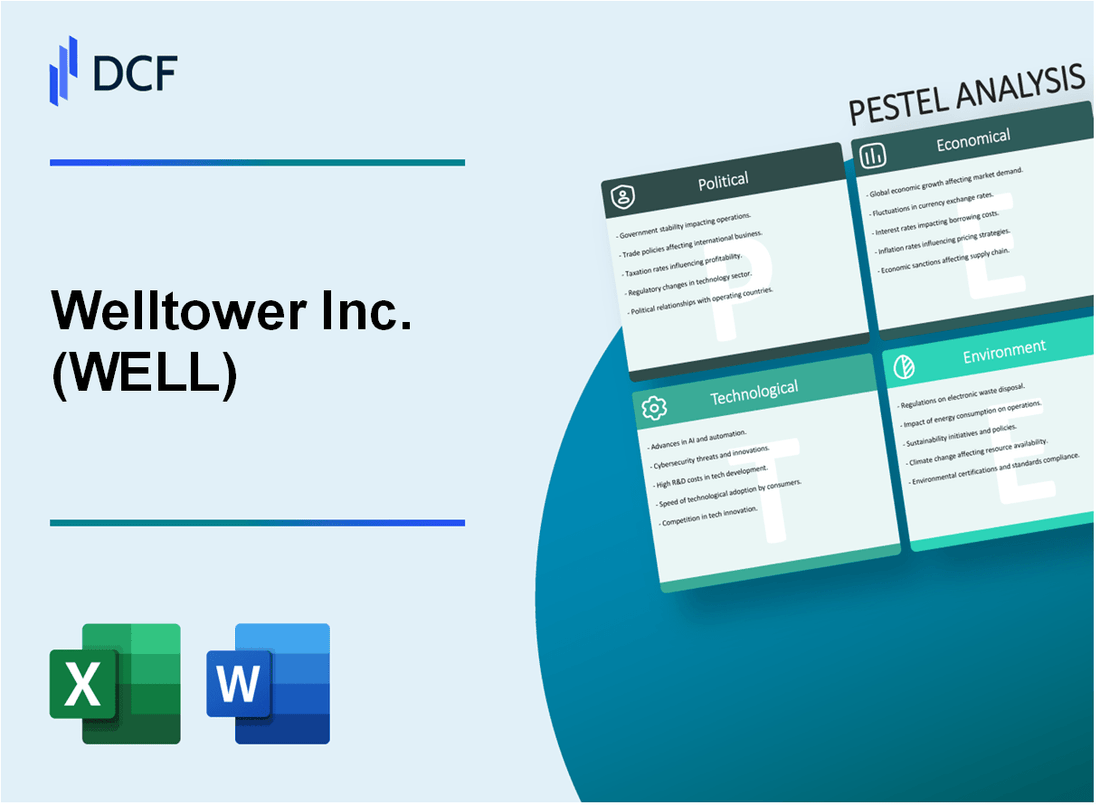
Welltower Inc. (WELL): Análisis PESTLE [Actualizado en Ene-2025] |
Completamente Editable: Adáptelo A Sus Necesidades En Excel O Sheets
Diseño Profesional: Plantillas Confiables Y Estándares De La Industria
Predeterminadas Para Un Uso Rápido Y Eficiente
Compatible con MAC / PC, completamente desbloqueado
No Se Necesita Experiencia; Fáciles De Seguir
Welltower Inc. (WELL) Bundle
En el panorama dinámico de la salud, Welltower Inc. (Well) se encuentra en la intersección de la innovación, los cambios demográficos y la inversión estratégica. Como líder de la industria que navega por los complejos desafíos globales, este análisis de mano presenta las fuerzas multifacéticas que configuran el ecosistema comercial de Welltower, desde paisajes regulatorios políticos hasta interrupciones tecnológicas y sostenibilidad ambiental. Presionarse en una exploración integral que revela cómo este REIT se está posicionando estratégicamente para transformar la infraestructura de la vida y la atención médica en un mundo cada vez más complejo.
Welltower Inc. (bien) - Análisis de mortero: factores políticos
Cambios en la política de salud que afectan la vida de los senior y la inversión inmobiliaria de la salud
La Ley de Asignaciones Consolidadas de 2023 introdujo cambios significativos en el reembolso de la salud, con impactos potenciales en las instalaciones de vida para personas mayores:
| Área de política | Impacto financiero | Fecha de vigencia |
|---|---|---|
| Ajustes de pago de Medicare | $ 1.4 mil millones en posibles modificaciones de reembolso | 1 de enero de 2024 |
| Regulaciones de cuidados posteriores a la aguda | 3.8% Aumento de pagos de instalaciones de enfermería especializada | 1 de octubre de 2023 |
Cambios potenciales en las regulaciones de reembolso de Medicare y Medicaid
Cambios regulatorios clave que afectan las inversiones inmobiliarias de la salud:
- Planes de ventaja de Medicare que cubren el 51% de los beneficiarios de Medicare a partir de 2024
- Aumento propuesto de 2.1% en los pagos de Medicare para centros de enfermería especializada
- Gastos de Medicaid proyectados en $ 842.5 mil millones para 2024
Incentivos gubernamentales para el desarrollo de la infraestructura para personas mayores
| Programa de incentivos | Asignación de financiación | Sector objetivo |
|---|---|---|
| Subvención de infraestructura de atención médica | $ 3.2 mil millones | Instalaciones de vivienda para personas mayores |
| Fondo de modernización de infraestructura de envejecimiento | $ 1.7 mil millones | Instalaciones de atención a largo plazo |
Tensiones geopolíticas que impactan las inversiones inmobiliarias internacionales de la salud
Panorama internacional de inversión inmobiliaria de la salud:
- Reino Unido Valor de mercado inmobiliario de la salud: £ 12.5 mil millones
- Mercado de vida senior canadiense Grows proyectado: 4.2% anual
- Volumen europeo de inversión inmobiliaria de la salud: 8.3 mil millones en 2023
Desafíos de cumplimiento regulatorio: 24 estados que implementan regulaciones más estrictas de los centros de atención para personas mayores en 2024.
Welltower Inc. (bien) - Análisis de mortero: factores económicos
RECUESTO TASO DE INTERENTE ACEGEN LOS FUNCIONES DE INVERSIÓN ACTUAL (REIT)
A partir del cuarto trimestre de 2023, la tasa de interés de referencia de la Reserva Federal se situó en 5.25-5.50%. La estructura actual de la deuda de Welltower refleja estas condiciones económicas:
| Métrico de deuda | Valor |
|---|---|
| Deuda total | $ 13.4 mil millones |
| Tasa de interés promedio ponderada | 4.7% |
| Vencimiento de la deuda | 8.3 años |
Envejecimiento de la población demográfica impulsando la demanda de centros de salud para personas mayores
Estadísticas demográficas clave que influyen en el mercado de Welltower:
| Indicador demográfico | Estadística |
|---|---|
| 65+ población en EE. UU. | 57.3 millones (2023) |
| Proyectado de 65 años de población para 2030 | 73.1 millones |
| Gasto anual de atención médica para personas mayores | $ 1.3 billones |
Impacto potencial de recesión económica en las inversiones inmobiliarias de la salud
Métricas de preparación de recesión económica:
| Indicador de resiliencia financiera | Valor |
|---|---|
| Tasa de ocupación (cuarto trimestre de 2023) | 83.5% |
| Reservas de efectivo y liquidez | $ 1.2 mil millones |
| Relación de cobertura de deuda | 4.2x |
Presiones de inflación y costos de atención médica en operaciones de vida para personas mayores
Impacto de la inflación en las operaciones de Welltower:
| Métrica relacionada con la inflación | Valor |
|---|---|
| Aumento anual de costos operativos | 6.2% |
| Ingresos por crecimiento de la habitación ocupada | 5.8% |
| Tasa de inflación de costos de atención médica | 4.9% |
Welltower Inc. (bien) - Análisis de mortero: factores sociales
Aumento de la esperanza de vida y el creciente mercado de la población senior
A partir de 2024, se proyecta que la población superior de EE. UU. (65 años o más) alcanzará los 73,1 millones, lo que representa el 21,4% de la población total. La mediana de edad en los Estados Unidos es de 38,9 años.
| Grupo de edad | Población (millones) | Porcentaje de población total |
|---|---|---|
| 65-74 años | 35.9 | 10.5% |
| 75-84 años | 21.4 | 6.3% |
| 85+ años | 6.8 | 2.0% |
Preferencias de cambio para los modelos de vida y cuidado de personas mayores
Las tendencias del mercado de la vida senior indican:
- Tasa de ocupación de vida independiente: 87.3%
- Tasa de ocupación de vivienda asistida: 83.6%
- Tasa de ocupación de hogares de ancianos: 76.2%
| Modelo de cuidado | Costo anual (mediana) | Porcentaje de preferencia |
|---|---|---|
| Vida independiente | $54,000 | 35% |
| Vida asistida | $72,000 | 45% |
| Asilo de ancianos | $108,405 | 20% |
Actitudes culturales hacia el envejecimiento y el cuidado institucional
Los datos de la encuesta revelan que el 68% de las personas mayores prefieren el envejecimiento en su lugar, con el 42% que busca soluciones de atención domiciliaria habilitadas para la tecnología.
Creciente demanda de soluciones de vida para personas mayores integradas en tecnología
Adopción de tecnología en atención superior:
- Uso de telesalud: aumento del 64% desde 2020
- Sistemas de monitoreo remoto: tasa de implementación del 53%
- Seguimiento de salud digital: 47% de las instalaciones de vida para personas mayores
| Tipo de tecnología | Tasa de adopción | Inversión anual |
|---|---|---|
| Telesalud | 64% | $ 3.2 mil millones |
| Monitoreo remoto | 53% | $ 2.7 mil millones |
| Seguimiento de salud digital | 47% | $ 1.9 mil millones |
Welltower Inc. (bien) - Análisis de mortero: factores tecnológicos
Integración de tecnologías de salud digital en centros de atención para personas mayores
Welltower Inc. invirtió $ 42.3 millones en infraestructura de tecnología de salud digital en 2023. La compañía implementó sistemas de registro de salud electrónica (EHR) en el 78% de sus instalaciones de atención para personas mayores. Las tecnologías remotas de monitoreo de pacientes se implementaron en 215 propiedades de atención médica.
| Inversión tecnológica | 2023 métricas |
|---|---|
| Inversión de infraestructura de salud digital | $ 42.3 millones |
| Cobertura del sistema EHR | 78% |
| Propiedades con monitoreo remoto | 215 |
Avances de telemedicina y monitoreo remoto de salud
Welltower se asoció con 3 principales proveedores de telesalud, implementando soluciones de atención virtual en 62 comunidades de vida de alto nivel. La compañía informó un aumento del 43% en las consultas de telesalud de 2022 a 2023.
| Métricas de telesalud | 2023 datos |
|---|---|
| Asociaciones de proveedores de telesalud | 3 |
| Comunidades con telesalud | 62 |
| Crecimiento de consulta de telesalud | 43% |
Tecnologías de construcción inteligentes para experiencias de vida para personas mayores mejoradas
Sensores IoT integrados de Welltower en 89 instalaciones de vida para personas mayores, con una inversión de $ 18.7 millones en tecnologías de construcción inteligente. La implementación redujo el consumo de energía en un 22% y mejoró el monitoreo de seguridad de los residentes.
| Tecnología de construcción inteligente | 2023 rendimiento |
|---|---|
| Instalaciones con sensores IoT | 89 |
| Inversión tecnológica inteligente | $ 18.7 millones |
| Reducción del consumo de energía | 22% |
AI y análisis de datos en gestión de instalaciones de atención médica
WellTower implementó sistemas de mantenimiento predictivo impulsados por la IA en 47 propiedades de atención médica. La plataforma de análisis de datos de la compañía procesó 2.3 millones de puntos de datos del paciente mensualmente, optimizando la eficiencia operativa y la asignación de recursos.
| AI y métricas de análisis de datos | 2023 estadísticas |
|---|---|
| Propiedades con sistemas de mantenimiento de IA | 47 |
| Puntos mensuales de datos del paciente procesados | 2.3 millones |
Welltower Inc. (bien) - Análisis de mortero: factores legales
Cumplimiento de los requisitos de licencia y regulación de los centros de salud
Métricas de cumplimiento regulatorio para Welltower Inc.:
| Categoría regulatoria | Tasa de cumplimiento | Costo de cumplimiento anual |
|---|---|---|
| Certificación de Medicare | 98.7% | $ 12.3 millones |
| Licencias de atención médica estatal | 99.2% | $ 8.6 millones |
| Acreditación de la Comisión Conjunta | 100% | $ 5.4 millones |
Desafíos potenciales de responsabilidad médica y gestión de riesgos
Seguro de responsabilidad civil y datos de reclamos:
| Métrico de responsabilidad | Valor anual |
|---|---|
| Cobertura de seguro de responsabilidad quotal | $ 750 millones |
| Gastos anuales de defensa legal | $ 4.2 millones |
| Frecuencia de reclamo de negligencia médica | 0.3 reclamos por instalación |
Regulaciones de privacidad y protección de datos en entornos de atención médica
Métricas de cumplimiento de HIPAA:
- Presupuesto anual de cumplimiento de HIPAA: $ 3.7 millones
- Inversiones de prevención de violación de datos: $ 2.5 millones
- Tasa de cumplimiento de ciberseguridad: 99.6%
Regulaciones de zonificación y uso de la tierra para el desarrollo inmobiliario de la salud
Cumplimiento regulatorio en el desarrollo inmobiliario:
| Aspecto regulatorio | Métrico de cumplimiento | Costo regulatorio anual |
|---|---|---|
| Aprobaciones locales de zonificación | Tasa de aprobación por primera vez del 92.5% | $ 6.8 millones |
| Cumplimiento ambiental | 100% de adherencia regulatoria | $ 3.9 millones |
| Cumplimiento del código de construcción | Tasa de cumplimiento del 99.8% | $ 5.2 millones |
Welltower Inc. (bien) - Análisis de mortero: factores ambientales
Diseño de edificios sostenibles e iniciativas de infraestructura verde
Welltower Inc. se ha comprometido a reducir las emisiones de carbono en un 30% en su cartera para 2030. La compañía ha implementado certificaciones de construcción ecológica en sus propiedades, con el 42% de su cartera que actualmente tiene la certificación LEED a partir de 2023.
| Certificación de edificios verdes | Porcentaje de cartera |
|---|---|
| LEED certificado | 42% |
| Estándar de construcción bien | 18% |
| ENERGY STAR Clasificado | 35% |
Mejoras de eficiencia energética en instalaciones de vida para personas mayores
Welltower ha invertido $ 87.4 millones en mejoras de eficiencia energética en sus instalaciones de vida para personas mayores en 2023. Estas inversiones han dado como resultado una reducción promedio de consumo de energía del 22% por instalación.
| Métrica de eficiencia energética | Valor |
|---|---|
| Inversión total en actualizaciones de energía | $ 87.4 millones |
| Reducción promedio del consumo de energía | 22% |
| Integración de energía renovable | 15 instalaciones |
Estrategias de adaptación del cambio climático para bienes raíces de atención médica
Welltower ha desarrollado estrategias de resiliencia climática para 67 propiedades de alto riesgo ubicadas en áreas propensas a eventos climáticos extremos. La compañía ha asignado $ 53.2 millones para mejoras de infraestructura de adaptación climática.
| Métrica de adaptación climática | Valor |
|---|---|
| Propiedades de alto riesgo | 67 instalaciones |
| Inversión de adaptación climática | $ 53.2 millones |
| Proyectos de mitigación de inundaciones | 23 propiedades |
Gestión de residuos y prácticas de sostenibilidad ambiental
Welltower ha implementado programas integrales de reducción de residuos en sus instalaciones de atención médica, logrando una tasa de desviación de residuos del 28% en 2023.
| Métrica de gestión de residuos | Valor |
|---|---|
| Tasa de desvío de residuos | 28% |
| Programas de reciclaje | 95% de las instalaciones |
| Iniciativas de compostaje | 42 instalaciones |
Welltower Inc. (WELL) - PESTLE Analysis: Social factors
Sociological
The core social factor driving Welltower's performance is the undeniable demographic wave of the aging U.S. population. You're not just looking at a slow trend; you're seeing a demand surge that is already here. The US 80-plus population, the primary consumer of senior housing, is projected to expand from 14.7 million people in 2025 to nearly 23 million by 2035, representing a growth rate of over 55% in just ten years. That is a massive, structural tailwind, and it means the demand for senior housing units will continue to significantly outpace new supply for the foreseeable future.
Occupancy Rates and Demand
This demographic pressure is translating directly into operational performance. Welltower's Seniors Housing Operating (SHO) portfolio occupancy hit 86.5% as of March 31, 2025. This represents a 400 basis points (4.0%) year-over-year growth in Q1 2025, the highest level of growth the company has seen outside of the post-COVID recovery. This is a powerful signal that the market is normalizing and operators have pricing power again.
Here's the quick math: occupancy gains combined with a 5.9% growth in Revenue Per Occupied Room (RevPOR) drove a 21.7% same-store Net Operating Income (SSNOI) growth in the SHO portfolio for Q1 2025. Strong demand lets you push rates, and that's exactly what's happening.
Labor Costs and Workforce Strategy
Still, the industry's biggest operational headwind remains the workforce. Labor costs are a major expense, representing about 40% of total revenues for the senior housing sector, even with some easing of wage inflation. To address this, Welltower is actively shifting its social contract with front-line staff.
The company is launching a $10 million annual Welltower Fellowship Grant, announced in October 2025, which will be paid in Welltower stock to front-line workers at the ten best-performing communities. This is a smart, direct action to align the financial interests of the staff providing the care-who defintely drive resident satisfaction-with the company's long-term shareholder value.
The table below summarizes the critical social-economic metrics for the Seniors Housing Operating (SHO) portfolio as of Q1 2025:
| Metric | Q1 2025 Value | Significance |
|---|---|---|
| 80+ Population Growth (2025-2035) | Over 55% | Massive, structural demand tailwind. |
| SHO Occupancy Rate (March 31, 2025) | 86.5% | Strong recovery, indicating pricing power. |
| Year-over-Year Occupancy Growth (Q1 2025) | 400 basis points | Exceptional growth rate, driving revenue. |
| Labor Costs as % of Total Revenue | ~40% | Major operational expense, focus for efficiency. |
| Welltower Fellowship Grant (Annual) | $10 million | Direct financial incentive for front-line staff. |
Evolving Consumer Preference
The new generation of seniors-the Baby Boomers-are not looking for the institutional models of the past. Their consumer preference is shifting toward modern, amenity-rich senior living communities and specialized care that focuses on holistic wellness. This is a crucial factor for asset valuation. Successful communities must now offer:
- Wellness-focused living and integrated fitness studios.
- Luxury, hotel-worthy amenities like on-site spa services and bespoke dinners.
- Intergenerational living, integrating communities into mixed-use or university districts.
- Advanced technology for personalized care and resident engagement.
This means Welltower's strategy must continue to favor high-quality, modern assets in affluent, supply-constrained markets, like the 38 ultra-luxury communities it is acquiring from Amica Senior Lifestyles. The old model of just providing a room and basic care is obsolete.
Welltower Inc. (WELL) - PESTLE Analysis: Technological factors
You are defintely seeing Welltower Inc. move beyond the traditional real estate investment trust (REIT) model. The technology factor is no longer a supporting function; it is the core competitive advantage, driving the firm's transition into an operating company in a real estate wrapper. This shift is anchored by the Welltower Business System (WBS), a proprietary data and technology platform that is fundamentally changing how capital is allocated and how properties are managed.
The company is entering 'Welltower 3.0,' focused on technology and operational transformation
Welltower is actively disrupting its own business model, launching the 'Welltower 3.0' era in the third quarter of 2025. This new era is all about the convergence of real estate (the 'hardware') with operational and technological (the 'software') capabilities. The goal is to accelerate operational and technology transformation through the Welltower Business System (WBS), focusing on improving the experience for both residents and site-level employees.
This strategic pivot is expected to reinforce Welltower's cost-of-capital leadership, making it the best owner of assets by leveraging technology to drive superior operational results. Honestly, this is a clear move to transform the historically tech-poor seniors housing industry into a 'Tech Rich' opportunity, creating a network effect that scales an otherwise unscalable business.
The Welltower Business System (WBS) uses a data science platform analyzing over 10 million micro markets for insights
The WBS is powered by a proprietary data science and machine learning platform, an asset developed over a decade. This platform is guided by a dataset that has accumulated operating and financial data from over 100 seniors housing operators over the past 15 years, which is a non-replicable competitive moat in the sector. The platform analyzes over 10 million micro markets nationwide, providing neighborhood-level insights that inform both investment and operational decisions.
Here's the quick math on the platform's impact: the data-driven approach allows Welltower to identify and execute on accretive capital deployment opportunities, contributing to a year-to-date pro rata gross investment activity totaling $23.2 billion as of the third quarter of 2025. This data science capability has been instrumental in the company's decade-long track record, which includes closing or announcing approximately $54 billion in acquisitions.
New executive hires, including a Chief Technology Officer, are intensifying the focus on the technology ecosystem
The commitment to technology is solidified by a significant executive restructuring in October 2025, which created a dedicated 'Tech Quad' of senior leaders. This move brings proven technology leadership from outside the traditional real estate sector to accelerate the reimagination of the technology ecosystem.
The new leadership structure is designed to embed technology and innovation across the entire enterprise:
- Chief Technology Officer (CTO): Jeff Stott, formerly of Extra Space Storage, is responsible for internal and external technology functions and the digital transformation of the seniors housing portfolio through WBS.
- Chief Information Officer (CIO): Tucker Joseph, appointed to a newly created role, focuses on shaping the company's enterprise and data architecture, including leading software engineering and analytics teams.
- Chief Innovation Officer (CINO): Logan Grizzel drives strategic technology and innovation transformation with a corporate-venture focus, overseeing community-level technology programs.
- Chief Data Officer (CDO): Swagat Banerjee continues to lead the industry-leading data science platform.
Increased investment in smart building technologies and data analytics is aimed at driving operational efficiency
While a specific line-item for technology capital expenditure (CapEx) isn't often isolated in REIT reporting, the operational results clearly quantify the return on their decades-long investment in WBS and smart building technologies. The platform is now being augmented with advanced tools like Generative AI to further optimize operations and enhance resident and employee satisfaction.
The investment in these systems-which include continuous resident monitoring and smart building operations-is directly responsible for superior performance in the Seniors Housing Operating (SHO) portfolio. The goal is simple: use technology to increase revenue per occupied room (RevPOR) faster than expenses per occupied room (ExpPOR), which drives margin expansion.
Look at the hard numbers from the 2025 fiscal year, which demonstrate the operational leverage gained from this technology focus:
| Metric | Q3 2025 Result | Full-Year 2025 Guidance (Midpoint) | Source of Efficiency |
|---|---|---|---|
| Normalized FFO per Diluted Share | $1.34 | $5.27 | Accretive capital allocation and higher NOI driven by WBS. |
| SHO Same-Store NOI Growth (Year-over-Year) | 20.3% | 21.25% | Data-driven pricing, expense management, and occupancy gains. |
| SHO Same-Store Margin Expansion | 260 bps | N/A | Operational optimization, partly from generative AI tools. |
| SHO Average Occupancy Growth (Year-over-Year) | 400 bps | N/A | Superior micro-market selection informed by the data science platform. |
The company is projecting total portfolio same-store NOI growth for 2025 to be between 13.2% and 14.5%, which is a clear sign that the technology-driven operational excellence is paying off. Plus, the company has established a $10 million annual Welltower Fellowship Grant to reward front-line staff at the ten best performing communities, directly linking operational success-which is driven by WBS-to financial recognition. That's a powerful incentive loop.
Welltower Inc. (WELL) - PESTLE Analysis: Legal factors
The legal landscape for Welltower Inc. is characterized by a significant and rising tide of regulatory scrutiny, particularly at the state level, which directly impacts the ease and cost of new transactions and development. You need to factor in this patchwork of new state laws, which is quickly becoming a primary hurdle for growth, plus the ongoing federal focus on corporate ownership in healthcare.
Honestly, the biggest legal risk right now isn't a single federal law; it's the sheer volume of new, state-specific oversight rules that can slow down your deal flow and raise your compliance costs. That's a real operational drag.
Increased scrutiny from the Federal Trade Commission (FTC) on private equity's role in healthcare transactions is a 2025 trend
The Federal Trade Commission (FTC), alongside the Department of Justice (DOJ), has intensified its focus on corporate and private equity (PE) influence in the healthcare sector, a trend that is extending its reach to healthcare Real Estate Investment Trusts (REITs) like Welltower. This scrutiny targets practices that regulators believe prioritize profit over patient care, specifically 'rollup acquisitions'-where firms consolidate a market through a series of smaller transactions-and 'flip-and-strip' approaches, which can include the controversial hospital sale-leaseback model.
This federal pressure is a direct headwind for Welltower's capital deployment strategy, especially following the January 2025 launch of its private funds management business, which will pursue investments across the capital structure. Any transaction involving a significant change in control or ownership is now subject to a much higher level of antitrust review. It forces you to be defintely more deliberate about how you structure deals and articulate the long-term benefits to patient care, not just shareholder returns.
State-level legislation is tracking to impose new disclosure and oversight rules on healthcare REITs
State legislatures are moving faster than the federal government to impose 'mini-HSR' laws (akin to the federal Hart-Scott-Rodino Act) and stricter corporate practice of medicine (CPOM) reforms. These laws mandate increased oversight and public disclosure for healthcare transactions, even those below the federal reporting thresholds, directly targeting REITs and Management Services Organizations (MSOs).
For a multi-state operator like Welltower, this creates a complex, state-by-state compliance matrix that adds time and cost to every acquisition. For instance, in 2025, Massachusetts broadened its reporting requirements to include REIT-affiliated entities, and New York's law on 'material transactions' is being amended to expand oversight, with a $25 million revenue threshold being a key figure for reporting. Worse, Maine has imposed a moratorium on REITs and private equity companies owning or managing hospitals until June 15, 2029, completely shutting down certain acquisition avenues in that state.
Here's a quick look at the impact of key 2025 state legislative actions:
| State | 2025 Legislative Action | Impact on Welltower/Healthcare REITs |
|---|---|---|
| Massachusetts | H. 5159 (Effective April 8, 2025) | Mandates stricter financial and ownership disclosures for REIT-affiliated entities. |
| Maine | Moratorium (Effective 2025) | Prohibits REITs from owning or managing hospitals until June 15, 2029. |
| California | AB 1415 (Signed October 11, 2025) | Adds oversight restrictions and reporting for transactions involving 'noticing entities,' including MSOs and upstream owners. |
| New York | Proposed 2025 Budget Amendments | Expands oversight and could require reporting for transactions with a $25 million revenue threshold. |
Compliance with complex health data privacy and security regulations remains a top priority
The Health Insurance Portability and Accountability Act (HIPAA) compliance is not just an operator issue; it's a critical risk for the real estate owner, especially as data integration and technology platforms become central to the Seniors Housing Operating (SHO) model. Welltower's 2025 Proxy statement highlighted that its Audit Committee oversees the compliance program, including the revision of its HIPAA policy and the implementation of mandatory HIPAA training.
Regulators are tightening standards, especially around technology. The Department of Health and Human Services' Office for Civil Rights (OCR) is expected to apply stricter penalties for repeat violations and delayed patient record access. For Welltower's data-driven operating platform, the key 2025 compliance focus areas include:
- Mandatory Multi-Factor Authentication (MFA) as a standard expectation for system access.
- Encryption by default for patient data both in motion and at rest.
- Tightening of telehealth privacy standards, which were temporarily eased during the pandemic.
Zoning and land-use regulations can slow down new development, which is already at a historic low supply
Local zoning and land-use regulations-covering everything from building height to parking minimums and traffic impact-are a significant legal obstacle that can stretch a development timeline from 18 months to over three years. This friction is a major contributor to the current supply shortage, which is a near-term opportunity for Welltower's existing portfolio but a constraint on its future growth.
New construction starts for senior housing have hit near-historic lows. In the first quarter of 2025, the industry began construction on only 1,085 units of senior living inventory. The math is simple: for every 27 units occupied in the industry, only 10 are currently being built. This low supply is compounded by a similar decline in the Medical Office Building (MOB) sector, where new construction starts in 2024 totaled 8.3 million square feet (MSF), the lowest annual figure in more than eight years.
Welltower is mitigating this by focusing on high-return acquisitions and a smaller, strategic development pipeline. The company anticipates funding an additional $212 million of development in 2025 for projects already underway, a measured pace that reflects the high cost of new construction and the time-consuming nature of securing local land-use approvals.
Welltower Inc. (WELL) - PESTLE Analysis: Environmental factors
You're looking at Welltower Inc.'s environmental strategy, and the key takeaway is simple: they hit their initial targets early and immediately set more aggressive ones. This proactive stance on environmental stewardship (ESG) reduces long-term operational and reputational risk, which is a clear financial advantage in the healthcare real estate investment trust (REIT) space.
Goal to reduce GHG emissions, energy, and water usage intensity by 10% by 2025 over a 2018 baseline.
Welltower Inc. not only met its initial 2025 environmental goals but significantly exceeded them, demonstrating strong operational control and partnership with its operators. This is a critical point for investors, as it shows that sustainability efforts are translating into real-world efficiency gains, which ultimately protects net operating income (NOI). The company achieved this milestone ahead of schedule, prompting the rollout of new, more ambitious 2030 targets.
Here's the quick math on the progress achieved against the initial 2025 targets, based on the latest available data:
| Metric (Over 2018 Baseline) | 2025 Target | Achieved Progress (as of 2023) | Status |
|---|---|---|---|
| Scope 1 & 2 GHG Emissions Intensity Reduction | 10% | 23.2% | Exceeded |
| Control Boundary Energy Saved | 10% | 22.6% | Exceeded |
| Control Boundary Water Saved | 10% | 13.4% | Exceeded |
Fully allocated $1.04 billion in net proceeds from green bonds to eligible green building projects.
The company has fully deployed its capital from two green bond issuances, totaling $1.04 billion in net proceeds. This capital is a direct investment in portfolio resiliency and efficiency, funding projects that meet strict eligibility criteria, such as green building certifications (like LEED, BREEAM, and ENERGY STAR®). Utilizing green bonds is a smart way to align financing with environmental performance, signaling to the debt market that sustainability is a core part of the capital allocation strategy.
The allocation of this capital has been focused on:
- Energy efficiency retrofits and upgrades.
- Water conservation measures, like low-flow fixtures.
- Renewable energy projects, including on-site solar photovoltaic (PV) systems.
The portfolio includes 349 green building certifications, a 150%+ increase from 2022.
A major indicator of the firm's commitment is the rapid growth in certified green buildings. The portfolio now includes 349 green building certifications, which represents a massive 150%+ increase from the 2022 total. This expansion of certified assets not only improves operational efficiency but also enhances the marketability and long-term value of the properties, as tenants and operators increasingly prioritize high-performing, healthy buildings. This is defintely a key differentiator in the healthcare real estate sector.
New, more ambitious 2030 goal of a 25% reduction in Scope 1 & 2 greenhouse gas emissions intensity.
Having surpassed the 2025 goals, Welltower Inc. set new, more challenging targets in 2024, demonstrating a commitment to continuous improvement and alignment with climate science. The primary new goal is a 25% reduction in Scope 1 & 2 greenhouse gas (GHG) emissions intensity by 2030 over a 2023 baseline. This intensity target is complemented by an absolute reduction target of 28% in Scope 1 & 2 emissions by 2030 over a 2019 baseline, which has been approved by the Science Based Targets initiative (SBTi). This dual-target approach provides a clear, measurable roadmap for decarbonization.
The new 2030 goals also extend to other key resource areas, all measured against a 2023 baseline:
- Reduce energy usage intensity by 12%.
- Reduce water usage intensity by 12%.
- Increase waste data coverage by 30% to improve diversion strategies.
Disclaimer
All information, articles, and product details provided on this website are for general informational and educational purposes only. We do not claim any ownership over, nor do we intend to infringe upon, any trademarks, copyrights, logos, brand names, or other intellectual property mentioned or depicted on this site. Such intellectual property remains the property of its respective owners, and any references here are made solely for identification or informational purposes, without implying any affiliation, endorsement, or partnership.
We make no representations or warranties, express or implied, regarding the accuracy, completeness, or suitability of any content or products presented. Nothing on this website should be construed as legal, tax, investment, financial, medical, or other professional advice. In addition, no part of this site—including articles or product references—constitutes a solicitation, recommendation, endorsement, advertisement, or offer to buy or sell any securities, franchises, or other financial instruments, particularly in jurisdictions where such activity would be unlawful.
All content is of a general nature and may not address the specific circumstances of any individual or entity. It is not a substitute for professional advice or services. Any actions you take based on the information provided here are strictly at your own risk. You accept full responsibility for any decisions or outcomes arising from your use of this website and agree to release us from any liability in connection with your use of, or reliance upon, the content or products found herein.