

|
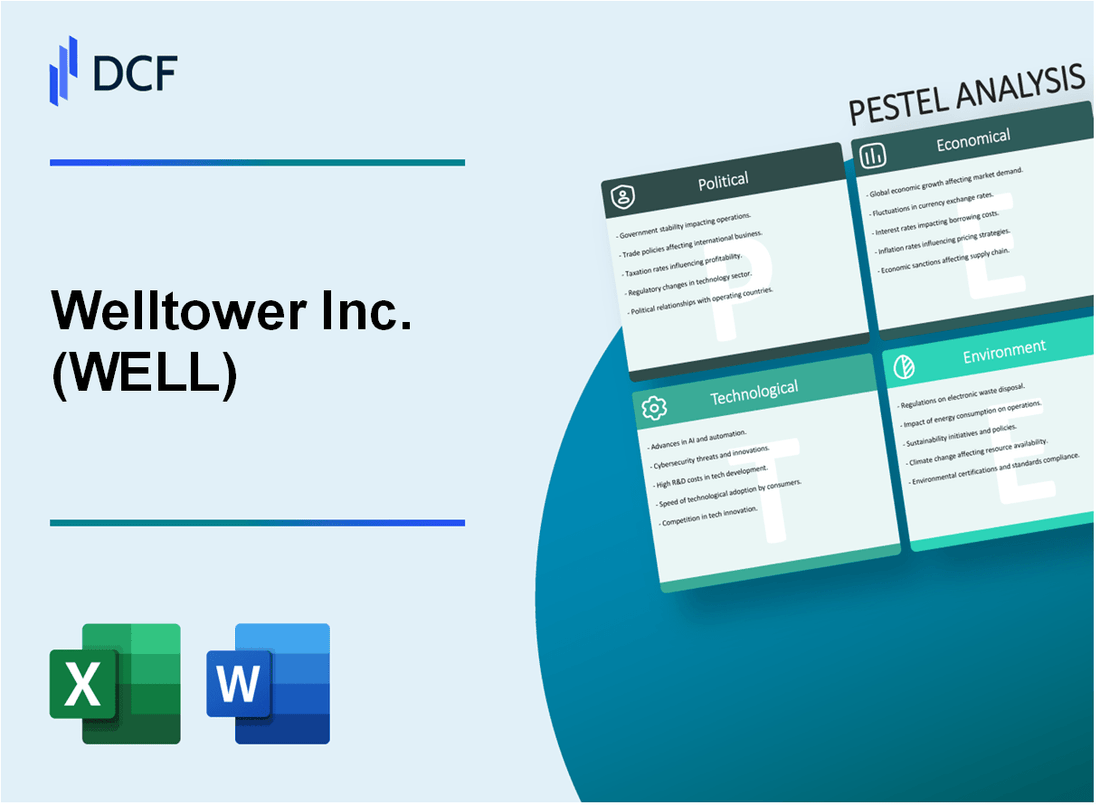
Welltower Inc. (bien): Analyse du Pestle [Jan-2025 MISE À JOUR] |
Entièrement Modifiable: Adapté À Vos Besoins Dans Excel Ou Sheets
Conception Professionnelle: Modèles Fiables Et Conformes Aux Normes Du Secteur
Pré-Construits Pour Une Utilisation Rapide Et Efficace
Compatible MAC/PC, entièrement débloqué
Aucune Expertise N'Est Requise; Facile À Suivre
Welltower Inc. (WELL) Bundle
Dans le paysage dynamique de l'immobilier des soins de santé, Welltower Inc. (bien) se tient à l'intersection de l'innovation, des changements démographiques et des investissements stratégiques. En tant que leader de l'industrie qui navigue sur des défis mondiaux complexes, cette analyse de pilotage dévoile les forces multiformes qui façonnent l'écosystème commercial de Welltower - des paysages réglementaires politiques aux perturbations technologiques et à la durabilité environnementale. Plongez dans une exploration complète qui révèle comment cette FPI se positionne stratégiquement pour transformer la vie des personnes âgées et les infrastructures de soins de santé dans un monde de plus en plus complexe.
Welltower Inc. (bien) - Analyse du pilon: facteurs politiques
Changements de politique de santé affectant l'investissement immobilier de la vie et des soins de santé pour personnes âgées
La Consolidated Credits Act de 2023 a introduit des modifications importantes au remboursement des soins de santé, avec des impacts potentiels sur les installations de vie pour personnes âgées:
| Domaine politique | Impact financier | Date d'entrée en vigueur |
|---|---|---|
| Ajustements de paiement Medicare | 1,4 milliard de dollars de modifications de remboursement potentiels | 1er janvier 2024 |
| Règlements de soins post-aigus | Augmentation de 3,8% des paiements spécialisés des établissements de soins infirmiers | 1er octobre 2023 |
Changements potentiels dans les réglementations de remboursement de Medicare et Medicaid
Modifications réglementaires clés ayant un impact sur les investissements immobiliers des soins de santé:
- Plans de Medicare Advantage couvrant 51% des bénéficiaires de Medicare à partir de 2024
- Augmentation proposée de 2,1% des paiements Medicare pour les établissements de soins infirmiers qualifiés
- Les dépenses de Medicaid projetées à 842,5 milliards de dollars pour 2024
Incitations gouvernementales pour le développement des infrastructures de soins aux personnes âgées
| Programme d'incitation | Allocation de financement | Secteur cible |
|---|---|---|
| Subvention d'infrastructure de soins de santé | 3,2 milliards de dollars | Installations de vie supérieure |
| Fonds de modernisation des infrastructures vieillissantes | 1,7 milliard de dollars | Établissements de soins de longue durée |
Tensions géopolitiques ayant un impact sur les investissements immobiliers internationaux
Paysage international de l'investissement immobilier des soins de santé:
- Royaume-Uni Healthcare Real Estate Market Valeur: 12,5 milliards de livres sterling
- GROPPORT CANADIAN SEINTER LIVING PROJECTIFS: 4,2% par an
- Volume d'investissement immobilier européen de santé: 8,3 milliards d'euros en 2023
Défis de conformité réglementaire: 24 États mettant en œuvre des réglementations plus strictes sur l'établissement de soins aux personnes âgées en 2024.
Welltower Inc. (bien) - Analyse du pilon: facteurs économiques
La hausse des taux d'intérêt affectant les fiducies de placement immobilier (FPI)
Au quatrième trimestre 2023, le taux d'intérêt de référence de la Réserve fédérale était de 5,25-5,50%. La structure de la dette actuelle de Welltower reflète ces conditions économiques:
| Métrique de la dette | Valeur |
|---|---|
| Dette totale | 13,4 milliards de dollars |
| Taux d'intérêt moyen pondéré | 4.7% |
| Maturité de la dette | 8,3 ans |
Vieillissement de la population démographique de la demande de la demande de soins de santé seniors
Des statistiques démographiques clés influençant le marché de Welltower:
| Indicateur démographique | Statistique |
|---|---|
| 65+ population aux États-Unis | 57,3 millions (2023) |
| Projeté plus de 65 habitants d'ici 2030 | 73,1 millions |
| Dépenses de santé annuelles annuelles | 1,3 billion de dollars |
Impact potentiel de la récession économique sur les investissements immobiliers de la santé
Métriques de préparation à la récession économique:
| Indicateur de résilience financière | Valeur |
|---|---|
| Taux d'occupation (Q4 2023) | 83.5% |
| Réserves en espèces et en liquidité | 1,2 milliard de dollars |
| Ratio de couverture de la dette | 4.2x |
Inflation et pressions sur les coûts des soins de santé sur les opérations de vie pour personnes âgées
Impact de l'inflation sur les opérations de Welltower:
| Métrique liée à l'inflation | Valeur |
|---|---|
| Augmentation annuelle des coûts opérationnels | 6.2% |
| Revenus par croissance de la salle occupée | 5.8% |
| Taux d'inflation des coûts des soins de santé | 4.9% |
Welltower Inc. (bien) - Analyse du pilon: facteurs sociaux
Augmentation de l'espérance de vie et du marché croissant de la population supérieure
En 2024, la population âgée américaine (65 ans et plus) devrait atteindre 73,1 millions, ce qui représente 21,4% de la population totale. L'âge médian aux États-Unis est de 38,9 ans.
| Groupe d'âge | Population (millions) | Pourcentage de la population totale |
|---|---|---|
| 65-74 ans | 35.9 | 10.5% |
| 75-84 ans | 21.4 | 6.3% |
| 85 ans et plus | 6.8 | 2.0% |
Préférences changeantes pour les modèles de vie et de soins aux personnes âgées
Les tendances du marché de la vie senior indiquent:
- Taux d'occupation de la vie indépendante: 87,3%
- Taux d'occupation de la vie assistée: 83,6%
- Taux d'occupation des maisons de soins infirmiers: 76,2%
| Modèle de soins | Coût annuel (médiane) | Pourcentage de préférence |
|---|---|---|
| Vie indépendante | $54,000 | 35% |
| Assiette | $72,000 | 45% |
| Maison de repos | $108,405 | 20% |
Attitudes culturelles envers le vieillissement et les soins institutionnels
Les données de l'enquête révèlent que 68% des personnes âgées préfèrent le vieillissement en place, avec 42% pour rechercher des solutions de soins à domicile compatibles avec la technologie.
Demande croissante de solutions de vie pour personnes âgées intégrées à la technologie
Adoption de la technologie dans les soins aux personnes âgées:
- Utilisation de la télésanté: augmentation de 64% depuis 2020
- Systèmes de surveillance à distance: taux de mise en œuvre de 53%
- Suivi de la santé numérique: 47% des établissements de vie pour personnes âgées
| Type de technologie | Taux d'adoption | Investissement annuel |
|---|---|---|
| Télésanté | 64% | 3,2 milliards de dollars |
| Surveillance à distance | 53% | 2,7 milliards de dollars |
| Suivi de la santé numérique | 47% | 1,9 milliard de dollars |
Welltower Inc. (bien) - Analyse du pilon: facteurs technologiques
Intégration des technologies de santé numérique dans les établissements de soins aux personnes âgées
Welltower Inc. a investi 42,3 millions de dollars dans l'infrastructure de technologies de santé numérique en 2023. La société a mis en place des systèmes de dossiers de santé électronique (DSE) dans 78% de ses établissements de soins aux personnes âgées. Des technologies de surveillance des patients à distance ont été déployées dans 215 propriétés de soins de santé.
| Investissement technologique | 2023 métriques |
|---|---|
| Investissement d'infrastructure de santé numérique | 42,3 millions de dollars |
| Couverture du système DSE | 78% |
| Propriétés avec surveillance à distance | 215 |
Avancement de surveillance de la télémédecine et de la santé à distance
Welltower s'est associé à 3 principaux fournisseurs de télésanté, mettant en œuvre des solutions de soins virtuels dans 62 communautés de vie supérieures. La société a déclaré une augmentation de 43% des consultations de télésanté de 2022 à 2023.
| Métriques de la télésanté | 2023 données |
|---|---|
| Partenariats des fournisseurs de télésanté | 3 |
| Communautés avec télésanté | 62 |
| Croissance des consultations en télésanté | 43% |
Technologies de construction intelligentes pour des expériences de vie pour personnes âgées améliorées
Welltower a intégré des capteurs IoT dans 89 installations de vie pour personnes âgées, avec un investissement de 18,7 millions de dollars dans les technologies de construction intelligentes. La mise en œuvre a réduit la consommation d'énergie de 22% et amélioré la surveillance de la sécurité des résidents.
| Technologie de construction intelligente | Performance de 2023 |
|---|---|
| Installations avec des capteurs IoT | 89 |
| Investissement technologique intelligent | 18,7 millions de dollars |
| Réduction de la consommation d'énergie | 22% |
AI et analyse des données dans la gestion des établissements de santé
Welltower a déployé des systèmes de maintenance prédictive axés sur l'IA dans 47 propriétés de soins de santé. La plate-forme d'analyse de données de la société a traité 2,3 millions de points de données des patients mensuellement, optimisant l'efficacité opérationnelle et l'allocation des ressources.
| Métriques de l'IA et de l'analyse des données | 2023 statistiques |
|---|---|
| Propriétés avec des systèmes de maintenance d'IA | 47 |
| Points de données mensuels traités | 2,3 millions |
Welltower Inc. (bien) - Analyse du pilon: facteurs juridiques
Conformité aux exigences de licence et de réglementation des établissements de santé
Métriques de la conformité réglementaire pour Welltower Inc.:
| Catégorie de réglementation | Taux de conformité | Coût annuel de conformité |
|---|---|---|
| Certification Medicare | 98.7% | 12,3 millions de dollars |
| Licence de soins de santé de l'État | 99.2% | 8,6 millions de dollars |
| Accréditation de la Commission mixte | 100% | 5,4 millions de dollars |
Défis potentiels de responsabilité médicale et de gestion des risques
Données d'assurance responsabilité civile:
| Métrique de la responsabilité | Valeur annuelle |
|---|---|
| Couverture d'assurance responsabilité civile totale | 750 millions de dollars |
| Frais de défense juridique annuels | 4,2 millions de dollars |
| Fréquence de réclamation pour faute professionnelle médicale | 0,3 réclamations par installation |
Règlements sur la confidentialité et la protection des données dans les établissements de santé
Mesures de conformité HIPAA:
- Budget annuel de conformité HIPAA: 3,7 millions de dollars
- Investissements de prévention des violations de données: 2,5 millions de dollars
- Taux de conformité de la cybersécurité: 99,6%
Règlements sur le zonage et l'utilisation des terres pour le développement immobilier des soins de santé
Conformité réglementaire dans le développement immobilier:
| Aspect réglementaire | Métrique de conformité | Coût réglementaire annuel |
|---|---|---|
| Approbations de zonage local | Taux d'approbation de 92,5% pour la première fois | 6,8 millions de dollars |
| Conformité environnementale | Adhérence réglementaire à 100% | 3,9 millions de dollars |
| Conformité du code du bâtiment | Taux de conformité à 99,8% | 5,2 millions de dollars |
Welltower Inc. (bien) - Analyse du pilon: facteurs environnementaux
Initiatives de conception durable des bâtiments et d'infrastructures vertes
Welltower Inc. s'est engagé à réduire les émissions de carbone de 30% dans son portefeuille d'ici 2030. La société a mis en œuvre des certifications de construction vertes à travers ses propriétés, 42% de son portefeuille détient actuellement la certification LEED en 2023.
| Certification du bâtiment vert | Pourcentage de portefeuille |
|---|---|
| Certifié LEED | 42% |
| Norme de construction bien | 18% |
| Energy Star classée | 35% |
Améliorations de l'efficacité énergétique dans les installations de vie pour personnes âgées
Welltower a investi 87,4 millions de dollars dans les améliorations de l'efficacité énergétique dans ses installations de vie supérieures en 2023. Ces investissements ont entraîné une réduction moyenne de la consommation d'énergie de 22% par installation.
| Métrique de l'efficacité énergétique | Valeur |
|---|---|
| Investissement total dans les mises à niveau énergétiques | 87,4 millions de dollars |
| Réduction moyenne de la consommation d'énergie | 22% |
| Intégration d'énergie renouvelable | 15 installations |
Stratégies d'adaptation du changement climatique pour l'immobilier des soins de santé
Welltower a développé des stratégies de résilience climatique pour 67 propriétés à haut risque situées dans des zones sujettes à des événements météorologiques extrêmes. La société a alloué 53,2 millions de dollars pour les améliorations des infrastructures d'adaptation climatique.
| Métrique d'adaptation climatique | Valeur |
|---|---|
| Propriétés à haut risque | 67 installations |
| Investissement d'adaptation climatique | 53,2 millions de dollars |
| Projets d'atténuation des inondations | 23 propriétés |
Pratiques de gestion des déchets et de durabilité environnementale
Welltower a mis en œuvre des programmes complets de réduction des déchets dans ses établissements de santé, atteignant un taux de détournement de déchets de 28% en 2023.
| Métrique de gestion des déchets | Valeur |
|---|---|
| Taux de détournement des déchets | 28% |
| Programmes de recyclage | 95% des installations |
| Initiatives de compostage | 42 installations |
Welltower Inc. (WELL) - PESTLE Analysis: Social factors
Sociological
The core social factor driving Welltower's performance is the undeniable demographic wave of the aging U.S. population. You're not just looking at a slow trend; you're seeing a demand surge that is already here. The US 80-plus population, the primary consumer of senior housing, is projected to expand from 14.7 million people in 2025 to nearly 23 million by 2035, representing a growth rate of over 55% in just ten years. That is a massive, structural tailwind, and it means the demand for senior housing units will continue to significantly outpace new supply for the foreseeable future.
Occupancy Rates and Demand
This demographic pressure is translating directly into operational performance. Welltower's Seniors Housing Operating (SHO) portfolio occupancy hit 86.5% as of March 31, 2025. This represents a 400 basis points (4.0%) year-over-year growth in Q1 2025, the highest level of growth the company has seen outside of the post-COVID recovery. This is a powerful signal that the market is normalizing and operators have pricing power again.
Here's the quick math: occupancy gains combined with a 5.9% growth in Revenue Per Occupied Room (RevPOR) drove a 21.7% same-store Net Operating Income (SSNOI) growth in the SHO portfolio for Q1 2025. Strong demand lets you push rates, and that's exactly what's happening.
Labor Costs and Workforce Strategy
Still, the industry's biggest operational headwind remains the workforce. Labor costs are a major expense, representing about 40% of total revenues for the senior housing sector, even with some easing of wage inflation. To address this, Welltower is actively shifting its social contract with front-line staff.
The company is launching a $10 million annual Welltower Fellowship Grant, announced in October 2025, which will be paid in Welltower stock to front-line workers at the ten best-performing communities. This is a smart, direct action to align the financial interests of the staff providing the care-who defintely drive resident satisfaction-with the company's long-term shareholder value.
The table below summarizes the critical social-economic metrics for the Seniors Housing Operating (SHO) portfolio as of Q1 2025:
| Metric | Q1 2025 Value | Significance |
|---|---|---|
| 80+ Population Growth (2025-2035) | Over 55% | Massive, structural demand tailwind. |
| SHO Occupancy Rate (March 31, 2025) | 86.5% | Strong recovery, indicating pricing power. |
| Year-over-Year Occupancy Growth (Q1 2025) | 400 basis points | Exceptional growth rate, driving revenue. |
| Labor Costs as % of Total Revenue | ~40% | Major operational expense, focus for efficiency. |
| Welltower Fellowship Grant (Annual) | $10 million | Direct financial incentive for front-line staff. |
Evolving Consumer Preference
The new generation of seniors-the Baby Boomers-are not looking for the institutional models of the past. Their consumer preference is shifting toward modern, amenity-rich senior living communities and specialized care that focuses on holistic wellness. This is a crucial factor for asset valuation. Successful communities must now offer:
- Wellness-focused living and integrated fitness studios.
- Luxury, hotel-worthy amenities like on-site spa services and bespoke dinners.
- Intergenerational living, integrating communities into mixed-use or university districts.
- Advanced technology for personalized care and resident engagement.
This means Welltower's strategy must continue to favor high-quality, modern assets in affluent, supply-constrained markets, like the 38 ultra-luxury communities it is acquiring from Amica Senior Lifestyles. The old model of just providing a room and basic care is obsolete.
Welltower Inc. (WELL) - PESTLE Analysis: Technological factors
You are defintely seeing Welltower Inc. move beyond the traditional real estate investment trust (REIT) model. The technology factor is no longer a supporting function; it is the core competitive advantage, driving the firm's transition into an operating company in a real estate wrapper. This shift is anchored by the Welltower Business System (WBS), a proprietary data and technology platform that is fundamentally changing how capital is allocated and how properties are managed.
The company is entering 'Welltower 3.0,' focused on technology and operational transformation
Welltower is actively disrupting its own business model, launching the 'Welltower 3.0' era in the third quarter of 2025. This new era is all about the convergence of real estate (the 'hardware') with operational and technological (the 'software') capabilities. The goal is to accelerate operational and technology transformation through the Welltower Business System (WBS), focusing on improving the experience for both residents and site-level employees.
This strategic pivot is expected to reinforce Welltower's cost-of-capital leadership, making it the best owner of assets by leveraging technology to drive superior operational results. Honestly, this is a clear move to transform the historically tech-poor seniors housing industry into a 'Tech Rich' opportunity, creating a network effect that scales an otherwise unscalable business.
The Welltower Business System (WBS) uses a data science platform analyzing over 10 million micro markets for insights
The WBS is powered by a proprietary data science and machine learning platform, an asset developed over a decade. This platform is guided by a dataset that has accumulated operating and financial data from over 100 seniors housing operators over the past 15 years, which is a non-replicable competitive moat in the sector. The platform analyzes over 10 million micro markets nationwide, providing neighborhood-level insights that inform both investment and operational decisions.
Here's the quick math on the platform's impact: the data-driven approach allows Welltower to identify and execute on accretive capital deployment opportunities, contributing to a year-to-date pro rata gross investment activity totaling $23.2 billion as of the third quarter of 2025. This data science capability has been instrumental in the company's decade-long track record, which includes closing or announcing approximately $54 billion in acquisitions.
New executive hires, including a Chief Technology Officer, are intensifying the focus on the technology ecosystem
The commitment to technology is solidified by a significant executive restructuring in October 2025, which created a dedicated 'Tech Quad' of senior leaders. This move brings proven technology leadership from outside the traditional real estate sector to accelerate the reimagination of the technology ecosystem.
The new leadership structure is designed to embed technology and innovation across the entire enterprise:
- Chief Technology Officer (CTO): Jeff Stott, formerly of Extra Space Storage, is responsible for internal and external technology functions and the digital transformation of the seniors housing portfolio through WBS.
- Chief Information Officer (CIO): Tucker Joseph, appointed to a newly created role, focuses on shaping the company's enterprise and data architecture, including leading software engineering and analytics teams.
- Chief Innovation Officer (CINO): Logan Grizzel drives strategic technology and innovation transformation with a corporate-venture focus, overseeing community-level technology programs.
- Chief Data Officer (CDO): Swagat Banerjee continues to lead the industry-leading data science platform.
Increased investment in smart building technologies and data analytics is aimed at driving operational efficiency
While a specific line-item for technology capital expenditure (CapEx) isn't often isolated in REIT reporting, the operational results clearly quantify the return on their decades-long investment in WBS and smart building technologies. The platform is now being augmented with advanced tools like Generative AI to further optimize operations and enhance resident and employee satisfaction.
The investment in these systems-which include continuous resident monitoring and smart building operations-is directly responsible for superior performance in the Seniors Housing Operating (SHO) portfolio. The goal is simple: use technology to increase revenue per occupied room (RevPOR) faster than expenses per occupied room (ExpPOR), which drives margin expansion.
Look at the hard numbers from the 2025 fiscal year, which demonstrate the operational leverage gained from this technology focus:
| Metric | Q3 2025 Result | Full-Year 2025 Guidance (Midpoint) | Source of Efficiency |
|---|---|---|---|
| Normalized FFO per Diluted Share | $1.34 | $5.27 | Accretive capital allocation and higher NOI driven by WBS. |
| SHO Same-Store NOI Growth (Year-over-Year) | 20.3% | 21.25% | Data-driven pricing, expense management, and occupancy gains. |
| SHO Same-Store Margin Expansion | 260 bps | N/A | Operational optimization, partly from generative AI tools. |
| SHO Average Occupancy Growth (Year-over-Year) | 400 bps | N/A | Superior micro-market selection informed by the data science platform. |
The company is projecting total portfolio same-store NOI growth for 2025 to be between 13.2% and 14.5%, which is a clear sign that the technology-driven operational excellence is paying off. Plus, the company has established a $10 million annual Welltower Fellowship Grant to reward front-line staff at the ten best performing communities, directly linking operational success-which is driven by WBS-to financial recognition. That's a powerful incentive loop.
Welltower Inc. (WELL) - PESTLE Analysis: Legal factors
The legal landscape for Welltower Inc. is characterized by a significant and rising tide of regulatory scrutiny, particularly at the state level, which directly impacts the ease and cost of new transactions and development. You need to factor in this patchwork of new state laws, which is quickly becoming a primary hurdle for growth, plus the ongoing federal focus on corporate ownership in healthcare.
Honestly, the biggest legal risk right now isn't a single federal law; it's the sheer volume of new, state-specific oversight rules that can slow down your deal flow and raise your compliance costs. That's a real operational drag.
Increased scrutiny from the Federal Trade Commission (FTC) on private equity's role in healthcare transactions is a 2025 trend
The Federal Trade Commission (FTC), alongside the Department of Justice (DOJ), has intensified its focus on corporate and private equity (PE) influence in the healthcare sector, a trend that is extending its reach to healthcare Real Estate Investment Trusts (REITs) like Welltower. This scrutiny targets practices that regulators believe prioritize profit over patient care, specifically 'rollup acquisitions'-where firms consolidate a market through a series of smaller transactions-and 'flip-and-strip' approaches, which can include the controversial hospital sale-leaseback model.
This federal pressure is a direct headwind for Welltower's capital deployment strategy, especially following the January 2025 launch of its private funds management business, which will pursue investments across the capital structure. Any transaction involving a significant change in control or ownership is now subject to a much higher level of antitrust review. It forces you to be defintely more deliberate about how you structure deals and articulate the long-term benefits to patient care, not just shareholder returns.
State-level legislation is tracking to impose new disclosure and oversight rules on healthcare REITs
State legislatures are moving faster than the federal government to impose 'mini-HSR' laws (akin to the federal Hart-Scott-Rodino Act) and stricter corporate practice of medicine (CPOM) reforms. These laws mandate increased oversight and public disclosure for healthcare transactions, even those below the federal reporting thresholds, directly targeting REITs and Management Services Organizations (MSOs).
For a multi-state operator like Welltower, this creates a complex, state-by-state compliance matrix that adds time and cost to every acquisition. For instance, in 2025, Massachusetts broadened its reporting requirements to include REIT-affiliated entities, and New York's law on 'material transactions' is being amended to expand oversight, with a $25 million revenue threshold being a key figure for reporting. Worse, Maine has imposed a moratorium on REITs and private equity companies owning or managing hospitals until June 15, 2029, completely shutting down certain acquisition avenues in that state.
Here's a quick look at the impact of key 2025 state legislative actions:
| State | 2025 Legislative Action | Impact on Welltower/Healthcare REITs |
|---|---|---|
| Massachusetts | H. 5159 (Effective April 8, 2025) | Mandates stricter financial and ownership disclosures for REIT-affiliated entities. |
| Maine | Moratorium (Effective 2025) | Prohibits REITs from owning or managing hospitals until June 15, 2029. |
| California | AB 1415 (Signed October 11, 2025) | Adds oversight restrictions and reporting for transactions involving 'noticing entities,' including MSOs and upstream owners. |
| New York | Proposed 2025 Budget Amendments | Expands oversight and could require reporting for transactions with a $25 million revenue threshold. |
Compliance with complex health data privacy and security regulations remains a top priority
The Health Insurance Portability and Accountability Act (HIPAA) compliance is not just an operator issue; it's a critical risk for the real estate owner, especially as data integration and technology platforms become central to the Seniors Housing Operating (SHO) model. Welltower's 2025 Proxy statement highlighted that its Audit Committee oversees the compliance program, including the revision of its HIPAA policy and the implementation of mandatory HIPAA training.
Regulators are tightening standards, especially around technology. The Department of Health and Human Services' Office for Civil Rights (OCR) is expected to apply stricter penalties for repeat violations and delayed patient record access. For Welltower's data-driven operating platform, the key 2025 compliance focus areas include:
- Mandatory Multi-Factor Authentication (MFA) as a standard expectation for system access.
- Encryption by default for patient data both in motion and at rest.
- Tightening of telehealth privacy standards, which were temporarily eased during the pandemic.
Zoning and land-use regulations can slow down new development, which is already at a historic low supply
Local zoning and land-use regulations-covering everything from building height to parking minimums and traffic impact-are a significant legal obstacle that can stretch a development timeline from 18 months to over three years. This friction is a major contributor to the current supply shortage, which is a near-term opportunity for Welltower's existing portfolio but a constraint on its future growth.
New construction starts for senior housing have hit near-historic lows. In the first quarter of 2025, the industry began construction on only 1,085 units of senior living inventory. The math is simple: for every 27 units occupied in the industry, only 10 are currently being built. This low supply is compounded by a similar decline in the Medical Office Building (MOB) sector, where new construction starts in 2024 totaled 8.3 million square feet (MSF), the lowest annual figure in more than eight years.
Welltower is mitigating this by focusing on high-return acquisitions and a smaller, strategic development pipeline. The company anticipates funding an additional $212 million of development in 2025 for projects already underway, a measured pace that reflects the high cost of new construction and the time-consuming nature of securing local land-use approvals.
Welltower Inc. (WELL) - PESTLE Analysis: Environmental factors
You're looking at Welltower Inc.'s environmental strategy, and the key takeaway is simple: they hit their initial targets early and immediately set more aggressive ones. This proactive stance on environmental stewardship (ESG) reduces long-term operational and reputational risk, which is a clear financial advantage in the healthcare real estate investment trust (REIT) space.
Goal to reduce GHG emissions, energy, and water usage intensity by 10% by 2025 over a 2018 baseline.
Welltower Inc. not only met its initial 2025 environmental goals but significantly exceeded them, demonstrating strong operational control and partnership with its operators. This is a critical point for investors, as it shows that sustainability efforts are translating into real-world efficiency gains, which ultimately protects net operating income (NOI). The company achieved this milestone ahead of schedule, prompting the rollout of new, more ambitious 2030 targets.
Here's the quick math on the progress achieved against the initial 2025 targets, based on the latest available data:
| Metric (Over 2018 Baseline) | 2025 Target | Achieved Progress (as of 2023) | Status |
|---|---|---|---|
| Scope 1 & 2 GHG Emissions Intensity Reduction | 10% | 23.2% | Exceeded |
| Control Boundary Energy Saved | 10% | 22.6% | Exceeded |
| Control Boundary Water Saved | 10% | 13.4% | Exceeded |
Fully allocated $1.04 billion in net proceeds from green bonds to eligible green building projects.
The company has fully deployed its capital from two green bond issuances, totaling $1.04 billion in net proceeds. This capital is a direct investment in portfolio resiliency and efficiency, funding projects that meet strict eligibility criteria, such as green building certifications (like LEED, BREEAM, and ENERGY STAR®). Utilizing green bonds is a smart way to align financing with environmental performance, signaling to the debt market that sustainability is a core part of the capital allocation strategy.
The allocation of this capital has been focused on:
- Energy efficiency retrofits and upgrades.
- Water conservation measures, like low-flow fixtures.
- Renewable energy projects, including on-site solar photovoltaic (PV) systems.
The portfolio includes 349 green building certifications, a 150%+ increase from 2022.
A major indicator of the firm's commitment is the rapid growth in certified green buildings. The portfolio now includes 349 green building certifications, which represents a massive 150%+ increase from the 2022 total. This expansion of certified assets not only improves operational efficiency but also enhances the marketability and long-term value of the properties, as tenants and operators increasingly prioritize high-performing, healthy buildings. This is defintely a key differentiator in the healthcare real estate sector.
New, more ambitious 2030 goal of a 25% reduction in Scope 1 & 2 greenhouse gas emissions intensity.
Having surpassed the 2025 goals, Welltower Inc. set new, more challenging targets in 2024, demonstrating a commitment to continuous improvement and alignment with climate science. The primary new goal is a 25% reduction in Scope 1 & 2 greenhouse gas (GHG) emissions intensity by 2030 over a 2023 baseline. This intensity target is complemented by an absolute reduction target of 28% in Scope 1 & 2 emissions by 2030 over a 2019 baseline, which has been approved by the Science Based Targets initiative (SBTi). This dual-target approach provides a clear, measurable roadmap for decarbonization.
The new 2030 goals also extend to other key resource areas, all measured against a 2023 baseline:
- Reduce energy usage intensity by 12%.
- Reduce water usage intensity by 12%.
- Increase waste data coverage by 30% to improve diversion strategies.
Disclaimer
All information, articles, and product details provided on this website are for general informational and educational purposes only. We do not claim any ownership over, nor do we intend to infringe upon, any trademarks, copyrights, logos, brand names, or other intellectual property mentioned or depicted on this site. Such intellectual property remains the property of its respective owners, and any references here are made solely for identification or informational purposes, without implying any affiliation, endorsement, or partnership.
We make no representations or warranties, express or implied, regarding the accuracy, completeness, or suitability of any content or products presented. Nothing on this website should be construed as legal, tax, investment, financial, medical, or other professional advice. In addition, no part of this site—including articles or product references—constitutes a solicitation, recommendation, endorsement, advertisement, or offer to buy or sell any securities, franchises, or other financial instruments, particularly in jurisdictions where such activity would be unlawful.
All content is of a general nature and may not address the specific circumstances of any individual or entity. It is not a substitute for professional advice or services. Any actions you take based on the information provided here are strictly at your own risk. You accept full responsibility for any decisions or outcomes arising from your use of this website and agree to release us from any liability in connection with your use of, or reliance upon, the content or products found herein.