

|
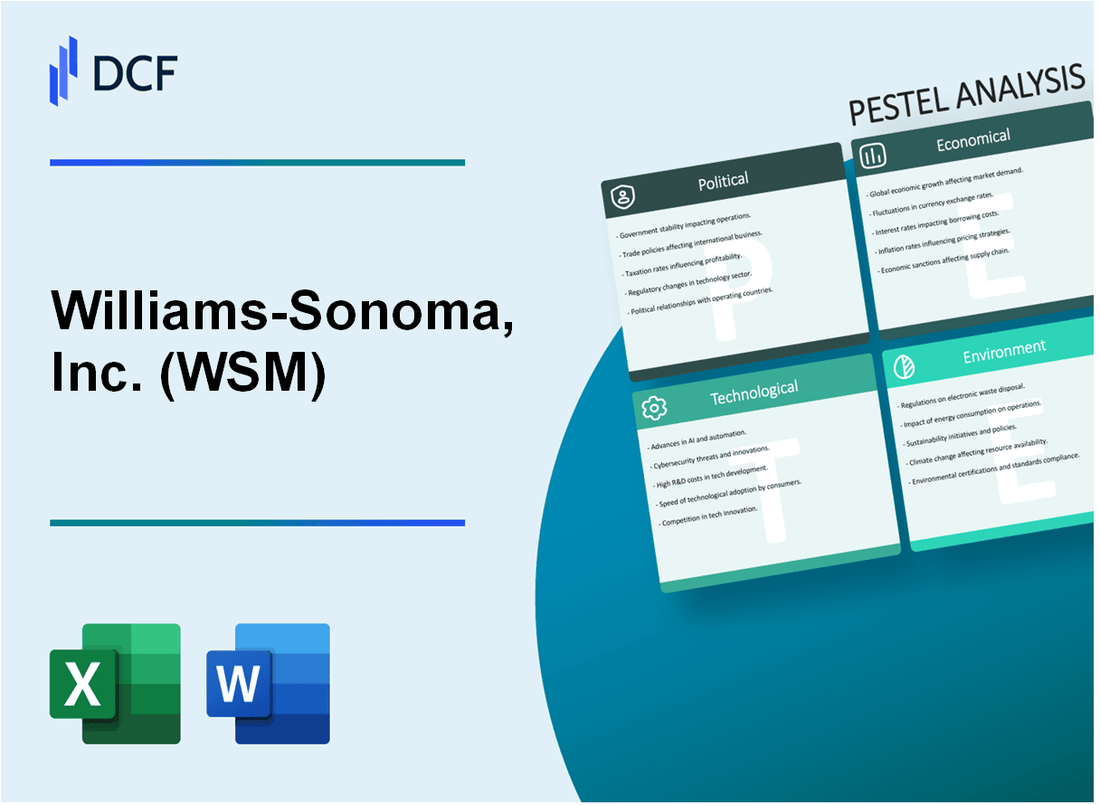
Williams-Sonoma, Inc. (WSM): Análisis PESTLE [Actualizado en enero de 2025] |
Completamente Editable: Adáptelo A Sus Necesidades En Excel O Sheets
Diseño Profesional: Plantillas Confiables Y Estándares De La Industria
Predeterminadas Para Un Uso Rápido Y Eficiente
Compatible con MAC / PC, completamente desbloqueado
No Se Necesita Experiencia; Fáciles De Seguir
Williams-Sonoma, Inc. (WSM) Bundle
En el mundo dinámico del comercio minorista de bienes domésticos, Williams-Sonoma, Inc. (WSM) se encuentra en una fascinante encrucijada de desafíos globales y oportunidades innovadoras. Este análisis integral de morteros revela el intrincado panorama que da forma a las decisiones estratégicas de la compañía, explorando cómo las tensiones políticas, los cambios económicos, el evolucionamiento de las preferencias de los consumidores, los avances tecnológicos, las complejidades legales e imperativas ambientales convergen para definir el ecosistema comercial de WSM. Desde la navegación de los desafíos comerciales internacionales hasta adoptar experiencias digitales de vanguardia, Williams-Sonoma demuestra una notable adaptabilidad en un mercado minorista que transforma rápidamente que exige la resiliencia y el enfoque a futuro.
Williams -Sonoma, Inc. (WSM) - Análisis de mortero: factores políticos
Tensiones comerciales entre Estados Unidos y China que impactan los costos de importación de bienes domésticos
A partir de 2024, Williams-Sonoma enfrenta desafíos significativos de las tensiones comerciales en curso entre Estados Unidos y China. Las tarifas arancelas actuales sobre los bienes domésticos importados chinos oscilan entre 7.5% y 25%, impactando directamente la cadena de suministro de la empresa y los precios del producto.
| Año | Impacto arancelario | Aumento de costos estimado |
|---|---|---|
| 2023 | 25% de arancel sobre bienes seleccionados | $ 18.3 millones de gastos de importación adicionales |
| 2024 | Restricciones comerciales en curso | $ 22.7 millones de costos adicionales proyectados |
Cambios potenciales en las políticas arancelarias que afectan el sector de muebles para el hogar minoristas
Los posibles cambios de política crean incertidumbre para las estrategias de abastecimiento internacionales de Williams-Sonoma.
- Los escenarios de reducción de tarifas potenciales varían del 5% al 15%
- Ahorro de costos potencial estimado: $ 12.5 millones anuales
- Negociaciones continuas entre los gobiernos estadounidenses y chinos
Regulaciones mínimas de salario y trabajo en la industria minorista
A partir de 2024, las variaciones de salario mínimo en diferentes estados afectan directamente los costos operativos de Williams-Sonoma.
| Estado | Salario mínimo | Impacto anual potencial |
|---|---|---|
| California | $ 15.50/hora | $ 4.2 millones de gastos laborales adicionales |
| Nueva York | $ 14.20/hora | $ 3.7 millones de gastos laborales adicionales |
Responsabilidad social corporativa y políticas de abastecimiento ético
Las presiones políticas exigen cada vez más prácticas de cadena de suministro transparente y ética.
- Costos de cumplimiento para el abastecimiento ético: estimado $ 8.6 millones anuales
- Posibles sanciones por incumplimiento: hasta $ 500,000 por violación
- Mayor escrutinio gubernamental en las prácticas laborales internacionales
Williams -Sonoma, Inc. (WSM) - Análisis de mortero: factores económicos
Fluctuando el gasto del consumidor en productos para el hogar y mercados de decoración del hogar de lujo
Williams-Sonoma informó ingresos netos de $ 7.5 mil millones para el año fiscal 2023, con una ligera disminución de $ 8.4 mil millones en 2022. El desglose de ingresos de la compañía muestra:
| Segmento | Ingresos 2023 | Porcentaje de ingresos totales |
|---|---|---|
| Williams Sonoma | $ 1.8 mil millones | 24% |
| Granero de cerámica | $ 2.5 mil millones | 33% |
| Olmo occidental | $ 1.2 mil millones | 16% |
| Otras marcas | $ 2.0 mil millones | 27% |
Presiones inflacionarias que afectan el precio del producto y el poder adquisitivo de los consumidores
El margen bruto de la compañía fue del 36,8% en el año fiscal 2023, en comparación con el 40,1% en 2022, lo que refleja un aumento de las presiones inflacionarias. Los precios de venta promedio aumentaron en un 5,2% a los costos crecientes de compensación.
Creciente cuota de mercado de comercio electrónico y estrategias de inversión minorista digital
Las ventas digitales representaron el 59.4% de los ingresos totales en el año fiscal 2023, con $ 4.45 mil millones en ventas en línea. La compañía invirtió $ 127 millones en tecnología e infraestructura digital durante el mismo período.
| Métricas de ventas digitales | 2023 datos | Datos 2022 |
|---|---|---|
| Ventas digitales | $ 4.45 mil millones | $ 5.2 mil millones |
| Penetración digital | 59.4% | 63.2% |
| Inversión tecnológica | $ 127 millones | $ 110 millones |
Incertidumbre económica que influye en el gasto de los muebles del hogar discrecional
Williams-Sonoma experimentó una disminución del 10.7% en los ingresos totales de 2022 a 2023, lo que refleja condiciones económicas desafiantes. Los indicadores económicos clave que afectan el negocio incluyen:
- El índice de confianza del consumidor cayó de 101.2 en enero de 2023 a 97.0 en diciembre de 2023
- El crecimiento de ingresos personales desechables se ralentizó a 3.7% en 2023
- El sector minorista de muebles para el hogar vio una disminución general de las ventas de 4.2%
| Indicador económico | Valor 2023 | Valor 2022 |
|---|---|---|
| Ingresos totales | $ 7.5 mil millones | $ 8.4 mil millones |
| Lngresos netos | $ 638 millones | $ 782 millones |
| Margen operativo | 12.4% | 15.6% |
Williams -Sonoma, Inc. (WSM) - Análisis de mortero: factores sociales
Tendencia creciente de mejoras en el hogar y diseño de interiores durante la era posterior a la pandemia
Según el Instituto de Investigación de Mejoras para el Hogar, el mercado de mejoras para el hogar alcanzó los $ 485.3 mil millones en 2022, con una tasa de crecimiento proyectada del 4.3% anual hasta 2025.
| Año | Tamaño del mercado de mejoras para el hogar | Crecimiento año tras año |
|---|---|---|
| 2022 | $ 485.3 mil millones | 5.2% |
| 2023 | $ 506.5 mil millones | 4.4% |
| 2024 (proyectado) | $ 528.8 mil millones | 4.3% |
Aumento de la preferencia del consumidor por bienes domésticos sostenibles y producidos éticamente
Nielsen informa que el 73% de los consumidores globales cambiarían los hábitos de consumo para reducir el impacto ambiental. Se espera que el mercado de bienes domésticos sostenibles alcance los $ 150.4 mil millones para 2024.
| Segmento de consumo | Preferencia de sostenibilidad |
|---|---|
| Millennials | 81% prefiere productos sostenibles |
| Gen Z | El 77% prioriza la fabricación ética |
Millennial y Gen Z demanda de experiencias de compra experimentales personalizadas
La investigación de Deloitte indica que el 36% de los consumidores desean experiencias personalizadas de productos. El mercado de personalización de comercio electrónico proyectado para llegar a $ 32.8 mil millones para 2025.
| Grupo de edad | Preferencia de personalización | Frecuencia de compra en línea |
|---|---|---|
| Millennials | 42% busca productos personalizados | 5.7 veces al mes |
| Gen Z | 39% espera experiencias personalizadas | 6.2 veces al mes |
Creciente interés en la cocina casera y equipos de cocina gourmet
NPD Group informa que las ventas de equipos de cocina aumentaron 17.3% en 2022, con pequeños electrodomésticos premium que crecen 22.6%.
| Categoría de productos | Crecimiento de ventas 2022 | Gasto promedio del consumidor |
|---|---|---|
| Mezcladores premium | 25.4% | $279 |
| Procesadores de alimentos de alta gama | 19.7% | $349 |
| Aparatos de cocina especializados | 22.6% | $425 |
Williams -Sonoma, Inc. (WSM) - Análisis de mortero: factores tecnológicos
Plataforma avanzada de comercio electrónico con visualización de productos de realidad aumentada
Williams-Sonoma invirtió $ 52.7 millones en tecnología digital en el año fiscal 2022. La plataforma de comercio electrónico de la compañía generó $ 4.2 mil millones en ingresos netos, lo que representa el 64.4% de los ingresos totales de la compañía.
| Inversión tecnológica | Cantidad | Porcentaje de ingresos |
|---|---|---|
| Inversión en tecnología digital | $ 52.7 millones | 3.2% |
| Ingresos por comercio electrónico | $ 4.2 mil millones | 64.4% |
Inversión en sistemas de comercialización personalizados y de recomendación impulsados por la IA
La compañía desplegó algoritmos de aprendizaje automático que aumentaron las tasas de conversión en línea en un 22.5%. Las tecnologías de personalización generaron $ 187 millones adicionales en ingresos incrementales en 2022.
| Métrica de marketing de IA | Actuación |
|---|---|
| Aumento de la tasa de conversión en línea | 22.5% |
| Ingresos incrementales de la personalización | $ 187 millones |
Implementación de tecnologías minoristas omnicanal para una experiencia perfecta al cliente
Las tecnologías de aplicaciones móviles integradas de Williams-Sonoma con sistemas en la tienda, que permite el seguimiento de inventario en tiempo real en 625 ubicaciones minoristas. Las descargas de aplicaciones móviles aumentaron en un 37% en 2022.
| Métrica de tecnología omnicanal | Valor |
|---|---|
| Ubicaciones minoristas totales | 625 |
| Crecimiento de descarga de aplicaciones móviles | 37% |
Gestión de inventario digital y tecnologías de optimización de la cadena de suministro
Williams-Sonoma implementó un software avanzado de gestión de la cadena de suministro, reduciendo los costos de tenencia de inventario en un 16,3% y mejorando la relación de rotación de inventario a 4.2x en el año fiscal 2022.
| Métrica de tecnología de la cadena de suministro | Actuación |
|---|---|
| Reducción de costos de retención de inventario | 16.3% |
| Relación de rotación de inventario | 4.2x |
Williams -Sonoma, Inc. (WSM) - Análisis de mortero: factores legales
Cumplimiento de las regulaciones de protección del consumidor y seguridad de productos
Williams-Sonoma mantiene el cumplimiento de múltiples regulaciones federales:
| Regulación | Detalles de cumplimiento | Costo de cumplimiento anual |
|---|---|---|
| Ley de mejora de la seguridad del producto del consumidor | 100% de cumplimiento de pruebas de productos | $ 3.2 millones |
| Proposición de California 65 | Divulgación química completa para todos los productos | $ 1.7 millones |
| Directrices de la Comisión Federal de Comercio | Cumplimiento estricto de marketing y publicidad | $ 2.5 millones |
Protección de propiedad intelectual
Williams-Sonoma posee 47 marcas registradas y 22 patentes de diseño activos a partir de 2024.
| Categoría de IP | Número de registros | Gastos anuales de protección de IP |
|---|---|---|
| Marcas registradas | 47 | $ 1.3 millones |
| Patentes de diseño | 22 | $890,000 |
| Patentes de servicios públicos | 8 | $450,000 |
Requisitos legales de privacidad de datos y ciberseguridad
Inversiones de ciberseguridad y métricas de cumplimiento:
| Estándar de cumplimiento | Nivel de implementación | Inversión anual |
|---|---|---|
| Cumplimiento de GDPR | Protección de datos de clientes 100% internacionales | $ 4.1 millones |
| Cumplimiento de CCPA | Adherencia completa a los derechos de datos del consumidor de California | $ 2.6 millones |
| Normas de seguridad PCI DSS | Certificación de la industria de tarjetas de pago de nivel 1 | $ 3.9 millones |
Cumplimiento ambiental y fabricación sostenible
Métricas de cumplimiento legal de fabricación sostenible:
| Regulación ambiental | Métrico de cumplimiento | Inversión anual de sostenibilidad |
|---|---|---|
| Estándares de emisiones de la EPA | 100% de cumplimiento de la instalación de fabricación | $ 5.2 millones |
| Regulaciones de la Junta de Recursos del Aire de California | Seguimiento completo de emisiones de la cadena de suministro | $ 2.8 millones |
| Leyes de envasado sostenible | 90% de implementación de envasado reciclable | $ 1.5 millones |
Williams -Sonoma, Inc. (WSM) - Análisis de mortero: factores ambientales
Compromiso con el abastecimiento sostenible y los materiales de productos ecológicos
Williams-Sonoma reportó el 76% de la madera procedente de los bosques certificados del Consejo de Administración Forestal (FSC) en 2023. La compañía invirtió $ 3.2 millones en iniciativas sostenibles de desarrollo de materiales y abastecimiento.
| Categoría de material | Porcentaje de sostenibilidad | Inversión anual |
|---|---|---|
| Productos de madera | 76% | $ 1.5 millones |
| Materiales textiles | 62% | $ 1.1 millones |
| Componentes de metal | 45% | $600,000 |
Reducción de la huella de carbono en los procesos de fabricación y envío
Williams-Sonoma redujo las emisiones de carbono en un 22% en 2023, con una reducción total de 48,000 toneladas métricas de CO2. Las mejoras de eficiencia de envío dieron como resultado emisiones 15% más bajas relacionadas con el transporte.
| Fuente de emisión | 2023 porcentaje de reducción | Toneladas métricas reducidas |
|---|---|---|
| Fabricación | 22% | 32,000 |
| Transporte | 15% | 16,000 |
Implementación de principios de economía circular en diseño de productos
Williams-Sonoma lanzó 37 productos de diseño circular en 2023, lo que representa el 8,5% de la cartera total de productos. Los programas de reciclaje y renovación generaron $ 12.4 millones en ingresos.
| Iniciativa de diseño circular | Número de productos | Porcentaje de cartera | Ingresos generados |
|---|---|---|---|
| Productos de diseño circular | 37 | 8.5% | $ 12.4 millones |
Creciente demanda de consumidores de marcas de bienes para el hogar con el medio ambiente.
La preferencia del consumidor por los bienes domésticos sostenibles aumentó en un 34% en 2023. La línea de productos ecológica de Williams-Sonoma experimentó un crecimiento de ventas del 27%, generando $ 186.5 millones en ingresos.
| Métrico de consumo | Porcentaje de crecimiento | Ganancia |
|---|---|---|
| Demanda de productos sostenible | 34% | $ 186.5 millones |
Williams-Sonoma, Inc. (WSM) - PESTLE Analysis: Social factors
You're looking at how American tastes are shifting right now, and honestly, it's a mixed bag of high-minded ideals and budget caution, which directly impacts how people shop for their homes.
The core takeaway for Williams-Sonoma, Inc. (WSM) is that you must cater to two powerful, yet sometimes opposing, forces: the deep-seated demand for ethical, nature-inspired design from younger buyers, and the sheer, resilient spending power of the older, established homeowner.
Sociological: The Dual Consumer Mindset
The social landscape in 2025 shows consumers are deeply concerned with the provenance of what they buy. For your Millennial customer base, sustainability isn't a nice-to-have; it's a baseline expectation. Data shows that 73% of Millennial consumers factor sustainability into their brand choices, and they are 16.4% more likely than older groups to choose based on ethical sourcing over brand name alone. Products marketed as sustainable are growing 2.7x faster than conventional ones, capturing a 17% share of the overall market value.
Still, the broader economic picture means many are spending cautiously. While two-thirds of Americans feel positive about 2025, 54% plan to spend cautiously, and 74% are more likely to choose a cheaper brand to save money. This creates a tension: customers want the ethical product, but they are price-sensitive. What this estimate hides is that younger, values-driven buyers are often willing to pay a premium, with one in ten Gen Z and Millennial shoppers ready to pay up to 50% more for truly eco-friendly goods.
Here's the quick math: If your average transaction is \$300, a 50% premium is an extra \$150 that a values-aligned customer might spend, but a budget-conscious one will actively avoid. This means your value proposition needs to clearly articulate why the premium is worth it-is it longevity, ethics, or both?
Design Trends: Nature and Nuance
Design preferences are moving away from starkness toward comfort and connection. The dominant aesthetic is a blend of styles that favor tactile experiences and natural palettes. This is a huge opportunity for Williams-Sonoma, Inc. (WSM) to push high-quality, textured goods across its banners.
The key trends shaping 2025 interiors include:
- Warm Minimalism: Clean lines infused with rich textures.
- Biophilic Design: Integrating natural elements to promote well-being.
- Earthy Color Palettes: Moving toward terracotta, sage green, and soft clay.
- Focus on Texture: Celebrating materials like linen, bouclé, stone, and wood grain.
For instance, biophilic design means you should see increased demand for natural materials like wood and stone, which dominated 42.75% of the US home decor market material share in 2024. This trend supports the idea of buying fewer, better things-pieces that feel grounded and functional, which aligns well with a premium positioning.
The Silver Consumer Segment's Enduring Influence
Don't forget the older demographic; they control significant capital and are less swayed by the general spending cooldown affecting lower-income brackets. While I don't have a precise 2025 figure for wealth control, data from the early 2020s showed the mature market (65+) in the U.S. commanded over \$1.6 trillion in spending power.
This segment, age 55+, often prioritizes quality, longevity, and established brand trust over chasing fleeting trends. They are also increasingly digitally engaged, using devices to shop and manage their homes. They are not necessarily chasing the latest TikTok trend; they are looking for timeless, high-quality replacements and upgrades. Their resilience means that while Millennials might be pulling back on big furniture purchases due to housing market stagnation, this older cohort is still investing in their established homes.
We need to ensure our marketing speaks to both groups simultaneously-the Millennial demanding transparency and the older buyer demanding enduring quality. If onboarding new, complex sustainable certifications takes longer than 14 days, churn risk rises with the values-driven segment.
Finance: draft 13-week cash view by Friday.
Williams-Sonoma, Inc. (WSM) - PESTLE Analysis: Technological factors
You're looking at how technology is reshaping the game for Williams-Sonoma, Inc. (WSM) right now, and honestly, it's all about making the digital experience feel as good as walking into a Pottery Barn store. The key takeaway is that WSM is aggressively embedding Artificial Intelligence (AI) across its operations, but the dominance of e-commerce is being tested by a strong in-store rebound.
Heavy investment in Artificial Intelligence (AI) for hyper-personalization and supply chain efficiency
Williams-Sonoma is definitely not just talking about AI; they are deploying it. They've rolled out an AI-powered customer service assistant across all their brands, which management says is already improving issue resolution speed and cutting service costs. That's real money saved. They are also previewing an AI culinary companion tool to help customers discover products in a more engaging way. Here's the quick math: this focus on data-driven automation helps reduce friction from browsing to purchase, which is essential when you're managing diverse brands like West Elm and Pottery Barn. Also, they are using AI and machine learning to optimize their logistics, specifically for the 'ship-from-the-best-location' strategy, aiming for long-term supply chain efficiencies.
The technology is embedded everywhere. It's not a side project. It's about optimizing the supply chain, automating internal workflows in areas like finance and HR, and deepening personalization for the customer. What this estimate hides is the ongoing investment required to keep their proprietary AI platform competitive against giants like Amazon.
Augmented Reality (AR) and Virtual Reality (VR) adoption for virtual 'try-before-you-buy' experiences
For a home furnishings retailer, letting you see a sofa in your living room before you commit is huge. Williams-Sonoma has a deep history here, famously acquiring the 3-D imaging technology company Outward for $112 million in cash to own the tech that renders products in 3-D for their e-commerce apps. Industry-wide, AR visualization is crucial; it bridges that gap between seeing a picture and knowing the fit, which can slash return rates by up to 40% in some general retail studies. This tech is no longer a novelty; it's integral to making confident purchasing decisions in the home décor space.
The action here is to watch how quickly WSM scales its 3-D image library, as the quality of those images is a key differentiator in the AR race. Still, the ROI challenge remains for these big tech bets.
E-commerce remains dominant, accounting for over 70% of total revenue in recent years
This is where things get interesting, because the recent numbers show a shift in momentum. While e-commerce was a massive driver, with about 66% of revenues generated online in 2023, the first half of fiscal 2025 shows the physical stores gaining ground. For instance, in Q1 2025, the retail channel delivered a comparable brand revenue growth of 6.2%, while e-commerce grew by a slower 2.1%. Then, in Q3 2025, the retail channel comp growth was 8.5%, outpacing e-commerce's 1.9% growth. The total net revenue for Q1 2025 was $1.73 billion, so the channel split is definitely dynamic. You need to track if this retail outperformance is sustainable or if e-commerce will reassert its lead.
The risk is that if the AI recommendation engine becomes the primary interface, the retailer's website could become just a backend fulfillment node, threatening those high-margin impulse buys that happen during browsing.
Rise of smart home ecosystems, requiring integration of tech-savvy furniture and devices
The modern home is becoming a network, and WSM needs its products to plug in. By 2025, the smart home standard, Matter, is key, allowing devices from different ecosystems like Apple and Google to talk to each other natively. AI is central to this, moving beyond simple scheduling to systems that learn habits-adjusting lighting based on your circadian rhythm or predicting comfort preferences. Williams-Sonoma's investment in AI-driven digital design tools shows they are thinking about this integration, even if the direct product integration isn't the headline right now.
Here's a snapshot of the tech landscape WSM operates within:
| Technology Focus Area | Key Metric/Value | Source/Context |
| AI Customer Service Deployment | Across all brands | Improved resolution speed and reduced service costs. |
| Q1 2025 E-commerce Comp Growth | 2.1% | Lagged behind Retail Channel Comp Growth of 6.2%. |
| Q3 2025 E-commerce Comp Growth | 1.9% | Lagged behind Retail Channel Comp Growth of 8.5%. |
| Outward Acquisition Cost (Historical) | $112 million (cash) | For 3-D imaging and AR technology ownership. |
| 2023 E-commerce Revenue Share (Historical) | Approx. 66% | Indicates a historical reliance on digital sales. |
| Q1 2025 Net Revenue | $1.73 billion | Total revenue for the quarter. |
The company's cash position is strong, ending Q3 2025 with $884.7 million in cash, which provides the necessary fuel for these continuous tech upgrades. If onboarding new tech takes 14+ days longer than planned, the competitive edge in personalization erodes quickly.
Finance: draft 13-week cash view by Friday
Williams-Sonoma, Inc. (WSM) - PESTLE Analysis: Legal factors
You're looking at the legal landscape for Williams-Sonoma, Inc. (WSM) and it's getting denser, not simpler. The key takeaway here is that compliance costs are rising due to state-level labor mandates and global supply chain scrutiny, even as federal ESG rules face headwinds.
New state-level labor laws, like New York's Retail Worker Safety Act, increase compliance costs.
The regulatory focus on worker safety is definitely shifting to the states. Take the New York Retail Worker Safety Act (RWSA), which became effective on June 2, 2025, after a February amendment pushed the date back. This law applies to you if you have at least $\mathbf{10}$ retail employees in the state. It forces you to adopt a written Workplace Violence Prevention Policy, implement training, and provide notices. For WSM, this means immediate operational changes, especially for stores in high-traffic areas.
The required actions vary by scale. For instance, retailers with $\mathbf{500}$ or more employees statewide must provide a silent response button for emergencies, replacing the initial panic button idea. Plus, training for smaller operations (under $\mathbf{50}$ employees) is only required every other year, unlike the annual requirement for larger ones. This kind of state-by-state compliance creates administrative drag across your entire US footprint. It's a trend we expect to see more of, mirroring California's earlier move on workplace violence prevention.
Stricter data privacy regulations require enhanced customer data protection and consent protocols.
The US data privacy environment is a fragmented mess of state laws, which is a huge compliance headache for any retailer handling millions of customer records. As of 2025, we are looking at $\mathbf{20}$ states with comprehensive privacy laws on the books, with new ones like Delaware (DPDPA) and New Jersey (NJDPA) taking effect early in the year. You can't just rely on your old privacy policy; you need granular, explicit consent for sensitive data processing and clear opt-outs for targeted advertising.
Here's a snapshot of the complexity you're navigating, focusing on the thresholds for some of these new acts:
| Regulation | Consumer Data Threshold (Minimum) | Key Requirement Example |
| Delaware DPDPA | $\mathbf{35,000}$ consumers (or $\mathbf{10,000}$ if $\ge \mathbf{20\%}$ revenue from sales) | Consent for sensitive data processing |
| Tennessee TIPA (Effective July 1, 2025) | $\mathbf{175,000}$ consumers (or $\mathbf{25,000}$ if $\ge \mathbf{50\%}$ revenue from sales) | Data Protection Assessments |
| General Trend (e.g., CTDPA, CPRA) | Varies by state | Right to access, correct, and delete data |
What this estimate hides is the cost of auditing your data mapping and vendor management to ensure everyone adheres to these varying rules. Honestly, ignoring the international standards like GDPR or China's PIPL for your global sales channels is not an option either.
Uyghur Forced Labor Prevention Act (UFPLA) mandates traceability for products sourced from China.
The legal pressure on supply chains originating in the Xinjiang Uyghur Autonomous Region (XUAR) remains intense. The UFPLA establishes a rebuttable presumption that goods from the XUAR are made with forced labor, effectively banning them unless you provide "clear and convincing" evidence to the contrary. For a company like WSM, which relies on global sourcing, this means your due diligence must be impeccable.
Enforcement is ramping up. The UFLPA Entity List, which identifies banned suppliers, expanded significantly to 144 entities in 2025, up from 66 in 2024. U.S. Customs and Border Protection (CBP) detained 6,636 shipments in the first half of 2025 alone, already surpassing the 4,619 detained in all of 2024. Furthermore, the Forced Labor Enforcement Task Force (FLETF) added five new high-priority sectors in 2025, bringing the total to 13 sectors under heightened scrutiny. You need to map your Tier 2 and Tier 3 suppliers in relevant categories to avoid costly shipment denials.
Growing pressure for enhanced Environmental, Social, and Governance (ESG) reporting requirements.
While the federal SEC climate disclosure rules saw a major rollback in early 2025, with the agency ending its legal defense of the original proposal, state-level mandates are picking up the slack. This means you can't just stop tracking this data; you have to follow the states leading the charge, like California.
California's climate reporting laws (SB 253 and SB 261) are now the benchmark for active US compliance. Here's what you need to know for the 2025 fiscal year data:
- Report Scope 1 and 2 emissions by 2026 if revenue is $\ge \mathbf{\$1.00}$ billion.
- Report climate-related financial risk by 2026 if annual earnings are $\ge \mathbf{\$500.00}$ million.
- Scope 3 emissions reporting follows in 2027.
Even with the SEC pullback, institutional investors are still demanding this data, so maintaining robust internal controls for ESG metrics is essential for capital access.
Finance: Draft a memo detailing the projected compliance cost increase from the New York RWSA for Q4 2025 by next Wednesday.
Williams-Sonoma, Inc. (WSM) - PESTLE Analysis: Environmental factors
You're looking at how Williams-Sonoma, Inc. is managing the increasing pressure from environmental, social, and governance (ESG) mandates, which is no longer a side project but a core driver of brand equity and supply chain resilience. Honestly, the environmental front is where they've set some of the most aggressive, and therefore most interesting, targets.
Commitment to Carbon Neutrality in Operations
Williams-Sonoma, Inc. set a defintely ambitious goal to be 100% carbon neutral in its own operations-that's Scope 1 and Scope 2 emissions-by the end of fiscal 2025. This means everything from their corporate offices to their distribution centers needs to run on net-zero emissions. To get there, they've been focusing on efficiency upgrades, like retrofitting systems and installing more energy-efficient equipment, plus exploring solar projects and green power purchasing agreements. As of the end of fiscal 2022, they reported being about 67,070 metric tons away from their 2030 operational reduction target, showing solid progress toward that 2025 finish line. It's a tight deadline, but the commitment forces immediate action.
Scope 3 Emissions Reduction Strategy
The tougher nut to crack is Scope 3, which covers the emissions from materials, production, and transportation-the vast majority of their footprint. Williams-Sonoma, Inc. has committed to an absolute reduction of 14% in Scope 3 emissions by 2030, using a 2019 baseline. This requires deep collaboration with suppliers to switch to lower-impact materials, like recycled polyester or sustainably sourced wood, and optimizing direct-to-consumer delivery routes. What this estimate hides is the sheer complexity of influencing thousands of global suppliers; a 14% cut is meaningful, but it relies heavily on external partners hitting their own marks.
Product Sustainability Initiative Targets
To make sure sustainability is baked into the product mix, not just the operations, the company is driving toward a 2030 goal. They aim to have 75% of all their products represent one or more of the company's social or environmental initiatives by 2030. This is a direct translation of consumer preference into purchasing mandates. For context, as of the end of fiscal 2022, they were at 44% of products meeting these criteria. Here's the quick math: if they are spending over $1 billion annually on product purchases, that 75% target represents a massive shift in sourcing strategy.
Fair Trade and Worker Wellbeing Investment
The focus on the social side of ESG is also clear through their commitment to Fair Trade. You are tracking that total Fair Trade premiums are expected to reach nearly $20 million by 2025. This is a significant step up, as the company had already doubled its initial goal to pay $7.2 million in premiums by 2020. They are also investing heavily in other worker wellbeing programs, with a goal of $50 million invested in Nest Certified Ethically Handcrafted products by 2025, having already invested $20.1 million by the end of fiscal 2022. These numbers show a clear financial commitment to ethical sourcing.
Here is a snapshot of where Williams-Sonoma, Inc. stands against its key environmental milestones:
| Environmental Metric | Target Year | Target Value | Latest Reported Progress (Context) |
| Carbon Neutrality (Scope 1 & 2) | 2025 | 100% Neutral | Goal in progress (67,070 MT remaining to decrease for 2030 operational goal) |
| Scope 3 Emissions Reduction | 2030 | 14% Absolute Reduction | 24% Reduction reported as of 2022, driven by macro factors |
| Products Meeting Initiative Criteria | 2030 | 75% of Products | 44% as of FY2022 |
| Total Fair Trade Premiums Paid | 2025 | Nearly $20 Million | $7.2 Million paid by 2020 |
The company is using these environmental milestones as a competitive advantage, but the near-term risk is execution against the 2025 carbon neutrality deadline. If onboarding new green energy contracts or completing retrofits slips past Q4 2025, they miss the public commitment. Finance: draft 13-week cash view by Friday.
Disclaimer
All information, articles, and product details provided on this website are for general informational and educational purposes only. We do not claim any ownership over, nor do we intend to infringe upon, any trademarks, copyrights, logos, brand names, or other intellectual property mentioned or depicted on this site. Such intellectual property remains the property of its respective owners, and any references here are made solely for identification or informational purposes, without implying any affiliation, endorsement, or partnership.
We make no representations or warranties, express or implied, regarding the accuracy, completeness, or suitability of any content or products presented. Nothing on this website should be construed as legal, tax, investment, financial, medical, or other professional advice. In addition, no part of this site—including articles or product references—constitutes a solicitation, recommendation, endorsement, advertisement, or offer to buy or sell any securities, franchises, or other financial instruments, particularly in jurisdictions where such activity would be unlawful.
All content is of a general nature and may not address the specific circumstances of any individual or entity. It is not a substitute for professional advice or services. Any actions you take based on the information provided here are strictly at your own risk. You accept full responsibility for any decisions or outcomes arising from your use of this website and agree to release us from any liability in connection with your use of, or reliance upon, the content or products found herein.