

|
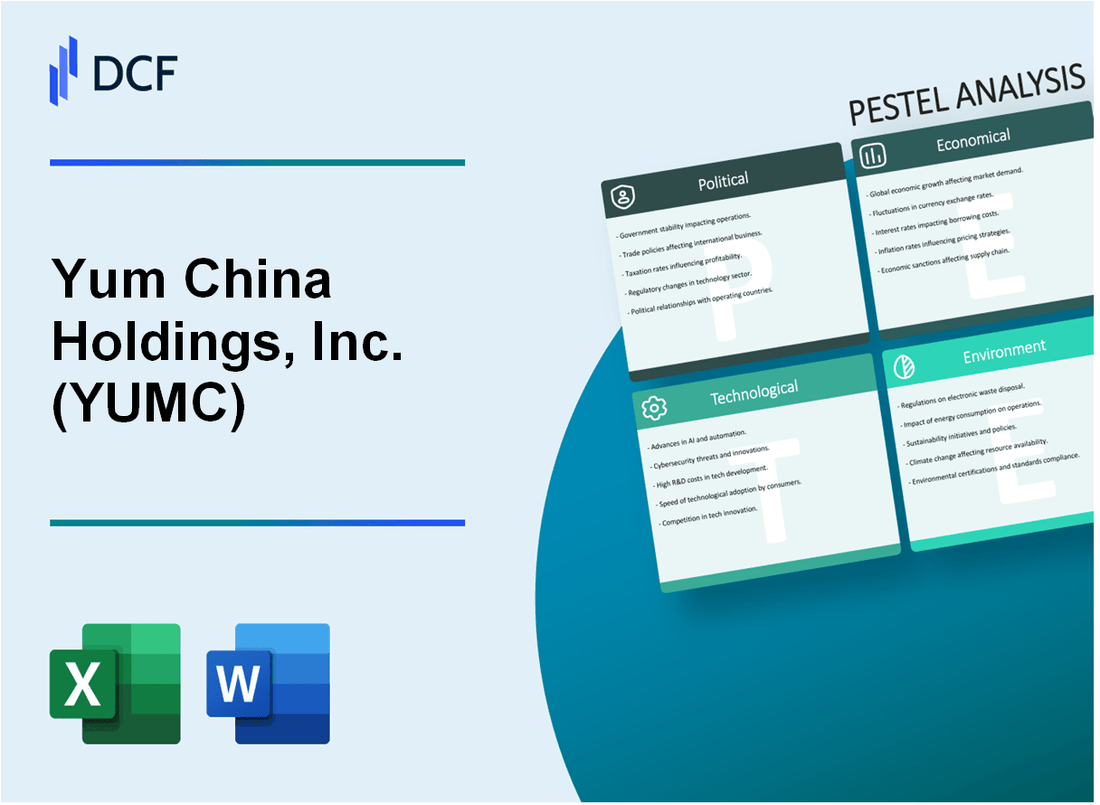
Yum China Holdings, Inc. (YUMC): Análisis PESTLE [Actualizado en enero de 2025] |
Completamente Editable: Adáptelo A Sus Necesidades En Excel O Sheets
Diseño Profesional: Plantillas Confiables Y Estándares De La Industria
Predeterminadas Para Un Uso Rápido Y Eficiente
Compatible con MAC / PC, completamente desbloqueado
No Se Necesita Experiencia; Fáciles De Seguir
Yum China Holdings, Inc. (YUMC) Bundle
En el panorama dinámico de las empresas globales de comida rápida, Yum China Holdings, Inc. (YUMC) se erige como un estudio de caso fascinante de la navegación de desafíos del mercado complejos. Este análisis integral de mano de mortero profundiza en el entorno externo multifacético que da forma a las decisiones estratégicas de la compañía, revelando complejas capas de factores políticos, económicos, sociológicos, tecnológicos, legales y ambientales que influyen continuamente en sus operaciones en el mercado más popular del mundo. Desde las regulaciones gubernamentales hasta las innovaciones tecnológicas, desde las preferencias de los consumidores cambiantes hasta los desafíos de sostenibilidad, el análisis proporciona una visión panorámica del intrincado ecosistema en el que YUMC debe maniobrar estratégicamente para mantener su ventaja competitiva e impulsar el crecimiento sostenible en el mercado chino en rápida evolución.
Yum China Holdings, Inc. (Yumc) - Análisis de mortero: factores políticos
Las estrictas regulaciones de seguridad alimentaria del gobierno chino
En 2023, la ley de seguridad alimentaria de China impuso regulaciones estrictas con posibles multas de hasta 5 millones de yuanes (aproximadamente $ 727,000) por violaciones de seguridad alimentaria. Yum China debe cumplir con estas regulaciones en sus 9.877 restaurantes en el país.
| Categoría de regulación | Requisitos de cumplimiento | Sanciones potenciales |
|---|---|---|
| Trazabilidad del ingrediente alimentario | Documentación del proveedor del 100% | Hasta 500,000 yuan bien |
| Normas de higiene de cocina | Inspecciones de salud mensuales | Suspensión de la licencia de operación |
| Monitoreo de la cadena de suministro | Sistemas de seguimiento en tiempo real | Revocación de licencias comerciales |
Impacto en las tensiones comerciales de US-China
A partir del cuarto trimestre de 2023, las tensiones comerciales en curso han aumentado la complejidad operativa para Yum China, con posibles implicaciones arancelarias del 10-25% en ingredientes y equipos alimentarios importados.
- Tarifas impuestas por Estados Unidos: estimados de $ 1.2 millones costos anuales adicionales para Yum China
- Interrupciones de la cadena de suministro transfronteriza: 15% aumentando los desafíos de adquisición
- Aceleración de la estrategia de localización: el 85% de los ingredientes ahora se obtienen a nivel nacional
Covid-19 Pandemic Policy Influences
Las políticas dinámicas de covid cero de China en 2022-2023 afectaron significativamente las operaciones de restaurantes, con bloqueos periódicos y restricciones de capacidad.
| Período de política | Limitación de capacidad de restaurante | Impacto de ingresos |
|---|---|---|
| Q1 2023 | Capacidad de asientos del 50% | Reducción de ingresos del 12% |
| Q2 2023 | 75% Capacidad de asientos | 6% de reducción de ingresos |
| Q3-Q4 2023 | Restauración de capacidad total | Recuperación operativa completa |
Escrutinio regulatorio comercial de propiedad extranjera
El gobierno chino mantiene una supervisión estricta de las empresas de servicios de alimentos de propiedad extranjera, con mayores requisitos de cumplimiento regulatorio.
- Restricciones de propiedad extranjera: máximo 51% de capital extranjero en cadenas de restaurantes
- Requisitos obligatorios de asociación local
- Mayos de informes y transparencia aumentados
Inversiones de cumplimiento regulatorio: Yum China asignó aproximadamente $ 45 millones en 2023 para el cumplimiento regulatorio y la gestión de relaciones del gobierno local.
Yum China Holdings, Inc. (YUMC) - Análisis de mortero: factores económicos
Fluctuando el poder del gasto del consumidor en el mercado chino
Según la Oficina Nacional de Estadísticas de China, el ingreso disponible per cápita en 2023 fue de 58,035 yuanes, lo que representa un aumento interanual del 6,1%. El índice de confianza del consumidor fluctuó entre 120-125 puntos a lo largo de 2023.
| Año | Ingresos disponibles per cápita (yuan) | Índice de confianza del consumidor |
|---|---|---|
| 2023 | 58,035 | 122.5 |
| 2022 | 54,282 | 115.3 |
Aumento de los costos laborales en los principales centros urbanos
Salarios mensuales mínimos en ciudades chinas clave a partir de 2024:
| Ciudad | Salario mínimo mensual (yuan) |
|---|---|
| Llevar a la fuerza | 2,590 |
| Beijing | 2,420 |
| Shenzhen | 2,360 |
La desaceleración económica potencialmente reduciendo los gastos de comidas discrecionales
La tasa de crecimiento del PIB de China en 2023 fue de 5.2%, con un crecimiento proyectado de 2024 en aproximadamente 4.8%. El gasto en el hogar en cenar disminuyó en un 3,7% en 2023 en comparación con el año anterior.
Tasas de cambio volátiles que afectan el desempeño financiero internacional
Fluctuaciones del tipo de cambio USD/CNY en 2023:
| Período | Tipo de cambio | Cambio porcentual |
|---|---|---|
| Enero de 2023 | 6.75 | - |
| Diciembre de 2023 | 7.10 | 5.2% |
La exposición financiera de Yum China a la volatilidad del tipo de cambio resultó en un impacto del 2.1% en la traducción de ingresos internacionales en 2023.
Yum China Holdings, Inc. (Yumc) - Análisis de mortero: factores sociales
Oportunidades de expansión de restaurantes de conducción rápida de urbanización
La población urbana de China alcanzó los 915.47 millones en 2022, lo que representa el 64.72% de la población total. Yum China opera 12.360 restaurantes en 1.700 ciudades a partir del tercer trimestre de 2023.
| Métrica de población urbana | Datos 2022 |
|---|---|
| Población urbana total | 915.47 millones |
| Porcentaje de población urbana | 64.72% |
| Yum China Restaurant Count | 12,360 |
| Ciudades cubiertas | 1,700 |
Cambiar las preferencias del consumidor hacia el pedido digital y la entrega
El mercado de entrega de alimentos en línea en China alcanzó los $ 93.6 mil millones en 2022. Las ventas digitales de Yum China comprendieron el 83% de las ventas totales del sistema en el tercer trimestre de 2023.
| Métrica de pedidos digitales | 2022-2023 datos |
|---|---|
| Tamaño del mercado de entrega de alimentos en línea | $ 93.6 mil millones |
| Porcentaje de ventas digitales de Yum China | 83% |
Cultivo de la demografía de clase media con hábitos de cena crecientes
La población de clase media de China alcanzó los 400 millones en 2022. El gasto promedio anual de comidas per cápita aumentó a $ 685 en áreas urbanas.
Las generaciones más jóvenes que prefieren las marcas internacionales de comida rápida
La generación Z representa el 17.2% de la población de China. El 62% de los consumidores de entre 18 y 35 años prefieren marcas internacionales de restaurantes.
Consumidores conscientes de la salud que exigen más opciones de menú nutricional
El mercado de alimentos de salud y bienestar en China valorado en $ 57.3 mil millones en 2022. Yum China introdujo 30 elementos de menú bajo en calorías en las marcas en 2023.
| Métrica de comidas consciente de la salud | 2022-2023 datos |
|---|---|
| Valor de mercado de alimentos saludables | $ 57.3 mil millones |
| Elementos de menú bajo en calorías agregados | 30 |
Yum China Holdings, Inc. (YUMC) - Análisis de mortero: factores tecnológicos
Plataformas avanzadas de pago digital y pedidos
Yum China procesó 1.900 millones de pedidos digitales en 2022, representando 84% de ventas totales del sistema. El ecosistema digital de la compañía incluye WeChat Pay, Alipay y Mini-Programas patentados en KFC, Pizza Hut y Taco Bell Brands.
| Plataforma digital | Usuarios activos mensuales | Porcentaje de pedido |
|---|---|---|
| Mini-Programa de WeChat | 350 millones | 45% |
| Plataforma Alipay | 280 millones | 35% |
| Aplicación de la empresa | 220 millones | 20% |
Integración de inteligencia artificial en servicio al cliente y operaciones
Yum China invirtió $ 52 millones En AI Technologies durante 2022, la implementación de algoritmos de aprendizaje automático para la gestión de inventario y los sistemas de recomendación de clientes.
Expandir las capacidades de aplicaciones móviles para marketing personalizado
La aplicación móvil de Yum China logró 220 millones de usuarios activos mensuales en 2022, con algoritmos de personalización conduciendo 37% de transacciones de clientes repetidas.
Inversión en análisis de datos para la predicción del comportamiento del consumidor
Las inversiones de análisis de datos totalizaron $ 38.7 millones En 2022, habilitando el modelado predictivo en más de 9,000 ubicaciones de restaurantes.
| Categoría de análisis | Monto de la inversión | Precisión predictiva |
|---|---|---|
| Comportamiento del consumidor | $ 22.4 millones | 85% |
| Optimización de inventario | $ 10.3 millones | 78% |
| Orientación de marketing | $ 6 millones | 82% |
Tecnologías gastronómicas sin contacto post-pandemia
Implementó tecnologías sin contacto en todo 95% de ubicaciones de restaurantes, con $ 67.5 millones Invertido en sistemas de pedidos y pagos sin toque en 2022.
- Escaneo del menú de código QR
- Integración de pagos móviles
- Quioscos de autoservicio
- Opciones de entrega sin contacto
Yum China Holdings, Inc. (Yumc) - Análisis de mortero: factores legales
Cumplimiento de estrictas regulaciones de seguridad alimentaria china
A partir de 2024, Yum China enfrenta rigurosas regulaciones de seguridad alimentaria impuesta por la Administración de Drogas y Alimentos de China (CFDA). La empresa debe adherirse a 18 Normas nacionales específicas de seguridad alimentaria.
| Categoría de regulación | Requisito de cumplimiento | Rango de penalización |
|---|---|---|
| Trazabilidad del ingrediente alimentario | Documentación del proveedor del 100% | ¥ 50,000 - ¥ 500,000 por violación |
| Inspección de higiene | Auditorías trimestrales de terceros | Suspensión de licencia comercial potencial |
Desafíos de protección de la propiedad intelectual
Yum China invierte ¥ 42 millones anualmente en estrategias de protección de propiedad intelectual en su cartera de marca.
Regulaciones de la ley laboral
La compañía cumple con regulaciones laborales integrales, incluido:
- Requisitos de salario mínimo de ¥ 2,360 por mes en ciudades de nivel 1
- Contribuciones obligatorias de seguro social del 35-40% del salario de los empleados
- Regulaciones estrictas de compensación de horas extras
| Categoría de regulación laboral | Métrico de cumplimiento | Impacto anual de costos |
|---|---|---|
| Seguro social | 100% de cobertura de empleados | ¥ 780 millones |
| Regulación de horas de trabajo | Máximo 40 horas/semana | ¥ 210 millones en gestión de cumplimiento |
Requisitos legales de privacidad de datos y ciberseguridad
Yum China asigna ¥ 68 millones anualmente Para el cumplimiento de la ciberseguridad y la protección de datos, cumplen con los estándares de la Ley de Protección de Información Personal de China (PIPL).
Acuerdo de franquicia y cumplimiento de licencias
La empresa administra 9.406 restaurantes con estrictos protocolos de licencia, invertir ¥ 35 millones en gestión anual de cumplimiento legal.
| Categoría de licencias | Número de licencias | Frecuencia de renovación |
|---|---|---|
| Licencia de operación de restaurante | 9,406 | Anual |
| Certificación de seguridad alimentaria | 9,406 | Anual |
Yum China Holdings, Inc. (YUMC) - Análisis de mortero: factores ambientales
Aumento del enfoque en soluciones de envasado sostenible
En 2023, Yum China se comprometió con Paquete 100% reciclable, recuperable o compostable para 2025. Las métricas de sostenibilidad del embalaje actual incluyen:
| Categoría de embalaje | Porcentaje sostenible | Objetivo de reducción anual |
|---|---|---|
| Embalaje de plástico | 68% | 15% de reducción para 2025 |
| Embalaje basado en papel | 82% | Reducción del 20% para 2025 |
Reducción de la huella de carbono en las operaciones de restaurantes
Objetivos de reducción de emisiones de carbono para las operaciones de restaurantes de Yum China:
| Alcance de emisión | 2023 emisiones (toneladas métricas CO2E) | Objetivo de reducción |
|---|---|---|
| Alcance 1 | 124,567 | 30% para 2030 |
| Alcance 2 | 256,890 | 40% para 2030 |
Implementación de programas de gestión de residuos y reciclaje
Indicadores de rendimiento de gestión de residuos:
| Categoría de desechos | Volumen anual (toneladas) | Tasa de reciclaje |
|---|---|---|
| Desperdicio de alimentos | 45,678 | 62% |
| Desperdicio de envasado | 23,456 | 75% |
Abastecimiento de ingredientes de proveedores ambientalmente responsables
Métricas de sostenibilidad del proveedor:
- El 86% de los proveedores tienen certificación ambiental
- 92% cumplir con las pautas de abastecimiento sostenibles
- $ 45 millones invertidos en prácticas agrícolas sostenibles
Iniciativas de eficiencia energética en infraestructura de restaurantes
Datos de consumo de energía y eficiencia:
| Tipo de energía | Consumo anual | Mejora de la eficiencia |
|---|---|---|
| Electricidad | 345,678 MWh | Reducción del 22% desde 2020 |
| Gas natural | 56,789 mmbtu | Reducción del 18% desde 2020 |
Yum China Holdings, Inc. (YUMC) - PESTLE Analysis: Social factors
Rapid urbanization drives demand for convenient, quick-service restaurant (QSR) options.
China's ongoing urbanization is a massive tailwind for the quick-service restaurant (QSR) sector, creating a huge, concentrated consumer base that prioritizes convenience. The country's urbanization rate is expected to be near 70% in the next five years, up from approximately 67% in 2024. This shift means millions more people are moving into cities, increasing the demand for fast, reliable, and branded food options like KFC and Pizza Hut.
This demographic shift is why Yum China Holdings, Inc. is executing an aggressive expansion strategy, focusing heavily on lower-tier cities where QSR penetration is still lower. The company is on track to open between 1,600 to 1,800 net new stores in the 2025 fiscal year, aiming to reach 20,000 total stores by the end of 2026. This rapid expansion is directly capitalizing on the convenience needs of new urban residents.
Health and wellness trends increase demand for non-fried and plant-based menu items.
Consumers, especially the emerging middle class in urban centers, are increasingly focused on health and wellness, a trend that directly challenges traditional fried QSR menus. This is not just a niche; global plant-based food market size is growing rapidly, projected to reach $64.14 billion in 2025. Yum China Holdings, Inc. is responding by diversifying its menu and launching new concepts.
In 2024 alone, the company introduced around 600 new or upgraded menu items across its brands, showing a commitment to innovation beyond the core fried chicken. They are actively developing concepts like KPro, a light-meal concept focused on healthier choices, and exploring the use of alternative ingredients. This shift is critical because artificiality is a rising barrier to purchase for consumers in the plant-based space, making natural, whole-plant ingredients more desirable. You must keep innovating here.
Strong brand loyalty to established names like KFC and Pizza Hut remains a key asset.
The decades-long presence of KFC and Pizza Hut in China has built a deep reservoir of brand trust and loyalty, which is a massive competitive advantage. This loyalty is quantified through the company's industry-leading digital membership program, which has grown to approximately 560 million members as of the second quarter of 2025. This is a huge, defintely sticky customer base.
The financial impact of this loyalty is clear: member sales accounted for approximately 64% of KFC and Pizza Hut's system sales in aggregate as of June 30, 2025. This high percentage of repeat, member-driven business provides a stable revenue base and allows for precise, personalized marketing campaigns, making new customer acquisition costs lower over time.
Younger consumers (Gen Z) prioritize digital experience and social media engagement.
China's Gen Z cohort (born 1997-2012) represents nearly 20% of the population and dictates the future of retail engagement. They are digital natives who live on their smartphones, with over 94% using them for purchases. Yum China Holdings, Inc. has successfully captured this digital-first consumer, turning its restaurants into a truly omnichannel experience.
The company's digital leadership is a key social factor advantage. In Q2 2025, digital sales accounted for an astounding 94% of total company revenue, totaling $2.4 billion for the quarter. Furthermore, delivery sales grew a strong 32% year-over-year in the third quarter of 2025, demonstrating effective use of platforms like Douyin (TikTok China) and Xiaohongshu (RED) for customer engagement and fulfillment.
Here's the quick math on how critical digital engagement is:
| Metric (as of Q3 2025) | Value/Amount | Significance |
|---|---|---|
| Total Store Count | 17,514 | Physical reach to meet urbanization demand. |
| Digital Sales as % of Total Revenue (Q2 2025) | 94% ($2.4 billion) | Digital fluency is near-total. |
| Total Membership Base | Approximately 560 million | Massive scale of brand loyalty. |
| Member Sales as % of System Sales (KFC & Pizza Hut, Q2 2025) | Approximately 64% | Core revenue is driven by loyalty. |
| Delivery Sales Growth (Q3 2025 YoY) | 32% | Strong execution on convenience and digital fulfillment. |
The next step is simple: Finance and Marketing need to draft a 2026 budget allocating a 20% increase to Douyin-specific interactive content and livestreaming initiatives by January 15th.
Yum China Holdings, Inc. (YUMC) - PESTLE Analysis: Technological factors
The technological landscape is not just a factor for Yum China Holdings, Inc.; it is the core operating system for the entire business model. You're looking at a company that has fully embraced digitization, moving far beyond simple online ordering to integrating Artificial Intelligence (AI) into the kitchen and supply chain to combat rising costs and improve efficiency. This deep tech integration is a major competitive moat (a sustainable competitive advantage).
Digital orders are projected to account for over 90% of YUMC sales in 2025.
The shift to digital is essentially complete, making Yum China more of a tech-enabled retailer than a traditional quick-service restaurant (QSR) chain. In the third quarter of 2025, digital ordering accounted for approximately 95% of total Company sales. That's a huge number. This massive volume of digital transactions, which totaled $2.8 billion in sales for Q3 2025 alone, provides the high-quality data needed to fuel their advanced AI systems. Delivery is a major component of this, contributing approximately 51% of total Company sales in Q3 2025.
Here's the quick math: nearly all sales are now a data point. This makes their physical store network a powerful distribution and fulfillment hub, not just a dining spot.
Proprietary membership programs drive data collection and personalized marketing.
The proprietary membership programs for KFC and Pizza Hut are the engine driving this digital dominance, creating a closed-loop ecosystem that captures customer preferences directly. As of September 30, 2025, the combined membership across KFC and Pizza Hut exceeded 575 million, representing a strong 13% year-over-year increase. This massive, engaged base means the company can execute highly targeted marketing campaigns and product launches.
The commercial impact is clear: member sales accounted for approximately 57% of KFC and Pizza Hut's system sales in aggregate during Q3 2025. This level of direct customer engagement is defintely a strategic advantage over competitors relying heavily on third-party aggregators (like DoorDash or Uber Eats in the US market, but in the China context, Meituan or Ele.me).
| Key Digital & Membership Metrics (Q3 2025) | Value | Significance |
| Digital Ordering % of Total Sales | ~95% | Near-total digitization of the customer journey. |
| Delivery % of Total Sales | ~51% | Delivery is the dominant channel for over half of all sales. |
| Total Members (as of Sep 30, 2025) | Over 575 million | Massive, growing customer data pool. |
| Member Sales % of System Sales | ~57% | Demonstrates high loyalty and marketing effectiveness. |
Investment in AI for demand forecasting optimizes inventory and reduces food waste.
The company's investment in Artificial Intelligence (AI) is focused on the back-end, specifically to improve operational efficiency and margin. Their AI platform utilizes decision-supporting capabilities like forecasting, optimization, and recommendation. For instance, the new Q-Smart AI-powered assistant, which is currently being piloted in select KFC stores, is designed to help restaurant managers with critical, time-consuming tasks.
This system monitors sales data in real-time to align inventory levels with sales forecasts, prompting managers for timely ordering and replenishment decisions. This directly addresses the risk of food waste and ensures optimal inventory, which is crucial for a high-volume, fresh-food operation. The company is committed to reducing food waste per restaurant by 10% by 2030 versus a 2020 baseline, a goal heavily supported by these AI tools.
Automated kitchen equipment and robotics address rising labor costs and efficiency.
To counteract rising labor costs and maintain speed, Yum China is actively deploying automation in its kitchens and front-of-house. This is part of their broader strategy to empower restaurant managers and make operations lighter. The capital investment is substantial, with the company targeting approximately $600 million to $700 million in capital expenditures for the 2025 fiscal year, a significant portion of which is dedicated to technology and store upgrades.
Concrete examples of this automation include:
- Noodle stir-frying machines
- Automatic ingredient dispensers
- Food delivery robots
- AI-enabled staff scheduling and meal preparation assistance via Q-Smart
Plus, they announced a $13.9 million Frontline Innovation Fund in June 2025 to specifically fuel technological innovation and support employees in adopting these new tools. This investment shows they're serious about making the technology work for the people, not just replacing them.
Yum China Holdings, Inc. (YUMC) - PESTLE Analysis: Legal factors
For a company operating at the scale of Yum China Holdings, Inc. (YUMC), navigating China's evolving legal landscape isn't just a compliance exercise; it's a core operational cost and risk management strategy. The government's push for consumer protection and data security in 2025 means YUMC must commit significant capital to digital compliance and labor formalization, or face substantial fines. You defintely need to treat regulatory risk as a line item on the budget, not an afterthought.
Stricter enforcement of China's Food Safety Law requires continuous compliance investment.
The regulatory environment for food safety has intensified, driven by amendments to China's Food Safety Law, with key changes effective December 1, 2025. These revisions impose a licensing system for the bulk road transportation of key liquid foods and clarify responsibilities across the supply chain, which directly impacts YUMC's massive logistics network. The government's commitment to oversight is clear: they invested approximately 10.3 billion yuan (about $1.45 billion) into improving school canteens and related initiatives by the end of 2024, showing the priority of food safety.
YUMC has responded by making a substantial investment in an intelligent, digitalized food safety and quality management system, utilizing Artificial Intelligence (AI) and Internet of Things (IoT) for real-time data collection across its value chain. This proactive investment is crucial because the new regulations also impose harsher penalties for violations.
- Food safety and quality audit covers 100% of YUMC restaurants and logistics centers.
- Food safety training covers 100% of all employees.
- Compliance requires continuous supplier monitoring and random sampling tests.
Data privacy regulations (like PIPL) govern the use of customer membership data.
The Personal Information Protection Law (PIPL), alongside the Data Security Law and Cybersecurity Law, forms a stringent framework for handling the personal data of YUMC's vast customer base. This is particularly critical for YUMC, which relies heavily on its digital membership programs for sales and marketing insights. The new Administrative Measures for Personal Information Protection Compliance Audits, effective May 1, 2025, mandate a self-initiated compliance audit at least once every two years for any data controller processing personal data of more than 10 million individuals.
YUMC's compliance must be flawless, as PIPL penalties are severe. Failure to comply can lead to fines up to RMB 50 million or 5% of the personal information processor's turnover in the last year. To mitigate this risk, YUMC has established comprehensive information security incident management standards and conducts security awareness training, penetration tests, and third-party audits.
| PIPL Compliance Requirement (2025) | Threshold for Mandatory Audit | Maximum Penalty for Violation |
|---|---|---|
| Self-Initiated Compliance Audit | Processing personal data of >10 million individuals (at least once every two years) | RMB 50 million or 5% of prior year's turnover |
Labor laws regarding part-time and gig economy workers impact delivery fleet management.
The sheer size of the gig economy in China-estimated to reach 200 million workers in 2025-has prompted the government to formalize labor protections. YUMC's delivery fleet, which is essential to its revenue, is directly affected by new guidelines requiring online platforms to ensure gig workers receive salaries at least equal to the local minimum wage and access to social insurance benefits.
This shift from a purely contract-based model to one with mandatory benefits increases YUMC's labor costs and operational complexity. The number of workers in emerging employment sectors, including delivery riders, surpassed 84 million in 2024, accounting for 21% of the total number of employees nationwide. While the average monthly income for delivery riders in 2023 was reported at 6,803 yuan, the new regulations on minimum wage, rest periods, and social insurance will push this cost base higher for YUMC's delivery partners, ultimately passing on to YUMC. This is a clear cost pressure point.
Intellectual property protection for proprietary recipes and systems is paramount.
Protecting intellectual property (IP) is a strategic priority for YUMC, covering its proprietary recipes, operational systems, and digital assets like app names and online identifiers. China has set an ambitious national goal for IP-intensive industries to contribute 13% to the country's GDP by 2025, signaling a strong judicial commitment to enforcement.
The revised Anti-Unfair Competition Law (AUCL), effective October 15, 2025, strengthens YUMC's ability to protect its brand in the digital space. The law now explicitly protects online usernames, new media account names, and application names/icons that have a 'certain influence,' making it easier to prosecute brand impersonation or confusion acts. Furthermore, Chinese courts resolved 494,000 IP-related cases in 2024, demonstrating a high volume of judicial activity in this area. YUMC must ensure its trade secrets-like its signature recipes and operational blueprints-are properly registered and defended under this increasingly robust legal framework.
Yum China Holdings, Inc. (YUMC) - PESTLE Analysis: Environmental factors
Government mandates push for reduced plastic use in packaging and delivery.
The Chinese government's aggressive push to curb plastic pollution creates a significant operational challenge and opportunity for Yum China. You are operating in a market where the National Development and Reform Commission (NDRC) mandates a 30 percent cut in the consumption of non-degradable single-use plastic tableware for take-out services in cities by the end of 2025. This is a hard deadline, not a suggestion.
In response, Yum China set a parallel goal to achieve a 30% reduction in non-degradable plastic packaging weight by the end of 2025, benchmarked against its 2019 baseline. This target is currently marked as ongoing, meaning the pressure to innovate packaging is real and immediate. The company has already achieved a key milestone: 100% of its customer-facing plastic packaging is now recyclable, but the sheer volume of takeout orders-especially with delivery sales growing 32% year-over-year for the third quarter of 2025-makes meeting the weight reduction target a constant battle.
Focus on sustainable sourcing and reporting for key commodities like palm oil.
Investor and regulatory scrutiny on supply chain sustainability, particularly concerning deforestation risk, is intensifying. Honestly, this isn't just about looking good; it's about securing your long-term supply chain and managing reputational risk in a global market.
Yum China has set clear, quantifiable goals for 2025 to ensure responsible sourcing for high-risk commodities like palm oil and paper. For palm oil, the company aims for 100% of its purchased volume to be certified by the Roundtable on Sustainable Palm Oil (RSPO). Similarly, its goal for paper packaging is to reach 100% certification from the Forest Stewardship Council (FSC) by the end of the 2025 fiscal year. This focus on verifiable standards, like RSPO and FSC, translates jargon into clear, auditable actions.
Increased scrutiny on carbon emissions from a projected 16,000+ store network.
The sheer scale of Yum China's operations is the biggest environmental factor you face. As of September 30, 2025, the total store count reached 17,514 units, and the company is targeting approximately 1,600 to 1,800 net new stores this year alone. A network this large means every efficiency gain is magnified, but so is every environmental impact.
The company is making progress on its carbon footprint (Scope 1 and 2 emissions), achieving an approximate 8% average carbon footprint reduction per restaurant in 2024 compared with the prior year, mostly through energy-saving technology and green building standards. The long-term commitment, approved by the Science Based Targets initiative (SBTi), is a 63% reduction in absolute Scope 1 and 2 greenhouse gas (GHG) emissions by 2035 from a 2020 baseline. The real challenge lies in Scope 3, which includes purchased goods, where the target is a 66.3% reduction per ton of goods purchased by 2035.
Here's the quick math on the operational footprint:
| GHG Emission Scope | 2022 Emissions (tCO2e) | 2035 Reduction Target (from 2020 base) | 2024 Per-Restaurant Reduction |
|---|---|---|---|
| Scope 1 (Direct) | 165,197 | 63% (Absolute) | ~8% (Combined Scope 1 & 2) |
| Scope 2 (Energy Indirect) | 1,740,134 | 63% (Absolute) | ~8% (Combined Scope 1 & 2) |
| Scope 3 (Value Chain) | 8,198,807 | 66.3% (Per ton of goods) | Not reported per restaurant |
The company is also aggressively pursuing renewable energy, increasing its usage by 370% year-over-year in 2024, which is a massive step.
Water usage efficiency is critical in water-stressed regions of China for operations.
Water scarcity is a critical, often overlooked, risk in many of China's operating regions. For a large restaurant chain, water usage for cooking, cleaning, and sanitation is a major factor in operational resilience.
The company set a target of a 10% reduction in average restaurant water consumption by 2025 compared to its 2017 baseline. The good news is that this goal has already been achieved, demonstrating effective implementation of water-saving technologies and better management practices across the store base. Still, continued rapid expansion into lower-tier cities, which may have less developed water infrastructure, means water management must remain a top priority for capital expenditure, which is projected to be between $600 million and $700 million for the 2025 fiscal year.
Key actions for water management include:
- Using water-saving equipment in kitchens.
- Implementing regular water management audits.
- Focusing new restaurant construction on Green Building Standards.
You must defintely continue to monitor local water stress indices for new store locations to mitigate future supply risks.
Disclaimer
All information, articles, and product details provided on this website are for general informational and educational purposes only. We do not claim any ownership over, nor do we intend to infringe upon, any trademarks, copyrights, logos, brand names, or other intellectual property mentioned or depicted on this site. Such intellectual property remains the property of its respective owners, and any references here are made solely for identification or informational purposes, without implying any affiliation, endorsement, or partnership.
We make no representations or warranties, express or implied, regarding the accuracy, completeness, or suitability of any content or products presented. Nothing on this website should be construed as legal, tax, investment, financial, medical, or other professional advice. In addition, no part of this site—including articles or product references—constitutes a solicitation, recommendation, endorsement, advertisement, or offer to buy or sell any securities, franchises, or other financial instruments, particularly in jurisdictions where such activity would be unlawful.
All content is of a general nature and may not address the specific circumstances of any individual or entity. It is not a substitute for professional advice or services. Any actions you take based on the information provided here are strictly at your own risk. You accept full responsibility for any decisions or outcomes arising from your use of this website and agree to release us from any liability in connection with your use of, or reliance upon, the content or products found herein.